



Abstract
Professional service jobs exist at the high end of the skill ladder; thus, some have assumed that highly trained professional workers are relatively immune to being replaced by automation. However, this assumption is a bit dubious because automation does not occur at the job level but rather at the task level, and some tasks within a professional job might be highly susceptible to automation disruption. This research builds on prior research by (1) empirically testing a model for automation of professional services and (2) developing a professional task-automation framework that shows how individual tasks within a given job can be enhanced or disrupted by automation in very different ways. Some tasks are augmented by automation and remain in the purview of professionally trained workers. Other tasks are deskilled by automation, allowing the tasks to be transferred to lower cost workers (who are aided by automation). Other tasks are moved directly to customers through self-service technologies, reducing or eliminating the need to interact with professionals or other workers. Finally, some professional tasks are centralized, which leverages professional workers’ distinctive expertise. Our framework shows precipitating conditions for each task-automation strategy and outlines logic for reconfiguring tasks within professional service systems.
Keywords
Introduction
Automation has had major impacts on industry in recent years. Robotics and other means of automation have permeated manufacturing industries, leading to increased productivity and decreased employment. For example, between 2000 and 2010, U.S. manufacturing employment declined by 5.6 million jobs, with 88% of the decline attributed to productivity improvements mostly due to automation (Hicks and Devaraj 2015). Consolation comes from the well-known Clark-Fisher hypothesis, which says that as productivity increases in one sector of the economy, employment shifts to sectors of lower productivity (Clark 1957). For example, when agricultural productivity increased in developed economies, workers shifted to manufacturing jobs. Then, as manufacturing productivity increased due to automation, workers flocked to what is referred to as the service sector (Autor and Dorn 2013).
Service jobs, which are distinguished by the need for customer interaction, have been endowed with inefficiencies and are resistant to automation (Autor and Dorn 2013; Kellogg and Nie 1995; Sampson 2012), but that has changed in recent years. Automation has taken over many routine service interactions that were previously performed by semiskilled employees (van Doorn et al. 2017). Part of this is attributed to automation advancing well beyond manual tasks performed by robots. A much more common form of automation in recent years is computerization, wherein information and decision tasks are partially or completely performed by computers, reducing the need for human effort (Frey and Osborne 2017). Indeed, various service jobs have seen an increase in technology followed by a decrease in employment (Rifkin 1995). Examples include telephone operators (down 90% from 2001 to 2017), telemarketers (down 61%), survey researchers (down 51%), medical transcriptionists (down 47%), and travel agents (down 45%; BLS 2017). The need for these types of services has not necessarily decreased, but the need for human workers has been replaced with effective customer-interactive technologies. The economic strategy is to upgrade the skills of workers so that they can move to jobs that are less routine (Autor, Levy, and Murnane 2003; Huang and Rust 2018).
At the top of the skill ladder are the so-called professional service jobs that require extensive training and preparation. Professional service jobs have been considered immune to technological displacement, which is fortunate because it is difficult to upgrade the skills of a worker who is already at the top of the skill ladder. However, as technologies continue to evolve, we are seeing the potential for automating increasingly complex processes. For example, artificial intelligence (AI) technology is finding application in highly skilled health care professions (Cohen 2018; Jha and Topol 2016; Wang and Summers 2012).
In this research, we explore the potential impact of automation on professional service jobs. There is published research on job automation in general, but as we will see, automation occurs at the task level, not the job level. While a job taken as a whole may not be susceptible to being automated, individual tasks within the job may be easily automated. Our assertion is that task-level analysis provides a different picture of susceptibility to automation than job-level analysis. Our overarching goal is to demonstrate how analyzing professional jobs at the task level provides different and better managerial insights than (as prior researchers have done) analyzing at the job level.
We have three major research objectives. The first objective is to develop a professional task-automation framework (P-TAF) that describes how different types of professional service tasks are potentially influenced by automation. This framework will be based on a professional automation model that we derived from the literature and verified with empirical data. The second objective is to use the framework to demonstrate how task-level analysis is different from, and superior to, job-level analysis. This will be accomplished by gathering and analyzing job- and task-level data for a specific professional service and then showing statistical differences between the two types of data. We will see that even though the professional job is normally perceived as being resistant to automation, tasks within the job vary significantly in susceptibility to automation. Our third objective is to review strategic and managerial implications of the framework and statistical findings.
The next section will review important literature pertaining to job and task automation, including research literature focusing on professional services. From that literature, we formulate a model of professional automation. We validate the model with secondary data, drawing out observations about how automation is likely to impact professional services. From those observations, we develop a two-dimensional framework. We subsequently present a survey we developed to gather task-level data from professionals and then describe an exploratory study involving data collected from academic professionals. The survey results demonstrate insights that come from the framework. We discuss strategic and managerial implications of the empirical observations and also describe opportunities for future research. A final section summarizes the research and its application.
Literature Review and Model
Job Automation
The literature has experienced a recent surge of interest in job automation that corresponds to advances in information technology, including AI. Self-service technologies (SSTs) have replaced frontline workers, bringing advantages but also some disadvantages (Andreassen, van Oest, and Lervik-Olsen 2018). One primary advantage of automated interactions is increased productivity and lower labor intensity (Rust and Huang 2012). Rifkin (1995, p. 9) pointed out that with automation, “large numbers of human beings could be liberated from long hours of labor in the formal marketplace, to be free to pursue leisure time activities.” In essence, Rifkin is saying that automation will lead to unemployment in automatable jobs. Frey and Osborne (2017) assessed the probability of 702 jobs becoming completely automated by computers based on an analysis of job attributes that will be described below. They estimated that 47% of U.S. employment is at a high risk of being automated away. They reported that “surprisingly, we find that a substantial share of employment in service occupations, where most US job growth has occurred over the past decades, are highly susceptible to computerisation” (Frey and Osborne 2017, p. 286).
Arntz, Gregory, and Zierahn (2016, p. 4) criticized the methodological assumption “that whole occupations rather than single job-tasks are automated by technology.” Using a “task-based approach,” they estimated that only 9% of jobs in studied Organization for Economic Cooperation and Development (OECD) countries are automatable, but their results are still about job automation, not task automation. Using similar data, Nedelkoska and Quintini (2018) estimated that 14% of the jobs in OECD countries are highly automatable and that an additional 32% of jobs are also at risk, “pointing to the possibility of significant change in the way these jobs are carried out as a result of automation” (p. 7).
Chui, Manyika, and Miremadi (2015, p. 5) had a more optimistic forecast, reporting: “According to our analysis, fewer than 5 percent of occupations can be entirely automated using current technology. However, about 60 percent of occupations could have 30 percent or more of their constituent activities automated.” Similarly, Huang and Rust (2018, p. 156) pointed out that “job replacement occurs fundamentally at the task level rather than the job level.” Even though their analysis is at the job level, Huang and Rust related their analysis to the task level by observing that if half of the tasks for a given service job became automated, then only half as many workers would be needed to complete the job. Of course, that assertion requires some simplifying assumptions. For example, it ignores the fact that the tasks that can be automated may consume more or less time than the tasks that are not automated. It also assumes that demand for tasks and attention to tasks are independent, when in fact automating some tasks may change how much attention is given to other tasks. Still, the assertion that automating tasks reduces the need for human workers is compelling. What matters to this research is the idea that individual tasks within a job may be automated, even if the entire job may not be automated.
Task Automation
Analysis at the task level provides certain benefits. Rather than focusing on job displacement, research can focus on job improvement. For example, Davenport and Kirby (2015) discussed that even though automation takes over routine aspects of jobs, it also provides opportunities to augment jobs by allowing workers to provide service at a level that was previously not possible.
Automation affects different tasks in different ways. Autor, Levy, and Murnane (2003) modeled the impact of computerization on the task content of jobs. Using Department of Labor (DOL) data available at the time, they assessed the degree to which various jobs contained tasks that are manual versus cognitive and routine versus nonroutine. They did not study actual tasks but rather modeled how the mix of task types would change due to computerization. They concluded that computerization “(1) substitutes for workers in performing cognitive and manual tasks that can be accomplished by following explicit rules; and (2) complements workers in performing nonroutine problem solving and complex communications tasks” (p. 1279).
One thing that has not been adequately addressed in research literature is how automation might motivate strategies for reconfiguring the tasks within a given job, taking into consideration the nature of specific tasks. Few researchers have studied individual tasks with respect to automation potential—most study at the job level. A rare instance of research that evaluates individual tasks is Brynjolfsson, Mitchell, and Rock’s (2018) assessment of the degree to which various generic tasks were suitable for machine learning using ratings collected through crowdsourcing. Our research will be more refined in that (1) we will collect information from individuals working in a specific type of job and (2) we will focus on tasks that are inherent to their specific job. The jobs we are interested in are professional services.
Automation of Professional Services
The term “professional services” has been defined in various ways in the literature. Abbott (1988, p. 8) defined professions as “exclusive occupational groups applying somewhat abstract knowledge to particular cases” but then acknowledged that this is difficult to operationalize, wondering “how abstract is abstract enough to be professional?” He reviewed elements seen in some professional occupations such as professional associations, professional examinations, and professional licensing but acknowledged that defining professions by those elements might be inappropriately limiting.
In an article titled “What Is a Professional Service Firm?” von Nordenflycht (2010) reviewed various professional distinctions and concluded: “Perhaps the central characteristic associated with professionals is their mastery of a particular expertise or knowledge base” (p. 156). Others have emphasized the knowledge intensity of professional services (Frey, Bayón, and Totzek 2013; Zardkoohi et al. 2011). Professional services involve workers with an extensive amount of particular expertise (Verma 2000) and high amounts of specialized education (Abbott 1988; Shapero 1985).
In the literature, the most common factor described as leading to automation is whether a task is routine (Bresnahan, Brynjolfsson, and Hitt 2002; Violante 2008). Professional service jobs are recognized as being nonroutine, abstract, and involving intuition, creativity, and persuasion (Autor, Levy, and Murnane 2003). Another factor leading to automation is whether a task can be codified (Autor 2015). Professional services are difficult to codify and are described as being ill-structured and ambiguous, with low task programmability (Campbell 1988; Goodale, Kuratko, and Hornsby 2008). Professional jobs often require expert judgment (Abbott 1988; Harvey 1992). In the past, expert judgment has meant human experts, but that is changing somewhat with advances in AI (Huang and Rust 2018).
AI technology has brought professional services into the automation arena. Autor (2015, p. 12) showed that employment growth in highly skilled jobs decelerated markedly at the beginning of the 21st century, suggesting that “automation, information technology, and technological progress in general are encroaching upward in the task domain and beginning to substitute strongly for the work done by professional, technical, and managerial occupations.” An example is medical radiology, where AI technology has been developed to do the diagnostic work of radiologists (Jha and Topol 2016; Wang and Summers 2012).
Still, it is clear that professional service jobs are less automated than nonprofessional jobs, which, as we will show below, is supported by empirical data. The literature provides two explanations for this that are helpful in developing a P-TAF: (1) Automation reduces the skill requirements for professional jobs, allowing the jobs to be performed by less trained workers and (2) some professional job requirements are barriers to automation. The following two subsections will review these explanations.
Professional deskilling
The process of reducing the skill requirements for jobs is referred to in the literature as “deskilling” (Braverman 1998; Frey and Osborne 2017), “downskilling” (Modestino, Shoag, and Ballance 2016; Sampson 2018), and “degradation of work” (Abbott 1988). One way to deskill 1 jobs is to break them down into simplified components, thus allowing workers with narrower skill sets to perform each job’s tasks. Although technology sometimes makes jobs more complex, automation technology can take over (or automate) functions of jobs, thus simplifying the jobs and fostering deskilling. As such, deskilling can allow jobs to be performed by less skilled workers or even by customers.
For example, automation technology has impacted the tax preparation profession. Tax accountants benefit from computer systems that handle many of the complex yet mundane tax calculations. This technology allows common tax work to be performed by workers who are not accountants and who have meager preparation (Cohn 2013). In addition, this technology is embodied in consumer products (like TurboTax) that allow customers to do their own tax preparation.
This deskilling evolution was alluded to by Sampson (2018) in terms of three modes of automation in professional services, as depicted in Figure 1. He specifically referred to expert systems, which involve the automation of expert (i.e., professional) decisions.
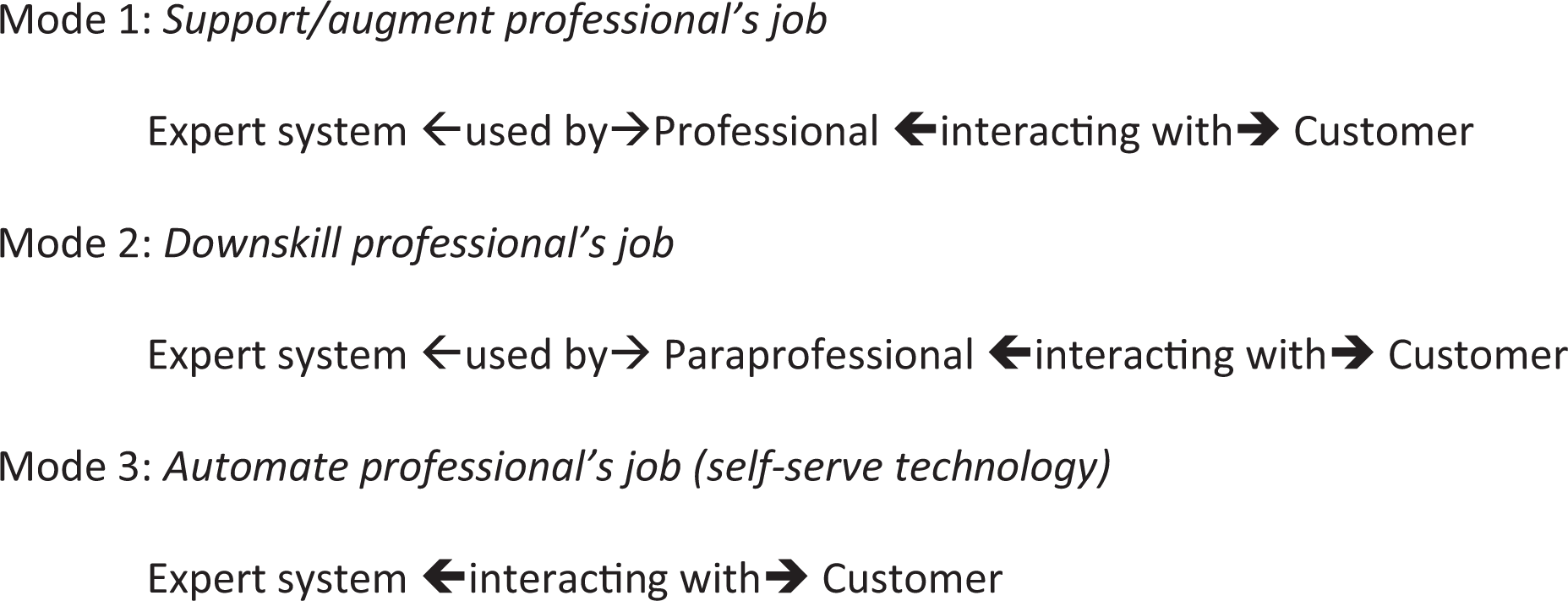
Modes of interaction for professional services. Source. Sampson (2018).
Sampson’s three modes provide a foundation for developing a P-TAF. With Mode 1, the professional service worker uses the expert system to enhance his or her job and continues to interact directly with customers. Eventually, technology becomes so good at making decisions that a less trained and lower paid paraprofessional (or “semiprofessional”) is able to do the job, which encompasses Mode 2—downskilling (i.e., deskilling). Finally, in some cases, the technology is so accessible that untrained customers are capable of using the expert system to meet their own needs, which is represented by Mode 3. In the 2018 paper, Sampson presented the modes and gave examples but his analysis only focused on Mode 2. He observed that some professional jobs (e.g., in management) are more susceptible to deskilling than others (e.g., in health care). His empirical analysis was at the job level and not the task level. The present research builds on the modes of Figure 1 by deriving a framework that indicates which automation modes are appropriate for professional tasks with specific characteristics.
Barriers to professional job/task automation
A second possible explanation that the literature provides for why professional service jobs are less automated than other jobs is that some professional job requirements are barriers to automation. The theory behind this is that (1) some jobs/tasks require advanced skills, (2) advanced skills require advanced (professional) preparation, (3) advanced skill requirements are not easily met by automation, and thus, (4) those jobs/tasks are not suitable for automation.
We consulted the literature to identify “advanced skill requirements” that require advanced (professional) training and are not easily automated. Autor (2015) described two broad sets of tasks that are difficult to automate: “abstract” tasks that involve intuition and creative problem-solving and “manual” tasks that involve physical adaptability and effective interpersonal interactions. He asserts that abstract tasks are the characteristic of highly educated professional occupations, but manual tasks can be performed by workers who are not highly skilled. These assertions were presented in his prior publications, where he split manual-physical and interpersonal tasks into two different categories of nonroutine tasks that, along with creative problem-solving, are resistant to automation (Acemoglu and Autor 2011; Autor and Dorn 2013).
Similarly, Frey and Osborn (2017) described some tasks as having “engineering bottlenecks to automation” because they require some combination of perception, manipulation (including manual dexterity), creative intelligence, and social intelligence. They observed that “the extent of computerisation will be determined by the pace at which the above described engineering bottlenecks to automation can be overcome” (p. 265). Note that these bottlenecks are essentially the same categories of tasks identified by Autor (2015), although Frey and Osborn did not make any statement attributing them to professional workers.
More recently, Huang and Rust (2018, p. 159) described human skills (“intelligences”) that are resistant to being replaced by automation (specifically AI), namely, empathetic intelligence (described as including “interpersonal, social, and people skills”) and intuitive intelligence (defined as “the ability to think creatively and adjust to novel situations”). They refer to intuitive intelligence as “hard thinking professional skills” but recognize that empathetic intelligence is found in “skilled professionals, such as psychologists, or relatively unskilled frontline workers such as flight attendants” (p. 159). In other words, they suppose that professionals excel at creativity but are not distinctive in terms of interpersonal skills.
The common theme in these references is that automation is inhibited by some combination of physical-manual skill requirements, creative skill requirements, and interpersonal/social skill requirements. Of these three areas, Autor (2015) suggested that physical-manual requirements are not distinctive of professionals, which we empirically confirmed with the O*Net data described below: Professional jobs are actually lower in physical-manual requirements than jobs in general.
Therefore, we will consider that the advanced skill requirements described above include both creative skill requirements and interpersonal skill requirements. While we assume that creative skill requirements are distinctive of highly trained professional jobs, we are not certain about interpersonal skill requirements. We also assume, as the literature indicates, that both of these requirements are barriers to automation. These relationships are depicted in Figure 2.
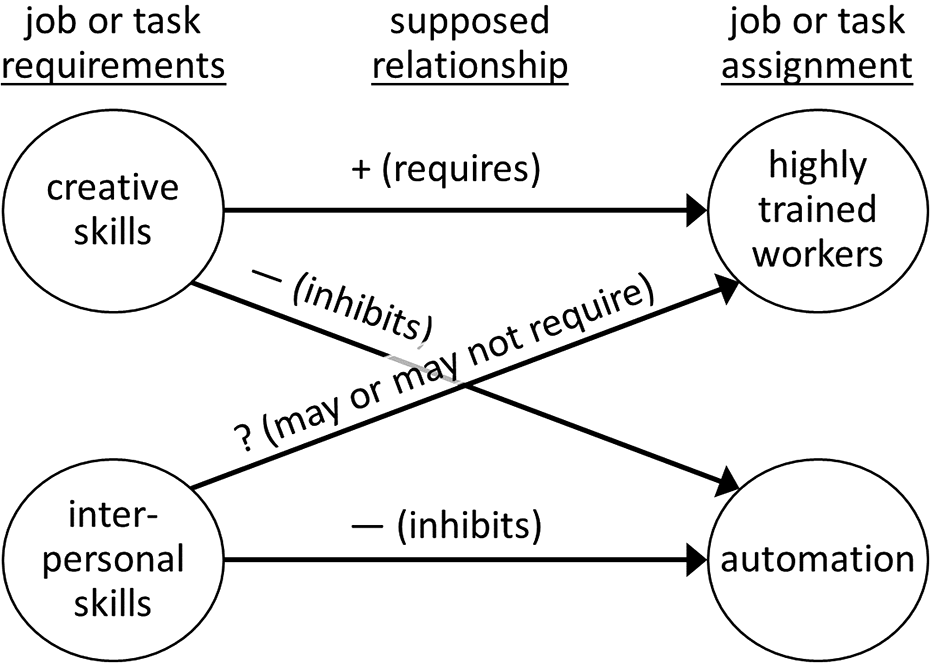
Professional automation model.
In other words, from the literature we assert that if a job or task requires creative skills, then the job or task requires assignment to a highly trained (i.e., professional) worker, implying a positive relationship between those two constructs. The creative skill requirement inhibits automation of the job or task, implying a negative relationship between the skill and automation constructs, and so forth. We will test these relationships with empirical data.
Developing a P-TAF
The model in Figure 2 led to a framework for analyzing professional automation at the task level. However, before proceeding to task-level analysis, we will present how we empirically validated the model using job-level data. The move from job-level analysis to task-level analysis is justified by recognizing that jobs are bundles of tasks (Brynjolfsson, Mitchell, and Rock 2018), and therefore, job-level measures of automation might be considered a composite of task-level measures. This was essential because we initially had only job-level data to work with. Validating the model with the job-level data leads to observations that form the foundation of our task framework.
Validating the Model
The job-level data we used to validate the professional automation model represented in Figure 2 are called O*Net. O*Net is a job characteristic database created and maintained by contractors working for the U.S. DOL, primarily the Research Triangle Institute (Tippins and Hilton 2010). The DOL began the O*Net project in 1998, and data collection commenced shortly thereafter. O*Net researchers spend between US$6.5 and US$6.8 million per year updating O*Net data (Tippins and Hilton 2010). Our analysis used database Version 23.0, which was released August 2018. This database contains detailed information on 966 jobs from 22 job families (e.g., management, legal, healthcare). The O*Net databases have been used in various credible studies in the social sciences (e.g., Anthoney and Armstrong 2010; Johnson and Allen 2013), including prominent studies pertaining to job automation (e.g., Acemoglu and Autor 2011; Autor and Dorn 2013; Brynjolfsson, Mitchell, and Rock 2018; Frey and Osborne 2017).
O*Net data were originally collected from career experts, but over time, the data have been collected from “job incumbents” who are individuals with experience working in specific jobs. The O*Net surveys are very extensive, covering worker characteristics, worker requirements, occupational requirements, experience requirements, occupation characteristics, and occupation-specific requirements.
Assessing Professionalism: Job Zones
Our first step was identifying which of the 966 jobs described in the O*Net data were professional service jobs, which allowed us to verify the correlation of job requirements as shown in Figure 2. In the literature review, “professional” was defined to mean a job that requires advanced training and preparation. Since researchers have pointed out that there are differing degrees of professionalism (Haywood-Farmer and Ian Stuart 1990; von Nordenflycht 2010), we turned to a scaled O*Net data element called “job zones.” Job zones are categorizations made by occupational experts according to the required preparation and training for a specific job. The five job zones included in the O*Net data are listed in Table 1. For a more detailed description of O*Net job zones, see DOL (2008) or Sampson (2018).
Job Zone Summary.
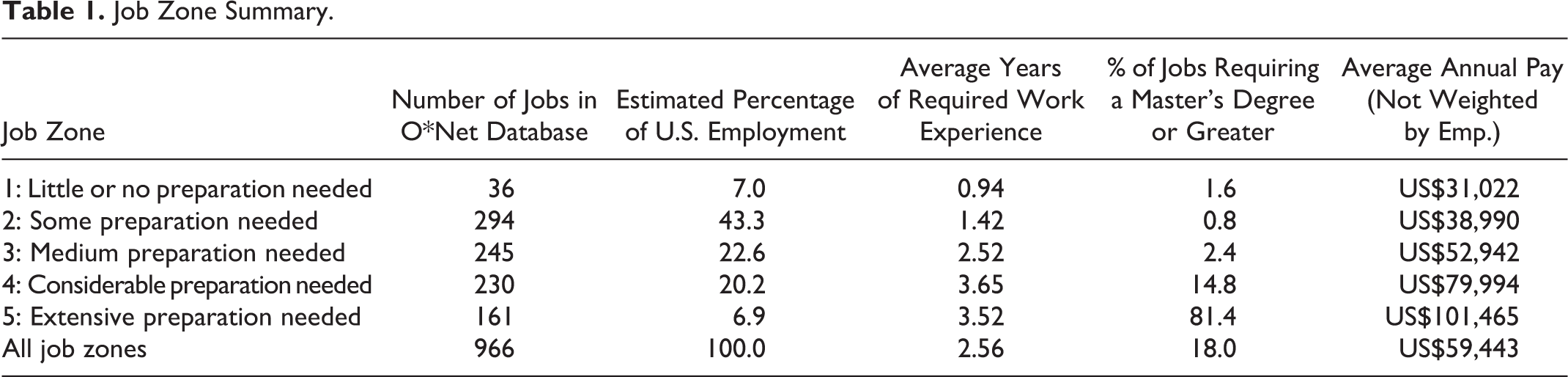
For our analysis, we considered job zone measures to represent degree of professionalism, with Zone 5 (extensive preparation needed) jobs being the most professional. Table 1 shows that the O*Net database we used contains 161 jobs in Zone 5. In our analysis, we needed to compare these Zone 5 jobs with less professional jobs. However, it was not appropriate to include all job zones in the comparison. Autor and Dorn (2013) described two “imperfectly substitutable” labor skill groups: workers with a high school education (or less) and workers with more than a high school education. The former pertains to Zones 1 and 2 and the latter to Zones 3–5. The lack of substitutability between these two groups suggests that it is unlikely that an extensively trained Zone 5 professional would be displaced by a worker upskilling from Zones 1 or 2. Thus, to provide a reasonable comparison, we restricted our statistical analysis to Zones 3–5.
The O*Net database includes data about the required education and required work experience for each job. From that data, we were able to calculate the percentage of jobs in each zone that required a master’s degree or above and estimate the average number of years of work experience required for all 966 jobs. Table 1 provides a summary of that information. Note that Zone 4 jobs actually require more work experience than Zone 5 jobs, but Zone 5 jobs require significantly more advanced education (defined as requiring a master’s degree or greater). This leads us to believe that job assignments to Zone 5 were largely driven by educational requirements.
Our research focus is on professional service jobs. The definition of “service” has been the topic of considerable debate over the past 50 years, and extending that debate is not a goal of this research. Instead, we note that almost all of the 161 Zone 5 jobs could be considered service jobs. For example, the 966 O*Net jobs were categorized according to the North American Industrial Classification System (NAICS) and the somewhat dated Standard Industrial Classification (SIC) system. Based on job incumbent reports, an estimated 83.5% of Zone 5 jobs were in the SIC industry division titled “Services” and an additional 9.8% fell into “Public Administration.” The NAICS has more detailed categories, and 94.7% of Zone 5 jobs fell into traditional service categories such as education, health care, and technical services (weighted by the numbers of subjects in each job reporting their job being Zone 5). Of the remaining 5.3% of Zone 5 jobs, almost half are in service functions, confirming that practically all Zone 5 jobs can be categorized as service jobs. Therefore, we did not split out the insignificant portion of nonservice Zone 5 jobs in our analysis of O*Net data.
Assessing Automation
The lower right-hand element of Figure 2 pertains to job/task suitability for automation. The O*Net data did not contain any direct measures of automation suitability. As mentioned, most of the O*Net data come from surveys of job incumbents, who are individuals with experience working in specific jobs. For example, the data about lawyers came from actual lawyers who are trained in legal work but not trained in technology forecasting. Lawyers may have little idea about what aspects of their jobs will be automated in the future but will know what aspects are currently automated. In this research, we took an ex post approach to job and task analysis. In other words, rather than try to predict what jobs and tasks will be automated in the future—which would be speculative at best—we assessed what jobs and tasks are currently automated and assumed that if a job/task is already automated, then it must be suitable for automation. If a job/task is not automated, it could still be suitable for automation, but the technological or economic conditions for automation may not yet be present. For example, a task that has not been automated could possibly be automated by emerging technology, or customer interactions may be suitable for automation, but the automation might be delayed due to inhibited customer adoption (Weijters et al. 2007). Still, if a task is not suitable, then it is not likely to have been automated, implying that current automation is a reasonable surrogate for automation suitability, at least for the recent past. Further, researchers have suggested that jobs that are partially automated at one point in time are likely to be increasingly automated in the future (Agrawal, Gans, and Goldfarb 2018; Ford 2015).
The O*Net data pertaining to automation is survey item 4.C.3.b.2, “degree of automation,” which simply asks, “How automated is your current job?” Responses are on a one to five scale, from (not at all automated) to (completely automated.) The actual survey responses are discrete and ordinal. However, the O*Net data points are the averages of responses from multiple survey subjects (average n = 28.1 per job), allowing us to treat the job averages as continuous.
Figure 3 shows mean degree of automation values for each of the five job zones. Zone 5 jobs were rated as being less automated than jobs in the other zones, as we supposed above. To test statistical significance, we first verified that the degree of automation data were sufficiently normal: A Q-Q plot shows good fit with a normal distribution, with acceptable skew, and excess kurtosis statistics by job zone and overall (0.362 and −0.269). Mean tests show that there is a statistically significant (t = 7.53, p < .001) difference in the degree of automation between professional Zone 5 jobs and semiprofessional Zone 4 jobs but no significant difference between degree of automation in Zones 1 through 4. This supports the above assertion that professional service jobs are less automated than nonprofessional jobs. Our model analysis will help us understand why.
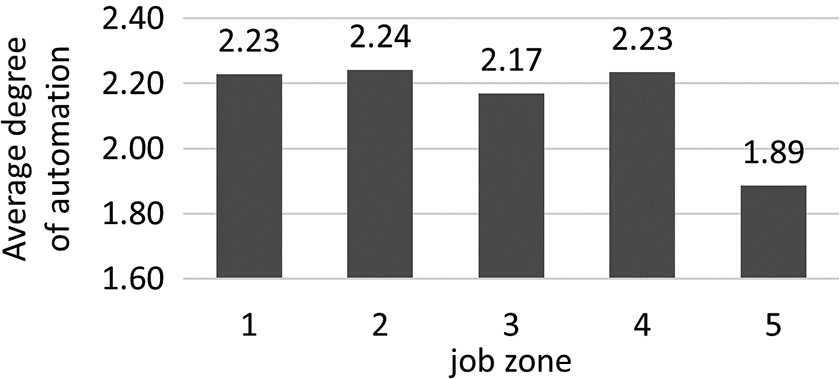
Degree of automation for job zones.
Assessing Skill Requirements
The literature review revealed two professional job requirements that are assumed to also be barriers to automation: creative skills and interpersonal skills. We find measures for these skill requirement constructs in the O*Net Work styles database, which is described in Appendix A. From Appendix A, we see that creative requirements are measured by the innovation item from the Work styles database, which indicates that a job “requires creativity and alternative thinking to develop new ideas for and answers to work-related problems.” Note from Table A2 (in Appendix A) that the innovation item has the largest negative correlation with degree of automation, supporting the above-cited research suggesting creative requirements are a barrier to automation.
Interpersonal requirements are represented by two Work styles items: concern for others (the job “requires being sensitive to others’ needs and feelings and being understanding and helpful on the job”) and social orientation (the job “requires preferring to work with others rather than alone and being personally connected with others on the job”). Appendix A describes how we identified a total of nine Work style items that measure interpersonal job requirements, all of which are negatively correlated with degree of automation. Concern for others and social orientation have the strongest negative correlation of those items and fit well with the interpersonal skills concept described in the literature.
Test and Results
We tested the relationships in Figure 2 using structural equation modeling (SEM). The endogenous variable that we tried to predict was degree of automation, which we held as a surrogate for suitability for automation (as discussed above). The predictor variables were requirements for interpersonal and creative skills as discussed. While we believed advanced skill requirements precipitate advanced training, we did not assume causality. On the one hand, people may get advanced training because they want to qualify for jobs that require advanced skills. On the other hand, people who have advanced training may be attracted to jobs that require advanced skills. We were interested in the correlation: That people with advanced training tend to be in jobs that require advanced skills.
The results of the SEM are shown in Figure 4 (as customary, error terms were omitted for clarity). Model fit statistics were good: comparative fit index = .990 and standardized root mean residual = .016, well within the .08 threshold. 2 The R 2 for predicting automation was .258, which was better than expected, and the two skill factors had highly significant coefficients. The two skill requirement factors (interpersonal and creative) were not correlated with each other (coefficient = .029, not significant), suggesting that they are distinct constructs and that some jobs might require one skill factor but not the other. This lack of correlation also affirms discriminant validity between the skill requirement factors. Also, as we suspected, innovation skills were strongly correlated (p < .001) with job zone, but interpersonal skills had a weaker correlation (p < .05), which was also supported by a χ2 difference test of nested models. In other words, as suggested by Huang and Rust (2018), creativity is distinctive of professionals, but interpersonal skills are less distinctive.
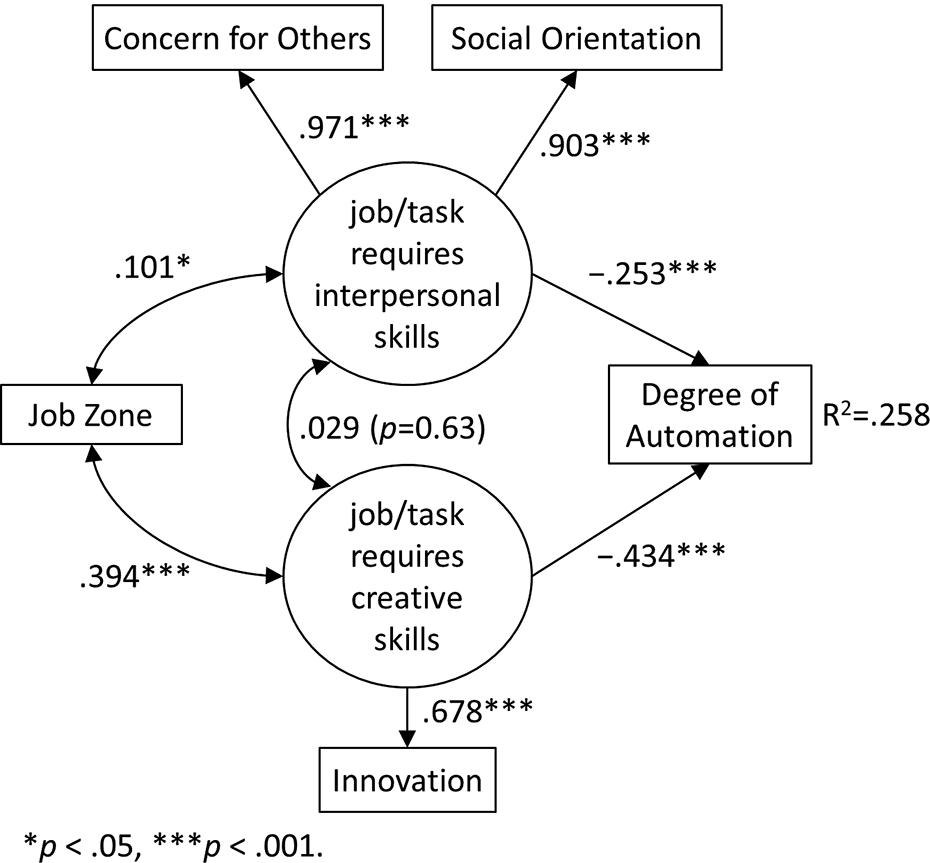
Structural equation modeling results.
Observations and Strategic Framework
From the results depicted in Figure 4, we made two observations that we used in developing our P-TAF: Observation 1: Jobs requiring professional training (high job zone) are distinctive in requirements for creative skills but less so for interpersonal skills. Observation 2: Automation is inhibited by a requirement for either interpersonal skills or creative skills.
We assume that these observations apply to jobs and tasks within jobs as discussed above. This is based on an assumption that tasks are separable, meaning that the individual tasks bundled within a job can be unbundled and potentially dispersed among different productive entities (Brynjolfsson, Mitchell, and Rock 2018). If we assume that tasks are sufficiently independent or, in other words, that the various tasks that are part of a given job could be performed by different entities, then the goal is to identify the appropriate entity to perform each given task. The above observations lead to the following strategies for professional task assignment: If a task requires high creative skills, then it cannot be easily performed by automation. The question then becomes whether the professional worker performs the task interactively or noninteractively (decoupled from the customer/beneficiary). If a task requires high interpersonal skills, then it cannot be easily performed by automation; however, it can possibly be performed by a semiprofessional worker who, like the professional, also has interpersonal skills. If a task requires high interpersonal skills but not high creative skills, then the task can likely be performed at a lower cost by a semiprofessional worker. If a task requires neither high interpersonal skills nor high creative skills, then it is possible that the task can be completely automated. In essence, customers can meet needs by interacting directly with technology—SST.
These assignment rules are represented by a P-TAF shown in Figure 5. What follows is a description of the four task strategies represented in the P-TAF, including illustrative examples from health care and other professions. Additional examples will be given in the Discussion section.
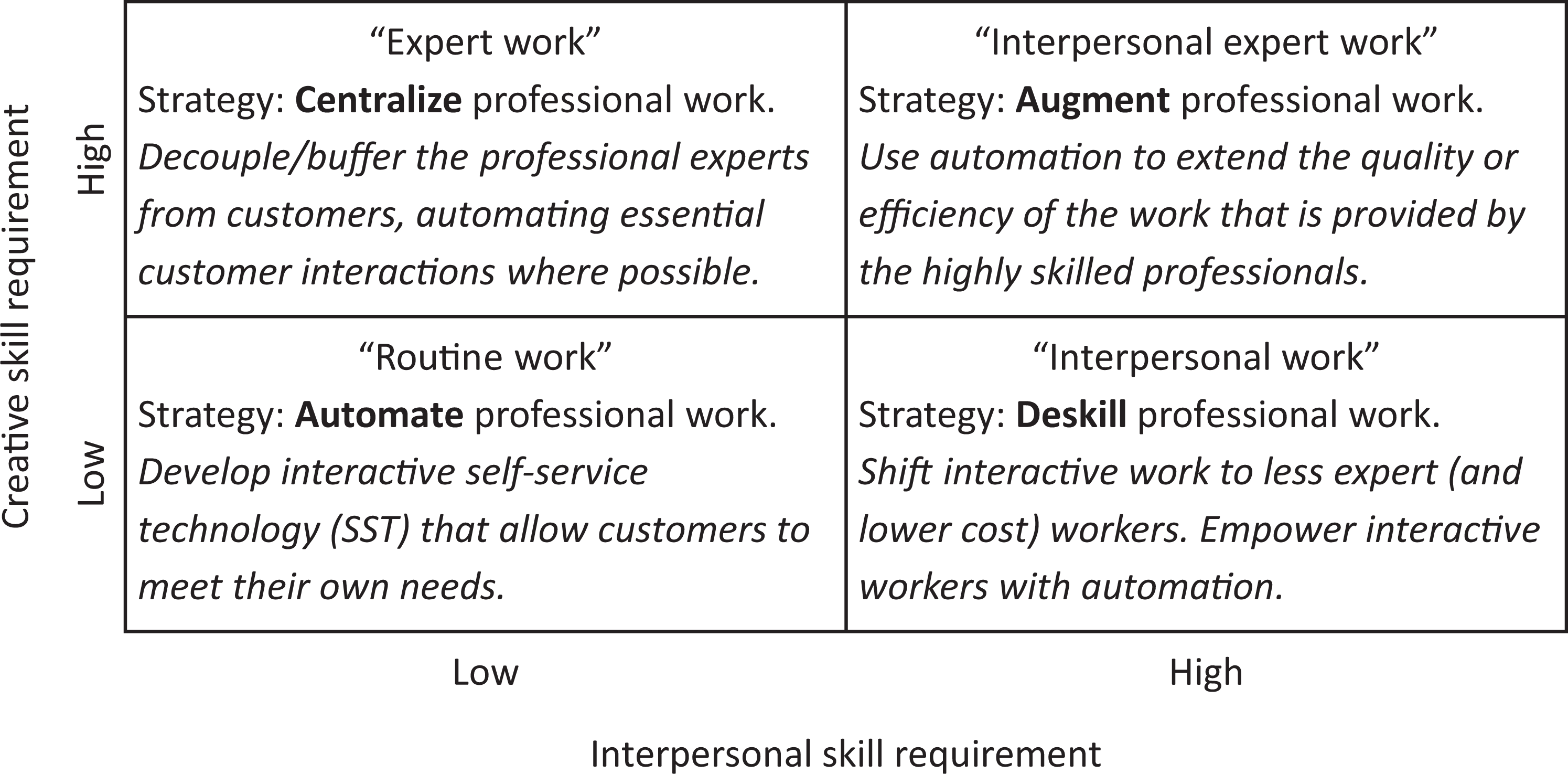
Professional task-automation framework.
The augment strategy applies to those tasks that require both interpersonal and creative skills, thus needing to be performed by professionals. This corresponds to Mode 1 from Figure 1, where the automation goal is to augment the work of professionals by either (1) allowing the professional to perform work to a degree that was not previously possible or (2) improving efficiency and freeing up time to focus on expert tasks that require personal attention (Davenport and Kirby 2015). A health care example of augmentation is the use of an expert system to assist medical professionals in diagnosing complex patient conditions. For example, in 2015, a woman was incorrectly diagnosed as having acute myeloid leukemia. Her slow response to chemotherapy led the doctors to utilize an automated diagnostic system that was able to identify the correct diagnosis in 10 minutes instead of the 2 weeks it normally would have taken (Rohaidi 2016). A non-health care example of the augment strategy is architects using computer-aided design (CAD) software to create 3D renderings of buildings, which enhances their ability to communicate ideas to clients.
Sometimes, professional augmentation comes in simple forms. There are many smartphone and tablet applications specifically designed for physicians. Examples of these include “implant risk assessment,” a smartphone app that “helps radiologists who are scanning patients with implanted devices or foreign bodies,” and “Contrast Media NSF vs. CIN,” a smartphone app that helps radiologists choose the safest contrast agents when imaging patients with renal impairment (Kaplan 2017).
The deskill strategy corresponds to Mode 2 from Figure 1 and recognizes that if the requirements for creative expertise are not high, then a semiskilled worker armed with advanced technology might provide the same quality of work as a professional but at lower cost (Davenport and Kirby 2016). In some cases, this enables the offshoring of professional jobs (Ford 2015). This strategy is employed in health care, where patients have the option of meeting with a nurse practitioner instead of waiting to meet with a more highly trained physician. Nurse practitioners have access to similar diagnostic technology that the physicians have access to, and as the technology becomes smarter, the quality gap between physician diagnosis and nurse practitioner diagnosis decreases (Davenport and Kirby 2016). Another example of the deskill strategy is software that allows the work of high-wage patent attorneys to be performed by lower wage patent agents or paralegals (this example will be revisited below in the Discussion section).
The automate strategy is where there are neither interpersonal nor creative barriers to automation, allowing customers to perform tasks through SSTs, which corresponds to Mode 3 from Figure 1. (As mentioned above, we are only focusing on the potential for automation and recognize that there are complex SST adoption issues to also consider [Weijters et al. 2007].) The benefits of SST include improved efficiency, improved productivity, and, in some cases, improved service quality (Rust and Huang 2012). Examples of the automate strategy include the TurboTax example mentioned above and the WillMaker software that automates the process of creating legal wills and trusts, allowing individuals to draft their own wills and trusts without needing to hire an attorney.
The centralize strategy covers an important option for professional service tasks that was not anticipated by Sampson (2018). This is the situation where a task requires creative expertise but does not rely heavily on interpersonal skills. The creative skill requirement suggests that a trained professional needs to perform the task but perhaps remotely as facilitated by technology. The centralize strategy is defined as centralized expertise that can be accomplished remotely. Massive open online courses follow this strategy, where topical experts teach courses that are accessible anywhere (Rifkin 2014). This strategy is increasingly being used in aspects of diagnostic medicine that do not require direct patient interaction (Ford 2015, p. 152). An example is teleradiology, wherein diagnostic image scans are evaluated by remote radiologists, often located in another country (Bashshur et al. 2016). Teleradiology is part of the broad and growing field of telemedicine. On-demand synchronous patient visits with health care professionals have been shown to provide high-quality medical advice at significant cost savings (Nord et al. 2018).
Again, these four strategies are task strategies, not job strategies, since a given job is likely to be comprised of tasks that might optimally fit under different quadrants of the framework in Figure 5. For example, Pfeiffer Consulting conducted qualitative research interviews involving 75 design professionals whose jobs are considered highly creative. O*Net Work styles data show that Zone 3–5 jobs involving design (graphic design, fashion design, etc.) have an average innovation score (our measure of creativity) of 4.59, which is significantly greater (t = 7.492, p < .001) than the average innovation scores for nondesign jobs (3.70). As we assume that innovation (a creative skill requirement) is a barrier to automation, we might conclude that design jobs are resistant to automation. However, in the Pfeiffer study, 74% of the subjects reported spending over half of their time on repetitive and uncreative tasks (Pfeiffer 2018), which presents tremendous opportunities for automation.
Task-Level Analysis
Our original assertion was that task-level analysis provides a different picture of susceptibility to automation than job-level analysis. Our SEM tests of the model in Figure 2 were performed using the job-level data available from O*Net. That analysis provided evidence about the impact of skill requirements on job automation, which led to the development of the strategic framework found in Figure 5. We could apply the framework to job-level data (such as O*Net data) by plotting where different jobs fall in different quadrants but that would ignore our supposition that individual tasks within a given job may fall in differing quadrants. Our purpose in this research is to demonstrate this task difference phenomenon, which necessitated recollecting skill requirement and automation data at the task level.
The challenge in shifting from job-level analysis to task-level analysis is the increased complexity of data collection. Instead of surveying subjects about their jobs, we needed to survey them about each of the tasks they performed within their jobs. O*Net data helped us identify relevant task lists—O*Net researchers had already extensively surveyed job incumbents and developed task lists for all 966 jobs within the data set. Individual jobs in the O*Net data had between 4 and 40 tasks. The mean was 20.15 tasks per job (σ = 6.36), which was quite consistent across job zones. O*Net researchers also collected a list of emerging tasks that could someday become common enough to be included in the task lists for specific jobs.
The O*Net information about each task includes task relevance, task importance, and task frequency. However, the O*Net database does not include any information about the characteristics of individual tasks or any task-level Work style ratings, meaning that we needed to develop and administer a task-level survey. The task-level survey that we developed for this research has three parts: Questions about the survey respondent, including asking about his or her job, education (to verify job zone), and demographics. Questions about the respondent’s job. This was primarily to identify the overall positioning of the job in the framework. Questions about the job’s tasks. This demonstrated the spread of tasks across the framework and pointed to appropriate automation strategies.
Note that the job questions were the same as the questions about the job’s tasks, except the task questions were scored for every task. We used the task list from the O*Net database. It was possible that some respondents did not perform one or more of the tasks from the O*Net task list. Therefore, we included an initial task question about whether each task was considered part of the subject’s job.
In all practicality, we needed to limit the task survey to one interpersonal skills question for each task and one creative skills question for each task. We also asked about the degree of automation for each task. With the task relevance question, this resulted in 4 questions per task for 20 tasks, or 80 task questions total. Any more task questions than that would have jeopardized the response rate of busy professionals.
For the interpersonal skills question, we created a composite item that combined the language from the Concern for Others and Social Orientation O*Net items (see Table A1 in Appendix). After a few wording iterations, pretest subjects reported that this characterization of interpersonal skills made sense and had high face validity. For the creative skills question, we used the innovation item description from Table A1, again receiving a positive validation from the pretests.
The automation question was more difficult to construct. We started with the basic degree of automation question from the O*Net survey. Pretest subjects expressed concerns about the meaning of automation. Some equated automation with factory robotics. Others thought of automation as a dichotomous issue. With some effort, we were able to develop a brief explanation that clarified (1) automation comes in degrees, (2) automation involves technology, (3) the technology could be a computer, which is most common for professional knowledge work, and (4) a task could be partially automated (see Parasuraman and Riley 1997).
The resulting survey questions were loaded into an online survey system running on the Drupal web platform. The survey went through four rounds of pretests involving 13 professional subjects. The pretest subjects had significant opinions about the usefulness and nature of the question components that helped us converge on clear and precise survey wording. The final survey questions are listed in Table 2.
Survey Questions.
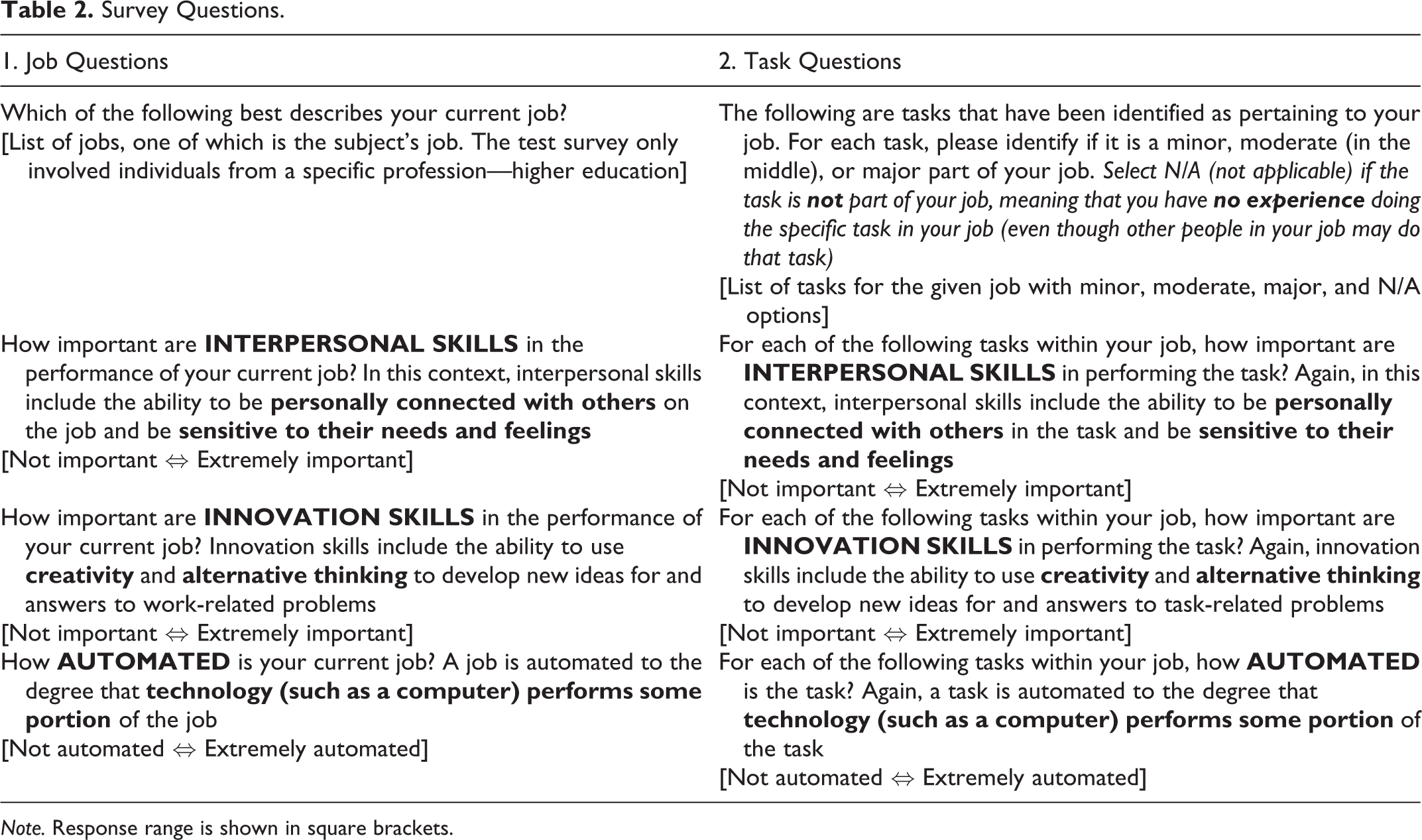
Note. Response range is shown in square brackets.
Data Collection: Business Professors
To demonstrate the use and usefulness of the P-TAF, we needed to collect data from a professional (Zone 5) subject pool. As suggested in Table 1, Zone 5 professionals are highly paid and thus likely to experience a high opportunity cost for completing a survey. For an initial exploratory study, we selected a professional subject pool with a reasonable likelihood of getting survey responses—faculty colleagues at the author’s business school of employment. This corresponds to the O*Net career 25-1011.00: business teachers, postsecondary, which is categorized in Job Zone 5 (thus “professional” by our definition). Although this is a single job category, we achieved needed variance by including faculty who are involved in differing intensities of interpersonal (e.g., teaching) and creative (e.g., research) activities.
The pretests involved faculty volunteers from the author’s department who were willing to complete the survey and spend time in focus groups discussing question wording and structure. After the final set of pretests, the author visited the department chairs from four other departments in the business school and personally invited them to take the survey. These department chairs then invited faculty in their department to take the survey. A note (and some fudge) was placed in the faculty mailboxes in the department offices explaining the survey and providing the web link.
The faculty were given just over a week to respond and, since it was an online survey, could respond from any location. Respondents were required to log in using their university network IDs, which allowed us to verify the identities and professional status of the respondents. Upon logging in, the respondents were assured that their responses would remain anonymous in the analysis and reported results, and they were given a typical human subjects verbiage.
Eighty-seven faculty were contacted from those four departments, and 46 faculty responded by the indicated deadline for a 53% response rate, which is not far from the 61% O*Net survey response rate for this job category. Demographic questions verified that the respondents had advanced (Zone 5) education and that the respondents’ job tenure was similar to the O*Net survey respondents for this specific job. (We collected data about respondent age and gender, but those items were not provided in the O*Net database for comparison.)
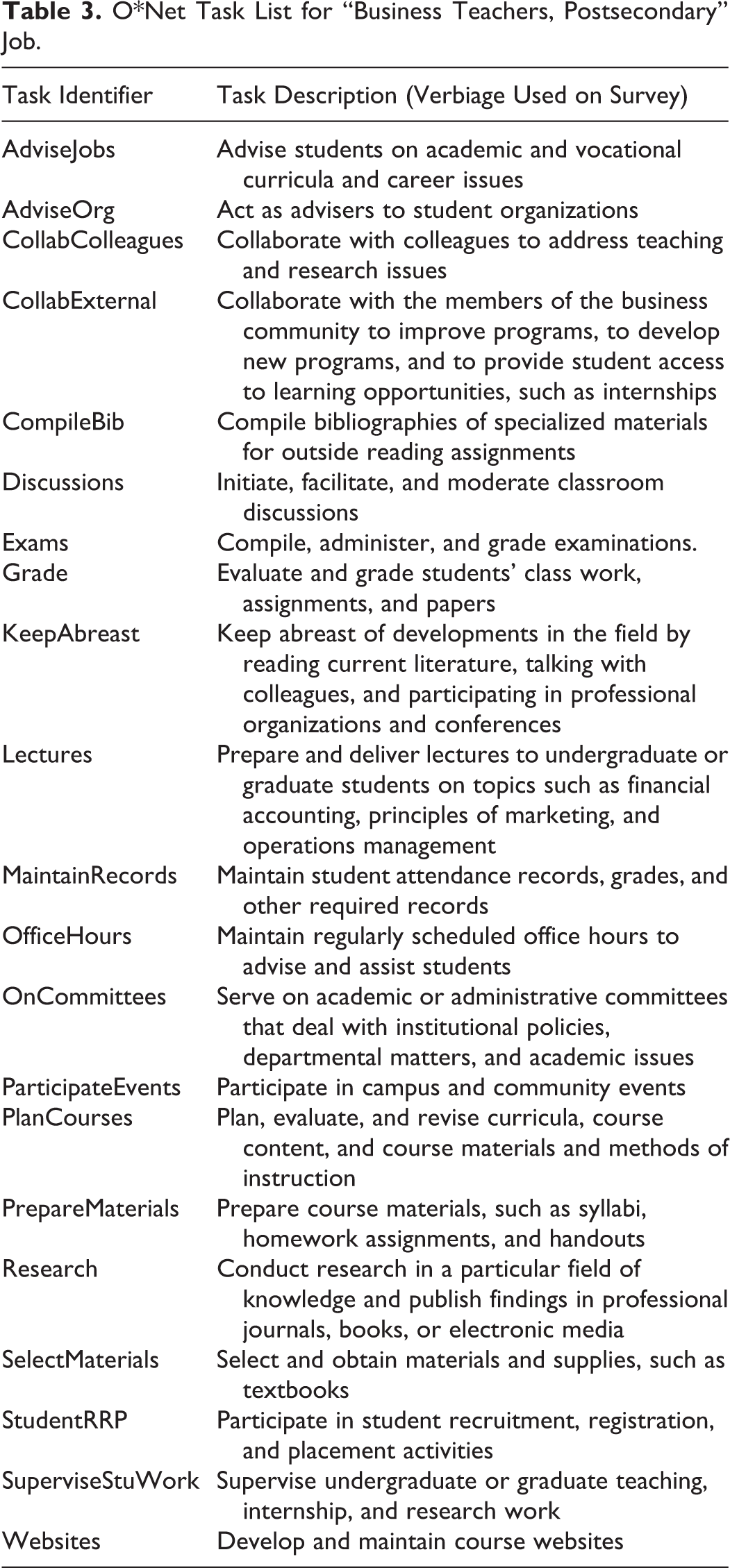
The specific task list from the O*Net database is shown in Table 3. We made up identifiers for use in reporting results. Two task descriptions were modified for the survey from the original O*Net descriptions. The O*Net “lectures” task listed lecture topics that did not apply for some of the subjects’ departments, so the topics list was removed. Also, the “exams” task included the option of “assigning work to others,” which is different from actually administering exams, so that phrase was also removed. Although some of the respondents indicated they did not do a few of the tasks in their jobs, the overall list was shown to be very relevant and appropriate.
O*Net Task List for “Business Teachers, Postsecondary” Job.
Job-Level Results
Figure 6 shows the two dimensions and the four quadrants that correspond to Figure 5. At the job level, the mean interpersonal skills response value was 4.39 (σ = 0.65) and the mean creative skills response value was 4.11 (σ = 0.74). These mean values are shown as the
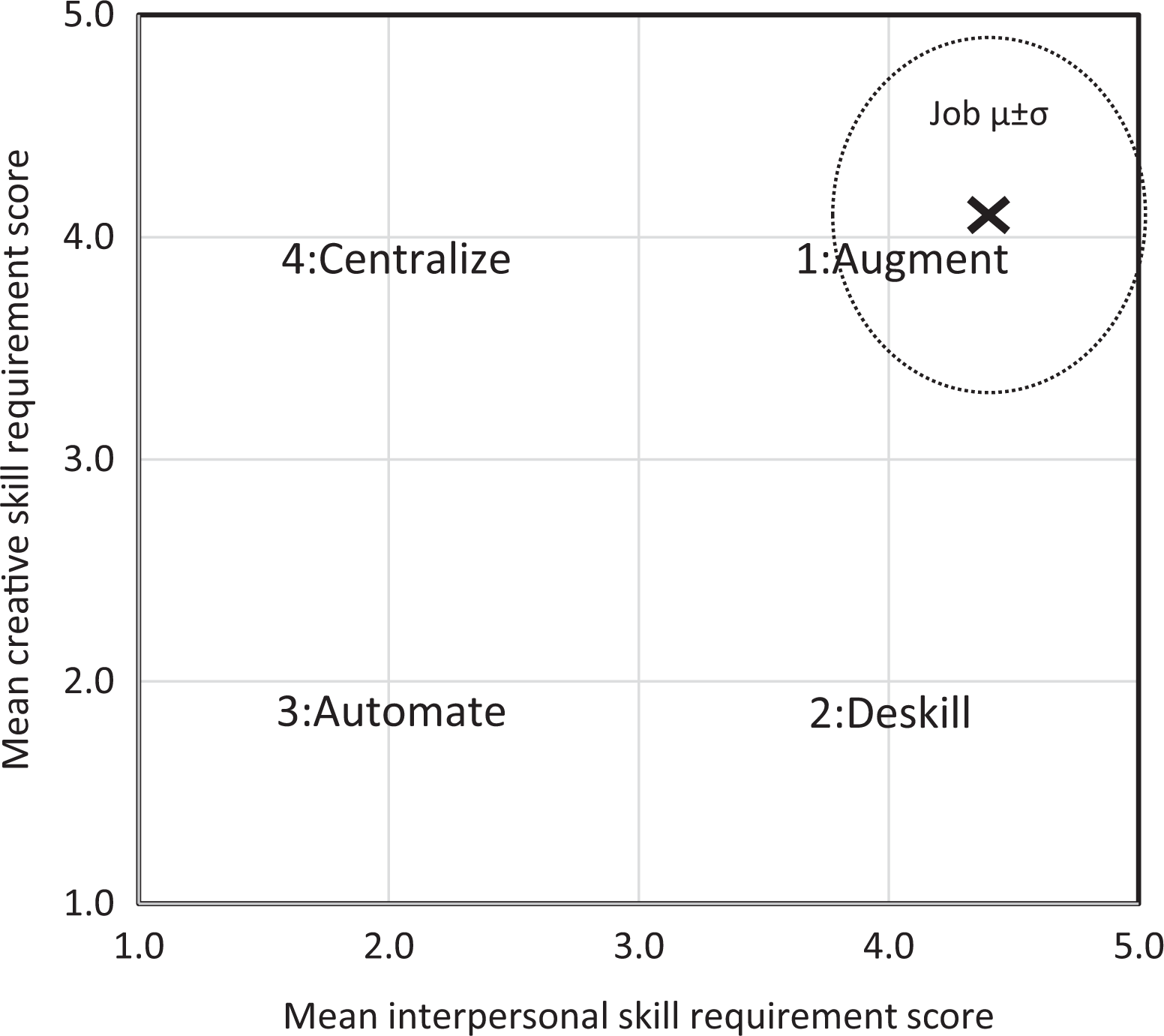
Framework (professional task-automation framework) showing job-level item means.
It is clear that both the O*Net subjects and our survey subjects perceive that their professional jobs are high in both interpersonal and creative skill requirements. They also perceive that their jobs are on the lower end of automation, reporting an average of 2.17 (σ = 0.74) on the one to five automation scale (which is also consistent with the O*Net survey results for this job). There was not much variation within each of these three job-level measures (i.e., responses were quite consistent across subjects), and there were no significant correlations among the three. As such, these job-level data were not helpful in modeling automation, which emphasizes our advantage in using the O*Net data—with a large amount of variation—to validate the model in Figure 2.
Task-Level Results
Our research assertion stated in the Introduction section was that task-level analysis provides a different picture of susceptibility to automation than job-level analysis, which was indeed supported by our task survey results. Figure 7 includes the job statistics from Figure 6 and also shows survey item means for each of the 21 individual tasks from Table 3. To improve visualization, the size of the dots represents the square of the mean task-automation measure for each task. (There was little variation in task-automation means, so squaring the measures made the variation more prominent on the figure.)
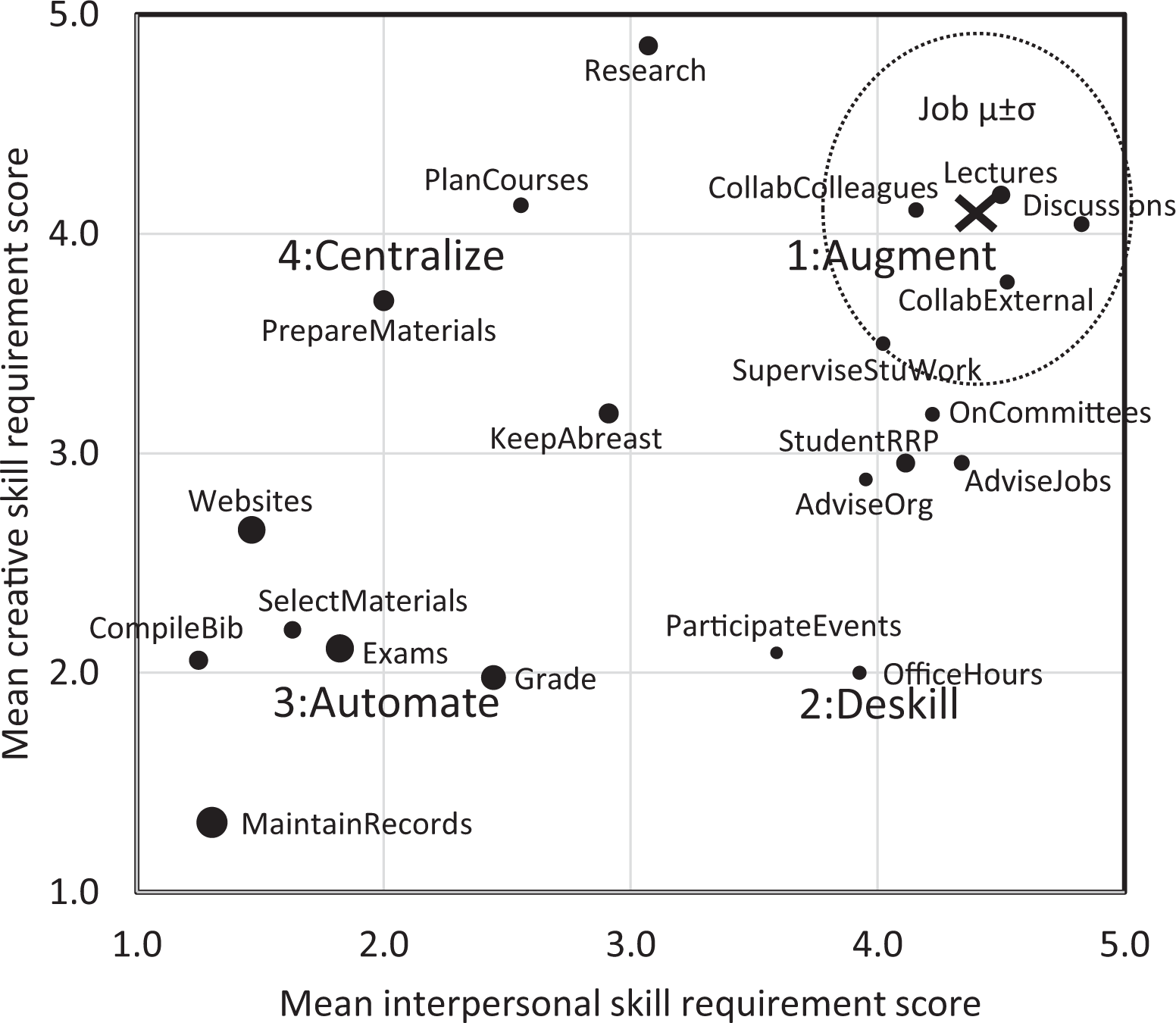
Framework (professional task-automation framework) showing item means for individual tasks.
The most striking observation in Figure 7 is that the individual tasks are distributed all over the framework, not just around the job-level means. Five of the 21 tasks fall within 1 standard deviation of the job-level means. Other tasks have means that are far from the job-level means. Table 4 shows that most of the task means are significantly different from the job-level means, causing us to reject a null hypothesis that tasks within a job are consistent with the overall perception of that job.
Comparing Task-Specific Means to Job-Level Means.
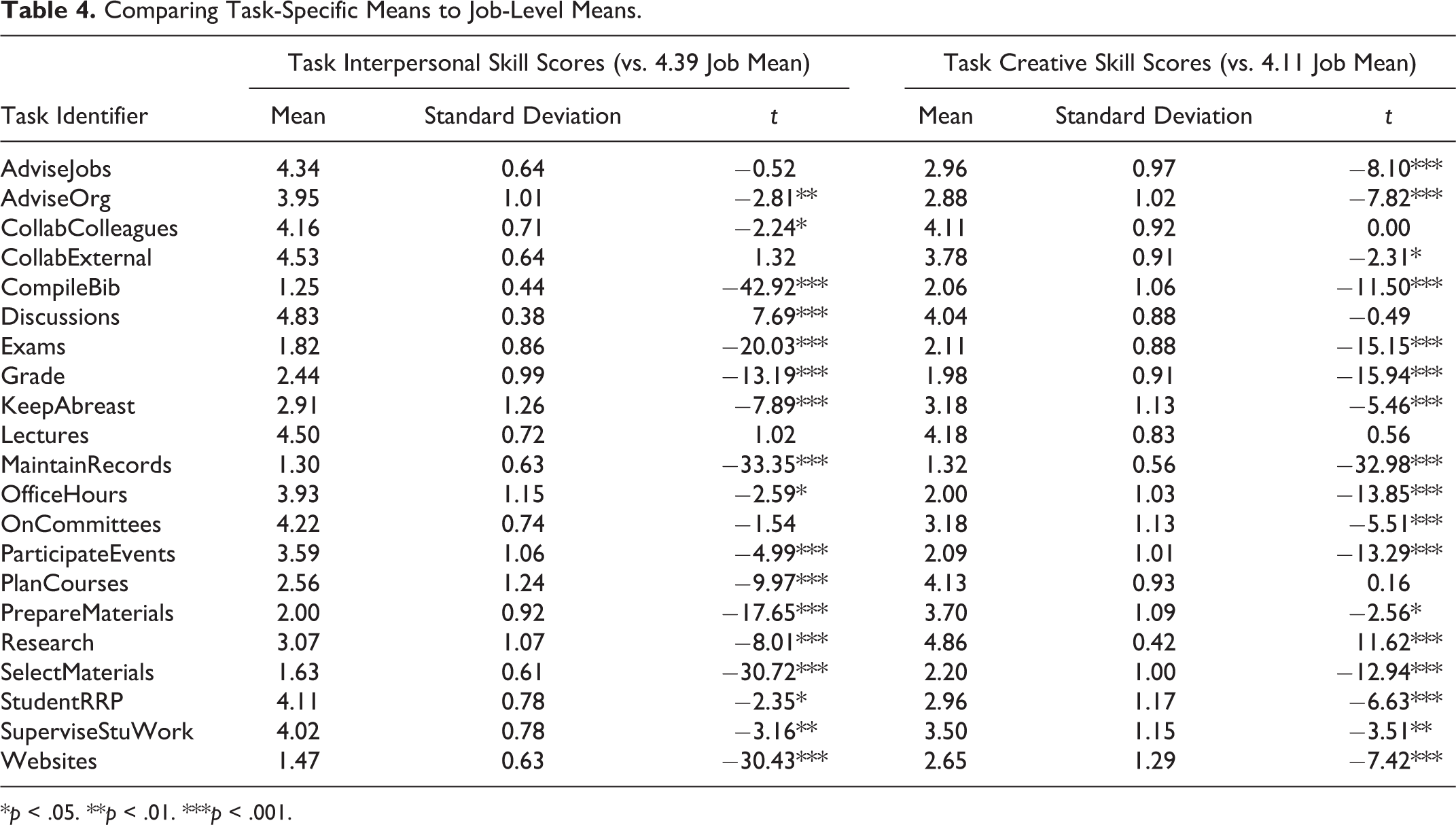
*p < .05. **p < .01. ***p < .001.
Another interesting observation from Figure 7 was that the most automated tasks were those with low skill means, especially low interpersonal skill means. Task-automation scores had negative correlations with the interpersonal skill requirement (−.287, p < .001) and the creative skill requirement (−.129, p < .001), which was as we expected. However, we were surprised that interpersonal skills appeared to be the stronger inhibitor of automation for this particular set of tasks, which could be an artifact of the task variation for this particular job. We emphasize that this empirical study is simply exploratory, and for other professions, we might find that creative skill requirements are the stronger inhibitor of automation.
Discussion and Managerial Implications
As mentioned above, most of the literature regarding increases in automation focuses, at least empirically, on job automation. While modeling job automation provides interesting insights, we have shown that it is imprecise—the various tasks within a given job can each have different susceptibilities or immunities to automation. The increased precision of task-level analysis allows us to shift the research focus from job displacement to job redesign. While jobs will certainly be lost to automation, it is individual tasks that make the shift, with some tasks remaining in the purview of professional labor.
Huang and Rust (2018) studied this idea in their analysis of stages of job displacement (which they assert applies at the task level). They posit that as one type of job (task) falls to automation, other types of jobs (tasks) become more prominent. This means that professional workers need to be willing to give up some traditional tasks to less trained and less costly workers (the deskill strategy) and perhaps give up some tasks to fully automated customer-interactive systems (the automate strategy). Professionals would then need to focus more attention on enhancing the tasks that are uniquely theirs (the augment strategy) or, in some cases, be willing to shift to technology-mediated interactions with customers to provide better economies of scale (the centralize strategy). We can apply these ideas to the business professors that we surveyed. The results shown in Figure 7 suggest the following:
The “research” task is interesting because it involves the highest creative skill requirement of the task set yet is in the middle in terms of interpersonal skill requirements. Research is certainly enhanced by automation (the augment strategy), such as the EndNote bibliography software, which automatically formats a manuscript’s reference list according to a journal’s style. Research can also benefit from economies of scale through consolidation (the centralize strategy). One of the departments participating in this study, for instance, employs two full-time researchers who conduct analysis on behalf of other faculty members in the department. They are analysis experts, and often coauthors, yet they rely on other faculty to interact with the academic community. This research task demonstrates how, under some circumstances, it may be desirable to position a task under more than one strategy. A strategic question for a researcher would be whether she or he wanted to emphasize or deemphasize a reliance on interpersonal skills.
Implications for Professions in General
The culmination of this research is the observation (Figure 7 and Table 4) that task-level measures can vary significantly from job-level measures. This confirms our suspicion that job-level analysis of automation factors is imprecise: Different tasks have different levels of susceptibility to automation. Some researchers have referred to “total automation” of jobs but that should not be the immediate concern for professionals. The immediate concern should be how automation will cause tasks to shift and what roles there will be for professionals, semiprofessionals, and customers in the future. The nature of professional work will change, likely with professionals focusing more on tasks requiring their creative expertise.
Furthermore, our P-TAF proposes that tasks within a given job are impacted by automation in different ways. We have referred to degrees of automation as other researchers have done. The P-TAF posits that there are also relevant contexts of automation. In the literature review, we saw that automation can sometimes substitute for workers, and at other times, it can complement workers (Autor, Levy, and Murnane 2003). We extend that idea by considering the scope of “workers” to include professionals, semiprofessionals, and even customers. An advancement in technology that is thought of as removing part of the job of a professional worker may actually be augmenting the job of a semiprofessional worker. SST may be thought of as automation that augments the “job” of a customer, allowing the customer to do more in meeting his or her own needs.
Progression of Task Automation
We do not expect that these automation-enabled shifts in tasks and roles will be abrupt, but instead, we expect that the shifts will follow a logical progression (Agrawal, Gans, and Goldfarb 2018; Ford 2015). A technology that facilitates professional augmentation today may facilitate deskilling tomorrow and SST automation after that (Sampson 2018). Spohrer and Maglio (2008) provided a technical-support call center example wherein the answering of customer questions evolves over time from (1) domain experts to (2) “average performers” using FAQ tools to (3) outsourced workers in a low-wage country to (4) automated self-service systems. Note that this evolution corresponds to the augment, deskill, centralize, and automate strategies, respectively.
Bank tellers and retail cashiers are other poignant examples of sequenced technological disruption; the technologies (bank card and bar code scanners) that allowed them to be more productive evolved into technologies (ATMs and self-checkout) that customers could operate themselves (Davenport and Kirby 2016). Even highly trained professionals may like automation to make their jobs easier, but perhaps not too easy. Ford (2015, p. 122) said it this way: “If you find yourself working with, or under the direction of, a smart software system, it’s probably a pretty good bet that…you are also training the software to ultimately replace you.”
Industry Barriers to Task Automation
We have shown how skill requirements can be barriers to the progression of automation and referred to customer adoption issues. In addition, there may be industry efforts to erect barriers. For example, in 2015, a company named Opternative launched an online tool that allowed individuals to perform their own assessment of visual nearsightedness and farsightedness using a smartphone. The tool is similar to autorefractor technology that was invented by Tom Cornsweet in the early 1970s and has been shown to provide accurate diagnoses under normal health conditions (Choong, Chen, and Goh 2006). Optometrists use autorefractor technology as part of the eye examination process, which is job augmentation. In reality, it is likely that autorefractor tests are administered by lower paid optometric technicians, which is the deskill strategy. The Opternative software allowed customers to perform a function that previously required professional or semiprofessional attention, which is how the automate strategy is manifest. As an additional part of the Opternative eye exam process, customers could optionally pay a US$35 fee to have a licensed optometrist review the data and provide an official eyeglass prescription, which is an example of the centralize strategy. This task-automation progression was thwarted in 2019 when the American Optometric Association succeeded in convincing the U.S. Food and Drug Administration that Opternative was a risk to patients and thus pressured the company to remove the product from the market (Bailey 2019). The threat of disruption is likely to be a factor in the automation of other professional services in the future.
Implications for B2B Professional Services
In this article, we have applied the P-TAF to health care and higher education, which are B2C contexts. The framework also has application in business-to-business (B2B) profession services, which often have more complex provider-client relationships than typical business-to-consumer (B2C) services. One B2B issue is innovation governance, which may regulate how idea development is managed in a relationship (Morgan 2017). The provider needs to decide what resources to invest toward developing ideas in behalf of a client and how that investment will be recovered (Ricketts 2007). One option is to have highly trained professional employees develop ideas at a high billable rate. Another option is for the provider to acquire technology that will enable lower wage semiprofessionals to develop ideas. Governance issues may include what the client requires and how to price the service. If the client gets professional results from a semiprofessional worker using advanced technology, at what rate is it billed?
For example, the author’s home institution hires law firms to handle patent work. A crucial element of this work is a patent search, which involves identifying all prior patents related to or possibly infringed upon by a new patent. A patent search is a complex process that has traditionally been very labor intensive. The search can be performed by highly trained attorneys or by less trained paralegals. The university may prefer the work of an attorney who is better trained and more experienced than a paralegal. However, AI is beginning to automate patent searches and related legal document discovery processes (Chui, Manyika, and Miremadi 2015). If a law firm invests in technology to allow paralegals to perform professional-quality patent searches, should the client care?
In the future, B2B professional service contracts may need to specify how automation and AI technologies will be used in service delivery. If a client pays a high fee for an attorney to do a patent search (augment strategy) and instead a paralegal armed with AI technology does the search (deskill strategy), the quality of the search may be the same, but perhaps the fee should be lower. Or the firm may offshore the search to an attorney located in a low-wage country (centralize strategy). As patent search technology evolves, the client may elect to license the AI for their own use (automate strategy), in which case the professional service firm acts as a software as a service (SaaS) provider (e.g., https://www.aipatents.com/).
Directions for Future Research
As mentioned earlier, the past research pertaining to professional job automation has focused on predicting job displacement, which can be a fatalistic and reactionary perspective. As such, the research has tended to promote a macroeconomic view of trying to figure out how to respond to the predicted employment contractions.
The findings of this research suggest a more proactive and innovative approach to job automation. Instead of asking what jobs will exist in the future, we might ask what tasks within jobs are conducive to different applications of automation: augmenting, deskilling, centralizing, or customer-enabling. Our belief is that most professionals will have good work opportunities in the future if they focus on redesigning jobs to better leverage their creative expertise.
For example, the COVID-19 pandemic of 2020 forced workers in professional services to rethink how to maintain interactions with customers. Universities abruptly shifted to online instruction and increased use of streamed material. Healthcare organizations stepped up promotion of and reliance on telemedicine and other online diagnostic tools. Consulting and engineering firms shifted to remote meetings with clients and coworkers. These are the examples of shifting work from the upper-right quadrant of the Figure 5 P-TAF to other quadrants.
Admittedly, the abrupt change caused some short-term stresses on productivity, but in the long run, many professional organizations will have found that (a) most professional service workers can have less direct interaction with customers and still be effective and (b) customers and less skilled workers are capable of meeting a sizable portion of customer needs pertaining to the professional service. At this writing, the overall impact of social distancing on professional service effectiveness is yet to be determined, but our belief is that much of the professional service adjustments will have a positive lasting impact on productivity and efficiency.
The author suggests that professional workers need not, and should not, wait for an interaction crisis to consider job redesign. Wise professionals will proactively assess the skill requirements of the various tasks within their jobs, make adjustments and task reassignments as necessary, and thus be more prepared for the upcoming onslaught of AI and other automation technologies. Research can assist that effort by delving into the intricacies of automation-driven job redesign, including ideas suggested below.
In the process of exploring task-level automation, we made some simplifying assumptions that point to promising future research opportunities. First, we assumed that tasks within a job are separable, meaning the tasks can be unbundled and redistributed within a service system. If tasks are not separable, then we need to account for task codependency. Second, there may be other factors besides skill requirements that may prevent tasks from being redistributed. For example, laws may require licensed professionals to do certain tasks even though technology would allow semiprofessionals or customers to effectively perform those tasks (the autorefractor example cited above is an example). Third, we did not address customer adoption issues. Some customers’ segments (such as the elderly) may resist deskilling or automating (through SST) professional tasks even if the technology is proven. Future research can tie the P-TAF into the literature on these topics.
We also needed to make measurement assumptions in our analysis. As discussed, we assumed that degree of automation is a surrogate measure of susceptibility to automation. Future research might explore other ways of estimating susceptibility to automation such as using longitudinal data (i.e., studying what factors precipitate automation as tasks become automated). Similarly, in characterizing the skill levels of professional and semiprofessional workers, we assumed that if a job requires a skill, then people employed in that job have the skill, which allowed us to use job requirements as surrogate measures of ability. Also, we defined “professional” according to job preparation, which allowed us to use the job zone measure. Other dimensions of “professional,” such as associations and qualifying examinations, could be explored in future research.
The P-TAF suggests what is possible in terms of task automation, but not necessarily what is optimal. For example, a professional task may be susceptible to deskilling, but the professional worker may be capable of completing the task in less time or with higher reliability than a semiprofessional would using automation. Future research might consider time and other cost issues that could lead to optimizing across the task-automation strategies.
After we developed the P-TAF, we only tested it with one profession: postsecondary business teachers. Thus, the empirical survey portion of the research is merely exploratory, and we cannot yet be certain about generalizability inside or outside academic professions. However, the reader will note that the task survey that we developed (Table 2) is completely generic. The survey could be administered in other professions by simply inserting the appropriate task list. This initial application of the framework was valuable in demonstrating its usefulness, which evidence might be helpful in motivating data collection in other professional service industries. The O*Net database has 160 other Zone 5 jobs to consider, each with a task list. The list of promising future research opportunities might include administering task surveys and conducting analysis of law firms and healthcare organizations.
Summary
This research set out to move the focus of professional automation from the job level to the task level. We developed a professional automation model from relevant literature and used O*Net data to validate the model. This led to the development of a P-TAF with two dimensions: interpersonal skill requirements and creative skill requirements. The P-TAF prescribes strategies for task reconfiguration according to the two dimensions.
Our research objectives included showing that task-level analysis is more insightful—more granular and precise—than job-level analysis. To apply the P-TAF, we developed a survey for measuring its dimensions at the task level. In an initial exploratory study, we administered the survey to business professors who qualified as Zone 5 professionals. The empirical results show that business professors rate their jobs on the two dimensions in a way that suggests their jobs are very resistant to automation. However, when measuring the two dimensions at the task level, we observe that the study subjects rated most of the tasks significantly lower on the two dimensions, meaning that individual tasks are more susceptible to automation, as the data suggest has actually been the case. This opens the door for deskilling, using customer SST, and/or centralizing expertise of individual tasks within the job.
This research promotes a proactive perspective on professional service automation. Rather than focusing on job displacement, the P-TAF helps us instead focus on job redesign—determining strategies for reconfiguring the assignment of tasks among professionals, semiprofessionals, and automated SST systems to improve productivity and efficiency.
Supplemental Material
Supplemental Material, AutoTask_R4-Executive-Summary - A Strategic Framework for Task Automation in Professional Services
Supplemental Material, AutoTask_R4-Executive-Summary for A Strategic Framework for Task Automation in Professional Services by Scott E. Sampson in Journal of Service Research
Supplemental Material
Supplemental Material, Scott_E_Sampson_biographical_information - A Strategic Framework for Task Automation in Professional Services
Supplemental Material, Scott_E_Sampson_biographical_information for A Strategic Framework for Task Automation in Professional Services by Scott E. Sampson in Journal of Service Research
Footnotes
Appendix A
Declaration of Conflicting Interests
The author(s) declared no potential conflicts of interest with respect to the research, authorship, and/or publication of this article.
Funding
The author(s) received no financial support for the research, authorship, and/or publication of this article.
Supplemental Material
Supplemental material for this article is available online.
Notes
References
Supplementary Material
Please find the following supplemental material available below.
For Open Access articles published under a Creative Commons License, all supplemental material carries the same license as the article it is associated with.
For non-Open Access articles published, all supplemental material carries a non-exclusive license, and permission requests for re-use of supplemental material or any part of supplemental material shall be sent directly to the copyright owner as specified in the copyright notice associated with the article.
