




Abstract
While service providers strive to maintain customer relationships, a nontrivial number of customers downgrade their services, something that has been particularly true during the post-pandemic period or economic recession. Studying downgrade behavior is vital because it damages the bottom-line performance of service providers and reflects a reduced customer commitment. Unlike previous studies, we further divide downgrade behavior based on whether there is a change in the product category, that is, a downgrade to a lower-priced service option within the same product category (“pure downgrade”) versus a downgrade to a lower-priced service option in a different product category (“hybrid downgrade”). An analysis of customer data collected from a major telecommunications company shows fundamental differences in the determinants and consequences of these two downgrades. Transaction-related variables, such as service usage, have a significantly stronger positive effect on the likelihood of hybrid downgrade than on that of pure downgrade. Conversely, relationship-related variables like relationship length have an inverted U-shaped effect on pure downgrade but barely affect the likelihood of hybrid downgrade. Interestingly, customers who engage in pure downgrade are more likely to churn than those who engage in hybrid downgrade. The empirical findings offer valuable insights on customer relationships and churn management.

Customers subscribe to continuous service providers (e.g., telecommunications, insurance, utilities, banking, and entertainment), and a nontrivial number of them modify their subscribed services. As a particular case of service modification, service downgrade can be described as a situation wherein a customer switches to a cheaper service option, hence reflecting a reduced relationship commitment between customers and their current service providers (Marinova and Singh 2014).
Service downgrade is pervasive in the current business environment. In developing countries, during the post-pandemic period, and at times of economic recession, customers are prone to downgrade their subscriptions to more basic service options to avoid waste and increase savings (Chen, Qian, and Wen 2021; Li 2018). This can have a severe impact on the bottom-line performance and reputation of service providers. Such a reduction in commitment may indicate customers’ lack of confidence and trust in the ability of service providers to deliver promised benefits (Marinova and Singh 2014; Morgan and Hunt 1994).
Thus, it is both vital and urgent for service providers to understand the antecedents and consequences of service downgrade. While service modification is recognized as an essential research topic, most studies focus on service upgrades (Bellezza, Ackerman, and Gino 2017; Bolton, Lemon, and Verhoef 2008; Miller, Wiles, and Park 2019; Okada 2006) and pay very limited attention to service downgrades. Moreover, service downgrade is closely related to relationship decline and termination. The existing relationship marketing literature calls for additional research on relationship decline and termination (Gummerus, Koskull, and Kowalkowski 2017), but only few researchers have examined the former (Zhang et al. 2016). However, according to Jap and Anderson (2007), decline “is a separate phenomenon, unique in its own right, and deserves more systematic research….”
To fill this research gap, this article investigates service downgrades, with a focus on downgrade types. In practice, service providers offer different price tiers for service options. Within each price tier, they offer multiple product lines with different benefits. Therefore, when customers downgrade a service option, they can modify both the price and product category. Customers face two types of downgrade option, namely, downgrading to a lower-priced service option within the same product category or downgrading to a lower-priced service option in a different product category. The former describes a pure downgrade, where the customer chooses a cheaper and lower-volume version of the current service, whereas the latter describes a hybrid downgrade that involves a price reduction and a major product category change.
The primary objective of this research is to identify the antecedents and consequences of service downgrades. Specifically, we are interested in how downgrade type influences downgrade predictors. We propose substantial differences in customer behavior between pure and hybrid downgrades. Compared with a pure downgrade, a hybrid downgrade is a more severe modification, involving a switch pair with a higher degree of dissimilarity, higher customer involvement, and non-local information search. These differences suggest that pure and hybrid downgrades may have distinctive downgrade predictors. We develop a conceptual framework to capture such differences.
To this end, drawing upon the service modification literature (e.g., Bellezza, Ackerman, and Gino 2017; Bolton, Lemon, and Verhoef 2008; Miller, Wiles, and Park 2019), we first theorize relationship deterioration and usage misfits with specified service capacity as two fundamental switching drivers behind service downgrade. Then we conceptualize key differences in the switching drivers of pure and hybrid downgrades. Given the striking differences between the two downgrade types, we argue that as a more severe modification, hybrid downgrade may be viewed as a reaction to the initial service and may thus be more closely related to the usage misfit issue (to which it provides a remedy) than pure downgrade. Meanwhile, we posit that pure downgrade, by reducing the volume/extent of the existing service, indicates customers’ and associates’ reduced dependence on the service provider and reflects a relationship decline. However, given that customers actively look for alternatives in new product categories in a hybrid downgrade, such downgrades should be less related to reduced dependence and a deteriorating relationship. We propose that transaction-related variables (e.g., customer overuse and underuse) are manifestations/levels of the usage misfit driver, while relationship-related variables (e.g., customer status and relationship length) capture the degree of relationship decline. We expect these variables to influence service downgrades mainly through one of the switching drivers behind the downgrade. Based on this theoretical background, we propose several hypotheses about the moderating role of downgrade type in the effects of transaction- and relationship-related variables. We also expect different effects from pure and hybrid downgrades on customer churn.
To test our hypotheses, we empirically investigate a major continuous service provider in the telecommunications industry. We analyze a sample of 21,155 customers from a China-based global telecommunication service provider, which also offers comprehensive information on the characteristics of these customers, their cellphone plan usage, and the characteristics of their cellphone plans. The time window for the field study spans 24 months, from January 2013 to December 2014, during which we obtain detailed information on the usage behavior of each service user. Our empirical results support our hypotheses and reveal fundamental differences between pure and hybrid downgrades.
Our findings are as follows. First, we identify both transaction- (e.g., service underuse and overuse) and relationship-related variables (e.g., relationship length and customer status) as important downgrade predictors. Consistent with the literature, service underuse (overuse) by customers increases (decreases) their likelihood of downgrading. However, we find that relationship-related variables have an inverted U-shaped relationship with service downgrade likelihood, which suggests that customers with a medium-level relationship with the firm are more likely to downgrade than those with a high- or low-level relationship. Second, we highlight the strong moderating effect of downgrade type. Specifically, the transaction-related variables, such as service underuse, have a significantly stronger positive effect on the likelihood of hybrid downgrade than on that of pure downgrade. By contrast, relationship-related variables have a strong inverted U-shaped association with the likelihood of pure downgrade but only a weak influence on the likelihood of hybrid downgrade. Third, given that we model customer renewal and modification together, our analysis reveals striking differences between renew (or churn) and downgrade in predictors. We also find that customers with prior hybrid-downgrade experience (relative to pure downgrade) are more (less) likely to renew the service (churn).
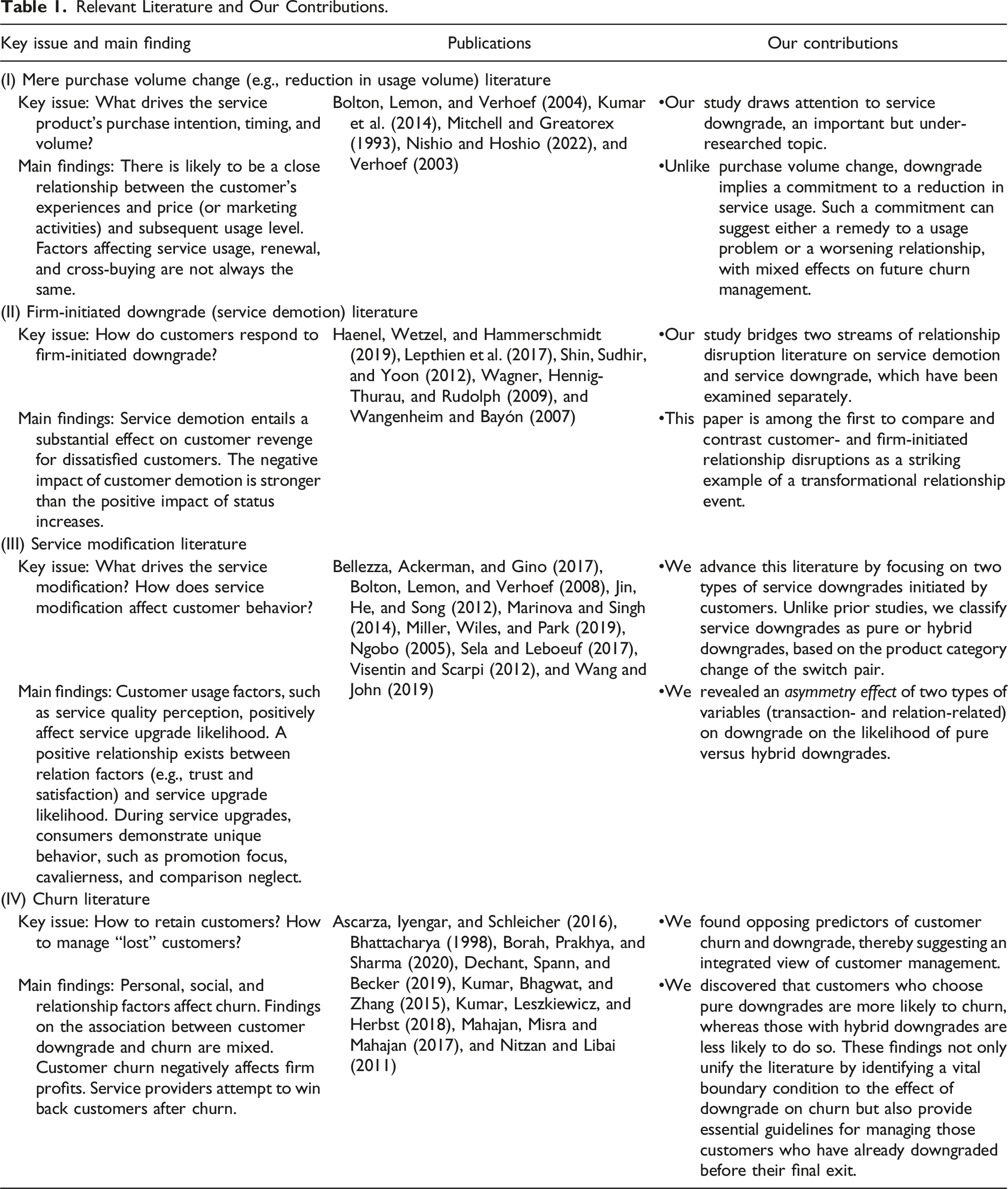
This research offers several theoretical contributions. First, we complement the service volume change literature (e.g., Bolton, Lemon, and Verhoef 2004; Kumar et al. 2014; Mitchell and Greatorex 1993; Nishio and Hoshio 2022; Verhoef 2003) by systematically investigating service downgrade, which is an under-explored yet unique research topic. A downgrade is a discrete, transformational “event” that truly changes the course of a relationship in terms of a customer’s deliberate decision, and it involves high cognitive effort. However, the volume change decision tends to be less thoughtful, with back-and-forth adjustments later. Hence, factors affecting downgrade and purchase volume reduction tend to be different.
Second, we advance the emerging service modification literature (Bellezza, Ackerman, and Gino 2017; Bolton, Lemon, and Verhoef 2008; Miller, Wiles, and Park 2019) by focusing on two types of service downgrade initiated by customers. We classify service downgrades as either pure or hybrid, based on the product category change of the switch pair. Then, we conceptualize the major differences between these two types of downgrade and examine the influence of downgrade type on the antecedents of service downgrades. We reveal that the effect of transaction- and relationship-related variables on downgrade likelihood is asymmetric between pure and hybrid downgrades.
Third, our study further extends the customer retention literature (e.g., Ascarza, Iyengar, and Schleicher 2016; Borah, Prakhya, and Sharma 2020; Kumar, Leszkiewicz, and Herbst 2018; Mahajan, Misra and Mahajan 2017; Nitzan and Libai 2011) by showing when service downgrade leads to churn. Our empirical findings reveal that customers involved in pure downgrades (relative to hybrid downgrades) are more likely to defect, suggesting that firms should consider customers’ downgrade type when investigating customer retention.
Last, this paper bridges two streams of relationship disruption literature on service downgrades (Marinova and Singh 2014) and service demotions (Haenel, Wetzel, and Hammerschmidt 2019; Wagner, Hennig-Thurau, and Rudolph 2009), which have been examined separately so far. Conceptually, service downgrades are initiated by customers voluntarily, while firms initiate service demotions without seeking customers’ consent. Our results highlight the distinctions in the predictors of relationship disruptions between service downgrade and demotion. Hence, our paper is among the first to compare and contrast the customer- and firm-initiated relationship disruptions as a striking example of a transformational relationship event.
Literature Review
We review the extant literature (e.g., Bellezza, Ackerman, and Gino 2017; Bolton, Lemon, and Verhoef 2008) on service modification, which is defined as the process of addressing issues related to usage matching and congruence (Alderson 1965; Bolton, Lemon, and Verhoef 2008). Customers engage in a problem-solving process to determine the level of service option that best meets their needs (Bolton, Lemon, and Verhoef 2008).
Notably, service modification is a type of customer-initiated voluntary behavior, in contrast with service demotion/termination (Haenel, Wetzel, and Hammerschmidt 2019; Wagner, Hennig-Thurau, and Rudolph 2009; Wangenheim and Bayón 2007), which is firm-initiated involuntary divestment from service contracts. Service demotion substantially affects customer revenge for dissatisfied customers (Haenel, Wetzel, and Hammerschmidt 2019). The negative impact of customer demotion is stronger than the positive impact of status increases (Wagner, Hennig-Thurau, and Rudolph 2009).
The service modification literature is closely related to two other streams of research, namely, the customer usage volume change (e.g., Bolton, Lemon, and Verhoef 2004; Kumar et al. 2014; Mitchell and Greatorex 1993; Nishio and Hoshio 2022; Verhoef 2003) and renewal literature (e.g., Ascarza, Iyengar, and Schleicher 2016; Bhattacharya 1998; Borah, Prakhya, and Sharma 2020). Service modification differs from mere usage change as it is a discrete and transformational event, suggesting a higher involvement in the decision-making process and a stronger commitment to the decision. Conversely, mere usage changes are subject to back-and-forth adjustments following the decision. Therefore, service modification marks a dramatic shift in the relationship trajectory and influences perceptions of whether a relationship is improving or worsening. Service modification also differs from service renewals, which signify a customer’s continuance commitment. Service renewals indicate that the customer agrees to continue with their current decision without changing their level of commitment. On the other hand, a service modification decision represents a tangible change in the level of commitment. An upgrade or downgrade decision reflects a customer’s decision to increase or decrease their commitment to the provider’s services, respectively.
The majority of the service modification literature (e.g., Bellezza, Ackerman, and Gino 2017; Bolton, Lemon, and Verhoef 2008; Miller, Wiles, and Park 2019; Sela and Leboeuf 2017; Wang and John 2019) has focused on service upgrades, a form of relationship expansion in which the customer purchases an expanded offering—a higher price and augmented good or service—instead of repurchasing a low-price good or service (with lower service levels or fewer features) from the same supplier (Bolton, Lemon, and Verhoef 2008).
Drivers of Service Modification
Prior literature has highlighted the crucial role of previous service experience in customers’ modification decisions. For continuous services, customers can assess the quality of their service experience at a particular point in time. If something unexpected occurs, such as a decline in service performance, customers may re-evaluate their service experience, potentially leading them down a path to switch to a different service option (Roos 1999). Customers may attribute low service quality to inadequate service contract levels, which would then encourage them to upgrade their services (Bolton, Lemon, and Verhoef 2008). While service experience influences the repeat purchase decisions of customers, it does not prevent them from choosing to downgrade (Ngobo 2005). In the automobile industry, Miller, Wiles, and Park (2019) find that trading-in ownership time enhances the degree of upgrades in automotive transactions; however, the trade-in windfall size negatively affects this degree. The act of upgrading to a more exclusive product is driven by the self-threat customers feel when exposed to dissimilar users (Wang and John 2019). Therefore, upgrade behavior can serve as a response on the part of customers to dissimilar product usage among brand users.
Previous studies have emphasized the positive impact of relational assets on a variety of outcomes, such as service upgrade and customer retention (Marinova and Singh 2014; Wetzel, Hammerschmidt, and Zablah 2014). Relational assets refer to the quality of the relationship between customers and service providers and reflect the additional value that customers receive from the relationships they hold (Palmatier 2008). These assets can bring enormous benefits to service providers, including cooperative behavior from their partners, reciprocation (Morgan and Hunt 1994), the ability to offer loyal customers favored status (Wetzel, Hammerschmidt, and Zablah 2014), and empathic responses to mistakes (Palmatier 2008). Given their ties to relationships, customers often bear substantial psychological costs when ending their ties (Burnham, Frels, and Mahajan 2003).
Effects of Service Modification on Customer Behavior
An increasing number of research studies have investigated the impact of modifications on consumer behavior. When presented with opportunities to upgrade their current products, consumers tend to exhibit careless behavior and act impulsively (Bellezza, Ackerman, and Gino 2017). They may even unconsciously disregard their current product’s status when considering upgrades. Interestingly, consumers do not typically compare upgrade options to their existing products to assess the additional benefits of upgrading (Sela and Leboeuf 2017). By comparing service downgrades and upgrades, researchers find that consumers tend to focus on promotions during service upgrades but on preventions during downgrades (Marinova and Singh 2014).
However, the link between service modifications (e.g., downgrades) and customer churn has received limited research attention, and empirical findings on this relationship have been mixed. While some studies have indicated that downgrades favorably impact future customer churn (Bhattacharya 1998), others (Marinova and Singh 2014) suggest that downgrades can prolong customer relationships and decrease churn rates by offering an intermediate option to customers who might otherwise discontinue their relationship with the service.
Relevant Literature and Our Contributions.
Hypothesis Development
Continuous service providers (e.g., telecommunications, insurance, and utilities) often use menu-based pricing and offer various service options. Service subscribers usually evaluate service packages periodically, decide whether to renew their service, and then, if necessary, modify the service options according to changes in external environment and internal experience. Figure 1 presents consumers’ decision process in a time period and Figure 2 presents the conceptual framework. Consumers’ decision process. Note. Figure 1 depicts consumers’ decision process in the model. All told, we simultaneously model (pure/hybrid) downgrade, upgrade, and renewal/churn. In each period, consumers first decide whether to renew or churn the service. If consumers decide to churn, they will not experience the later periods. Otherwise, if consumers decide to renew the service, they encounter the second-stage decision. That is, they make the service modification decision. There are three possibilities: consumers may choose (i) not to modify the service (the “No Change” option), (ii) upgrade the service (the “Upgrade” option), and (iii) downgrade the service. If consumers downgrade the service, then they need to further decide between pure downgrade (the “Pure Downgrade” option) and hybrid downgrade (the “Hybrid Downgrade” option). Conceptual framework. Note. Figure 2 depicts our conceptual framework. All identified variables are included as predictors to examine downgrade and upgrade decisions conditional on the renewal decision in an overarching framework (e.g., modification decision); notably, we categorize downgrades into pure and hybrid downgrades, and test the moderating role of downgrade type in the effects of usage misfit and relationship decline on downgrade likelihood. We also isolate the effects of renewal drivers from those of service modifications by explicitly modeling the predictors of the renewal decision. We further test the effect of prior downgrade behavior on renewal likelihood by controlling other key churn predictors.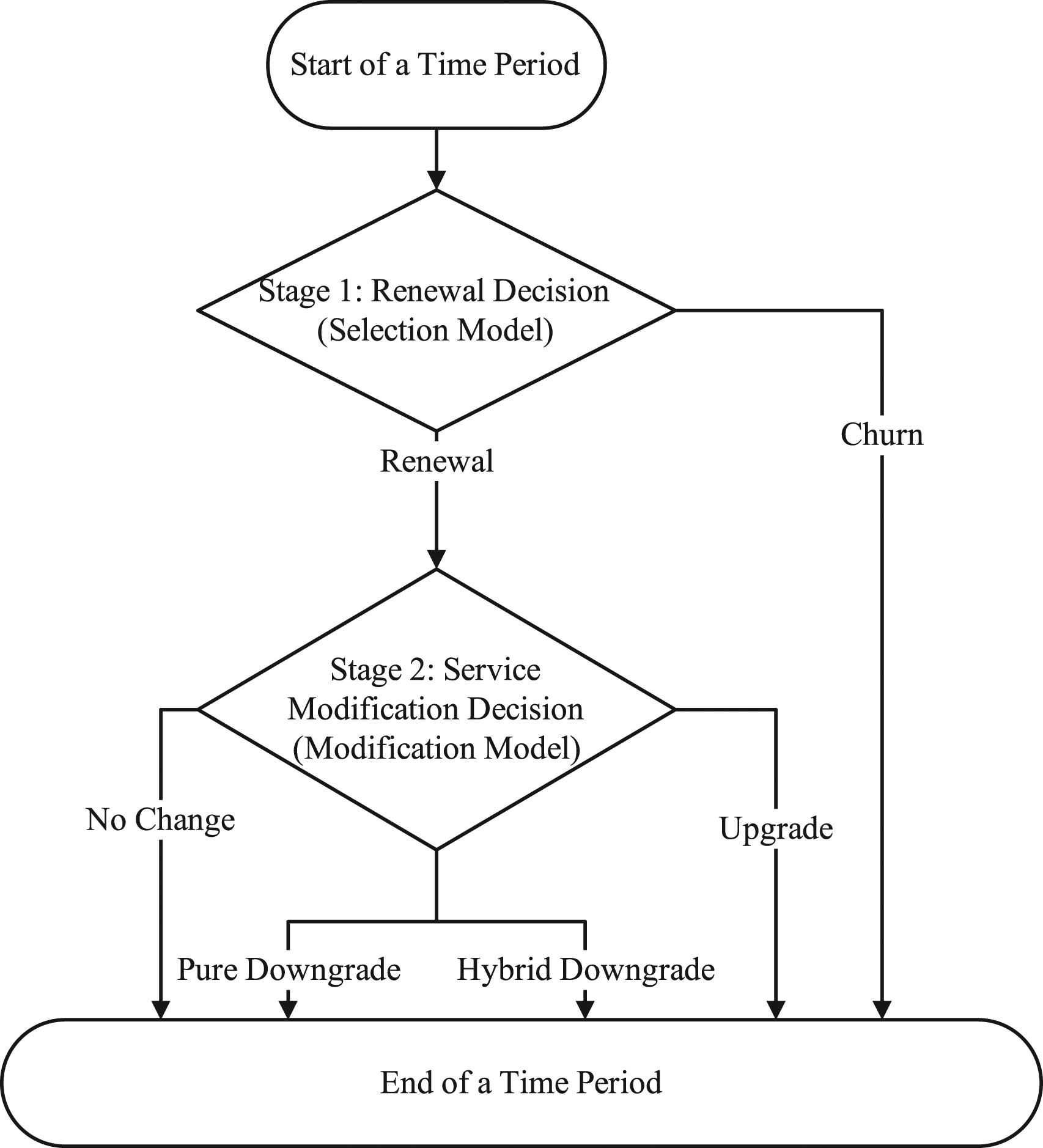
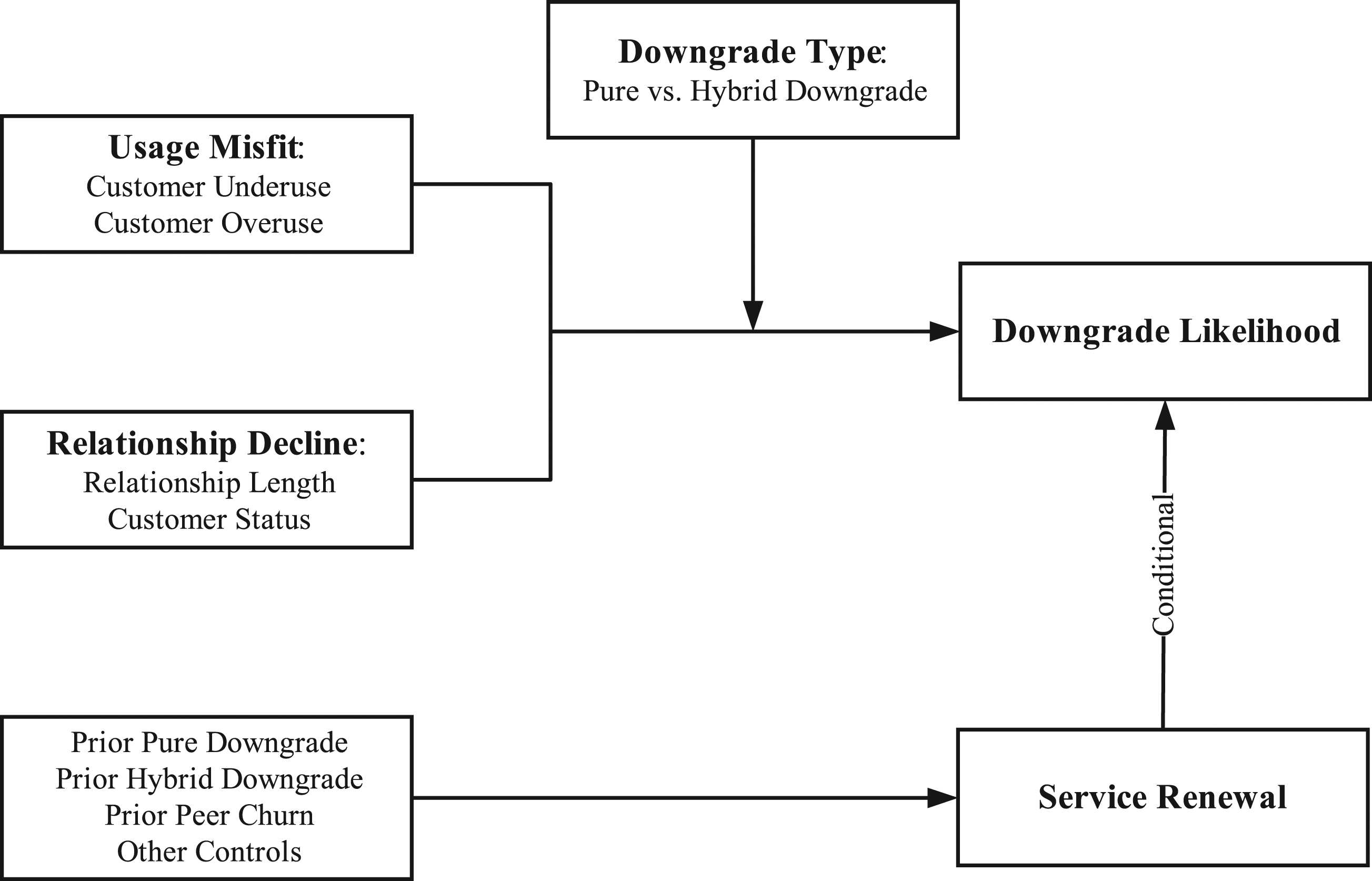
Our conceptual model analyzes the antecedents of service modification with a particular focus on service downgrade and the moderating role of downgrade types. We model the impact of the two main drivers of service modification, namely, usage misfit and relationship decline, on service downgrades and consider their potential interactions with downgrade types (pure downgrade vs. hybrid downgrade). Pure downgrade refers to the downgrade behavior of customers who do not change product category (e.g., within-category switch), whereas hybrid downgrade refers to the downgrade behavior of customers who do change product category (e.g., cross-product switch).
We mainly attribute service downgrades to the usage misfits of the selected service plan and to relationship decline. We propose that transaction-related variables (e.g., customer over- and underuse) are manifestations/levels of usage misfit; meanwhile, relationship-related variables (e.g., customer status and relationship length) capture levels of relationship decline, thus affecting downgrade likelihood. Given the striking differences between pure and hybrid downgrades, we argue that hybrid downgrade is more often a remedy to the usage misfit problem, whereas pure downgrade highlights a relationship decline. Accordingly, we expect variables related to customer usage misfit and relationship status to have distinctive impacts on each downgrade type, highlighting the moderating role of downgrade type in the effects of transaction- and relationship-related variables.
All told, we model downgrade, upgrade, and churn. Although we do not claim an incremental contribution for understanding the drivers of service renewal/upgrade (and accordingly do not posit additional hypotheses), we empirically model the renewal/upgrade decision and all identified variables as predictors to (1) examine downgrade and upgrade decisions conditional on renewal decisions in an overarching framework; (2) isolate the effects of renewal drivers from those of service modifications; and (3) avoid bias in the estimation of service modification.
Two Types of Downgrades
Comparisons Between Pure and Hybrid Downgrades.

Degree of Modification
Hybrid downgrade can be seen as more severe than pure downgrade. For instance, in pure downgrades, a customer can downgrade their ISP cable speed package to a slower and cheaper one. Meanwhile, in hybrid downgrades, a customer can downgrade his/her ISP cable package to a cheaper service option under a different product category, such as a DSL or mobile Internet subscription, in a different product line. Compared with the former case, the latter represents a more severe example of downgrading and may be viewed as a reaction to the initial service.
Clue to Relationship Status
Customer downgrade processes also offer additional information about switch decisions. In hybrid downgrades, customers implicitly offer reasons to justify their downgrade decisions (i.e., their change in preference is implied by the cross-category change). Meanwhile, in pure downgrades, customers do not offer any reason to justify their downgrade decisions and the corresponding reduction in their relationship commitments.
In hybrid downgrades, the customer actively looks for alternatives in new categories. In other words, instead of turning their back on the service provider, the customer chooses another service and likely increases their usage in other service categories. Meanwhile, pure downgrades reduce the usage extent/volume of existing services, hence implying a reduced dependence of customers on service providers and signaling a relationship decline.
Customer Behavior
Compared with pure downgrades, hybrid downgrades involve a switch pair with dissimilar service options. Hence, we expect that compared with pure downgrades, hybrid downgrades involve a more complex switching process that requires greater customer involvement. The cross-category modification increases customer involvement because the switch pair is difficult to compare and perceived to provide less information relevant to customers’ decision-making (Zhang and Markman 1998). Furthermore, the switch pair must be evaluated on a holistic rather than relative basis (Zhang and Markman 1998), so the comparison requires more effort. By contrast, for within-product category modification such as pure downgrades, consumers face a switch pair with comparable attributes that allow them to develop preferences with minimal effort.
Hybrid downgrades can also be perceived as boundary-spanning tasks designed to find items that differ from those a customer has purchased or expressed interest in purchasing (Schmitz, Li, and Lilien 2014). Similar to other boundary spanning tasks, hybrid downgrades require customers to extensively seek knowledge in other domains. During this process, customers evaluate alternatives holistically (i.e., by taking all of attributes into account) and then make comparisons based on their overall evaluations. This stimulates high-level consideration (Cho, Khan, and Dhar 2013), while engagement in pure downgrades only stimulates low-level consideration. Specifically, customers focus on specific information (e.g., comparable attributes) and conduct a local search.
Effects of Usage Misfits on Downgrades
We consider transaction-related variables (e.g., overuse and underuse) and expect they will capture the degree of service usage misfit, thereby inducing customers to engage in service downgrade. We also expect transaction-related variables to interact with downgrade types. Therefore, the impact of transaction experience on service downgrade should be contingent on how customers downgrade their existing service option.
As mentioned, the modification decision solves the problem of market matching and congruence. A firm has distinctive levels of marketing offerings, and customers are heterogeneous concerning their specific market needs. Customers engage in a problem-solving process to find the service plan (i.e., an appropriate level of service from the firm) that best meets their needs.
Consumers tend to face a usage misfit problem if they choose a service plan not explained by actual usage, hence motivating them to engage in problem-solving to identify the appropriate service level. This presents two types of usage misfit, namely, service overuse and underuse. Service overuse (underuse) occurs when the actual usage by a customer greatly exceeds (falls behind) the projected service usage amount. For instance, given the monthly usage limits for a service, which are usually set based on historical usage trends, when actual usage is significantly below the monthly limit, the customers are overcharged, thereby leading to usage misfit concerns (i.e., the service is not worth its price). Customers reject the current service plan and search for new and cheaper plans to avoid further losses.
Similarly, when the actual usage is significantly higher than the monthly limit, customers tend to overpay due to having subscribed to a suboptimal plan. Therefore, they should reject their current service plan and search for more expensive options (e.g., with higher monthly limits). Overall, we propose the following:
Customer underuse will have a positive effect on downgrade likelihood.
Customer overuse will have a negative effect on downgrade likelihood.
Moderating Role of Downgrade Type for the Effects of Variables Related to Usage Misfit
We expect downgrade type to moderate the effect of customer underuse on service downgrade. First, hybrid downgrade can be perceived as a more severe modification, where customers change their service plans as a reaction to the service they initially received. Accordingly, we expect that the association between prior underuse/overuse and downgrade likelihood will be magnified in hybrid downgrades. Compared with pure downgrades (i.e., less severe modifications), customers are more (less) likely to engage in hybrid downgrades when customer underuse (overuse) occurs.
Second, customer underuse in services motivates these customers to engage in hybrid downgrades. Given that poor performance represents flaws in existing practice, decision-makers tend to reject the status quo and focus on alternatives (Greve 2003). The pressure resulting from poor usage performance tends to motivate these decision-makers to act boldly in order to appear progressive and in control (Abrahamson 1996; Greve 2003). Previous studies on performance feedback suggest that a more significant shortfall between actual performance and the aspirational level corresponds to a greater motivation for decision-makers to engage in riskier types of change (Cyert and March 1963; Greve 2003; Xu, Zhou, and Du 2019).
In the context of a service downgrade, due to underuse of the service plan and the striking overspending problem, customers are motivated to explore alternatives to avoid future overspending. In hybrid downgrades, the alternative service option chosen by customers is perceived as a new product with a higher degree of dissimilarity, which likely catches the attention of customers after experiencing poor performance. On the basis of the overspending amount, customers can evaluate whether they have selected an appropriate plan. Here, the appropriate use of the current service plan can be viewed as the aspiration that customers strive to meet for each subscription period. When actual usage is significantly lower than the monthly limit, customers tend to significantly overspend due to their inappropriate plan selection. Accordingly, customers are motivated to reject the current service plan, focus on their inappropriate service usage, and actively search for new yet risky options. In this case, they tend to engage in hybrid downgrades.
Third, compared with pure downgrades, hybrid downgrades provide helpful knowledge that addresses customers’ usage misfit problems. After experiencing a service failure, decision-makers engage in non-local search through which they look beyond their own experiences for new ideas and solutions (Rosenkopf and Nerkar 2001). Baum and Dahlin (2007) find that when the railroad accident rate is well below the aspirational level, a railroad operator benefits less from its own operating experience but more from the operating experiences of other railroads. After an underuse experience, customers are motivated to seek new alternatives through service downgrades to avoid further losses. Customers who question the appropriateness of their current plan are more likely to benefit from a new and significantly different option. By contrast, the plan selected by customers in pure downgrades is relatively similar to the previous offering. The search process tends to be local and cannot provide diversified information and valuable solutions.
In sum, customers’ underuse motivates them to look for an accurate solution to their problem. A hybrid downgrade represents the right direction, providing large amounts of new information that help customers address their problem. Therefore, customers experiencing underuse are more motivated to choose a hybrid downgrade. Similarly, customers’ overuse also motivates them to look for a solution to their problem. However, a downgrade is the wrong direction to pursue. Therefore, such customers are more likely to avoid a wrong decision (e.g., hybrid downgrade) requiring higher involvement on their part. We propose the following:
Compared with pure downgrades, customer underuse will have a more positive effect on downgrade likelihood under hybrid downgrades.
Compared with pure downgrades, customer overuse will have a more negative effect on downgrade likelihood under hybrid downgrades.
Effects of Relationship Decline on Service Downgrade
We consider relationship-related variables and expect them to mainly capture the extent to which relationships have deteriorated, thereby causing customers to engage in service downgrades. We also hypothesize that relational assets influence customer decisions to engage in each downgrade type differently, that is, customers’ downgrade type affects the link between relationship assets and service downgrade likelihood.
Relational assets should affect customer maintenance and their likelihood to downgrade. On the one hand, by establishing stronger relationships with service providers, customers can receive external benefits, such as preferred status, reciprocity, convenience, discounts, gifts, or bonuses, which are referred to as economic, functional, and psychological rewards (Palmatier et al. 2006). Relationship assets can induce customer satisfaction and loyalty (Steinhoff et al. 2016), thereby preventing relationship decline. Given the aforementioned benefits, customers who reduce their commitments tend to incur high psychological costs and may feel indebted and anxious when switching out of self-interest (Burnham, Frels, and Mahajan 2003). On the other hand, relational assets may also have a dark side, leaving the relationship vulnerable to deterioration and increasing the likelihood for consumers to downgrade (Anderson and Jap 2005). Among various relationship-related variables, we focus on relationship duration and customer status, which are essential variables related to relational assets (Palmatier et al. 2006).
Relationship Length
Relationship length captures the length of time for which exchange partners have been working with each other. A longer relationship provides customers better information and reduces the uncertainties surrounding the future behavior of their exchange partners. We expect that relationship length will affect service downgrade likelihood in the following ways.
First, at the early stage, when relationship length increases from a short to a medium span, the customer relationship is still fragile and prone to decline (Jap 2001). During this stage, customer trust has not been developed. What is worse, as relationship length increases, customers are more likely to discover mutual incompatibility (Marcos and Prior 2017) (e.g., the loyalty program imposes burdens on customers seeking to maintain the current relationship level or the process of redeeming loyalty points is too complicated). Accordingly, customers find less complementary and fewer future relationship benefits, thereby leading to relationship decline and customer downgrade.
Second, when relationship length increases from a medium to a long span, we expect mutual trust to develop and overcome the negative effect mentioned above, thereby preventing relationship deterioration and customer downgrade. Longer relationships that engender high trust are likely to evoke motivation to nurture the current relationship and develop its relational benefits, which can effectively prevent relationship deterioration, induce customer commitment, and reduce the likelihood of service downgrade. Customers who have had more prolonged contact with the company are more embedded in the relationship and tend to show more empathic behavior toward the service provider. When unanticipated service failures arise, customers in a long relationship will be more tolerant of them and tend to attribute them to external causes beyond the control of the seller, hence reducing the adverse effects caused by service failures and preventing relationship decline (Palmatier 2008). Following these discussions, we predict a non-linear relationship between relationship length and downgrade:
Relationship length will have an inverted U-shaped relationship with downgrade likelihood.
Customer Status
Tier-based loyalty programs often award preferred customer status (e.g., elite membership) that provides exclusive benefits to consumers who have exceeded a certain spending level (Wagner, Hennig-Thurau, and Rudolph 2009). Elevated status levels correspond to a set of exclusive rights and benefits, often provoking respect, consideration, or envy from others (Wagner, Hennig-Thurau, and Rudolph 2009). We expect that customer status will affect service downgrade likelihood as follows.
First, when customer status increases from low to medium level, a higher status tends to induce customers to become overly demanding and develop higher expectations of the service provider (Wetzel, Hammerschmidt, and Zablah 2014), thereby leading to feelings of incompatibility with the current service. Over-demanding customers are also prone to self-interest and opportunistic behavior, which damage mutual relationships and lead to service downgrades.
Second, when customer status increases from medium to high level, customer gratitude and reciprocity develop, dominating the negative effect and eventually preventing relationship decline. According to Wetzel, Hammerschmidt, and Zablah (2014), preferential treatment from service providers can also elicit feelings of gratitude from customers. The impact of relationship management on decision-making is driven by the underlying emotional state of gratitude, which creates a desire to repay the service provider. Repaying generates pleasurable feelings, while failing to repay results in feelings of guilt (Palmatier 2008). Over time, customer gratitude encourages the development of long-term norms of reciprocity (Palmatier 2008). The reciprocity norm (Gouldner 1960) suggests that privileged customers will feel compelled to repay the service provider for the benefits they have received in the future. Therefore, because of the gratitude and reciprocity norms that arise in high-status relationships, customers are more likely to remain committed to their existing relationships with service providers, thereby preventing relationship deterioration.
Providing preferential treatment allows high-status customers to enjoy various exclusive benefits. However, in most cases, customers must typically maintain a high level of spending to retain their status. If customers reduce their spending, they risk losing their preferred status and the associated benefits. This represents a loss for customers in relation to their reference point, which is their previous high-status. As individuals are typically averse to losses (Kahneman and Tversky 1979), the anticipation of losing exclusive benefits associated with high-status can affect people’s judgment and negatively impact their decision to downgrade. Following these discussions, we propose the following:
Customer status will have an inverted U-shaped relationship with downgrade likelihood.
Moderating Role of Downgrade Type on the Effects of Variables Related to Relationship Decline
We posit that the effect of relational assets on downgrades will be weaker in hybrid downgrades than in pure downgrades, which suggests that relationship assets are less effective in affecting hybrid downgrades than pure ones.
At a low relationship level, we expect an increase in relational assets to be prone to relationship decline, eventually leading to pure downgrades. As discussed, compared with hybrid downgrades, pure downgrades have closer ties with relationship decline and thus are more sensitive to changes in the relationship-related variables.
At a high relationship level, we expect that an increase in relational assets is likely to prevent relationship decline and pure downgrade. First, compared with hybrid downgrades, pure downgrades are more likely to indicate deterioration in the relationship between customers and service providers. In pure downgrades, customers reduce their usage (e.g., the extent/volume) of the existing service, hence reducing their dependence on the service provider and indicating a relationship decline. Prior relationship assets (at a high relationship level) can prevent such a decline and influence the likelihood for customers to downgrade. However, in hybrid downgrades, usage is less associated with relationship deterioration. In this case, customers tend to modify their existing service due to shifts in their preferences and their matching of new preferences. Specifically, customers actively look for products in other product categories offered by their service provider. Accordingly, prior relationship assets become less effective in preventing hybrid downgrades. These relationship assets may even help customers seek new alternatives (e.g., new attributes) during the hybrid downgrade process because customers with long relationships with their service providers are highly familiar with the various service options/attributes offered by the latter. Overall, we expect that at a high relationship level, the stated negative effect of relationship assets on downgrades will be weaker for hybrid downgrades than for pure downgrades.
Second, an increase in relationship assets has less effect on hybrid downgrades. Customers have a strong desire to justify their decisions and have certain reasons for their choices (Hsee 1995; Shafir, Simonson, and Tversky 1993). Compared with pure downgrades, hybrid downgrades offer additional information (i.e., changing preferences, as implied by cross-category changes) that customers can use to justify their reduced commitment. Therefore, hybrid-downgrade behavior (i.e., modifying a prior service) is less likely to be the immediate result of the break-up of a prior relationship. For instance, customers feel less indebted and less bound by prior high relationship assets when engaging in hybrid-downgrades. By contrast, pure downgrades do not offer any information that can help customers justify their reduced commitment. Therefore, these customers may feel highly indebted (especially at a high relationship level) when engaging in pure downgrades because of their strong prior relational bonds. We therefore propose the following:
Compared with pure downgrades, relationship length will have a weaker inverted U-shaped relationship with downgrade likelihood for hybrid downgrades.
Compared with pure downgrades, customer status will have a weaker inverted U-shaped relationship with downgrade likelihood for hybrid downgrades.
Method
Data
We analyzed a dataset of 25,000 customers provided by a China-based global telecommunications service provider. These customers were randomly sampled from the company’s customer databases. The time window for our study spans 24 months, from January 2013 to December 2014. We chose this period to avoid structural changes caused by technology shifts. During this period, telecommunications companies provided stable service options under a 3G standard; however, in spring 2015, they started to launch completely different products under the new 4G standard. We focused on the sample of customer subscriptions to the WCDMA (Wideband Code Division Multiple Access Standard) plan, which is a significant cellphone plan offered by the selected company during the study period that accounted for around 80% of its total user base. The final sample for analysis gives us a total of 363,643 customer-month pairs (21,155 customers).
Our data includes comprehensive information on cellphone plan usage and the corresponding customer and cellphone plan characteristics for the selected period. For each customer in our sample period, we observed their monthly usage outcomes, such as actual bill rate and breakdowns in data, voice, and text usage. We obtained detailed customer-level information, such as the date when the customer signed with the company, their acquisition channel, and their location. Given that this service provider has loyalty programs, the customers are categorized into five status levels (i.e., regular, entry-level, silver, gold, and diamond) based on their loyalty status. The service provider evaluates its customers and changes their loyalty status over time.
We can observe the service plan name, a specific minimum fee, and the extra charge rule if data and voice usage exceed a preset minimum for each service plan. For instance, the WCDMA plan has eleven tiers of minimum price fees (from 36 CNY to 586 CNY). For each price tier, the WCDMA plan covers three sub-plans, namely, WCDMA-A (excellent service for streaming data), WCDMA-B (excellent service for voices), and WCDMA-C (excellent service for local calls only). These sub-plans satisfy the customers’ different service needs. Notably, the WCDMA plan provides detailed information about cellphone plan characteristics (e.g., product features and lines) and the corresponding minimum fee for each option. Therefore, we can accurately categorize the modification behavior of WCDMA subscribers into upgrades, pure downgrades, and hybrid downgrades. Additional data details, summary statistics, and correlation matrix are provided in Appendix C.
In the sample period, we observed all customers’ renewal and modification decisions about the service plan. We identified 7,903 customers who modified their service plans at least once and tracked their selected service plans and usage outcomes before their exit during the selected time window. Among these subscribers, 4,853 modified their plans once, 2,219 twice, 580 thrice, and 251 more than thrice. Notably, for those customers subscribing to the WCDMA plan, 5,938 discontinued their patronage by defecting before December 2014.
Variables
Downgrade and Upgrade
We coded Downgrade as 1 if the customers are involved in a downgrade (e.g., switching from a high-price to a low-price plan) and 0 if they stick to their current service plan. Meanwhile, we coded Upgrade as 1 if the customers have engaged in an upgrade (e.g., from a low-price to a high-price plan) and 0 if they keep their current plan.
Two Types of Downgrades
We observed two types of downgrades. In pure downgrades, a customer switches to a cheaper service option without any change in the product category. In hybrid downgrades, a customer switches to a cheaper service option in a different product category. We classified each downgrade case based on changes in the plan’s category. For instance, if the before- and after-downgrade plans are both WCDMA-A plans with different price tiers, then we classified the switch as a pure downgrade. On the other hand, if customers switch from WCDMA-A plans to WCDMA-B (or WCDMA-C) plans, then we classified it as a hybrid downgrade.
Variables Related to Usage Misfit
To measure the usage outcome, we used the actual monthly bill rate and compared it to a preset minimum price (e.g., the basic monthly fee) prescribed by the plan, which can be taken as a projected monthly bill rate. We classified underuse (overuse) based on whether the actual bill rate falls below (exceeds) 50% of the projected bill rate each month. We incorporated lagged values of customer underuse and overuse into our model to capture the effect over a long period. In the robustness section, we provided alternative measurements of customer underuse/overuse.
Variables Related to Relationship Decline
To measure relationship length, we calculated the duration (in months) between the month the customer initially registered with the company and the month when the switch occurred; then, we took the log of duration. We classified customer status (and the corresponding benefits) into five levels, namely, regular, entry-level, silver, golden, and diamond. We used the numbers 0 to 4 to capture customer status from the regular to diamond levels.
Controls
We included several time-varying controls to capture the effects of other factors on modification likelihood. At the service plan level
For marketing activities, we incorporated marketing expense, which captures the marketing expenditure of service providers for each subscriber. To nurture its relationship with customers, the service company provides them with loyalty rewards, such as monetary incentives that can be used to purchase new or additional items included in the provider’s core services (e.g., voice, message, or data amount packages) or related services (i.e., ringtones, music downloads, apps, or targeted data flow service packages). These customers can also use their loyalty rewards to pay their monthly bills.
For firm and customer interactions, we included two dummy variables, customer status elevation and descent, to capture firm-initiated actions (loyalty status upgrades and downgrades) for managing the loyalty program, which rewards high-value customers and punishes low-value ones. We incorporated the lagged values of status elevation and descent into the model. To control for fixed time-effect and plan-effect, we included time-dummies for each month during the study period and two plan-type-dummies (WCDM-A and WCDM-B) for the pre-switch plan types. Table C4 (Appendix C) provides the descriptive statistics and a correlation matrix for all variables. All covariates are time lagged, so we can examine their effects on the modification likelihood.
Model
We utilized a fixed effect multinomial logit model to capture the proposed relationships and test hypotheses. First, we simultaneously modeled the customers’ decision to upgrade, downgrade, or make no change to the service conditional on their renewal decision. Then, to obtain unbiased estimates of the drivers of the second stage of the decision process (upgrade, downgrade, or no change), we also modeled the preceding effects of service renewal and its drivers. We included the hypothesized drivers of downgrade, controls, and exclusion variables as predictors of the first-stage renewal decision. This model accounts for unobserved customer heterogeneity due to unobserved variables that are interdependent across renewal and modification decisions.
Modification Model
To model the modification decision choices, we expressed customer’s utility from choosing the service decision option 
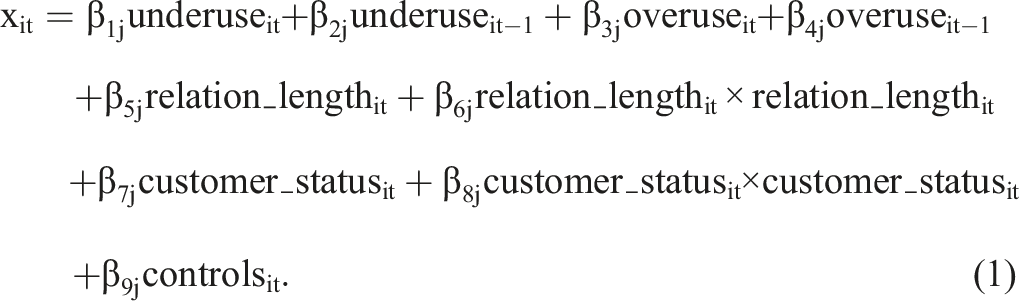
Therefore, we estimated a separate set of parameters for downgrade (versus no change) and upgrade (versus no change). The probability that customer 
The coefficient
Selection Model
We modeled the renewal decision for each customer 

Following the literature (e.g., Nitzan and Libai 2011), we expect that due to the social effect, neighboring customers’ churn behavior will positively (negatively) affect the focal customer’s churn (renew) likelihood. We also expect that those customers with more expenses on added-value services (e.g., ringtones, music, apps, reminder messages, and weather forecast service) are less likely to churn. Indeed, the service provider can provide more variations on this related service to mitigate industry competition. Similarly, a higher inbound/outbound call degree asymmetry for a customer (measured as the number of inbound calls divided by the number of outbound calls) suggests that customers have become more reliant on the service and less likely to churn due to higher switching costs. Meanwhile, the customers’ bill payments are usually not responsive to monthly bill rates because people tend to pay their bills in rounded numbers (e.g., 50, 100, and 200 CNY). We expect that those customers with higher deposits (i.e., overpayment) on their service accounts are less likely to churn due to higher perceived switching costs.
We also included prior downgrades, which are expected to affect the churn (or renew) likelihood. As discussed, we expect a prior pure downgrade to indicate a relationship decline, thereby inducing future churn; conversely, a prior hybrid downgrade is more of a remedy to the usage misfit problem and is, therefore, less likely to cause future defection.
We used the fixed-effect multinomial logit model estimation to run the modification models. As a control variable, we included the inverse Mills ratio obtained from the selection model by means of Heckman’s two-step selection model (Heckman 1979). This procedure allowed us to control for any potential bias stemming from customer
Empirical Results
Predictors of Downgrade Decision
Effect of Variables Related to Usage Misfit and Relationship Decline on Service Modification Likelihood.
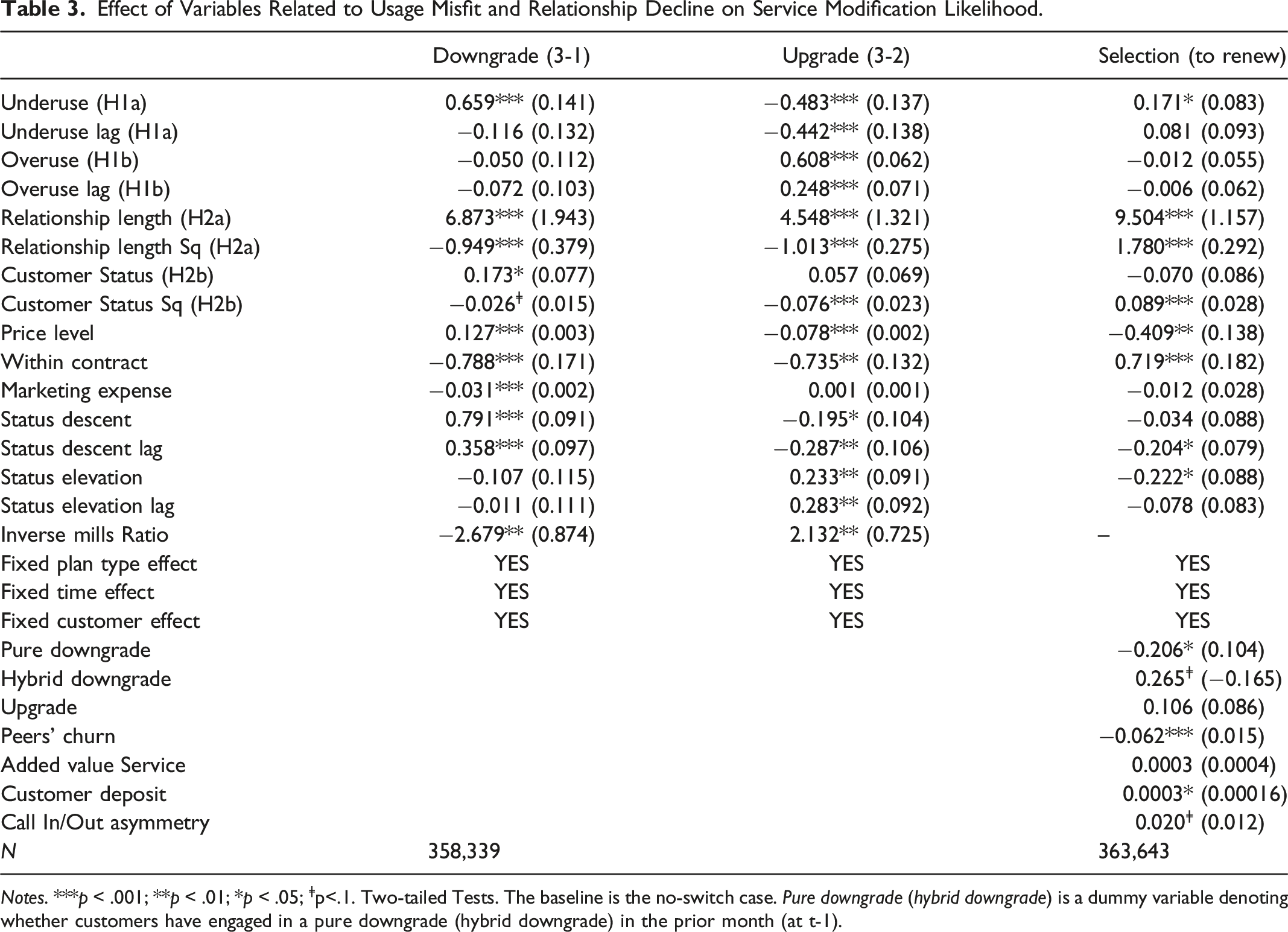
Notes. ***p < .001; **p < .01; *p < .05; ǂp<.1. Two-tailed Tests. The baseline is the no-switch case. Pure downgrade (hybrid downgrade) is a dummy variable denoting whether customers have engaged in a pure downgrade (hybrid downgrade) in the prior month (at t-1).
Effect of Variables Related to Usage Misfit and Relationship Decline on Service Modification Likelihood (Pure vs. Hybrid Downgrade).
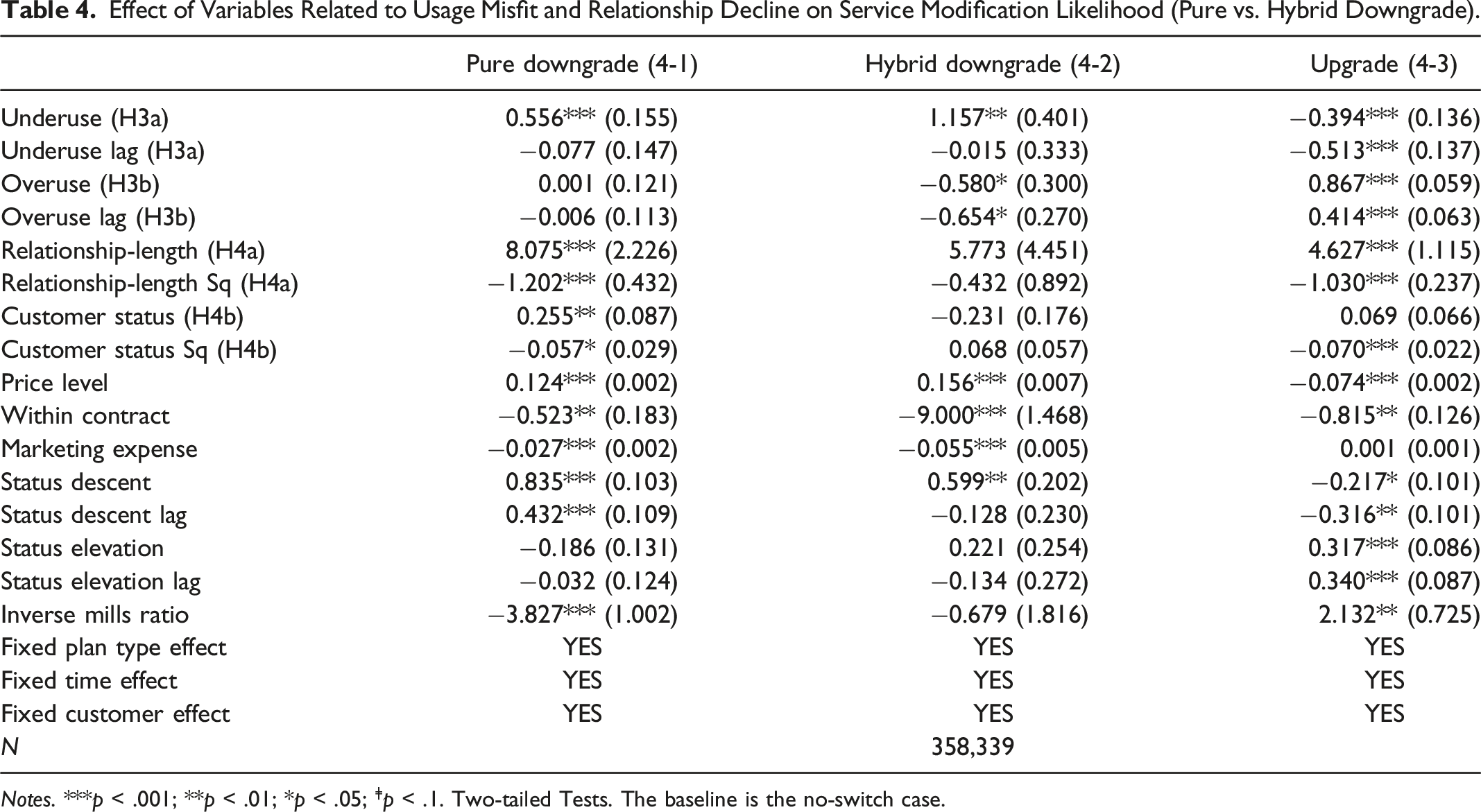
Notes. ***p < .001; **p < .01; *p < .05; ǂp < .1. Two-tailed Tests. The baseline is the no-switch case.
Impact of variables related to relationship decline. As shown in Table 3, the coefficients of relationship length (6.873; p < .001) and its square term (−0.949; p < .001) are positive and negative, respectively, and statistically significant at the 0.001 level. These results confirm an inverted U-shaped relationship between relationship length and downgrade likelihood, that is, customers with a moderately long relationship with the service provider are more likely to downgrade than those with a short or long relationship. Similarly, the coefficients of customer status and the square term are positive (0.173; p < .05) and negative (−0.026; p < .1), respectively. These results confirm an inverted U-shaped relationship between customer status and downgrade likelihood, that is, customers with medium-level loyalty status are more likely to downgrade than those with low- or high status. These empirical results support H3a and H3b.
Table 4 shows a striking difference in the coefficients of the two types of downgrade predictor for the relationship-related variables. For pure downgrade, the coefficients for relationship length and its square term are significantly positive (8.075; p < .001) and negative (−1.102; p < .001), respectively, whereas for hybrid downgrade, this effect is weakened. Similarly, for pure downgrade, the coefficients for customer status and its square term are significantly positive (0.255; p < .01) and negative (−0.057; p < .05), respectively, whereas for hybrid downgrade, this effect is weakened. These results confirm an inverted U-shaped relationship between relationship-related variables and downgrade likelihood, such that a non-linear relationship is more pronounced in a pure downgrade than in hybrid downgrade, supporting H4a and H4b.
Predictors of Renewal Decision
Effect of Prior Downgrades on Churn (Renew)
As shown in Table 3, we find that the prior downgrade type likely affects the link between prior downgrade and churn (or renew), namely, prior pure downgrade is more likely to lead to churn than prior hybrid downgrade. In fact, we found results diametrically opposed to one another: a prior pure downgrade (as compared to no modification) is more likely to lead to churn (0.206; p < .05), while a prior hybrid downgrade is less likely to lead to churn (−0.265; p < .10). This result is consistent with our posit that prior pure downgrade indicates a relationship decline, therefore inducing future churn. Conversely, prior hybrid downgrade is more of a remedy to the usage misfit problem and is therefore less likely to cause future defections.
Our empirical results also underscore the differences in the predictors of downgrade and churn (or renew). As shown in Table 3, relationship-related variables (e.g., customer status) have a significantly negative impact on churn (−0.089; p < .05), suggesting that relational investments can effectively prevent customer churn (or induce customer renewal). Meanwhile, for transaction-related variables, customer underuse has a significantly negative effect on churn (−0.171; p < .05), whereas overuse has an insignificant effect. This suggests reminding customers of service underuse may backfire and induce churn, which is consistent with prior findings in Ascarza, Iyengar, and Schleicher (2016). We also find that our results are robust to alternative measurements, alternative models, and endogeneity (Appendix A).
Additional Analysis
Service demotion (Haenel, Wetzel, and Hammerschmidt 2019; Wagner, Hennig-Thurau, and Rudolph 2009) is an involuntary downgrade initiated by firms. However, our research focuses on voluntary downgrades initiated by customers. We conduct additional analysis on the predictors of service demotion (firm-initiated downgrades). Following Haenel, Wetzel, and Hammerschmidt (2019), we test the model using an alternative dependent variable (e.g., service demotion), measured as a dummy variable indicating customers downgraded by the service provider from a high to a low status in the loyalty program. Generally, our key findings still hold for this new dependent variable (Appendix B).
We have also identified some main differences in predictors between service demotion and downgrade. First, compared to those in customer-initiated service downgrade, relationship-related variables in firm-initiated downgrade have more substantial effects on downgrade likelihood (e.g., the coefficients of relationship length and its square term are significantly positive and negative, respectively), possibly because the company considers profitability and pays less attention to short-term usage outcomes/variations. Second, the most recent under-usage by customers does not immediately lead to service demotion determined by the firm. The coefficient of the lagged one-period underuse is negative (−0.327; p < .05), and the coefficient of the lagged two-period variable is positive (0.245; p < .05). However, for customer-initiated service downgrades, the most recent under-usage significantly induces service downgrade likelihood, perhaps because the service provider cares about the corporate image and makes thoughtful decisions before dropping customer status in the loyalty program.
Conclusion
A customer choice to downgrade service reflects a contraction of the service relationship and warns of potential future churn. By using a unique dataset from the telecommunications industry, we investigated (1) which variables influence downgrade likelihood; (2) how the impact of these variables differs across downgrade types; and (3) how downgrade type influences churn. We observed fundamental differences in the predictors of pure and hybrid downgrades and found that of the two, pure downgrade is more likely to lead to churn.
Theoretical Contributions
First, our paper contributes to the emerging service modification literature (e.g., Marinova and Singh 2014; Miller, Wiles, and Park 2019; Visentin and Scarpi 2012) by focusing on service downgrades. Previous studies on service modification have focused on service upgrades (e.g., Bolton, Lemon, and Verhoef 2008; Marinova and Singh 2014). Recent studies have extended their investigations to service downgrades, but they have focused on either involuntary downgrade, in which the customer status is revoked by the firm (Wagner, Hennig-Thurau, and Rudolph 2009; Wangenheim and Bayón 2007), or on comparing downgrade and upgrade decisions (Jin, He, and Song 2012; Marinova and Singh 2014; Wangenheim and Bayón 2007). To fill this gap, we focused on voluntary downgrades by customers, classifying them as either pure or hybrid downgrades, something never done before in previous downgrade studies (e.g., Bolton, Lemon, and Verhoef 2008; Marinova and Singh 2014; Ngobo 2005).
We conceptualized the fundamental differences between pure and hybrid downgrades using several elements, including the degree of modification, product similarity perception, customer involvement, and information search. Given the differences in these two downgrade types, our empirical results show that transaction-related variables (e.g., customer usage outcome) are more essential for hybrid downgrades than pure ones, whereas relationship-related variables are more essential predictors for pure than for hybrid downgrades. We also proposed downgrade type as a new boundary condition and found that two critical downgrade levers, namely, transaction- and relationship-related variables, dominate each other. Our empirical findings on these variables that influence each downgrade type also provide helpful insights for service providers interested in downgrade prevention.
Our results enrich prior relationship marketing studies (e.g., Gummerus, Koskull, and Kowalkowski 2017; Harmeling et al. 2015; Palmatier 2008) by comparing the impacts of relationship assets between hybrid and pure downgrades and showing when relationship marketing matters. We found that high relationship investments (e.g., sufficiently high customer status) are more important downgrade preventers for pure downgrades than for hybrid downgrades. Previous studies show that the impact of relationship variables (e.g., customer gratitude) on switch behavior is highly contingent and influenced by external factors, such as the free will of sellers (versus contractual behavior), their real motives, and the amount of risk in their relationship investments (e.g., Palmatier 2008). Therefore, our results contribute to the relationship marketing literature by highlighting downgrade type as a new contingency.
Second, our study also advances the literature on customer retention (e.g., Ascarza, Iyengar, and Schleicher 2016; Bolton 1998; Dechant, Spann, and Becker 2019; Neslin et al. 2006; Nitzan and Libai 2011) by linking two phases of relationship deterioration. Specifically, relationship contraction (i.e., service downgrades) allows customers to limit the scope of a relationship without exiting, while relationship termination (i.e., customer churn) enables customers to explore external options and closes the option of the current service provider. Only a few studies have examined the links between these two phases, and their findings have been mixed.
Previous studies have identified several crucial factors that influence customer defection, including customer satisfaction, usage patterns, perception of fairness, social influences, and plan recommendations (Dechant, Spann, and Becker 2019; Jaiswal et al. 2018; Nitzan and Libai 2011). We found that consumers involved in hybrid downgrade (relative to pure downgrade) are less likely to defect, thereby suggesting that the manner in which customers engage in downgrade should also be considered when investigating customer retention. For service providers, we offer rich managerial implications about proactive churn management. Our empirical findings suggest that different downgrade types can give service providers some clues regarding the state of their relationships with customers, and managers can use such information to manage churn proactively.
Managerial Implications
The managerial implications of our research are also noteworthy. First, we advise service providers to pay more attention to the problem of service downgrade. While a downgrade can significantly reduce a company’s profits, it can also give service providers an opportunity or a second chance to increase profits before losing customers for good (Marinova and Singh 2014). Therefore, service providers should comprehend the factors behind service downgrades and assess the effects they have on customer behavior.
Second, our study offers guidelines on how to effectively target the right customers for customer maintenance and prevent downgrades. For consumers who may potentially become involved in pure downgrades, providing more external rewards to build a stable relationship is crucial for preventing downgrades. To strengthen relationships with customers, industry practitioners should consider setting up customer clubs and offer a range of personalized value-adding services segmented either by the specific individual or customer segment. Managers should be cautious because relational investments may backfire at a low relationship level. Therefore, when managing downgrades, managers should strengthen their relationships with customers who have developed a sufficiently long relationship with the company and reached a sufficiently high loyalty status. However, for customers who may potentially become involved in hybrid downgrades, service managers should focus on varying usage experiences to prevent downgrades. Implementing effective marketing strategies, such as a notification alerting customers to unlock the full value of the service feature, can offer customers an appropriate selection of service plans and prevent them from overspending on their phone bills.
Third, we also guide service managers in customer retention management. Our findings suggest that companies should target crucial customers based on previous downgrade procedures to reduce the rate of defection. Specifically, they should allocate more resources to those customers who downgrade to options within a similar product category (i.e., pure downgrade). For these customers, companies can adopt either a positive retention strategy, by providing economic incentives to maintain a continuous relationship, or a negative retention strategy, by increasing the switching costs for competitive alternatives.
Service managers tend to view churn and downgrade as separate phenomena. And indeed, we find a significant difference between the predictors of churn and those of downgrade. For instance, relational variables may backfire for downgrades but will effectively prevent churn. Customer underuse leads to downgrading but has an opposite effect on churn. These opposing effects of relation- and transaction-related variables on churn and downgrade underscore the importance of incorporating downgrade into customer retention management. Therefore, our findings suggest an integrated view of managing churn and downgrade.
Limitation and Future Research
This study opens up many avenues for future research. First, considering that our empirical analysis is based on data from the telecommunications industry, future research must test whether or not the same pattern of results can be observed in other industries.
Second, this study investigates service downgrades under discrete choice. However, for service modifications, consumers also consider the level of service downgrade. Instead of studying the discrete upgrade decision (e.g., whether to upgrade or not), Miller, Wiles, and Park (2019) examine those factors that influence the degree of upgrade customers choose in automotive transactions and find that mental accounting factors, brand loyalty, perceived benefits, and marketing-mix factors greatly influence the degree of upgrade. Therefore, future studies should investigate what drives the degree of service downgrade and how these drivers differ from those of the upgrade process.
Third, future research should directly link the downgrade and upgrade processes and explore such issues as how to motivate customers to upgrade their current service after their downgrade decisions. Specifically, studies should address the following questions: (1) what types of customers are more likely to upgrade after their previous downgrade decisions? (2) How can firms optimize their marketing strategies to reduce the length of time that customers spend with a low-price plan and increase their spending level?
Fourth, comparing various modification processes may generate interesting findings. Customers may have a mixture of upgrade and downgrade experiences during a prolonged service period. The patterns of past usage experience distribution (frequency, timing, proximity, and sequence of over- and underuse experience) likely affect customer perception of service quality (Sivakumar, Li, and Dong 2014). Thus, a worthwhile extension would be to examine how customer retention is determined by the frequency, timing, sequence, and proximity of upgrades and downgrades.
Supplemental Material
Supplemental Material - Reductions in Customer Commitment: An Empirical Study on Pure Downgrade versus Hybrid Downgrade
Supplemental Material for Reductions in Customer Commitment: An Empirical Study on Pure Downgrade versus Hybrid Downgrade by Chenxi Zhou, Liming Lin, Zhaoyang Guo, and Juncai Jiang in Journal of Service Research
Supplemental Material
Supplemental Material - Reductions in Customer Commitment: An Empirical Study on Pure Downgrade versus Hybrid Downgrade
Supplemental Material for Reductions in Customer Commitment: An Empirical Study on Pure Downgrade versus Hybrid Downgrade by Chenxi Zhou, Liming Lin, Zhaoyang Guo, and Juncai Jiang in Journal of Service Research
Footnotes
Declaration of Conflicting Interests
The author(s) declared no potential conflicts of interest with respect to the research, authorship, and/or publication of this article.
Funding
The author(s) disclosed receipt of the following financial support for the research, authorship, and/or publication of this article: This project is supported by National Natural Science Foundation of China for Young Scientists (No. 71902167).

Supplemental Material
Supplemental material for this article is available online.
Author Biographies
References
Supplementary Material
Please find the following supplemental material available below.
For Open Access articles published under a Creative Commons License, all supplemental material carries the same license as the article it is associated with.
For non-Open Access articles published, all supplemental material carries a non-exclusive license, and permission requests for re-use of supplemental material or any part of supplemental material shall be sent directly to the copyright owner as specified in the copyright notice associated with the article.
