




Abstract
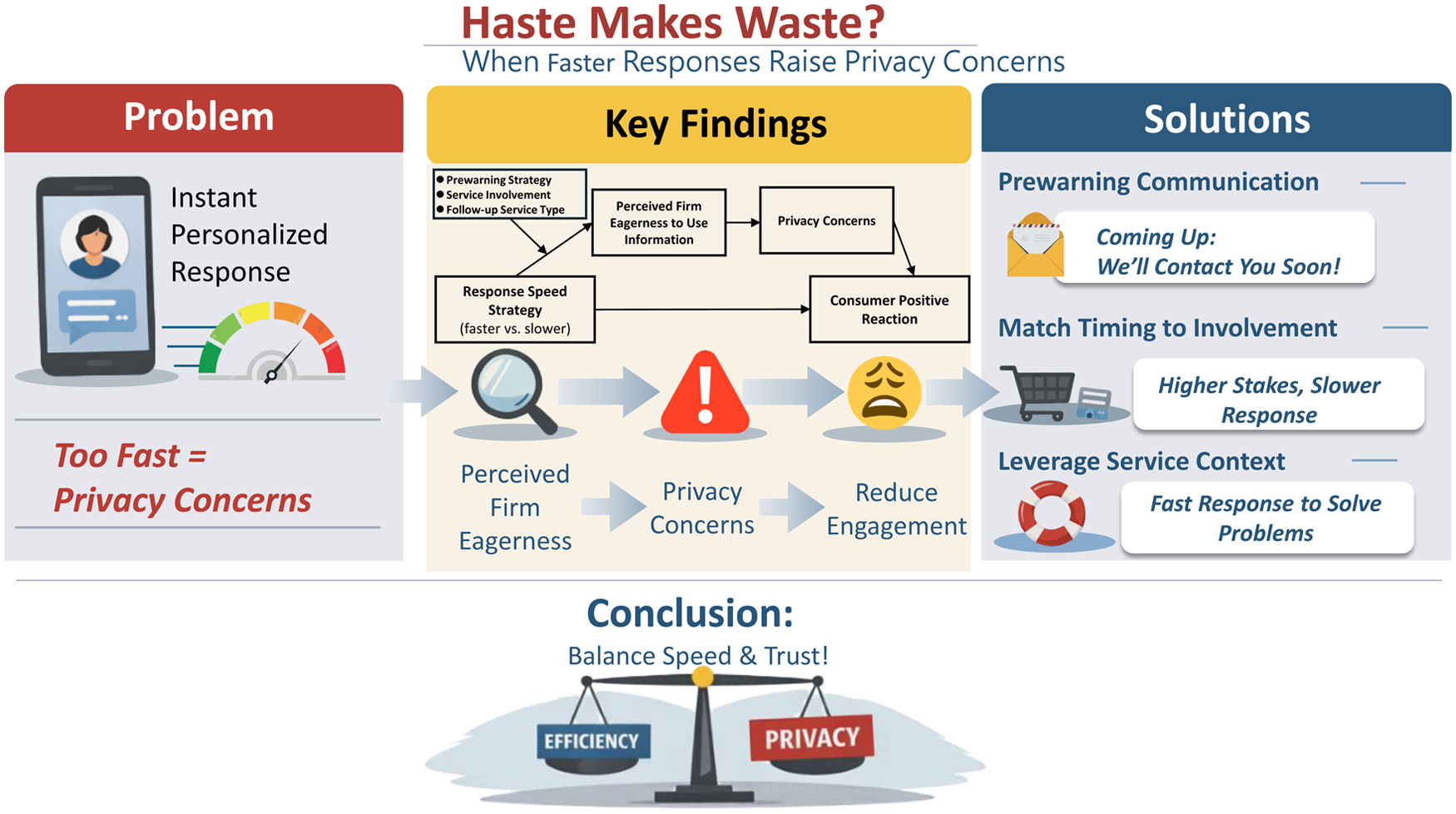
Empowered by advances in artificial intelligence (AI) and data technologies, service personnel can deliver highly personalized communication using automatically acquired consumer data. However, as firms increasingly rely on such data to enhance service efficiency, consumers’ privacy concerns have become more salient. Drawing on the persuasion knowledge model, this research integrates field data with four controlled experiments to examine how response speed following data acquisition influences consumer reactions. We find that faster (vs. slower) responses, defined as those delivered moderately earlier (vs. later) than consumers’ normative expectations in comparable service contexts, attenuate consumers’ positive reactions to marketing communications. This effect is driven by a serial mediation involving perceived firm eagerness to use information and privacy concerns, highlighting privacy concerns as one of the key psychological mechanisms shaping consumer reactions. Importantly, this negative effect is attenuated when firms provide prewarning messages about upcoming data-based communication, when service involvement is low, or in service recovery contexts. These findings suggest that response speed should be managed strategically. While overly fast responses may backfire in high-involvement or routine services, combining fast responses with prewarning strategies can help firms balance efficiency and privacy perceptions in digital service environments.
Keywords
Get full access to this article
View all access options for this article.
References
Supplementary Material
Please find the following supplemental material available below.
For Open Access articles published under a Creative Commons License, all supplemental material carries the same license as the article it is associated with.
For non-Open Access articles published, all supplemental material carries a non-exclusive license, and permission requests for re-use of supplemental material or any part of supplemental material shall be sent directly to the copyright owner as specified in the copyright notice associated with the article.
