




Abstract
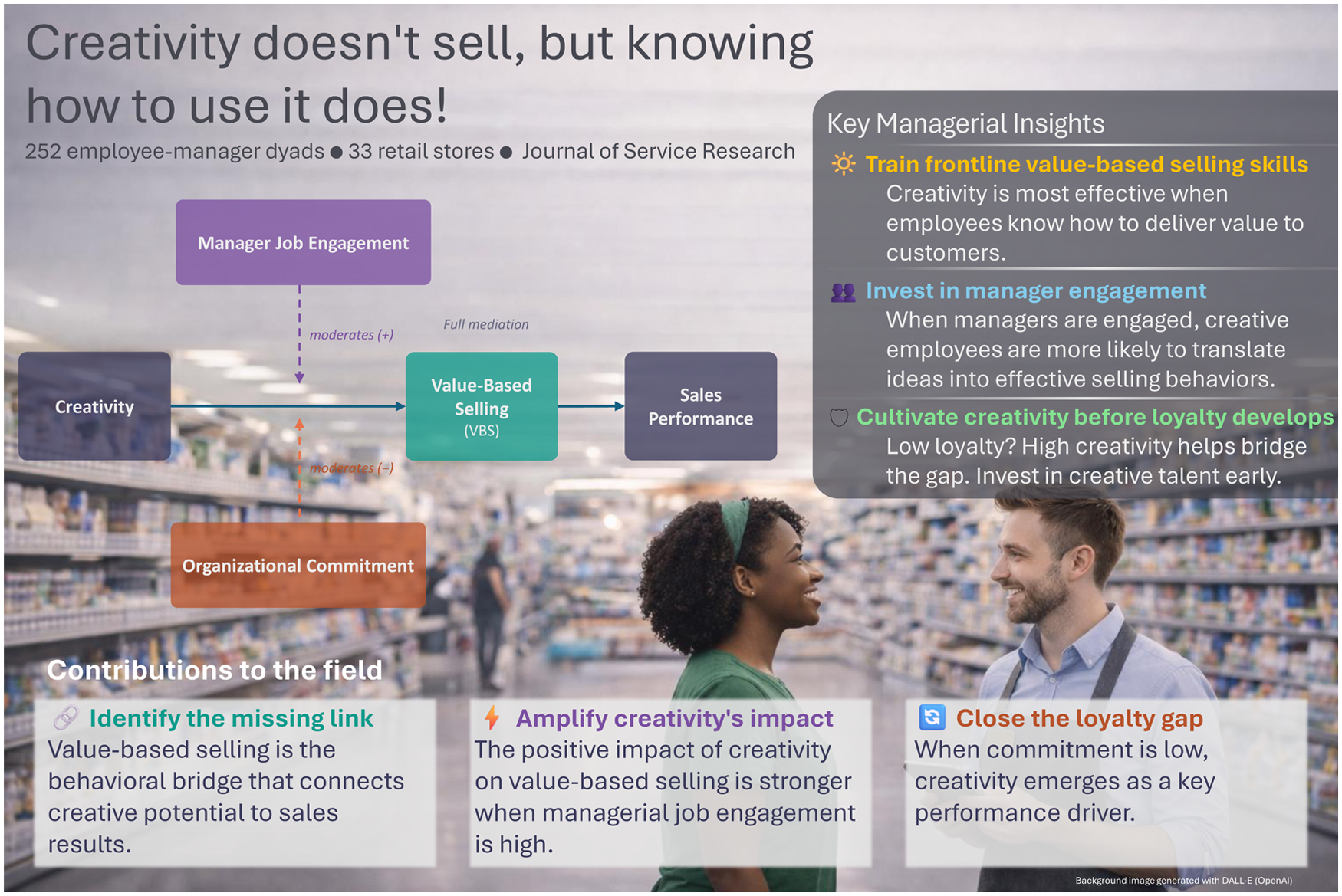
The current research investigates how frontline employee (FLE) creativity contributes to sales performance through value-based selling and how contextual conditions shape this process. Drawing on Amabile’s Componential Theory of Creativity and the Motivation-Opportunity-Ability framework, we test a multilevel moderated mediation model using data from 252 employee-manager dyads in a Canadian art supply retail chain. Findings reveal that creativity influences sales performance indirectly through value-based selling, supporting a full mediation. In terms of moderation effects, the positive impact of creativity on value-based selling is even stronger when managerial job engagement is high. We note a different moderation pattern for organizational commitment. Indeed, when organizational commitment is high, FLEs sustain strong value-based selling regardless of their level of creativity. However, when organizational commitment is low, creativity becomes a key differentiating factor, enhancing value-based selling. Overall, these findings position value-based selling as the behavioral mechanism through which creativity affects sales performance and clarify the boundary conditions under which creativity has more or less effect on this central mediator. We further discuss the theoretical and managerial implications of these findings for frontline service employees.
Keywords
Introduction
In today’s service-driven economy, firms increasingly compete not only on the quality of their offerings but also on the effectiveness of their frontline service delivery. As customer interactions become more complex and personalized, frontline employees (FLEs) play a crucial role in shaping customer perceptions, fostering loyalty, and facilitating value creation during service encounters. Service research consistently positions FLEs as boundary spanners who connect organizational systems, managerial practices, and customer outcomes through their day-to-day behaviors (Subramony et al. 2021). To meet rising customer expectations, FLEs must go beyond standardized procedures and engage in creative problem-solving to personalize interactions, resolve issues in real time, and enhance the service experience. This view aligns with emerging evidence showing that proactive and adaptive frontline behaviors are key drivers of value creation and customer success (Hochstein et al. 2021). However, while the importance of employee-driven creativity in service experiences has been previously acknowledged (Agnihotri et al. 2014), we lack a clear conception of how FLE creativity translates into value-enhancing service interactions that improve sales performance.
A persistent paradox in service research is that FLE creativity, while widely regarded as beneficial, does not reliably or uniformly translate into enhanced performance outcomes. Prior research acknowledges that creativity supports customization and problem-solving, yet its direct effect on service performance appears limited or contingent on contextual factors (Agnihotri et al. 2014; Lua et al. 2024; Lussier et al. 2017). Consistent with this perspective, recent evidence indicates that FLEs' performance depends strongly on employees' motivational orientation and the service context (Jung et al. 2024). How FLEs transform creative ideas into effective, value-oriented service practices remains a crucial yet understudied topic. To address this gap, we examine how FLE creativity enhances performance outcomes through value-based selling (VBS). While VBS has been primarily studied in the sales literature, we position it as the ability-based behavior through which creativity is enacted during service interactions. Importantly, this process does not operate in isolation. Both managerial job engagement and employee commitment moderate the effects of creativity, and the selection of these moderators is consistent with recent multilevel work in frontline service research (Jung et al. 2024; Subramony et al. 2021).
Drawing on these insights, we develop a dyadic, multilevel model that examines how FLE creativity influences sales performance through value-based selling, and how this indirect effect is moderated by managerial job engagement and FLEs’ organizational commitment. To test this model, we draw on a dataset in which FLEs are nested within store managers, with each manager evaluating the performance of the employees under that manager’s supervision. Our model is grounded in two complementary theoretical foundations. First, Amabile’s Componential Theory of Creativity (Amabile 1996) conceptualizes creativity as a motivational resource emerging from employees’ intrinsic drive to generate novel and appropriate responses. Second, the Motivation–Opportunity–Ability (MOA) framework (Siemsen et al. 2008) specifies how behaviors result from the alignment of motivational inputs, ability-based mechanisms, and opportunity conditions. Building on these theories, we treat creativity as a motivational input that requires both an ability-based mechanism and opportunity conditions to translate into performance. Figure 1 summarizes the resulting conceptual model.
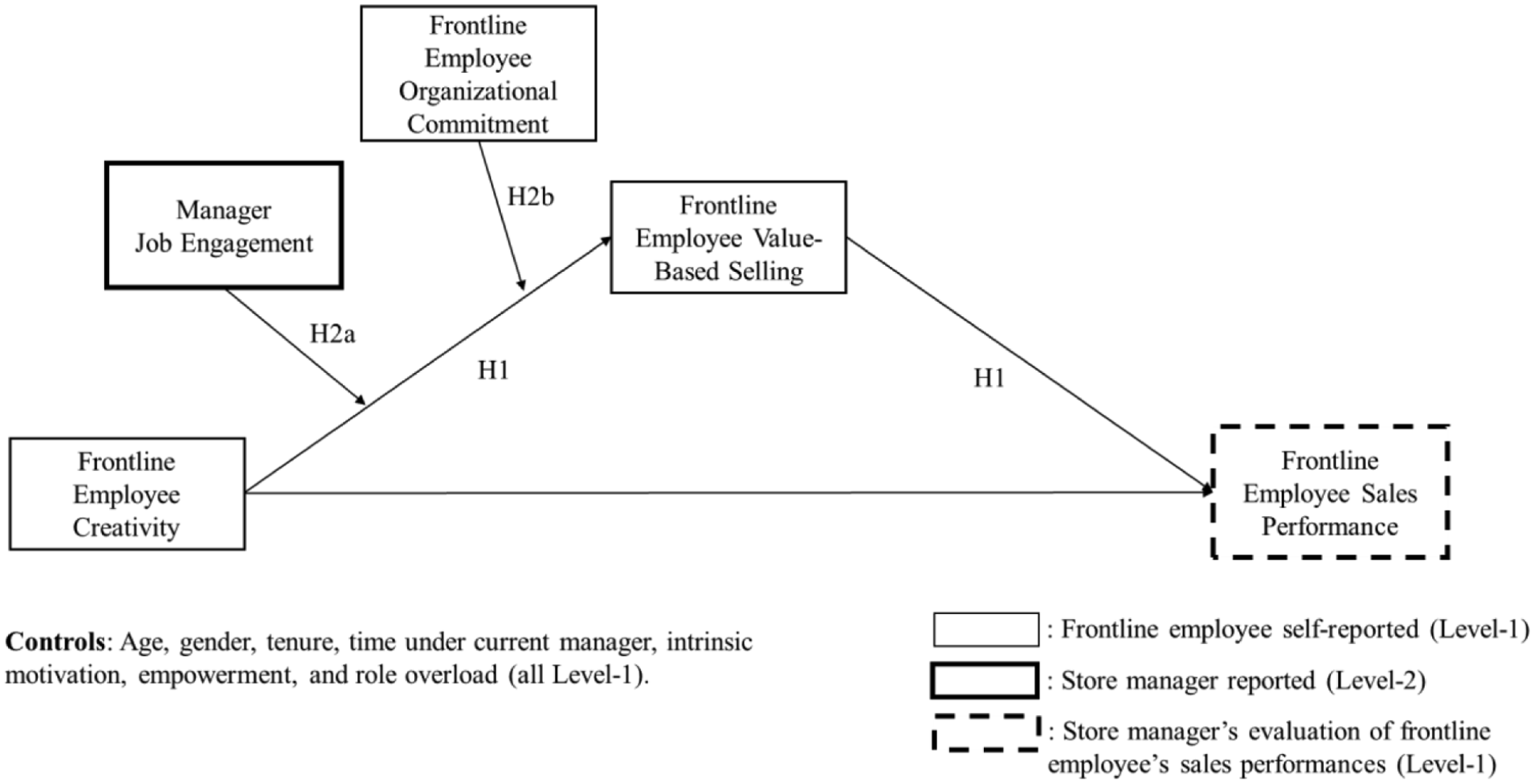
Conceptual framework and hypotheses.
Our study makes three key contributions to service research. First, we clarify the mechanism through which FLE creativity contributes to sales performance. Although prior literature recognizes creativity as a foundation for service customization and problem-solving (Cadwallader et al. 2010; Wilder et al. 2014), the specific behavioral pathway linking creativity to performance outcomes has remained insufficiently specified (Agnihotri et al. 2014; Lua et al. 2024). We propose that creativity functions as a motivational input that leads employees to enact VBS behaviors, which in turn influence performance outcomes. In our model, VBS represents the ability-based behaviors by which FLEs diagnose customer needs, formulate value propositions, and communicate value. Thus, creativity influences performance indirectly through its effects on these VBS behaviors. By identifying this motivational–behavioral pathway, we document the process that explains how creative ideas can ultimately generate sales and performance for FLEs.
Second, we extend service research by demonstrating that manager job engagement serves as a boundary condition that moderates the link between creativity and VBS. Consistent with the MOA framework, engaged managers enhance the extent to which creative motivation drives VBS behaviors (Rich et al. 2010). In other words, when managers are highly engaged, they provide clearer direction, more consistent feedback, and stronger alignment around service priorities, increasing the possibility that FLEs translate creative ideas into value-focused selling behaviors (Zhou and George 2001). This perspective is also shared by recent multilevel service studies, which show that engaged leadership and supportive climates strengthen the effects of frontline adaptability and value co-creation (Hochstein et al. 2021; Jung et al. 2024). By leveraging dyadic, multilevel data, our research clearly demonstrates that managerial engagement amplifies the creativity-VBS pathway; this theorizing offers a precise account of when creative motivation is more effective in driving sought-after FLE behaviors and sales performance.
Third, we explore another boundary condition by examining the moderating role of organizational commitment, a variable that is typically associated with positive service outcomes (Anaza and Rutherford 2012; Jaramillo et al. 2005). Here, we expect and find a different moderation pattern for this variable (compared to manager job engagement). Consistent with the view that commitment increases adherence to established routines and compliance with organizational norms (Solinger 2008; Wiener 1982), highly committed employees may be more inclined to prioritize established procedures over experimentation, thereby reducing the beneficial effects of creativity. Accordingly, highly committed FLEs should sustain strong VBS behaviors with a limited positive effect of creativity. This prediction is aligned with commitment being described as a stabilizing force that guides role-congruent behaviors (Riketta and Van Dick 2009). However, the positive effect of creativity on VBS should become especially strong among FLEs with lower commitment. For these employees, who cannot rely on a strong sense of organizational commitment, creativity serves as a strong driver leading to VBS in our proposed model. In a context of low organizational commitment, creative FLEs still display strong VBS behaviors, whereas we expect particularly weak VBS among low-committed, non-creative employees. At the end, our findings highlight the need for service organizations to balance organizational commitment with the resources required for the creativity-based process.
Theoretical Background and Hypotheses Development
Motivation–Opportunity–Ability Framework
The MOA framework, also referred to as Ability-Motivation-Opportunity (AMO) or other permutations, offers a structure for explaining how individuals engage in goal-directed behaviors. It posits that action occurs when individuals are motivated, possess the ability to act, and operate within an enabling environment (Maclnnis and Jaworski 1989; Siemsen et al. 2008). Although originally developed to explain consumer information processing, the framework has since been extended to organizational behavior and service research (Bigné et al. 2015; Clark et al. 2005; Gruen et al. 2006).
In frontline service roles, employees are expected to constantly adapt to evolving customer needs. MOA offers a framework to explain how individual dispositions and contextual cues jointly shape value-creating behaviors in such contexts (Cadwallader et al. 2010; Elbaz et al. 2018). In the present model, we conceptualize creativity as the motivational input that generates novel and appropriate ideas, and VBS as the ability-based behaviors through which creative motivation is expressed in customer interactions. We further position managerial job engagement as the opportunity condition that moderates the extent to which creativity is translated into VBS. This framing aligns with prior service research, emphasizing that frontline motivation must be paired with appropriate conditions and task-relevant abilities to ensure consistent and effective execution (Martinaityte et al. 2019; Wilder et al. 2014). While MOA provides the foundation for understanding how creativity contributes to performance, FLEs also operate within broader organizational constraints that shape how these behaviors unfold. We incorporate organizational commitment as a boundary condition, recognizing that while commitment aligns employees with organizational goals, it may also orient them toward maintaining established routines, thereby reducing the positive effects of creativity on behavioral responses (i.e., VBS).
Creativity as a Driver of Value-Based Selling
In customer-facing service environments, FLEs play a central role in co-creating value with customers by personalizing interactions, resolving problems in real time, and adapting to shifting needs. While creativity is widely recognized as a driver of innovation and adaptive behaviors (Amabile and Pratt 2016), the understanding of its effect remains limited in frontline and service contexts (Groza et al. 2016; Wang and Netemeyer 2004).
According to Amabile’s (1996) definition, creativity refers to responses or outcomes that are both novel and appropriate to the task at hand. Aligning with the MOA framework, we conceptualize FLE creativity as a motivational component that brings employees to consider nonroutine approaches when engaging with customers. In our model, creativity provides the drive to diverge from established scripts, and it is conceptualized as an antecedent leading to an ability or a behavioral expression. Specifically, the impact of creativity on performance occurs when it is translated into an appropriate ability-based behavior, referred to as VBS. Although prior research has shown that creativity supports adaptability in service contexts (Wilder et al. 2014), the way that creativity ultimately generates frontline sales performance remains insufficiently understood.
In service-oriented retail environments, sales interactions are inherently experiential. They require FLEs to interpret ambiguous customer cues, negotiate preferences, and adapt solutions in real time. In such settings, creativity becomes highly functional. It enables employees to diagnose customer needs, generate nonmechanical responses, and consider alternative ways of creating value. As Wilder et al. (2014) show, creativity enhances the frontline’s capacity to adjust service responses and deliver adaptive customer-focused solutions.
Prior work suggests that the relationship between creativity and performance is inconsistent and ambiguous (Halinski et al. 2023; Wang and Miao 2015). The lack of clear evidence supporting the effect of creativity on performance can be explained by different reasons. Indeed, creative ideas could be poorly implemented, insufficiently supported by managers, or constrained by organizational norms (Shalley and Gilson 2017; Sung et al. 2017). The mixed results about the impact of creativity raise a key question: if creativity is essential for frontline success, why does it not always translate into sales performance? As Anderson et al. (2014) and Acar et al. (2019) suggest, the answer likely lies in better understanding the creativity-based process leading to performance. The linkage “creativity–performance” may not be as straightforward as it would appear.
Although creativity is widely regarded as relevant to frontline roles, its link to sales outcomes remains underexplored, with only a few notable exceptions (Groza et al. 2016; Lassk and Shepherd 2013; Lussier et al. 2017). Extant research emphasizes creativity’s role in problem-solving and customer engagement (Agnihotri et al. 2014; Wang and Miao 2015) but rarely explains how creativity is expressed through concrete selling behaviors that influence performance. Moreover, prior research often conceptualizes creativity as a fixed personal trait or thinking style rather than a driver of behaviors (Groza et al. 2016; Wang and Netemeyer 2004). This distinction is central to our use of the MOA framework, in which creativity represents a motivational component that must be expressed through the ability component of the model (i.e., VBS) to affect sales performance (Lua et al. 2024). Building on the above, our core contribution lies in unpacking the behavioral mechanism and contextual boundary conditions that determine when and how creativity enhances sales performance.
Value-Based Selling as an Ability-Based Mechanism
VBS is a customer-centric selling approach that is behaviorally enacted when FLEs diagnose customer needs, craft a relevant value proposition, and clearly articulate how the product of service improves the customer’s outcomes. Consistent with prior work (Terho et al. 2012, 2015, 2017), we retain this definition of VBS, which we conceptualize as an ability-based behavior within the MOA framework.
VBS was originally conceptualized in B2B exchanges, where value aligns with the client’s business model and bottom-line objectives (Terho et al. 2012; Töytäri and Rajala 2015). In this research, we posit that VBS naturally extends to B2C service environments. In a retail setting, value is co-created through personalized interactions in which FLEs tailor service delivery to individual needs, goals, and constraints. Consistent with the three core pillars of VBS (Terho et al. 2012), this notion involves (a) understanding the customer’s context, (b) formulating a compelling value proposition, and (c) communicating how the product or service enhances the customer’s experience. For example, a customer preparing for a first-time fly-fishing trip may rely on an FLE to assess their needs, propose customized equipment solutions, and justify selections based on usability and durability. Our conceptualization is also consistent with prior work that has examined VBS through the MOA framework. For example, Terho et al. (2017) identify antecedents (e.g., learning orientation and internal networking) that encourage employees to adopt VBS behaviors.
Building on these explanations, we conceptualize VBS as an ability-based behavior that mediates the effect of frontline creativity on sales performance (Terho et al. 2015; Töytäri and Rajala 2015). Creative employees are more likely to discover novel sources of customer value and to generate personalized narratives around those benefits (Agnihotri et al. 2014; Wang and Miao 2015), which translates into higher levels of VBS and ultimately sales performance (Liu and Zhao 2021; Töytäri and Rajala 2015). Empirical evidence supports this mechanism. Ferdinand and Wahyuningsih (2018) show that creativity increases employees’ propensity to engage in VBS, which subsequently improves sales performance. Similarly, Mullins et al. 2020 find that promotion-focused employees, who are predisposed to use creative, risk-taking strategies, are more likely to adopt VBS behaviors, which ultimately increase customer adoption of new products (a core dimension of performance). Lastly, recent research shows that VBS behaviors, which are routed in trust, increase sales performance (Itani et al. 2025). Formally:
The Moderating Role of Manager Job Engagement
The extent to which FLE creativity is translated into VBS behaviors depends on whether the work environment affords the opportunity to do so. This is particularly salient in frontline service settings, where performance depends not only on individual initiative but also on the supervisory conditions (e.g., degree of guidance, role clarity). We argue that manager job engagement represents a core opportunity condition moderating the linkage creativity—VBS.
Manager job engagement refers to the extent to which managers invest themselves in their role, directing sustained energy and attention to their day-to-day managerial responsibilities. This definition is grounded in Kahn’s (1990) role-based view of engagement and follows the operationalization developed by Rich et al. (2010). In customer-facing service environments, the degree of managerial engagement helps shape the social and psychological conditions in which employees work (Anaza and Rutherford 2012). When managers are highly engaged, they tend to provide clearer direction, richer feedback, and emotional support, signaling that creative efforts are valued and safe to enact (Zhou and George 2001). These managerial cues help FLEs determine when and how creative ideas should be translated into VBS.
In contrast to the other concepts in our model, which are conceptualized at the level of the employee (Level-1), manager job engagement is a Level-2 construct because it reflects a shared contextual condition experienced by all FLEs reporting to the same manager. As a result, FLEs who work under the same manager are likely to encounter similar levels of support, guidance, and performance expectations. This logic aligns with multilevel research showing that leadership behaviors often create collective contexts that shape how employees perform at work (Chen et al. 2007; Liao and Chuang 2007). Moreover, our approach is also consistent with recent calls in the service literature for greater use of multilevel theorizing to capture how higher level conditions influence FLE experiences (Subramony et al. 2021). In comparison to the leadership style or autonomy support, manager job engagement is distinct because it captures the degree to which supervisors personally invest themselves in their role, a quality that employees can readily observe (Rich et al. 2010). Compared to broader constructs such as organizational climate, manager job engagement is enacted directly by the supervisor, is closer to daily interactions, and provides immediate cues about supported behaviors. In sum, we propose that highly engaged managers create opportunity conditions that amplify the effect of FLEs’ creativity on VBS behaviors. Conversely, when managers are less engaged, creative motivation is less likely to drive VBS among FLEs. Formally:
The Moderating Role of Organizational Commitment
Organizational commitment is traditionally associated with higher employee effort and adherence to organizational goals, making it a key predictor of job performance in service contexts (Jaramillo et al. 2005; Klein et al. 2012). Employees with high organizational commitment typically demonstrate perseverance, dedication to their roles, and sustained contributions to performance outcomes (Michaels et al. 1988).
At the same time, commitment reflects psychological attachment to organizational norms and expectations, often encouraging employees to behave in ways that maintain stability and the status quo (O’Reilly and Chatman 1986; Mathieu and Zajac 1990). Meta-analytic evidence further shows that committed employees tend to engage in predictable, normalized behaviors that align closely with organizational expectations (Meyer et al. 2002). This pattern is reinforced in work environments characterized by formalization and procedures, where commitment is especially likely to develop (Sommer et al. 1996). In frontline service roles that rely on standardized scripts and established processes, such tendencies can limit flexibility and reduce employees’ willingness to deviate from routines.
Creativity, by contrast, involves diverging from established routines, taking risks, and exploring alternative approaches to customer interactions (Aldabbas et al. 2021; Madjar et al. 2011). In service contexts, organizational commitment is, therefore, expected to attenuate the effect of creativity on VBS. This moderation effect is explained by the fact that highly committed employees are reluctant to depart from routinized patterns, which restrains the translation of creative motivation into VBS. From a MOA perspective, organizational commitment acts as a boundary condition by influencing whether FLEs feel permitted or free to enact creative ideas through VBS. Specifically, highly committed employees should prioritize established procedures over experimentation, thereby reducing the beneficial effects of creativity. Accordingly, highly committed FLEs should sustain strong VBS behaviors, regardless of their level of creativity, because they follow well-established, successful routines.
However, when commitment is lower, FLEs may have greater flexibility to adjust their behavior, allowing creative insights to be more readily expressed through VBS behaviors. In the context of low organizational commitment, the positive effect of creativity on VBS should gain in strength. For weakly committed employees who cannot rely on a strong knowledge of the established procedures, creativity serves as an alternative driver leading to VBS. In other words, among weakly committed FLEs, creative individuals can still display strong VBS behaviors; in turn, non-creative individuals should be associated with particularly low VBS behaviors. Formally:
Methods
The methods section is organized as follows. We first describe the preliminary studies conducted to validate our focal measures. We then present the main study, including the sample data-collection procedure and a detailed overview of all measures. We conclude with a description of the analytical approach used to test our hypotheses.
Preliminary Studies
To validate our focal constructs and the applicability of our survey instrument, we conducted two preliminary studies in addition to the main data collection. The first, a cross-validation study (N = 423), assessed the psychometric properties of our creativity and VBS measures across an international sample of retail employees. The second, a pilot study (N = 99), tested the clarity of the instrument and provided an initial empirical validation of the proposed mediation mechanism linking creativity to sales performance via VBS within a retail context.
In the cross-validation study, confirmatory factor analyses provided strong evidence for convergent, discriminant, and predictive validity of the creativity and VBS scales. The five-item creativity scale, adapted from Lussier et al. (2017), and the three-item VBS scale, adapted from Ferdinand and Wahyuningsih (2018), both showed high reliability (α = .91 and .90, respectively) and strong factor loadings (λ = .74–90). Nomological validity was confirmed through significant correlations with related constructs, and predictive validity was established through significant associations with self-rated sales performance. Detailed results and comparisons with alternative scales are reported in Supplemental Web Appendix B.
The pilot study replicated these psychometric findings in a Canadian retail context and provided preliminary support for the central mediation pathway. Regression analyses showed that creativity significantly predicted VBS (β = .35, p < .001), and Monte Carlo simulations (5,000 replications) confirmed a significant indirect effect of creativity on sales performance through VBS (95% CI [0.002, 0.128]). The results of the pilot study demonstrated the robustness and clarity of the measures and established the empirical soundness of the proposed mechanism (H1). Detailed descriptive statistics and psychometric tables are reported in Web Appendix A.
Main Study
The main study was conducted in collaboration with a Canadian arts and crafts retail chain operating thirty-four physical stores nationwide. This setting was well-suited to the research objective, given the emphasis on personalized service and direct employee-customer interactions. Data were collected from both FLEs and their immediate supervisors (store managers) as part of a multilevel, dyadic survey. FLEs completed self-report measures on creativity, VBS, organizational commitment, and control variables during paid work hours. In parallel, managers assessed their own job engagement and rated the sales performance of their subordinates. Surveys were administered in both English and French to ensure linguistic accessibility across regions. Participation was voluntary, and confidentiality and anonymity protocols were followed to reduce social desirability bias and encourage candid responses. After removing unmatched dyads and incomplete and invalid responses, the final dataset consisted of 252 FLE-manager pairs nested under thirty-three store managers. The FLE sample consisted of 69.0% females, with an average age of 34.7 years (SD = 15.3), a mean organizational tenure of 5.8 years (SD = 7.26), and an average of 3.0 years (SD = 3.4) of working experience under their current manager. Managers supervised an average of 7.6 FLEs (range: 3–13). This study served as the main empirical test of the hypothesized model while accounting for the nested dyadic structure of the data. Additional descriptive statistics and correlation matrices are reported in Web Appendix A.
Measures
We employed a dyadic survey design drawing on two information sources: FLEs and their immediate store managers. This design reflects the hierarchical structure of the data, with FLE-level variables classified as Level-1 constructs and manager-level variables classified as Level-2 constructs. FLE’s sales performance, although rated by managers, is categorized as a Level-1 construct because it captures individual employee outcomes. The surveys drew on previously validated scales adapted for the retail sales context. Unless otherwise indicated, all items were measured using a seven-point Likert scale ranging from 1 (“strongly disagree”) to 7 (“strongly agree”). Psychometric properties are reported in Table 1.
Correlation Matrix and Descriptive Statistics.
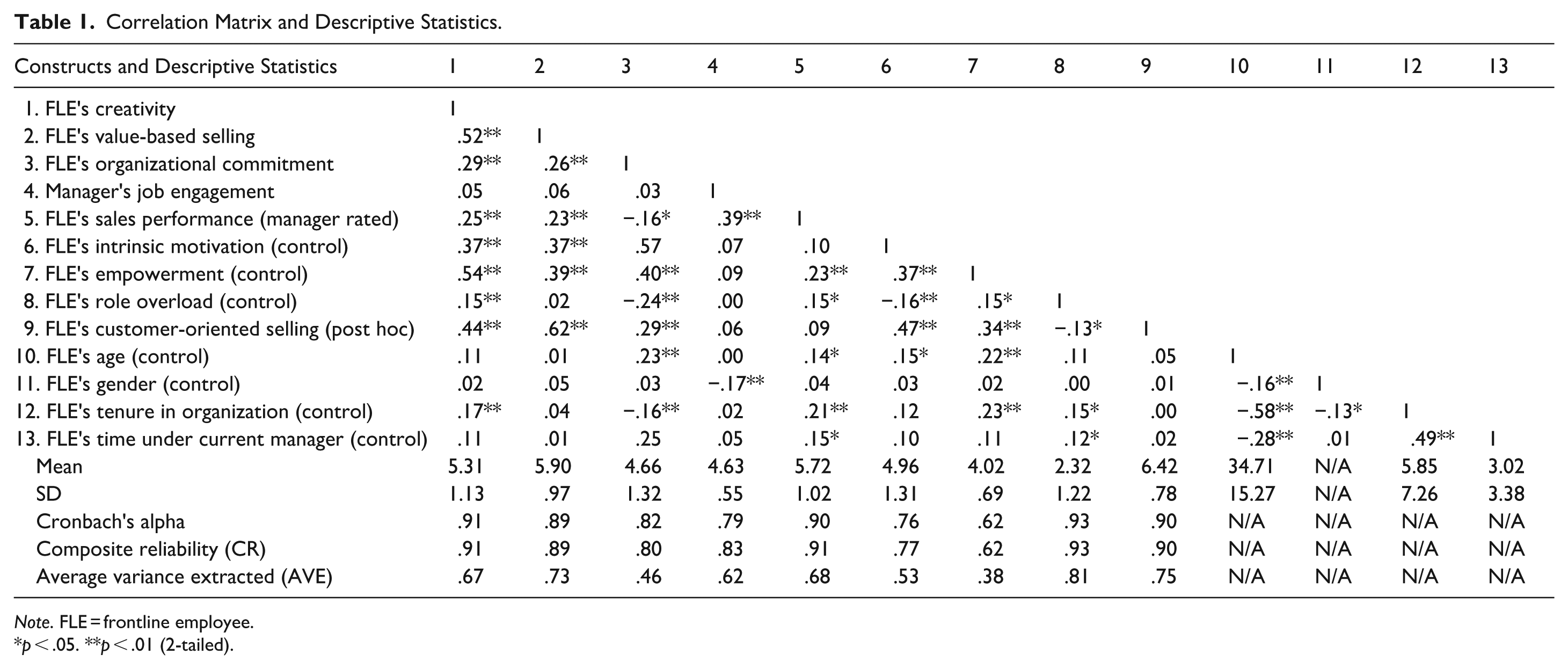
Note. FLE = frontline employee.
p < .05. **p < .01 (2-tailed).
Creativity (Level-1; Main Study and Preliminary Studies). We measured FLE creativity with the five-item scale adapted from Lussier et al. (2017) for the sales context. This scale captures employees’ propensity to generate novel, useful, and practical ideas in customer interactions. Example items include “I suggest new ways to achieve goals or objectives” and “I exhibit creativity on the job when given the opportunity to.”
Organizational Commitment (Level-1; Main Study only). We assessed FLEs' organizational commitment using the six-item affective commitment scale developed by Deconinck and Johnson (2009), which is grounded in the sales literature. This measure captures FLEs' emotional attachment to, identification with, and involvement in their organization. Example items include “I really feel as if this organization's problems are my own” and “I would be very happy to spend the rest of my career in this organization.”
Value-Based Selling (Level-1; Main Study and Preliminary Studies)
The FLE’s ability to articulate and deliver value in a sales context is measured using Ferdinand and Wahyuningsih’s (2018) three-item scale. Despite the prevalence of the scale developed by Terho et al. (2015) in the sales literature, Ferdinand and Wahyuningsih’s proposed scale is more suitable for our B2C perspective, as it can be used without modification. Example items are “I have the ability to articulate a product/service’s worth in time, effort, and money” and “I have the ability to make the customer feel they're getting their money’s worth.”
Managerial Job Engagement (Level-2; Main Study only)
Store managers' job engagement was measured using a three-item scale adapted from Rich et al. (2010), which captures managers' vigor, dedication, and absorption in their work. Example items include “I put in a lot of effort at work” and “I am focused on my work tasks.” As a Level-2 construct, managers' engagement scores were shared across all FLEs reporting to the same manager.
Sales Performance (Level-1; Main Study only)
FLE sales performance was assessed by store managers using a five-item scale adapted from Lussier et al. 2021 and Martin and Bush (2006). This managerial evaluation focuses on how employees meet objectives, exceed expectations, and generate customer satisfaction. Example items include “This person has a good overall sales performance” and “This salesperson reaches overall objectives.”
Control Variables
To reduce omitted variable bias and account for alternative explanations and heterogeneity, we included several theoretically relevant control variables. These include FLEs’ intrinsic motivation (Mallin et al. 2022), psychological empowerment (Martin and Bush 2006), and role overload (Bolino and Turnley 2005), all of which are associated with proactive work behaviors. As part of a post hoc test effort, we also controlled for an alternative selling behavior, i.e., customer-oriented selling (Mullins et al. 2020), which captures a different approach to tailoring sales behaviors based on situational demands or customer needs. Finally, we included demographic controls: FLE’s age, gender, tenure in the organization, and time under current manager. Unless otherwise specified, all control variables were included to isolate the unique effects of creativity on VBS and sales performance. The reliability and validity of all scales were assessed through confirmatory factor analysis (CFA). Table 1 presents the means, standard errors, psychometric statistics, and intercorrelations among all composite variables.
Analytical Approach
To test our cross-level hypotheses, we used linear mixed modeling (LMM), which is well-suited for hierarchically structured data in which FLEs (Level-1) are nested under a manager (Level-2; Aguinis et al. 2013). LMM enabled us to appropriately address the non-independence of observations and the partitioning of variance across levels. We specified random intercepts at the manager level to capture unobserved heterogeneity in baseline sales performance across store units. To assess whether random slopes were needed, we conducted likelihood ratio tests (LRTs) comparing models with and without random slopes for key predictors. These tests revealed no significant improvements in model fit, supporting the use of a random-intercepts-only structure. All models were estimated using a restricted maximum likelihood (REML) regressor. The relationships of our core model (see Figure 1) were tested using the following three main equations, which are organized according to their dependent variables.

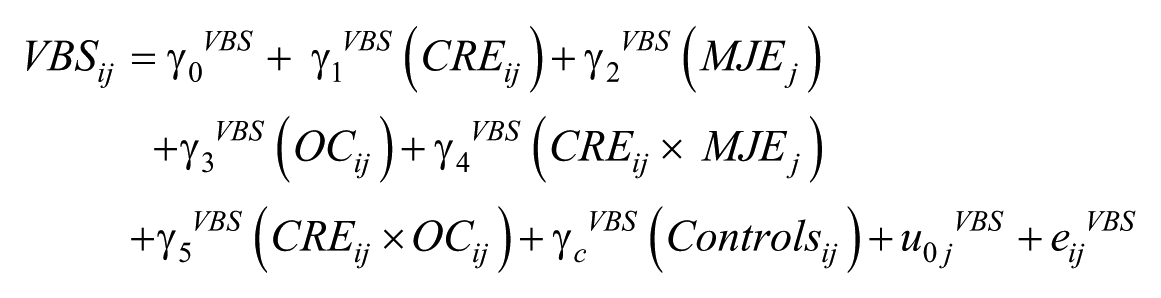

Here, VBSij is the value-based selling of FLE i under manager j, whereas SPij is the sales performance of FLE i under manager j. In equation (1), VBSij is modeled as a function of employee i’s creativity (CREij) and commitment (OCij) under manager j, in addition to manager j’s job engagement (MJEj) and a set of control variables (Controlsij), which includes employee i’s age, tenure, intrinsic motivation, psychological empowerment, role overload, and time under current manager j. Equation (2) is the same as equation (1), but including the following interaction terms: CREij × MJEj and CREij × OCij. In equation (3), SPij is modeled as a function of employee i’s value-based selling (VBSij) under management j and the same set of control variables (Controlsij). In the three equations, random intercepts u0j capture between-manager variation in the outcome, while eij denotes the residual variance at the employee level. All continuous variables, except for demographic control variables, were grand-mean standardized before analysis to facilitate interpretation and reduce multicollinearity in interaction terms.
Results
Main and Indirect Effects
Tables 2 and 3 present the main results associated with our three equations. Consistent with our predictions related to H1, in Model 1 (Table 2), FLE creativity significantly predicted VBS (b = .407, SE = .062, 95% CI [0.286, 0.529], p < .001), supporting the first stage of the proposed indirect effect. In turn, in Model 4 (Table 3), VBS significantly predicted manager-rated sales performance (b = .182, SE = .074, 95% CI [0.036, 0.329], p = .015), providing empirical support for the second stage of the indirect effect. We conducted an additional model in which creativity was added as an antecedent of sales performance after controlling for the mediator (VBS). We found that creativity did not have a significant effect on performance (b = .087, SE = .077, 95% CI [–0.065, 0.239], p = .261), as VBS remains significant (b = .154, SE = .077, 95% CI [0.004, 0.304], p = .045); these results suggest the presence of a full mediation.
Direct and Interaction Effects on VBS.
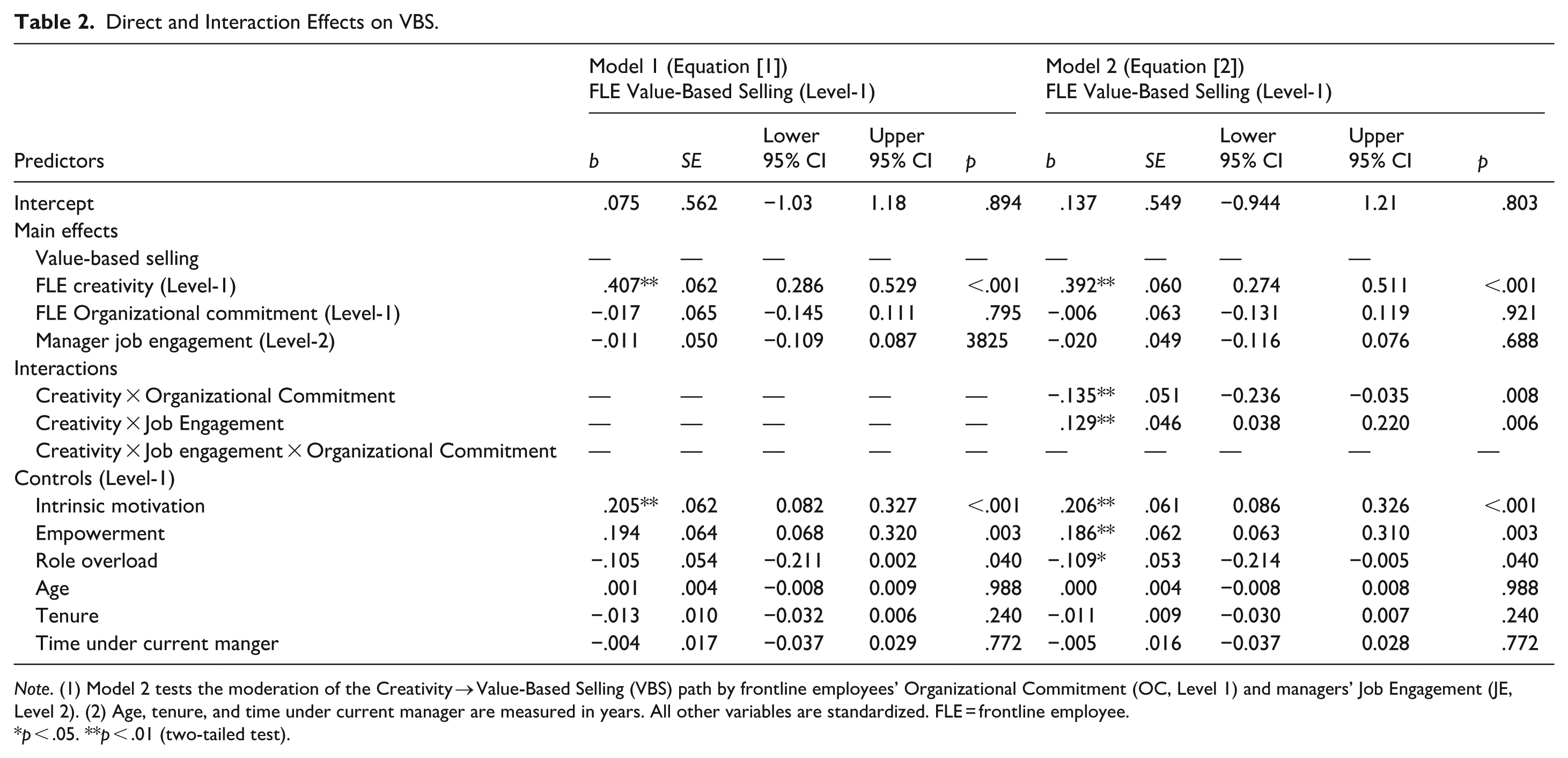
Note. (1) Model 2 tests the moderation of the Creativity → Value-Based Selling (VBS) path by frontline employees’ Organizational Commitment (OC, Level 1) and managers’ Job Engagement (JE, Level 2). (2) Age, tenure, and time under current manager are measured in years. All other variables are standardized. FLE = frontline employee.
p < .05. **p < .01 (two-tailed test).
Direct and Interaction Effects on VBS and Sales Performance.
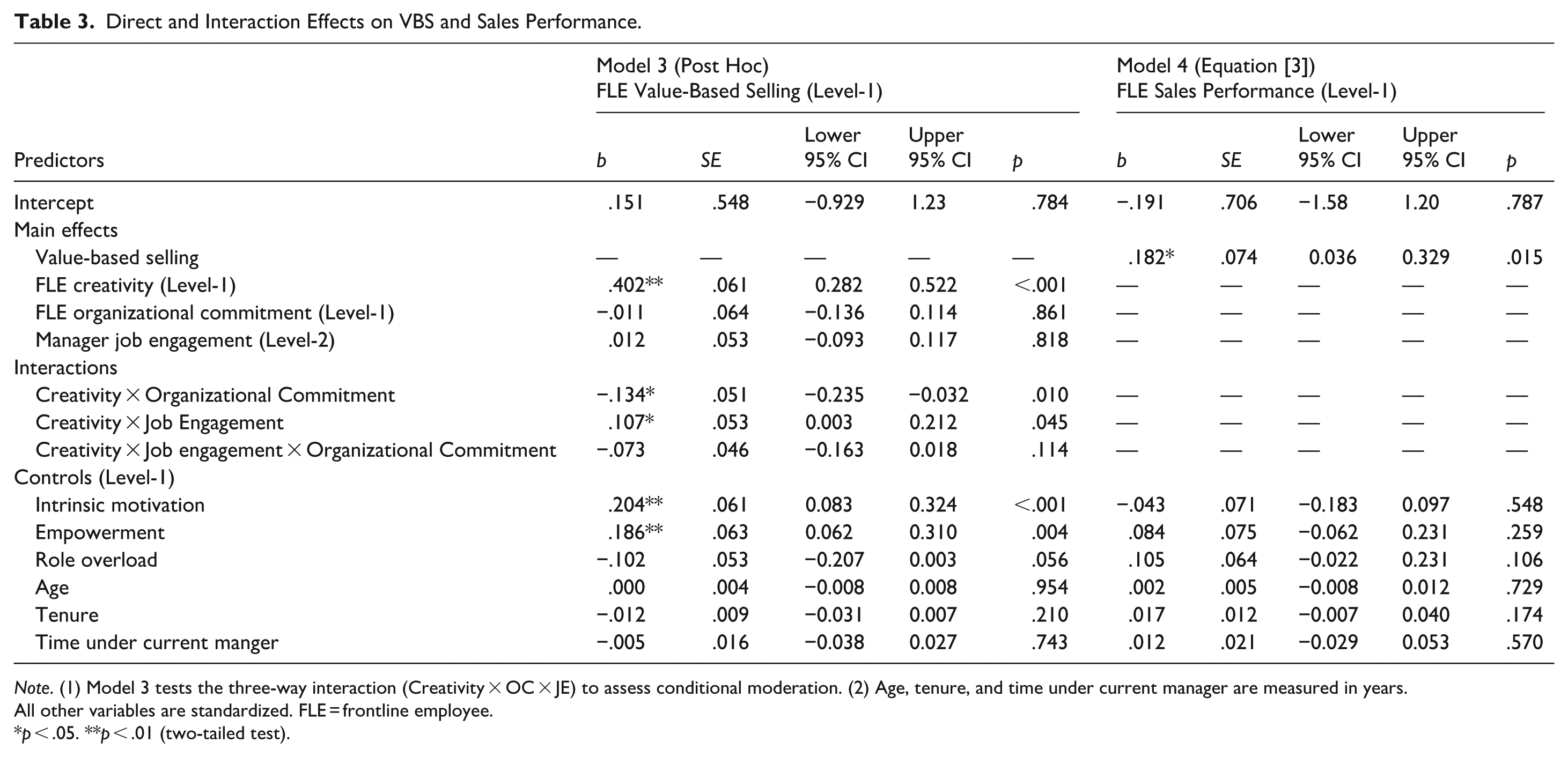
Note. (1) Model 3 tests the three-way interaction (Creativity × OC × JE) to assess conditional moderation. (2) Age, tenure, and time under current manager are measured in years.
All other variables are standardized. FLE = frontline employee.
p < .05. **p < .01 (two-tailed test).
To formally test the indirect effect (H1), we tested the significance of the indirect effects “creativity → VBS → sales performance” by conducting a Monte Carlo simulation with 5,000 iterations. The results confirmed a statistically significant indirect effect (95% CI [0.002, 0.129]; mean = .063, SD = .032), as the confidence interval excluded zero. These findings confirm that VBS fully mediates the relationship between creativity and sales performance. H1 is supported.
Interaction Effects
Table 2 presents the moderation results (Model 2), also estimated via LMM to account for cross-level interactions and manager-level clustering. Supporting H2a, the interaction between FLE creativity and manager job engagement (Level-2) was significant (b = .129, SE = .046, 95% CI [0.038, 0.220], p = .006). This suggests that the positive effect of creativity on VBS is stronger when managers are more engaged. Spotlight analysis confirmed this pattern (see Figure 2). When manager engagement is high (+1 SD), the slope of the creativity → VBS relationship is stronger (b = .364, SE = .062, p < .001) than when engagement is low (–1 SD; b = .193, SE = .076, p = .012).
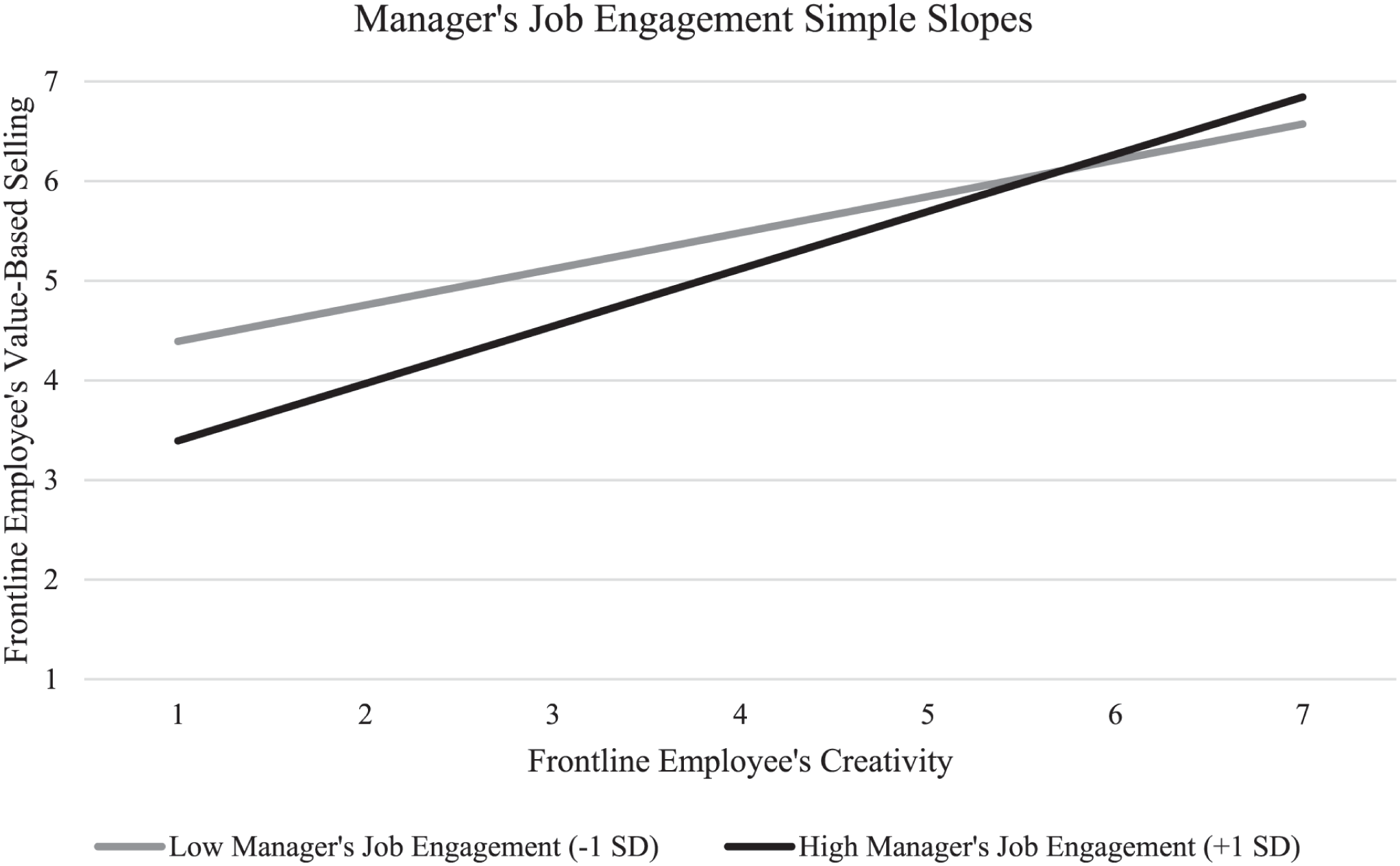
Manager job engagement interaction with creativity.
Supporting H2b, the interaction between FLE creativity and organizational commitment (Level-1) was negative and significant (b = –.135, SE = .051, 95% CI [–0.236, –0.035], p = .008). The creativity → VBS link was stronger at low commitment (–1 SD; b = .529, SE = .062, p < .001) than at high commitment (+1 SD; b = .309, SE = .067, p < .001; see Figure 3). Importantly, the creativity → VBS relationship remains positive and significant at both levels of commitment, indicating that the interaction reflects differences in the strength of creativity’s effect rather than its direction. As Figure 3 illustrates, when organizational commitment is high, FLEs sustain strong VBS behaviors regardless of their level of creativity. However, when organizational commitment is low, creativity becomes the differentiating factor. That is, highly creative FLEs achieve VBS levels comparable to their committed counterparts, whereas FLEs low in both creativity and commitment demonstrate the weakest VBS results. These findings suggest that organizational commitment is a significant boundary condition of creativity’s effect on VBS. H2a and H2b are supported.
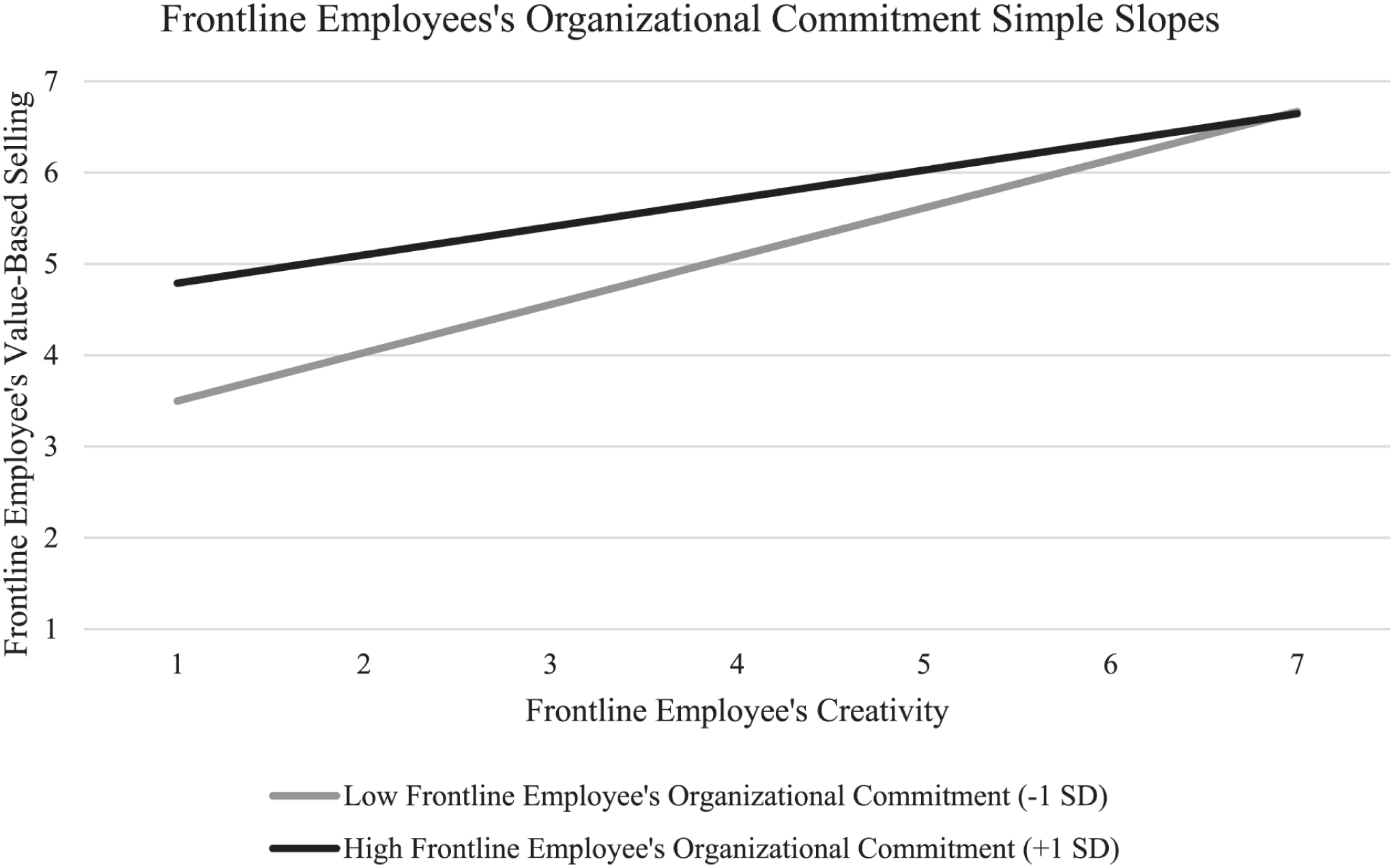
Organizational commitment interaction with creativity.
Endogeneity Checks
To assess and rule out potential endogeneity in the key predictors, FLE creativity, organizational commitment, and managerial job engagement, two complementary modeling strategies were employed. The first was the Gaussian copula approach (Park and Gupta 2012). The second was a control function strategy based on fixed-effects modeling at the manager level (Bliese et al. 2020). Because endogeneity may arise from unobserved team characteristics, selection bias, or reverse causality, and because no valid instruments were available in our data, these diagnostics offer suitable means of evaluating endogeneity.
The Gaussian copula method is specifically designed for observational data where instruments are not available. Its implementation requires that the focal predictors (a) are not Bernoulli-distributed and (b) deviate from normality. These assumptions were verified using Shapiro-Wilk tests for creativity (W = .964, p < .001), organizational commitment (W = .982, p < .01), and job engagement (W = .971, p < .01). Using empirical cumulative distribution functions (CDFs), each predictor was rank-transformed and converted via inverse normal transformation to yield copula terms. When factored into the model predicting VBS, none of the copula terms were statistically significant (Creativity: b = –.239, p = .416; Organizational Commitment: b = .109, p = .734; Job Engagement: b = .243, p = .332), indicating the absence of endogeneity bias.
In parallel, a control function approach was conducted using a fixed-effects model that leveraged the nested structure of the data. Residuals were first estimated from regressions predicting each focal predictor using available covariates. These residuals were then introduced into the main LMM as additional regressors. Because the fixed-effects structure controls for all manager-level unobserved heterogeneity, this strategy isolates the potential bias attributable to omitted variables at Level-2. Results indicated that none of the residual terms was significant (Creativity residual: b = –.007, p = .926; Organizational Commitment residual: b = –.135, p = .368; Job Engagement residual: b = .084, p = .406), and the main predictor effects remained stable. Together, the copula and control function diagnostics results, summarized in Table 4, converge in indicating that the focal predictors are unlikely to be endogenously determined. Detailed estimation results and diagnostics are reported in Supplemental Web Appendix D.
Endogeneity Assessment Results for Focal Predictors.
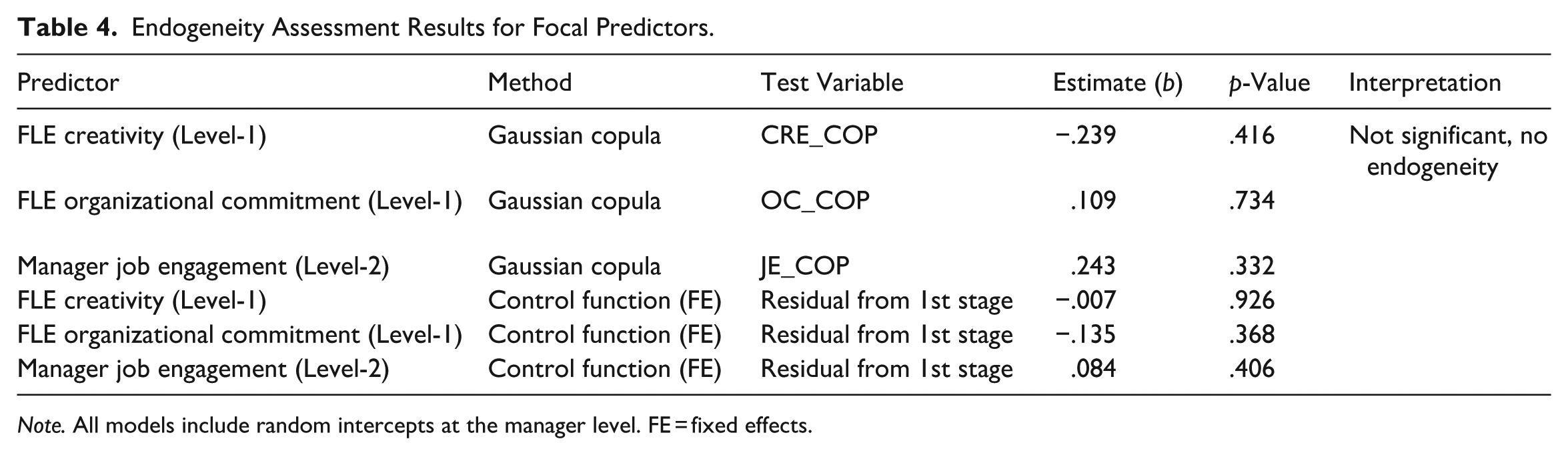
Note. All models include random intercepts at the manager level. FE = fixed effects.
Common Method Variance
Consistent with best-practice guidelines (Podsakoff et al. 2003), several procedural remedies were implemented to minimize the risk of common method bias, particularly for employee-level variables collected via self-report. First, a multi-source design was employed: FLEs self-assessed creativity, VBS, organizational commitment, and control variables; managers self-assessed their own job engagement and independently rated their employees’ sales performance. This separation of sources reduces common rater effects. Second, participants were assured of anonymity and confidentiality, reducing social desirability bias. Third, all constructs were measured using conceptually distinct and psychometrically validated scales adapted from prior research, minimizing item ambiguity and construct overlap. Finally, theoretically relevant control variables, including intrinsic motivation, psychological empowerment, and role overload, were included to account for alternative explanations and better isolate the effects of the focal predictors. All these procedural safeguards reduce the likelihood that the observed relationships are attributable to CMV.
Effects of Control Variables
All models included intrinsic motivation, empowerment, role overload, age, tenure, and time under the current manager as control variables, measured at Level-1. For models predicting VBS, intrinsic motivation (e.g., Model 2: b = .206, SE = .061, 95% CI [0.086, 0.326], p < .001) and empowerment (e.g., Model 2: b = .186, SE = .062, 95% CI [0.063, 0.310], p = .003) were significant positive predictors. Role overload was negatively associated with VBS (e.g., Model 2: b = –.109, SE = .053, 95% CI [−0.214, −0.005], p = .040). By contrast, age, tenure, and time under the current manager were not significant in any of the models predicting VBS. In the model predicting sales performance (Model 4, Table 3), no control variables were statistically significant. These values are reported in Tables 2 and 3.
Additional Analyses and Robustness Check
To further assess the robustness, theoretical soundness, and generalizability of our findings, we conducted a series of supplementary analyses. These tests evaluated (a) the influence of control variables, (b) the stability of interaction effects, and (c) the unique predictive validity of VBS relative to competing selling behaviors. First, we re-estimated all models without control variables. Notably, the direct effect of creativity on sales performance, controlling for VBS, became significant (b = .155, SE = .075, 95% CI [0.008, 0.303], p = .040). Meanwhile, the core mediation process remained intact: creativity continued to predict VBS (b = .554, SE = .052, 95% CI [0.452, 0.656], p < .001), and VBS predicted sales performance (b = .203, SE = .063, 95% CI [0.078, 0.327], p = .002). Monte Carlo simulations (5,000 iterations) confirmed a statistically significant indirect effect (mean = .113, SD = .037, 95% CI [0.042, 0.185]), reinforcing the robustness of H1 across model specifications.
Second, the moderation model held across both specifications. The interaction between creativity and organizational commitment remained significant (b = –.138, SE = .053, 95% CI [–0.242, –0.034], p = .010), as did the cross-level interaction between creativity and managerial job engagement (b = .131, SE = .048, 95% CI [0.037, 0.225], p = .007). We tested the three-way interaction “Creativity × Job Engagement × Organizational Commitment,” which did not achieve significance (b = –.076, SE = .046, 95% CI [–0.166, 0.014], p = .098). These findings provide additional evidence that the observed moderation effects are not artifacts of statistical control and are robust to model simplification.
Third, we examined the distinctiveness of VBS by introducing customer-oriented selling behavior (Mullins et al. 2020) as a competing predictor of sales performance. In this model, VBS remained a significant predictor (b = .241, SE = .083, 95% CI [0.077, 0.405], p = .004), while customer orientation was not (b = –.055, SE = .082, 95% CI [–0.216, 0.106], p = .502). This result supports the conceptual claim that VBS is a unique behavioral mechanism that more directly captures how employees translate creative ideas into sales performance (see Supplemental Web Appendix E).
General Discussion
Drawing on Amabile’s Componential Theory of Creativity (1996) and the MOA framework (Cadwallader et al. 2010; Elbaz et al. 2018; Maclnnis and Jaworski 1989), this study examines how FLE creativity enhances sales performance through VBS, and how contextual moderators shape this pathway. Leveraging a dyadic dataset that links FLEs to their store managers across thirty-three retail units, our multilevel design enabled us to capture cross-level interactions. First, we found that VBS fully mediates the relationship between creativity and performance, highlighting its role as the ability component and behavioral mechanism through which creativity is expressed. Second, the strength of the creativity—VBS linkage varied as a function of contextual factors, being amplified under high managerial job engagement and attenuated under high organizational commitment. Together, these findings indicate that creativity contributes to performance when it is expressed through VBS within favorable contexts.
Theoretical Contributions
This study offers several theoretical contributions to the service and sales literatures by leveraging the MOA framework to explain how FLE creativity drives sales performance in service settings. We contribute to three areas: (a) identifying VBS as the ability-based behavior through which creativity is enacted, (b) clarifying the opportunity-enabling role of managerial job engagement, and (c) highlighting the boundary condition posed by organizational commitment.
Value-Based Selling as an Ability-Based Translation Mechanism
Although FLE creativity has been recognized as a driver of adaptability, customer engagement, and service problem-solving (Agnihotri et al. 2014; Lussier et al. 2017), its direct contribution to performance remains theoretically under-specified. Guided by the MOA framework, we treat creativity as the motivational component and VBS as the corresponding ability component. Creativity reflects a motivational input that prompts employees to consider nonroutine options, whereas VBS reflects the ability to articulate and deliver customer-relevant value propositions. Our mediation findings confirm that VBS is the behavioral path through which creative motivation is expressed in customer interactions. This contributes to service theory by explaining how creativity becomes performance-relevant through an identifiable ability-based behavior. By applying VBS in B2C context, we extend its theoretical relevance and clarify its function as the ability through which creativity affects sales outcomes.
Managerial Job Engagement as an Opportunity Condition
Our second contribution concerns the contextual importance of managerial job engagement in conditioning when creative motivation becomes effective. While past work acknowledges that the social environment influences creativity (Amabile and Kramer 2011), service research has offered limited evidence about the moderation effect of manager-based variables. Here, our results indicate that managerial job engagement amplifies the relationship between FLE creativity and VBS, aligning with the opportunity component of the MOA framework (Siemsen et al. 2008). When managers are highly engaged, FLEs operate in an environment where support and feedback are more consistently available. These opportunity conditions increase the likelihood that creative motivation enhances VBS. This contribution extends service leadership literature by demonstrating how manager-level variables function as contextual cues amplifying the effects of creativity in service encounters. It also highlights the importance of dyadic, multilevel designs for identifying cross-level effects that may be overlooked in single-source models.
Organizational Commitment as a Boundary Condition
Our third contribution identifies organizational commitment as a boundary condition that shapes when and for whom creativity drives VBS the most. While commitment is generally associated with alignment and persistence (Jaramillo et al. 2005), our findings indicate that it attenuates the extent to which creativity translates into VBS behaviors. Specifically, highly committed employees may favor adherence to established procedures, which reduces the contribution of creativity to VBS. Of note, commitment does not directly reduce creative motivation, nor does it reduce VBS levels. Highly committed employees sustain strong VBS behaviors regardless of their creativity level. Rather, commitment defines the conditions under which creativity matters most. When organizational commitment is low, creativity emerges as a key differentiating factor. However, FLEs who are low in both creativity and organizational commitment demonstrate the weakest VBS results.
This result offers a more nuanced understanding of the interplay between organizational commitment and creativity in service settings. Organizational commitment remains a stabilizing force (Mathieu and Zajac 1990) that sustains VBS independently, yet it also delimits the conditions under which creativity exerts its strongest behavioral impact, as employees with high organizational commitment may comply with established procedures over experimentation (O’Reilly and Chatman 1986). Within our model, the moderation effect of organizational commitment attenuates the creativity-VBS link without reversing or eliminating it. By identifying this boundary condition, our research demonstrates that creativity’s contribution to VBS matters most when organizational commitment is low. Highly creative employees in this condition achieve VBS levels comparable to those of their highly committed counterparts, whereas employees low in both variables achieve the weakest results.
Managerial Implications
Our findings offer practical guidance for service organizations across various service sectors, including retail, where FLEs play a central role in shaping customer experiences. In such contexts, creativity is often expected to drive personalization, problem-solving, and value co-creation. However, our results suggest that creative potential alone does not guarantee performance. Its impact depends on how it is behaviorally expressed, the signals employees receive from managers, and the degree of flexibility allowed within the organizational context. We highlight three key areas where managers can intervene: equipping employees with VBS skills, sustaining managerial engagement, and redefining the meaning of commitment.
Make Creativity Work Through VBS
Creativity is often praised in frontline roles, but our findings clarify that it improves sales performance only when expressed through specific value-enhancing behaviors, namely VBS. Prior work has shown that creative employees are better at problem-solving and adapting to customer needs (Amabile 1996; Wilder et al. 2014), yet the behavioral mechanism linking creativity to performance has been underdeveloped. Our findings indicate that VBS facilitates this translation by enabling employees to diagnose customer needs, formulate relevant benefits, and communicate value clearly (Ferdinand and Wahyuningsih 2018; Terho et al. 2012).
For managers, this implies that creativity should not only be recruited and encouraged but also supported through systematic development of VBS behaviors. Training programs can integrate VBS role-play exercises with creativity-enhancing tools such as customer journey mapping, diagnostic inquiry, and storytelling. As prior research suggests, creativity can be nurtured through a supportive environment that emphasizes autonomy, task significance, and opportunities for idea implementation (Amabile and Kramer 2011). By pairing this environment with concrete behavioral training, firms increase the likelihood that creative potential translates into meaningful customer interactions, and, ultimately, sales performance.
Turn Managerial Engagement into an Opportunity Signal
Managerial job engagement strengthens the link between creativity and VBS, positioning it as a clear opportunity condition in the MOA framework (Siemsen et al. 2008). This aligns with research showing that frontline creativity is shaped not only by individual factors but also by the social context in which employees work, particularly leadership behaviors (Amabile and Kramer 2011; Zhou and George 2001). When managers are highly engaged in their role, meaning that they are cognitively, emotionally, and behaviorally invested in their supervisory responsibilities, they legitimize creative expression and signal that such behavior is valued and safe. This insight has important implications for service leadership. Managers should not only oversee performance but also shape day-to-day conditions through their attention, involvement, and support. Organizations can develop managers' job engagement by fostering managerial autonomy, clarifying expectations, encouraging developmental support, and recognition (Rich et al. 2010). Training programs can also help managers understand how their own behaviors, feedback patterns, and emotional tone contribute to the psychological conditions that enable or inhibit the effect of FLE creativity. Therefore, we emphasize the amplifying role of managerial job engagement and suggest that leadership development may be more impactful than efforts to increase employee loyalty alone.
Redefine Commitment to Support Flexibility
Organizational commitment has traditionally been viewed as a positive force that strengthens effort, persistence, and alignment with organizational goals (Jaramillo et al. 2005). However, our findings add nuance to this view by clarifying when creativity matters most. Highly committed FLEs sustain strong VBS behaviors and serve as a reliable foundation for performance. Yet for FLEs with lower organizational commitment, creativity becomes a key factor enhancing VBS. Highly creative employees in this group achieve VBS levels comparable to those of their highly committed counterparts, whereas employees low in both creativity and commitment achieve the weakest results. This suggests that investments in developing and stimulating creativity yield their greatest returns among less committed employees, where creativity serves as a strong driver of value-based selling. Rather than viewing organizational commitment and creativity as opposing forces, managers should recognize them as complementary. Organizational commitment provides a stable performance floor, while creativity elevates performance, most steeply when that floor is lower.
Reframing creativity’s contribution as aligned with shared organizational success and recognizing employees who explore new approaches can help cultivate a culture where commitment and creativity reinforce one another. This insight is particularly relevant for service-oriented retailers, which typically face high turnover rates and relatively short employee tenures. In such contexts, strong organizational commitment may take considerable time to develop, if it develops at all, making creativity an especially critical performance driver for a large portion of the workforce. Managers in these environments should therefore prioritize identifying and cultivating creative talent, recognizing that for many of their FLEs, creativity may be the primary pathway to VBS.
Limitations and Future Research Directions
While this research provides important insights into the impact of frontline creativity, several limitations offer opportunities for future research. First, our data are cross-sectional, which limits our ability to make causal inferences about the relationships among creativity, VBS, and sales performance. Creativity, job engagement, and VBS may fluctuate according to work demands, feedback, or emotional states. Longitudinal methods could capture how these variables evolve over time and how creativity is sustained, depleted, or redirected in frontline settings (Amabile and Kramer 2011). For example, future research could examine how creativity fluctuates across high- and low-season periods or how earlier customer interactions shape subsequent VBS behaviors. Moreover, we recognize that while the creativity construct was grounded in established theory and validated measures, its face validity may remain open to interpretation in frontline selling contexts. Future studies should further refine the conceptual boundaries of creativity in service work to ensure that item wording fully captures its domain-specific meaning.
Second, the role of creativity, organizational commitment, and managerial job engagement may vary across cultural contexts. In high power-distance, collectivist, or strongly hierarchical environments, employees may experience different constraints or opportunities for creative enactment. Replicating this model in non-Western settings could clarify how cultural norms shape the translation of creative motivation into VBS, strengthening the boundary conditions of our conceptual framework.
Third, the arts-and-craft retail context may attract employees with stronger creative predispositions, potentially amplifying the effect of creativity on downstream outcomes. Moreover, the moderating role of organizational commitment observed here may itself be context dependent. In settings where creativity is deeply embedded in organizational culture, such as creative agencies or technology firms, commitment may reinforce rather than attenuate the creativity-VBS relationship. Future research should examine whether the boundary condition identified here generalizes across organizational contexts or remains specific to settings where creativity is valued but not institutionalized.
Fourth, our study focused on the positive outcomes of creativity without fully considering its potential costs. While creativity is typically linked to innovation and adaptability, it may also lead to role conflict, tension with supervisors, or resource depletion (Zhou and George 2001). In high-pressure frontline roles, employees who innovate may face conflicting demands, peer resistance, or ambiguity around performance expectations. Future research should explore the potential downsides of creativity, including its impact on emotional and physical exhaustion, perceived fairness, and team cohesion. Such work would help delineate when and for whom creativity becomes a double-edged sword.
Fifth, although our model highlights key interpersonal and contextual drivers of how creativity translates into VBS and sales performance, the study does not incorporate direct measures of customer outcomes. This is an important limitation in service research, where customer perceptions often determine whether creative behaviors genuinely translate into improved experiences or stronger relationships. Variables such as customer satisfaction, perceived value, trust, or intention to return may meaningfully impact, amplify, or even attenuate the effects identified in our model. This represents a natural extension of our work and an opportunity to examine how creativity affects not only managerial evaluations of performance but also customer-level outcomes.
Conclusion
This research clarifies how FLE creativity affects sales performance when it is expressed through VBS, a customer-centric behavioral mechanism. We demonstrate that this motivational pathway is strengthened under conditions of high managerial job engagement and that its impact is contingent on organizational commitment. When organizational commitment is high, FLEs sustain strong VBS behaviors regardless of creativity level. When organizational commitment is low, creativity becomes the key differentiating factor driving VBS. We highlight the importance of aligning motivational inputs with contextual conditions that enable the behavioral expression of creativity. These findings provide a more nuanced account of how creativity operates in frontline service roles and underscore the importance of managerial environments and organizational norms that support, rather than restrict, the enactment of creative potential.
Supplemental Material
sj-pdf-1-jsr-10.1177_10946705261449615 – Supplemental material for Frontline Employee Creativity and Sales Performance: A Multilevel and Dyadic Investigation
Supplemental material, sj-pdf-1-jsr-10.1177_10946705261449615 for Frontline Employee Creativity and Sales Performance: A Multilevel and Dyadic Investigation by Simon Boissonneault, Yany Grégoire, Bruno Lussier and Christian Vandenberghe in Journal of Service Research
Footnotes
Acknowledgements
The authors thank Le panel d’expérience globale and the Omer DeSerres Chair of Retailing at HEC Montréal for their support and access to data. We also acknowledge the Sales Institute HEC Montréal for making this research possible. We are grateful to the managers and employees who participated in the study.

Funding
The authors received no financial support for the research, authorship, and/or publication of this article.
Declaration of Conflicting Interests
The authors declared no potential conflicts of interest with respect to the research, authorship, and/or publication of this article.
Supplemental Material
Supplemental material for this article is available online.
Author Biographies
References
Supplementary Material
Please find the following supplemental material available below.
For Open Access articles published under a Creative Commons License, all supplemental material carries the same license as the article it is associated with.
For non-Open Access articles published, all supplemental material carries a non-exclusive license, and permission requests for re-use of supplemental material or any part of supplemental material shall be sent directly to the copyright owner as specified in the copyright notice associated with the article.
