



Abstract
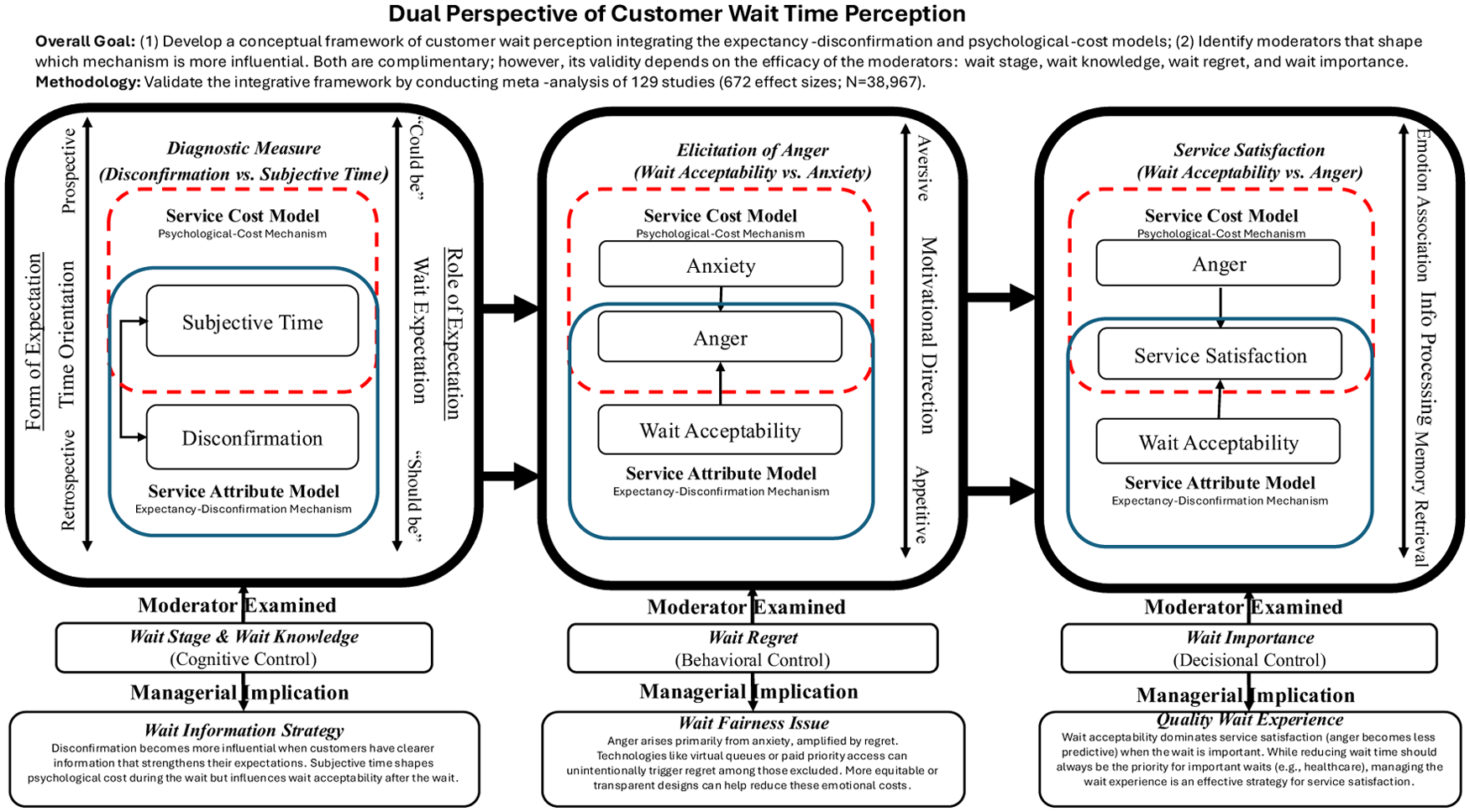
Past studies on service waits have primarily applied two theoretical perspectives—the expectancy–disconfirmation model and the psychological‑cost model—leading to conflicting explanations of how customers react to waits. To reconcile these perspectives, we propose a conceptual framework that integrates the dual perspectives of customer wait perceptions and identify four key moderators that shape which mechanism becomes more influential: wait stage, wait knowledge, wait regret, and wait importance. We validate our conceptual framework through a structural‑equation‑modeling meta‑analysis of 129 studies from 103 articles (672 effect sizes; N = 38,967). Our conceptual integration highlights a coherent system of interdependent mechanisms that shape how customers experience, evaluate, and emotionally respond to waiting. Its validity, however, depends on the efficacy of the moderators. During the wait, subjective time primarily drives psychological cost, heightening anxiety and anger—especially when regret is present. After the wait, subjective time instead shapes how acceptable the wait feels. Disconfirmation becomes more influential when customers have clearer information that strengthens their expectations. When the wait is important, wait acceptability becomes the dominant predictor of service satisfaction. These findings underscore the need to balance strategies that reduce psychological cost and manage expectations, particularly as technology transforms waiting experiences.
Keywords
Get full access to this article
View all access options for this article.
References
Supplementary Material
Please find the following supplemental material available below.
For Open Access articles published under a Creative Commons License, all supplemental material carries the same license as the article it is associated with.
For non-Open Access articles published, all supplemental material carries a non-exclusive license, and permission requests for re-use of supplemental material or any part of supplemental material shall be sent directly to the copyright owner as specified in the copyright notice associated with the article.
