




Abstract

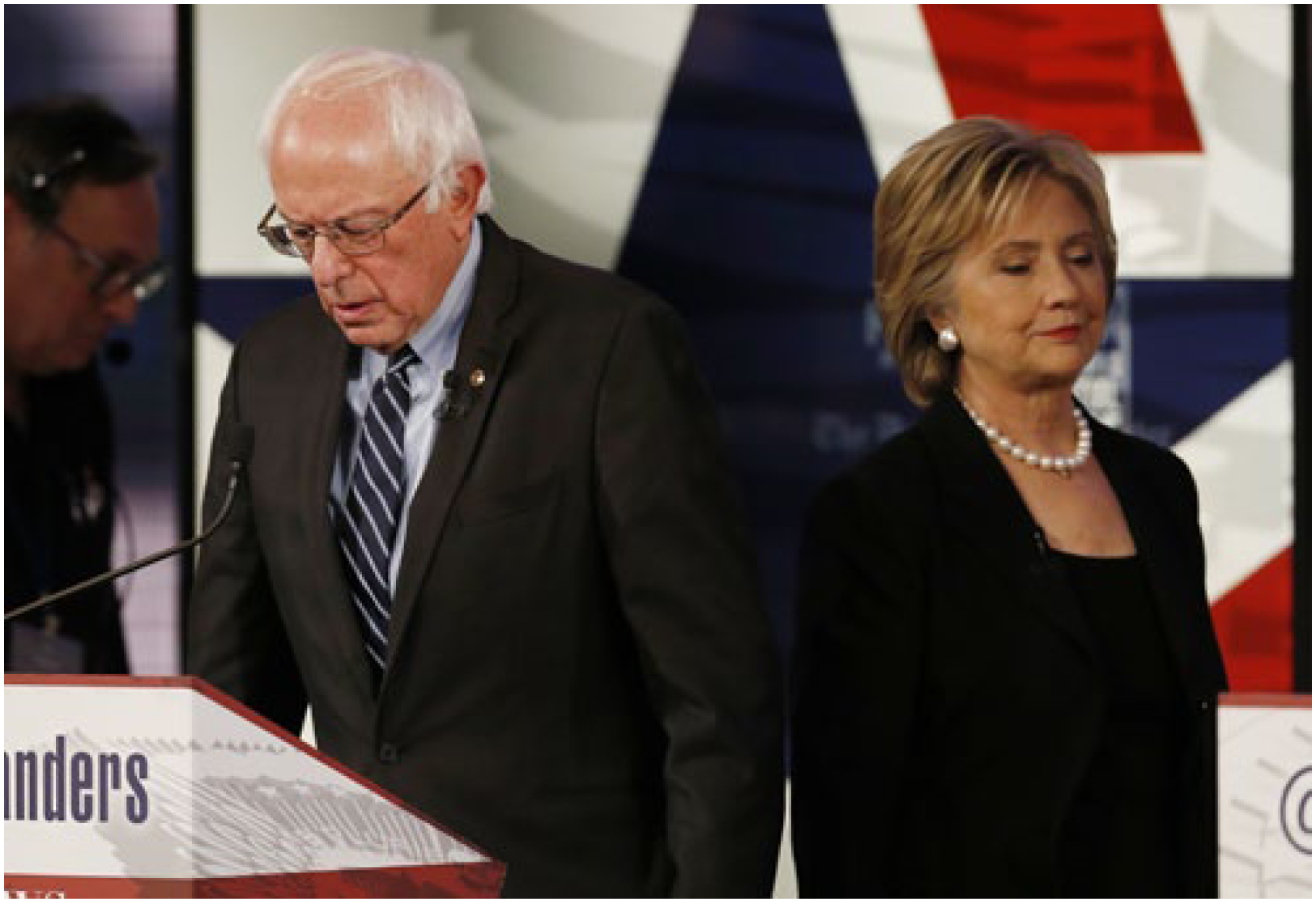
Democratic U.S. presidential candidate and former Secretary of State Hillary Clinton walks past fellow candidate and Senator Bernie Sanders during a break at the second official 2016 U.S. Democratic presidential candidates’ debate in Des Moines, Iowa, November 14, 2015.
REUTERS/Jim Young
When Bernie Sanders announced his candidacy for president, his assertion that he was in this to win seemed like maybe the kind of statement a candidate feels he has to make. If you followed this sort of thing, a more modest and reasonable hope seemed to be that he would at least fare better than Dennis Kucinich, the last candidate of the left to attempt a significant run, in 2004 and 2008. The left-minded community hoped that Sanders, as a U.S senator, self-identified socialist, and the longest-serving member of Congress could at least draw some serious attention and maybe approach the success level of the Jesse Jackson campaigns of 1984 or 1988. All this changed in a hurry, however, as it quite quickly became clear that Sanders might really be in this thing. There were apparently far more people out there who were ready to pick up their pitchforks and march on the castle than most people had realized.
Seemingly in no time, long before it was clear whether he would actually achieve vote levels on the level of Jackson’s, Sanders had become not only a plausible alternative to the widely favored establishment candidate for the Democratic nomination, Hillary Clinton, but the only plausible one. This was a status that Jackson never had. In fact, no presidential candidate of the left had been in this kind of position since George McGovern won the nomination in 1972.
So how did this happen? The answer has at least three parts: The nation was ready. The right candidate stepped forward. And he made the right step.
The Great Recession and Occupy
As the movie The Big Short has so cleverly reminded us, on the eve of the Great Recession of 2008, virtually the entire political and economic establishment was unaware of what was about to come. What happened was unexpected and would set the stage for other surprises. On October 3, 2008, with the illusion that the American economy had entered a new era of permanent prosperity interred once again, President George W. Bush signed into law the bill creating the Troubled Asset Relief Program (TARP), a $700 billion fund to purchase failing bank assets. The relative success or failure of the program, as well as its true cost, may be debated for years. But the public’s reaction was clear. One economist called it “one of the most hated, misunderstood, and effective policies in modern economic history.” 1 In the view on the street, it was the little people who lost their houses in all this, while the bankers got bailed out.
But business went on as usual, which was, after all, the point of the government package. That was until September 2011, when the first Occupy Wall Street protests occurred. The idea for the protests originated with the little-known Canadian magazine, Adbusters, but it spread like no one imagined. The movement, which physically occupied Zuccotti Park in lower Manhattan, was rapidly replicated across the nation and the world. Like the financial crisis three years earlier, no one saw it coming. Faintly reminiscent of the Arab Spring the previous year, its spontaneity and decentralized nature brought to mind the rebellious events of France in 1968, for those with memories long enough. Occupy events occurred in perhaps six hundred separate American cities and towns (and on every other continent but Antarctica). An estimated 6,705 were arrested. 2 In the opinion of social critic Noam Chomsky, it constituted “the first major public response . . . to about thirty years of a really bitter class war that has led to social, economic, and political arrangements in which the system of democracy has been shredded.” 3
And it famously had no program or demands, which is precisely what allowed it to spread so freely. If you were unhappy with the powers that be and the way things were, you supported Occupy. And then it went away. But it did leave behind a concept that stuck—the 99 percent and the one percent. The 99 percent—we—were largely powerless, as the top one percent rigged the game in its favor and would continue to do so until the 99 percent came to understand how things really were.
The one percent? Statistically, they are the owners of 35 percent of the nation’s wealth and 42 percent of its financial wealth, which is to say wealth over and beyond the value of people’s homes. 4 These figures had been creeping up, but the accumulation of wealth is a slow process. Income, however, can change much more rapidly. In 1979, the one percent had earned 9.9 percent of all income in the United States. By 2007, that figure was 23.5 percent, the most since the all-time high of 23.9 percent was reached in 1928, on the eve of the Great Depression. 5 (The latest available figures from 2012 put the highest earners at 22.5 percent.) The precise numbers were never the issue, of course. It was the idea that after nearly eighty years, the sum total of all efforts toward equalization was virtually nothing. It had been a long time since Americans thought of the nation’s inequality in such stark terms. 6
The Mood
On April 30, 2015, Bernie Sanders announced his intention to seek the Democratic nomination. On May 4, Gallup reported that “63 percent of Americans . . . say that money and wealth should be more evenly distributed among a larger percentage of the people.” The polling company also noted, though, that “Despite the growing focus on inequality in recent years,” this was actually “almost the same as the 60 percent who said this in 1984.” But the fact most pertinent to the prospects of the Sanders campaign for making something of this long simmering discontent was that
Americans’ views on how money and wealth should be distributed in the country are strongly correlated with their partisanship and ideology. Agreement ranges from 86 percent among Democrats and 85 percent among liberals, down to 34 percent and 42 percent among Republicans and conservatives, respectively. (Independents were at 61 percent.)
7
On June 3, the New York Times reported the results of a joint Times/CBS poll that described a Democratic constituency that captured the crux of Sanders’ supporters. Sixty-seven percent of Americans thought the gap between the rich and the poor in the United States was getting larger; 74 percent of Democrats believed this. Sixty-five percent of Americans thought this gap was a problem that needed to be addressed now; 83 percent of Democrats thought so. Fifty-seven percent thought the government should do more to reduce that gap; 81 percent of Democrats thought that. Sixty-eight percent favored raising taxes for people earning more than $1 million per year; 87 percent of Democrats said so. Seventy-four percent thought large corporations have too much influence on American life and politics today, including 84 percent of Democrats. 8
The potential Sanders vote in the caucuses and primaries was there for all to see. And it appeared to run deep. In September 2015, YouGov, a company with connections to the British Conservative Party, conducted a seven-nation opinion poll on “What the world thinks of capitalism.” Perhaps surprisingly, no other country exceeded the 37-30 percent margin by which Americans rejected the statement “What is good for business is usually good for the rest of society.” Corporate America appeared to have lost the country’s heart. Americans also agreed by a 65-10 percent margin that “Most of the biggest businesses in the world have dodged taxes, damaged the environment, or bought special favours from politicians” (although on this one the other nations thought so even more strongly). 9
And if you needed one more signal that people were looking for something different, there is the fact that on May 18, 2014, French economist Thomas Piketty’s Capital in the Twenty-First Century, a study of wealth and income inequality in Europe and the United States since the eighteenth century, reached the top of the New York Times hardcover non-fiction bestseller list. 10
The Man
The fact that Bernie Sanders actually told people what he really thought, specifically that he called himself a socialist, was long considered a limiting factor in his career. Yet it was clearly the widespread perception of his genuineness that thrust him to the fore in the presidential race. Having served in office for so long and having actually administered a municipal government, Sanders has inevitably disappointed a few people and changed a position here and there. Nevertheless, to a degree quite rare in politics, if you wondered why Bernie Sanders was saying the things he said on the campaign trail, there was a simple answer: It was because he believed them to be true and had, in most cases, believed them to be true for some time. Any further questions? And he really did not take corporate money. Likewise, the no-frippery, let-us-get-to-the-issues style that might border on the gruff also seemed to work surprisingly well in the presidential arena this time around. With Hillary Clinton having had her ducks lined up as the Democratic Party establishment candidate like no non-incumbent that anyone can remember, there was little room to challenge her for any other candidate also attempting to stand with the 99 percent on one foot and with the one percent on the other. You knew where Bernie Sanders stood—on both feet.
Being the longest-serving independent in congressional history is, of course, a story in itself. Among other things, it means that if there is one thing Bernie Sanders knows, it is campaigning. Starting in 1971, he ran four statewide races as the Vermont Liberty Union Party candidate, his highest share of votes received was 6 percent. But in 1981, running as an independent, he was elected mayor of Burlington, the state’s largest city, by ten votes. During the third of his four terms in that office, he ran for governor, finishing a distant third to a sitting liberal Democrat. During his last term, he ran for the state’s single seat in the U.S. House of Representatives, losing that as well but only by three points, with a vote total double that of the Democratic candidate. In 1990, he won the seat, becoming Congress’ first independent in forty years; the Democrat got only 3 percent. From then on, Vermont Democrats never seriously contested his candidacies. In 2006, he was elected to the Senate. If you have not been counting, the presidential race is his twenty-first. So if you’re looking for an experienced candidate, Sanders is your man.
Back when nobody else was taking this idea of a Sanders presidential run too seriously, Sanders was. On December 10, 2010, he conducted an old fashioned, actual—not just threatened—eight-and-a-half-hour filibuster speech against upper-income tax cuts. A Guardian article of the day predicted that “it’ll be enough to make Sanders a hero to the left” and start “‘Bernie for President’ talk.” 11 But, as he remained largely an oddity to the mainstream, corporate-run media, when people started turning up in great numbers at his rallies and supporting him with unprecedented numbers of small campaign contributions, the nation was shocked—just as it had been by the financial crisis and the burgeoning of Occupy.
How could a self-described socialist get this far? Well, there had been some changes in thinking on that front too, and like the growth of the wealth and power gap, and the public’s increased unhappiness about it, this change had not come in secret either. A May 6-8, 2015 YouGov poll found that 43 percent of Democrats favorably inclined toward socialism, compared with only 29 percent unfavorable. In this poll, socialism actually fared better than capitalism. The pollsters asked for agreement or disagreement on three statements related to the topic. They found that 41 percent of all Americans agreed with Dr. Martin Luther King that “All life is interrelated, and all men are interdependent.” Thirty-four percent agreed with Mikhail Gorbachev that “Jesus was the first socialist, the first to seek a better life for mankind.” Coming in last, at 31 percent, was Winston Churchill’s statement that “socialism is the philosophy of failure, the creed of ignorance and the gospel of envy.” 12
The headline for a June 22, 2015 Gallup poll, “In U.S., Socialist Presidential Candidates Least Appealing,” seemed to contradict those results. But an actual reading of the results might suggest a different take. The real news here may have been the fact that Gallup actually decided to pose the question of whether Americans would vote for a socialist for president. The company first asked voters whether they would consider voting for a Catholic, Jew, or woman in 1937. Black candidates were added in 1958 and gay or lesbian in 1978, but this was the first time socialist ever made it into a Gallup presidential poll. Fifty percent said they would not support one; 47 percent said they would. Not bad for the first time out for a label about which mainstream media rarely, if ever, had anything good to say. A January 7-10, 2016 Bloomberg Politics/Des Moines Register Iowa Poll found 43 percent of the state’s likely Democratic caucus attendees identifying themselves as socialist, compared with only 38 percent who saw themselves as capitalist. 13
You may recall that Republican presidential candidate Mitt Romney told what he thought was a private audience that “there are 47 percent” who would be against him because they “are dependent upon government . . . believe that they are victims . . . believe the government has a responsibility to care for them . . . believe that they are entitled to health care, to food, to housing, to you-name-it.” Possibly, these are the same 47 percent who would vote for the socialist. (And obviously not the 47 percent who actually wound up voting for Romney.) In any case, the makeup of those already willing to vote for a socialist actually did augur well for the Sanders campaign’s potential growth, as it included 59 percent of Democrats and 69 percent of those below age thirty. 14 By September 8, 2015, even the Voice of America, the official broadcast institution of the U.S. government, had run an article titled “Bernie Sanders’ Surge Reflects U.S. Shift on Socialism.” 15
The Method: On to the Democratic Primaries
For those who did not have their ears to the ground on this, the Sanders decision to enter the race for the Democratic nomination might have come as a substantial surprise. There was, after all, the fact that the famously independent Sanders had built his reputation and career on not being a Democrat, just as much as on being a socialist. But those listening to what Sanders was saying in his speeches leading up to his announcement may have been less surprised. At those events, he would ask audiences which route, third party or primary, he should take should he actually decide to make a presidential run. But if pressed about his own inclinations, he would brusquely assure his audiences that he was not going to repeat the situation Nader had gotten into in 2000. By process of elimination, he was saying that he would enter the Democratic Party fray (precisely the route the Progressive Democrats of America had publicly campaigned for him to take over the course of the prior year).
What Sanders recognized was that although there were a few third-party die-hards who took Dennis Kucinich’s lack of success as further proof that nothing was really possible within the Democratic Party, the third-party option had never recovered from the perception that Nader’s run had enabled George W. Bush’s election in 2000. The merits of that contention have been debated ever since. But the 2004 drop in Nader’s vote share from 2.7 percent to 0.4 percent, while the Green Party separately avoided any type of campaign activity that might be seen as inadvertently aiding a Republican presidential candidate, suggested that third-party presidential candidacies would for now only be accorded symbolic value. Nader has run again, getting 0.6 percent in 2008, and the Green Party has as well, but no third-party presidential campaign of the left has emerged as a serious factor since. And Sanders, who had made it all the way to the U.S. Senate as an independent, concluded that he could not make a White House run via that route.
Whatever else one might argue about the 2000 Nader campaign, it was hard to call it a success. In building nothing lasting, while being blamed for Bush’s victory, things could hardly have turned out worse. Yes, it was true that some of the Democratic Party establishment was crying crocodile tears, in that it was the Clinton administration that illegally shut down websites attempting to match up Nader and Gore voters for interstate swaps, to avoid a Bush Electoral College victory. 16 But that mattered little to voters subsequently assessing the viability of the third-party strategy. For just as people in the legal and political world often fall from grace not because of actual conflict of interest but because of the appearance of conflict of interest, the simple appearance of a third-party presidential campaign in the mix of factors that elected Bush has seemingly iced the prospects of such campaigns for the foreseeable future. 17
To put the 2000 Nader campaign in perspective, had he succeeded in reaching the hoped for five-percent level, it would have been only the third time since the beginning of the twentieth century that a third-party candidate of the left had done so. Republican senator Robert La Follette had done it with a 16 percent share in 1924 running under the Progressive Party label revived as a vehicle for his candidacy. The only time a candidate of an actual pre-existing party of the left did it was when Eugene Debs got six percent in 1912. At that point, it really did look as if the system might be on the verge of big change: former Republican president Teddy Roosevelt’s challenge (the first use of the Progressive label) sent sitting Republican president William Taft to the party’s first third-place finish, and Debs’ showing produced the first election with four presidential candidates receiving better than five percent of the vote. But neither of these outcomes would be repeated in the course of the next hundred years.
Whether Sanders’ decision to opt for the primaries will permanently settle the question of the right route for the left to the White House remains to be seen, but it has obviously proven extremely successful in channeling the energy of large numbers of people who do not want a corporate Democrat but also do not want to risk something that might bring us an even-more-corporate Republican. There seems little doubt that a substantial factor in Clinton’s early support vis-à-vis Sanders was the belief that she would be the stronger candidate in the final chapter. But action will trump theory every time, and it turns out that this conventional wisdom may not be so, as polls have begun to show the opposite, the Sanders edge apparently deriving from the fact that he is an independent. 18
Likewise with another pillar of her early lead among the Democratic Party’s traditional core constituencies such as youth, women, African-Americans, and Latinos: the fact is that, whatever their shortcomings, the Clinton White House years, sandwiched as they were between twelve years of Reagan and Bush I and eight years of Bush II, represented a relatively hopeful era for many of the Democratic Party’s traditional constituencies, and Hillary Clinton was obviously in the thick of it. Yet even as her campaign has trumpeted her early polling advantages among these groups as evidence of her superior fitness to govern, her leads have been fading as the Sanders message of wresting power from corporate control has spread to the sectors that stand to gain the most from it.
And in any case, no one accuses Sanders of being a Republican enabler, and he has gone out of his way not to be seen as spoiling Clinton’s chances against a Republican, should she win the nomination. There have been some complaints that the Sanders campaign is failing to build “the movement” as it goes, but this comes largely from individuals without campaign experience who fail to understand that supporters and voters rightfully expect total focus on the task at hand. As Sanders tells John Nichols in the afterword to the reissue of his autobiography, Outsider in the House, when he speaks to the need for a “political revolution,” as he campaigns:
What I am referring to is the need to do more than just win the next election. It’s about creating a situation where we are involving millions of people in the process who are not now involved . . . It’s about helping to educate people, organize people. If we can do that, we can change the dynamic of politics for years and years to come.
19
Post Super-Tuesday Postscript
The defining moment of the Bernie Sanders campaign may prove to have been the day before Super Tuesday, when supporters were asked to give $4 million to reach $40 million for the month and responded with $6 million. They did so with full knowledge that Hillary Clinton would likely sweep six Southern states with huge margins the next day, which would occasion a renewed call from the Clinton campaign, establishment opinionators, and the mainstream media for Sanders people to accept the inevitability of the candidate that Democratic Party leaders had chosen.
After Super Tuesday, Sanders trailed 576-386 in elected delegates (Clinton’s widely reported larger lead coming from super delegates who have the option to reconsider their votes should Sanders overtake her in the popular vote). An uphill fight, but then Sanders supporters always understood that. They knew how far they had come—within 1.4 percent in Massachusetts, for instance, where Clinton beat Barack Obama by fifteen points in 2008 and where Sanders had trailed by thirty-four points in polling last fall. Of the eight contests in states that actually went Democratic in the last two elections, Sanders had won four and come within six points in three others; Clinton came no closer than 18 percent in Sanders’ blue-state victories.
Outreach to African-Americans continues to pose a particular problem—at least in the South—a source of great soul searching within the campaign. But at the core lay a great strength—voters actually agreed with Sanders. A WBZ/UMass Amherst poll that showed Clinton ahead 47-44 percent also found a 64-25 percent majority thinking that Sanders “best represents my views on the issues.” But voters thought Clinton had the “best chance to win in November” (despite numerous polls showing the opposite) and “the right experience.” For Bernie Sanders, the challenge now is to convince the electorate that becoming the financial darling of the health care industry, voting for the Iraq War, promoting “regime change” in Libya, and declaring Henry Kissinger’s vision “just and liberal” is just not “the right experience.”
Footnotes
Declaration of Conflicting Interests
The author(s) declared no potential conflicts of interest with respect to the research, authorship, and/or publication of this article.
Funding
The author(s) received no financial support for the research, authorship, and/or publication of this article.