




Abstract

There is a prosecutor in Manhattan Criminal Court who wears a Black Lives Matter button on the job. One day, a group of public defenders, myself included, found him alone in a courtroom where only quality of life offenses are heard, authorizing plea bargains more lenient than the standard recommendations of the New York County District Attorney’s office: reducing fines, reducing community service, even avoiding convictions. The button seemed a puzzling appropriation for a prosecutor. At the height of the Black Lives Matter movement in 2015, after all, public defenders had worn the same pins in court only to face hostile looks and defensive questioning from court and police officers.
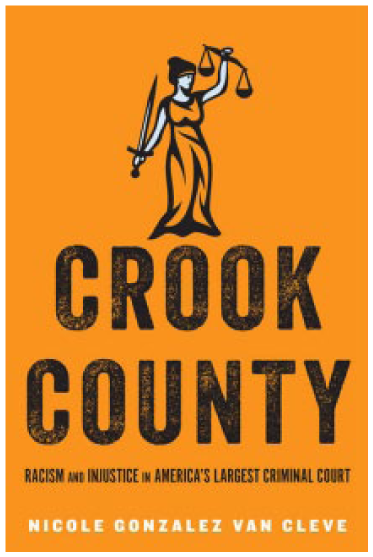
Nicole Gonzalez Van Cleve would probably roll her eyes at this surprise, arguing that public defenders scarcely have higher moral standing than prosecutors. In her new book Crook County: Racism and Injustice in America’s Largest Criminal Court, Van Cleve examines the criminal courts in Chicago’s Cook County. She finds that all lawyers working in the criminal courts are complicit in the propagation of America’s caste system. Crook County exposes how the gritty daily rhythms of the criminal process methodically put people through the mill of mass incarceration and reproduce twenty-first-century racism.
Van Cleve’s long-term study relies on her internships as both a prosecutor and defender from 1997 through 2004. She also draws on her own direct observations as unaffiliated researcher, as well as those from court observers under her supervision. Her qualitative research is supplemented by questionnaires and interviews. The book narrates patterns and practices common throughout American criminal courts, magnified in Cook County because of the large number of defendants it engenders and cycles through its processes. The local specificities also shine through, in particular, the police department’s brutal history of torture, such as at the illegal detention black site known as Homan Square.
In Van Cleve’s account, all parties in the court are responsible for what she calls “racial degradation ceremonies” performed on those accused of crimes. Shackling, sitting for hours awaiting cases to be called, harsh discipline by court officers imposed on those situated in the courtroom pews—these routine indignities of criminal court, Van Cleve writes, solidify the defendant’s position as a racial, legal, and social outcast. Further ostracism takes place when defense, prosecutors, and judge meet behind closed doors to negotiate a plea bargain. In “402 conferences,” as they are known under Illinois law, a few professionals decide the worth of someone’s life and liberty.
Van Cleve pays attention to the moral language through which the professionals understand the accused—their misery, their criminality. Lawyers have difficulty seeing the defendants as anything but “mopes.” This is a term reserved for those who cannot make it up the imagined ladder of social mobility because of their own moral failings. A mope is unmotivated, lazy, and lacks the work ethic of professionals—like lawyers and judges. The mope discourse is the lawyers’ compromised vision of empathy that draws on the lexicon of the “culture of poverty.” For Van Cleve, prosecutors, defense attorneys, and judges are equally to blame for rendering defendants victims of their moral failings.
Van Cleve is strongest in her discussion of what she calls color-blind racism, in which the idea of the mope plays an important part. This is the kind of racism that operates somewhere between structural racism and overt, identifiable racism. It is a slippery phenomenon to pin down. Although it is enacted in daily legal practice, its enactors inevitably disavow any racial animus. It is the cultural rote of the court. The lawyers inherit it as they navigate everyday courthouse dynamics. The criminal justice system is a crucial site for the proliferation of modern racism in America, as Van Cleve points out. It plays this role in part by conveniently collapsing three separate value systems in play in criminal court—legal, moral, and racial. Racial categories are substituted for legal and moral ones. Racial identities become associated with negative legal and moral judgments, because most of those who are identified as criminals are poor and dark skinned. “Imbued with legal authority, power, and institutional legitimacy, the doing of colorblind racism transforms into state sanctioned racial degradation ceremonies,” Van Cleve writes. “The ‘governors’ can claim their behavior as ‘colorblind’ through coded language, mimic fairness through due process procedures, and rationalize abuse based on morality—all the while achieving the experience of segregation and de facto racism.”
Van Cleve points out that all lawyers, even defense attorneys, can speak about their clients in unflattering ways, adopting the prosecutor’s presumption of the defendant’s guilt. But she also recognizes that public defenders use the mope framework to speak about their own clients because they feel pressure to integrate into the lawyer “workgroup.” After spending time with judges and prosecutors, she notes that appeals for “authentic sympathy or even contextual factors . . . were not going to win favor.” The most successful defense attorney, according to Van Cleve, came off as “humble, self-deprecating.” These qualities “offset any requests that could be read as aggressive or aligning with the client and allowed the public defender to defend while keeping his distance” from his client’s perceived depravity.
Politicized public defenders are nowhere to be seen in Van Cleve’s account, perhaps because her fieldwork dates to 2004, when there existed less consensus on the desperate need for criminal justice reform. But public defenders claiming moral high ground may not deliver better results for any given client. Such advocacy could alienate the prosecutor, whose favors your client so desperately needs. Van Cleve is sensitive to these trade-offs, but none of her informants grapple explicitly with such questions of solidarity.
Unfortunately, she does not investigate further why the mope framework persists, despite the defender’s ambivalence and the prosecutor’s power. The workgroup appears as monolithically oppressive—with all parties contributing to the dehumanization of defendants equally. The closest the ethnography gets to questions of responsibility is its examination of how the professionals speak about who is to blame for the current state of affairs. Very few in the courthouse are willing to take responsibility, despite their awareness of the ills of the system. Blame is passed from one actor to another: prosecutors blame police, defense, and policy makers.
I am a public defender. In my own exchanges with prosecutors, including liberal attorneys who understand the consequences of a conviction, the conversation often comes back to the defendant. “It’s not my fault your client committed the crime.” In the final analysis, according to Van Cleve, “for the collective workgroup, it is the mope who is to blame for their own failures.” “This ‘everyone is to blame’ notion of the criminal justice system is the evolved perspective that allows criminal justice professionals to reflect upon and criticize the system at large and even the work they do within it.” Culpability is everywhere and, thus, nowhere.
Inadvertently, by sketching such a totalizing system, Van Cleve adopts the “everyone is to blame” perspective she critiques. The account focuses on the actors’ performances, without any systematic account for the power dynamics among them. At the helm of the criminal justice system are the prosecutors, the arbiters of blame and morality. The prosecutor determines what grade of crime to charge, a decision that controls the sentencing discretion of the judge. Only the prosecutor can recommend a lower-grade crime. It is always the prosecutor who has to be persuaded. Defense attorneys are often reduced to begging, which Van Cleve captures anecdotally, without naming it as such. Van Cleve also identifies the power that prosecutors wield in sanitizing police misconduct, but their trespasses are rendered equivalent to the defense attorney’s unimaginative advocacy. This equivalence is false, however. Recent empirical research also suggests that rising incarceration rates can be attributed to prosecutorial discretion. This discretion is exercised without any systematic public oversight, with the exception of district attorney elections that are often uncontested.
Another effect of Van Cleve’s totalizing argument is that we never really learn why the actors make the decisions they do. Clearly, racism and classism influence their practice, at the expense of the defendants. Defense attorneys are caught spending less time on certain cases than on others, depending on the defendant’s personality, race, and case strength. But, besides a generalized disregard for the defendants, Van Cleve does not always offer the most satisfying answers for why prosecutors or defenders proceed in the manner in which they do. As a result, it is difficult to assess the actors, even, on their own terms. A book remains to be written about how prosecutors justify themselves.
Still, the book’s exclusive focus on the process from the perspective of the defendant is forgivable. By this strategy, Van Cleve illustrates that any power differences among the professionals are minute in comparison with those between the professionals and the defendant. Van Cleve shows clearly how the accused, whom the process is ostensibly about, is rendered almost invisible throughout the court proceedings. As a rule, defendants are told not to speak up in court, to protect them from self-incrimination. But, in practice, this means defendants are silenced and ignored by judges and prosecutors. Meanwhile, defendants who want to defend themselves are routinely mocked. Their desire to take matters into their own hands is often perceived as a symptom of mental illness.
What makes the prosecutor touting the Black Lives Matter button so perplexing is that it is not clear to whom the statement is addressed—is it a reminder to himself? Van Cleve’s account operates effectively as a call for more ethical individual practices for those working within the system. She reminds practitioners to distance themselves from the casual racism and classism that informs the daily operation of court practice and to develop meaningful solidarity with those under siege by the criminal justice system. But her call for better intentioned practices will not fix its fundamental flaws. A prosecutor’s momentary sympathy is a small interruption in the repetitive degradation of defendants that Van Cleve methodically documents. Relying on the individual goodwill of benevolent prosecutors cannot be the solution. Insofar as systemic reform goes, the book fails to identify the hierarchy of complicity. By any measure, blame must lie most squarely with those who call the shots.