



Abstract

Pictured above from top left, clockwise: Nicolás Maduro, President of Venezuela, 2013-Present; Cristina Fernández de Kirchner, President of Argentina, 2007-2015; Rafael Correa, President of Ecuador, 2007-Present; and Dilma Rousseff, President of Brazil, 2011-2016.

From the end of the century to 2005, Latin America experienced roughly half a dozen popular rebellions that succeeded in overturning existing regimes. The so-called “Pink Tide,” the wave of progressive reform governments that swept into office, is now ebbing. By all accounts, center–left governments in the three major countries that spearheaded the swing against market orthodoxy—Argentina, Brazil, and Venezuela—have either been defeated or are just barely holding on to power. In Argentina, the neo-Peronist government of Cristina Fernández de Kirchner lost to a middle-class, pro-business party. In Brazil, Dilma Rousseff, successor to two-time president and founder of the Workers’ Party, Luiz Inácio Lula da Silva (known as Lula), was impeached in what many have called a constitutional coup. In Venezuela, after his party was trounced in congressional elections last year, Nicolas Maduro, Hugo Chávez’s chosen successor, if he survives the country’s deteriorating economic and political scenarios, will surely succumb to the right in the next elections. Considering how strong these regimes appeared to be just five years ago, and that, with allied reformers in Bolivia, Ecuador, and Paraguay, the Pink Tide seemed to enjoy regional hegemony, many observers, both inside the region and elsewhere, have asked how its leading governments suffered such falls.
While much has been made of the right’s ability to capitalize on the scandals and economic mismanagement that have plagued the Pink Tide governments in Argentina, Brazil, and Venezuela, I argue that, rather than a consequence of the adoption of more effective strategies by their opponents, the reformers’ decline has had more to do with their failure to introduce structural reform, which in turn reflects the built-in limitations of their populist bases. Ironically, the very marginality of Pink Tide constituents—on whom they rely and whose welfare they are committed to—has undercut reformers’ ability to press further and deeper and transform their countries’ economic growth strategies.
Pink Tide regimes have also been labeled twenty-first century socialism, neo-developmentalist, and/or post-neoliberalism. While no consensus exists as to their policy and institutional parameters, most analysts agree that Latin America’s new reform governments are characterized by a democratic deepening that recalibrates the state–society compact, offers more extensive and generous social provision, and involves more inclusive government promotion of exports and growth. Prominent defenders of the Pink Tide explain that these regimes are founded on
a set of political aspirations centered on “reclaiming” the authority of the state to oversee the construction of a new social consensus and approach to welfare, and [a] set of economic policies that seeks to enhance or “rebuild” the capacity of the state to manage the market and the export economy in ways that not only ensure growth but are also responsive to social need and citizenship demands.
1
Left-wing assessments are far more critical, asserting that the new reformers accommodate the basic rules of neoliberal development and the U.S.-led commercial regional order, and even seek to co-opt and divide more militant social movements. With respect to the Kirchnerist governments in Argentina, for instance, Mariano Feliz argues that the neo-Peronist interlude remains neoliberal in its essence as it is founded on an export-oriented, extractivist model of accumulation and historically depressed wages. 2 Emilia Castorina adds that the populist reforms under the Kirchners installed a new form of “democratic” neoliberalism, which, while restoring citizen rights and certain forms of regulation, actually resolved the crisis of neoliberalism rather than transcending it. 3 More evenhanded approaches, while recognizing the limitations of the Pink Tide, nonetheless identify some of its enduring reforms. 4
Assessing the Pink Tide
One direct way to evaluate the Pink Tide regimes is to compare the distributional effects of their social policies with those of the region’s enduring orthodox regimes, such as Chile, Mexico, and Peru. As Figure 1 shows, Pink Tide countries have indeed experienced a significant and sustained decrease in inequality since 2000. Inequality has fallen dramatically since reformers were elected in Argentina (2003), Brazil (2002), Bolivia (2005), and Venezuela (1998). Interestingly, however, it has declined at similar rates in countries that most diligently continued to embrace free-market neoliberalism. Whereas Chile and Mexico have enjoyed steady distributive improvements since 2000, Peru’s reduction was the fastest, rivaling the sharp reversals of inequality in the 2000s in Argentina and Venezuela, the best Pink Tide performers.
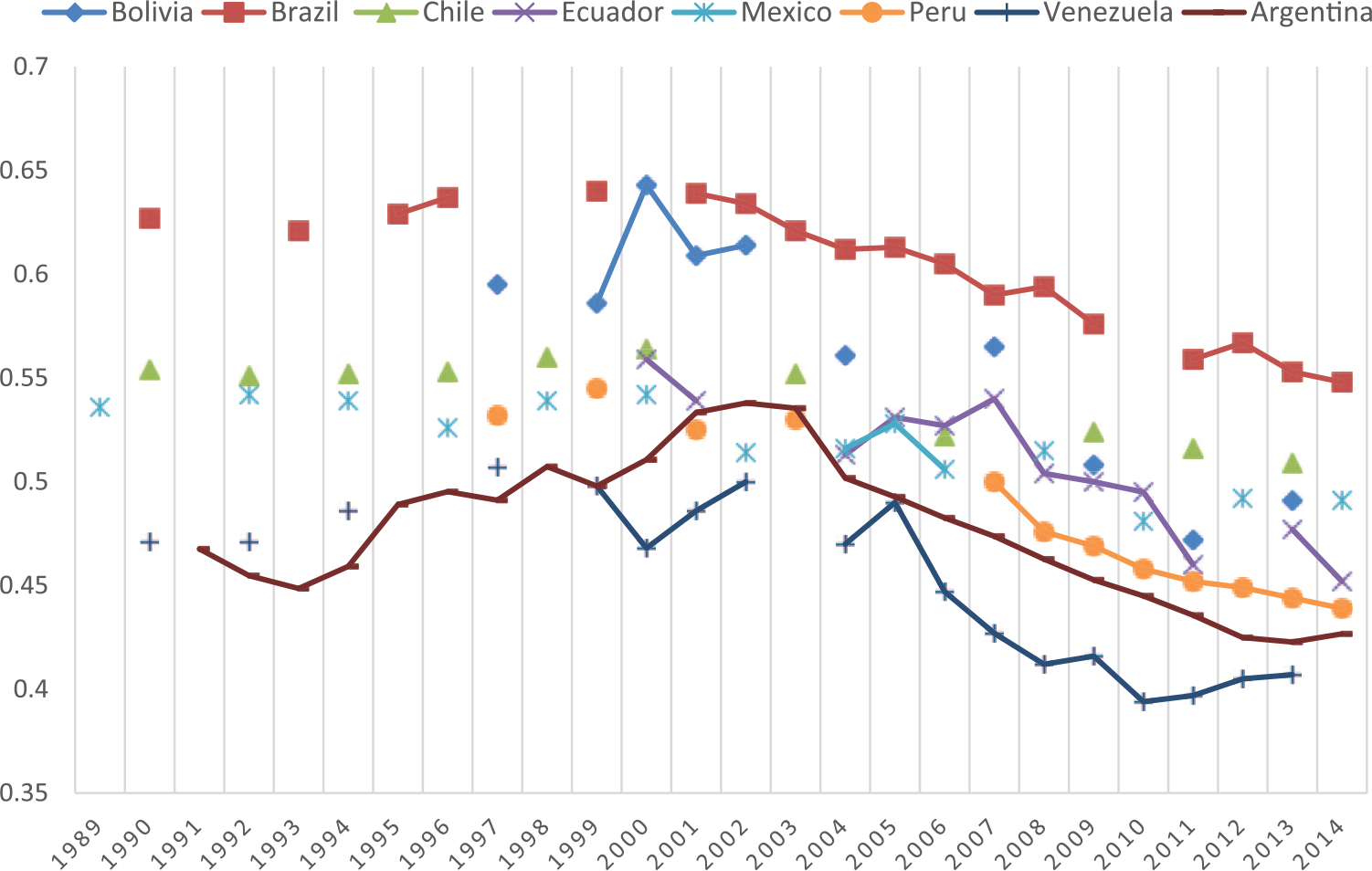
Regional inequality: GINI coefficients.
A look at changes in social spending provides some understanding of these dynamics (see Figure 2). Latin American countries have increased per capita social expenditures across the board, with more pronounced general increases since 2000. Again Brazil, Argentina, and Venezuela experienced drastic funding hikes, the first two in a way sustained up to 2013. While the recent economic downturn has halted the accelerated expansion of social spending in these two countries, growth in Venezuelan social provision oscillated throughout, at times wildly and with devastating human consequences, with the ups and downs of oil export revenues, owing either to global market vicissitudes or to domestic instability. In Ecuador, though expenditures remain modest, they have expanded by almost one-third under Rafael Correa’s governments, an impressive accomplishment considering the country’s oil dependence. By contrast, in Bolivia, while per capita spending has grown by 15 percent since Evo Morales first came to power, it remains extremely low and inadequate.
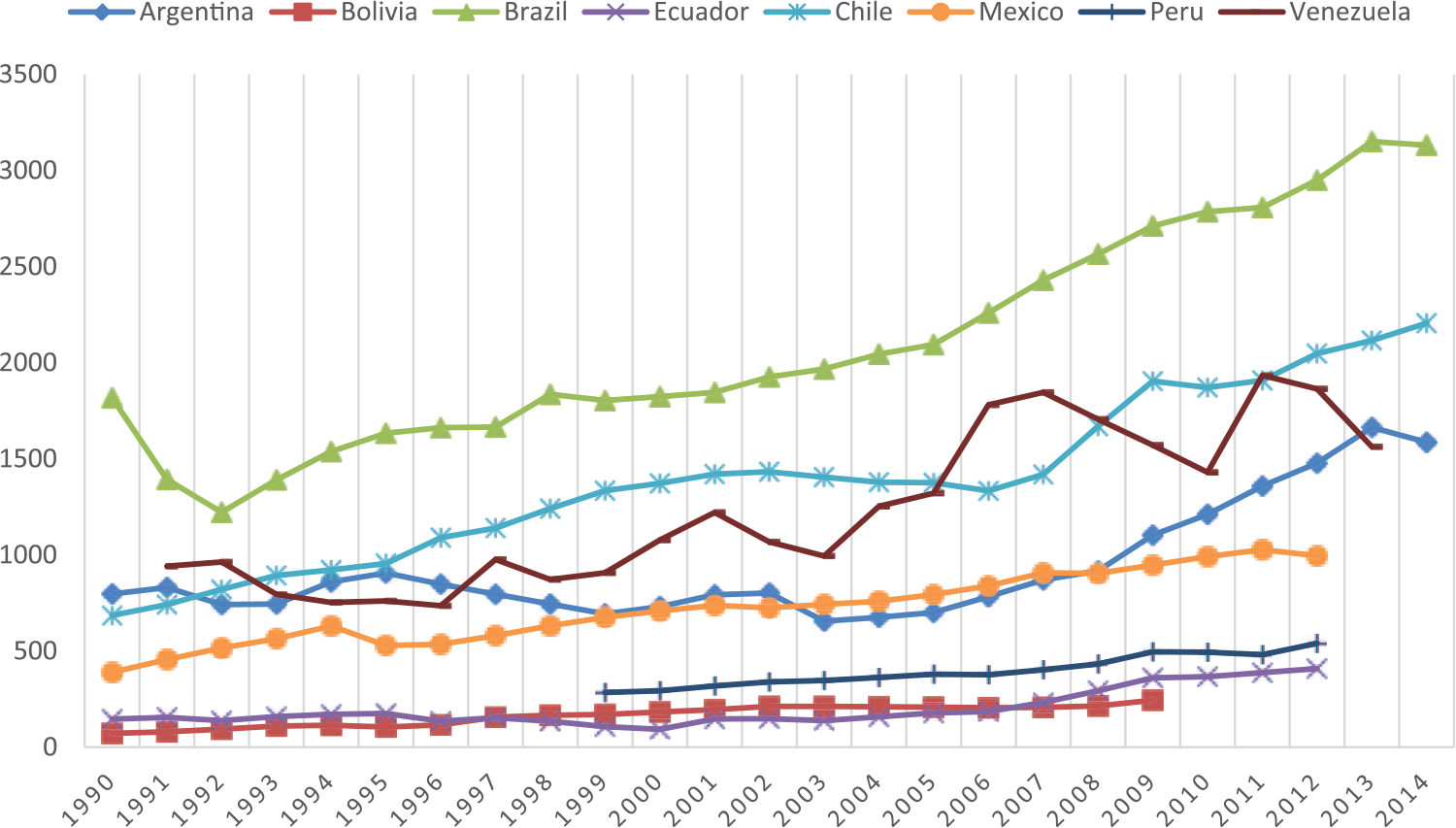
Per capita social public expenditure.
Comparing Pink Tide achievements against other regimes in the region, however, yields less formidable results. In Brazil, for example, where per capita spending has increased by almost 40 percent, welfare expansion reflects rates experienced under pre-PT (Partido dos Trabalhadores) market orthodoxy. Chile’s expansion of social spending since 2000 falls just below Brazil’s impressive gains. And while nowhere near spending levels of Argentina, both Mexico and Peru increased per capita social expenditures by over 40 percent (albeit from lower baselines).
Thus, though it is clear that Pink Tide governments have been committed to reversing decades of growing inequality by expanding social provision, there is no exclusive relationship between such gains and the regimes themselves. All regional states pumped resources into welfare programs, some earlier than the ones looked at here. 5 Pink Tide defenders might counter that what sets social provision apart in more recent populist regimes is the quality of their programs, particularly with regard to their criteria and reach. 6 But the most generously funded programs in Brazil and Argentina, bolsa familia and asignación universal por hijo, respectively, are far from universalist, following the same World Bank model of narrow means-tested and targeted cash transfers that characterize welfare spending in Chile, Mexico, and Peru.
The clear exception to this pattern is Venezuela, where radical Bolivarianism implemented unconditional education and health care programs open to all. However, Venezuela’s erratic social spending points to the key feature of welfare expansion in the region, both in Pink Tide countries and their pro-market rivals—namely, their vulnerability to the fluctuations in export revenues. Thus, during export booms, social spending as a share of overall economic value increased in all countries, while at times of low global commodity prices, such spending either stagnates, as in Ecuador since 2009 or contracts, as in Chile in the late 2000s, Bolivia and Venezuela in the 2010, and Argentina since 2013. Not surprisingly, then, in Chile and Venezuela, at opposite ends politically, the share of gross domestic product (GDP) spent on public welfare ended up converging around one-sixth of the total (see Figure 2).
In sum, though Pink Tide regimes certainly deepened their “responsive[ness] to social need and citizenship demand” as supporters have asserted, this commitment is neither unique nor qualitatively distinct. Just as their orthodox neoliberal regional counterparts, Pink Tide populists have covered social demand by relying strictly on earnings derived from commodity exports. This dependence on primary and extractive goods, such as agricultural and mineral exports, not only reflects the same problems faced by orthodox governments, more important, it calls into question the claim that the state has adopted measures to manage the economy in a more activist manner to ensure equitable growth and meaningful citizenship. In fact, Pink Tide states have shied away from the kind of development policies that might alter the underlying structure of production and generate reliable sources of provision to be managed more progressively and sustainably.
Figures 3 to 5 show the failure of all these countries to modify underlying economic structures. Venezuela actually deepened its dependence on oil: whereas under half of its export revenues came from oil when Chávez first came to power, by 2013 over fourth-fifths of all foreign earnings came from petro-exports. In Argentina, although automotive exports have recovered their pre-collapse shares, soybeans and by-products increasingly dominate the value of overall exports. In this regard, they reflect an unchanged overarching regional tendency, similarly embodied in Chile, where copper and its derivatives have accounted for roughly half the value of all exports since 2000. 7 The Brazilian case is slightly more promising as Workers’ Party governments succeeded in expanding earnings from increasingly competitive iron ore production and diversifying the country’s commodity export portfolio. In sum, welfare expansion has followed the peaks and troughs of world copper, oil, and soy prices, rather than sustainable redistributive strategies. Thus, very real gains in equality and social spending notwithstanding, the Pink Tide regimes have not ushered in new “national-popular” development models designed to open opportunities that broaden and deepen the state’s commitment to popular welfare.
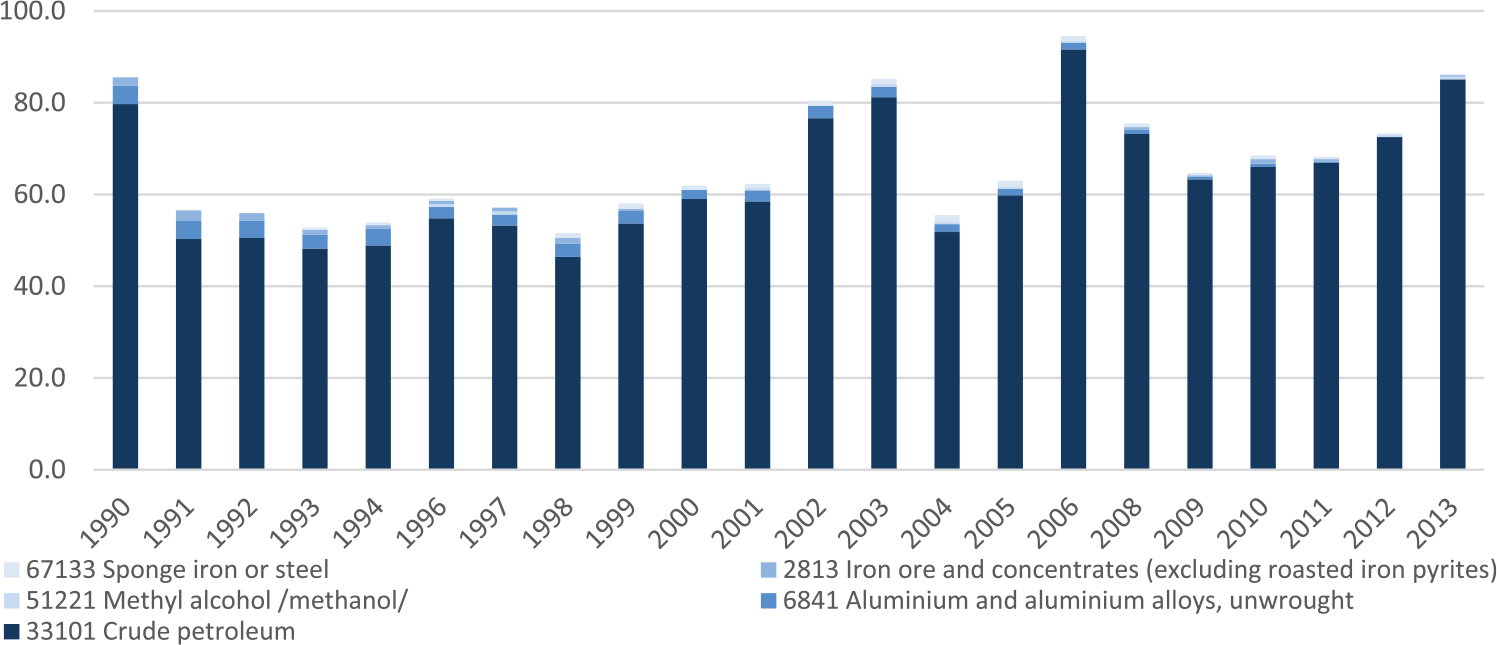
Leading Venezuelan exports (% of total).
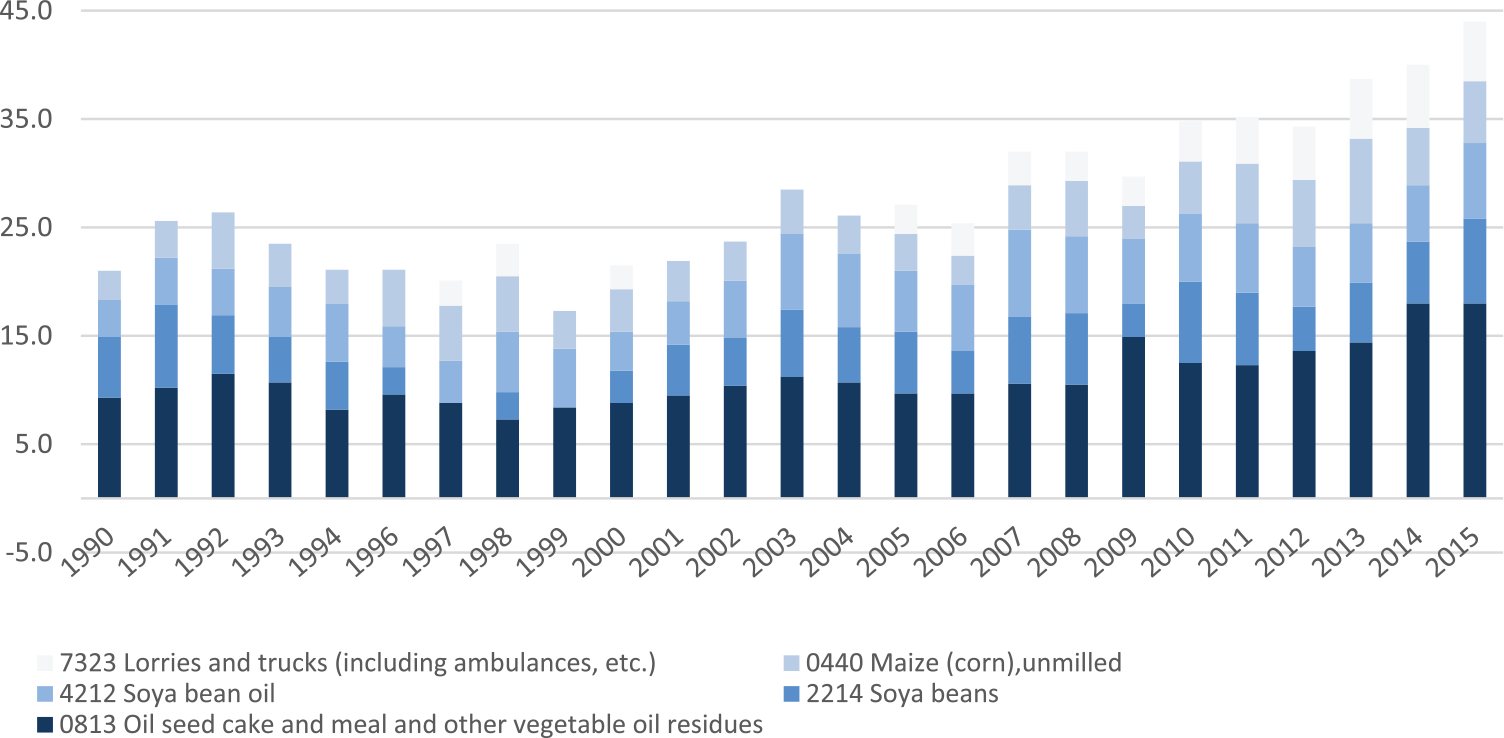
Leading Argentine exports (% of total).
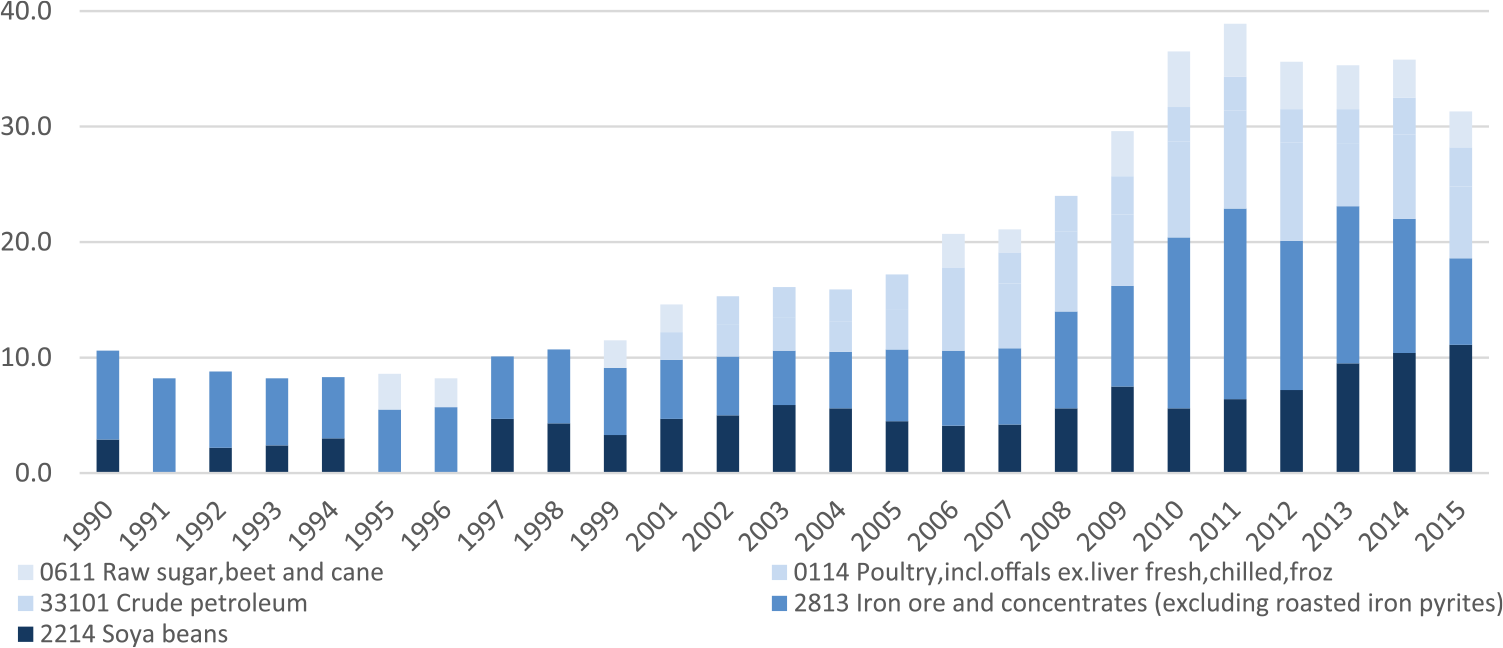
Leading Brazilian exports (% of total).
Does relatively unexceptional welfare reform support the critique of continued Pink Tide subordination to elite interests? Neo-Marxists correctly point out that the new regimes were never alternatives to former growth models but were instead built on their very foundations. Even supporters acknowledge that Pink Tide development policies involve better, rather than alternative, management of current export strategies. Effectively, reformers’ commitment to expansion based on existing dominant sectors has precluded a challenge to established business elites, the main reason their critics describe them as an Izquierda permita (or “authorized left”). But while it is true that populist reformers have largely eschewed the type of interventionism needed to restructure national industry, it is misleading to claim that Pink Tide governments have been exclusively or even foremost dedicated to defending elite interests.
This view ignores the strong social and political attachments that the Kirchners, Morales, Correa, and most of all Chavez and his successor forged to powerless sectors of their societies. In fact, these governments owe their very existence and their prolonged rule to mutually beneficial relationships with informal and urban poor layers of their countries’ working classes. (Accordingly, they owe their decline to the whittling of this support rather than new effective strategies on the part of their right-wing rivals.) It was the mobilizations and rebellions of these popular sectors against the social exclusion wrought by market orthodoxy that propelled them to power and constituted their core base of support. Given these links, it is clear that the Pink Tide governments’ primary concern was securing the backing of these popular layers, even under the constraints of economic elite profit requirements.
To understand the nature of these links, one has to appreciate the extent to which neoliberalism, which picked up steam in the 1980s, swept away the mechanisms for mediating popular interests, producing new forms of partisan alignments that scholars have called shifts in “popular interests regimes.” 8 In all cases, the crisis of legitimacy and representation that accompanied the impact of austerity and structural adjustment sent powerful shocks to existing party systems. With the exception of Brazil—where the emergence of the Workers, Party occurred earlier, before market liberalization undermined governments’ abilities to guarantee basic welfare to core popular constituents—powerful urban mobilizations rocked governing institutions, eventually sweeping them aside and generating new political alignments. The established system of electoral competition, which privileged traditional center–left and labor-based parties and alliances, was replaced by new party systems that incorporated, through various participatory mechanisms, the rebellious sectors thrown into disparate forms of precarious work. In effect, these rebellions, with the marginalized informal workers in the lead and with unions at best on the sidelines, toppled the former regimes and created the conditions for new forms of governance.
So if indeed the Pink Tide governments were not mere instruments of business elites and were, as argued, committed to the well-being and political incorporation of their bases, one must ask why the new reformers, including Chavistas and Kirchnerists, failed to do more to defend their power and the interests of their backers. Their continued embrace of growth and welfare models that exacerbated the crises driving their demise is puzzling. In short, the key question is: Why did Pink Tide fail to make the structural transformations that might have permitted them to escape the cycle that brought about their downfall?
Market Liberalization and the Changing Role of Organized Labor
Comparison with a previous period, during the 1960s and 1970s, in which popular and labor sectors pushed beyond a more generous welfare state to demand a new development model, is instructive. It underscores that the working class that backed reformers then enjoyed a level of power that non-elite sectors behind contemporary reform governments lack. Essentially, the industrialization programs pursued during the postwar era spawned a powerful and increasingly organized and militant labor movement that could sustain a push for radical change, providing the leverage for popular sectors to push for a transformative agenda. 9 By contrast, the neoliberal strategy adopted by ruling sectors in the 1980s and 1990s undermined the power of workers. Without the structural leverage that growing industry conferred on the pre-neoliberal working classes, no social force has been strong enough to push Pink Tide governments beyond the constraints of the commodity export growth model.
During the earlier period, ironically, newfound working-class power arose from the very growth strategies pursued by elites. The negative commercial impact of the Great Depression led political and business leaders to question dominant export models and adopt strategies of import substitution industrialization (ISI) that would diminish foreign dependence in favor of local production of industrial goods. The state-led expansion in manufacturing promoted labor’s structural power and organizational capacities, as the region’s industrial takeoff placed growing numbers of workers in key, tightly integrated branches of industry. This meant that any disruption at their worksites could impose huge costs and stymie ruling-class objectives. Likewise, accelerating job creation under elite industrialization plans significantly reduced unemployment, giving workers heightened leverage in the labor market, leverage that could be wielded not only to improve wages and working conditions but also to bargain for better national-level policies. Mass clustering of workers toiling in similar conditions and tight labor markets undergirded the organization of increasingly powerful unions. Often states attempted to harness this power, lest it challenge elite policy preferences. In many ways, postwar corporatism—best exhibited in Argentina, Brazil, and Mexico but also present in other countries with strong labor-based parties such as Peru, Venezuela, and Bolivia—consisted of an elite accommodation of this rising power. Granting important bread-and-butter demands as well as political concessions in the form of access to policy-making institutions was an effort to manage and direct this power toward elite aims.
This raises the question of whether the corporatist alliance itself undermined the ability of unions and popular sectors to push for more structural change in the more recent period. While the corporatist arrangement certainly included key features that handicapped working-class power and independence, notably a false sense of security, and over-dependence on a benevolent state, it was the dissolution of the material bases of corporatism which decisively weakened non-elites in the current context. Without the economic and organizational positions gained by workers that sustained incorporation into the developmentalist state, non-elites lacked a necessary weapon with which to deepen reforms. Examining the bases of working-class power in the postwar period and contrasting these with present conditions bear this out. Although the quality of data is patchy, three basic measures illustrate the point: the share of the working class employed in industry, union density, and the frequency and scale of strikes. On all three, labor’s power grew during the ISI period and far exceeded present measures.
This was particularly true in terms of manufacturing, which increased its share of national output and industrial employment throughout the region. In Argentina, for instance, where industrial promotion was the most ambitious and successful, manufacturing, increasingly oriented toward motor vehicles, machinery, and basic metals, represented one-third of the economy in the 1970s; at that time, even amid rising productivity, manufacturing and construction absorbed the same share of the labor force. 10 By the 1990s, only 17 percent of the labor force was industrial. Between 1991 and 2003, manufacturing employment fell another 42 percent! 11 Worse still, whereas in 1970, a quarter of the industrial working class was employed in skilled, high-value engineering-intensive branches, by 2002, when the collapse occurred, fewer than one-eighth of the country’s workers were located in such valuable industries, while nearly three-quarters had shifted to natural resource-based branches. Although the cycle of economic recovery that opened in 2003 generated hundreds of thousands of new manufacturing jobs, these hardly offset the decades-long deterioration of workers’ industrial clout. Informality still plagued around two-thirds of all wage earners throughout the mid- to late 2000s boom.
At the height of ISI in Chile, during the early 1970s, industry accounted for one-quarter of total economic output and the same proportion of employment. By the early 1980s, manufacturing employees had fallen to under 20 percent. 12 And whereas in 1970, almost one-fourth of all industrial workers toiled in engineering-intensive branches, a decade later, less than one-seventh did so; a full two-thirds worked in natural commodity sectors. The same phenomenon was replicated throughout the region. In Brazil, where industry grew at a torrid pace in the immediate postwar years and again throughout the 1970s, 3 percent annual growth in manufacturing employment produced similar outcomes. Industrial investments also exploded in Mexico during the 1970s, leading to 23 percent of workers employed in manufacturing by 1980. Even in Venezuela, the classic rentier petro-state, industrial production increased almost tenfold between 1950 and 1985. 13 Liberalization viciously undercut manufacturing work in both countries. In a three-year period alone, 1980s Mexico saw its industrial employment drop by 4 percentage points. 14
As mentioned, growing structural leverage promoted potent workers’ organization. Across the board, unionization reached zeniths during the pre-neoliberal decades. Peak union density in Argentina reached 50 percent in Argentina, 35 percent in Chile, 32 percent in Venezuela, and roughly a quarter in Brazil, Venezuela, Bolivia, and Peru. 15 These associational capacities were devastated during the neoliberal turn throughout the region which cut union density by more than half. The erosion in Argentina’s and Venezuela’s unionization rates were most dramatically replicated in Chile and Peru, where by the 1990s union density had fallen from 35 to 13 percent and from 25 to 6 percent, respectively. Mexico suffered a similar, if delayed, collapse in its unionized labor force; if in the 1990s it had held at 22 percent, by 2006, according to the International Labour Organization (ILO), only 11 percent of the labor force was represented by a union. Brazil is the only case that has managed to mitigate plummeting union density rates. Since the 1990s, union density there has held at roughly 17 percent.
Growing organizational capacity allowed regional working classes to turn their structural leverage into collective industrial action. 16 In Argentina, for instance, in 1974 and 1975, there were over 1,809 major strikes, a third in manufacturing. In Chile, workers carried out almost 1,300 strikes in 1969 and another 2,700 in 1971, even under a friendly socialist government. Similarly, during the height of ISI in Venezuela, from 1972 to 1981, there were nearly 160 major strikes per year. Mexico also experienced a wave of industrial actions beginning in the early 1970s. During the decade after 1973, Mexican unions, which were absorbed into the ruling party structure and therefore typically docile, carried out over eight hundred strikes a year. 17 The Brazilian data are more ambiguous, yet show that in just the half decade following re-democratization in 1985, a vibrant new labor movement carried out almost 2,200 strikes a year! Because national industry remained strong following the military’s 1970s ambitious development schemes, half of these occurred in manufacturing. In sum, elite industrialization projects bestowed upon the working class not only structural power but strong organizational capacities that translated potential leverage into industrial action, even in cases where unions lacked political independence due to their incorporation into the state and ruling parties.
With the adoption of market liberalization starting in the late 1970s, the region’s working classes’ inclination toward militant collective action eroded as elites abandoned the industrialization model and embraced one based on primary and extractive exports. The reversal came earliest and was perhaps most dramatic in Chile, where strikes virtually disappeared by the end of the 1970s under military rule. Even during the massive protest wave during the mid-1980s, unions, decimated by brutal repression and abrupt restructuring, 18 held on average only forty strikes a year. The return to democracy in 1990 scarcely improved collective worker action, particularly compared with the heyday of the labor movement in the late 1960s and early 1970s. During the first fifteen years of post-authoritarian center–left governments, unions averaged only 150 strikes a year. The turnabout in workers’ mobilization was equally stark in Argentina. Fifteen years after the labor movements’ apex, there were fewer than two hundred strikes a year, only one-fifth occurring in manufacturing. During the 1980s, when industrial restructuring was already underway, workers still held thirty-eight strikes a month; by the first half of the following decades, this number had been halved. 19 By the late 1980s and early 1990s, Venezuelan strikes had collapsed to a paltry five per year! In Mexico, strikes declined precipitously after the implementation of structural adjustment in 1983. In the decade leading up to the NAFTA, which further hurts Mexican labor, unions there held 160 strikes a year, a mere fifth of the stoppages led by unions in the prior decade. The trend was evident even in Bolivia, where industrialization lagged significantly and informal commerce and agriculture continued to absorb most of the national labor force. During the 1980s, the country recorded 238 strikes a year; the first half of the 1990s, by contrast, reported a mere forty work stoppages per year.
Given all this, it is not surprising that working classes in the region made significant material gains, in terms of legal protections as well as undeniable economic well-being. In Mexico, for instance, the working class came to control 45 percent of national income in the postwar period, 20 while in Argentina, workers attained over half of the country’s income at the height of Peronist corporatism in the 1950s. 21 Even when encouraged by corporatist and political party managers, rather than the rank and file, labor’s rising real power could not always be contained. More often than not, the working class did not confine itself within these very real and steady gains. Throughout the region, whether empowered from above by the state or building their own independent organization from below, unionized workers pushed for deeper structural reform, including deepening the nationalization of industry, worker control of the production process, and co-management of firms. In addition, the labor movement pressed for an expansion of public services, which by delinking working families’ social reproduction from market dependence directly challenged the power of business elites. In Chile, a Communist–Socialist alliance, built on top of independent unions and popular movements, won national power and attempted an electoral route to socialism. In Argentina, rank-and-file workers took advantage of their networks in official unions, and the shop-floor power these granted, to launch a wildcat movement which emerged from factories and linked up with local rebellions in what took on insurrectionary dimensions. 22 Even in Brazil, where unions were the weakest, the labor movement spawned by early industrialization successfully blocked elite austerity plans and placed radical options on the national agenda. 23
To be sure, the reformist politics of the period was significantly constrained by hard economic limits. Moreover, these efforts failed, many cut short by devastating military interventions. Nonetheless, the limits they faced and their ultimate defeats in no way undermine the fact that popular sectors in the pre-neoliberal era had an effective foundation from which to organize and make transformative demands. By contrast, the region’s present non-elite sectors count on far weaker structural bases to build popular organization and disrupt elite interests. The Pink Tide countries’ inability to escape the primary commodity export model and open a path to development and social reform that departs from their regional market-orthodox counterparts is therefore not altogether puzzling.
Latin American Reform Governments—An Inexorable Demise?
The contrast between the contemporary bases for transformative politics in Latin America and the structural foundations of the region’s postwar radicalization calls into question claims about the strategic potential of currently mobilized popular sectors. It also challenges claims of qualitative democratic improvements under reformers. At the same time, less pessimistically, it points to grounds for broad continuity in the social advances that have been achieved, even under rightist governments that have displaced the present cohort of reformers.
In recounting the history of Pink Tide regimes, some analysts have taken an optimistic view of the new leverage that the region’s urban and informal poor can continue to wield. Political sociologist Ana Dinerstein, for example, points to the new emancipatory identities of these forces in struggle, while others describe how new non-labor social movements and organizations broaden the social bases and political agendas of the Latin American left. 24 Together, they argue that the novel subjectivities and associational logics of the Pink Tide’s backers create new forms of power that will continue to win meaningful structural reforms.
Although the mobilizations that paved the way for the twenty-first century reformers undeniably broadened popular participation to new groups, overcame the associational challenges that bedevil the dispersed informal poor, and emphasized a host of more inclusive grievances and demands, these advances have all come up against built-in limits. As the experience of Kirchnerism in Argentina and Chavismo in Venezuela have shown, their core popular constituencies suffered and continue to suffer primarily from the lack of independent associational capacities and weak structural power. While the informal and unemployed masses that characterize the neoliberal development model did find ways to mobilize and win concessions from export-based corporate elites, eventually their ability to a do so was exhausted. Simply put, to remain organized, they required resources dispensed by the state and new political party elites, which led to a loss of autonomy and political manipulation. Without the systemic leverage stemming from strategic roles in production, eventually, the efforts and costs involved in sustaining disruptive street mobilizations became unsustainable, thereby weakening democratic participation.
This is not to say, as many observers assert, that the reforms achieved under the Pink Tide will automatically be rolled back by the new right-wing rulers. The fact is that conservatives, from President Macri in Argentina to leaders of the “palace coup” that toppled Dilma Rousseff in Brazil to the less fragmented and increasingly vocal anti-Chavistas in Venezuela, face the same constraints as their populist rivals. Without any alternative development model, one which is viable in an era of global capital—and for now they have proposed no policies to escape the requirements of commodity-based growth—they will not be able to rule with any degree of popular consent. As recent polls indicate, the anti-Chavistas in Venezuela have no way of cobbling together a stable majority that can not only win elections but also govern with legitimacy. This explains why, once in power, the new right in these countries has mostly maintained the same social programs as those instituted by the previous Pink Tide governments. In short, as observers are now concluding, Latin America finds itself in a sort of stalemate: just as reformers cannot push forward, their opponents will find it nearly impossible to move backward.
Footnotes
Declaration of Conflicting Interests
The author(s) declared no potential conflicts of interest with respect to the research, authorship, and/or publication of this article.
Funding
The author(s) received no financial support for the research, authorship, and/or publication of this article.