




Abstract
The leaked Panama Papers erupted in controversy last year. The documents exposed how the richest people on the planet shelter billions in offshore bank accounts to hide money and dodge taxes. A Panamanian law firm cached the fortunes of over fourteen thousand wealthy clients, including David Cameron, Bashar al-Assad, and Vladimir Putin. These disclosures sparked public outcry over the legality—and morality—of the firm’s dealings. A contentious debate arose over whether the investments fall under legal forms of tax avoidance or illegal tax evasion.
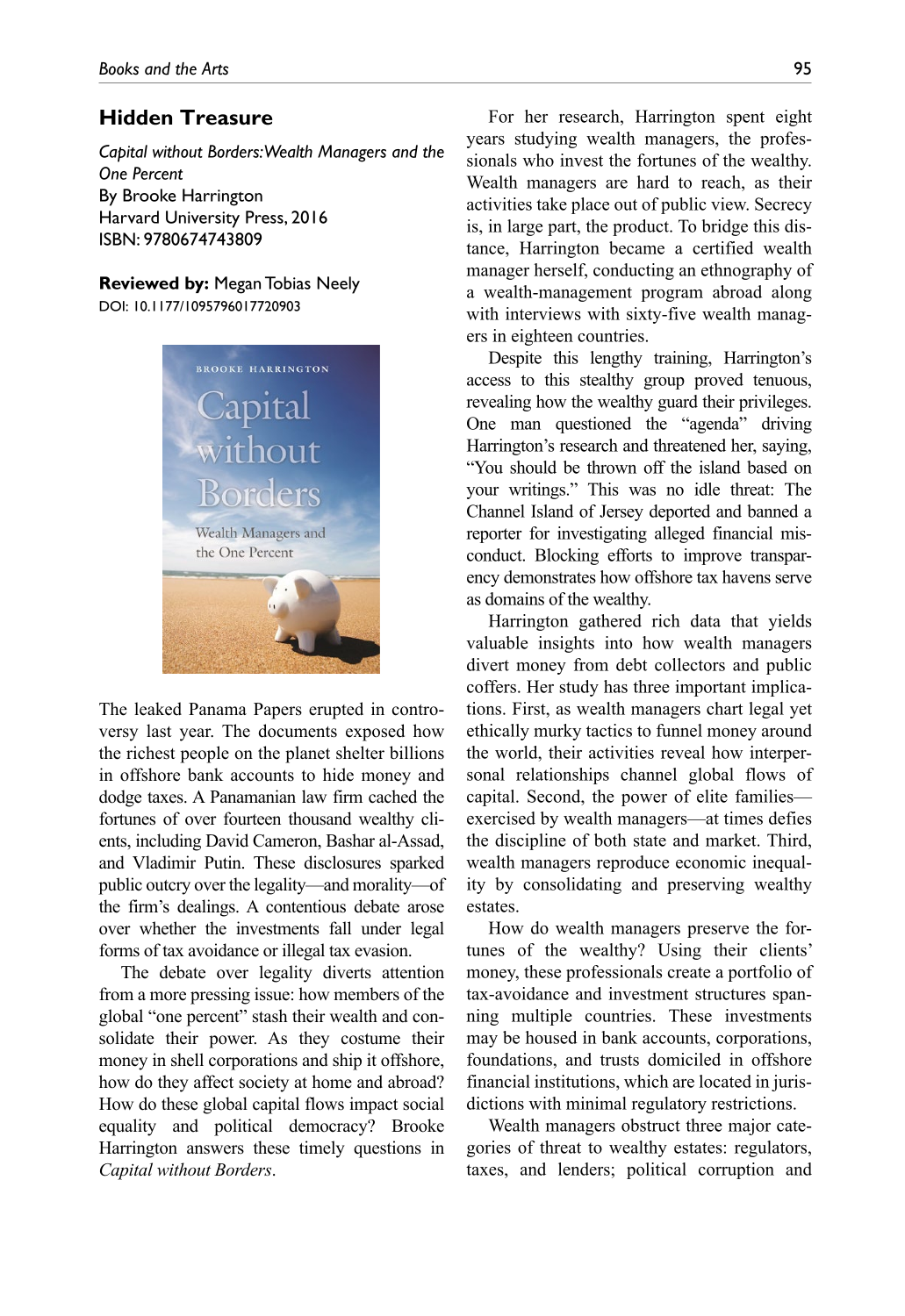
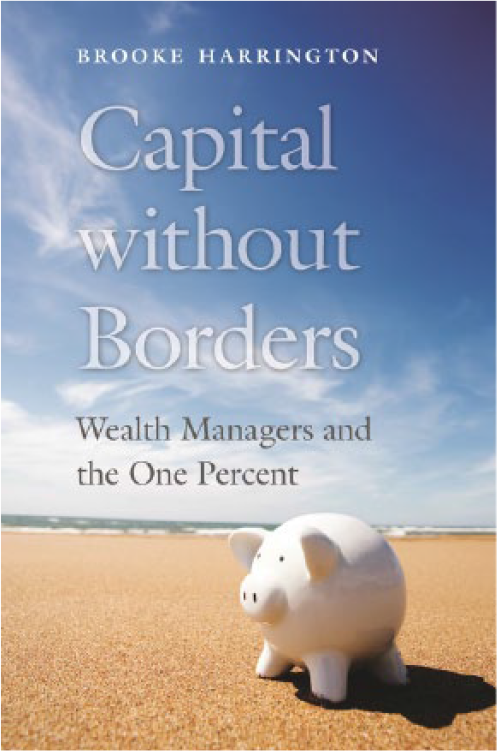
The debate over legality diverts attention from a more pressing issue: how members of the global “one percent” stash their wealth and consolidate their power. As they costume their money in shell corporations and ship it offshore, how do they affect society at home and abroad? How do these global capital flows impact social equality and political democracy? Brooke Harrington answers these timely questions in Capital without Borders.
For her research, Harrington spent eight years studying wealth managers, the professionals who invest the fortunes of the wealthy. Wealth managers are hard to reach, as their activities take place out of public view. Secrecy is, in large part, the product. To bridge this distance, Harrington became a certified wealth manager herself, conducting an ethnography of a wealth-management program abroad along with interviews with sixty-five wealth managers in eighteen countries.
Despite this lengthy training, Harrington’s access to this stealthy group proved tenuous, revealing how the wealthy guard their privileges. One man questioned the “agenda” driving Harrington’s research and threatened her, saying, “You should be thrown off the island based on your writings.” This was no idle threat: The Channel Island of Jersey deported and banned a reporter for investigating alleged financial misconduct. Blocking efforts to improve transparency demonstrates how offshore tax havens serve as domains of the wealthy.
Harrington gathered rich data that yields valuable insights into how wealth managers divert money from debt collectors and public coffers. Her study has three important implications. First, as wealth managers chart legal yet ethically murky tactics to funnel money around the world, their activities reveal how interpersonal relationships channel global flows of capital. Second, the power of elite families—exercised by wealth managers—at times defies the discipline of both state and market. Third, wealth managers reproduce economic inequality by consolidating and preserving wealthy estates.
How do wealth managers preserve the fortunes of the wealthy? Using their clients’ money, these professionals create a portfolio of tax-avoidance and investment structures spanning multiple countries. These investments may be housed in bank accounts, corporations, foundations, and trusts domiciled in offshore financial institutions, which are located in jurisdictions with minimal regulatory restrictions.
Wealth managers obstruct three major categories of threat to wealthy estates: regulators, taxes, and lenders; political corruption and instability; and family turmoil. To skirt taxes, debts, and trade restrictions, wealth managers establish trusts, offshore banks, and shell corporations. For example, to evade the debt collector, a trust allows a third party to hold an account for the beneficiary. Trusts separate the benefits of ownership from the obligations involved, such as paying taxes or debts. The beneficiary can claim to neither own nor control the money. In one case, an Oklahoma property developer housed his money in trusts in the Cook Islands. When the developer defaulted on loans from Fannie Mae, the trusts safeguarded his fortune from the debt collectors. The cost of traveling abroad to contest the law often deters creditors from collecting on their loans.
Political crises and corruption pose another threat to family wealth. Wealth managers told Harrington how communist regimes, dictators, and corrupt banking officials demand a cut from their wealthy constituents. For example, oil magnate Mikhail Khodorkovsky placed his company shares in a Guernsey trust to avoid seizure by Putin’s government. Since Russia did not sign the Hague Convention on Trusts, Khodorkovsky’s efforts proved unsuccessful.
Threats to family fortunes arise not only from external forces but also from instability within the family. Bitter divorces, rebellious children, and family businesses may compromise an estate. One wealth manager established trusts to benefit the spouses of the client’s children in the event of a divorce. He explained how the goal was to “throw a bone to the divorcing sons- and daughters-in-law, heading off challenges to the real family wealth, which was contained in the larger trusts to which the clients’ children were beneficiaries.” The trusts would undermine any claims the in-laws made on the larger estate.
Harrington’s findings significantly inform our understanding of inequality and fiscal policy. Although the top tax rate is 20 percent in Jersey, officials allow wealth managers to negotiate lower rates on an individual basis. The practice shifts the tax burden to the rest of society. This is a heavy cost to bear in a place where nearly half of residents report economic hardship—not to mention the effects on the jurisdictions from which this wealth has been trafficked away.
The tactics through which wealth managers consolidate their clients’ wealth punish the public sector. Access to public education and health care suffer, over time weakening the relative bargaining power of working- and middle-class workers relative to elites. By shifting funds from the general public, the wealthy—aided by the work of wealth managers—thwart efforts to increase economic mobility. This exacerbates inequality throughout society.
Beyond the social and economic consequences, however, Harrington identifies another, arguably more profound political effect of wealth management. Taxation is a defining feature of state power. By avoiding taxes, wealth managers undermine the authority of the state. They provide high-net-worth clients with autonomy, mobility, and secrecy, unfettering the wealthy from the restrictions of any given sovereignty.
Members of the wealthy elite enjoy greater mobility to cross national jurisdictions and freedom to disregard the obligation to abide by any particular state’s laws. One wealth manager, Erika, recounted how she traveled without a passport to several countries on a client’s private jet. The authorities neither required her to pass through customs nor checked her passport. Erika remarked, “It’s potentially very dangerous.”
In extreme cases, the clients of wealth managers may even renounce citizenship to avoid paying debts. Harrington finds a declining “old-money” ethic that the wealthy have a moral commitment to give back to society. She argues that the “stateless super-rich” live in a parallel state system, affording them special benefits and reducing states—once defined by the grandeur of compulsory tribute-exaction that is taxation—to beggars.
Capital without Borders provides a fresh perspective on why economic inequality has widened over the past thirty years. Most research on this topic has focused on the causes and consequences for those most disadvantaged. Current trends in economic inequality, however, are largely driven by the increasing incomes and wealth of the “one percent.” This finding has led to a renewed interest in studying the rich.
Harrington adjusts our understanding in two major ways. First, she shifts the conversation from income to wealth. Public scrutiny has focused on the ultra-elite’s rising incomes, yet less is known about how the rich secure their wealth. While income refers to annual taxable earnings, wealth refers to total net financial resources. Harrington identifies how wealth stabilizes a family’s position over time. She reasons, “While income is measured in the short term—as an hourly or monthly rate, or as an annual salary—wealth permits us to think long term, and potentially to change our position within the socioeconomic structure.” Wealth allows families to invest in education, health care, and other resources to ensure the next generations’ well-being. It affords a safety net, allowing a family to take risks and endure hardship. An analysis of wealth, rather than income, reveals not only how inequality is generated but also why inequality persists.
Second, Harrington calls attention to the people who create the financial structures institutionalizing inequality. In doing so, she uncovers how interpersonal negotiations generate institutional change on a global scale. Harrington illuminates how the interplay between high-net-worth individuals, wealth managers, and public agencies is not fixed, but rather emerging and improvisational. One wealth manager described a sense of satisfaction from the “intellectual challenge of playing cat and mouse with tax authorities around the world.”
Some of the most fascinating insights in Capital without Borders concern the intimate relationship between wealth manager and client. Built on mutual trust and aligned interest, this interaction is vital to the success of their efforts. One wealth manager discovered that his client withheld crucial investment details that compromised the legality of the wealth manager’s financial planning. Without access to a client’s complete investment portfolio, wealth managers may jeopardize themselves and their clients.
Thus, openness and trust are paramount—an irony in the secrecy business. To cultivate trust, a wealth manager must demonstrate his or her own elite upbringing or relevant expertise. For example, one wealth manager “never comes back from vacation without new clients.” He stays at the “right hotels” and mingles at the opera to pose as a peer. Performance of social class signals expertise in both business and family matters.
The wealthy are more likely to place trust in a wealth manager who is perceived as sensitive to their personal circumstances—legal issues, family affairs, scandals, and the like. Wealth managers’ utmost discretion is especially required when the need arises to establish a secret account to provide for a client’s extramarital affair or a child’s substance abuse treatment. An elite family’s finances are like a monetary map of personal issues. A wealth manager serves as both financial-legal advisor and family counselor, advising clients on predicaments such as divorce or rehabilitation.
When negotiating intimate affairs, a wealth manager must gain a client’s trust, which is more readily provided when the two parties share common ground. Harrington provides the example of Shivani, an English wealth manager of Indian descent, who recounted how an elderly male Indian client questioned her authority as a younger woman. Over time, Shivani won him over. While Shivani made efforts to flex her technical expertise, her client eventually granted her trust on the basis of their shared ethnicity. Shivani recounted their father and daughter dynamic and how the client would say, “You’re Indian, you’ll understand my point.” By performing the gendered authority structure of a traditional Indian family, Harrington explains how Shivani put the client at ease and secured his business.
While Harrington calls some attention to the gendered dynamics of trust, a more systematic gender analysis would have taken the analysis in fruitful directions. For example, Harrington recounts the tactics used by manager James to gain a client’s trust. When James signaled his own elite background—James golfs, shoots pistols, and travels abroad—the client ignored him. James finally earned the client’s respect by mentioning a mutual friend by an informal nickname, Willie. This mutual friend was the prime minister’s father-in-law. Harrington identifies how James uses his social-class status to establish trust with the client. Yet James also reveals the inner workings of elite masculinity, which warrants further analysis to deepen our understanding of the ruling class.
Despite this omission, Capital without Borders provides important takeaways for those concerned with alleviating inequality. Harrington argues that efforts to regulate, tax, or enforce wealth management have unintended consequences. For example, when the European Union reformed tax policy in 2005 to prevent tax evasion, wealth managers transferred their clients’ money to shell corporations, which provided a loophole in a policy designed to tax personal accounts. The reform resulted in more tax evasion and was ultimately repealed. Harrington concludes that efforts to regulate or penalize the wealthy will be met with challenges to state authority.
Instead, Harrington calls for changing the incentive structures at work. She cites recent legislation in Israel that deters the rich from hiring foreign wealth managers. Meanwhile, the government incentivizes local wealth managers to comply with the tax code. This severs the aligned interests of wealth managers and their clients, thwarting efforts to undermine the government.
The globalization of capital has often been understood as the spread of corporate debts and assets across national lines. But Capital without Borders reveals how the personal wealth of the elite follows this same path. The wealthiest stratum of society works mightily to render itself untouchable. This threatens social equality and political democracy as much as the mobility of invested capital. This threat, however, stems from relationships built on trust. The political task is at once bureaucratic—shifting incentives—and sociological, even emotional: dissolving the bonds of trust that make stateless wealth management work.