




Abstract

Keywords
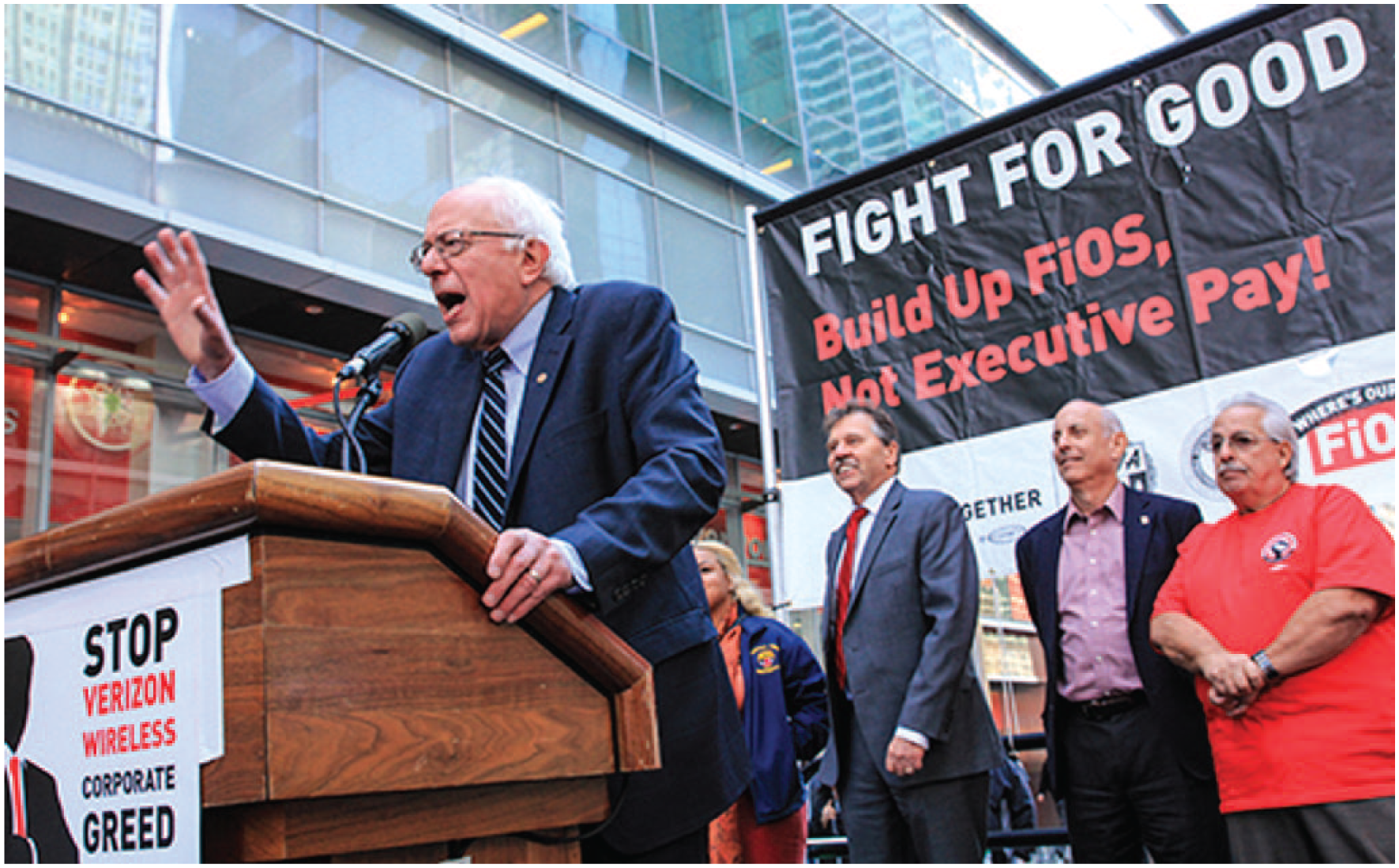
Bernie Sanders backs CWA in Verizon contract battle, October 2015.
Communications Workers of America, District 1
Telecom remains one of the most strategic and potentially powerful industries in the modern U.S. economy. Our cell phones are now an ever-present aspect of our lives, and the business world increasingly relies on the smooth and rapid flow of information via the internet. Wireless connectivity is expected to become even more important in years to come for robots, driverless cars, and a myriad of devices, which will require exponential increases in the current bandwidth.
It is also an industry where unions continue to have a significant, if declining, presence—at least in a couple of major companies—and where many jobs require skilled workers, doing work that cannot be offshored. With strikes in the United States at an all-time low, the sector still stands out for big strike activity. In just the last three years, telecom has seen:
a four-month strike by 1,700 FairPoint Communications workers in Vermont, Maine, and New Hampshire during the winter of 2015;
a forty-nine-day strike April-May 2016 by thirty-nine thousand Verizon workers on the East Coast;
a three-day strike by 21,000 retail and call-center workers at AT&T Mobility and 17,000 AT&T landline workers on the West Coast in May 2017, plus sporadic grievance strikes by AT&T landline workers across the country;
an ongoing strike by 1,800 workers at Spectrum (formerly Time Warner Cable) in New York City and New Jersey, which began March 28, 2017; and
a 22-day strike by 1,400 Frontier workers in West Virginia in March 2018.
The willingness of telecom unions to exercise the strike weapon with some frequency, in long, mass strikes shows that organized workers in the industry still feel they have some power, as well as the unions’ ongoing connection to a legacy of long phone company strikes. The recent strikes themselves have garnered mixed results, ranging from the Verizon strike, widely seen as a win for the unions, to the Spectrum strike, where International Brotherhood of Electrical Workers (IBEW) Local 3 members are approaching ten months on strike, with no end in sight.
But what do these strikes tell us about trends in technology, corporate structure, and employer-labor relations strategies, and what do the strikes mean for labor’s future in the industry?
Unions in Telecom
As in the rest of the U.S. economy, union density has dropped dramatically in telecom since the early 1980s. The balance of the industry has shifted, as hundreds of thousands of jobs have been created in the mostly nonunion cable and wireless industries, while the heavily unionized phone companies have continued to shed jobs. Still, union membership in telecommunications remained at 16.1 percent in 2017, among the highest rates in any private industry.
1
That includes an estimated 129,000 workers at AT&T who are represented by unions, third only to United Parcel Service (UPS) and Kroger in the private sector, plus another 37,000 at Verizon, the other big union telecom.
2
But unions have struggled to gain a foothold in industry’s growth areas. In the all-important wireless market, only one of the four big players, AT&T Mobility, is unionized, with tens of thousands of workers at retail stores and call centers and technicians represented by Communications Workers of America (CWA). That is thanks to a contractually negotiated neutrality clause, committing the employer to remain neutral in the face of union organizing drives, which the union won in the early 2000s. At Verizon Wireless, workers successfully formed a union at retail stores in Brooklyn, New York, and Everett, Massachusetts, in 2014, joining approximately a hundred New York City-area techs as the only union members in the company’s mobile division. T-Mobile and Sprint both remain nonunion. And in cable, unions are even weaker, with no significant national company unionized.
A Test of Strength
Given trends in telecom, and the inability to organize these growth areas, what leverage remains for telecom unions?
The Verizon strike of 2016 provided a good test case. 3 The strike was provoked by company efforts to outsource more call-center work to low-wage locations abroad, cap pension contributions, subcontract more utility-pole work, and increase its ability to send workers on assignments far from their homes. Another contributing factor was worker frustration with increasing micromanagement and disciplinary write-ups in areas including New York City. But the unions were hesitant to call another strike, offering $200 million in health care concessions to try to get the company to move on other issues. Union activists wondered how much a strike would impact the company, given its seeming lack of concern about its copper network, combined with the attrition that had shrunk the workforce down to just 39,000.
But the strike showed that the unions were still a force to be reckoned with, capable of taking on the company and winning. Union leaders believe Verizon execs were not expecting a long strike, and were surprised when, for seven straight weeks, boisterous pickets hounded managers and replacement workers, disrupting their ability to get work done. Verizon Wireless workers who had unionized at a handful of stores in New York and Massachusetts also joined the strike, allowing pickets to be set up outside stores across the country, making the company worried about its wireless brand image. The timing of the strike, in the midst of the Democratic presidential primary in New York and several mid-Atlantic states, was also key, with Senator Bernie Sanders in particular helping paint the strike as a fight against corporate greed.
Competition in the industry also strengthened the unions’ hand. With Verizon still in the midst of its FiOS build in New York, the company took a hit from the loss of potential FiOS customers during the strike, with installations suspended as managers and replacement workers, unprepared to take over the skilled FiOS installation work, focused on maintenance and repair jobs. The company’s long-standing neglect of its copper network ensured there was plenty of that kind of work.
The strike showed that the big telecom companies are still vulnerable to long strikes. In a changing telecom landscape, companies’ brand reputation, short-term competition for lucrative cable/phone/home internet customers, and relationships with politicians and regulatory bodies may provide leverage. But that remains dependent on both the workers’ ability to sustain a long strike and the unions’ ability to make strikes highly visible to customers and the broader public. The 2016 Verizon strike showed both objectives can be reached.
Spectrum Counter-Example
A year later, hoping to repeat the success at Verizon, Spectrum cable workers in New York City and New Jersey struck over employer efforts to pull out of IBEW Local 3’s pension, health, and welfare plans. But the strike, ongoing since March 28, 2017, has suffered a different fate. Spectrum appears to have successfully hired contractors to do much of its work, and the union never organized the type of mobile picketing that gave Verizon management and replacement workers such a headache. While the union has protested that many of the contractors are from out of state—a violation of Spectrum’s franchise agreement—that has not stopped these contractors from getting the work done. New York’s City Council has begun looking into the company’s franchise agreement, which is up for renewal in 2020, but that has not yet resulted in any visible movement at the bargaining table from the company. Ten months in, a couple hundred strikers have crossed the picket lines, while others have taken other jobs or entered the Local 3 apprenticeship program.
It is a demoralizing story, and a powerful counter to the Verizon strike when it comes to weighing leverage in the industry. But the Spectrum situation is also a reminder of unions’ different capacities when it comes to battling employers, as well as the hostile atmosphere toward unions in the cable industry.
Cable, whose dramatic rise began in the early 1980s, is historically nonunion. A 2005 New York Times article estimated there were 7,000 union members out of 133,000 workers in the industry, and cable companies have fought tooth and nail against organizing drives since then. 4 Cable industry workers typically earn wages and benefits far inferior to their unionized telecom counterparts: the Bureau of Labor Statistics stopped reporting wireline and cable wages separately in 2007, but at that time, the hourly wage in wireline was $28.71, versus $21.05 in cable. 5 A strategy of hard-nosed bargaining, making it nearly impossible to get a first contract in the rare places where workers have successfully organized, has prompted workers to throw up their hands and decertify the union in a number of units at Comcast and Charter Communications (the parent-company of Spectrum), the industry’s two biggest companies.
In 2016, Charter acquired the biggest bargaining unit in cable—the 1,700 workers who are now on strike at Spectrum, formerly Time Warner Cable, in New York City and New Jersey. Prior to acquiring Time Warner Cable and Bright House Networks in 2016, Charter reported only sixty employees covered by collective bargaining agreements in its 10-K filing.
6
One factor in cable, which mitigates against both organizing and striking, is that cable companies generally maintain relationships with numerous smaller contractors who they can call upon to provide extra workers when needed. That is a potent antidote to any potential strike. This relationship also makes it difficult to organize these contractors, since the bigger companies can—and do—respond to organizing drives by pulling work from these contractors, as occurred at Cablevision contractors Vision Pro and Falcon, both organized by CWA in 2012. CWA did pull off a big organizing victory that year at Cablevision’s Brooklyn unit, where 262 workers voted to join the union. They finally secured a first contract in February 2015, after a bruising and expensive fight.
While most of the work in the industry continues to be done by employees of the cable companies or their contractors, there is also a growing segment of the workforce hired as independent contractors and paid a flat fee per job, another challenge to organizing. 7
Cable faces an uncertain future, with growing competition from cheaper streaming services prompting a wave of cord-cutting. That promises to put a squeeze on overall industry revenue: One study found that it could cost the industry $1 billion a year, since cable subscribers spent $187 a month on average for cable, phone, internet, and streaming services, while those who just relied on streaming services for their television spent an average of $71 to $83 a month. 8 The squeeze has cable companies like Charter and Comcast—and even Dish Network—looking to expand into wireless, with the latter two trying to maintain and attract customers by offering a “quad play” package: cable, home phone, internet, and cell phone service.
Pressures like these have telecom companies looking at merger deals to gain a competitive edge. Sprint, Charter, and Comcast have held talks. Verizon itself has tried to push for a merger with Charter. AT&T had a deal for T-Mobile that fell through. Sprint and T-Mobile periodically explore merging and so on. How these potential mergers and recombinations play out will have an effect on unions’ leverage going forward. Heated competition will also ramp up pressure to cut costs, raising stakes at the bargaining table, though as the Verizon strike showed, it also may give unions leverage over companies seeking to avoid a strike or a lengthy public relations battle.
(Un)Regulated
An important source of leverage for unions in telecom has always been the regulated nature of the industry. In exchange for their local phone monopoly or duopoly, and ability to charge a regulated rate, the phone companies historically have had to maintain certain standards, including rapidly repairing customer outages and performing installations on a short timeline. That meant the companies had to maintain a workforce big enough to maintain the network, which has provided a source of pressure on employers during a strike.
But state-level service quality standards have come under relentless attack from Verizon, AT&T, and others, eager to get out from under regulations that require them to continue to maintain their copper networks. They argue that the requirements are antiquated, and that the advent of cell phones and fiber should get them off the hook. While the unions continue to battle to defend these standards, efforts to gut them are likely to accelerate in the future. And forcing companies to abide by the regulations—and getting state and local governments to enforce them—has required major political efforts by unions. A case in point is the ongoing battle between Verizon and New York State’s Public Service Commission over the company’s alleged failure to maintain its copper network as well as its creative accounting to shift money from the regulated wireline side to its nonregulated operations.
In any case, telecom companies face various regulations, a point of leverage that the unions can still exploit. “AT&T is still pretty sensitive about reputational damage among elected officials,” says Bob Master, legislative and political director for CWA District 1. “The fact that the company is still on the edges of the regulatory world means that what government does matters to them.”
Changing Technology
Meanwhile, the ongoing transition from copper to fiber is likely to weaken telecom unions’ industrial leverage, in addition to continuing to shrink the number of jobs in the industry’s unionized sector. “Fiber doesn’t get damaged by the elements the way copper did,” says Pamela Galpern, a Verizon field tech and member of CWA Local 1101 in Manhattan. One Verizon executive estimated that trouble reports from customers on its fiber network are one-tenth of those on its copper network. 9 Fiber does, however, still get damaged by contractors in manholes, or by poles and branches coming down in storms. “It’s not like what we thought, which is you put it in and it’s there forever,” says Galpern. The 2016 strike at Verizon showed that a months-long work stoppage can still create serious issues, though plenty of those stemmed from the company allowing its copper network to deteriorate.
A robust and massive fiber network is essential to wireless, carrying data from the tens of thousands of cell towers and growing numbers of small cells that are seen as key to the 5G network. Small cells are antennas installed in urban areas to bolster the wireless network (the industry term is densification) by expanding capacity and reaching places towers have more trouble with. They are often placed on street lights, utility poles, or other public right-of-way infrastructure. The term “5G” refers to the fifth generation of wireless, and is expected to feature dramatically higher speeds and greater capacity, what Eric Ekudden, Chief Technology Officer of Ericsson, describes as a “fiber experience in your pocket.” 10 The transition to 5G will require a tremendous buildup of the fiber network to handle dramatic growth in traffic, with traffic per smart phone expected to skyrocket from 5 GB a month in 2016 to 25 GB a month by 2022. 11
But unions are weak—and even nonexistent—in the sections of the industry responsible for building out key parts of the wireless infrastructure. While the work cannot be moved offshore, companies have discovered that it can be outsourced and subcontracted, making it harder for workers to organize and build collective power.
Take cell tower workers, for example, who are responsible for building towers and installing and repairing equipment on them. Industry website Wireless Estimator recently estimated that there are now 29,000 tower climbers, up dramatically from a 2006 estimate of 9,800. 12 An increasingly wireless world will require even more. A ProPublica investigation published in 2012 reported that climbers often make just $10 or $11 an hour, and benefits are hard to come by. 13 It is one of the deadliest jobs in the country—and entirely nonunion, with workers trapped in a byzantine maze of subcontractors. 14 David Weil, former head of the Department of Labor’s Wage and Hour Division under President Obama, cites cell towers as a prototypical example of the “fissured workplace.” 15 Wireless titans like AT&T and Verizon have spun off their tower work to other companies, who themselves then subcontract out maintenance and construction work to other companies who may then subcontract it out to even smaller companies. Tower workers themselves are generally employed in crews for small companies—averaging 25.5 climbers per employer, according to Wireless Estimator. Given the hundreds of other companies in the industry, any company that goes union could find itself out of work. That, coupled with the footloose nature of the workforce, presents a formidable challenge for any organizing effort.
Or take small cells, another key part of future wireless infrastructure. Here, again, much of the work is done on a project basis by small contractors, though companies may have a small core workforce of full-timers. While the rollout of small cells has been slower than expected, thanks in part to the time it takes to secure permits from municipalities, the addition of hundreds of thousands of small cells is expected over the next few years, as a critical component of the 5G network. 16 Unions’ long-term leverage in the industry will likely depend on the ability to organize these and other sectors—no easy task.
The 5G wireless network could also mean a decreased reliance on fiber to the home, potentially eliminating some installation jobs. Verizon, for example, is planning to offer fixed 5G wireless in three to five markets in 2018, with hopes that customers will even be able to install their own antennas to receive superfast internet in their home or at their business. 17 There are still technical challenges with getting the millimeter waves from towers to users—particularly through modern UV-resistant windows—and it is possible the service will end up requiring Verizon techs to install the antennas. But these possibilities offer a glimpse at the types of offerings that may be possible in a 5G world, with potentially difficult ramifications for the core wireline workers who still form the heart of the telecom unions’ power. 18 Others are less concerned, arguing that customers are still likely to want fiber at their homes for its speed and reliability, all the more important as data usage continues to rise. The extent to which mobile broadband or fixed wireless is able to supplant wired offerings will impact unions’ remaining leverage in telecom.
Recognizing the growing importance of wireless, CWA has placed increasing emphasis and resources on internal organizing among the tens of thousands of members at AT&T Mobility. The union just conducted the biggest contract campaign in the history of Mobility among workers in thirty-six states covered under the company’s Orange contract. That included a three-day strike in May 2017, as well as ongoing actions at retail stores and call centers throughout the campaign. The final deal includes an agreement that 9 percent of Mobility calls will go to call centers covered under the collective bargaining agreement, which the union believes will create hundreds of jobs and provide greater security against the threat of offshoring even more call-center work. The union also won pioneering job security language for retail workers, ensuring that they would be offered a job somewhere in the company if theirs is eliminated—including if AT&T eliminates an entire job title, as Verizon Wireless did to retail support specialists in 2016.
But AT&T still has free rein to shut down union retail stores and shift business to nonunion authorized retailers, an ongoing trend in the industry. During the Mobility contract campaign, CWA drew attention to the ways in which this model harms customers, asking Mobility customers to share complaints about service at the authorized retailers, whose workers will often send people with issues to the unionized stores. 19 The scarcity of regulations in the wireless industry means that this effort lacks the same punch packed by customer complaints in the once heavily regulated landline phone industry. The union has also attempted to forestall the trend of outsourcing call-center work through legislation in Congress that would force companies to inform customer-service callers about the country in which the representative on the line is based, and to request one based in the United States. The bill would also make companies with offshore call-center jobs ineligible for certain federal subsidies. 20 At the same time, CWA has supported organizing by call-center workers at AT&T and Verizon contractors in the Philippines and the Dominican Republic.
Recognizing the need to build power across the industry if they are to take on these trends, CWA has developed a “Mobility Organizing Brigade” to train its members to go out and organize nonunion workers at Verizon Wireless and T-Mobile. The aim is to generate contacts through already existing networks among retail workers, who may know each other from working at stores near each other or have family or friends in the industry. The union also hopes that having members organize their peers from similar demographics and cultures—retail workers in particular tend to be younger and more racially diverse—will have an impact. The union is now circulating a “Wireless Workers Statement of Principles,” approved by members of all three companies (see https://wirelessworkersunited.org/).
Ultimately, whether or not telecom unions can expand on these kinds of activities and build up a powerful union among these groups of workers—a challenge given the high turnover and dispersion of the retail workforce—may help determine their fate in the industry. 21
Footnotes
Declaration of Conflicting Interests
The author(s) declared no potential conflicts of interest with respect to the research, authorship, and/or publication of this article.
Funding
The author(s) received no financial support for the research, authorship, and/or publication of this article.