



Abstract

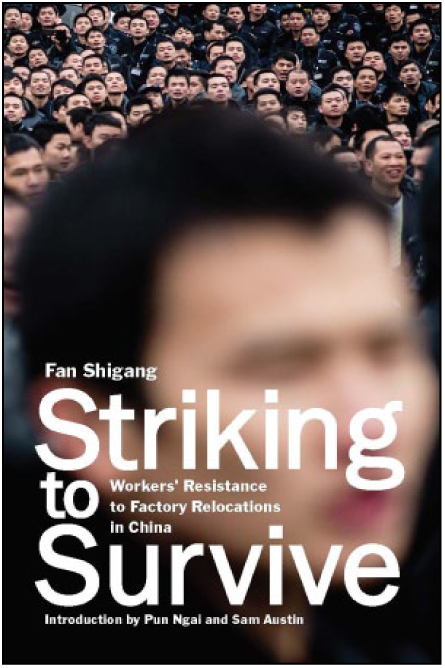
This is a unique book. Written by a worker activist, Striking to Survive documents workers’ struggles in the grassroots Chinese labor movement, employing intensive interviews of workers and their leaders in two factory strikes in South China during the period of 2013 to 2015. It is also timely; China’s labor issues loom large in the country’s economic slowdown and the likely escalating trade war between China and the United States. The vivid experiences of the workers in this book contribute to a much-needed understanding of the plight of Chinese workers in the global economy and their brave resistance to neoliberal capitalism, similar to that of their counterparts elsewhere in the world. Such understanding is of great value for academics, labor organizers, and the general public in and beyond China.
The first strike occurred in Factory D, a Hong Kong-owned manufacturer supplying furniture to multinational corporations such as Walmart. Soon after the New Year holiday of 2013, the boss started to plan the factory’s relocation to another city. The workers, most reluctant to move, began to plan action to win relocation compensation. But the strike, involving hundreds of workers of the entire factory, finally began spontaneously when a worker blocked a truck from relocating a machine. As there was a huge gap in severance pay between what workers had asked for and what the boss was willing to offer, the strike lasted several weeks and involved the workers’ keeping the boss’ vehicles in custody, holding two sit-ins at the sub-district government office and two demonstrations near the factory, and marching to the municipal government to petition. However, the strike collapsed after some workers were detained for several days on their way to the municipal government office.
The second case (told in detail in the appendix of the book) examines two strikes caused by (planned) factory relocation in a Hong Kong-owned garment factory supplying the Japanese clothing brand Uniqlo—one in December 2014 and the other in July 2015. The 2014 strike was initiated by activist workers who were coached by a labor non-governmental organization NGO, with demands for unpaid pension and housing funds, as the employer had not started the relocation yet. After a few rounds of fruitless negotiation, the police arrested some workers and patrolled on the shop floor, under which pressure the workers resumed work with only a small cash bonus from the employer. The 2015 strike, provoked by the dismissal of a worker who constantly asked for unpaid pension contribution, occurred after the factory relocation started. The workers petitioned to various levels of government, which forced the employer to sit at the negotiation table. But the employer firmly refused to pay the relocation compensation demanded by the workers. After the repression of both the government and the employer, particularly the arrest of a few workers and worker delegates, the strike came to an end.
From the perspective of workers, this book complements extant literature on Chinese labor activism with rarely seen insights and nuances. To begin with, while China has witnessed waves of labor unrest since its economic reform, the nature of these protests has been debated. Some suggest a change in the nature of strikes in China from largely defensive—that is, protecting existing rights and benefits—to more offensive—for example, demanding wages and working conditions above or beyond those stipulated by the law; others are skeptical about this shift. The two strikes examined in this book, however, suggest that while China’s economic boom in the past decades had indeed emboldened workers in the world’s factories to fight for more, the economic slowdown and industrial upgrading policies of local governments in recent several years have resulted in a rising number of factory relocations and closures, forcing a return to defensive demands for rights such as legal severance pay and unpaid social insurance contributions.
Another feature of Chinese labor activism is that strikes are largely short-lived, scattered, disorganized, and based at individual factories. Shigang seems to believe that his two cases are similar: “Strikes continue to be spontaneous and collective actions generally exhibit a low level of organization (p. 10).” However, while the two strikes are isolated, they both have significantly longer duration than typical strikes of migrant workers in China, which normally run only hours or a few days, and both are more organized and tactical than a typical spontaneous strike. Although one may still see these two strikes as transient and spontaneous, this view risks overlooking or downplaying the positive changes in the process of worker organizing.
In addition, a few scholars attribute the rising labor unrest in the past years to the second generation of migrant workers (i.e., those who were born after 1980), who are better educated and better-off materially, are supposedly more interested in pursuing personal development and freedom, and are thus more prone to collective action. Nonetheless, this youth empowerment thesis has been challenged by some scholars who do not see any solid evidence. Shigang lends support to the latter view, as the strikers in both his cases are middle- or old-aged workers who are not much different in practice from the young migrant workers studied by others in terms of knowledge of labor rights and courage of collective action. If anything, these older workers tend to be more tactical and determined, as shown in the book.
Perhaps the most important contribution of this book lies in the detailed accounts of Mr. Wu, the worker leader, and seven workers on strike at Factory D, which shed rare light into the process of worker organizing. For most academic studies, how Chinese workers are mobilized and organized without labor unions or other workers’ organizations is largely a “black box.” Through the workers’ own words, Shigang contributes to our better understanding of the changing collective action of Chinese workers in the following important aspects. First, what is the role of laws in Chinese workers’ collective action? Some scholars view laws as central in Chinese workers’ contentious actions, while others disagree by asserting that workers may pursue their interests through industrial action without first resorting to administrative or legal means. Shigang’s findings, to some extent, reconcile the two seemingly contradicting views. On the one hand, the workers were more conscious of laws and the legality of their action, which can be clearly seen from Mr. Wu’s approach toward collective action: “Mr. Wu never encouraged people to do those things [the march, the sit-in, and the march to the municipal government office] (p. 116).” On the other hand, however, they were ready to break the law if an action would help them achieve their goal. As foreman Gong said, “Everyone exclaimed, ‘The township government just detained us that one time . . . We have to go to the municipal government.’” In other words, the workers were paradoxically “unwilling but unafraid to break the law.”
Second, in both strikes the workers took a new strategy of contention, namely worker-led collective bargaining. As an emerging type of collective bargaining in China that is conducted between workers and employers through elected workplace delegates and often involves concerted collective action of workers, worker-led collective bargaining has proved effective in achieving workers’ goals in a few academic studies. In these two strikes, however, the effectiveness of worker-led collective bargaining seems limited. It helped mobilize and maintain the workers to some extent, but eventually failed to solidify the workers to confront the repression of the state and employers. These failures suggest great difficulties in implementing effective strategies. Specifically, as Shigang shows, the workers did not develop strong and broad solidarity for collective action; there was a severe free-riding problem; their sense of efficacy significantly decreased after arrests; many workers distrusted their delegates; and there were disputes regarding collective action strategies, even among workers themselves. For example, Mr. Wu recalled, “Everyday there were also workers who said that we delegates weren’t bold enough and called for us to take to the streets (p. 72).” How can Chinese workers overcome these collective action problems? Shigang takes the first step by identifying these problems. Solutions, however, will require more efforts by workers and labor activists to understand and experiment.
Third, Shigang’s description and analysis of the role of worker leaders are worth noting. Although hidden leadership or informal strike activists exist in some strikes, elected workers’ delegates have been uncommon in China due to legal restrictions on independent worker organizing and fear of repression. Workers’ delegates may emerge out of different backgrounds and with a variety of motives. At Factory D, an election made several foremen the workers’ delegates, who then played a key role in organizing the strike at the beginning. It is not surprising that mid- or low-level managers, thanks to their higher stake in factory relocation or closure such as higher wages and seniority, often have stronger motivation for collective action. In addition, compared to rank-and-file workers, managers tend to have higher authority and capability in mobilizing workers. However, foremen also present serious weaknesses as leaders: They are likely to be paid off by the boss, have strong fear of reprisals, and do not have the courage to confront the government. There was only one common worker elected as a delegate, Mr. Wu, who turned out to be the most important leader of the strike. Whatever their background, workers’ delegates bear disproportional costs and risks in collective action. Without proper mechanisms to supervise and protect workers’ delegates, as suggested by Shigang, it will be difficult for worker leaders to emerge and to play an important role.
Fourth, the author’s discussion of the role of gender in Chinese workers’ collective action is interesting, which supports my own observation from a number of strikes that Chinese female workers tend to be more active, persistent, and brave than male workers. Yet, as Shigang suggests, there may be another explanation for pushing the girls to the very front when fighting the government—that is, to mitigate the state’s violence.
The book also examines the role of three external actors in the two strikes: the All-China Federation of Trade Unions (ACFTU), labor non-governmental organizations, and the state. As the single official trade union in China, the ACFTU has been widely criticized for its failure to represent workers. Even the Chinese Communist Party is not satisfied with its performance in maintaining industrial peace. Shigang’s findings suggest that the ACFTU played little role in either of the strikes, confirming these criticisms.
Emerging in China since the early 1990s, labor NGOs’ major activities include providing workers with various legal services and labor education, helping workers get back unpaid wages, and participating in the corporate social responsibility movement. Since 2011 a few have begun to mobilize workers for strikes and collective bargaining, playing a trade union-like role. Shigang shows how in the two strikes—particularly the strikes at the Uniqlo supplier—the labor NGOs encouraged the aggrieved workers to elect their own delegates to negotiate with their employers and coached the workers in contention tactics, helping mobilize them to sustain their collective action. Yet the capacity of these labor NGOs is extremely limited, making it difficult for them to effectively support relatively large strikes. As Shigang observes, they “are able to make contact with and influence only a small number of militant workers (p. 180).” Even worse, since the state’s crackdown on movement-oriented labor NGOs in Guangzhou in December 2015, many labor NGOs have refrained from mobilizing workers for collective bargaining.
The role of the state is critical in both strikes examined in the book. From the workers’ perspective, Shigang shows how the state skillfully repressed the workers’ collective action. Without their own organization, the workers clearly lacked power to confront the state. It is because of the state’s decisive influence on workers’ collective struggle that Shigang is rather pessimistic about the current state of labor activism in China. “Although workers’ economic and political environment is constantly changing, there have been no significant changes in the form of labor struggles (p. 10).” Perhaps his pessimism is even deeper today given the backward political development and harsher repression of civil society since Xi Jinping has consolidated his leadership.
All told, this book presents real voices of Chinese workers on their living and working conditions and daily struggles. Challenging the popular perception in the United States that Chinese workers are “stealing American jobs,” Shigang reveals that Chinese workers are similarly suffering from job losses and “outsourcing” and fighting for their rights and interests against long odds, much like their counterparts in the United States. The collective action experiences of Chinese workers in a strong authoritarian state might even prove to have value for workers and labor organizers in the United States, given the convergence of the two countries around authoritarian capitalist workplaces. China, the world’s factory, is a mean toward which others may shift—for this reason, this book is not to be missed.