




Abstract

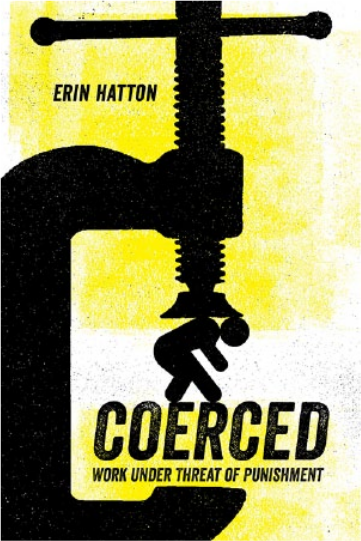
“If you could change one thing about your workplace, what would it be?” Erin Hatton included this classic organizing question among others in her study of prison, workfare, college athletic, and graduate student workers, in order to discern commonalities among those who are not always understood as “workers.” Coerced: Work Under Threat of Punishment is a refreshing articulation of the ways those who hold dual roles—as “workers” and something else—face a special form of coercion from their employers, which Hatton terms “status coercion.” Employers use status coercion to control not only our short-term economic circumstances, but also our futures and life chances. While Hatton makes a compelling case for status coercion as a novel form of labor control, her book does not teach us much about how workers can build power to subvert its influence. This absence largely stems from her analysis of these workers’ self-conceptions vis-à-vis a static analytic concept of “rights-bearing” work, thereby taking much of the modern political economy as a given.
Hatton’s central argument is that employers’ coercive power is seen most clearly in their relationship toward workers who are not always understood as “rights-bearing” workers deserving of employment rights at work. This group includes those who labor in prisons, those workfare workers who work to earn public assistance programs, graduate student workers in labs, and college athletes. While these workers’ labor is quite distinct, Hatton effectively justifies her decision to study their very different workplaces in an effort to demonstrate the wide array of ways in which status coercion plays out through diverse forms of labor. For graduate students and college athletes, advisors and coaches gatekeep their academic and career prospects, forcing them to live under a range of personal as well as professional demands from their bosses. For prison and workfare workers, the coercion is more acute, with supervisors controlling whether or not the latter have access to a social safety net and whether the former will sit in solitary confinement or face an extended prison sentence. Identifying the hegemonic narratives around the criminality of prison workers and workfare workers, on the one hand, and the privilege of college athletes and graduate student workers, on the other, Hatton demonstrates the ways in which privilege and criminality are both deployed to justify stripping workers of their basic rights.
Hatton’s central argument is that employers’ coercive power is seen most clearly in their relationship towards workers who are not always understood as “rights-bearing” workers deserving of employment rights at work.
Hatton makes clear that, at least some of the time, these workers do not passively accept the status-coercion imposed upon them. The book examines workers’ “resistance” and the ways they mobilize their own narratives about “rights-bearing” work to draw attention to the need for change. These narratives, Hatton shows, revolve around themes that struggles for workplace and economic democracy have long advanced—those of work and citizenship, morality and immorality, dependence and independence, productivity and idleness, and rights and rightlessness. At the same time, Hatton found that others accepted the premises, if not the practice, of status-coercion, seeing their work as somewhat distinct from that performed by those who could be classified as traditional workers. In between these two poles were still more who felt they should enjoy some but not all of the rights afforded to many other workers. Hatton could have studied these sets of understandings and the ways in which they can and were martialed for change. However, by focusing on the diversity of the ways in which these workers understood their labor in relationship to “rights-bearing” forms of work, Hatton’s book obscures the reality that nearly everyone wanted to be treated better at work, and that such a desire for change (combined with organization) is what has historically transformed people’s working conditions.
In drawing conclusions about how these workers understood their right to fair wages and working conditions, Hatton relies on a static conception of “rights-bearing” work. As legal scholars have shown, rights-bearing work is a socio-historically and socio-legally determined category, both in terms of the content of those rights and who wins them. While Hatton defines “rights-bearing” workers as those who enjoy specific workplace rights, because of how they are perceived by society and under the law, such a definition misses the ways in which who falls into the ambit of “worker” is subject to changing laws and social understandings. For instance, before the New Deal, workers did not enjoy the legal protections they do today regarding unionization, access to certain social benefits, and basic labor standards. However, Hatton takes this set of rights which emerged through battles between labor and capital as a given, and relies on them to define what “rights-bearing work” is. In her project, the absence of rights-bearing work means a lack of the “typical” (i.e., mid-twentieth century) workplace norms, regulations, and employment protections that provided workers with recourse to unions, human resources departments, and basic privileges and protections. But after decades of intensifying employer hostility, it would be a stretch to consider them anything like a norm today. The gap separating those employed in “rights-bearing work” and those not, then, is rapidly narrowing. In such a context, imagining a new legal paradigm in which all workers have the right to organize—whether it be the Protecting the Right to Organize (PRO) Act or something that emerges out of new workplace struggles—may be more profitable than stressing workers’ self-conceptions vis-à-vis mid-twentieth-century rights-bearing work.
. . . [I]magining a new legal paradigm in which all workers have the right to organize . . . may be more profitable than stressing workers’ self-conceptions vis-à-vis mid-twentieth-century rights-bearing work.
Why does not Hatton spend more time considering how such workplace organizing might be made possible? The simplest explanation is that that is not the book Hatton set out to write, and that her concern lies instead with employers’ powers of status coercion and workers’ resistance in situations where they have little recourse. In the ongoing struggles between labor and capital, she seeks to better understand capital’s tools. As such, she is above all interested in the ways in which the state deploys certain narratives and ideologies to make “docile yet productive bodies” among a wide swath of workers in the criminal justice, welfare, and education systems. However, these narratives offer something more than hegemony and forms of resistance. They also suggest a means for addressing the serious workplace issues and mistreatment that the prison workers urged Hatton to highlight, or the ways in which college athletes and graduate student workers are already organizing for more rights. Each and every worker can organize to win workplace rights, whether or not the law of the time sanctions those rights. Hatton’s demonstration that a substantial group of workers conceive of themselves as without rights at work, as dependent on their supervisors, as lacking in full citizenship without sufficient responsibility at work, offers not only a vision of workers’ diverse and perhaps contradictory understandings of their work. It also, and more importantly, presents a set of understandings that can be martialed for expanding the rights that those workers currently have.
A theory of rights-based work must attend to the question of how workers’ agency changes over time, for without attention to legal and historical contingencies, we miss potentials to organize and ways that people can win better working conditions despite status coercion. Most workers that I have an organizing conversation with believe that they do not have enough rights, that they are paid too little and work too much, that they do not have enough decision-making authority or autonomy in their work, and for international student-workers specifically, that they are subject to incomplete rights that intersect with immigration status. These are the issues that motivate workers to organize. The rights we do win are not static, but something we must continually enforce and expand upon through collective action. In academic student employee organizing, for instance, tens of thousands of workers are joining unions and winning more rights because of it, including independent recourse, in a system that Hatton rightfully describes as often without remedies when problems arise. College athletes have been calling for change to their exploitative working conditions for years, and as UCLA football player, Otito Ogbonia, said at a recent UAW 2865 event on austerity at the university: “There is power in asking for things as a collective . . . they would not be able to cut every single one of us, suspend every single one of us.” Hatton’s own research shows the legal mobilization that both prison and workfare workers are turning to, offering a starting point for demanding more rights in concert with organizations like the Incarcerated Workers Organizing Committee.
The state is not only a body making “docile yet productive bodies”—it is also composed of the prison, workfare, and university workers who do the work that reproduces it. Status coercion is the latest in a long line of labor control techniques, but workers—whether we currently bear rights or not—have the power to change our working conditions. For those who read Erin Hatton’s book, I hope they are inspired to understand coercive institutions—whether prisons, universities, or any other site of intensive exploitation—as places that are made and remade by workers. Without foregrounding the ways in which workers always have the potential to organize and transform “rights-bearing” work, we are liable to overlook the fact that every workplace organizing drive includes some who initially understand differently than others that we deserve more rights, we can organize others, and we can change more than one thing about our workplaces.
