




Abstract

French economist Thomas Piketty once wrote something puzzling: “In North America, there is no nostalgia for the postwar period because the Trente Glorieuses never existed there.” On the surface, this is clearly wrong: much of American politics and culture is animated by nostalgia for a postwar period when America was great, overlapping more or less with what the French call the “thirty glorious years” of 1945-1975. This was the golden age of capitalism, the era of the New Deal consensus, when growth was strong, inequality low, and manufacturing employment plentiful and well compensated.
But if you ever flip through magazines or documents from the postwar years, you might find yourself thinking that Piketty was actually onto something. Before the 1960s, recessions were regular and growth was, by global standards, low. To those then living, it was no doubt a relief that depression-level unemployment and total war did not return. But there was still unemployment and there were still wars, and the moments when unemployment was lowest were when the Cold War turned hot. From 1958 to 1964—seven entire years at the heart of the supposed golden age—quarterly unemployment never fell below 5 percent (about a third of that time, it was above 6 percent.)
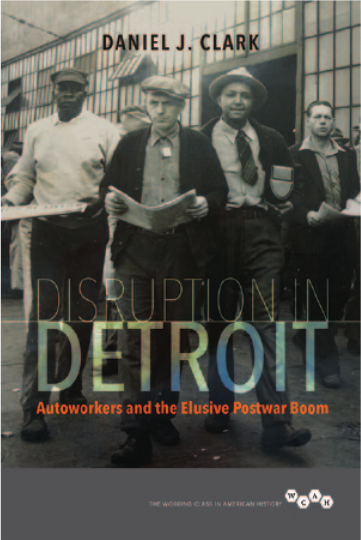
In Disruption in Detroit, Daniel J. Clark fleshes out this sense that the good times were not so great with a detailed look at the Motor City’s auto industry from 1945 to 1960. If anyone fit the image of a well-off postwar working class, surely it should be the employees of the paradigmatic Fordist industry, the signatories to the epoch-making Treaty of Detroit. But in oral histories with forty-two former autoworkers, Clark was struck that “job instability and economic insecurity dominated these workers’ lives during the supposed postwar boom.” The subjects spent much of their time in the 1950s “trying to be autoworkers,” but frequent layoffs meant they often had to do something else (Clark lists a few dozen of their side hustles, ranging from “promotional event searchlight officer” to “trailer home washer”). Most of his interviewees, moreover, were white men, so this precarity could not be explained by the era’s ascriptive boundaries.
In Disruption in Detroit, Daniel J. Clark fleshes out this sense that the good times were not so great with a detailed look at the Motor City’s auto industry from 1945 to 1960.
To verify the impression he got from oral histories, Clark read a large volume of coverage from three Detroit newspapers, including the African-American weekly Michigan Chronicle. What he found corroborated his sense that “the auto industry in no way provided stable employment and secure, rising incomes.” Reading a chapter called “‘The Fifties’ in One Year, 1955” and another called “The Nadir, 1958” tells you something about history that you could not get from a more general account of “auto workers in the mid-to-late 1950s.” The alternation not only gives some sense of the instability of workers’ lives but also a hint of the underlying laws of motion: one year’s record-breaking production becomes next year’s glut, and labor scarcity and efforts to recruit new workers give way to labor surplus and attacks on southern migrants and working mothers.
Besides the ups and downs of the business cycle, the year-to-year analytic captures the volatile impact of the Cold War. Clark takes his title from a line in the Detroit Free Press in December 1950: “The war planners in the Pentagon say firmly that ‘there will be disruption in Detroit employment in 1951.’” In contrast to the high watermark of the World War II mobilization, the Cold War at best had mixed effects. Yet at least since Thomas Sugrue’s Origins of the Urban Crisis (1996), historians have recognized how early deindustrialization began in Detroit. Maybe the period’s real labor aristocracy is to be found in the place where capital went, like Southern California, where the aircraft-cum-aerospace industry would soon pass auto as the nation’s leading sector.
Be that as it may, the tight focus on Detroit yields a finely textured portrait. In under 200 pages, Clark offers frequent illuminating glimpses into social history. The classic Fordist formula—paying workers enough to buy what they made—did not prevail in postwar Detroit. On the unrealistic assumption of steady full-time employment, the average industrial worker in Detroit made $3,345 annually in 1950 (less than $40,000 in 2020 dollars). The parlous economics of middlemen is a running subplot. The manufacturers forced their franchised dealers to buy up surplus cars, often taking on debt in doing so. In turn, the franchisees exported unsellable new cars at cost to used-car dealers in other cities (a practice called “bootlegging”). Only the extension of credit could possibly provide adequate final demand, but abrupt changes in credit conditions could then ruin dealerships. All this is a reminder that the consumers’ republic had not yet solved the problem of underconsumption. Out of this context emerged the discounted employee leasing programs, which decades later help to defeat organizing drives at auto plants in the U.S. South: some companies have apparently learned the value of letting workers drive what they make.
Another thread outlines the worlds beyond the factory gates that enabled workers to survive layoffs or strikes. Michigan’s unemployment benefits offered some support, but eligibility requirements excluded precisely the most precarious. Casual labor absorbed some surplus, as when thousands of laid-off autoworkers competed for the chance to shovel the city streets by hand in the winter 1950. In 1955, Ford invited the press to a retirement celebration for sixty-five-year-old Jim Wolfe, who despite working thirty years at Ford had never owned a car. Wolfe told the audience that his pension and social security would provide just $151 a month. “It is going to be a tight squeeze,” but his son “has a concrete business and maybe I can help him out.” Workers who had somewhere else to call home often left. In 1950, Greyhound tripled its southbound bus service out of Detroit; in 1958, reverse migration swelled the population of Harlan County, Kentucky by eighteen thousand.
Chronic unemployment had qualitative meanings not captured by the ticker of economic statistics. Throughout Clark’s book, one finds testimonies to the relationship between full employment and social equality. In the brief periods of labor scarcity, the barriers of discrimination were lowered, if never torn down: white women, Black men, people with disabilities, middle-aged people, and Southern migrants all report being able to find work more easily during booms. When downturns came, the most recently hired were the first to lose their jobs. Reflecting the industry pattern of discrimination, Clark’s forty-two interviews include three Black men and no Black women.
The book’s narrative closes abruptly in 1960. Perhaps there was a boom in the 1960s, Clark writes, but if so “it could hardly have been a postwar boom unless it had a very long fuse, and it could not have lasted very long given the oil crises and increased competition in the 1970s.” This is well put. The historian Nelson Lichtenstein has called the mid-1960s “the high noon of American capitalism in this century” as well as the “years of opportunity for the UAW [United Auto Workers],” an interpretation that Clark echoes by noting that his interviewees came to identify with the UAW only after the period he writes about.
. . . [T]here was no unified “postwar” golden age, but rather an exceptional 1960s experience sandwiched between two periods of higher unemployment.
Clark’s suggestion that the golden age did not really start until the 1960s reminded me of an argument from a surprising source: Christina Romer, the Berkeley economist and former head of the Obama’s Council of Economic Advisers. In a pair of articles, Romer has sought to “rehabilitate” the restrictive monetary policy of the 1950s and deplore the consequences of the 1960s “mistaken revolution” in macroeconomics. She explicitly praises “the low-inflation 1950s and post-Volcker 1980s and 1990s”—both periods in which central bankers raised interest rates aggressively at the first sign of inflation—while denouncing the full employment commitments of the 1960s and 1970s. Politically, it is notable that a liberal (by economists’ peculiar standards) is so enthusiastic about Republican economic policy, and so disdainful of American liberalism in its heyday. But analytically, it is striking that she agrees with Clark: there was no unified “postwar” golden age, but rather an exceptional 1960s experience sandwiched between two periods of higher unemployment.
However one characterizes the three or so decades after 1945, we are still left with the question of what came next—namely, the post-Volcker period in which we are arguably still living. In September 2019, forty-eight thousand UAW members struck GM and stayed out for forty days. This was the first strike in the industry since the near liquidation of GM and Chrysler during the Great Recession. The subsequent government rescue worked as far as the corporations were concerned: 2015 and 2016 saw record-breaking production levels and the industry has been profitable year after year. This return to solvency was achieved through significant union concessions (Obama instructed his auto team, “I want you to be tough, and I want you to be commercial”).
Looking back from 2015, Obama’s economists were “thrilled and relieved with the result.” The same year, the generally pro-labor Economic Policy Institute issued a paper celebrating the UAW’s transition from “a union that primarily threatens to withhold labor to one that primarily enables work.” The GM strikers evidently found reasons to go back to withholding labor. As widely reported, workers who walked out felt that their concessions in 2009 should have bought them a better deal once business turned around, especially given their elected government’s role in restoring profitability. The problem was that, as the sociologists Josh Murray and Michael Schwartz have observed, the industry’s newfound profits were distributed upward in dividends and stock buybacks rather than reinvested in domestic manufacturing. Plants continued to close even before the current recession.
Especially for younger workers on the wrong side of the UAW’s two-tier contract, life increasingly resembles the precarious 1950s. Labor journalist Steven Greenhouse, in his recent book, Beaten Down, Worked Up: The Past, Present, and Future of American Labor (reviewed by Gabriel Winant New Labor Forum, Vol. 29 Issue 1), records a discussion with Jennifer Sanders, a fifth-generation UAW member. Sanders scrambles clichéd images of the labor market: unlike most college-educated millennials, she holds factory job, but like many others in our generation, she had to live with her parents for years after she started working at GM. Like Clark’s protagonists, she has been “repeatedly laid off, sometimes for months.” Greenhouse’s interview, conducted in 2015, foreshadows the 2019 strike as Sanders describes her frustration with the two-tier system and the divergence between profits and working conditions. For Sanders, it is not the 1950s but the cohort including her father, a skilled worker born around 1960, that represents the pinnacle of “essentially middle class” auto work. Perhaps because of her family’s deep connection to the industry, she confirms the “revisionist” argument that the 1950s were no golden age, as well as the intuition that decade has something in common with our own.
The nostalgia for the 1950s that pervades American politics is clearly misguided. But this does not make the decade irrelevant. What lessons might we draw from this recognition? One is the importance of political economy and the need for careful study of the business cycle. Indeed, we might make a comparison between it and the last decade (2010-2020), which is often subsumed under a general periodization of secular stagnation but in fact showed considerable variations. Labor markets did tighten over the course of the recent business cycle, partly as the result of state management (specifically, the ability of the Trump administration to expand deficit spending in a way that President Obama was unwilling or politically unable to do after 2010). The relative strength of the economy, in turn, helps explain the surprisingly strong support for Trump’s reelection (as Mike Davis has noted, “jobs and income were the major factor in the ‘soft Trump’ vote”). To recognize these cyclical dynamics is not to deny the broader context of slow growth, nor to imply that state control of the economy is total. But today, as in the 1950s, it is hard to understand reality without some theory of the political business cycle.
