




Abstract

Keywords
Edenpictures, Flickr
SAG-AFTRA picket, Union Square, New York, July 17, 2023.
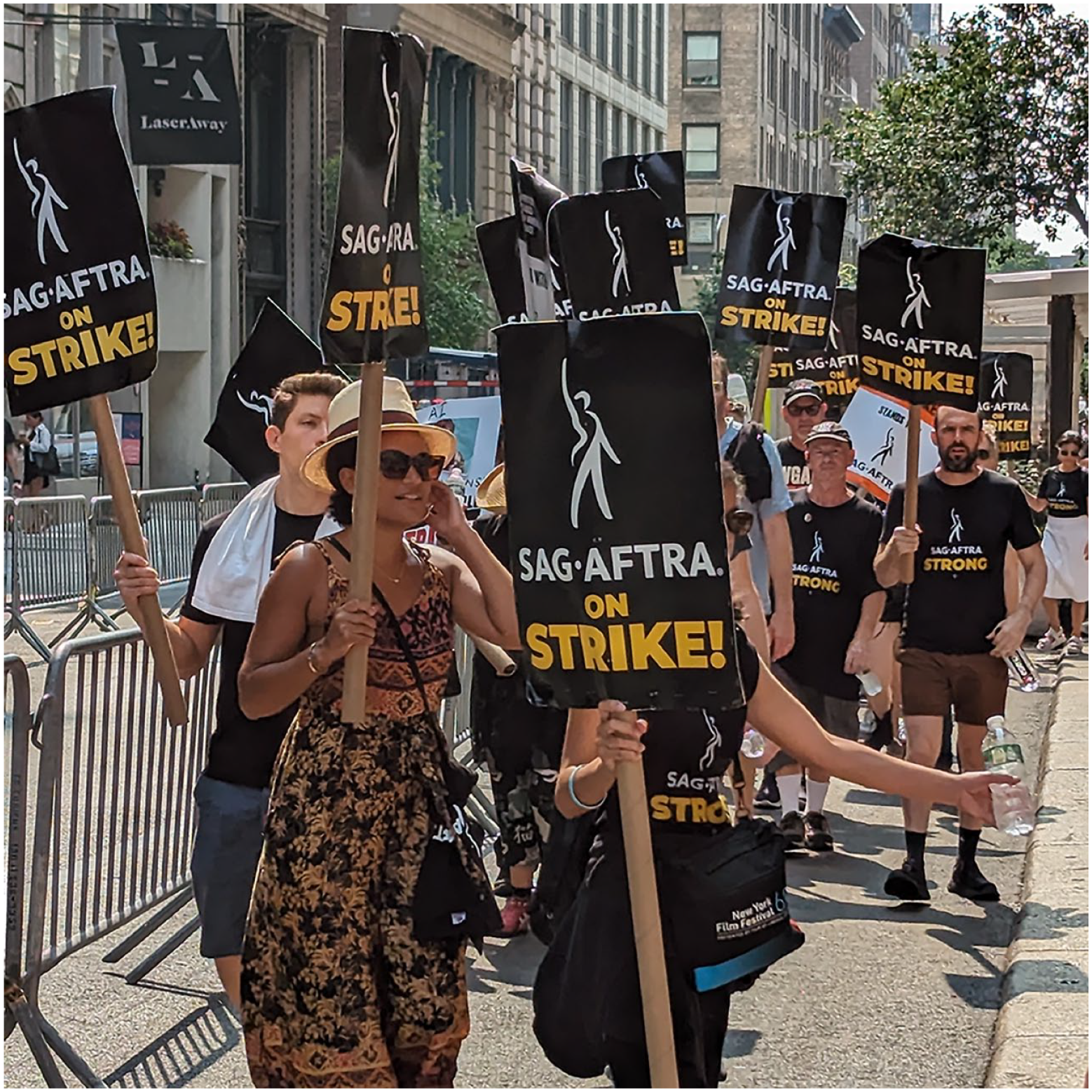
For 118 days last year, Hollywood’s film and television actors traded their usual routine of reciting scripted dialogue and walking red carpets for reciting union chants and walking picket lines. On November 8, 2023, they ended their longest strike in history after the Screen Actors Guild-American Federation of Television and Radio Artists (SAG-AFTRA) secured a tentative agreement on a new, three-year contract.
Involving some 160,000 actors—including day performers, background extras, and A-list stars—the SAG-AFTRA strike was the largest and most visible work stoppage in a year that saw more than half a million U.S. workers stage over 400 strikes. 1 Coupled with the overlapping Writers Guild of America (WGA) strike, which lasted 148 days, the Hollywood shutdown cost the national economy an estimated $6 billion in lost consumer spending. 2
With beloved celebrities standing alongside their fellow union members to collectively shut down one of the most important industries in our economy and culture, the SAG-AFTRA strike was a high-profile lesson in solidarity to millions of film and TV fans who also happen to be workers. Thanks to Hollywood’s omnipresence, the strike garnered more attention than any other U.S. work stoppage last year. What’s more, because the union was confronting dramatic technological change in the workplace—namely, the introduction of artificial intelligence (AI)—the strike and the new protections it achieved offer a potential model for workers and unions in numerous other industries impacted by AI.
The actors’ strike began on July 14, 2023, after the Alliance of Motion Picture and Television Producers (AMPTP), the trade association with which SAG-AFTRA and other entertainment unions negotiates, rejected the union’s core proposals, which aimed to tackle the dramatic transformations Hollywood is undergoing as it is gradually swallowed up by Silicon Valley and Wall Street. Indeed, the union largely blamed the breakdown in negotiations on the notoriously anti-union attitudes of big tech companies like Netflix, Amazon, and Apple, which have become powerful entertainment industry players in just the past decade.
While Hollywood executives have always prioritized profit-making over art, thanks to union protections they have long been forced to provide actors with a certain measure of economic stability while respecting their craft. But with tech companies determined to churn out a maximum amount of “content” for their streaming services and other online platforms to get more clicks, advertisers, and subscribers—combined with newer, faster methods to create such content using computer-generated imagery and AI—the work of actors is becoming increasingly unstable and de-professionalized. 3 Since the pandemic, casting calls have switched to being unpaid and done almost entirely remotely instead of in-person and with compensation, as they used to be. This means anyone anywhere with basic recording equipment can submit a self-taped audition, leading to an explosion in the labor supply. For example, the online casting platforms Breakdown Services and Talent Systems host a combined 2.7 million actor profiles. 4
With such drastically increased competition for parts, along with reduced residual payments due to the rise of streaming, real wages for working actors have fallen, forcing them to juggle multiple side hustles to get by. A full 86 percent of SAG-AFTRA members do not make the minimum $26,470 per year needed to qualify for the union’s healthcare plan—illustrating how most Hollywood performers suffer the same kinds of precarity as many other U.S. workers. 5
Going into contract negotiations last summer, the union was determined to address these and other issues by demanding significant pay increases, improved streaming residuals, and protections around the growing use of AI. A strike authorization vote passed with a whopping 97.91 percent approval in early June. What’s more, 300 of SAG-AFTRA’s most high-profile members—including Meryl Streep, Mark Ruffalo, Julia Louis-Dreyfus, Quinta Brunson, Brendan Fraser, Jennifer Lawrence, and Bob Odenkirk—sent a letter to the union’s leadership urging full preparation for a strike. “We feel that our wages, our craft, our creative freedom, and the power of our union have all been undermined in the last decade,” the letter stated. “We need to reverse those trajectories . . . This is not a moment to meet in the middle, and it’s not an exaggeration to say that the eyes of history are on all of us.” 6
On Strike
Negotiations between SAG-AFTRA and the AMPTP broke down on July 12. The actors went on strike two days later, giving a boost to the 11,500 members of the WGA who had already been on strike since May 2, 2023, to secure a new contract of their own. It was only the second time in history that Hollywood’s actors and writers staged a simultaneous work stoppage. The other time was in early 1960, when future union-buster-in-chief Ronald Reagan was the president of SAG. Not wanting to appear too militant, striking actors that year had refrained from walking picket lines and went ahead with attending the Oscars ceremony. 7
This time, actors proudly and energetically picketed outside the studio lots and corporate offices of the big film and TV companies in Los Angeles and New York. Because of the centrality of Hollywood in our culture, the entire country—and indeed much of the world—was forced to take notice of the strike. Production on sets at major studios was shut down, including on-location shoots around the globe. Fans of popular television series like Stranger Things, The White Lotus, Euphoria, and American Horror Story learned they would have to wait longer than expected for new seasons to be made, while the making of anticipated movie sequels like Deadpool 3, Gladiator 2, Avatar 3, and Beetlejuice 2 was delayed. Furthermore, SAG-AFTRA members held back on promoting their completed shows and movies, meaning no interviews or social media posts related to their projects and no participation in film festivals or awards ceremonies. As a result, the Emmy Awards show was postponed from September 2023 to January 2024.
The work stoppage was even drawn into the cultural phenomenon known as “Barbenheimmer,” the simultaneous release of two of 2023’s most popular and acclaimed films: Barbie and Oppenheimer. The London premiere of Oppenheimer on July 14 coincided with SAG-AFTRA’s announcement that the strike was starting, prompting the film’s stars to walk out of the ODEON Luxe Leicester Square Cinema before the movie was played. “They’re off to write their picket signs . . . in the struggle for fair wages for working members of their union,” director Christopher Nolan told the audience. At Barbie’s London premiere two days earlier, star Margot Robbie told reporters she was “absolutely” prepared to strike, adding, “I’m very much in support of all the unions.” In September 2023, Robbie joined other strikers in a SAG-AFTRA and WGA march from Netflix Studios to Paramount Studios in Los Angeles. 8
The AMPTP apparently hoped to wait out the twin strikes. Revealing Hollywood bigwigs’ same contempt for worker organizing as other bosses in the U.S. economy, an anonymous studio executive told a reporter: “The endgame is to allow things to drag on until union members start losing their apartments and losing their houses.” 9 But the strikers remained resolute, with stars like Streep, Dwayne “The Rock” Johnson, Leonardo DiCaprio, Oprah Winfrey, Julia Roberts, and Ben Affleck each donating $1 million or more to a SAG-AFTRA emergency financial assistance fund to help members struggling to pay their bills. 10
Actors also had the support of the Teamsters and International Alliance of Theatrical Stage Employees (IATSE), whose respective memberships of camera operators, gaffers, costumers, makeup artists, mechanics, animal wranglers, drivers, and others were put out of work by the strike. Members of SAG-AFTRA, the WGA, and Directors Guild organized fundraisers to provide financial support to unemployed “below-the-line” workers and the crew members who work on the set of movie productions, with some celebrity performers auctioning off their personal time and presence to fans in exchange for donations to the hardship fund. (For example, someone gave $24,550 to have dinner with Odenkirk and his Mr. Show costar, David Cross). 11
Such solidarity stands in stark contrast to the 1980 actors strike, when the Teamsters and IATSE held counter-pickets to demand SAG and AFTRA (which were separate unions until a 2012 merger) immediately end the strike so crew members and drivers could return to work. 12 It also contrasts with the ugly history of Hollywood craft unions feuding over jurisdiction and crossing each other’s picket lines, which was especially common in the 1930s and 1940s as the film industry first began to unionize in earnest. These feuds were notoriously symbolized by a violent brawl outside Warner Bros. Studios in October 1945 between members of IATSE and the now-defunct Council of Studio Unions, an embarrassment for organized labor that gave congressional Republicans political ammunition to pass the anti-union Taft-Hartley Act two years later. 13
The SAG-AFTRA and WGA strikes also had widespread public approval from film and TV fans who could relate to the economic hardships faced by Hollywood workers. A Data for Progress poll released on August 18 found that 67 percent of likely U.S. voters supported the strikes, with only 18 percent opposed. President Joe Biden weighed in on the side of the unions, with a White House spokesperson saying, “The president believes all workers—including actors—deserve fair pay and benefits.” Senator Bernie Sanders took to social media to express solidarity with the actors and writers. “Wealthy studio executives would rather see workers lose their housing than pay them what they deserve. Greed, greed, greed,” Sanders wrote on Twitter. 14
Facing public pressure, the ongoing production shutdown, and unprecedented unity between Hollywood unions, the AMPTP was finally forced to settle—first with the writers in late September, then with the actors in early November.
Thanks to pay increases secured by SAG-AFTRA that are higher than what actors have typically won in past contracts, in the first year of the new agreement, background actors will see an 11-percent raise to their minimum pay, and day performers will get a 7-percent increase. Both groups of performers will get 4-percent and 3.5-percent raises in years two and three of the agreement. Perhaps more significantly, the actors’ guild extracted concessions from the studios and streamers on two of the most contentious issues in their bargaining: streaming residuals and AI.
Streaming Residuals
Residuals, or payments for recorded material that continues generating revenue through reuse, have long been a major focus of collective bargaining for SAG-AFTRA. As media studies scholar Kate Fortmueller writes in Below the Stars: How the Labor of Working Actors and Extras Shapes Media Production, residuals “had to be continually renegotiated” throughout the history of Hollywood unions with the periodic introduction of new technologies like television and home video. 15
During the 1960 strike, Universal Studios chief Lew Wasserman initially dismissed the idea of residuals by reputedly quipping, “I don’t pay my plumber every time I flush my toilet.” But feeling the pressure of that work stoppage, Wasserman became the first studio boss to agree to residuals—specifically for movies replayed on TV—and his fellow moguls soon followed.
In the decades since, residuals have been calculated based on how much revenue a given movie or television show brings in: The more successful a project is, the more money actors get in residual payments. But in the relatively new world of streaming, residuals have been paid at a flat rate unrelated to whether a movie or series is a hit, meaning artists stand to substantially lose out if their projects rake in big money, with the profits being hoarded by executives.
Emmy-winning actor Aaron Paul made headlines during the strike when he revealed that he does not “get a piece” of the pie for the massive popularity of his series Breaking Bad as it streams on Netflix. “Shows live forever on these streamers, and it goes through waves,” Paul explained from the picket lines in September. “I just saw the other day that Breaking Bad was trending on Netflix. I think a lot of these streamers, they know that they have been getting away with not paying people a fair wage, and now it’s time to pony up.” 16
SAG-AFTRA’s fight over streaming residuals was perhaps ultimately less about money than it was about transparency. Box office receipts and Nielsen ratings are used to gauge the success of titles released through theaters and traditional TV, which in turn allow residuals to be calculated based on a project’s financial performance. But there is no equivalent measurement of success for titles watched on streaming services. Streaming companies are notorious for hiding (or only selectively disclosing) the viewership numbers of individual films or shows, instead only reporting their overall number of subscribers. This not only makes it easier for streamers to withhold fair residuals based on a title’s success but also spares them embarrassment and loss of investor confidence when a program they were banking on underperforms expectations. 17
The union initially proposed using a third-party data analytics company to track viewership numbers and then compare them to the streamers’ publicly available revenue figures. Upon determining how much revenue any given show or movie generated, according to the proposal, the streamers would pay the cast 2 percent of that amount in residuals. Loath to open their books in this way, the AMPTP adamantly rejected this suggestion at the bargaining table for months.
Under the compromise ultimately reached, streamers will disclose data to SAG-AFTRA indicating the total number of hours subscribers spent watching individual titles (data that will be kept private and subject to a confidentiality agreement). If a movie or series garners views amounting to at least 20 percent of the streaming service’s U.S. subscribers within the first 90 days of its release—effectively making it a hit—the actors involved will earn a “bonus” that doubles their normal flat-rate residual. A quarter of that bonus will go into a fund jointly administered by SAG-AFTRA and the AMPTP to be distributed to other performers whose films or shows did not break the 20-percent viewership threshold. The union estimates the bonuses will add up to a total of $40 million per year, meaning about $10 million each year will go into the fund.
While SAG-AFTRA did not get the 2 percent of streaming revenues it initially sought—and although breaking 20-percent viewership will be a steep climb for titles on platforms like Amazon Prime, which has nearly 170 million U.S. subscribers (many of them presumably more interested in free shipping than watching shows)—the union still counts the new bonus system as a groundbreaking victory. 18
“It didn’t matter the mechanism, it didn’t even matter the amount,” SAG-AFTRA president Fran Drescher explained after the tentative agreement was reached, noting that what ultimately counted most was getting “into a new pocket” of streaming revenue for actors. 19
“This was a way to negotiate to get them to hand over some data,” David Offenberg, an entertainment finance professor, told Deadline. “It’s not perfect . . . but [the union is] getting data. And with that data, I think they’re going to be able to negotiate for much more in the years to come.” 20
Artificial Intelligence
Generative AI could prove to be the biggest technological shakeup to hit Hollywood since the introduction of talking pictures a century ago. From scriptwriting to performances to shooting and editing, “talkies” completely upended the way movies were made and—as dramatized in the classic Singin’ in the Rain—ended the careers of many silent film stars. With the ability to generate scripts and digitally scan performers, AI may similarly upend the entertainment industry very soon, a fact not lost on SAG-AFTRA going into this round of negotiations.
“I believe this is the last time any labor action will be effective in our business,” former SAG-AFTRA board member Justine Bateman wrote last May. “If we don’t make strong rules now, they simply won’t notice if we strike in three years, because at that point, they won’t need us.” 21
Thanks to the strike, the union secured protections around the use of AI. For example, the new contract requires studios to obtain actors’ consent before scanning their faces or bodies to create and use digital replicas of them, giving a “reasonably specific” description of the replicas’ intended use and providing the actor at least one day’s pay plus residuals.
In addition, the agreement defines the terms of use of “synthetic performers,” or AI-generated digital objects meant to look and sound like humans, but not replicas of real actors. Any time the studios intend to use synthetic performers for human roles, they must first inform SAG-AFTRA and provide the union with an opportunity to bargain for consideration of casting real actors instead. 22
These are basic protections that were not in place before the strike, but some in the union hoped the new contract would go further. Bateman, who has consistently warned about AI, was critical of the new contract for allowing the use of synthetic performers at all. “Having that in there would be like if the Teamsters said that it’s okay to use self-driving trucks instead of them . . . It would be like the WGA saying it’s okay if ChatGPT authors full scripts,” she said. “That’s an object. That’s not a person, not going to be paid, not paying dues to the union, you’re not going to have pension and health contributions on behalf of that object.” 23
Ann-Marie Johnson, a SAG-AFTRA board member who voted against sending the tentative agreement to the general membership for ratification (along with at least seven other dissenting board members), agreed with Bateman. “Only human beings should be used in what we create for public consumption,” Johnson said. “Without staving off AI, everything we achieved is for naught.”
Acknowledging that the agreement is “not perfect,” SAG-AFTRA chief negotiator Duncan Crabtree-Ireland accurately noted that “there has never been a time when we have been able to successfully just block technology from advancing . . .. Strategically, our best option is to channel that technology in the best possible direction.” 24
Although it does not go as far as some members had hoped, the union’s contract language on AI sets an important precedent by placing any limits at all on how the new, mostly unregulated technology is used in the workplace. It establishes a baseline that SAG-AFTRA can potentially build on in future contract negotiations to win more protections, while also serving as an inspiration to unions in other industries concerned about AI where no such limits currently exist.
After all, whether or not the new technology replaces workers in existing jobs is something that will be determined by human decisions. As Signal Foundation president and AI Now Institute cofounder Meredith Whitaker recently argued, “AI isn’t going to autonomously replace people’s jobs as a product of scientific innovation.” Whitaker contends that unions—and specifically higher union density—are workers’ best defense against the potentially negative impacts of AI. 25 In that sense, SAG-AFTRA’s hard-fought gains around AI can be considered the beginning of a much bigger, longer fight by a resurgent labor movement.
The Future
Despite the misgivings by some, SAG-AFTRA members voted to ratify the agreement on December 5, 2023, with 78-percent approval. Although the language around streaming residuals and AI did not go as far as many actors had initially hoped, the strike unquestionably pushed the studios and streamers to make concessions that were off the table when negotiations began. Whether the AMPTP learned any lessons from this experience will be revealed later this year, as the IATSE and the Teamsters contracts are both set to expire on July 31.
Besides the contract gains, the SAG-AFTRA and WGA strikes appear to have helped inspire non-union Hollywood workers to seek union representation. Last fall, visual effects artists at Marvel Studios and Disney voted to unionize with IATSE. Meanwhile, SAG-AFTRA has expressed support for reality TV performers hoping to unionize as well. 26
The high-profile nature of the strikes arguably gave added encouragement to workers beyond Hollywood in their own contract fights last year, including at UPS and the Big Three automakers. In southern California, members of SAG-AFTRA and the WGA joined the picket lines of striking Amazon drivers with Teamsters Local 396 and striking hotel workers with UNITE HERE Local 11. In Chicago, SAG-AFTRA members—including star Sean Astin—participated in a solidarity rally with members of SEIU Healthcare on strike at a safety-net hospital. In November, SAG-AFTRA members in New York joined a rally of striking baristas with Starbucks Workers United. 27
Perhaps one of the most important outcomes of the strikes is that movie and television viewers have now learned that a majority of screen actors and writers face the same kinds of economic struggles they do. With such knowledge may come an intentional demand from audiences for art and entertainment thoughtfully crafted by fairly compensated, dignified workers—and not mere “content” spewed out by computer algorithms.
Footnotes
Declaration of Conflicting Interests
The author(s) declared no potential conflicts of interest with respect to the research, authorship, and/or publication of this article.
Funding
The author(s) received no financial support for the research, authorship, and/or publication of this article.
