




Abstract

The current prime minister of Pakistan, Shahbaz Sharif, of the Pakistan Muslim League Nawaz, one of Pakistan’s three major parties, seen in 2017.
From Wikimedia Commons
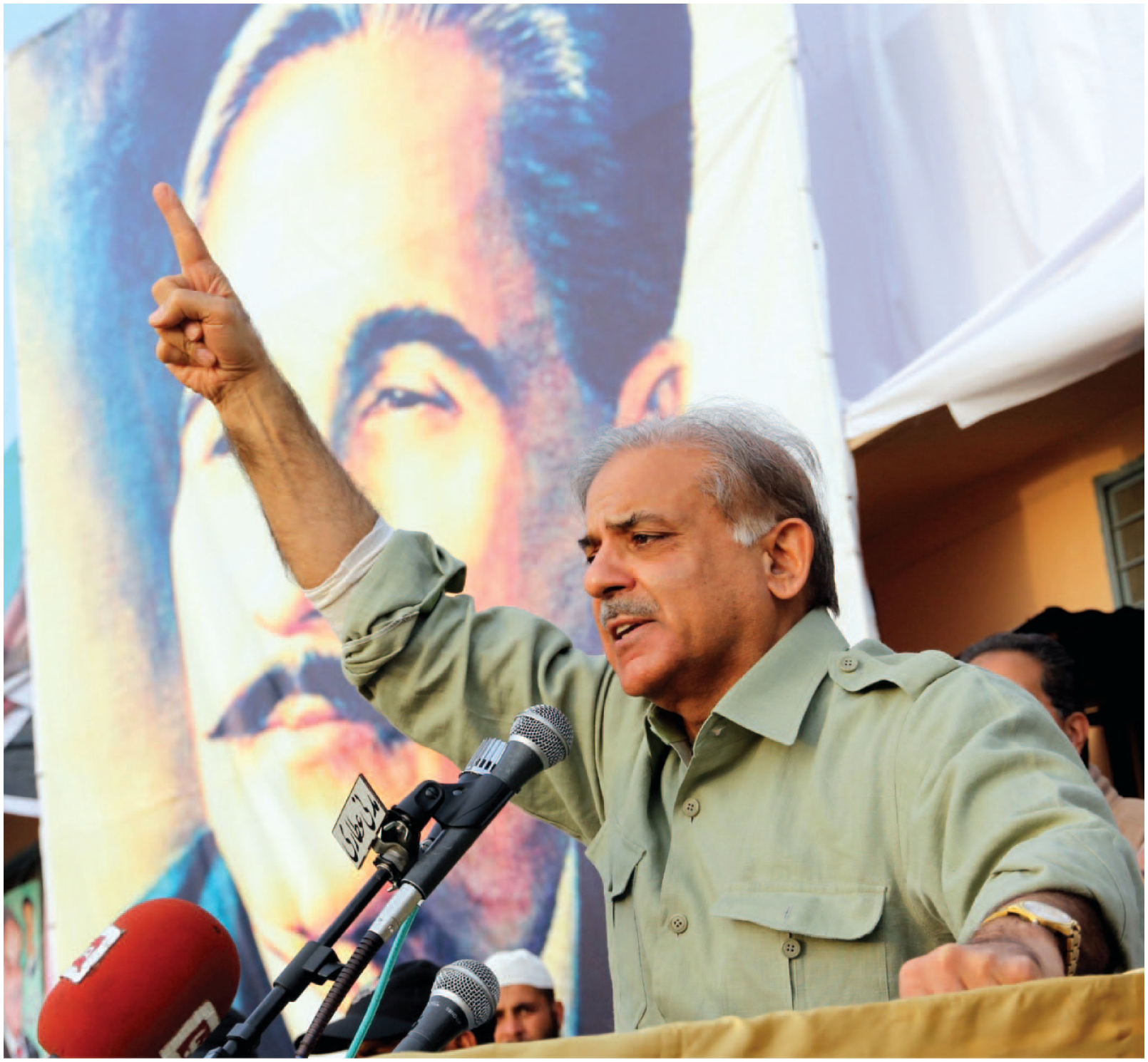
In Pakistan’s seventy-seven-year history, there has not been a single election that one could confidently claim to be free of controversy. The general elections held on February 8, 2024, were no different. The military, which has dominated the country’s politics since its founding, won yet another battle to protect its interests and its preferred candidates, despite its primary opponent, the former Prime Minister Imran Khan, who was seemingly on course to a major victory.
But it appears the limits of the military’s power are perhaps finally being tested. The pre-election polls showed a clear rejection of the military’s longstanding power, preceded by months-long protests over the imprisonment of Imran Khan, and an increasing appetite among the masses for a new social contract.
At the same time, there are many aspects of Pakistan’s social and political life that the election rhetoric, party positions, and media coverage did not reflect at all—including historically high rates of inflation, unemployment, and stagnant wages. Conversations were focused on the fight within the civil-military elite. The state’s policy of quashing public grievances and dissent with military force continues after the elections. This article will attempt to make sense of the moment and seek to address key questions: To what extent did the elections reflect real issues facing the country? What is the situation of working-class political mobilization? Why is not there a left alternative (that includes labor) on the national scene? And most importantly, where is Pakistan headed from here?
The Long Reign of the Military
When Pakistan came into existence in August 1947, and was grappling with the intense task of forming entirely new institutional frameworks, the military, inheriting a colonial institutional legacy from the British, was relatively small but well trained and organized. The country faced low growth, inflation, and fiscal deficits during the 1950s, in addition to a series of unelected prime ministers. In 1958, the military imposed martial law, based on a perception that the civilian leadership was incompetent and corrupt, and thus unqualified to lead. The first general elections were held in 1970. The outcome led to a war that resulted in East Pakistan breaking away to become an independent state—present day Bangladesh—when the political elite refused to concede defeat to the east-based Awami League, which had won 167 out of the 313 seats in parliament. 1 Ever since, the military has effectively ruled the country, either through a proper dictatorship or an inherently compliant democratic government.
Militarization became the means as well as the end to the state’s political-economic aspirations as it effectively became a rentier party for global powers like the United States who, to pursue its geo-strategic interests in the region, provided extensive funding to Pakistan to fight the Soviets in Afghanistan. For the United States, continued military rule in Pakistan was essential, it being easier to maneuver through funding than a democratic government. 2
An obvious consequence was the weakening of Pakistan’s democratic caliber as it was never allowed to properly function and flourish. 3 But there are some deeper implications. The most obvious one is the development of the military as an omnipotent force across political, economic, and social realms. It is the biggest player in the economy, controlling key sectors including real estate, agriculture, energy, heavy industry, and security services, and apportioning a lion’s share of the government’s annual budget to itself at the expense of public spending. 4 Its economic prowess is proportional to its political power: its authority is entrenched within the country’s political and bureaucratic elites, and no national mainstream power player can operate without its sanction.
The military has historically overseen a colonial-style ensemble of electoral players, usually from the landed and economic elite, who were given large portions of land by the British colonial government in return for political allegiance. The elite gather votes using their financial and political clout and by providing political and economic patronage to their constituents, who otherwise have little access to governance institutions. With little regard for political ideology, they shift allegiances across political parties based on short-term calculations, and frog hop in the run-up to every election. 5
These individuals, called “electables,” usually belong to political dynasties such as the Qureshi, Leghari, Tareen, and Kasuri families, and are almost sure-shot winners in their respective constituencies. In many instances, individuals belonging to the same dynasty contest elections as representatives from different parties in the same constituency, effectively acting as the sole point of access for the public to elected officials. The military helps them by impeding their opponents or through naked election rigging, and they do the generals’ bidding including in parliamentary voting.
Pakistan has three major political parties with nationwide presence: Pakistan Muslim League Nawaz (PML-N), headed by the Sharif family; Pakistan People’s Party (PPP), headed by the Zardari-Bhutto family; and Pakistan Tehreek-e-Insaf (Pakistan Justice Movement, PTI), led by Imran Khan. Since 2018, all of them have held office and attempted to develop cozy relations with the military and two were removed from office when they fell out of favor with the military.
In 2018, Imran Khan, a former international cricket superstar, became prime minister, having launched his own political party, the PTI, in 1996, running on a platform of anti-corruption against the PML-N and PPP. The premature ouster of his government in April 2022 was aided by the military, thus ending the “hybrid” regime, 6 a version of democracy based on the military effectively ruling through a compliant civilian apparatus. (No prime minister has completed a full five-year term in office.) While Khan had come to power with the support of the military, he lost its support following his disastrous handling of the economy and a major rise in inflation, which led to him also losing public support.
Khan was the first prime minister to be sent home through a vote of no confidence (which is the only constitutional way to remove the head of government in Pakistan). Khan blamed first the United States 7 and then the Pakistani military for forcing his party’s parliamentarians to switch sides. Following the consequent takeover by a military-friendly coalition government of the other two parties, the PML-N and PPP, the PTI successfully used this narrative to exacerbate anti-military sentiments among the people, especially in Punjab, Pakistan’s most powerful province and a military stronghold. 8
The PTI’s ascent to power in 2018 was based on a familiar template in Pakistani politics. Khan and the military were on good terms and the focus of the latter’s wrath was the PML-N, 9 which was in power. Prime Minister Nawaz Sharif was ousted through a controversial Supreme Court decision and Khan was quick to woo PML-N electables. In the run-up to the elections, over sixty electables abandoned the PML-N and other political parties and joined the PTI. These same faces were then quick to abandon the PTI’s sinking ship, resulting in the no-confidence vote against Khan.
The 2024 Election: Taking Down the PTI
On the afternoon of Election Day, as results started to come in, Khan’s party, the PTI, seemed on course for a major victory. 10 This was despite the many obstacles the authorities had thrown at it. First, Khan was imprisoned in 2023 following charges of mishandling secret documents, corruption, inciting violence, and marrying illegally, and was since convicted in four cases, along with his wife Bushra Bibi in two of them, and is looking at over thirty years in prison. 11 Then, during the months leading up to the elections, his party underwent a massive crackdown. 12 Law enforcement raided homes of thousands of party workers and jailed them, and some were tried in military courts. The Election Commission of Pakistan prohibited the PTI from retaining its electoral symbol (the cricket bat), a decision affirmed by the Supreme Court over an accusation of failing to properly conduct intra-party elections. Its candidates were forced to contest on separate electoral symbols. 13
All this could be described as pre-poll rigging to suck the life out of PTI’s electoral campaign. The onslaught had started after May 9, 2023, when, in retaliation for the ouster of the PTI-headed coalition government, PTI workers stormed military installations in multiple cities and burnt down a core commander’s house in Lahore. 14 A series of obviously coerced press conferences were held, where the PTI politician headlining the event would condemn the PTI’s attack on the country’s ideological saviors—the armed forces—and announce that they were leaving the PTI or politics altogether. PTI politicians fell like dominoes—they included former chief ministers, federal and provincial ministers, and some top-tier leaders from PTI’s earlier tenure in power. The plan was to single out Khan by taking away his closest friends.
And yet, the elections came as a surprise for PTI’s friends and foes alike. Initial results showed a big PTI lead, not just in its stronghold of Khyber Pakhtunkhwa but in other key constituencies and major cities across the country. The authorities ceased releasing polling station results (they typically release unofficial results to party agents and the media). Internet access had already been shut down to keep voters away from polling stations, and for the next few hours everyone, perhaps even the Election Commission of Pakistan, waited for the results. When results finally emerged, PTI’s lead had been cut to size: they had won just 93 out of 266 elected seats, whereas TV broadcasters had shown them leading in at least 125 seats. Candidates from the other two parties, whom everyone knew stood no chance, started to emerge as victors.
Eventually, as always, a coalition was forged. It consisted of veteran politicians who had until then promised to drag their opponents on the streets and hang them upside down 15 —as current prime minister Shahbaz Sharif (PML-N) had said about Asif Ali Zardari (PPP), who was then made president—but had now struck yet another alliance, under the controlling hand of the military. This coalition of the PML and the PPP is now running Pakistan while Khan sits in prison amid a continuing crackdown against his party. 16
Lessons from the Elections
While the 2024 elections have exhibited the continued grip of the military over Pakistan’s electoral landscape, the key lesson for radicals should be about the limits of this power, seen in its inability to prevent PTI’s fightback. And a pivotal shift in the middle and professional classes who were earlier embedded in the military’s power structure, but now possibly disillusioned, has seen them emerge as the core of PTI’s support. Finally, these elections revealed the innovative nature of PTI’s mobilizing techniques, especially its use of social media and other digital technology, that handicapped its political rivals. 17 Despite the PTI’s eventual loss, it is clear that any force able to cause ruptures within local class politics could become the breakaway Pakistan’s masses desperately need.
How did the PTI manage to conduct a fightback with its hands tied? First, it was able to transform the elections into a national referendum on the war between civilian and military power, centered around Khan’s personality as a former sports superstar and a major philanthropist. The elections were fought strictly along party lines, rejecting the role of the electables, with many voters claiming on social media that they voted strictly for the party regardless of candidate. While this resulted in socio-economic issues being ignored in the elections, it allowed the PTI to stay alive, unusual for parties at odds with the establishment. The PTI is a center-right party lacking a mass structure, organized membership, or a political-economic program, and has already had a disastrous run in office. 18 But, by organizing the support of the middle class and members of the elite along party lines and deflecting from substantive electoral issues, it overcame its shortcomings and resurrected itself as a party to vote for. 19 In this way, Khan also distanced himself from the breed of politician who seeks to renegotiate a deal with the military establishment once he or she gets thrown out. 20
Second, after the PTI was stripped of its leadership and candidates, most of its new candidates came from the middle and professional classes, a strategic shift away from electables and patronage networks. Many of them did not have electoral experience, which worked in their favor as it separated them from the traditional “corrupt” elite. In some key urban constituencies, the PTI struck deals with progressive members of civil society whose track record of being anti-military was extremely important to the PTI campaign.
Finally, PTI bested its political rivals in the use of technology. For instance, when its electoral symbol was taken away, PTI’s web team set up an online portal and a text messaging service through which they communicated with voters. 21 They used artificial intelligence to create deepfake speeches of Khan about his ouster, while he was inside prison, and organized massive online rallies. 22 The authorities, despite all their resources, lacked the technical knowledge to counter these strategies. Their response was to ban social media sites periodically, take PTI’s website offline (but new PTI domains kept emerging), and shut down the internet entirely on polling day. Ridiculous as it sounds, X (formerly Twitter) is still banned in Pakistan.
Where Is the Left?
Electorally speaking, they are nowhere, although they have reemerged in the last few years. In Pakistan’s initial years, the left was not a major force but enjoyed support among students, intellectuals, labor, and peasantry. Some were active in India against the British Empire and migrated to Pakistan after independence. Since trade unions were relatively very active, they were a vital component of the left.
The state has continually undermined the left and attempted to sever its connection with its key constituencies. The Communist Party of Pakistan was banned as early as 1954 following the famous Rawalpindi Conspiracy Case. 23 Yet, the left retained its support base among students and workers who remained on the frontlines during the 1968 upheaval against Field Marshall Ayub Khan, the military ruler whose decade-long rule was marked by inequality, wealth accumulation in the hands of an elite minority, and a massive increase in defense spending during the 1965 Pakistan-India war. Interestingly, this revolt was one of the few, if not the only one, in the global uprisings in those years that sent a military dictator home. 24 The PPP emerged through this uprising, with its vague left-nationalist program, and drafted the country’s constitution. Its founding leader Zulfiqar Ali Bhutto was ousted by a military coup amid allegations of vote rigging following his 1977 parliamentary election victory, and hanged after what Pakistan’s Supreme Court recently admitted was a sham trial. 25
General Zia-ul-Haq, the military dictator who oversaw Bhutto’s hanging, stripped the left of its natural constituencies. In 1984, he banned student unions across Pakistan, and armed Islami Jamiat-e-Talaba, the student wing of the right-wing Jamaat-e-Islami, 26 to nurture an Islamist opposition to socialist ideas. 27 The ban is effective even today and students are made to sign an affidavit upon admission to college that they will not “indulge in political activity of any kind.”
Similarly, he attempted to neutralize labor and trade unions that had expanded during Bhutto’s rule, something even democratic governments have since continued. Union density among Pakistan’s labor force is below 3 percent today, 28 within which many factories operate with sham unions and keep workers devoid of legal rights such as a social security card, employment contracts, workplace safety regulations, minimum wage, and job security. 29 In the absence of effective unions, Pakistan’s workers have to turn to labor laws for relief. Consequently, labor mobilization is directed toward the government as opposed to direct action and negotiations with factory owners. Since parliamentarians are either owners themselves or have quid pro quo relations with the capitalist class, the system is effectively rigged against the workers. In 2019, for instance, the PTI’s government in Punjab barred its own labor department from inspecting factories. 30 When inspections do happen, they are ineffective, either due to incompetence, negligence, bribery, or simply because no one cares. 31
External repression apart, an amalgam of internal issues in recent decades has also kept the left from becoming a national force again. These include massive infighting, a failure to update political practices in line with the changing socio-political scenario, an insistence on ideological purity at the cost of social irrelevance, and the clear failure to identify successful strategies to organize labor on a large scale.
Since 2018, there has been a revival of the left, at least on the streets. It started with a student movement against the ban on student unionization that grew into a nationwide alliance of progressive student organizations in 2019, when Students Solidarity Marches were organized in more than fifty cities. 32 These were perhaps the largest student demonstrations since the 1968 uprising, and similar social movements like the Aurat (Women’s) March and Climate March have emerged since then. These social movements have attracted a lot of people, mostly youth, toward progressive politics, if not to the left, but it has not translated into a nationwide movement that can put the left back on the map. 33
Anti-military politics has made headway in places outside the powerful Punjab province where, in some areas, the military rules through naked force. For example, Balochistan, Pakistan’s largest but most underdeveloped province, has remained under repressive military control and is governed by the military’s literally hand-picked parliament. There is a permanent crackdown on dissent, which is met with extrajudicial killings and enforced disappearances. But in December 2023, a protest march was launched by women who had lost male family members in these disappearances and killings. The March Against Baloch Genocide started from Balochistan and went all the way to Islamabad, the country’s capital. 34 Law enforcement used brutal force and torture against the participants but support for its organizers continues to grow. 35
Similarly, massive protests have recently erupted in Pakistani-administered Kashmir against high wheat and electricity prices. 36 These protests are also questioning the Pakistani state and military’s role in repressing dissent in the region. There are multiple cases of law enforcement opening gunfire on protesters but the state’s usual policy of stifling demonstrations through violence is becoming unsustainable as scores of people continue to join. In May 2024, after successful negotiations between protesters and the government, Pakistan’s prime minister announced an $86 million grant to help meet their demands for economic relief, after which the protests were called off.
The World Is There to Win
Despite significant interest in nationalist and rights-based mobilization across Pakistan and its administered territories, the left’s re-emergence is hindered by a national amnesia facilitated by the state and the political elite that has disconnected the masses from the traditions of the left, depriving them of an organic relationship with the history of labor organizing and resistance of the past.
It is quite clear that the coalition running Pakistan’s government is unable to address the country’s growing economic concerns. In the last five years, Pakistan’s reverting to borrowing from the International Monetary Fund has caused a drastic increase in the prices of basic goods, while real wages have fallen significantly. Electricity and fuel prices have nearly doubled and unemployment is at an all-time high. 37 This has especially hit the working class and the informal sector, which employs around 75 percent of Pakistan’s total workforce.
The elections have exposed both the military’s impunity and the limits of its challengers, none of which possess an economic program that can relieve the masses in the short or long term. For the left, especially labor, to be a viable force in helping fill this vacuum, it must first confront the challenge of reviving its own moribund existence, and building a narrative that connects the growing crises with the fundamental contradictions within Pakistan’s political economy, as opposed to symptomatic campaigns like anti-corruption. It needs to bring the focus back to the serious social and economic issues facing the country, and political responsibility for the same. It needs to articulate a program based on an anti-imperialist and anti-militarization agenda, rebuilding itself around the power and organization of labor and providing an economic base for the nationalist struggles happening on the country’s periphery. In the short term, its goal should be focused on organization and revival, and building key alliances with its lost constituencies—students, women, the working class, and intellectuals—in Pakistan.
Footnotes
Declaration of Conflicting Interests
The author(s) declared no potential conflicts of interest with respect to the research, authorship, and/or publication of this article.
Funding
The author(s) received no financial support for the research, authorship, and/or publication of this article.
