




Abstract

Tara is a teacher in an inclusive preschool classroom. Large- and small-group storybook readings are part of her classroom’s early literacy activities. Although Tara knows that vocabulary is an important part of early literacy instruction, she struggles to find the best words to teach and the best ways to teach these words. Today she is reading Noisy Nora (Wells, 1997) to her class. “No Nora in the cellar, No Nora in the tub,” she reads. She asks her class, “What does cellar mean?” Ramon calls out, “Pizza!” Tara tries to explain the meaning of cellar but she isn’t sure how to describe it and there is no picture of a cellar in the storybook. Her students look at her blankly, clearly ready for her to get on with the story. Ramon has stopped paying attention and is playing with his shoelace. Tara returns to reading the story, knowing that she needs to finish the story and move to the next activity.
Like many teachers, Tara faces some challenges in her classroom. Many of her students come from families with low socioeconomic status, and several have been diagnosed with oral language impairments. When Tara completed her fall screening, many of the children in her class performed below age expectations on the vocabulary measure. Tara knows that storybook reading can provide an opportunity for vocabulary instruction, but she is not sure of the best way to do this. Also, Tara is concerned that the children in her class have different levels of vocabulary knowledge. How can she develop ways to provide vocabulary instruction that is appropriate for the individual children in her classroom?
Teaching Vocabulary to Young Children
Vocabulary instruction is a critical component of early language and literacy programs. Vocabulary skills in the early elementary school years are strong predictors of later reading achievement (National Early Literacy Panel, 2008; National Institute of Child Health and Human Development, 2000) and there is a correlation between vocabulary knowledge and reading comprehension (Elleman, Lindo, Morphy, & Compton, 2009). Children who have limited vocabulary in kindergarten are at high risk of later reading difficulty (Catts, Fey, Zhang, & Tomblin, 2001). Challenges for children with limited vocabulary may be compounded by a Matthew effect in which children who enter school with greater vocabulary knowledge are better able to take advantage of opportunities to learn new words and thus, develop vocabulary knowledge more quickly (Stanovich, 1986).
For children with disabilities, including children with primary and secondary language impairments, vocabulary instruction is important to provide strong vocabulary knowledge and prevent future reading difficulties (Biemiller, 2001). Explicit teaching of vocabulary embedded in shared storybook reading is a promising evidence-based practice for young children (Beck & McKeown, 2007; Coyne, McCoach, & Kapp, 2007; Coyne, Simmons, Kame’enui, & Stoolmiller, 2004; Dickinson & Smith, 1994; Sénéchal, 1997), including those from low-income families (Justice, Meier, & Walpole, 2005; Whitehurst et al., 1994), and is appropriate for instruction in inclusive settings (Gormley & Ruhl, 2005). The purpose of this article is to provide evidence-based recommendations to guide practitioners in explicit teaching of vocabulary embedded in storybooks. In the next section, we review the evidence base for principles of vocabulary instruction for young children, including children with disabilities.
Evidence-Based Principles for Vocabulary Instruction for Young Children
Effective Vocabulary Instruction Is Explicit
Explicit teaching involves intentional design and delivery of information by the teacher to children. To explicitly teach vocabulary in a storybook, the teacher provides information about a new word, often an explanation about the word’s meaning. For example, teachers may stop a story to define a vocabulary word. In contrast, in incidental learning, children are exposed to a vocabulary word as the teacher reads the story but no additional information about the word’s meaning is provided. Children can learn vocabulary through incidental learning during shared reading, but effects are modest (Elley, 1989; Robbins & Ehri, 1994). Comparisons of learning of new words in incidental learning and explicit teaching conditions have demonstrated that children learn more words and more about those words when teaching is explicit (Johnson & Yeates, 2006). For children who are at risk for reading disabilities due to limited vocabulary, explicit teaching may be particularly important (Foorman & Torgesen, 2001) because children with limited vocabulary learn fewer words from incidental exposure in storybooks than peers with higher vocabulary (Coyne et al., 2004).
Effective Vocabulary Instruction Requires Careful Selection of Vocabulary Targets
It is unrealistic to expect that explicit teaching can be provided for each vocabulary word that a child learns. Instead, careful decisions must be made about the most important words to teach. Many vocabulary interventions have drawn on the model of robust vocabulary instruction provided by Beck, McKeown, and Kucan (2002). In this model, words can be categorized into three tiers. Tier 1 words (e.g., table, barn, run) are words that are heard often and likely to be familiar to most preschool children. Tier 2 words (e.g., speedy, protect) are words that are used frequently by adults and found in stories but are likely to be unfamiliar to young children. Tier 3 words (e.g., peninsula, swoon) are words that are used rarely or are specific to content areas (e.g., science content like evaporation). Tier 2 words are excellent targets for explicit instruction in storybooks because they are words that are unfamiliar to young children, have high utility, occur frequently in storybooks, and are encountered in conversations. The categories suggested by Beck et al. can guide teachers in the selection of vocabulary targets; however, teachers will need to select the best words to teach within the broad category of Tier 2 words. For children with very limited language, Tier 1 words may be appropriate vocabulary targets; the selection of additional vocabulary targets will be discussed as a strategy for differentiating instruction in this article.
Effective Vocabulary Instruction Is Intentionally Designed
Principles of effective vocabulary instruction can guide the intentional design of vocabulary instruction. These principles include teaching for depth of understanding, providing opportunities for active responding, and repeated exposure and practice opportunities.
Teaching for depth of understanding
Depth of understanding refers to how well a child knows a word. A child with deep knowledge of a word might be able to define a word and can associate its meaning with a number of contexts (Curtis, 1987). Deep knowledge of word meanings has the potential to impact comprehension (National Early Literacy Panel, 2008). Teaching that addresses depth of understanding includes opportunities to recognize a word, produce a word, and connect a word to multiple contexts, including contexts outside the story (Coyne, McCoach, Loftus, Zipoli, & Kapp, 2009; Stahl, 1986). In particular, providing children with opportunities to connect a word to their own lives shows children that the word can be a useful part of their vocabularies (Beck et al., 2002).
“Providing children with opportunities to connect a word to their own lives shows children that the word can be a useful part of their vocabularies.”
Active responding
Children learn best when they are actively engaged with the instruction (Baker, Dreher, & Guthrie, 2000; Taylor, Peterson, Pearson, & Rodriguez, 2002). During storybook reading, when children are given chances to respond, children are more likely to learn new words (Dickinson & Smith, 1994; Sénéchal, 1997; Sénéchal, Thomas, & Monker, 1995). Active responses can include verbal responses (e.g., repeating the word or answering a question; Beck & McKeown, 2007), nonverbal responses (e.g., raising a hand, using a gesture; Coyne et al., 2007), or responses using cards or pictures (e.g., response cards; Munro & Stephenson, 2009).
Repeated exposure and extensive practice
Effective vocabulary instruction includes repeated exposure to instructional targets and extensive, guided practice with immediate feedback. Repeated readings of the story, 2 to 4 times, can increase the number of exposures to vocabulary words and the likelihood that children will learn those words (Penno, Wilkinson, & Moore, 2002; Sénéchal, 1997; Stahl, 1986). Practice opportunities should be included during the storybook reading as well as in other classroom contexts. During the storybook, choral responding, in which children respond as a group, can increase the number of opportunities that each child has to respond (Sainato, Strain, & Lyon, 1987).
Effective Instruction Is Linked to Assessment
To evaluate the effectiveness of vocabulary instruction and to make decisions about appropriate strategies for individual students, appropriate assessment strategies must be in place (National Research Council, 2008). Measures that assess the specific vocabulary words targeted in instruction can provide information about learning as a result of the instruction provided (National Institute of Child Health and Human Development, 2000). These measures can be formal or informal and also may serve to identify children who need additional instruction. For example, teacher-designed measures may include oral vocabulary tests in which children are asked to define vocabulary words taught in a specific book.
“To teach vocabulary well, teachers must prepare in advance.”
Applying the Evidence Base to Practice
As illustrated by Tara’s experience, it can be difficult for teachers to provide effective explicit vocabulary instruction during storybook reading without planning ahead. Preschool curricula vary dramatically in the scope and sequence for vocabulary instruction and provide limited guidance for teachers to provide explicit teaching (Neuman & Dwyer, 2009). To teach vocabulary well, teachers must prepare in advance, carefully selecting words to teach and designing instruction that provide information about the meaning of the words and creating opportunities to practice using the words. In the next section, we provide specific recommendations for teachers, drawing on the evidence base reviewed in the previous section. Three steps for explicit vocabulary instruction are provided: (a) identify words to teach, (b) design explicit instruction, and (c) make a plan for assessment.
Step 1: Identifying Words to Teach
The first challenge that teachers face is the selection of words to teach. Children’s storybooks are likely to include many words that will be unfamiliar to young children. From this pool of words, teachers should select a small number of words to target. For young children, two or three words might be a reasonable expectation considering attention span and memory skills at this age. Embedded instruction can make the story reading lengthy, adding perhaps 3 minutes per word. As well, multiple interruptions might make it hard for children to comprehend the story.
First, teachers should select words that are likely to be useful to children. Teachers will need to consider the story context, classroom activities, and academic goals. In some cases, a word might be useful in the context of a particular story. In a story about a porcupine, the teacher might select quills because it is a useful word for comprehension of the story events. Selection of words should also be guided by the potential usefulness of words in contexts beyond the story. Some words might be useful for classroom activities, later reading comprehension, or conversation. The word disappointed might be useful because it overlaps with content covered in the social-emotional lesson that week. The word discuss is a word that might be useful in classroom conversations about academic content.
Second, teachers should select words that they can teach effectively. Teachable words have meanings that young children can understand. One way to determine if a word meets this criterion is to attempt to define the word with a simple, child-friendly definition. Words that can be simply defined with synonyms or antonyms (e.g., enormous means big) or with short phrases of familiar words (selfish means you do not want to share) are likely to have meanings that are familiar to young children. In contrast, words that require longer or more abstract definitions (e.g., embarrassed means to feel bad about something you did) may represent concepts that are difficult for young children. Teachable words are words that have multiple child-friendly examples that can provide information to children about the meaning of a word. For example, there are lots of reasons young children would be thrilled (e.g., having a birthday party, going to the movies). Teachable words may be nouns that can be represented with real or miniature objects (e.g., showing children examples of a map) or verbs that can be taught by gestures or actions (e.g., the word grin could be demonstrated visually by smiling).
Words are teachable when the storybook readily provides information about the word’s meaning. This information might come from a story event, an illustration in the story, or through multiple exposures to the word within the story. In particular, words that are associated with a key story event or character can often be taught well. Ideally, information about the meaning of the word will be provided by context and illustration. For example, the word chilly might be taught effectively in a book in which the main characters go sledding. Information could be provided by illustrations that depict the characters playing in the snow and by story events in which characters wear coats and hats to get ready to play outside and talk about the chilly weather.
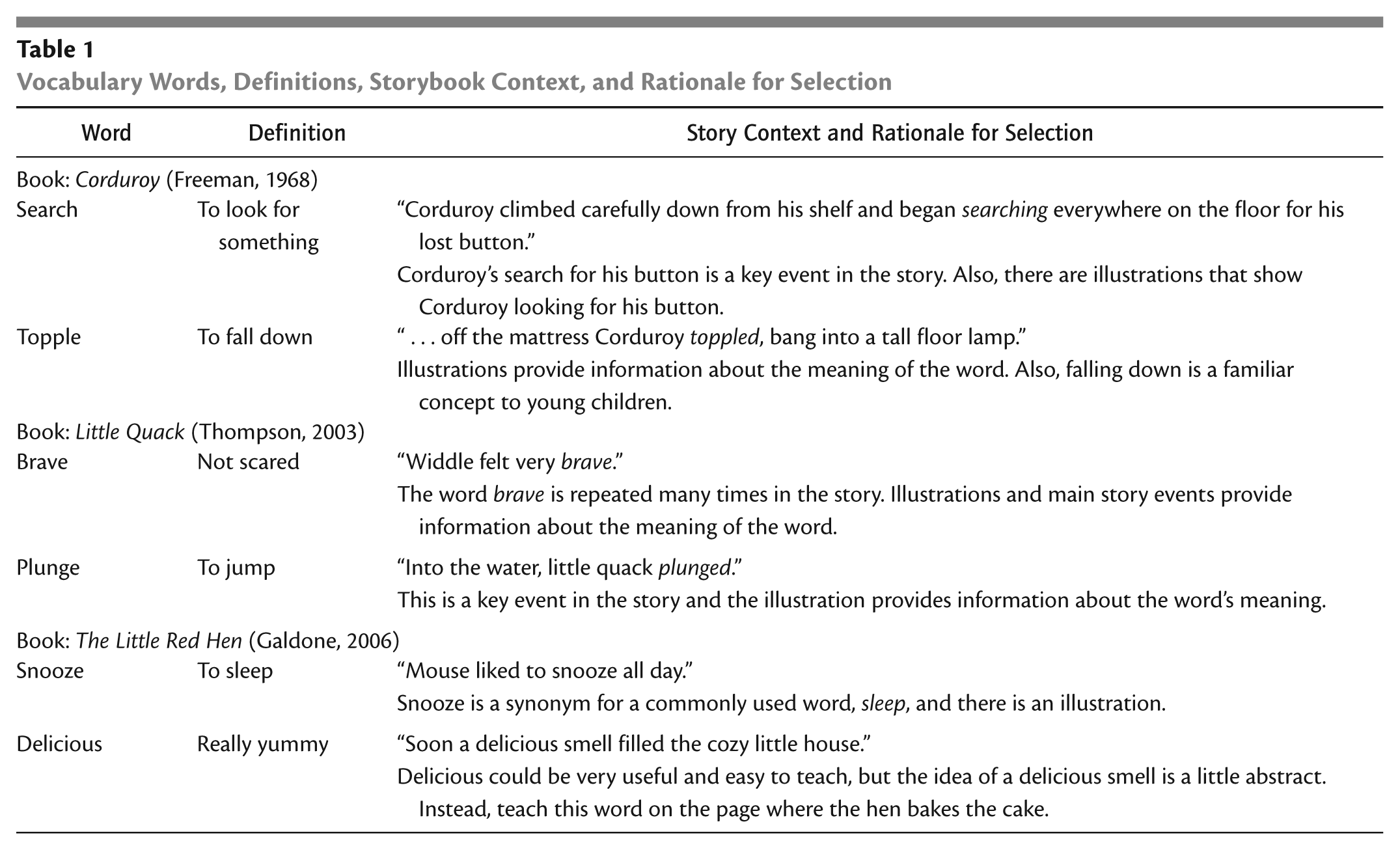
Put it into action: Read through the story and make a list of the words that you think will be unfamiliar to most of the children in your class. Next, circle the words that you think will be most useful to your students. These might be words that will help children understand the story or words that you think will come up in daily conversations or experiences. Now, underline the circled words that you think you can teach well in this story. These words can be defined simply with a few words and have information about the meaning of the word in the story text or illustrations. These also might be words that you can provide several contexts for, including examples from the child’s experience. Finally, star the two or three words from this list that you think are the best targets. See Table 1 for words and rationale for selection.
Vocabulary Words, Definitions, Storybook Context, and Rationale for Selection
Step 2: Design Explicit Instruction
To provide effective explicit instruction, teachers need to plan brief, engaging instructional activities that provide information about the meaning of the vocabulary words. Teachers should develop consistent instructional language that introduces the word, provides opportunities to say the word and definition, and makes a connection between the word and everyday experiences. Instructional language also should provide opportunities to use the word in a variety of contexts.
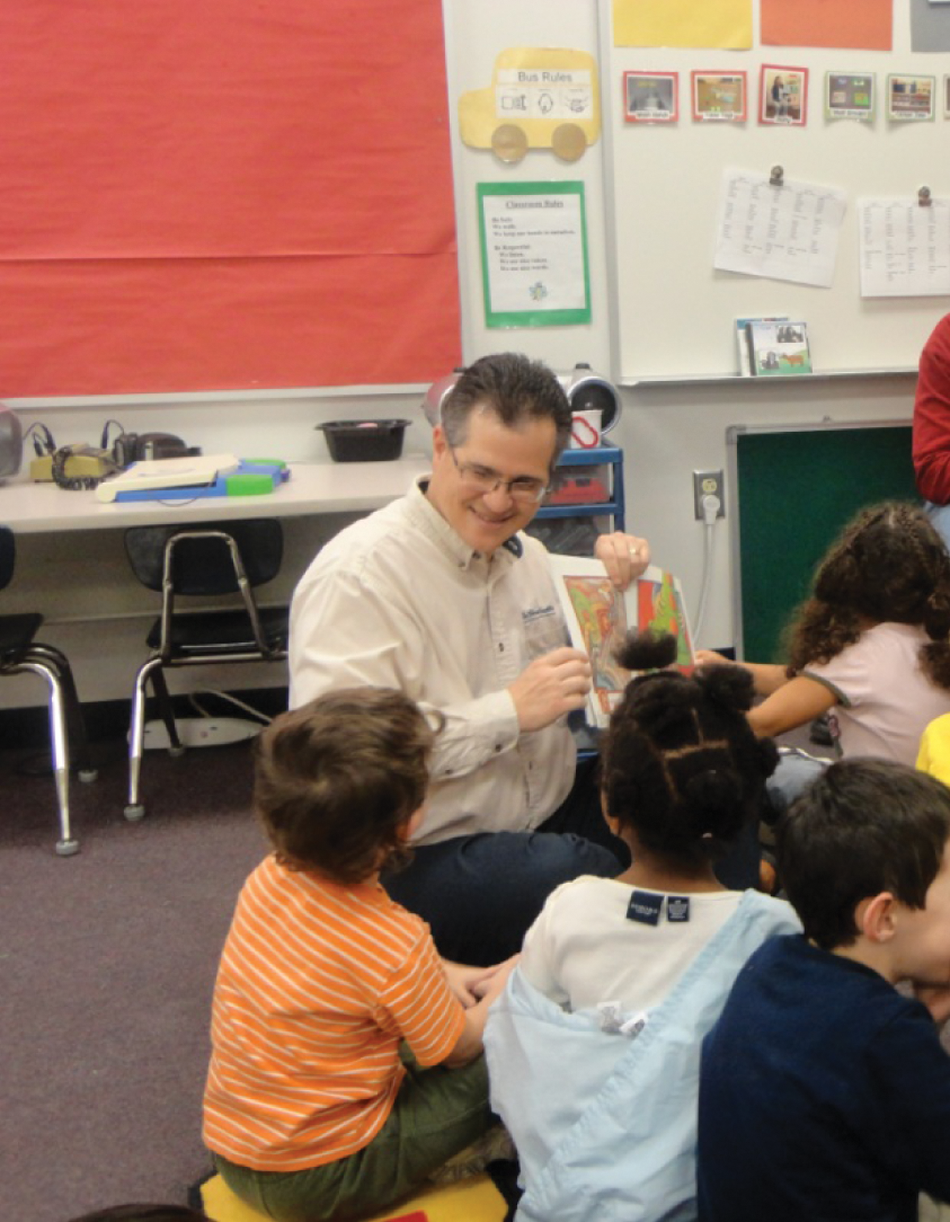
Table 2 provides a sample framework for instructional language. First, introduce the vocabulary word and emphasize the story context that relates to the word. For example, the word kind could be taught in the context of a story about a child who is nice to his teacher, his mother, and his friends. The teacher can interrupt the story to say, “Sammy is being kind! He is helping his teacher clean up.” Next, provide opportunities for children to repeat the word and definition. Teachers can direct children to respond (e.g., Kind. Say kind.). Provide a child-friendly definition, “Kind means nice” and prompt children to repeat the definition. The teacher can model the appropriate response for children and provide encouragement (e.g., Tell me, what does kind mean? [pause for children’s response] Nice. Good thinking!). Teachers can vary the question to ask children to respond to the definition with the target word, “Tell me, what is another word for nice?”
Framework for Explicit Vocabulary Instruction

Instruction should connect the vocabulary word to the child’s everyday experiences. For example, for the word careful, the teacher might describe daily activities in which children would need to be careful (e.g., When I cross the street, I am very careful to look both ways and make sure no cars are coming before I cross. When I am on the playground, I am careful when I am by the swings to make sure I do not walk in front of someone who is swinging.). The teacher could provide children with an opportunity to respond by asking, “Can you think of a time when you are careful?” For the word delicious, the teacher might ask children to list things that are delicious (e.g., cookies, pizza, watermelon). For the word ill, the teacher might ask, “What makes you feel better when you are ill?” The teacher can respond to children’s response as well as model other appropriate responses.
Instruction also can include an activity related to the words’ meaning. Children are particularly responsive to activities that include a gesture (e.g., Put your hand on your tummy and pretend you feel ill.) or interactions with peers (Greet your friends. Wave at them and say hi!). The teacher should also provide opportunities to say the word in a meaningful context. For example, ask children to repeat a simple phrase with the target word (e.g., Mmm . . . that’s delicious!).
Explicit teaching of vocabulary words will be most effective when practice opportunities are provided. At the end of the story, the teacher can repeat the words and definitions or examples. These activities should be brief and use instructional language that is consistent with the embedded interventions. The teacher also should plan for ways to provide experiences with the words outside the storybook context. These experiences will be most effective if children have the opportunity to use targeted words in meaningful ways in classroom routines and activities. For example, the teacher might encourage children to greet each other at morning circle or when guests visit the classroom. Opportunities to use delicious might be provided during snack or in pretend play at the home living center. The teacher can provide a brief review of vocabulary words during transition or other “filler” times. For example, while waiting in line, the teacher could review the word search by asking children to search for a particular item in the room or hallway. Teachers may need to create reminders for themselves and for children to use the new words, perhaps by printing the word on the classroom word wall.
“Measurement that is closely aligned with instruction will provide the best information about children’s learning.”
Put it into action: First, pick the page in the book where you will teach the word. This might be the page on which the word occurs in the text, or it might be the page with an illustration that provides some information about the word. Next, write a simple definition for the word using a familiar synonym or short phrase. Then, make a plan for instruction. Script out some opportunities for children to say the word, provide responses, and complete activities that will teach the meaning of the word. Make a note to guide your teaching during the book, after the book, and in the classroom. See Figure 1 for sample notes.
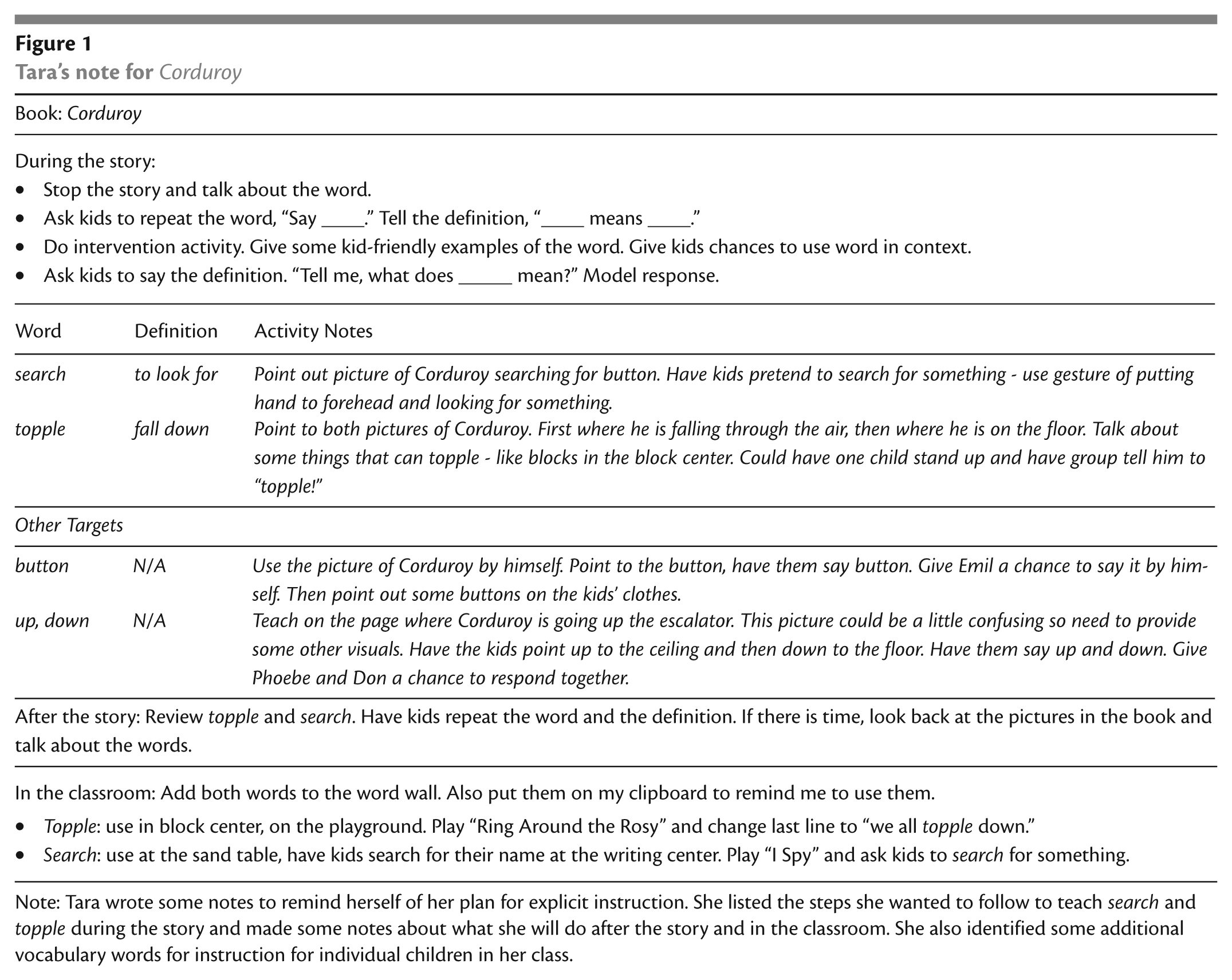
Tara’s note for Corduroy

Step 3: Make a Plan for Assessment
Teachers will need to assess student learning to determine if explicit teaching is effective. Some information can be provided during observations of children’s responses during instruction. For example, an assistant teacher might take brief notes on participation and responses of individual children during large-group readings. Additional information can be gathered during brief, individual assessments. Teachers should use a mastery monitoring approach in which learning of instructional targets is assessed directly. Teachers might ask children to define a target word (e.g., Tell me, what does enormous mean?), to respond to a question about a target word (e.g., What is something that is enormous?), or to indicate knowledge of the word receptively (e.g., Point to the picture of something that is enormous.). In all cases, measurement that is closely aligned with instruction will provide the best information about children’s learning.
Differentiating Vocabulary Instruction for Individual Students
Teachers in inclusive classrooms face the challenge of providing appropriate instruction to individual children in their classrooms who have different vocabulary knowledge and learning needs from other children in their classrooms. For example, inclusive classrooms will likely include preschoolers with language impairments. Children with a language impairment may have difficulty learning specific types of words, particularly verbs (Leob, Pye, Redmond, & Richardson, 1996), and may require more exposure to learn new words than peers with typical language development (Gray, 2003; Kiernan & Shelley, 1998). Inclusive classrooms may also include children with intellectual disabilities, children with augmentative and alternative communication needs, children who are English language learners, and children who have other developmental disabilities such as autism. Providing effective differentiated vocabulary instruction for such a diverse group of children presents a challenge and will require the expertise of special educators, speech-language pathologists, parents, and other members of the early education team. In the next section, we offer general recommendations for differentiated vocabulary instruction to complement the explicit vocabulary instruction already taking place in the classroom.
Selection of Additional Vocabulary Targets
Teachers can identify additional vocabulary targets for explicit instruction that are appropriate for individual children in the classroom. The selection of vocabulary targets should be based on the child’s current vocabulary knowledge and communication needs.
For example, a child who uses just a few words might benefit from instruction to increase knowledge of core vocabulary words (e.g., chair, lunch, paint). Teachers can choose to teach words that will be useful for classroom activities and interactions with teachers and peers. The teacher might target the labels for materials at the art center (e.g., marker, pencil, eraser) and the verbs that children might use there (e.g., draw, write, erase). For children who only have a few single words in their vocabulary, instruction could focus on core vocabulary but emphasize the function, category, and attributes of the word. Teachers also might identify specific vocabulary targets for children who need help participating in classroom activities. For example, for a child learning to use a visual schedule to transition between activities, teachers might target concept words that help children follow routines (e.g., first, last).
To identify additional targets, teachers might make use of lists that describe the vocabulary knowledge of very young children (e.g., Macarthur-Bates Communicative Development Inventories, Fenson et al., 2002; Language Development Survey, Rescorla, 1989). Teachers might use these lists in collaboration with parents to identify appropriate vocabulary targets by selecting words that children do not yet know. Children with augmentative and alternative communication needs will require access to appropriate vocabulary to be active participants in storybook reading; teachers might use the language produced by peers during storybook reading to generate a list of vocabulary to be included in story-specific displays programmed into devices (Da Fonte, Pufpaff, & Taber Doughty, 2010). Teachers will also need to make careful decisions about how many words to teach. For children with disabilities, a selection of a very few highly functional vocabulary targets may be preferred rather than a larger pool of words (Paul, 2007).
Additional Instruction and Practice Opportunities
Additional instruction and practice opportunities can be provided by instruction provided to small groups of students (Foorman & Torgesen, 2001). Teachers might use the storybooks that are used in large-group instruction or might provide supplemental instruction for vocabulary words using other storybooks. For supplemental instruction, teachers should select books with simple vocabulary and uncomplicated story lines that provide clear information about a word’s meaning. For example, Where’s Spot? (Hill, 1980) could be used to provide practice opportunities to learn preposition words (e.g., in, under).
“Teachers may choose to recruit parents as partners in providing additional practice opportunities.”
Teachers may choose to recruit parents as partners in providing additional practice opportunities. These opportunities might occur during play and during activities other than storybook reading.Naturalistic interventions, such as enhanced milieu teaching, can facilitate language development in young children with disabilities, including children with autism (Hancock & Kaiser, 2002; Kaiser & Hester, 1994).
Although vocabulary instruction in inclusive classrooms can be challenging, teachers can capitalize on the diverse abilities of their students. During storybook reading, children with different levels of vocabulary knowledge can all benefit from the exposure to rich language in stories and explicit vocabulary instruction. Children can benefit from peer modeling in inclusive classrooms (Kohler & Strain, 1999). Even when vocabulary instruction is not the goal, students with severe disabilities may benefit from shared story activities to increase communication and engagement (see, for example, Browder, Mims, Spooner, Ahlgrim-Delzell, & Lee, 2008).
Conclusion
Today Tara is reading Noisy Nora to her students again. She checks the notes she has taped on the back of the book and starts reading. Tara pauses on a page with a detailed illustration of the kitchen. She asks Phoebe to point to the chair and then asks Emil, “What do we do with a chair?” “Sit,” he replies. Tara gives Don an opportunity to point to the table and several other students comment on the picture. Next, Tara stops the story to teach a word. “Jack is filthy! He is really dirty. Filthy. Say, filthy.” As she continues the instruction, Tara is happy to see the children in her class repeat the word and participate in the activity. Later that day, Tara makes a quick list of main ideas about embedded explicit teaching to share with her colleagues.
Plan ahead! Read the book before you read it to the class and pick out the words you want to teach. Write some notes on the definitions you want to teach and the ways you are going to teach the words.
Get active! Give your students lots of chances to respond and participate. Activities that are quick and fast-paced keep students interested. Have your students answer questions as a group so that everyone gets a turn. Students who need extra practice can be called on before or after choral responding.
Be flexible! When you teach words that are easy for some of the children in your class, they get a chance to be successful. And all your students can benefit from hearing explanations about challenging vocabulary words.
Try again! It’s okay if some of what you plan just does not work the first few times. Try again or try something different, and figure out what works best for your students.
Footnotes
Preparation of this manuscript was supported by Cooperative Agreement R324C080011 from the U.S. Department of Education, Institute of Education Sciences. You may reach Elizabeth Spencer by e-mail at