




Abstract

Participation in this activity enabled me to view the nature of the community and the interwoven relationships within. I was able to consider the contributions made by the individuals, families, schools, communities, cultures, and businesses that make up the whole. I found that understanding the community and cultures was imperative for understanding the needs of the students and the families as well as locating the resources and services that could and would meet those needs.
Community mapping is a promising practice that can assist early intervention/early childhood special education (EI/ECSE) professionals uncover the depth and diversity of community needs, resources, and learning opportunities, in the neighborhoods surrounding their schools. Community mapping is an inquiry-based method that situates learning in the context of students’ lived realities (Tredway, 1995). For many educators, community mapping can also promote increased interactions among program staff and the families that they serve by removing potential cultural barriers, and unearthing sociocultural assets and natural resources (Ordoñez-Jasis & Jasis, 2011). Although many EI/ECSE professionals are prepared to work directly with children, few receive adequate preparation to identify community-based resources and learning opportunities for children with disabilities and their families (Dunst, Herter, Shields, & Bennis, 2001). According to O’Sullivan (2001), mapping the community surrounding the school by taking photos/videos, observing the neighborhood, writing field notes, and interacting with the people who work and live in the area allows teachers and other program specialists to view the resources of a community with a new perspective. This article describes the mapping experiences of one cohort of EI/ECSE candidates as they prepare to enter the field of ECSE. We believe that their experiences will shed new light on how all EI/ECSE professionals in various settings can use community mapping as a tool to develop the critical knowledge necessary to work in consultation and collaboration with families, community-based organizations, and other community collaborators to better meet the specific needs of all children.
Theoretical Framework
Community Mapping
In specialized fields such as sociology, psychology, urban planning, political science, and geography and cultural anthropology, community mapping has been shown to build knowledge and awareness of community assets, needs, resources, and culture (Tindle, Leconte, Buchanan, & Taymans, 2005). The purpose of community mapping within the field of education is to discover—by documenting through observational field notes, interviews, photos, or videos—a rich array of educational spaces, places, and settings in the community (Tredway, 2003) that hold the potential to enhance learning for young children while developing stronger ties to young children and their families. The importance of community mapping within early childhood education is supported by the theories put forth by Bronfenbrenner and Dewey. For example, Bronfenbrenner’s (1979) ecological system perspective of children’s learning includes the numerous settings of family and community as important contexts to heighten learning opportunities. Bronfenbrenner’s ecological model demonstrates the understanding of development as a function of environmental influences and child characteristics. Similarly, Dewey (as cited in Ordoñez-Jasis & Jasis, 2011) criticizes traditional education for lacking in a holistic understanding of students and for adopting curriculum that is overly focused on isolated sets of skills rather than the knowledge that is derived through one’s interaction with, and knowledge of, their environment. Over 70 years later, the debate continues over the role of context—specifically, the local everyday realities and worlds of children—in teacher instruction, student learning, and home–school relations. For these theorists, and others, it is the responsibility of the educators to understand the unique and ever-changing dynamics of their surrounding school communities to meaningfully create educational experiences and identify learning opportunities that may have a positive impact on young children’s social, emotional, and cognitive development (Early, Maxwell, & Burchinal, 2007; National Association for the Education of Young Children, 2009).
Mapping and the Role of the ECSE Professional
“For EI/ECSE professionals, community mapping not only allows for the understanding of a specific geographical area, one in which they may be unfamiliar, it may also serve as a reflective, capacity-building tool that can open the door to the wealth of resources for families.”
Community mapping is used to describe a process and a product (Ordoñez-Jasis & Jasis, 2011; O’Sullivan, 2001). Community mapping is a process of discovery and reflection that allows the “mapper” to develop new understandings about a specific geographical area that can assist his or her quest to uncover valuable community resources for children and their families. For EI/ECSE professionals, community mapping not only allows for the understanding of a specific geographical area, one in which they may be unfamiliar, it may also serve as a reflective, capacity-building tool that can open the door to the wealth of resources for families. These resources can provide two types of critical information: resources to address family outcomes and resources that identify opportunities for child learning in natural, community-based settings.
“Through community mapping, EI/ECSE professionals can gather neighborhood resources that can potentially have a profound impact on family outcomes by providing useful information to families.”
Through community mapping, EI/ECSE professionals can gather neighborhood resources that can potentially have a profound impact on family outcomes by providing useful information to families. Resources in the community may include family support groups, community liaisons, educational organizations/agencies, mental and health services, and other service providers (Dunst, Hamby, Trivette, Raab, and Bruder, 2001). Developing outcomes for families is a mandated requirement of EI/ECSE services. Community mapping addresses the outcome of families helping their children learn and develop. Family outcomes, as part of family-centered practice, are an emphasis in EI/ECSE programs and align with the Supporting Changes and Reform in Interprofessional Pre-service Training in Iowa (SCRIPT) family-centered principals (as cited in Brotherson, Summers, Burns, & Sharp, 2008). Specifically, Principle 5 discusses the need to “build upon and use families’ informal community support systems before relying solely on professional, formal services” (p. 60). In addition, community mapping can be integrated into the four guiding principles of effective family-centered practices identified by Trivette and Dunst (2005):
Families and professionals share responsibility and work collaboratively.
Practices strengthen family functioning.
Practices are individualized and flexible.
Practices are strength and assets based.
In this way, community mapping provides opportunities for EI/ECSE professionals to enhance goals that are functional, meaningful, and individualized.
Many learning opportunities experienced as part of young children and their families’ everyday living oftentimes go unnoticed. Community mapping allows EI/ECSE professionals to learn how families carry out their daily routines and social practices within the context of their local communities (Bruder & Dunst, 1999). Uncovering resources within the community can also help identify opportunities and support the practice of embedding routine-based approaches into the “daily activities, routines, and within natural learning opportunities” (Chandler & Maude, 2008, p. 210). These may include recreational spaces/locations, cultural activities, community celebrations, learning/educational programs, parks and recreation, historical sites, clubs/organizations, museums, community celebrations, and family outings. For many EI/ECSE professionals, the importance of identifying opportunities for children to naturally act on, and learn from, their environment cannot be underscored. In fact, federal legislation (Individuals With Disabilities Education Improvement, 2004) and Bruder and Dunst (1999) suggest that EI/ECSE professionals expand their focus on intervention to include these types of natural learning opportunities.
Dunst, Hamby, Trivette, Raab, and Bruder (2000) identify the importance of learning opportunities that are naturally occurring. These learning opportunities (described as situated learning by Lave & Wenger, 1991) occur in the context of real-life experiences. Research by Dunst et al. (2000) demonstrates the value of providing learning opportunities for children with or at risk of delays and disabilities within three contexts of their lives: family, community, and early childhood intervention. Dunst et al. (2001) found that these community-based activities and settings are rich and varied, and provide an array of learning opportunities for young children. For example, they described how a family outing to a park may encourage a child to engage in motivating physical activities (i.e., playing on the slide) that enhance the child’s gross motor development. In addition, the park outing presents multiple opportunities for the child to engage in play with peers, which promotes social skills and language growth. Many of the community activities provide inclusive opportunities for children with, or who may be at risk of, delays or disabilities; however, Dunst et al. (2000) make a key statement that these natural learning environments are often viewed as simply “places” when in essence they are “experiences afforded children in the context of activity settings that make up the fabric of family and community life” (p. 161).
Capitalizing on those community-based learning opportunities and resources to support family outcomes requires that early childhood education specialists first understand the importance of tapping into the rich resources within the community. Community mapping utilizes a family-centered approach, one that allows programs to provide services that are flexible and supportive of the needs and realities of children and their families.
A Roadmap to Community Mapping
In this article we describe the learning process of six EI/ECSE candidates—Arlene, Maureen, Jennifer, Desiree, Rebecca, and Violet—ECSE credential students who are also preparing to take on a variety of leadership roles in EI/ECSE programs. We captured their discoveries as they attempted to gain an awareness and knowledge of the resources of various school communities. The community mapping project builds on the work of Dunst et al. (Dunst & Bruder (1999) Dunst et al., 2000; Dunst et al., 2001) in that the teacher candidates were requested to map the community resources, specifically the community-based learning opportunities, in areas that families lived and worked (see Table 1). Our goal is to share the six teacher candidate experiences and discuss possible implications for programs that wish to use community mapping as a means to support child development and family goals through the identification of resources that support family outcomes and opportunities for child learning in natural, community-based settings.
A Roadmap to Uncovering Resources for Young Children With Disabilities

Source: Adapted from Tredway, 2003.
The community mapping project was developed as part of the personnel preparation project, “Inclusion: Developmentally Responsive to Educational Experiences That Are Accessible and Meaningful” (I:DREEAM), funded by the Office of Special Education Programs of the US Department of Education to prepare EI/ECSE candidates to serve as consultants to early childhood teachers who teach in classrooms that include children with disabilities. A component of the three-semester education specialists in ECSE credential program required that EI/ECSE teacher candidates, enrolled in a university located in Southern California, complete 33 hours of additional seminars in the areas of inclusion, supporting social integration in the inclusive setting, emergent literacy, collaboration, consultation, and coteaching. In addition to the seminars and workshop, teacher candidates were required to complete 20 hours of consultation with teachers in private, community, and state preschools that included children with special needs. The community mapping project was one component of this practicum.
In our review of existing literature we found that the slow and fragmented progress toward more inclusion opportunities for children with, or who may be at risk of, delays or disabilities points to the critical need for teacher preparation programs to train highly qualified EI/ECSE professionals skilled in consultation and collaboration strategies to work effectively with key school personnel and community members to identify and/or create inclusive learning resources and opportunities for all children (Bruder, 2000; Guralnick, 2001; Klein & Harris, 2004). Community mapping supports the DEC-recommended practice for personnel preparation that focuses on learning experiences that include the study of cultural and linguistic diversity (Sandall, Hemmeter, Smith, & McLean, 2005). As such, the community mapping project has since been integrated into field experience for all EI/ECSE candidates so that they have the opportunity to use their placements as settings for study and critical analysis.

Following the roadmap to community mapping (see Table 1), EI/ECSE candidates were asked to collect data about their school demographics and to gather information from families related to their priorities, concerns, and resources related to their child’s needs. Next, the candidates scouted a 3-mile radius around their school sites. From this initial community “walk” and through print and online resources and directories, they identified places within the community—such as community centers, nonprofit organizations, local businesses, libraries, regional centers, museums, children’s attractions, and community gardens—that they thought would be beneficial for young children with, or are at risk of, delays and disabilities. Candidates were also encouraged to speak with a school informant at their school sites, such as teachers, administrators, or support staff, so that they could obtain additional information about local community resources. Later, as EI/ECSE teacher candidates visited these various locations, they collected artifacts such as pamphlets, brochures, and photos, and documented their observations in the form of field notes. When possible, they were encouraged to conduct an open-ended interview with a “community informant” such as a parent or local service provider from that community who would be able to share his or her perspective on resources available. As they conducted this aspect of their fieldwork, the teacher candidates carefully documented their findings and tabulated, in the form of a list, the various resources with a notation of how this would potentially impact their practice. To examine the breadth and depth of their community mapping experience, they were requested to reflect on each of their findings and to be prepared to debrief about their overall experience with others in a fieldwork seminar.
The Role of Reflection in Community Mapping
Reflection is often viewed as a process that enables educators to develop as change agents (McMahon, 1997). Reflection can serve as a form of insight into the development of critical thinking in EI/ECSE professionals. Research on reflection reveals that the development of reflection occurs over time, in conjunction with meaningful experiences and content through which educators can develop an inquiry into their practice (Myck-Wayne, 2007). Reflection can serve as a process for fostering ways of thinking more explicitly. In the theoretical frame work presented by McCollum and Catlett (1997), reflection may serve as a training approach in the development of higher order learning outcomes for teachers and while enhancing positive dispositional skills. For this community mapping project, we were particularly interested in prompted reflection, using the information collected from the mapping experience, as part of the prompt. Specifically, we asked teacher candidates to reflect on the following: (a) “Please describe one need and one resource that you uncovered during the community mapping activity” and (b) “Reflect upon how this new knowledge could assist you, as a consultant to this program site, build community, develop trust and mutual respect with families and school personnel, and make better informed decisions.” Through the reflection and debriefing process, we were able to critically question issues of needs, resources, strengths, and assets in the context of families’ lived realities and brainstorm practical applications of community mapping for EI/ECSE programs and professionals.
Community Mapping As a Promising Practice: A Family-Centered Approach
New knowledge about the school, the students and their families, and the local community was generated from the community mapping project. Arlene, Desiree, Jennifer, Rebecca, Violet, and Maureen discovered potential opportunities for families and children that could possibly have a positive impact on the adaptive skills, and social–emotional, communicative, physical/motor, and cognitive development of young students. For example, after making initial inquires with the school’s director and scouting the local neighborhood, Desiree walked into an after school arts program and discovered that they provided music, visual arts, dance, musical theater, and technology for children with special needs in the community. She excitedly noted the many sights and sounds of children happily engaged in piano, guitar, singing, violin, hip-hop, ballet, painting, drawing, and graphic arts classes. Desiree felt that she could compile this information and share it with families and teachers at her school site, perhaps in the form of a flyer or brochure. Together, they rediscovered the rich array of educational programs offered at the local zoos, community centers, parks, recreation centers, and museums. They collected essential materials from each site, such as services provided, hours of operation, costs, and locations, and decided to create a directory for their preschool parents. Jennifer was pleasantly surprised when she visited her school’s local library. She noted the numerous multilingual books and collected the informational brochures it offered in multiple languages. As Jennifer slowly moved around the library, she discovered children of all ages enjoying their afternoon reading program and families inquiring about the upcoming family movie and game nights. Jennifer recounted her interview with the librarian who emphatically exclaimed, “Everything in the library is free!” As Jennifer was about to leave she observed a sign informing visitors that accommodations were available on request (see Figure 1). She later reflected on the significance of this sign, particularly for teachers and families who work with young children with, or are at risk of, delays and disabilities. In her field notes she wrote,
Inconspicuous as it seems, a sign like this sends the message that this is a place where people who may require special accommo-dations are welcome. It lets the reader know that the staff is willing to provide a place that is accessible to every person.

Library Accommodations Sign
In the debriefing session, Jennifer noted the importance of EI/ECSE professionals visiting local resources so that they may make appropriate referrals to families with the confidence that comes with firsthand knowledge of friendly staff willing to create a welcoming space for all.
The six preservice teacher candidates expressed a desire to be responsive to the social and cultural contexts of young children and their families, and sought out multicultural and multilingual community-based learning resources and opportunities. Rebecca’s fieldwork placement, for example, was a state preschool located in a large, mostly Latino Spanish bilingual community. After driving around the community, she was excited to find a museum that offered children’s classes on arts and culture with “many family fun-filled festivals on an ongoing basis.” She noted in her observations that these resources “will help to enhance their pride in their cultural heritage and their sense of self.” Later, Rebecca reflected on the importance of knowing the school demographics and locating bilingual learning resources in the community that would be educationally enriching, and also meaningful and relevant to the families’ cultural and linguistic identities. Rebecca underscored the importance of providing translated materials and translation services to parents whose primary language is not English so that they may better access important information. Specifically, she reflected upon how
language barriers can become intimidating to families. Having a child with special needs aggravates the situation even more for these families. As a consultant, this knowledge would assist me in trying to collect information about resources around the area that could be accessed and offered to parents and see that the material is provided in the language that they can easily comprehend.
Rebecca later pondered about the possibility of creating an English–Spanish bilingual questionnaire that could survey families about their interests and activities. The information compiled from the questionnaire could be then used to develop an activity guide for the entire school community.
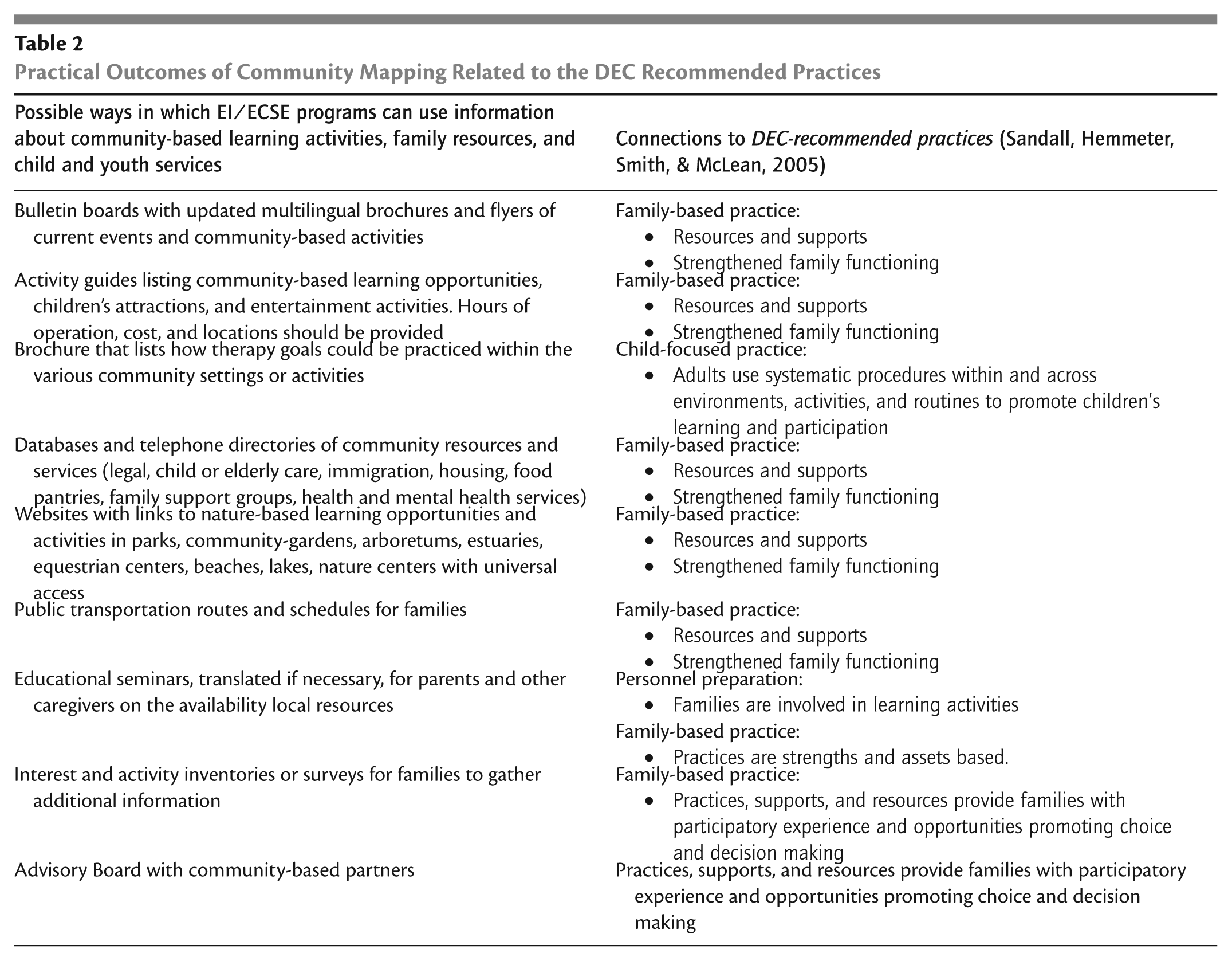
In addition to locating learning resources and opportunities that would positively impact the development of individual children, the EI/ECSE teacher candidates also began to identify resources that would potentially benefit the entire family. Viewing families as “educational units” (Jasis & Marriott, 2010), they began to understand the multiple responsibilities of parents and discussed how critical it is to uncover community-based learning resources that would benefit the entire family and meet their specific needs. This was best exemplified by Arlene who stated that “community resources are very essential to meet some of the needs of these families. These include places to relax and enjoy, not only for the children but [for families] to meet their own emotional needs.” As the six teacher candidates scouted, tabulated, observed, and interviewed key informants from the communities surrounding their schools, various other family needs became evident. With this in mind, they embarked on a journey to discover nonprofit organizations that provided child care, immigration, and legal, health, and mental health services. As part of their community mapping, they also visited community-based agencies that offered food pantries, transitional housing, adult education, and translation services. In our debriefing sessions, the teacher candidates discussed the idea of creating a database for teachers so that they may more effectively help families access services and support. Through their inquiry-based practice of discovery and reflection using the tools of community mapping, the EI/ECSE future professionals began the important process of incorporating family-centered approaches in their practice as a means of supporting the multidimensional needs of children and their families. Table 2 illustrates practical outcomes of community mapping related to the DEC-Recommended Practice.
Practical Outcomes of Community Mapping Related to the DEC Recommended Practices
Community Mapping As a Tool to Examine Issues of Accessibility
As mentioned earlier, the EI/ECSE candidates gained a new appreciation for community-based learning resources and opportunities for the individual child and/or his/her family. Through the process of mapping the community surrounding their fieldwork placements, they also discovered the importance of understanding the social contexts and lived realities of families’ day-to-day lives. Similar to Jennifer’s experience in the library, they were particularly attentive to issues of accessibility. The community mapping endeavor shed light on a deep and unsettling awareness that not all “resources” were accessible to children with disabilities and their families. For example, Violet was initially excited that her fieldwork placement was located near the beach. She understood that the sand and ocean would provide a natural learning environment for young children with disabilities. She brainstormed ways she could use this resource to help children develop their sensory motor skills and understandings about different habitats and sea life. However, this initial enthusiasm waned as she realized that the main beach “access” was not accessible at all for those children with physical disabilities. Violet’s geographical mapping of the area uncovered “that in order to get to the beach you must go down the hill and the only way down the hill are stairs and a really steep ramp that could be a problem for those who are in wheel chairs.” From mapping experiences such as these, Violet and the other teacher candidates gained new perspectives on families’ ability or inability to access their physical environment.
Throughout the community mapping project, the EI/ECSE teacher candidates reflected on how issues of environmental access to nature-based resources such as parks, walking trails, community gardens, estuaries, and arboretums, although a challenge for many households, are seriously aggravated for families who have children with, or at risk of, delays and disabilities. The importance of experiencing these resources firsthand and carefully examining issues of access were underscored.
Community Mapping and Creating Community Partners
As the EI/ECSE teacher candidates gained new understandings of, and appreciation for, the richness of community resources, they began to imagine new ways in which they could partner with families, local community-based organizations, regional centers, parents support groups, churches, colleges/universities, parks and recreation, and other service providers. They described the “untapped resources” in communities and stressed the importance of developing “professional relationships” and “building trust and respect” with community members so that school personnel and families could “make better informed decisions” for children. They also noted how current relationships with local organizations could be strengthened. Rebecca, for example, reassessed the potential partnership with a community church situated right across the school. She noted how the church was “quite actively engaged in the school” but felt it could be better utilized as a resource to “disseminate information and provide interactive trainings and seminars” for the mostly Spanish bilingual parents at her school site.
Overall, the candidates began to critically question the “divide” that they believe existed, to various degrees, between schools and the broad array of community resources located in the surrounding neighborhoods. As future professionals in the field of early childhood special education, they expressed the critical need, and profound desire, to partner and collaborate with outside community agencies so that he or she could better serve the needs of children with, or at risk of, delays and disabilities.
Conclusion
Being more knowledgeable about the area allows you as a professional to better inform the parents. It builds up the communication with the parents as well as the relationships because you are now able to help them out when they need it. (Desiree, EI/ECSE teacher candidate)
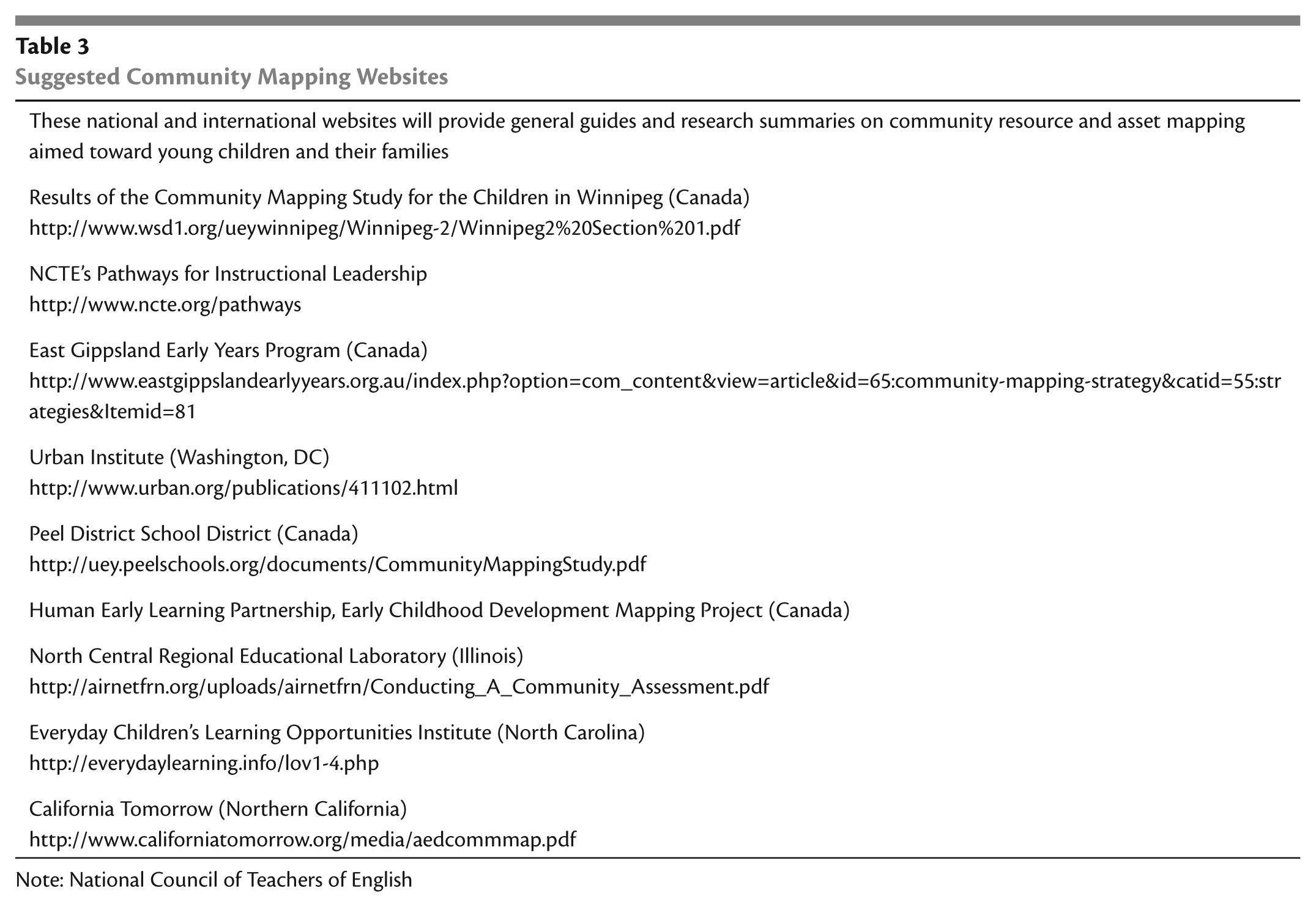
Community mapping can be used as a vehicle to discover the depth and diversity of resources surrounding early childhood education sites so that educators could become “more knowledgeable about the area” investigated. Mapping community-based resources and opportunities that would benefit the entire family may allow EI/ECSE professionals to see children, their families, and learning opportunities with a new, more informed perspective. The process of discovery and reflection, in particular, produces new knowledge and creates a keen awareness of families’ social and cultural contexts. As a result, community mapping contributes to the development of critical cultural competencies and positive dispositions necessary to work with diverse student populations. This includes understanding school demographics, family needs and outcomes, locating resources, and creating materials, websites, and databases that would benefit the entire family. This includesunderstanding school demographics, family needs and outcomes, locating resources, and creating materials, websites, and databases that would benefit the entire family (see Table 3). It also implies, and as noted by Desiree above, the desire to remove potential barriers by developing open lines of communication so that parents and program personnel can codevelop ways to practice functional, meaningful, flexible, and individualized goals within naturally occurring and adult-planned activities. Acknowledging the needs of families and helping them access formal and informal community-based support systems also builds trusting relationships with families that support desired family outcomes.
Suggested Community Mapping Websites
Note: National Council of Teachers of English
The lessons learned from the experiences of these EI/ECSE teachers candidates point to the need to rethink and redefine the role of the EI/ECSE professional. Lieber et al. (1997) reminds us that as communities and school districts begin to offer families with children with, or at risk of, delays and disabilities options in inclusive settings, EI/ECSE professionals will undergo changes in their roles as educators (Lieber et al., 1997). The shift in roles are now moving from providing services in self-contained classrooms to collaborating with families and early childhood general educators (Sandall & Schwartz, 2002). It appears imperative then that educators take a family-centered approach and seek to understand the unique dynamics of their surrounding school communities to identify learning opportunities and other family resources that will have a positive impact on students’ social, emotional, and cognitive development. As we consider the EI/ECSE professional’s changing role, and to ensure quality support for young children with disabilities, early childhood professionals must be trained to work in consultation with community organizations to identify and maximize learning resources for children and their families. Community mapping is a promising practice that can help inclusive early childhood programs promote optimal learning outcomes while forging strong partnerships with families and their community counterparts.
Footnotes
You may reach Rosario Ordoñez-Jasis by e-mail at