




Abstract
Mrs. Miller is a teacher in a preschool inclusion classroom. She currently has 16 children in her classroom. Recently, she has become frustrated by the disruptive behavior of one of the children. Jordan frequently yells, makes animal noises, and refuses to follow teacher directions (e.g., yelling “no”). The behaviors seem to occur throughout the day and during different activities, although the behavior is most intense during circle time and teacher-directed activities. Although Jordan has not been identified for special education services, Mrs. Miller is concerned that his disruptive behaviors might escalate to more severe behaviors requiring specialized assistance. Furthermore, Jordan’s disruptive behaviors are interfering with instruction and classroom activities.
Challenging Behaviors in Young Children
There has been increased recognition of the connection between children’s social behavior and early academic skills (e.g., Denham & Brown, 2010; Powell, Dunlap, & Fox, 2005) with evidence suggesting that young children’s challenging behavior is likely to interfere with opportunities for learning and peer interaction in classroom situations, leading to lower social and early academic competence (Bulotsky-Shearer, Fantuzzo, & McDermott, 2008). At the same time, classroom routines and activities may place more demands on children (Bulotsky-Shearer et al., 2008; Kontos & Keyes, 1999), and subsequently, children may engage in challenging behavior to escape the demands. For example, children may be asked to follow multistep directions, sustain attention for longer periods of time, and demonstrate task persistence even if the task is difficult. Furthermore, lack of skill in key learning domains, such as language, early literacy, or mathematics may increase the intensity of the task demands and lead to challenging behavior as well.
Understanding how social behavior and early academic learning interact with one another and with classroom variables is important from a transactional or ecobehavioral perspective (Bulotsky-Shearer et al., 2008; Carta & Greenwood, 1985). A transactional perspective takes into account classroom and instructional variables and their potential influence on young children’s behavior. The purpose of this article is to discuss an approach to assessment and intervention of challenging behavior in early education settings that integrates a focus on instructional conditions and early academic skill development. We suggest this approach allows for a better understanding of the relationship between social behavior and child performance with the overall goal of developing interventions that both reduce challenging behavior and increase learning. First, an overview of functional behavioral assessment (FBA; for a more detailed description of FBA, see Wood & Ferro, in press) is provided followed by a discussion of early academic considerations. Finally, recommendations are made to support a more comprehensive assessment and intervention approach for challenging behavior.
FBA
Intervention based on FBA has been identified as an effective practice for addressing the challenging behavior of young children (Dunlap et al., 2006). Rather than focusing on the form of the challenging behavior, such as using the same strategy to address all occurrences of children’s kicking, data collected during an FBA allow program staff to identify the function of the challenging behavior (i.e., why the behavior occurs). For example, Lidia and Jose frequently kick their teachers. Information collected during Lidia and Jose’s FBAs indicates Lidia kicks to get teacher attention and Jose kicks to avoid picking up toys. As the function of the behavior is different for each child (i.e., Lidia’s kicking is to access teacher attention; Jose’s kicking is to escape from a nonpreferred task), program staff develop individualized behavior intervention plans for Lidia and Jose that address their needs and the specific function of their behavior.
During the FBA process, direct (e.g., observations in the classroom) and indirect (e.g., parent and teacher interviews, rating scales) methods of data collection are used to identify what comes immediately before the challenging behavior (what triggers the behavior; the antecedent) and why the behavior occurs (the behavior’s function; Bambara & Kern, 2005). In a review of applications of FBA in early education settings, Wood, Blair, and Ferro (2009) found FBAs with young children included a variety of direct and indirect methods, with the majority including observations in home and/or school settings (direct measure) and interviews conducted with the teacher and/or parents (indirect measures). Once the function is identified, program staff use this information to develop a behavior intervention plan that incorporates strategies to increase appropriate behavior and decrease challenging behavior. For example, teachers may be asked to give Lidia more frequent positive attention so that she does not engage in challenging behavior to gain teacher attention, whereas teachers may be asked to provide Jose with a choice of cleanup tasks to reduce his challenging behavior. In any case, the data gathered in the FBA process directly inform the development of the behavior intervention plan.
Mrs. Miller requests assistance from the behavior support team, which includes Jordan’s parents, a special educator, and a school psychologist. The special educator on the team conducts a FBA and the data suggest Jordan’s disruptive behaviors seem to serve to escape nonpreferred tasks. In addition, the team identifies activities involving fine motor skills (e.g., coloring, cutting) as the “trigger” for the majority of occurrences of disruptive behavior. As Mrs. Miller and the team develop Jordan’s behavior intervention plan, they refer to the FBA data collected during interviews and direct observations. They decide to adjust/modify fine motor activities to include grips on Jordan’s pencils/markers and adapted scissors to address fine motor issues. In addition, Mrs. Miller teaches Jordan to request a break rather than allowing him to escape nonpreferred tasks.
One potential limitation of the indirect FBA methods currently used in early childhood settings is that they do not include multiple elements intended to gather information about instructional variables and early academic skill development. For example, many FBAs conducted in early education settings include the same interview forms used with parents and teachers of older students with few modifications for young children (i.e., Primary Functional Assessment Survey, Dunlap et al., 1993; Functional Assessment Interview Form, O’Neill, Horner, Albin, Storey, & Sprague, 1990).Both interview forms include two general questions to identify possible skill deficits but do not include additional questions to identify specific areas of concern that may be related to early academic skill development. In addition, the questions do not specifically target the typical instructional activities and routines of young children (e.g., “Does the behavior occur only during certain subjects?”; Dunlap et al., 1993).
Other applications of FBA in early education settings (Wood, Ferro, Umbreit, & Liaupsin, 2011) have included a parent–teacher interview adapted for parents and teachers of young children (e.g., Functional Assessment Form–Young Child, adapted from O’Neill et al., 1997; Located on the
“Additional and more specific information can be gathered about the instructional environment to develop interventions that reflect a more transactional perspective of the child and his or her environment.”
Direct observations are designed to further investigate the behaviors of concern identified during interviews. Typically during direct observations, the observer records what occurs immediately before the behavior (the antecedent/trigger), a description of the behavior, and what occurs immediately after the behavior (the consequence; Bijou, Peterson, & Ault, 1968). Attending to directions or the task demand and other instructional variables during direct observations may provide added value to the assessment process. Some studies have included instructional variables in direct observation. For example, in one study, teacher directives were recorded as specific or general (Harding et al., 1999). In another study, preferred activities and preferred conditions (e.g., many materials, few peers) were investigated as variables related to challenging behavior (Blair, Umbreit, & Eck, 2000). However, in these studies, the content of the directive or the required task (i.e., academic vs. nonacademic) was not noted nor did researchers identify whether nonpreferred tasks or conditions included some dimension of early academic skill development or instruction.
In sum, although FBA procedures provide an effective means of addressing challenging behavior in early education settings (Dunlap et al., 2006), we believe the effectiveness of FBAs can be increased by including a focus on instructional variables and early skill development. Additional and more specific information can be gathered about the instructional environment to develop interventions that reflect a more transactional perspective of the child and his or her environment. Furthermore, when early academic skill development data are collected prior to developing a behavior intervention plan, the effectiveness of plan can be evaluated in terms of decreasing challenging behavior and increasing skill development. Research suggests when challenging behavior is reduced effectively, engagement improves (Blair, Fox, & Lentini, 2010). Furthermore, increased engagement in instruction and classroom activities is likely to lead to increased skill development (Kern et al., 2007). Conceptualizing early education settings as important instructional contexts increases the relevance and importance of an integrated approach to understanding and supporting both social behavior and early academic skill development.
After 2 weeks of implementing the behavior intervention plan, Mrs. Miller is still having problems with Jordan’s disruption and the behaviors seem to be escalating. In addition to refusing to complete requested tasks, Jordan begins yelling, hitting, and breaking items. Given that there has not been improvement since intervention implementation, the program director is deciding whether to decrease Jordan’s class time to half-days until problem behaviors improve. Even with modified tasks, Jordan is rarely engaged during circle time activities and nonpreferred table tasks. Off-task behaviors begin with minor disruptive behaviors (e.g., animal noises) and increase in intensity (e.g., hitting peers) to the point of being removed from the activity. Mrs. Miller and the behavior team estimate Jordan is losing approximately 1 hr of instructional time each day because of his challenging behavior. Looking back over the FBA data, the behavior support team realizes they did not include information about Jordan’s present levels of early academic skill development, or Jordan’s response to the instructional environment of the classroom.
“Information about instructional variables and child skill development are important in understanding behavior, and such information should be collected as part of the FBA process.”
Early Academic Skill Development
A recent meta-analysis of longitudinal data underscores the need for children to develop strong foundations in early literacy and mathematics as these skills at kindergarten entry were both related to later achievement (Duncan et al., 2007). Children vary considerably in their skill development in these key early academic domains and early education experiences can provide a critical means of reducing performance gaps between children through rich educational activities (National Research Council, 2001). In inclusive environments in which children have diverse abilities, emphasizing early literacy and mathematics with all children provides opportunities for increased participation in routine classroom activities as well as the development of skills that will play a central role in daily functioning (Browder, 2001).
For some children, instructional activities provide positive opportunities for skill development as their attempts to learn colors, recognize letters, rhyme, and count are met with success. For other children, the same instructional activities may lead to increasing demands on their attention, participation, and current level of skill development. Consider the child who has limited counting skills. Daily calendar activities can lead to frustration, which in turn can lead to challenging behavior to avoid the activity. Early education classrooms are instructional environments and children’s behavior is often influenced by environmental variables. Information about instructional variables and child skill development are important in understanding behavior, and such information should be collected as part of the FBA process.
Toward an Integrated Approach
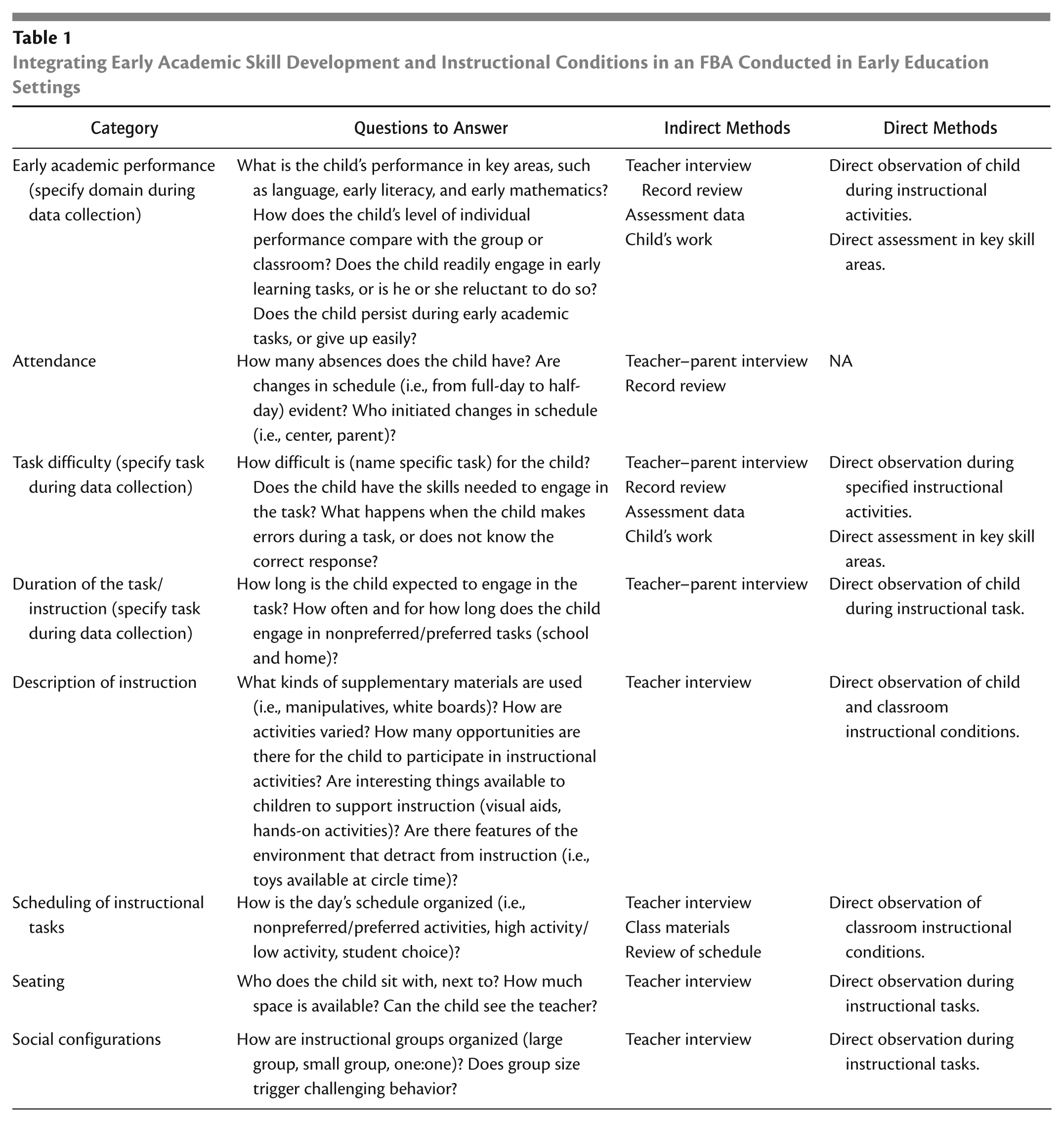
Information about the specific task or activity (i.e., early academic or nonacademic), errors or mistakes the child makes and how those are handled, the meaningfulness of the task, the pace of instruction, the availability of choice in activities, the sequence of tasks, the instructional grouping (i.e., large group, small group, one-to-one interaction), attendance, and student performance data are important to the FBA process (Steege & Watson, 2009). Such information may lead to the identification of triggers for problematic behavior that had not been considered. Table 1 provides guidance in integrating a focus on early academic skill development data and instructional variables into an FBA in early education settings using methods most typically included in an FBA (Wood et al., 2009). Table 2 illustrates how a broadened focus can inform a more comprehensive approach to assessment linked to intervention.
Integrating Early Academic Skill Development and Instructional Conditions in an FBA Conducted in Early Education Settings
Importance of Additional Considerations in the FBA Process

Instructional and early academic skill development data may be gathered through indirect methods (e.g., interviews) or direct methods (e.g., observation during instructional tasks and a review of child skill development data). Whereas interviews may require modification to include an instructional focus, more direct measures of child early academic skill development may be gathered through assessment data. To inform instruction and intervention efforts in the area of early academic skill development, assessment tools such as the Individual Growth and Development Indicators (IGDIs; Early Childhood Research Institute on Measuring Growth and Development, 1998/2000) have been developed that focus on early academic skills and can be used with individual children and large groups of children (e.g., for a more detailed discussion, see Hojnoski & Missall, 2007). In addition to measures like the IGDIs, early academic data may include teacher created assessments that use checklist or rating formats and identify child skill level. Data that provide an indication of what a child knows and does not know may help to better understand a child’s behavior in specific situations, and consequently, develop more effective interventions that target both challenging behavior and early academic skills.

At Mrs. Miller’s request, the behavior support team reassesses Jordan’s disruptive behavior. During the reassessment, the team adds follow-up interview questions to identify possible issues with specific early academic tasks during classroom activities and routines. Jordan’s parents and teacher identify activities involving letters and counting, more specifically tasks that require letter recognition and counting aloud as possible triggers. During observations, Jordan’s disruptive behavior usually follows the teacher directing Jordan to pick out his name from an array or count on the calendar during circle time. For example, during one observation when Jordan is asked to identify his name and move it to the “at school” attendance column, he knocks the magnetic board over and moves to another area. On another occasion, When Mrs. Miller asks Jordan to be the counter, he refuses and his behavior escalates to hitting a peer next to him. In these instances, Jordan momentarily “escapes” tasks that require early academic skills. Finally, the team considers data collected by the school psychologist as part of universal screening procedures to assess early academic development. Specifically, data on Jordan’s language, early literacy skills, and his early number sense were reviewed. These data indicate Jordan is lacking skills in key early learning domains as compared with his peers in the classroom. Thus, it appears that instructional demands combined with Jordan’s skill level serve as antecedents to, or triggers for Jordan’s challenging behavior.
“In addition to informing intervention development, early academic skill development data can be used to evaluate whether interventions are effective in both decreasing challenging behavior and increasing the extent to which children are engaging with and benefiting from instruction and classroom activities.”
Considering instructional variables and child skill development can lead to more comprehensive interventions that potentially address challenging behavior and learning. Although behavioral strategies such as providing choice or following a nonpreferred task with a preferred task may be helpful in reducing challenging behavior, neither is guaranteed to increase the child’s early academic skill development. In contrast, specifically providing the child with additional support in an early academic skill domain that appears to be related to the challenging behavior is likely to increase the targeted skill and may reduce the challenging behavior. That is, if the child experiences more success with the task, he may be less likely to use challenging behavior to escape from the task. Activities that fit children’s developmental level and individual interest increase the likelihood of active engagement and decrease the likelihood of challenging behavior (e.g., Godfrey, Grisham-Brown, Schuster, & Hemmeter, 2003).
Including assessment of instructional conditions and early academic skill development is necessary to make the link between challenging behavior and instruction and skill development. A behavior intervention plan, then, may include strategies to support skill development as well as strategies to reinforce positive behavior. For example, the following summary statement could be developed through an FBA that includes attention to early academic and instructional variables, “When Jordan is presented with a counting task during circle time, he is likely to engage in negative verbal and physical behavior to escape the task.” The behavior intervention plan to address Jordan’s behavior may include small-group support to develop counting skills, chorale responding as an alternative response mode, teacher support with responding, and positive attention for engaging in the task.
In addition to informing intervention development, early academic skill development data can be used to evaluate whether interventions are effective in both decreasing challenging behavior and increasing the extent to which children are engaging with and benefiting from instruction and classroom activities. Data that are collected regularly on children’s early academic skill development provide a means of evaluating whether children are benefiting from the instruction provided. If an intervention is implemented and data indicate a reduction in challenging behavior but no corresponding gains in engagement or skill development, then additional strategies are needed to target skill development.
Using methods outlined in Table 1, behavior support teams can integrate an emphasis on contexts for learning and early academic skill development with more common FBA procedures. Specific consideration can be given to the instructional environment and to children’s skill level in key early academic domains by including additional questions in interviews with teachers and parents, observing during instructional activities and noting children’s response to instruction as well as the instructional environment, and direct assessment or review of teacher collected assessment data. An integrated approach can be applied to the assessment process and to intervention development resulting from the assessment.
With information from the interviews, observations, and assessments, Mrs. Miller and the behavior team are able to identify the specific early academic skill deficits that occasion Jordan’s challenging behaviors and what maintains the behaviors (escape from early academic tasks). This information is used to develop a multicomponent function-based intervention to reduce challenging behavior and increase skill development. Specifically, Jordan receives additional one-on-one support to improve his letter and name recognition skills as well as his counting. One-on-one support provides him with frequent opportunities to respond, corrective feedback, and close monitoring of his skill development. Jordan is also receiving support at home, working with his parents using short, interesting computer activities designed to increase skill development. In addition, during circle time, Mrs. Miller modifies the early academic task so Jordan can be successful. For example, he counts aloud with a more skilled peer and the array of names in which his appears is reduced to two, one of which is very different from Jordan’s. To evaluate the effectiveness of these strategies, the school psychologist is collecting observational data on Jordan’s challenging behavior during circle time and monitoring his progress in letter recognition and number sense.
As models of service delivery continue to evolve in early education, there is a need to connect social and early academic behavior to promote a more comprehensive approach to supporting early development (Fox, Carta, Strain, Dunlap, & Hemmeter, 2009). Challenging behavior can interfere with children’s engagement in classroom instruction and activities, thereby potentially limiting opportunities for skill development. In addition, children with limited skills may engage in challenging behavior to avoid difficult tasks. In either case, a focus on both challenging behavior and early academic skill development is needed for effective assessment linked to intervention. By increasing a child’s repertoire of appropriate and functional skills, including those related to early literacy and mathematics, we may increase a child’s engagement and participation in classroom instruction and activities, thereby decreasing the child’s use of challenging behavior. Addressing these two domains together in practice better reflects the transactional relation between behavior and learning that is supported in research.
Footnotes
Authors’ Note
You may reach Robin L. Hojnoski by e-mail at