




Abstract
“We must strive to move beyond saying that children with disabilities made gains while in early intervention or early childhood special education services. Instead, we must be asking if the gains that they are making are enough.”

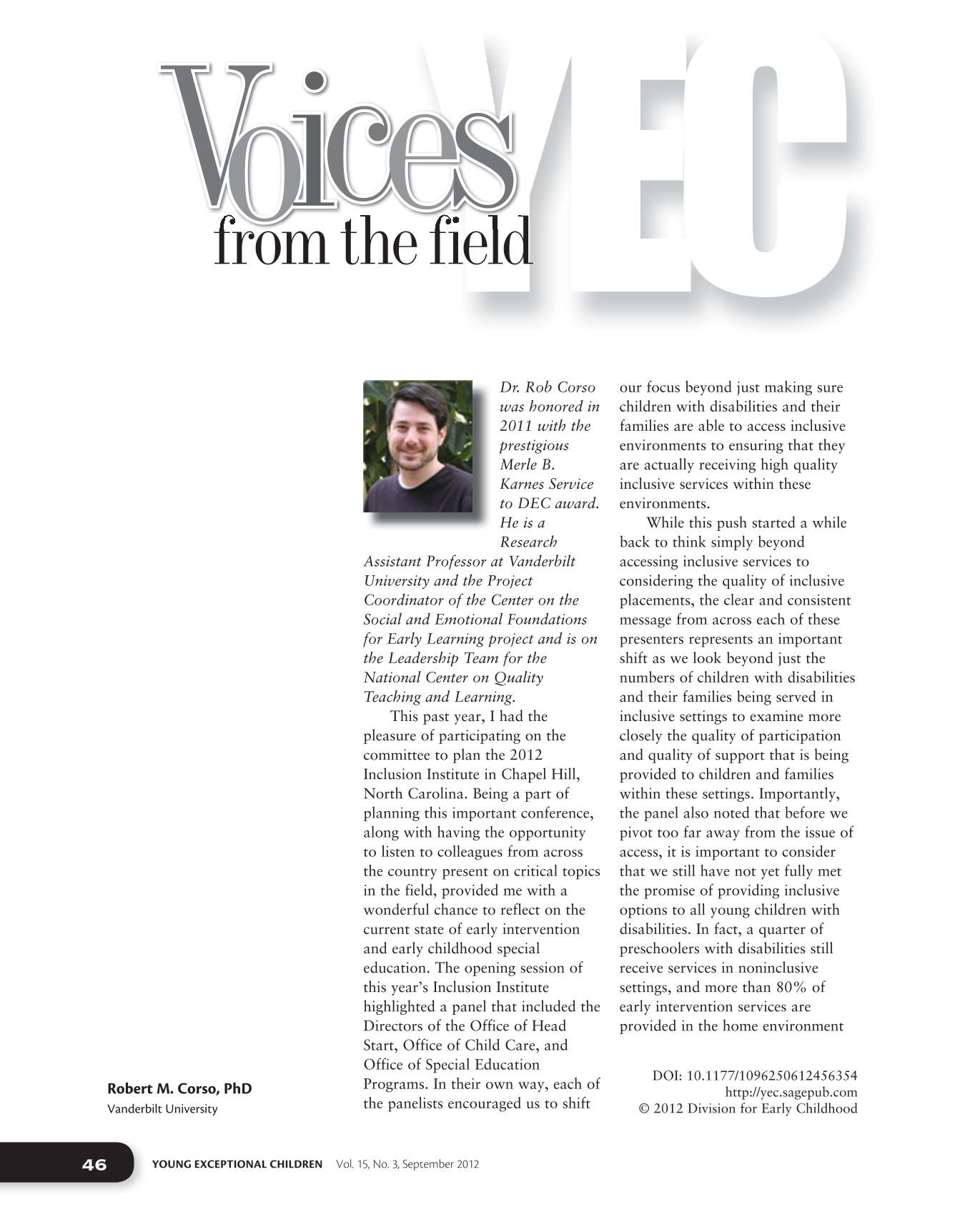
Dr. Rob Corso was honored in 2011 with the prestigious Merle B. Karnes Service to DEC award. He is a Research Assistant Professor at Vanderbilt University and the Project Coordinator of the Center on the Social and Emotional Foundations for Early Learning project and is on the Leadership Team for the National Center on Quality Teaching and Learning.
This past year, I had the pleasure of participating on the committee to plan the 2012 Inclusion Institute in Chapel Hill, North Carolina. Being a part of planning this important conference, along with having the opportunity to listen to colleagues from across the country present on critical topics in the field, provided me with a wonderful chance to reflect on the current state of early intervention and early childhood special education. The opening session of this year’s Inclusion Institute highlighted a panel that included the Directors of the Office of Head Start, Office of Child Care, and Office of Special Education Programs. In their own way, each of the panelists encouraged us to shift our focus beyond just making sure children with disabilities and their families are able to access inclusive environments to ensuring that they are actually receiving high quality inclusive services within these environments.
While this push started a while back to think simply beyond accessing inclusive services to considering the quality of inclusive placements, the clear and consistent message from across each of these presenters represents an important shift as we look beyond just the numbers of children with disabilities and their families being served in inclusive settings to examine more closely the quality of participation and quality of support that is being provided to children and families within these settings. Importantly, the panel also noted that before we pivot too far away from the issue of access, it is important to consider that we still have not yet fully met the promise of providing inclusive options to all young children with disabilities. In fact, a quarter of preschoolers with disabilities still receive services in noninclusive settings, and more than 80% of early intervention services are provided in the home environment with only 3% or early intervention services being provided in programs that serve typically developing children (Lazara, Dannaher, Kraus, & Goode, 2009). So we still remain a significant distance away from shifting our focus totally away from access.
The panelists also discussed how the recent activities that have been generated by the Race to the Top Early Learning Challenge Grants have led states to consider how to better develop and design seamless systems that meet all children where they are at. One of the most important focus areas in these statewide initiatives is working to ensure that there are integrated and transparent evaluation systems that include ongoing professional development for the early learning workforce. While many states have established training and technical assistance supports for early interventionists and early childhood special educators, there are still many states that do not offer these types of supports. Even in those states where professional development systems exist, much more needs to be done to ensure that training on effective practices and strategies occurs alongside opportunities to apply those practices and receive supportive feedback beyond merely attending a training event (Blasé, 2009).
In addition to the need to continue to deepen the type of professional development that is offered to early childhood practitioners to ensure that quality inclusive services are being provided, there has been a renewed push to ensure families are both informed and engaged in the process of supporting their child’s development in meaningful ways. This development has encouraged us to move beyond simply involving families to the deeper concept of engaging families. Importantly, the emphasis on the word engagement conveys that the families are an integral and essential part of the process. There is an assumption of equality and reciprocity where families and early care professionals walk alongside one another in the best interest of the child. Much more exploration of this concept needs to be done to ensure we are not simply giving lip service to being family focused.
Although much progress has been made in recent years, several critical challenges are evident as we move forward. We remain limited in our ability to collect meaningful data on the children and families served in early learning environments. Our desire to demonstrate positive outcomes for all children, including children with disabilities, across multiple service settings, including early intervention, pre-k, early childhood special education, Head Start, and child care, is at an all-time high. And yet, collecting high quality data for all of these systems remains difficult. In addition, understanding how to account for the diverse data and outcomes that states may require based on Head Start Performance Standards and/or school readiness goals, QRIS systems, and OSEP child outcomes remains a frustration. We must strive to move beyond saying that children with disabilities made gains while in early intervention or early childhood special education services. Instead, we must be asking if the gains that they are making are enough. Without reliable data to use, moving to a place where we can answer this question in a thoughtful, data driven way is clearly hampered.
As a field, we remain at a place where we are still grappling with trying to define what the quality indicators are for understanding the move from simply accessing inclusive environments for children with disabilities to providing supportive and participatory inclusive opportunities for these children. What is clear is that not only must we be better able to articulate what these indicators are, but we must also institutionalize these indicators within our accountability, and quality rating and improvement systems. This includes indicators that account not only for children accessing services in high quality inclusive environments but also for children receiving evidence-based instruction and curricula that are adapted and modified to meet their individual needs.
And finally, it is not enough to simply hope that if we only look at early childhood practices that we believe to be good for all children that we will appropriately account for supporting high quality inclusive practices for children with disabilities. This means that these additional indicators that reflect high quality inclusive practices must be embedded directly within quality and accountability systems like Quality Rating Improvement Systems and accreditation. Currently, just over half of the states are implementing QRIS systems, and of those, only a handful of states are accounting for supporting children with disabilities and their families into their rating systems in any meaningful way (Hallam, Rous, & Cox, 2008). Much more needs to be done in this regard. Despite these challenges, as I listen to our leaders at the federal, state, and community level, I remain hopeful that we will remain vigilant to ensuring the gains that have been made over the past several decades will not only be maintained but will also be further pushed to ensure children with disabilities and their families are able to access inclusive services and are assured that those services will be of the highest quality.
Footnotes
Author’s Note
You may reach Robert M. Corso by e-mail at