




Abstract

When teacher preparation is disconnected from classroom practice, preservice teachers are left to try to make this connection without the guidance and support of skilled mentors. Practicum or field experiences are essential for effective personnel preparation. Practicum experiences can provide situated learning for preservice teachers to “practice” newly acquired skills and apply new knowledge in real-life settings (Macy, Squires, & Barton, 2009). However, a fundamental disconnect often exists between what happens in early childhood field placements and what happens in college classrooms. Microteaching is one way to bridge this gap.
The purpose of this article is to introduce microteach lessons as a powerful teaching tool for early childhood personnel preparation and to share our experiences using microteach lessons within early childhood special education (ECSE) preservice training at the University of Illinois at Urbana–Champaign (UIUC). We begin with a vignette followed by a description of microteach lessons and a brief review of literature on the use of these lessons in personnel preparation. Then, we share information about how the use of microteach lessons evolved at UIUC and provide a detailed description of the steps we follow when incorporating these lessons during ECSE preservice personnel preparation. We conclude with implications for practice. A glossary of instructional strategies used in this article appears in Table 1.
Glossary of Instructional Strategies

Melissa is 1 of 10 ECSE preservice teachers enrolled in a weekly seminar for teacher candidates who are spending 20 hr/week in inclusive field placements. The seminar instructor spends 30 min during the second practicum seminar session describing the microteach assignment and explaining the nine-step microteach procedures. Over the course of the semester, each preservice teacher will sign up to present at least one microteach lesson (if the class size is small, teacher candidates will present two different microteach lessons across the semester). Melissa, who was in the seminar the previous semester, introduces one of her previously completed microteach lessons as an example, shares copies of the necessary paperwork, and together with the group watches her video clip. As practicum students watch the video, they practice collecting data on Melissa’s self-identified behaviors of interest. Following the video, preservice teachers share feedback with Melissa. Over the course of the semester, each preservice teacher will have at least one opportunity to conduct a microteach and share his or her video clip with the other practicum students.
Introducing Microteach Lessons: Evidence of Impact
Microteaching is an essential component for increasing effective teacher practices in the early childhood classroom. Considered an innovative approach to preservice teacher education training when first introduced in the early 1960s, microteaching has evolved as one of the most widely used methods to introduce clinical practicum experiences to preservice teachers (Amobi, 2005; Benton-Kupper, 2001; Katz, 1973). Microteaching is comprised of a video-recorded microlesson and feedback. The video-recorded microlesson is an intentional and carefully planned lesson with young children, led by the preservice teacher, focusing on specific instructional strategies, such as commenting, asking questions, or using triadic strategies (Kohler, Anthony, Steighner, & Hoyson, 2001; Mahonesy, Boyce, Fewell, Spiker, & Wheeden, 1998; P. S. Miller et al., 2003; Ostrosky, Meadan, & Lyons, 2008). In a seminar class (taken by all teacher candidates enrolled in practicum during any given semester), preservice teachers view their microteach videos with peers and the practicum instructor for the purposes of analyzing, reflecting on, and improving the lesson as taught. Peers point out strengths of the lesson and offer constructive feedback; they follow up their verbal feedback with written feedback. These characteristics of microteaching enhance the development of effective teaching skills and reflection on these emergent skills (Amobi & Irwin, 2009).
“Viewing video of one’s teaching helps preservice teachers notice details of interactions with students that may be hard to notice.”
The Division for Early Childhood of the Council for Exceptional Children (DEC) has published recommended practices for the preparation of early childhood special educators. These practices provide guidance on the development, implementation, and evaluation of personnel preparation programs (P. S. Miller & Stayton, 2005). One such recommended practice emphasizes the importance of “providing opportunities for students to provide direct services to children” (Miller & Stayton, 2005, p. 202). This is one of the main components of the microteach: Preservice teachers practice a skill or technique with young children.
Another component of microteaching is the feature of video recording the lesson. Video can be a powerful tool to support teacher learning (Kpanja, 2001). Viewing video of one’s teaching helps preservice teachers notice details of interactions with students that may be hard to notice while teaching (Zhang, Lundeberg, & Eberhart, 2010). Video also allows preservice teachers to engage in conversation and draw on collective experiences to gain a better understanding of how particular strategies and lessons can be adapted to meet the needs of their students (J. M. Miller, 2009).
Varied and frequent feedback is crucial to a preservice teacher in training (Macy et al., 2009). DEC Recommended Practices (2005) highlight the importance of “multiple methods of supervision . . . including feedback” (Miller & Stayton, 2005, p. 202). Throughout the semester, preservice teachers consistently engage in the process of microteaching, during a weekly seminar class. During this seminar, preservice teachers are prepared to alternately present their microteach lessons and engage in the process of providing (or receiving) constructive feedback. Each person in the class offers verbal as well as written feedback to the student presenter; only the microteach presenter views the written feedback. Ground rules are established at the beginning of the semester to make sure that preservice teachers feel that the seminar is a safe place to discuss issues that may be sensitive or controversial. In addition, establishing ground rules about offering feedback is important to ensure that feedback from peers is constructive and not overly critical.
“While discussing their microteach with peers, preservice teachers are able to acknowledge and challenge values or assumptions that characterize their practice as manifested in their actions.”
Researchers suggest that microteach lessons can provide a window into preservice teachers’ reflective processes (I’Anson, Rodrigues, & Wilson, 2003). When presenting their microteach to peers, preservice teachers develop reflective thinking by viewing their actions and comparing them with their intent while planning for their microteach (Hadfield, Littleton, Steiner, & Woods, 1998; Kottkamp, 1990). According to Osterman (1990), “reflection is concentration and careful consideration, and reflective practice is the mindful consideration of one’s actions, specifically, one’s professional actions” (p. 134). Viewing themselves “in action” enables preservice teachers to consider what went well in their microteach video as well as what they would do differently if they engaged in the same activity again (Amobi, 2005). Furthermore, while discussing their microteach with peers, preservice teachers are able to acknowledge and challenge values or assumptions that characterize their practice as manifested in their actions (I’Anson et al., 2003; Pierce, 1996).
Reflection and critical thinking are also cultivated when preservice teachers share meaningful and constructive feedback after viewing each others’ video-recorded microteach lessons in a safe environment. The outcome of this sharing process can be “new meaning, alternative perspectives, and new views about how things work” (Osterman, 1990, p. 135). The latter promotes diversity of opinion, respect for different ideas, and a sense of community among preservice teachers who may continue to engage in sharing their practice with colleagues during their future professional careers.
Developing Microteach Lesson Materials
During the past two decades, researchers have worked to bridge the gap between research and practice by translating research findings into practices that can be easily learned and implemented by practitioners. These efforts have provided a pool of evidence-based practices that have been used to advance and strengthen teacher preparation programs. Microteach content is derived from the descriptions of research-based practices that have been disseminated through reliable websites (e.g., http://www.autisminternetmodules.org, Autism Internet Modules) or developed based on peer-reviewed practitioner journals (e.g., Young Exceptional Children).
Microteach lesson materials have been used in the ECSE teacher education program at UIUC for several decades. The original microteach materials were developed by Dr. Jeanette McCollum around 1980. In the following years, teacher education faculty, course instructors, and doctoral candidates have created additional microteach materials and made revisions to the original topics.
These microteach lesson materials cover various evidence-based strategies such as dyadic and triadic interaction, helping children initiate play, reading a book with a small group of children, using visual supports with children, giving corrective feedback, conducting small group activities, and facilitating communication (Cook, Tessier, & Armbruster, 1987; Dale, Drain-Thoreson, Notari-Syverson, & Cole, 1996; Ganz & Flores, 2010; Mahonesy et al., 1998; McCollum & Yates, 1994; Stanton-Chapman & Hadden, 2011; Sulzer-Azaroff & Mayer, 1997; Warren & Gazda, 1990). The microteach materials that were developed at UIUC include three main components: a rationale for the strategy, a description of the instructional technique, and references. Each component will be described.
The first component of the microteach materials is background information for each strategy, including its research base, how it supports child development, where it can be used, and for which child age group it is intended. For example, with the Asking Questions microteach, preservice teachers learn about the importance of asking questions to assess children’s learning, make minute-to-minute instructional decisions, facilitate learning, and encourage problem solving and generate solutions. It is equally important for future teachers to learn about the different settings where using this strategy can be most effective. During playtime, a preservice teacher might ask a variety of questions to understand a child’s play ideas, facilitate communication, manipulate the play situation, and encourage problem solving. Understanding developmentally appropriate practice is crucial to successfully using early childhood instructional strategies. Therefore, the microteach strategy description should include information about when it is developmentally appropriate to use the instructional strategy (i.e., when it is appropriate to ask questions to facilitate learning).

The second component of the microteach lesson materials is a description of how to use the instructional strategy. Providing preservice teachers with step-by-step instructions helps them assess their present level of performance in using the strategy, identify the steps they need to practice, and ultimately understand all the components of the specific strategy. For example, preservice teachers learn that there are two kinds of questions they can ask children: convergent and divergent. Convergent questions allow for one right response, whereas divergent questions allow for many possible responses. Preservice teachers read examples of these types of questions as well as guidelines to help refine their skills at questioning (i.e., guidelines include providing wait time following a question and ensuring that questions are directed to all children involved in an activity as opposed to only a few children). The last component of the microteach strategy description is a short list of references. These citations provide preservice teachers with additional resources to learn more about the specific strategy.
Nine Steps to Supporting Teachers’ Practices Through Microteaching
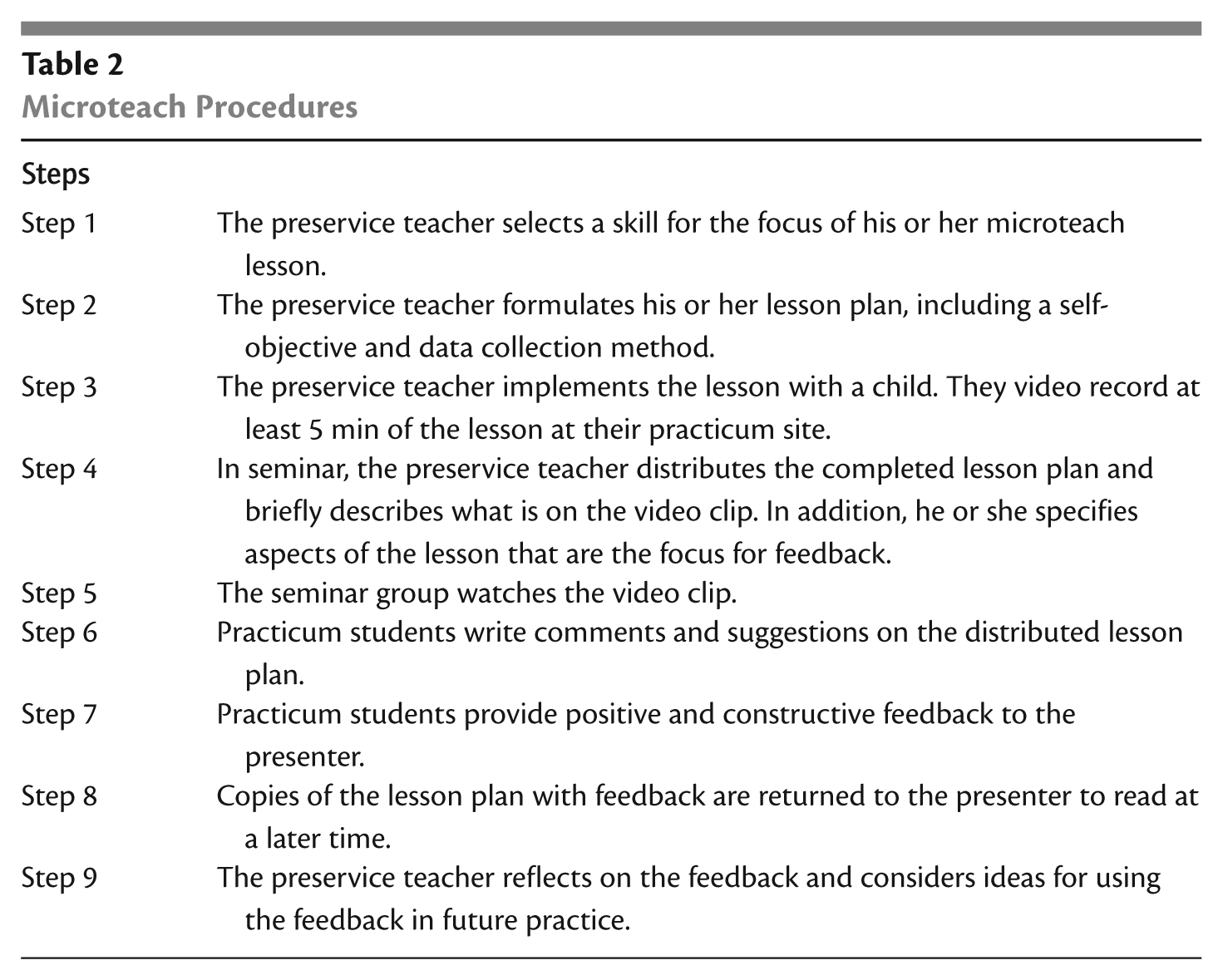
The microteach procedures used within UIUC’s teacher preparation program involve nine steps, as shown in Table 2. Each step is described below with vignettes serving as illustrations. The following steps can serve as guidelines to introduce microteach lessons into a seminar class.
Microteach Procedures
Step 1: Choose a Skill for the Focus of the Microteach Lesson
The seminar instructor provides the class with two sets of microteach materials from which to choose for this assignment. She knows that half of her preservice students are in birth-three settings while the other half are in preschool classrooms, so she selects microteach topics that will work in either setting (e.g., communication skills and asking questions). The microteach descriptions are uploaded to the class learning management system site (e.g., Moodle™) so that teacher candidates can read both descriptions and consider which one makes the most sense given their practicum site and their own professional development.
Melissa selects the microteach that focuses on facilitating young children’s communication skills. She downloads and reads the microteach description of how to support young children’s communication development, and an accompanying article on expansions, labeling, and parallel talk.
Step 2: Complete the Lesson Plan, Including Self-Objectives and Ideas for Data Collection
Practicum students complete their microteach lesson plans prior to being video recorded so that they are thoughtful and planful when practicing the targeted skill. Melissa’s lesson plan includes information under the following five subheadings (see Table 3 for a sample lesson plan).
Sample Microteach Lesson Plan
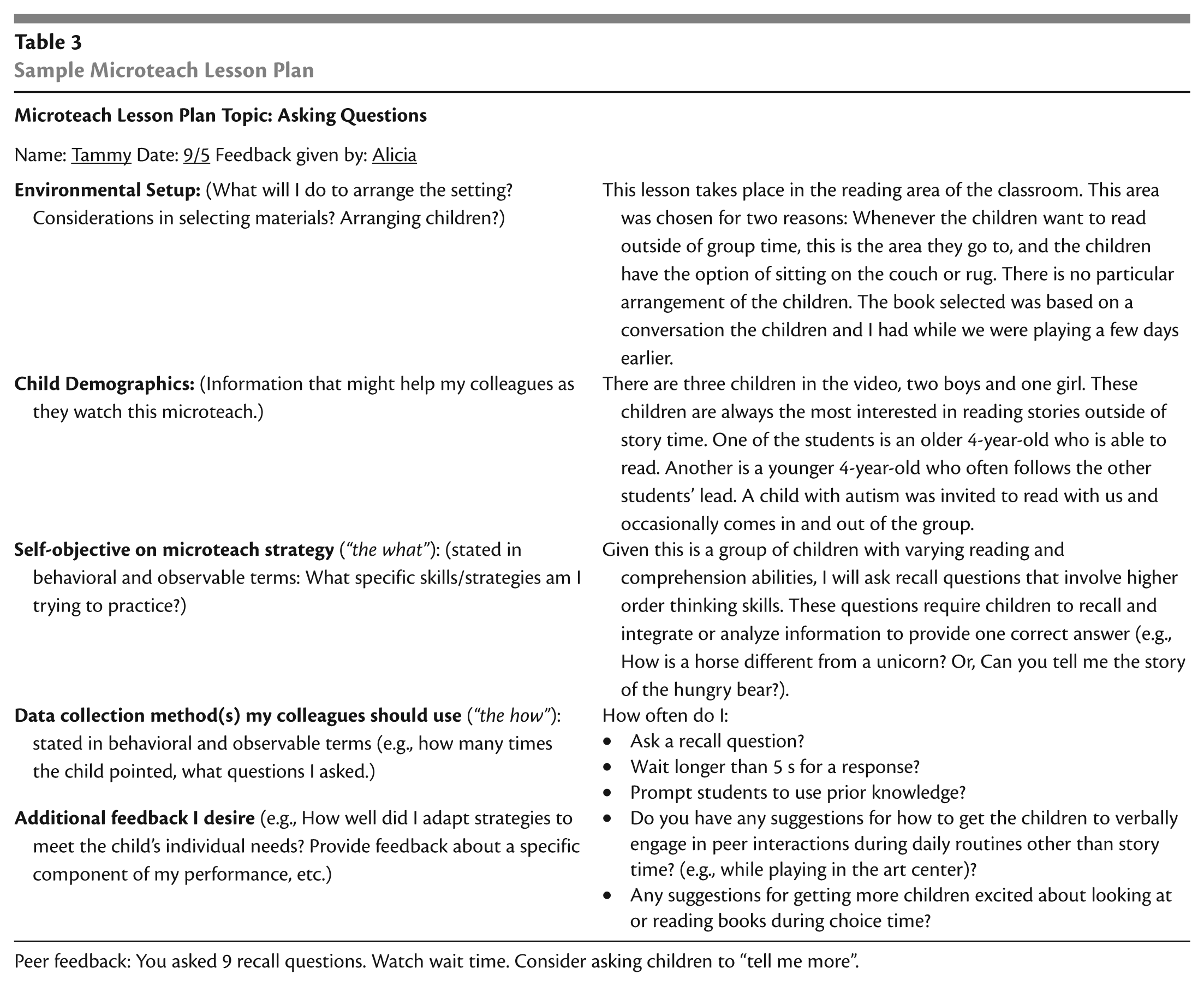
Peer feedback: You asked 9 recall questions. Watch wait time. Consider asking children to “tell me more”.
Environmental setup
This section of the lesson plan includes a description of the instructional context. Preservice teachers typically describe the physical location (e.g., this microteach was conducted on the carpeted area of the classroom, with three preschoolers present) along with the social environment (e.g., the three classmates included the target child along with one child who uses hearing aids and one child for whom English was his second language).
Melissa described the environment of her microteach in the following way:
The environment is a preschool classroom, and I conducted this microteach during snack time with three children at a small table. I wanted to provide a familiar setting with a small group of students to help my “target” student (Jack) communicate with his peers and me. I selected this familiar activity because I thought that it would provide multiple opportunities to improve Jack’s communication skills, especially as Jack requested more juice and snack, and as he made choices of his preferred type of snack.
Child demographics
In this section of the lesson plan, the preservice teacher describes the target child, including age, personality traits, services provided to the child, strengths, and areas of need.
Melissa described Jack in the following way:
Jack is a very quiet 3-year-old boy who recently began attending preschool. He loves spending time at the block center, and he really enjoys reading books with adults. Since he started school he has had a difficult time expressing his needs verbally, and does not talk much with his peers or with the adults in the room. I would like to see him use more words to express himself, as opposed to relying on gestures (e.g., pointing, shaking head “no”).

Self-objective on the microteach strategy
In this section of the lesson plan, the preservice teacher describes at least one objective in relation to the microteach strategy and the target child.
For example, Melissa wrote the following for her self-objective:
Through the use of expansions, labeling, and parallel talk, I will encourage Jack to use words during snack time. I hope that by modeling language and expanding on words that Jack says, I will support him in using more language.
Possible data collection methods
In this section, the presenter lists possible methods for collecting data to address the self-objective. Because many preservice teachers are new to gathering data at this stage in their professional development, it may be useful to have them select a method that they believe will provide adequate feedback on the presenter’s target behavior (or even one of the behaviors from among several that the presenter has targeted). Encouraging preservice teachers to select a data collection method of their choice results in multiple perspectives about the microteach video clip as teacher candidates watch the segment with an eye to their particular focus.
Melissa lists the following ways that her colleagues might collect data from her video recorded segment: frequency data on the three strategies she attempted to use (expansion, labeling, parallel talk), data on which strategies were most successful in getting Jack to engage in verbal communication, and focused data on one of the three strategies followed by detailed data on Jack’s responses to the strategy.
Additional feedback desired
In this section of the lesson plan, presenters list other topics or behaviors for which they would like feedback. It is not uncommon for preservice teachers to pose questions related to group management.
Melissa asks her classmates to provide feedback on what worked well in the small group snack activity, what did not work well, what she could have done differently, and any additional suggestions on how to get Jack to use his words with teachers and peers.
Step 3: Implement the Lesson and Video Record 5 Min
Preservice teachers are encouraged to disseminate video consent forms to the parents of the children at their practicum site. Only those children who return signed parent consent forms are included in the microteach video. Digital video cameras are available for preservice teachers to borrow from the UIUC College of Education Technology Center. University supervisors and cooperating professionals (i.e., teachers or early intervention providers paired with preservice teachers in practicum) are cognizant of this assignment and are encouraged to assist preservice teachers with video recording the lesson. Although the video of the lesson may be longer, the preservice teacher is only required to present 5 min of the video in seminar. Practicum seminar instructors have found that brief video segments provide enough time for preservice teachers to demonstrate the microteach strategy and for observers to understand the social and physical environment and gather the requested data.

On receiving written consent from three parents regarding the use of video and having prepared her activity, Melissa asks her university supervisor to assist with video recording. As she is getting ready to begin her activity, Melissa makes sure the digital camera’s recording settings are correct, and she briefly orients her supervisor on the use of the camera. Melissa also tells her supervisor that she will signal to him when the recording should end.
Step 4: Distribute the Lesson Plan During Seminar, Describe the Context of the Video-Recorded Segment, and Specify Aspects of the Lesson That Are the Focus for Feedback
Having completed her microteach activity, Melissa brings her recording to seminar, distributes her lesson plan, and shares some information with her classmates about the5-min video that they are about to watch. She uses the lesson plan form as a format for highlighting relevant features of the video clip prior to showing the segment to her classmates. Melissa’s colleagues ask clarifying questions about what they are preparing to watch (e.g., How will we know which child is Jack? If Jack typically speaks in one-word utterances, is an expansion anything longer than one word?). They also make sure they understand the type of feedback Melissa wants from them.
Step 5: Watch the Video Segment
As they are watching the video, preservice teachers and the seminar instructor collect data on Melissa’s performance and take notes on the lesson plan form. This is done independently, with each preservice teacher designing his or her own note-taking system, often using the backside of the lesson plan form for this activity.
Step 6: Write Comments and Suggestions on the Lesson Plan Form
Approximately 2 to 5 min are set aside for preservice teachers and the seminar instructor to summarize their observational notes following the viewing of the video clip. As the lesson plan form will be given to the presenter following the microteach activity, care is taken to make sure that comments are legible and that data are summarized so that the preservice teacher can understand what was observed.

Step 7: Practicum Students Provide Positive and Constructive Feedback to the Presenter
Either in a round-robin format or as an informal discussion, preservice teachers are encouraged to share the data they gathered and any general comments about the video segment with the presenter. To avoid repeating feedback, preservice teachers are encouraged to share data and ideas that have not been shared before.
Melissa’s nine classmates and the seminar instructor share much feedback with her, including these three primary ideas: (a) In the 5-min video clip, Melissa expanded on Jack’s utterances 7 times; (b) Melissa labeled nine things during snack time and two of these resulted in verbal communication from Jack; and (c) offering Jack smaller quantities of juice and choices of highly desirable snacks (e.g., goldfish crackers and raisins) might provide more opportunities to engage him in verbal communication by labeling the snack items and expanding on his utterances (should he repeat the labels).
Step 8: Copies of the Lesson Plans With Observers’ Notes on Them Are Given to the Presenter
By giving the presenter hard copies of the lesson plans with written feedback (data collection and other ideas) following the sharing portion of the microteach activity, he or she can review them at his or her leisure. Preservice teachers write their names on the forms so it is possible for the presenter to ask for clarification, if needed.
Step 9: Reflection and Ideas for Using the Feedback in Future Practice
The presenter reflects on the feedback from his or her peers and considers how to utilize these ideas in future practice.
Melissa considers her peers’ ideas for structuring the environment to provide increased opportunities for Jack to communicate with her. She plans to learn more about structuring activities to facilitate social communication and implement these ideas in her teaching.
“Microteaching introduces preservice teachers to the realities of teaching and the roles teachers assume in a variety of settings where young children with and without disabilities and their families receive services.”
Conclusion
The DEC Recommended Practices (2005) emphasize the importance of systematically designed and supervised field experiences for preservice teachers. Considering the significance of field-based experiences on teacher education, microteaching introduces preservice teachers to the realities of teaching and the roles teachers assume in a variety of settings where young children with and without disabilities and their families receive services (P. S. Miller & Stayton, 2005; Myers, 1996; Subramaniam, 2006; Wilkinson, 1996). Within these diverse settings, preservice teachers plan meaningful activities that hone their teaching and instructional skills. In addition, and given the format of microteach lessons, preservice teachers feel free to take risks and pursue challenges they may not have otherwise undertaken (e.g., choosing to work with children who demonstrate challenging behavior), experiment using a variety of strategies that they are learning in methods courses, and allow themselves to make mistakes and learn from them (Brent, Wheatley, & Thomson, 1996; J. M. Miller, 2009).
Microteaching helps bridge the gap between university instruction and practice. When planning for their microteach, preservice teachers have opportunities to choose to focus on a variety of evidence-based practices, thus connecting theories of teaching and research with service delivery (Wilkinson, 1996). While conducting their microteach, preservice teachers acknowledge the complexities of teaching within varied educational settings (e.g., homes, classrooms), realize the challenges of transferring knowledge into action, and begin linking theory to practice (Fernandez, 2005).
Preservice teachers at the University of Illinois have indicated that microteach activities are beneficial. Feedback provided to seminar instructors following the completion of the course in which microteach lessons were presented has generally been very positive. Comments included, “I think that microteach feedback and suggestions help improve my overall teaching ability and help me reflect on my teaching” and “From others’ microteach lessons, I learn how to effectively interact with young children.” Preservice teachers at UIUC are encouraged to include their microteach videos in their professional portfolios. These artifacts from their teacher education program are excellent examples of their interactions with young children to share with prospective employers.
Using microteach lessons in the ways described in this article can be a powerful training tool in preservice teacher education programs. As preservice teachers are challenged to view how their actions influence child outcomes, teacher preparation programs need to afford them with ample opportunities to practice skills and understand the consequences of their actions through reflection, conversations with peers, and consideration of multiple viewpoints (Brent et al., 1996; I’Anson et al., 2003; J. M. Miller, 2009). This in turn allows preservice teachers to make critical connections between university classrooms and field placements, and become meaningful participants in a community of practice.
Footnotes
Authors’ Note
You may reach Michaelene M. Ostrosky at