




Abstract
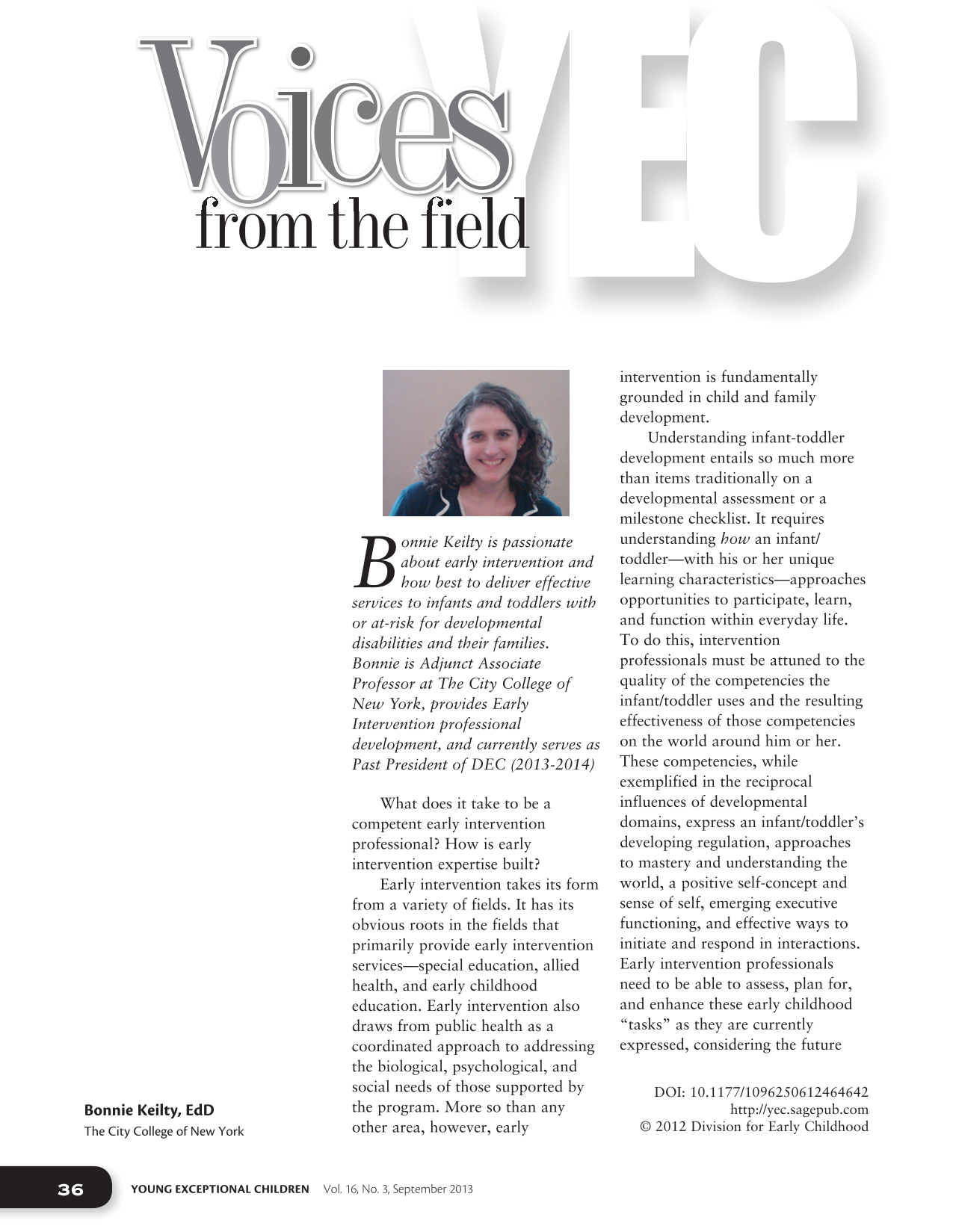

Bonnie Keilty is passionate about early intervention and how best to deliver effective services to infants and toddlers with or at-risk for developmental disabilities and their families. Bonnie is Adjunct Associate Professor at The City College of New York, provides Early Intervention professional development, and currently serves as Past President of DEC (2013-2014)
What does it take to be a competent early intervention professional? How is early intervention expertise built?
Early intervention takes its form from a variety of fields. It has its obvious roots in the fields that primarily provide early intervention services—special education, allied health, and early childhood education. Early intervention also draws from public health as a coordinated approach to addressing the biological, psychological, and social needs of those supported by the program. More so than any other area, however, early intervention is fundamentally grounded in child and family development.
Understanding infant-toddler development entails so much more than items traditionally on a developmental assessment or a milestone checklist. It requires understanding how an infant/toddler—with his or her unique learning characteristics—approaches opportunities to participate, learn, and function within everyday life. To do this, intervention professionals must be attuned to the quality of the competencies the infant/toddler uses and the resulting effectiveness of those competencies on the world around him or her. These competencies, while exemplified in the reciprocal influences of developmental domains, express an infant/toddler’s developing regulation, approaches to mastery and understanding the world, a positive self-concept and sense of self, emerging executive functioning, and effective ways to initiate and respond in interactions. Early intervention professionals need to be able to assess, plan for, and enhance these early childhood “tasks” as they are currently expressed, considering the future impact, and identify and maximize the opportunities afforded during developmental transitions. All of this requires a sophisticated, developmental eye, grounded in theory, research, and applied knowledge of child development.
Unyieldingly connected are the ways families “work” and the interrelatedness, or transactions, among the many facets of family life to infant/toddler learning and development. Intervention professionals must have a comprehensive knowledge base and applied expertise in family systems and the uniqueness of each family, the developmental process of parenting, family influences on child development, and, most particularly, the enormous power of parent–child interaction. With these perspectives in place, intervention professionals can work from a framework that views families as the unmistakable mediators of their infant/toddler’s learning and development with their own strengths and competencies to draw upon.
Knowledge and practice in child and family development are not owned by one discipline, but are the essential foundation from which every discipline’s expertise is situated. When intervention professionals across disciplines are well prepared in child and family developmental theory, research, and practices, they are readied to work in ways that embrace the complexity, unpredictability, and continued adjustments necessary for partnering with families with infants and toddlers with developmental delays and disabilities. They can effectively gather information and form hypotheses about each individual family and child, and then plan and implement programs within the individual family dynamic. They can apply quality evaluation and assessment practices, including informed clinical opinion, develop Individualized Family Service Plans (IFSPs) that fully consider the individual family, and partner with every family to support the infant/toddler’s learning and development. This is not easy work, yet it is much easier when one is well prepared.
As early intervention continues to evolve, this expertise does not become less important, but even more vital as early intervention leaders endorse practices well established in child and family development, namely, relationship-based, triadic partnerships with families, embedding interventions in routine activities, and supporting families to confidently and competently promote their child’s learning and development. These “new” practices can be seamlessly interwoven into one’s work when one can draw on an expert understanding of child and family development to creatively partner with each family and infant/toddler, according to their unique interests, ideas, and desires. Without it, early intervention professionals may struggle to see the conceptual link between endorsed practices and their work, which could be what impedes some early intervention professionals from embracing and implementing with fidelity recommended practices in natural environments. The onus of ensuring effective early intervention practice lies with professional development providers and early intervention systems.
Professional development for both emerging professionals and those already in the field can provide ongoing, intensive experiences to develop mastery and skillful application of knowledge and practice with infants, toddlers, and families within one’s disciplinary work. At the preservice level, a purposeful weaving of content knowledge and experiences throughout an entire program could support the acquisition of this proficiency rather than just a single course. For those already practicing, professional development providers might consider the prerequisite knowledge and skills needed to situate the advanced practices of early intervention in natural environments.
Just like the child cannot be looked at separately from his or her family, one cannot separate the work of the interventionist from the system in which he or she practices. The early intervention system can either facilitate or impede the use of recommended practices depending on whether it is structured in recognition of the complex variability of individual child development and each individual family culture and way of being. Those responsible for ensuring effective early intervention systems must not only allow for, but expect, this complexity by creating systems that insist on open-ended, flexible approaches to working with families; discourage overly simplistic, limiting methods to early intervention processes; and demand demonstrated competence by early intervention professionals.
Advances in the field of early intervention are meaningful when all families can benefit from them. Early intervention professionals will be equipped to integrate these innovations into their work when they are prepared with a comprehensive foundation in child and family development, and early intervention systems both facilitate and require application of this expertise with every family supported by early intervention.
Footnotes
Author’s Note
You may reach Bonnie Keilty by e-mail at