




Abstract

Introduction
The Centers for Disease Control and Prevention (CDC) has documented that 1 in every 88 children is identified with an autism spectrum disorder (ASD; CDC, 2012). Autism is now recognized in children at an earlier age because most researchers agree autism can be reliably identified by the time children reach 24 months (Cox et al., 1999; Stone et al., 1999). Therefore, families who have young children at risk for or identified with ASD are increasing in the early intervention community (Henderson, 2009). Early intervention is recognized as an effective approach for children at risk for or identified with an ASD (National Research Council [NCR], 2001; Rogers & Vismara, 2008; Wetherby & Woods, 2006); the earlier these children receive intervention, the more positive, long-term outcomes will occur (Volkmar, Lord, Bailey, Schultz, & Klin, 2004).
It is vital that early intervention enrich communication skills because this is one of the core deficits for children at risk for or identified with an ASD (Shumway & Wetherby, 2009) and the emergence of spoken language is a critical variable in predicting better outcomes in childhood and adulthood; children who exhibit communication and social delays, specifically those experiencing ASD, are at risk for developing problem behaviors and delays in literacy development (Horner, Carr, Strain, Todd, & Reed, 2002; Kamhi & Catts, 2005; Rayner, Foorman, Perfetti, Pesetsky, & Seidenberg, 2001; Tager-Flusberg et al., 2009). Numerous studies have demonstrated the positive effects of early intervention on language development for the majority of children with ASD (Rogers & Vismara, 2008; Tager-Flusberg et al., 2009). Therefore, the purpose of this article is to discuss evidence-based strategies for communication. Examples of how these strategies might be implemented in homes, early childhood education programs, and other natural environments, as well as additional web-based resources to understand and support communication development of young children at risk or identified with ASD are included.
Language intervention is most effective for children with ASD when the intervention begins early, includes social uses of language, and occurs with the intensity and duration needed to facilitate acquisition and generalization of new skills (Hancock & Kaiser, 2002). Teaching communication skills in the natural environment has resulted in an increase in vocabulary, generalization, maintenance, and unprompted use of language in young children with ASD (as reviewed in Mancil, 2009). Because intervention takes place in natural environments, these strategies allow for multiple practice opportunities and have the potential to occur in activities that are of high motivation to the child and family (Woods, Wilcox, Friedman, & Murch, 2011). The strategies discussed share the common feature of being able to be used within the context of home and family routines, as well as within the activities of an early childhood education (ECE) program.
“Language intervention is most effective for children with ASD when the intervention begins early, includes social uses of language, and occurs with the intensity and duration needed to facilitate acquisition and generalization of new skills (Hancock & Kaiser, 2002).”
If intervention is to be conducted within the context of family and ECE program routines and activities, early interventionists must be able to use adult learning strategies to support parents and other caregivers to learn and utilize the research-based intervention strategies. In this way, family, friends, and/or early care providers become an integral part of intervention. Current literature supports coaching strategies that include modeling, reflective listening, questioning, performance feedback, prompting, and problem solving (Woods et al., 2011). A triadic relationship among the child, parent/ECE teacher, and early interventionist where the interventionist acts as a coach is important to facilitate not only child growth but also adult learning and practice. These practices are illustrated in the scenarios below.
Strategies to Facilitate Communication Development in Young Children at Risk for or Identified With an ASD
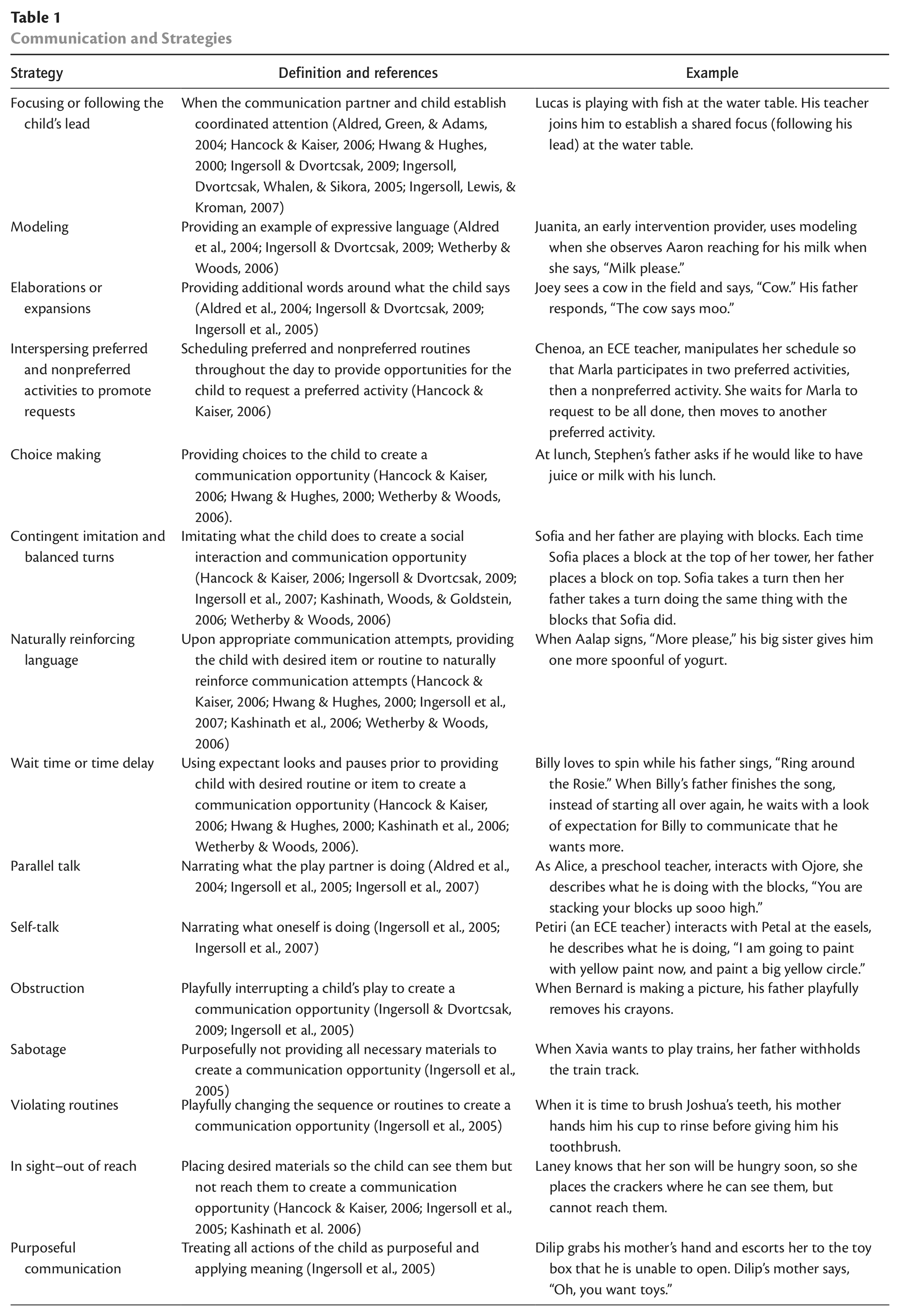
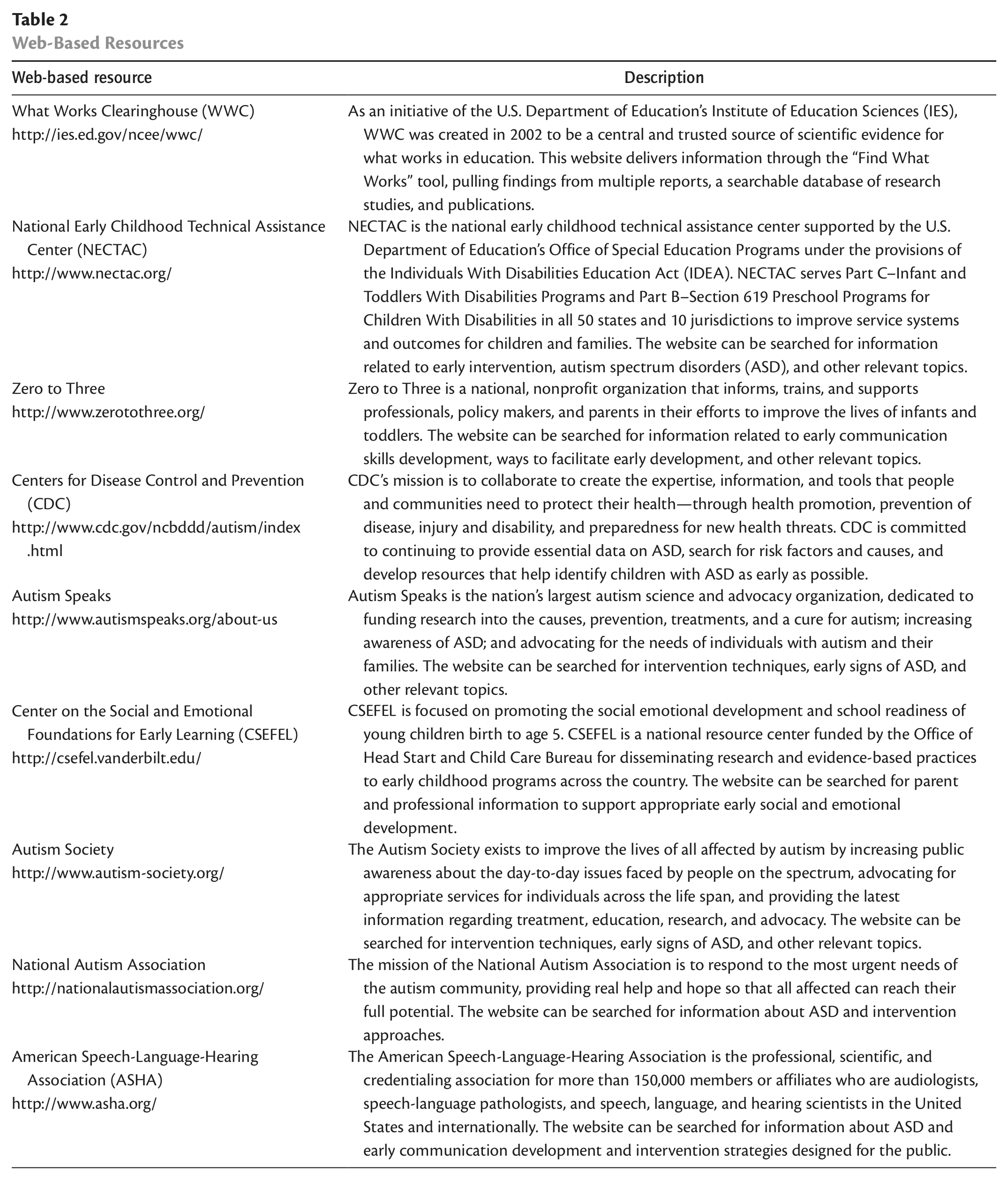
The strategies in this article have been implemented in a variety of intervention settings (e.g., home, community, clinic) with young children at risk for or identified with ASD and have led to an increase in communication skills (Aldred, Green, & Adams, 2004; Hancock & Kaiser, 2006; Hwang & Hughes, 2000; Ingersoll & Dvortcsak, 2009; Ingersoll, Dvortcsak, Whalen, & Sikora, 2005; Ingersoll, Lewis, & Kroman, 2007; Kashinath, Woods, & Goldstein, 2006; Wetherby & Woods, 2006). Table 1 provides an overview of the strategies and Table 2 provides a list of web-based resources that can be used to learn more about the strategies as well as other information to support communication skill development in young children. Included are strategies that can be used in natural environments and across cultures. Activities and routines in which the strategies are embedded should match those of the child and family and/or ECE program. For instance, some of the examples are used while playing with blocks; however, block play might not be an activity in which all families engage or in which all children show interest. Therefore, it is best to use the strategies in routines that are consistent with families’ and/or caregivers’ preferences and are of interest to the child.
Communication and Strategies
Web-Based Resources
Following the Child’s Lead
Following the child’s lead within activities and routines is important to provide opportunities for the child and communication partner to interact with one another. By following the child’s lead, the caregiver is motivating the child to participate in communication and interaction because they are engaging in a preferred activity (Aldred et al., 2004; Hancock & Kaiser, 2006; Hwang & Hughes, 2000; Ingersoll & Dvortcsak, 2009; Ingersoll et al., 2005; Ingersoll et al., 2007). The communication partner is focused on the child when following the lead of the child, and this allows the child to have opportunities for interaction. It also requires the communication partner to be observant of the child and to join in the child’s activity, whether it be within a play activity such as rolling Play-Doh© or a daily routine such as hand washing.
For example, Leo, an early interventionist, and Emily’s mother discuss routines and activities Emily enjoys. Leo explains, “By looking at those activities and routines that Emily enjoys, we can decide where we can use other intervention strategies such as modeling or expanding what she says.” Emily’s mother responds, “Emily enjoys walks, rolling balls, and watching television.” A few moments later, Leo observes Emily get a ball. Leo says, “It looks like Emily wants to play ball. Let’s go join her.” As they join in Emily’s play, they wait for Emily to roll the ball to them, then roll it back to her. If Emily points to or pats the ball, Emily’s mother responds, “Yes, that is your big yellow and red striped ball.”
Choice-Making Opportunities
By providing an opportunity for a child to make choices, the child is given opportunities to communicate his or her preferences (Hancock & Kaiser, 2006; Hwang & Hughes, 2000; Wetherby & Woods, 2006). The number of choices must be appropriate for each individual child. That is, while some children can choose one book to read from four possible books, other children’s options are better limited to two books from which to choose. Children can be given opportunities to make choices throughout the day in activities and routines such as getting dressed (“Do you want to wear your blue or red shirt today?”) or outdoor play (“Would you like to swing or play in the sand?”). It is important to note that the choices offered are all appropriate choices for the child to make.
For instance, Rachel, a preschool teacher, Lori, a speech-language pathologist, and Jamie, a paraprofessional, are collaborating with the goal of creating communication opportunities for the children in the classroom. One way they provide communication opportunities is by giving the children choices. After small groups, Rachel and Jamie ask the children in their small groups which center they will choose. Rachel and Jamie use a verbal prompt and pictures to be sure the children understand and give the children in their groups the opportunity to make a choice. Some children choose by pointing to a picture and some children verbally respond.

Intersperse Preferred and Nonpreferred Activities
Deliberately engaging the child in both preferred and nonpreferred activities provides opportunities for the child to use communicative behaviors to protest, request release from a nonpreferred activity, and to request a preferred activity (Hancock & Kaiser, 2006). This strategy also provides the opportunity to teach appropriate ways to request and protest. When the communication partners feel they know the child, they can purposefully arrange for both preferred and nonpreferred activities to occur to allow for these communication opportunities.
The following scenario illustrates interspersing preferred and nonpreferred activities. Myla, Raeshawn’s mother, explains to Keisha, the early intervention provider that Raeshawn loves to play with trucks, trains, and cars. She also indicates that reading stories and playing with baby dolls are nonpreferred activities. Myla attempts to read a book with Raeshawn which causes him to protest by hitting the book and squirming off the couch. Keisha immediately says to Raeshawn, “Raeshawn, use your cards to ask to play with your vehicles,” gives Raeshawn the appropriate card, and physically prompts him to show the card to Myla. Myla then says, “I see you would like to play with your cards and trucks, Raeshawn. Let’s go get them.”
Obstruction
One way in which the communication partner can provide a communication opportunity is by using obstruction or briefly interrupting the child’s routine to present a communication opportunity (Ingersoll & Dvortcsak, 2009; Ingersoll et al., 2005). When young children become focused in their play, it can be difficult to become a part of that activity; however, by using obstruction, the communication partner becomes an active participant in the routine in which the child is engaged. As the communication partner “obstructs” or stalls the child’s activity, the child is provided a prompt to communicate in order for the activity to resume by communicating verbally or nonverbally (e.g., gestures, visuals, choice boards) to convey meaningful intent.
For example, Jeremy is playing with his blocks. His mother is having a difficult time becoming part of this activity, but remembers how she and Jana, the early intervention provider, discussed obstruction as a possible strategy to use. Sitting “crisscross applesauce” on the floor close to Jeremy, she playfully scoops the blocks in between her legs and leans over them, blocking Jeremy from grabbing them. Jeremy provides his mother with an eye gaze and reaches for the blocks. Then his mother says, “Oh, you need the blocks?” and gives Jeremy one block. When Jeremy protests by trying to push his mother’s body away from the blocks, his mother says, “You want more blocks? Tell me, Jeremy . . . Use your words, say ‘More blocks.’” Jeremy’s mother waits for a response prior to providing the blocks to Jeremy.
Violating Routines
As children spend more time in an early care setting or in their home environment, they become accustomed to the sequence of activities and routines. Because of this, violating routines is a way in which the communication partner can create a communication opportunity for the child. Violating routines is changing the order of routines or the sequence of tasks within a routine; however, when violating routines, the communicative partner must think about the typical process or schedule that the child enjoys or to which the child has become accustomed and change the routine to create a communication opportunity (Ingersoll et al., 2005).
For instance, in preparation for bath time, Mark knows that the first thing he does is wait for his brother to finish his bath, and then Mark gets into the bathtub. However, when it is time for Mark to take a bath, Mark’s father begins to put him in an empty tub while his clothes are still on. Mark begins to shake his head no, and his father responds, “Oh Daddy is so silly! What did I forget to do?” Mark’s father waits for Mark to point to his clothes, and then says, “Yes, we need to take off your clothes first.”
Sabotage and In Sight–Out of Reach
Sabotage and in sight–out of reach are strategies the communication partner can use to manipulate the environment, allowing the child communication opportunities. The communication partner facilitates communication through using in sight–out of reach by placing desired items in a place visible, but out of reach, to the child (Hancock & Kaiser, 2006; Ingersoll et al., 2005; Kashinath et al., 2006). By allowing the child to see the item but not reach the item, the communication partner creates an opportunity for a request to be made. Another environmental strategy is sabotage or withholding the necessary materials to complete a task to interfere with the attainment of a desirable material and thus a need for communication arises (Ingersoll et al., 2005). The communication partner must prepare for upcoming routines by thinking about what is needed to successfully complete the desired task and what could be removed to create a communication opportunity.
The following scenario illustrates sabotage and in sight–out of reach. Julio’s mother places his juice cup on the counter where it is visible to Julio but where he is unable to obtain it on his own. When Julio reaches for his juice and says, “Ba ba,” his mother responds by saying, “Juice please.” She then waits for Julio to imitate her and provides another prompt before giving Julio his juice. Wade, the family’s intervention provider, comments, “You created an excellent opportunity for communication. Are there other routines in which you might be able to use this strategy?” Julio’s mother observes that Julio enjoys sorting his colored bears that are kept in a cabinet behind closed doors. She decides to place them instead on an open shelf that is visible to Julio, but too high for him to reach and grab the bears. Wade shares a similar environmental strategy is thinking about the routines and activities Julio enjoys and not providing all the necessary materials to create a communication opportunity.
Contingent Imitation and Balanced Turns
Communication partners can use contingent imitation and balanced turns to engage with the child by imitating child behaviors (Hancock & Kaiser, 2006; Ingersoll & Dvortcsak, 2009; Ingersoll et al., 2007; Kashinath et al., 2006; Wetherby & Woods, 2006). By using contingent imitation and balanced turn taking, the partner is engaging with the goal of becoming a part of the routine to create an opportunity for reciprocal social interaction and communication. Recognizing the need for balance within this strategy is key, as contingent imitation and balanced turns are meant to promote an equal partnership between the communication partner and child.
For example, Alice, a preschool teacher, uses contingent imitation during water play with Zeke. At the water table, Zeke is pouring water from one cup to another. Alice moves next to Zeke at the water table and begins to pour water from one cup to another, making her pours follow the pours of Zeke. At first, Zeke does not notice, but Alice continues to use contingent imitation and balanced turn taking and observes Zeke begin to notice her. She then begins to encourage him to verbalize, “My turn” when it is his turn, as she models, “My turn” when it is her turn.
Modeling
Modeling involves providing an expressive language example to the child (Aldred et al., 2004; Ingersoll & Dvortcsak, 2009; Ingersoll et al., 2005; Kashinath et al., 2006; Wetherby & Woods, 2006). The communication partner can use modeling by engaging in strategies that include self-talk, parallel talk, or expansions/elaborations because these are all different ways of providing expressive language around the child. Parallel talk involves the communication partner providing a narrative of the child’s actions by describing what the child is doing at an appropriate developmental level for the child (Aldred et al., 2004; Ingersoll et al., 2005; Ingersoll et al., 2007). Self-talk is a narration of what the adult or communication partner is doing and can be used to increase a child’s exposure to language (Ingersoll et al., 2005; Ingersoll et al., 2007). In addition, communication partners can engage in expansions by providing additional words around what the child says to increase language exposure and facilitate communication development (Aldred et al., 2004; Ingersoll & Dvortcsak, 2009; Ingersoll et al., 2005). Expansions provide a model of a lengthened utterance for the child.
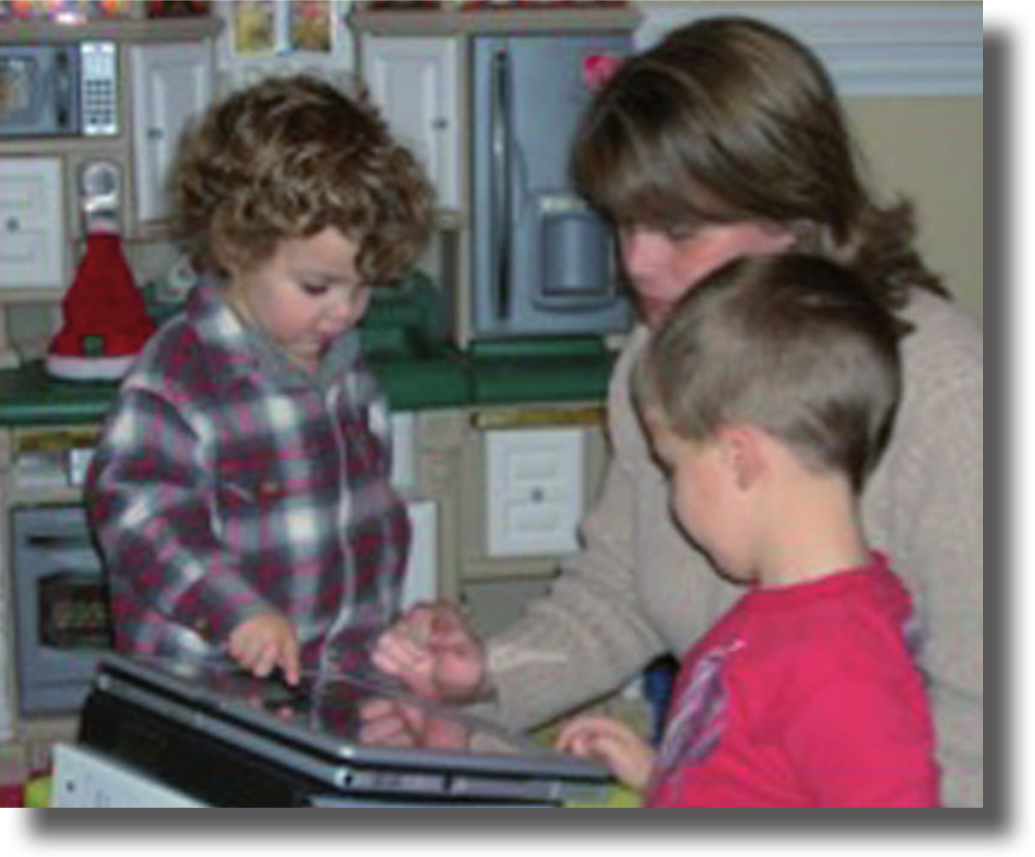
For instance, Ms. Joann facilitates communication development in her classroom by modeling appropriate communication, but she has also encouraged some of the children in her classroom to act as peer models of communication. It is time for lunch, and Alejandro begins screaming and looking at the lunch trays as the food tray arrives in the lunchroom. His friend, Samuel says, “Alejandro say ‘lunch please.’” Alejandro continued to scream and another peer, Samantha says, “We are ready for lunch.” Then Alejandro begins saying, “Please.” When Ms. Joann noticed Alejandro saying “Please,” she promptly provides him with his lunch while saying, “Lunch please” to expand upon what he said. As lunch continues, each of the children are using self-talk when they share what they are eating. Ms. Joann uses parallel talk when she says, “Alejandro is eating his sandwich.”
Wait Time or Time Delay
Adults often meet children’s needs without modeling or requiring communication; however, every instance in which a young child desires something could be an opportunity to practice communicating by waiting a few seconds to give the child the opportunity to initiate. Wait time involves waiting (or pausing) for a child to use a communicative behavior and is sometimes used after an adult makes a request or solicits a response, or wait time may simply involve an adult waiting for a child to make a request (Hancock & Kaiser, 2006; Hwang & Hughes, 2000; Kashinath et al., 2006; Wetherby & Woods, 2006; Woods et al., 2011). When communication partners engage in wait time, they are providing children the opportunity to practice spontaneous communication through gestures, vocalizations, words, or other forms of alternative communication (e.g., pictures, buttons).
The following scenario illustrates wait time or time delay. Laquisha enjoys music time, so her teacher decides to use the music routine as a time to embed wait time, as this would be a motivating routine. Ms. Joy, Laquisha’s teacher, passes around a basket that has shakers inside. As she gets to each child, she waits for them to say, “Shaker, please.” Once the child says this, he or she may take a shaker from the basket. When the teacher reaches Laquisha, she does not respond. Ms. Joy positions herself at Laquisha’s level, shows her the shakers, looks expectantly, and waits. After 5 s, Laquisha does not respond. Because Ms. Joy has been working with Laquisha and her family to develop some functional signs, she assists Laquisha in signing, “Please.” Once Laquisha signs “Please,” Ms. Joy allows her to take a shaker from the basket.
Combination of Strategies
The strategies discussed can also be used in conjunction with one another. For example, in a home or center-based setting, a family member, early intervention provider, friend, or ECE teacher might find it appropriate to use multiple strategies within one activity or routine. Because all of the strategies can be implemented in the natural environment of the child and within routines that are familiar to the child, family, or early care facility, once the communication partner begins feeling comfortable with each of these strategies, it would be appropriate to combine strategies which would allow the child more communication opportunities and exposure.
Using a combination of strategies is illustrated through Kaley’s experience with Eric and his family. Kaley, an early intervention provider, collaborates with Eric and his family. Eric’s mother, Ellen, identifies environmental arrangement, modeling, language stimulation techniques, and wait time as strategies she enjoys using because she can embed them into any routine in which Eric and his family participate. Because Ellen suggests these strategies are helpful, Kaley models for Eric’s mother how to combine these strategies. Eric enjoys mealtime, so Kaley and Ellen determine this would be a good routine to practice communication strategies. When it is time for lunch, Kaley uses environmental arrangement to place Eric’s lunch in sight, but out of reach, and uses wait time to provide a communication attempt. When Eric does not initially respond, Kaley uses modeling. Because Eric is verbal, she says, “Lunch please.” Eric does not respond within a few seconds, so Kaley assists Eric to sign, “Eat,” and quickly provides him with his lunch (natural reinforcement). Kaley shows Ellen how to use language stimulation techniques. That is, while Eric is eating, she says, “You are eating your sandwich and mommy is drinking some water.” Within the mealtime routine, Kaley and Ellen collaborated to use multiple strategies within one routine, as these were strategies that Ellen identified as helpful and easy to implement in many routines.
In addition to communication strategies, attributes of communication engagement enhance interaction and communication between the caregiver and child. Attributes of communication engagement include purposeful communication and naturally reinforcing communication. These are considered communication attributes, as they are not specific strategies; however, they are communication qualities that can be used during all communication exchanges. Purposeful communication involves capturing opportunities to respond to behaviors of the child as if they were purposefully communicating something to the communication partner (Ingersoll et al., 2005). For example, Myla builds a tower and then she begins throwing her blocks across the room. Her mother responds, “I see you are finished playing with blocks.” Myla’s mother observed her throwing blocks and responded as though the child was purposefully communicating that she was all done.
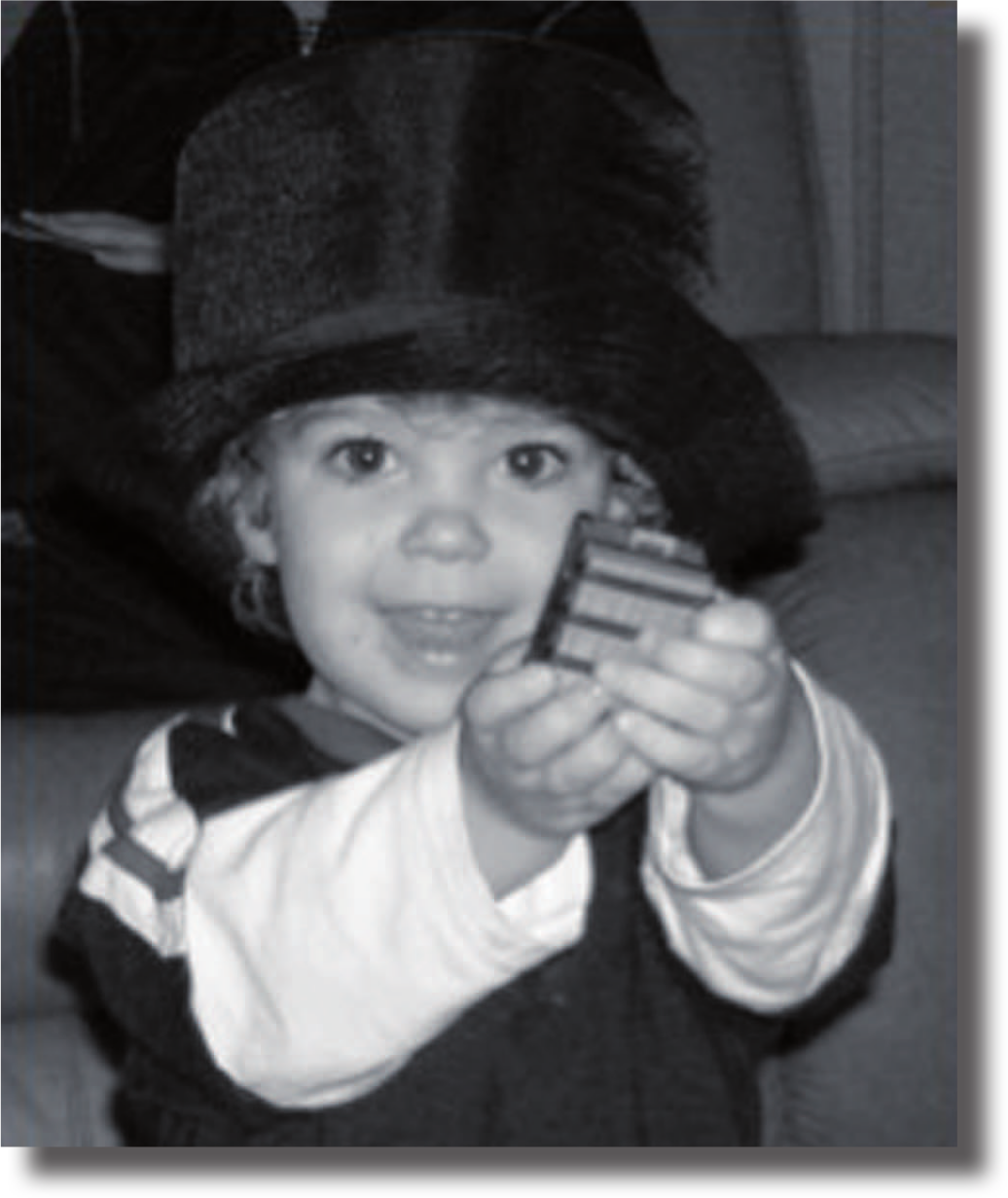
Naturally reinforcing communication is another attribute of communication that involves the communication partner directly responding to communication acts to reinforce communication acts (Hancock & Kaiser, 2006; Hwang & Hughes, 2000; Ingersoll et al., 2007; Kashinath et al., 2006; Wetherby & Woods, 2006). Communication acts can be gestures, approximations, words, or multiple words. For example, Lana gives a book to her teacher and places the teacher’s hands on the book, and the teacher responds, “You want to read a book.” The communication partner is reinforcing this communication act by responding directly to the child’s request.
Conclusion
As families, early intervention providers, and early childhood educators work to promote critical skill development in young children at risk for or identified with an ASD, it is vital to utilize research-based intervention strategies. Although the information presented in this article provides many strategies to facilitate communication development in young children at risk for or identified with ASD, it is important to note that there is a plethora of additional information available regarding other developmental approaches to facilitate the development of young children at risk for an ASD (Wetherby & Woods, 2008). It is critical that the strategies selected are carefully matched to child goals and to the preferences of family members and other caregivers. Furthermore, methods to monitor the effectiveness of the strategies must be used to ensure that intended outcomes are reached. However, this article provides families, early intervention providers, and early childhood educators with information about research-based strategies that can be embedded in the natural environment to facilitate communication development in young children at risk for or identified with ASD.
Footnotes
Authors’ Note
You may reach Christan Grygas Coogle by email at