




Abstract
Julia is a single mother of four children ages 2 months to 6 years. Emma, Julia’s 3-year-old daughter, enjoys playing with her siblings and helping her mother take care of her 2-month-old baby brother. Emma has developmental delays and sees a developmental therapist (DT) once a week. Recently, Emma began exhibiting challenging behaviors throughout the day, with these behaviors escalating during the evening bedtime routine. Every night, when Julia begins to get Emma and her siblings ready for bed, Emma starts throwing toys, hitting her younger siblings, and falling on the floor screaming and kicking. Julia tries to calm Emma down by talking to her and holding her, but these strategies are not working. Julia decides to ask Emma’s DT for assistance in addressing Emma’s persistent challenging behaviors.
Challenging behavior is often a source of frustration for parents. Challenging behavior is defined as any behavior that interferes with children’s learning and development, is harmful to children and to others, and puts a child at risk for later social problems or school failure (Bailey & Wolery, 1992; Kaiser & Rasminsky, 2003). Children’s challenging behaviors can affect a family’s ability to participate in home routines and community activities. When children engage in persistent challenging behavior, the importance of designing effective behavior interventions in collaboration with parents cannot be overstated.
One of the most important values when working with young children is emphasizing family-based practices (Trivette & Dunst, 2000), which focus on family strengths, promote family choice and control over desired resources, and stress the development of collaborative relationships between parents and professionals. The Division for Early Childhood of the Council for Exceptional Children’s (DEC) position statement emphasizes the critical role that families play in designing and implementing interventions to address challenging behavior (DEC, 2007). The family, a child’s most valuable and durable resource, exerts a powerful influence on a child’s development (Dunlap & Fox, 1996). Apart from knowing their child best, parents are also the key decision makers in selecting their child’s day-to-day activities to foster development. Parents have unique knowledge about family goals and values, typical routines, resources, social supports, and stressors.
Although parent training in the treatment and prevention of children’s externalizing problem behaviors (e.g., kicking, screaming, hitting) has emerged as an important topic, parent intervention has not been uniformly successful (e.g., Gross et al., 2003; Prinz & Miller, 1994; Webster-Stratton & Hammond, 1997). Given that interventions should focus on aspects that prevent the maintenance of challenging behaviors, research has shown promising results when interventions are designed to target the purpose, or function, of the challenging behaviors (Carr et al., 1999; Horner, 1994). Studies that compared function-based with non-function-based interventions have noted distinct differences in decreases in challenging behaviors as a result of function-based interventions (Ingram, Lewis-Palmer, & Sugai, 2005; Newcomer & Lewis, 2004).
One function-based intervention approach that has been deemed effective is Positive Behavior Support (PBS; Horner, Sugai, Todd, & Lewis-Palmer, 2005). PBS is a collaborative, assessment-based approach to developing effective, individualized interventions for those with challenging behaviors. The PBS framework provides a valuable and empirically based process to understand and resolve challenging behavior. It offers an approach to develop a better understanding of why children engage in challenging behavior and strategies to prevent the occurrence of problem behavior while teaching children new skills (Powell, Dunlap, & Fox, 2006). The approach emphasizes building collaborative partnerships throughout the assessment and intervention process. Practitioners can use this framework when collaborating with parents to create a support plan that is a good fit for the family and the environment in which the procedures would be implemented (Lucyshyn, Kayser, Irvin, & Blumberg, 2002).

The purpose of this article is to help early childhood practitioners collaborate with parents to identify the purpose of challenging behaviors, determine effective strategies to address these behaviors, and create a behavior support plan that “fits” the needs of the child as well as the family. Guidelines for observing challenging behaviors and creating behavior support plans also are described. Throughout the article, examples are presented to illustrate ideas that are presented; however, these examples are not meant to be comprehensive or exhaustive.
Family Partnerships
Building collaborative relationships with parents is an essential step in developing and implementing an effective behavioral intervention. The most successful programs for addressing children’s challenging behavior are based on partnerships between practitioners and parents (Marshall & Mirenda, 2002). Unfortunately, building these relationships is not always easy. Turnbull, Turnbull, Erwin, Soodak, and Shogren (2011) have written extensively on how to develop effective collaborative partnerships with parents. They suggest the following key components of a partnership: communication, respect, trust, commitment, and equality (see Table 1 for the principles of partnerships).
Principles of Partnership

Source: From Turnbull, Turnbull, Erwin, Soodak, and Shogren (2011).
“Valuing parents as experts about their children and helping parents understand that this is a key component they bring to the collaborative relationship is critical in establishing equality within the parent-professional relationship.”
Communication is a key component to collaborating with parents (Buschbacher, Fox, & Clarke, 2004; Marshall & Mirenda, 2002). Although many practitioners are taught to conduct themselves in a businesslike manner, this style can come off as distant and patronizing to parents. It is important for practitioners to develop and maintain rapport with parents and be good listeners. Practitioners also need to avoid using jargon, and they should work toward understanding what parents are experiencing without judging them. It is important for practitioners to respect what families bring to the collaborative relationship and honor their culture and values (Turnbull et al., 2011). Practitioners can show respect by affirming family strengths and acknowledging the hard work parents are investing in changing their child’s behavioral patterns or the strong support system that the family already has in place.
Parents need to know they can trust that the information they share with practitioners will be treated confidentially and the practitioners are committed to them and their child as they make intervention decisions. Commitment means being available and accessible for families, and serving as a referral agent for additional services the families might need to support their child’s development. Perhaps one of the most important components of a collaborative relationship is equality (Buschbacher et al., 2004). It is imperative that practitioners and parents share power. Valuing parents as experts about their children and helping parents understand that this is a key component they bring to the collaborative relationship is critical in establishing equality within the parent–professional relationship. Practitioners should foster empowerment so that parents and other team members are persistent in finding solutions to challenging behaviors.
A behavior support plan that is contextually appropriate for the family should consider goals and values of the family, strengths and supports for family members who will be implementing the plan, as well as the child’s strengths, skills, likes, and dislikes (Lucyshyn et al., 2002). A behavior plan that is technically sound but is not a good contextual fit for the family may be rejected by family members, may be implemented inconsistently or inaccurately, or may not be sustained over time. As practitioners collaborate with parents to gather information needed to create a behavior support plan, they can combine their understanding of the dynamics of behavior and information about family well-being to provide lasting and sustainable outcomes for children with challenging behaviors and their families (Horner, Albin, Sprague, & Todd, 2000; Horner et al., 2005). Furthermore, a behavior support plan needs to be easy and efficient to implement given the skills and resources of the target family that will implement the plan. Behavior support strategies should be proactive (aimed at preventing challenging behavior vs. reacting to challenging behavior), focus on teaching new skills, and match the purpose or function of the challenging behavior.
“A behavior plan that is technically sound but is not a good contextual fit for the family may be rejected by family members.”
Understanding Challenging Behavior
Children engage in challenging behavior for many reasons. However, these behaviors typically serve to communicate something (Fox, Dunlap, & Cushing, 2002; O’Neill et al., 1997). Normally, children’s challenging behavior tells us that they have a desire to escape from someone or something, or a desire to obtain or gain access to preferred activities, materials, or attention. Returning to our vignette, Emma might throw toys to obtain attention from Julia, or she might also throw toys to escape from cleaning up to get ready for bed.
An essential step before implementing a behavior intervention is to gather information about the events that lead to challenging behaviors to determine the purpose or function of the behavior, also referred to as functional behavior assessment (FBA; O’Neill et al., 1997). During a FBA, the practitioner gathers information about the family and the child through interviews and observations. Through this process, the practitioner and the family learn the triggers (things that “set the stage” for problematic behavior) and purpose of the challenging behavior. The assessment also gives the practitioner insight into the family values and the ecology that may contribute to the observed behaviors. Without this information, we end up guessing at why a child engages in challenging behavior instead of gaining insights from the data (Dunlap, Newton, Fox, Benito, & Vaughn, 2001).
As part of a FBA, observations are conducted to gather information on Antecedents, the challenging Behavior, and the Consequences (referred to as ABC Observations; Miltenberger, 1997). This information makes it easier for parents and practitioners to understand the behaviors and guides them in selecting appropriate intervention strategies. Antecedent data refer to the events, actions, or circumstances that happen prior to the occurrence of challenging behavior (Cooper, Heron, & Heward, 1987; for example, When Julia starts getting Emma’s siblings ready for bed, Emma starts throwing toys, hitting her younger siblings, and falling on the floor screaming and kicking). The antecedent for Emma’s challenging behaviors is that her mother had to attend to Emma’s younger siblings and get them ready for bed. In addition to antecedents, parents and practitioners should document the forms of challenging behaviors observed. For Emma, challenging behaviors included throwing toys, hitting her siblings, screaming, and kicking. Consequences refer to the immediate action or response that a child receives from others and/or the environment following the challenging behavior (O’Neill et al., 1997; for example, Emma’s mother holds her and talks to her.) The consequence in this situation is that Emma receives a lot of attention following her display of challenging behavior. For Emma, if this pattern was repeated across multiple observations, we would conclude that by exhibiting challenging behaviors, Emma successfully gained her mother’s attention. (See Table 2 for a completed ABC Observation Form.)
Completed ABC Observation Form
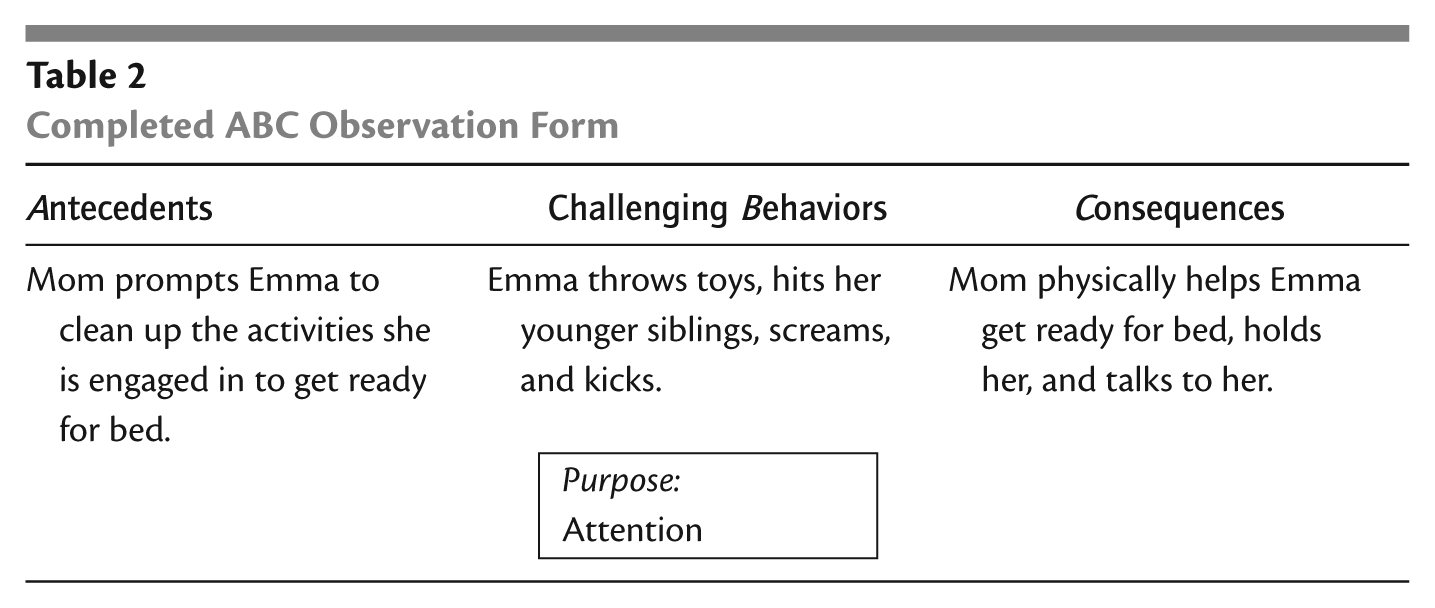

It is important to note that by using ABC Observation Forms, practitioners can summarize data gathered through direct observations. An ABC Observation Form can serve as a tool for practitioners to share observations with parents as well as for parents to share their observations of their child’s behaviors with practitioners. An ABC Observation Form is not a complete FBA and does not provide enough information to create an effective behavior support plan. It is one tool for gathering observational data to create a comprehensive picture about a child’s challenging behaviors.
Effective Strategies
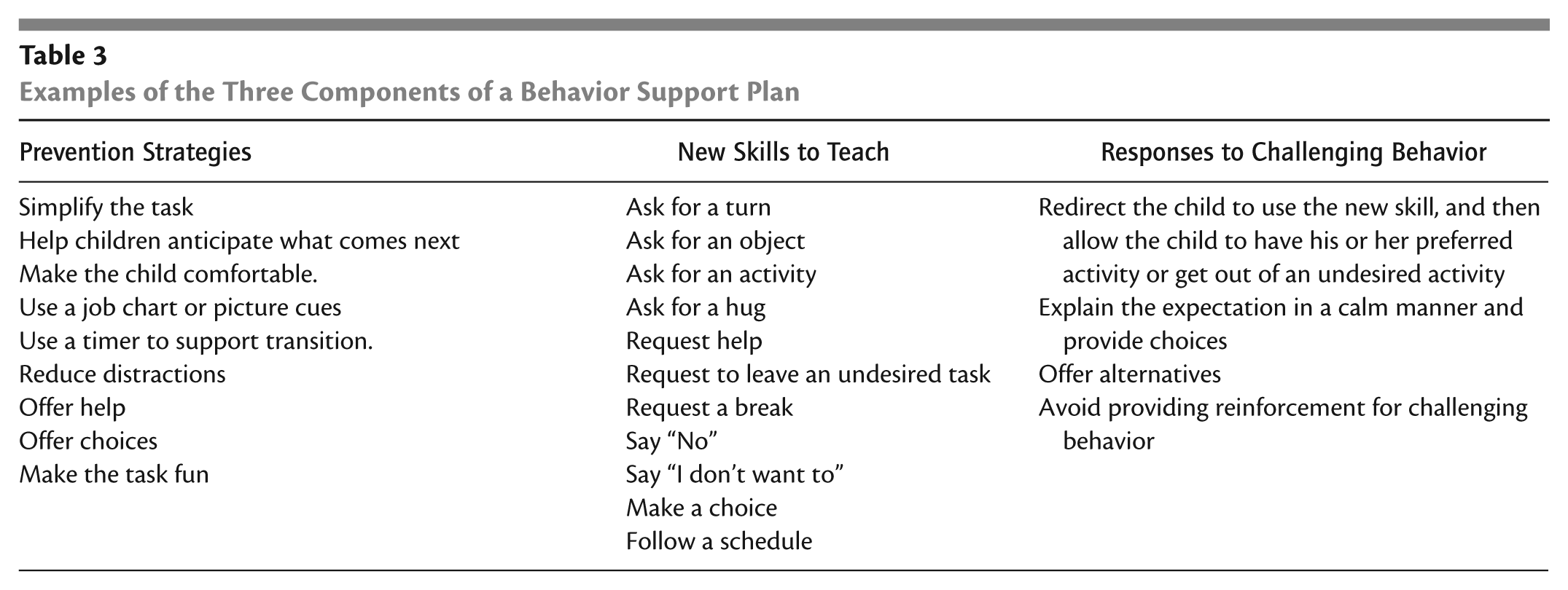
A good behavior support plan should include three components: prevention strategies, teaching replacement skills, and responses to challenging behaviors (Lucyshyn et al., 2002). Examples of these essential components are provided in Table 3 and described next.
Examples of the Three Components of a Behavior Support Plan
Prevention Strategies
Strategies should be carefully selected such that the use of the strategies makes challenging behavior irrelevant and reduces the likelihood that the child would need or want to engage in challenging behaviors. Prevention strategies are used in anticipation of the occurrence of challenging behavior to support children through their routines and tasks, and minimize the likelihood of a child engaging in challenging behaviors (Powell et al., 2006). Relatively simple strategies such as providing clear and age-appropriate expectations and telling children what to do rather than what not to do guide children in understanding what is expected of them (Dunlap et al., 2006). These strategies also reinforce the importance of utilizing proactive rather than reactive strategies when a child engages in challenging behaviors. Other prevention strategies include providing a job chart (so a child understands all the steps in his or her bedtime routine) and offering support when a child is completing a difficult task. For example, Julia might set a timer for a 5-min warning before the bedtime routine starts. When the timer goes off, Julia could use a bedtime routine chart to show Emma what will happen next.
Teaching Replacement Skills
One of the key components of a behavior support plan is to teach the child new skills to replace challenging behaviors. Parents can teach their children new ways to communicate or new skills for participating in activities. For example, Emma can be taught to request help when attempting a task that is too difficult or she can be taught to request access to desired objects or people (e.g., “I need help.” “Mom, will you read a book to me?”). Verbal modeling and prompting as well as using pictures, sign language, and gestures are some of the ways children can be taught to make requests or escape from something (Durand & Merges, 2001). By modeling simple phrases (e.g., “I need help,” “More books,” “I am done”) and supporting children in using the new communication skills, adults teach children replacement skills that decrease the likelihood of challenging behaviors.
“Positive reinforcement or descriptive feedback is most effective when delivered immediately following the display of the appropriate behavior.”
Positive reinforcement or descriptive feedback is an essential component that goes hand in hand with teaching children replacement skills (Kern & Kokina, 2008). When children exhibit appropriate behaviors in place of a challenging behavior, it is important that they are provided with feedback about their appropriate responses. A statement such as “Thank you for following my directions” or “I like the way you used your words to ask for help” communicates to children that they are making good choices. Positive reinforcement or descriptive feedback is most effective when delivered immediately following the display of the appropriate behavior and in a way that children can connect the reinforcement with the behavior they just demonstrated. Attention to children’s use of a new skill not only strengthens that skill but also communicates to children that the best way to gain access to something they want or to escape from something undesirable is by communicating in socially accepted ways. For example, Julia can teach Emma to say “Please help” when she needs help with part of the bedtime routine. When Emma requests help, Julia can provide positive verbal or physical feedback and proceed to help with the bedtime routine.
Responding to Challenging Behaviors
In addition to using preventive strategies and teaching a child appropriate ways of communicating, the way parents respond to challenging behaviors sends a very important message to their child. It is vital that parents provide logical consequences to help guide children to learn expectations for behavior in a variety of situations (Kaiser & Rasminsky, 2003). Parents need to communicate to their children that challenging behavior will not work. When a child throws her toys, the logical consequence would be to take the toy away. Interrupting and redirecting a child from a challenging behavior is another way of providing guidance to the child. Parents can use verbal redirection to distract a child who is beginning to engage in challenging behavior and provide an alternative activity. For example, when Emma appears ready to throw a toy when she is not getting attention, Julia can redirect her by saying “As soon as you put away the toys, we can read your favorite bedtime story.” Parents also can use physical redirection to interrupt a child’s challenging behavior and reengage the child in an appropriate task or guide the child back to tasks that need to be completed. When Emma begins to throw a tantrum, Julia can take her to her picture schedule and guide her through the steps of the routine with the “reward” of reading time with Julia at that end. As we return to our vignette, we can see if Emma’s challenging behavior continues to cause concerns.
Emma’s DT conducted several observations and used the ABC Observation Form to summarize the behaviors she saw Emma exhibit during her bedtime routines. She determined that Emma engages in challenging behaviors to seek attention from her mother. The DT encouraged Julia to spend extra time with Emma during the day. She also created a behavior plan consisting of a picture schedule for bedtime routines, using a timer during the transition to the routine, using lots of descriptive praise (and positive attention) following desired behaviors, and redirecting Emma to the picture schedule when challenging behaviors occur. The therapist quickly talked through the behavior plan with Julia, and provided her with all the materials needed to implement the plan. Julia tried to implement the plan for a few days with Emma; however, she felt overwhelmed with trying to implement the behavior plan while juggling the bedtime routines of her three other children. When Emma’s challenging behaviors did not decrease after 3 days of trying, Julia decided to stop following the behavior plan.

In the above scenario, the behavior support plan includes strategies that address the function of Emma’s challenging behaviors; however, the DT failed to consider important factors such as Julia’s skills and resources, as well as other responsibilities the parent needs to attend to when implementing the behavior plan. The plan was not a good “fit” for the family. The DT needed to collaboratively design the behavior support plan with the family to create an intervention program that worked for them. By adhering to Turnbull and colleagues’ (2011) principles of partnership, the DT and family might have a better chance of positively influencing Emma’s bedtime routine and thereby decreasing challenging behavior. For example, the DT might ask Julia to share information about Emma’s strengths and examples of challenging behaviors that occur throughout the day, and the DT can share her observations of Emma’s strengths and challenges. The DT can also encourage Julia to share her own strengths, challenges she faces daily, and resources and supports she has available to assist her with managing day-to-day tasks. Additional observations of the bedtime routine might help the therapist understand any challenges Julia faces. If observations of the bedtime routine are inconvenient, the DT might suggest that Julia videotape a few instances of the routine using her phone, a flip camera, or other digital camera. The videos and information gathered can provide the DT with a better understanding of the family dynamics and factors that need to be considered when creating a behavior support plan. Together, the DT and Julia can discuss strategies appropriate for the family and create a behavior support plan that “fits” the family.
Two weeks after Emma’s mother stopped trying to implement the behavior plan, the DT asked her why she was no longer using the plan. Julia shared that it did not seem to be working and it was too difficult to carry out while getting her three other children ready for bed. The DT acknowledged that Julia had a tough job. The DT observed Emma’s bedtime routine several more times (using a digital video that Julia made) and then sat down with Julia to more closely and critically examine the behavior support plan initially provided. With encouragement from the DT, Julia shared her goals and values of the family, resources available, and her day-to-day tasks and responsibilities. After the conversation, the DT realized that as a single parent, Julia was struggling as she tried to meet all of her children’s needs during their daily routines. The DT and Julia agreed that the behavior support plan needed to take into account Julia’s skills and the resources she needed to implement it.

Together, the DT and Julia modified the behavior support plan and brainstormed ideas on how they could address the function of Emma’s challenging behavior (accessing attention from her mother) and also involve Emma’s siblings in assisting Emma in completing her bedtime routine. The updated plan allowed Emma to be the first child to start the bedtime routine, with her working closely with her mother to prepare the bubble bath, gather bathtub toys, and select pajamas for everyone. When she completed the routine, Emma was encouraged to select a toy to play with for 5 min with one of her siblings while the other children got ready for bed. Julia also encouraged her oldest child to be her “helper” and care for the younger siblings while she supported Emma in completing the bedtime routine. Julia shared that she would like Emma to request help when needed (instead of tantruming), so the DT described some strategies that Julia could use to teach Emma this new skill. Next, for 2 nights, the DT modeled for Julia how to implement the behavior support plan during Emma’s bedtime routine. Julia was encouraged to implement the plan consistently for a week. The DT stayed in frequent contact with Julia to provide support and encouragement, until Julia expressed confidence in implementing the plan on her own.
Conclusion
Young children’s challenging behaviors can affect the family system; thus, addressing these behaviors and collaborating with families on strategies to implement at home can greatly enhance family functioning and relationships. Practitioners can share information about evidence-based practices to support parents in reducing their children’s challenging behaviors. Parent–professional relationships are key when designing behavior support plans to implement in the home. Important points to remember when partnering with families are as follows:
Collaborate with parents! Respect and affirm trust in parents by providing a comfortable environment where parents and professionals can openly and honestly share their strengths and concerns. Aim for equality in the partnership and encourage parental involvement. Provide parents with the support needed to address their child’s persistent challenging behavior.
Observe the challenging behaviors! Gather objective data to guide professionals’ and family members’ understanding of the challenging behaviors. The information gathered will help determine the function or purpose of the challenging behavior and provide insight into the family dynamics.
Select appropriate strategies! Select strategies that are proactive. Prevention strategies reduce the likelihood that the child will engage in challenging behaviors. Professionals and family members can teach children new skills to replace challenging behaviors. Have a jointly determined parent–professional plan for how to respond to challenging behaviors, such as redirecting children to use appropriate skills.
Create a plan that “fits!” An appropriate plan combines an understanding of the dynamics of behavior and information about family well-being, and best practices in collaboration, to provide lasting and sustainable outcomes for young children with challenging behaviors and their families.

By following these key points, practitioners and family members can collaboratively create a behavior support plan that not only includes developmentally appropriate and evidence-based strategies but is also culturally and contextually appropriate for families. Such behavior support plans lead to greater implementation and positive child and family outcomes.
Footnotes
Authors’ Note
This manuscript was made possible by Grant 90YD0119 from the Office of Head Start and Child Care Bureau, Administration on Children, Youth and Families, U.S. Department of Health and Human Services. The contents are solely the responsibility of the authors and do not represent the official views or policies of the funding agency, nor does publication in any way constitute an endorsement by the funding agency. You may reach Angel Fettig by e-mail at