




Abstract

Individuals at all levels and in a variety of roles in an early intervention service delivery system, including program administrators, direct service providers, and family members, can and do serve as leaders and participate in formal and informal leadership opportunities every day. For example, an early intervention program administrator might engage with other administrators and parents to change state-level policies to better meet the needs of the children and families served by her program. A service coordinator might use a coaching strategy to address a father’s self-identified need to communicate more effectively with his son’s physicians. A speech and language pathologist might share several feeding techniques with a new colleague. In these examples, each individual influences others to address shared goals and aspirations.
Leadership is not confined to a particular role, title, or position. It can be “learned and is available to everyone” (Northouse, 2012, p. 15). Acquiring leadership skills is a developmental process (Rodd, 1996), and individuals can gain confidence in their ability to lead from using leadership behaviors, watching others that they think are similar to themselves lead, getting feedback from those they trust, and feeling success in their attempts (Bandura, 1986, 1997). Authentic leaders are true to their values and beliefs (Avolio, 2011; Avolio & Gardner, 2005). They are proactive in influencing others to achieve common goals (MacGregor Burns, 2003; Yukl & Falbe, 1990; Yukl & Tracey, 1992), engaging in lifelong learning (Kouzes & Posner, 2012; Preskill & Brookfield, 2009), building working relationships founded in trust (Avolio & Gardner, 2005; Hoy & Smith, 2007; Rodd, 1996, 2005), and acting in ways they want others to act (Hoy & Smith, 2007; Kouzes & Posner, 2011, 2012).
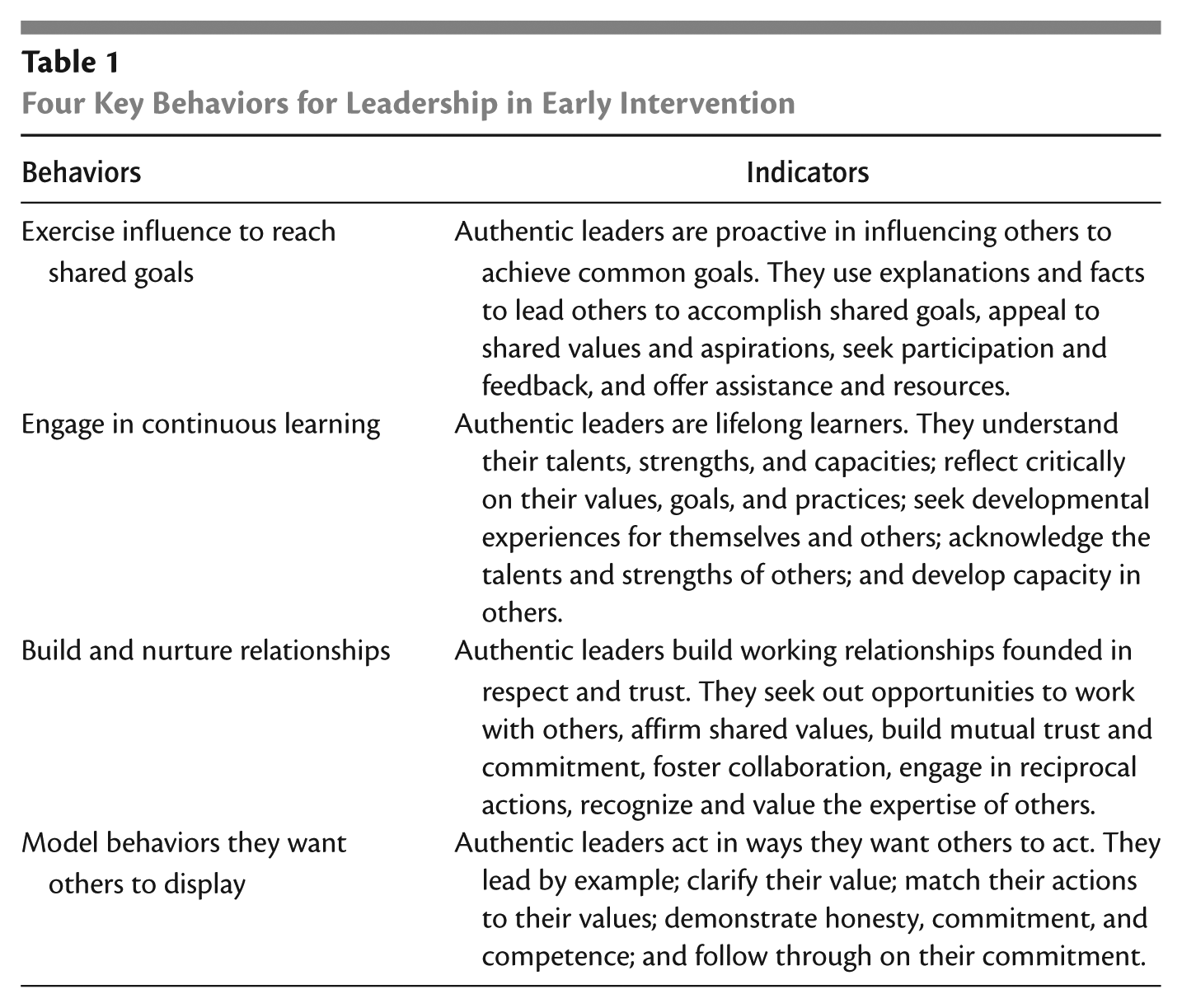
In this article, we highlight four key behaviors that typify authentic leadership. Authentic leaders (a) exercise influence to reach shared goals, (b) engage in continuous learning, (c) build and nurture relationships, and (d) model behaviors they want others to display. Although the behaviors are presented as distinct, they are inextricably linked and can be observed happening simultaneously. The four behaviors and indicators listed in Table 1 and described here are offered as a starting point for thinking about the many ways in which early intervention professionals can and do demonstrate leadership with and on behalf of young children, parents, caregivers, colleagues, and administrators.
Four Key Behaviors for Leadership in Early Intervention
“Authentic leaders act in ways they want others to act.”
Authentic Leaders Exercise Influence to Reach Shared Goals
Jared has attended Busy Bees child care center since he was 8 weeks old. He began receiving early intervention services when he was 9 months old for an unspecified genetic condition. Testing was inconclusive but his mother, Janie, noticed the delays early on. Jared had trouble feeding from the breast and bottle, was irritable most of the day, and did not reach milestones young infants do in their first few months of life. Jared’s infant room teacher, Ashari, also noted the delays. Having worked in child care for almost 10 years and also having worked with Jared’s siblings, who had not demonstrated any developmental delays, Ashari was fairly certain that Jared’s development was not on schedule with that of other infants.
Ashari spoke with Janie about her concerns and counseled Janie to call the local early intervention program. She did so gently and emphasized the importance of finding help for Jared as soon as possible so Janie and he could get the support they needed. Ashari was honest and tactful when she presented Janie with information about Jared’s delays.
Since its inception, the field of early intervention has called attention to the importance of service providers, administrators, and families working together (Dunst, Trivette, & Deal, 1988; McWilliam, Tocci, & Harbin, 1998; Park & Turnbull, 2003). Both Ashari and Janie wanted the best for Jared, placed value on his progress, and were committed to encouraging his development. They shared these goals. Ashari influenced Janie to take action on her son’s behalf. She was proactive in using factual developmental information to encourage Janie to seek early intervention services for Jared. She shared the information in a respectful and meaningful way, a recommended practice for early interventionists (Sandall, Hemmeter, Smith, & McLean, 2005) and, in doing so, Ashari demonstrated authentic leadership.
Leadership is the process through which one person influences another to achieve a common goal (Northouse, 2012). The description above highlights Ashari’s goals and aspirations for Jared’s success. Her authentic leadership abilities are evident in the way she conveyed those expectations and acted in Jared’s best interest. As James MacGregor Burns (1978) expressed, “Leaders induc[e] followers to act for certain goals that represent the values and motivations—the wants and needs, aspirations and expectations—of both leaders and followers [emphasis in the original]” (p. 19). Based on MacGregor Burns’s conceptualization and the purpose and functions of early intervention, it easy to see how early intervention professionals often find themselves in situations calling for authentic leadership. Foundational to early intervention is a continual focus on working with families and their children with disabilities and developmental delays to best meet their needs. This involves a participatory cycle of collectively identifying family aspirations, using data to set shared goals, and providing assistance and resources to meet identified needs.
Authentic Leaders Engage in Continuous Learning
Mallori, Jared’s developmental therapist from the local early intervention program, supported both Jared and his teacher, Ashari, by coming consistently to see how he was doing at Busy Bees. Ashari looked forward to Mallori’s visits. She observed Mallori’s interactions with Jared and asked many questions about her techniques. Mallori could see that Ashari was an eager learner. To support her and do her best at her job, Mallori made a point of keeping current on new strategies and techniques for working with infants and toddlers with developmental delays. As Mallori traveled between her visits with families, she often thought about what she had accomplished and what new information she would need. She was self-directed in her approach to learning and actively looked for workshops and other training opportunities that would build her knowledge and skills about various disabilities, medical conditions, and available family resources.
Authentic leaders are engaged learners. A defining characteristic is an ongoing search for new information (Armstrong, Kinney, & Clayton, 2009; Kouzes & Posner, 2011; Rodd, 2005). Mallori and Ashari demonstrated this leadership disposition in their eagerness to learn, how they approached learning, and the ways in which they shared their knowledge with those around them. Rodd (2005) explained that leaders “seek out and consider new information and ideas, draw on the opinions of others, and use them” (p. 252). In a similar fashion, the Council for Exceptional Children’s Division for Early Childhood (DEC; 2009) Code of Ethics encourages early intervention professionals to build competence by engaging in ongoing professional development, learning about and applying evidence-based practices, and engaging actively with others to continually improve those practices.
After Mallori attended trainings, she made sure to share what she had learned with the families of the children with whom she worked as well as her colleagues. She also actively sought their ideas and consulted with them in their areas of expertise. When Jared was having trouble with walking, Mallori consulted with the physical therapist and Jared’s teacher, Ashari, about Jared’s gross motor development. She worked with them, along with Jared’s mother Janie, to acquire a specialized gait trainer for Jared to use at child care and at home. Mallori especially liked working with Ashari. Ashari was always eager to share what she learned with Janie as well as the other infant teachers. Like Mallori, Ashari was enthusiastic about learning new skills to support the infants in her room. She took initiative to learn all she could from her coworkers and supervisor, routinely looked for opportunities to increase her knowledge, and was excited to take part in professional development.

To be effective, authentic leaders must be open to the contributions of others, reflect critically on their practice, and support the growth of others (Preskill & Brookfield, 2009). Leaders work with those around them to create a climate that is conducive to learning, where trust is evident because individuals feel safe to explore ideas and make mistakes, and where mutual respect is evident in the way individuals listen to each other and learn while doing (Knowles, 1978, 1980, 1984; Knowles, Holton, & Swanson, 1998; Kouzes & Posner, 2011). Early intervention professionals should actively and continually reflect on the work they do, evaluate their professional performance, and identify how they can improve the services they provide young children with disabilities and their families (DEC, 2009). Mallori’s behaviors exemplify these leadership attributes. She used her time traveling between visits to reflect on and assess her professional practice, and she readily supported and encouraged Ashari’s learning and professional growth. So too, Ashari was an engaged learner who willingly shared her knowledge with those around her.
Authentic Leaders Build and Nurture Relationships
When Jared was 17 months old, Ashari and Mallori began to talk with Janie about moving Jared up to the toddler room. Janie did not think he was ready because he was not talking and had only recently started walking. Ashari and Mallori each made time to listen to all of Janie’s worries about Jared. Together, they talked about strategies that were helping Jared in the infant room and identified possible problems he might face in the toddler room. Janie shared feeding tactics that were successful at home and her concerns about his safety while walking. With each conversation, Janie was more assured that Jared was ready to leave the infant room and learn from the toddlers and their teachers.
Early intervention professionals are expected to build relationships to facilitate young children’s development and learning (DEC, 2009). Leadership is about relationships (Kouzes & Posner, 2011). Authentic leaders build quality, working relationships characterized by trust and reciprocity (Avolio & Gardner, 2005; Hoy & Smith, 2007; Rodd, 2005). Authentic leaders also give their time and expertise, and they repay what is given to them (Avolio, Gardner, Walumba, Luthans, & May, 2004; Hoy & Smith, 2007). They help colleagues solve a problem and in return, they depend on the help of their colleagues when they need it. So too, a tenet of early intervention is collaborative problem solving among early intervention providers (Sandall et al., 2005).
Working with families, as Ashari and Mallori did with Janie, embodies a primary goal of early intervention, which is to recognize and advance a family member’s competence and efficacy beliefs related to performing their roles and tasks associated with the child’s development (Blue-Banning, Summers, Frankland, Nelson, & Beegle, 2004). The DEC (2009) Code of Ethics further requires that early intervention act ethically in all interactions with families and those with whom they work. Ashari and Mallori worked to gain Janie’s trust and shared their ideas and time. In the process of problem solving Janie’s concerns with Jared’s move to the toddler room, Ashari and Mallori not only demonstrated their own skills but also recognized Janie’s expertise.
Janie’s need for support and guidance is not atypical of families engaged in early intervention services (Bailey, Hebbeler, Scarborough, Spiker, & Mallik, 2004; Park & Turnbull, 2003). Quite often, families are called on to make decisions on behalf of their children and need information and resources to do so effectively. In these circumstances, parents often turn to an early intervention professional they trust for guidance and recommendations (Dempsey & Keen, 2008; Trivette, Dunst, & Hamby, 1996). Early intervention professionals have a responsibility to support families by sharing their expertise and discipline-specific information, so families can be knowledgeable about and have the necessary resources to become informed consumers of services for their children (DEC, 2009). Ashari and Mallori did not simply listen to Janie. They listened to understand Janie’s priorities and concerns. Listening to understand (Armstrong et al., 2009) is fundamental to authentic leadership. It means listening to others’ concerns, without judgment, and being appropriately supportive (Kouzes & Posner, 2012). Ashari’s and Mallori’s actions helped Janie build her confidence and competence and acted in Jared’s best interest. They listened not only to Janie but also to each other in their ongoing efforts to learn more about meeting the needs of young children with disabilities and their families.
Authentic Leaders Model Behaviors They Want Others to Display
A few weeks before Jared transitioned from the infant room to the toddler room, Ashari called a meeting with Janie and the toddler room staff to talk about Jared. She and Janie talked with the staff about Jared’s interests, routines, and his likes and dislikes. Ashari arranged a few times when she and Jared could visit the new classroom. She made sure that Mallori and Janie would be available for these times as well. During Jared’s visits, Ashari shared humorous anecdotes about Jared’s interest in sensory play and listening to books as well as his refusal to participate in music activities unless he was given wrist bells or shaker bottles (water bottles with beads or similar material inside). Janie shared information about Jared’s eating, answered questions about his nap routine, and showed the staff his diapering routine. Mallori offered ideas about how the staff might help Jared adjust to his new environment, showed them how to put on his orthotics, and modeled how to keep him safe when he was walking.

Ashari, Mallori, and Janie each led by example. Their behaviors made their values clear to those around them, and they acted accordingly. Each, in their own way, demonstrated respect, honesty, commitment, and competence through their actions. Ashari and Mallori, in their respective early intervention role, displayed behaviors that supported positive outcomes for Jared and Janie. Each worked to build quality relationships, a tenet of early intervention.
Authentic leaders model the behaviors they want others to display (Avolio & Gardner, 2005; Hoy & Smith, 2007; Kouzes & Posner, 2012). They “know who they are, what they believe and value, and they act upon those values and beliefs while transparently interacting with others” (Avolio et al., 2004, p. 802). Fundamental to early intervention is recognizing and demonstrating consideration for the structure, culture, values, and beliefs of all families and how these unique features influence the ways family members care for their children and their goals and expectations for themselves and their children (DEC, 2009). Ashari’s values are evident in her honest and sincere interactions with Janie, and they suggest that she had high regard for families. She acted on these values when she called the meeting with the toddler room staff and engaged Janie and Mallori in the process. Likewise, Mallori’s values are apparent in how she modeled behaviors expected of early intervention providers and readily partnered with Ashari and Janie.
Developing Authentic Leaders
Sharon, the director of Busy Bees, and Ashari’s supervisor noticed Ashari’s positive interactions with Jared’s mother and the way she worked collaboratively with his developmental therapist. She recognized Ashari’s leadership potential and recently encouraged her to attend a local workshop on leadership. During the training, Ashari completed a brief questionnaire asking what excited her about leadership, the leadership behaviors she saw as her strengths, and the kind of leader she wanted to be in the future. Ashari was surprised by the list of strengths that emerged and excited about the prospect of learning more about herself as a leader. Among other strengths, her profile revealed that she often used logic and facts to persuade others to take action; she sought opportunities to work with others, and acknowledged their talents and expertise.
When Ashari told Sharon about her questionnaire results, her supervisor’s reply was “I’ve always looked at you as a leader. The other teachers often comment on how you follow through on your commitments and act on your beliefs.” As Sharon and Ashari continued their conversation about the leadership workshop, Sharon mentioned an opening in the regional early intervention organization for a member-at-large. She explained how getting involved with this group would provide Ashari with leadership development experiences and that the group would be fortunate to have someone with her expertise and aptitude for collaboration. Ashari reflected on how working with others interested in young children with disabilities and developmental delays might help her grow professionally and pursued the member-at-large position as a way to make positive changes on behalf of children and families.
Sharon’s story provides a glimpse into how leadership development can be supported. As the center director, Sharon had specific managerial responsibilities that she needed to fulfill. Nevertheless, she reached beyond her formal position as manager and acted as an authentic leader. Her values are apparent in the staff she hired, which demonstrates her understanding of the importance of having skilled personnel in place to offer supports and resources to families (Epley et al., 2010). Sharon validated Ashari’s leadership potential by encouraging Ashari to attend the leadership workshop. Avolio (2011) put forth that validation stimulates leadership development especially “when another respected person sees something in you that you do not yet recognize in yourself” (p. 5). Sharon further motivated and challenged Ashari by mentioning the member at large position, which could serve as a leadership development opportunity for Ashari.
Van Velsor and McCauley (2004) explained that effective developmental leadership experiences contain three major elements: (a) assessment, (b) challenge, and (c) support. Assessment experiences are rich with opportunities for reflection and interpretation of one’s skills and behaviors. They are most effective when individuals integrate the new information with what they already believe about their skills and knowledge pertaining to a particular task to arrive on a conclusion as to whether they possess the requisite skills and knowledge to reach a new goal (Bandura, 1997). Challenge involves engaging in experiences where individuals reach beyond their comfort zone and have opportunities to learn (Van Velsor & McCauley, 2004). Engaging in new experiences fosters new ways of thinking and acting. When individuals experience authentic successes in the related tasks, they gain confidence (Bandura, 1997) and are apt to continue seeking out new challenges. Particularly helpful in building confidence is feedback and support from influential individuals such as a supervisor or colleague. The caveat is that the nature of the feedback must be authentic and convey the message that the person has the ability to complete given tasks. McCauley and Douglas (2004) reported that having the opportunity to learn from other people was the most important contribution to a leader’s development. Importantly, individuals gain confidence in tasks when they see others similar to themselves performing in a successful manner (Bandura, 1997). These experiences are most influential when individuals understand the strategies used and feel they can aim for like results.
Putting It All Together and Understanding Yourself As a Leader
Taken together, the stories of Ashari, Mallori, and Sharon provide snapshots of how the key behaviors for authentic leadership might look in one setting. Each person came to early intervention service provision with different experiences and expertise. Each expressed leadership in her own way in working with Jared and Janie. Each contributed to Jared’s development and Janie’s confidence as a parent of a young child with a disability. The stories of Ashari, Mallori, and Sharon provide examples of authentic leadership skills and behaviors that early intervention providers can aspire to on behalf of young children and their families. How do you understand yourself as a leader? What are your beliefs about your leadership abilities?
In Boxes 1 and 2, we provide activities that can be used to explore how you understand yourself as a leader. Use the questions in Box 1 to guide you through writing about and discovering your own leadership story. Writing your story will provide you with a chance to reflect on who you are as a leader currently and your vision for the kind of leader you want to be in the future. Once you have had the opportunity to review and think about your story, use the exercises in Box 2 to identify your leadership strengths and the areas in which you would like to grow. You can use the information from this exercise to help you identify the professional development experiences you might want to pursue. These could include reading more about leadership, and Box 3 offers a few resources. Whatever leadership development experiences you choose to pursue, be sure they provide you with a certain amount of challenge and opportunities to watch and engage with leaders you admire and respect.
What excites you about leadership?
Write Your Own Leadership Story
What excites you about leadership?
What is your leadership story today?
What do you want your future leadership story to be?
Who and what will assist you?
Gaining Confidence in Four Key Leadership Behaviors
Review the key leadership behaviors and indicators listed in Table 1. Think about these behaviors in the context of your program, your coworkers, and the work you do. In what areas do you feel particularly confident? In which ones do you feel less confident?
For the areas in which you feel confident:
Why do you think you are strong in these behaviors?
How did you develop your confidence in these abilities? Here are some ways in which you might have gained confidence. Add your own ideas.
Learning experiences where I practiced the behaviors with successful results. Experiences where I observed others, whom I believed to be similar to me, practice the behaviors with successful results. Verbal encouragement that I have the necessary skills to be a leader provided by individuals whose constructive feedback I value. The emotional and related physical feelings I have when I have used the behaviors with successful results. Other ideas:
What steps can you take to further build your strengths?
Who will assist you?
What resources do you need and how can they be accessed?
For the areas in which you feel less confident:
Why do you think these behaviors are a problem for you?
What do you think impedes your performance in this area?
How important is this area to you?
What concrete actions can you take to develop your skills in this area?
Who will assist you?
What resources do you need and how can they be accessed?
Resources
Fullan, M. (2011). Change leader: Learning to do what matters most. San Francisco, CA: Jossey-Bass.
Practices essential to change leadership are presented along with examples from various sectors of society. (ISBN: 978-0-470-58213-8; http://www.wiley.com/)
Intrator, S. M., & Scribner, M. (2007). Leading from within: Poetry that sustains the courage to lead. San Francisco, CA: Jossey-Bass.
This book contains 93 poems identified by leaders from various occupations and levels of society as having significant meaning in their lives and work. (ISBN: 978-0-7879-8869-2; http://www.wiley.com/)
Johansen, B. (2012). Leaders make the future: Ten new leadership skills for an uncertain world (2nd ed.). San Francisco, CA: Berrett-Koehler.
The author looks at a variety of factors that affect leadership, describes skills needed for the future, and presents exercises for developing skills. (ISBN: 9781609944872; http://www.bkconnection.com/)
Kouzes, J. M., & Posner, B. Z. (2010). The truth about leadership: The no-fads, heart-of-the-matter facts you need to know. San Francisco, CA: Jossey-Bass.
Drawing on their significant research on leadership, the authors present 10 enduring truths that every leader needs to know to be effective no matter the context or circumstance. (ISBN: 978-1-55766-805-9; http://www.wiley.com/)
McCracken Taylor, J., McGowan, J., & Linder, T. (2009). Guide to early childhood special education leadership, development, and supervision. Baltimore, MD: Paul H. Brookes.
As the title suggests, this book is focused on leadership within the context of managing an early childhood special education program. (ISBN: 978-1-55766-805-9; http://www.brookespublishing.com/)
Footnotes
Authors’ Note
You may reach Diana J. LaRocco by e-mail at