




Abstract
Elena is an itinerant early childhood special education teacher who has worked for 7 years for a metropolitan school district. Donna is the lead teacher in a community preschool with 13 years experience. Elena and Donna have occasionally spoken to each other at professional meetings, and Elena has attended some of the workshops where Donna has presented; however, the two have never worked together. This year, Kevin, a 3-year-old boy in Donna’s class, has been diagnosed with autism by his pediatrician. At the Individualized Education Plan (IEP) meeting, the team decides that Kevin’s needs will best be met in the inclusive setting where interventions are embedded into daily routines and that itinerant services will include consultation with Donna.
Elena and Donna meet several times a month at the preschool. During that time, they clarify the purpose of the consultation, discuss roles and responsibilities, and build a relationship. Elena also visits the classroom at different times to observe and while she’s there also compliment Donna on the arrangement of her classroom. At this point in the consultative process, they are ready to gather information and develop a plan.
At the next meeting, Elena begins by asking Donna how she’s doing. They then discuss their involvement with various professional organizations. Elena tells Donna how impressed she is with Donna’s commitment to the field. Eventually, she steers the conversation toward Donna’s concerns about Kevin. Elena listens carefully and summarizes Donna’s statements in a manner that avoids judgment. The two agree that their main concern is embedding Kevin’s communication goals into classroom routines.
Over several weeks, the two continue to meet and discuss their plan for instruction and to select a strategy for change. They agree that Kevin’s behavior is most disruptive during transitions and that they will try two intervention strategies. First, a warning will be provided to the whole class just before the transition, and second, Kevin will be shown a picture card that is part of a picture schedule strategy that depicts the next scheduled activity. To monitor progress, Elena creates a simple data collection sheet, and Donna agrees to use the sheet to collect data over the next few weeks.
Elena calls Donna after the 1st week and is told that the plan has been implemented. The whole class is responding well to the initial warning. Elena compliments Donna on getting started and on her success with the whole class. She then asks about Kevin. Donna relates that Kevin is still having difficulties. Elena tells Donna about another child and a teacher with whom she has worked, and who were successful using picture schedules. Donna and Elena agree to try the picture schedules for another week.
When they meet after the 2nd week of the plan’s implementation, Elena learns that Donna has stopped showing Kevin the picture cards during transition. Donna explains that there’s so much going on during transitions that she often forgets, and besides, the pictures didn’t seem to be helping. Elena is perplexed as Donna had seemed so excited about this idea and hadn’t voiced any concerns about implementing this strategy. What is Elena’s next step?
“Are there ways to increase the likelihood that teachers or other professionals will follow through with planned activities so that young children with special needs receive the support they need?”
Many who provide technical assistance (TA) or early childhood consultation services have faced similar problems. Why don’t early childhood professionals follow through with planned activities? Are there ways to increase the likelihood that teachers or other professionals will follow through with planned activities so that young children with special needs receive the support they need? If so, are there styles or modes of interaction that are effective in persuading or convincing others to follow through on an idea or strategy? Are there strategies that consultants and TA providers should avoid? If so, what are they?
The purpose of this article is to introduce and describe a model of social power and influence developed by Erchul and Raven (1997). This model describes the decision-making process a consultant would engage in to choose, implement, and evaluate the use of strategies that they might use to influence another person to act in a particular way (Erchul, Grissom, & Getty, 2008). Buysse and Wesley (2005) identified “social influence” and power as important features in early childhood consultation. While consideration of these concepts may be relatively novel in examining the practice of early childhood consultation, behavioral consultants and counselors have long been familiar with them (Erchul et al., 2008). Given the current interest in the use of coaching, consultation, and TA to support optimal services to young children with special needs and their families (Fox, Hemmeter, Snyder, Binder, & Clarke, 2011), we believe that it is important to discuss this model and outline its relevance to the early childhood community. We also agree with Buysse and Wesley (2005) about the ethical considerations that must be considered when making decisions to recognize the existence of social power and influence strategies and, perhaps, to consider the dynamics of social power and influence in our relationships with consultees.
As early childhood professionals who work with children and families, it is understandable how discussions of social power and influence might create unease or discomfort. It may be difficult for some people to explicitly consider social influence strategies within the context of collaborative relationships. However, it’s important to acknowledge that words and actions have consequences, both positive and negative. If individuals wish to build positive and effective consultative relationships, then it’s necessary to consider the extent to which what consultants say, or do, influences the behavior and beliefs of others. As part of the process, consultants and consultees should intentionally examine how their behaviors contribute to, or challenge, their relationships with others. The benefit of such an examination is that behaviors that may adversely affect a relationship can be avoided, and behaviors that facilitate trust, respect, and partnership can be adopted.
“Consultants and consultees should intentionally examine how their behaviors contribute to, or challenge, their relationships with others and consciously adopt behaviors that facilitate trust, respect, and partnership.”
Rationale for Considering Social Power and Social Influence
One can find relevant examination and discussion of social power and social influence in the fields of school psychology and consultation (i.e., school consultation; Erchul & Martens, 2002). School consultation and early childhood consultation are indirect, triadic service delivery models that share a common goal of producing changes in the practices of educational professionals and the behavior and skills of other adults who work with and care for children in a range of educational settings. Although it has not been demonstrated empirically that the outcomes of school consultation practices would be comparable to early childhood consultation, it would be instructive to consider these research findings in describing the practice of early childhood consultation (Winton, 2006).
Within early childhood consultation, social influence is an explicit aspect of the process, and the use of social power to change behaviors and attitudes is fundamental to the process (Newman, 1993). Buysse and Wesley (2005) identified social influence as one of three interrelated tasks that constitute the process of early childhood consultation (the other two elements are problem solving and professional support).
Background on Social Power and Influence
French and Raven (1959), both social psychologists, introduced their theory of social power as a process that one person uses to influence the behavior of another. Social influence happens when one person’s words or actions cause another person to change in some way (Erchul et al., 2008). One’s ability to bring about that change, using available resources, is social power (Erchul et al., 2008; Raven, 2008). The resources the person uses are power strategies. It is interesting to note however that the process of social influence also may be passive. The behavior of the consultee in a consultation relationship may be shaped by the perception of the power of the consultant. In other words, whether a consultant decides to adopt specific social influence strategies or not, the consultee may be responding to the consultant based on his or her perception of the potential social influence of the consultant.
Social Power Strategies
The original power strategies are informational power, legitimate power, expert power, referent power, reward power, and coercive power (Erchul et al., 2008; Raven, 2008). These power strategies can be further subdivided into positive/negative, personal/impersonal, and direct/indirect valences that yield a total of 14 distinct strategies. It is important to note that some researchers (Erchul et al., 2008; Getty & Erchul, 2009; Wilson, Erchul, & Raven, 2008) have dismissed reward and coercive power as consultants do not have supervisory authority and cannot, at least explicitly, dispense rewards or punishment. Figure 1 depicts the types of power strategies and provides examples of their presence in early childhood consultation relationships.
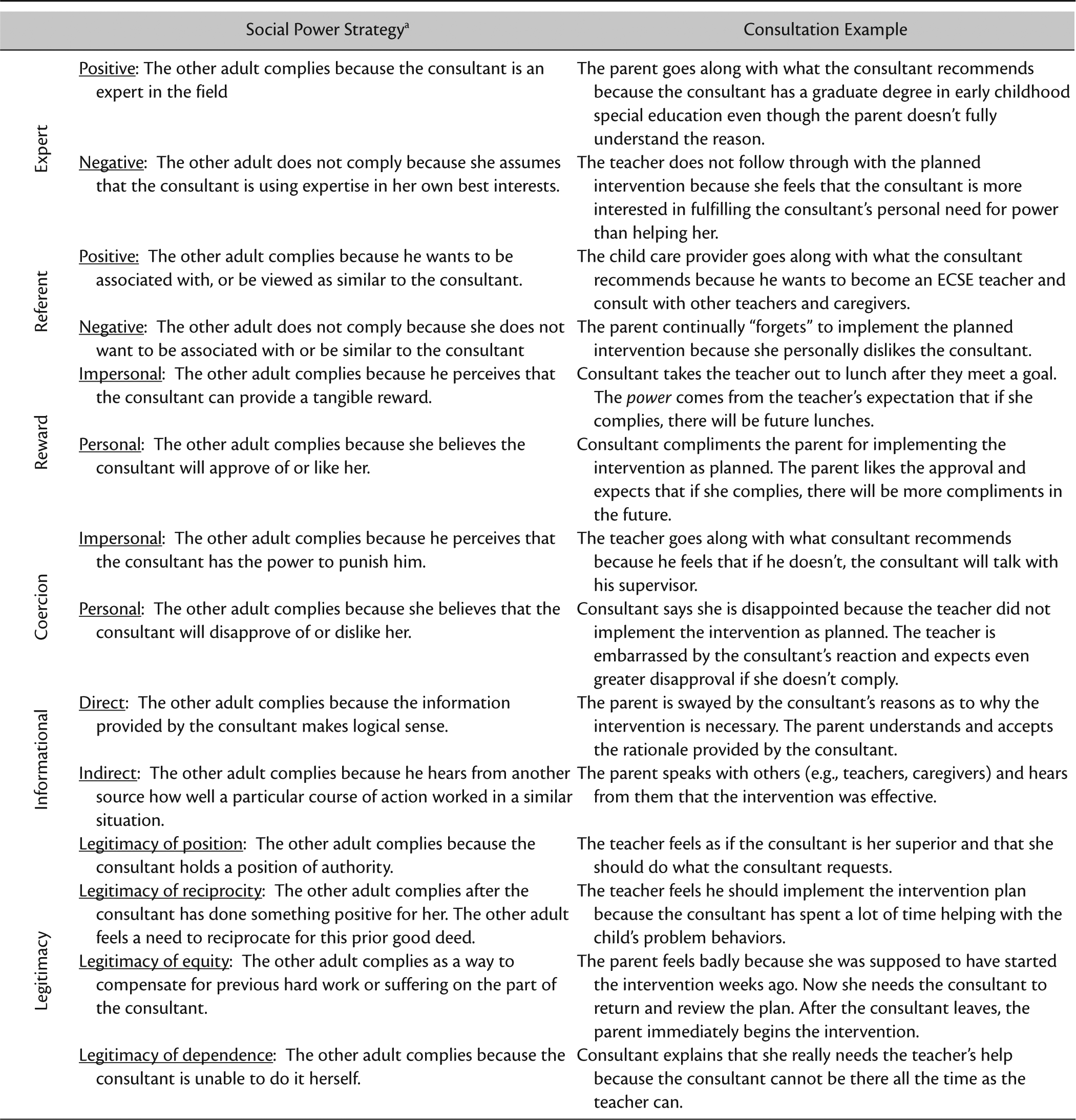
Definitions and early childhood consultation examples of the social power strategies
Underlying Differences Across Power Strategies
The power strategies identified above differ from each other in two ways (Raven, 2008): (a) the degree to which the changes one person makes is dependent or independent of the consultant’s words or actions and (b) whether the power strategy is maintained with or without follow-up. Dependence refers to the relationship between the consultant’s words or actions and the consultee’s response. “Following up” refers to observing or gathering information about other adults to determine whether they have followed through with another person’s requests. Following up may be necessary if the consultant believes that there is a greater chance the other adult will comply if he thinks that the consultant will be aware of whether he is following through with the intended plans of action. For example, as an early childhood teacher, Jack may comply with Kaniya’s requests to monitor Jessie’s behavior if he thinks that Kaniya is going to ask to see Jessie’s progress monitoring data. Figure 2 depicts the power strategies and how they are related, in terms of dependence and follow-up.

Differences in strategies according to need for follow-up and dependence on consultant behavior
Research on Use of Social Power Strategies
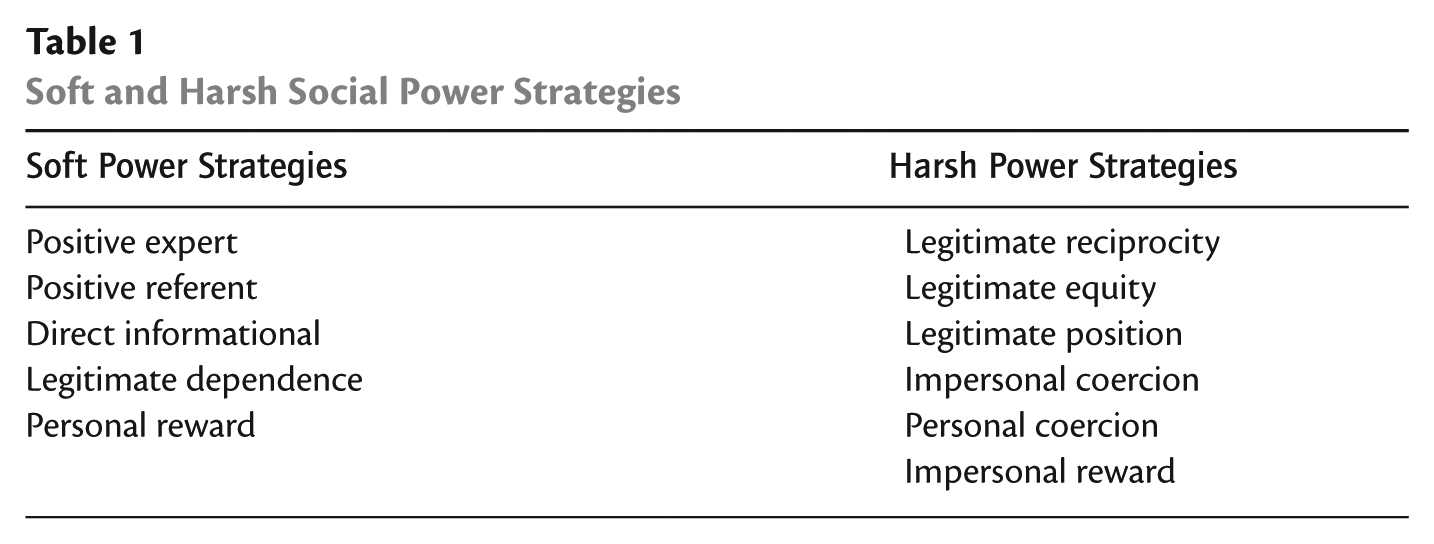
Research conducted on the use of social power strategies in the consultation process have primarily involved self-report measures completed by teachers (i.e., consultees) and consultants. These studies report two main findings. First, teachers and consultants perceived direct informational power and the positive use of expert power as the two most effective strategies in facilitating change in consultee behavior (Erchul, Raven, & Ray, 2001; Erchul, Raven, & Whichard, 2001). Consultants also rated these two strategies as the strategies they are most likely to use (Wilson et al., 2008). Second, teachers and consultants perceived “softer” power strategies as more effective than “harsher” strategies (Erchul, Raven, & Ray, 2001; Erchul, Raven, & Whichard, 2001) and as more likely to be used by consultants (Wilson et al., 2008). Softer power strategies are more subtle, nuanced, indirect, and relational than harsher strategies. Harsher strategies were perceived to be those that are more overt, explicit, coercive, and heavy-handed. Table 1 lists soft and harsh power strategies.
Soft and Harsh Social Power Strategies
Socially Independent Change Without Follow-Up
The informational power strategy is the only strategy that is not dependent on the consultant’s influence and is maintained without the need for follow-up. When a consultant uses this strategy, he or she provides information that is accepted by the other adult and results in a corresponding change in the other adult’s behavior. Even though it is the consultant who initiates the change, the other adult maintains these changed beliefs and/or behaviors when the consultant is absent. This is considered a socially independent change because the other adult does not associate his or her change in behavior with the consultant’s behavior; he or she merely integrates the change into his or her way of working with the child (Raven, 2008). For example, a consultant may provide information on how picture schedules can be effective in helping young children transition to activities. The information makes sense to the teacher, and he incorporates picture schedules into his regular practice, even after he is no longer working with the consultant.
A consultant who provides information is using a social power strategy. The consultant is seeking to change the beliefs and behaviors of their teacher partner. The teacher also may share information with the consultant (using the informational power strategy) to change the beliefs and behaviors of the consultant.
Socially Dependent Change With Follow-Up
The reward and coercive power strategies are socially dependent and are maintained with follow-up. These strategies mirror positive reinforcement and negative reinforcement interventions. For example, with the reward power strategy, the consultant offers, either explicitly or implicitly, some sort of positive incentive to the consultee if the consultee complies with the consultant’s request. Conversely, coercive power involves the suggestion of negative consequences if the other adult fails to comply with the request. Both of these strategies are socially dependent as the other adult complies because the consultant has offered an incentive, either positive or negative. For example, the early childhood teacher might think, “I did what she asked because she offered to buy some supplies.” The consultant may have made the offer to buy supplies without explicitly tying the offer to the teacher’s compliance. In this case, the use of the reward power strategy was unintentional. Another early childhood teacher might think, “I only did it because she knows my supervisor and might have told him if I didn’t comply.” Again, the consultant did not explicitly state she would inform the supervisor; however, the consultee assumed she might do so. In effect, while the consultant did not engage in coercive interaction, the presumption that the consultant could “use” this power resulted in coercive factors entering into their decision to comply with the consultant’s recommendations. These two strategies differ from the other four strategies in that they require follow-up. If consultants use only these two power strategies, then other adults may only comply if they believe that the consultants have some way of influencing their compliance (Raven, 2008).
Socially Dependent Change Without Follow-Up
The three power strategies in this category are legitimate power, expert power, and referent power. Legitimate power reflects the belief that the consultant has a legitimate right to make a request and that the other adult is obligated to comply with the request (Raven, 2008). The consultant is relying on legitimate power if a teacher thinks, “Well, she is kind of like my supervisor, so I should do what she asks me to do.” Rather than explicitly stating that the other adult is obligated to comply with her request, an effective consultant should use legitimate power and provide indirect suggestions that the other adult should comply. In addition, Erchul and Martens (2002) cautioned against the use of this strategy because “this blatant use of legitimate position power would be resented by the consultee, and could result in very disastrous consequences” (Erchul & Martens, 2002, p. 34).
Expert power is in play when the other adult believes that the consultant has greater knowledge or insight about what should be done (Raven, 2008). Readers should not confuse the use of the term expert with assuming a superior attitude that might translate into acting as a “know it all.” Consultants can and should acknowledge their expertise, while acknowledging and genuinely valuing the expertise that others bring to the relationship.
Expert power is at play when a consultant shares information with the other adult that illustrates her expertise or knowledge base in an area. In response to sharing information regarding the consultant’s experience with using responsive interaction strategies, for example, a parent might think, “Even though I don’t really understand it, this consultant has had a lot of experience with this, so she’s probably right.” This may sound like informational power, but the two are different. Informational power is based on an acknowledgment that the other adult understands the reasoning behind the information and the request. As a result, the change in the other adult’s behavior is due to the power of the information itself, versus the perceived station or position of the consultant. With expert power, the change is related to the authority or perceived expertise of the consultant—while the other adult may comply with the recommendation, they do not fully understand the reason(s) behind the consultant’s request.
The third strategy in this category is referent power. Referent power emanates from the other adult identifying with the consultant and, perhaps, wanting to be more like the consultant (Martin, 1978). For example, a teacher might comply with the consultant’s request because the teacher thinks, “I really admire the consultant and wish I could be like her. It really makes me feel good when I do things the way she wants them to be done.”
Power/Interaction Model of Interpersonal Influence
Raven (1992, 1993) applied the concepts of social power and social influence to develop the power/interaction model of interpersonal influence. This model describes a process and the corresponding decision making that a consultant engages in to select, implement, and evaluate the use of social power strategies (Erchul et al., 2008). The process and decision making may be highly structured and planned by the consultant or may occur naturally without conscious reflection. There are four stages in the model (Erchul & Martens, 2002; Raven, 2008): (a) uncovering motivation(s) for choosing different power strategies, (b) assessing costs/benefits of different power strategies, (c) preparing for implementation of power strategies (i.e., setting the stage), and (d) implementing power strategies and assessing their effects. Figure 3 depicts this model.

Raven’s power/interaction model of interpersonal influence

Stage 1: What Motivates Consultants to Elect Specific Power Strategies?
Various factors influence the choice of a power strategy, and these factors come into play even before a consultant begins a consultative relationship with another adult (Raven, 2008). Early Childhood Special Education (ECSE) and Early Intervention (EI) professionals who serve as consultants are primarily motivated to achieve a goal or outcome that they jointly determine with other members of the child’s intervention team. However, consultants can also be motivated by personal needs, such as a need for power, a need for affiliation, or a need for achievement. Other motivational factors include the consultant’s self-esteem, attitude toward the other adult, and concern about how third parties will view her.
The consultant chooses a power strategy, consciously or unconsciously, that will be most effective in meeting her own motivational needs. Self-awareness concerning one’s motivations might cause her to refrain from choosing a strategy to fulfill her own needs at the expense of helping the teacher or parent to change. It is important that early childhood consultants reflect on these constructs so that the decisions they make in their work with others are based on the best interests of children and their families.
Stage 2: Considering the Pros and Cons of Power Strategies
After reflecting on her motivations, the consultant may review the advantages and disadvantages in the use of specific power strategies. Raven (2008) provided various examples of the costs and benefits of these different strategies. If the consultant and the other adult with whom she is working are unfamiliar with each other, the consultant may be more successful using expert rather than referent power. If the two individuals know each other well, the consultant may believe that referent power might be more effective than expert power. However, using referent power may undermine the outcome of the relationship. Informational power might seem like an ideal strategy; however, it may consume considerable time and effort in providing convincing information to the other adult. Coercion, with the promise of quick results, includes the costs of maintaining follow-up and the risk of alienating the other adult.
Stage 3: Preparing for Implementation
Even though the consultant may be able to use a power strategy immediately, it might help to set the stage before adoption of a particular power strategy (Erchul & Martens, 2002; Raven, 2008). For example, to prepare for the use of informational power, the consultant might rehearse a speech or practice her delivery of a line of logic. Before using personal reward, personal coercion, or referent power strategies, the consultant may, legitimately, compliment the other adult. Before implementing expert power, the consultant may provide evidence of her extensive knowledge, training, or experiences. The consultant uses all of these preparatory devices to increase the effectiveness of the power strategy, as well as accelerate the effect of the power strategy when she eventually implements it. Remember that consultants would use these strategies to help other adults reach the goals that both have mutually identified and agreed upon as contributing to the development of the child who is the focus of their relationship.
“Working with an early childhood consultant should be a voluntary decision. Any tactic that restricts the other adult’s right to choose threatens the integrity of informed consent.”
Stage 4: Implementing and Assessing the Effect of Power Strategies
Just as with the use of any other intervention strategy, it is important that consultants reflect on the outcome of their actions. Consultants must examine the effect of their use of a particular power strategy or consider the implications of the unintended presence of a power strategy in the consultation relationship. Erchul and Martens (2002) and Raven (2008) encouraged consultants to reflect on the degree to which use of a particular strategy was successful in changing the behavior or the beliefs of those with whom they consulted. They also encouraged consultants to evaluate the degree to which use of a particular strategy either strengthened or weakened their relationship with other adults.
In the final analysis, if the consultant believes that her attempts to influence the other adult were unsuccessful, she must return to Stage 1 of the model and then proceed through each of the remaining three stages. With her return to Stage 1, the consultant reassesses the relationship and determines whether her motivations have remained the same. If her motivations are unchanged, the consultant can move on to reexamine the costs and benefits of specific social power strategies. The process, however, may have altered the consultant’s motivation as well as the relationship between the consultant and the other adult. For this reason, it is always wise to reflect and reassess before acting.
Ethical Considerations in the Use of Social Power and Influence Strategies
There are no clear guidelines governing the use of direct power strategies. A few sources may provide some guidance concerning the use of these strategies. The Division for Early Childhood of the Council for Exceptional Children’s (DEC, 2009) Code of Ethics emphasized avoiding direct or coercive power and influence strategies. In addition to DEC’s Code of Ethics, Buysse and Wesley (2005), Newman (1993), and Wesley and Buysse (2006) suggested that the principle of informed consent addresses the use of direct social power or influence strategies. Working with an early childhood consultant should be a voluntary decision on the part of the other adult, made only after a full and open discussion of the purpose, process, costs, benefits, and possible risks to the other adult. Any tactic that restricts the other adult’s right to choose threatens the integrity of informed consent. Coercive power strategies, or those that require intimidation of the other adult would, by definition, restrict the other adult’s right to choose to accept or reject a consultant’s suggestion and would be unethical.
Knowledge of the power/interaction model will support the development of effective relationships and promote ethical and values-based actions by consultants. Uninformed consultants, or those who choose not to reflect on their motivations and their intentional or unintentional use of these power strategies, may unknowingly engage in behaviors that are in opposition to the values and ethics of the field. Examining these forms of interaction and their effects on the consultation relationship provides the consultant with a context to consciously adopt strategies based on the needs and the rights of the other adult to choose a form, mode, and process of interaction. We encourage consultants to think carefully about using certain strategies, especially those strategies that are identified as “harsher” or can be viewed as more heavy-handed.
“Uninformed consultants may unknowingly engage in behaviors that are in opposition to the values and ethics of the field.”
Applying the Power/Interaction Model to Early Childhood Consultation
Remember Elena and Donna? Let’s review their situation through a social power and social influence perspective using the power/interaction model of interpersonal influence. We follow Elena through the model.
Cycling Through the Power/Interaction Model
After learning that Donna has stopped using picture cards during transition, Elena reassessed her relationship with Donna beginning with her own motivations. Elena felt that her original motivations had not changed; however, she did consider that she might have been too interested in wanting Donna to like her. She was also aware that her frustrations with Donna’s lack of action could lead her to choose direct strategies even though she knows that indirect strategies might be more effective.
Next, Elena reexamined the advantages and disadvantages of the available power strategies. She decided that she might have focused too much attention and effort on getting Donna to like her rather than helping Donna view her as an expert. Elena knows that she’ll have to find ways to strike a balance between the two strategies and will have to use indirect strategies that are subtle as well as positive methods to highlight her role as an expert and establish her credibility. Because of their relationship, and because she knows that Donna is an experienced professional, Elena believes that Donna will follow through with the plan because she knows that Elena cannot be there to follow through on the plan.
During their next several conversations, Elena lets Donna know that she has attended many conference sessions, workshops, and classes on working with young children with autism, and that she has had a lot of experience with young children struggling with transitions. She hopes that this will establish her as an expert in Donna’s eyes and build her credibility. Elena also confirms Donna’s commitment to their goal of helping Kevin with transitions between activities and centers. She reminds Donna that she cannot be in the classroom every time there’s a transition, so she needs Donna’s help to implement the plan. Elena explains that young children with autism often benefit from some sort of advance warning before transitions and recommends the use of a picture schedule to help Kevin. She mentions her previous success with other teachers who have used this method and provides Donna with an article on the topic. During their last conversation in the consultation session, Elena says she can come back the next week to show Donna and the teaching assistant how to use the picture card procedure and to provide examples of data collection forms that she might use in monitoring Kevin’s progress. Donna agrees and seems eager to move forward.
The next week, Elena demonstrates the picture card procedure and observes how the teachers implement it with Kevin. She provides constructive feedback and makes positive comments when they are warranted. Elena also asks that they collect data during the week and states that she will return next week to review the forms and discuss Kevin’s progress with them. For the next several weeks, Donna and the teaching assistant implement the plan with fidelity, and Elena reviews the data sheets. Elena also continues to engage in the consultative relationship by asking questions, listening carefully, providing suggestions, and also providing positive feedback when it is warranted. She makes sure that her words and actions convey her respect for Donna and her beliefs in the importance of a collaborative approach to their work together. As the weeks progress, more of the data sheets are completed, and Kevin’s behavior during transitions improves steadily.

Reflecting on the primary effects of the influence attempt, Elena recognizes that Donna’s behavior has changed. It is too soon to tell whether Donna has internalized these changes and whether they will last beyond Elena’s time with Donna. Elena also feels that as Kevin’s behavior started to improve, Donna’s respect for Elena also seemed to grow.
Conclusion
While some ECSE professionals may be uncomfortable with applying concepts of social power and influence to consultation, these constructs are universal in human relations. Furthermore, social power may be an integral element in every consultation relationship, whether or not consultants choose to recognize this. It is important to identify these relationship dynamics to minimize potentially negative effects of aggressive or intentional misuse of some of these strategies. These untoward outcomes can be minimized by referring to professional ethical standards and by selecting and using these strategies with full knowledge of their intended, and unintended, effects.
Consultation is a complex process that requires both content and process knowledge (Buysse & Wesley, 2004; Dinnebeil & McInerney, 2011; Wesley & Buysse, 2006). Understanding and applying social power and social influence strategies within the power/interaction model of interpersonal influence can help early childhood consultants as they work with others to support young children with disabilities. We hope that this article has served as a useful introduction to the dynamics of social power and influence, and will encourage EI and ECSE consultants to reflect on their actions in providing the highest possible quality of services to those with whom they work.
Footnotes
Note
You may reach Margie Spino by e-mail at