




Abstract
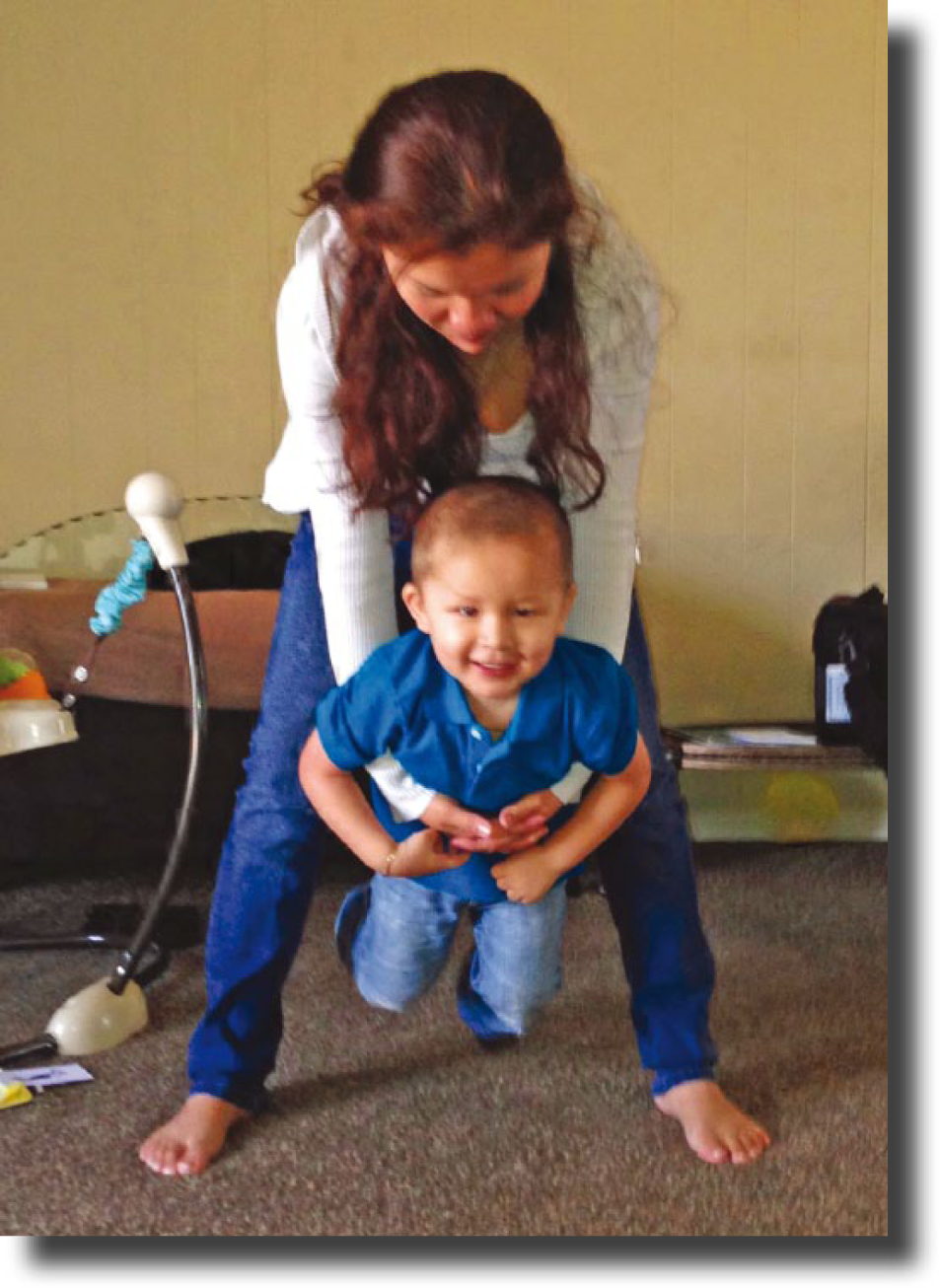
Maya, an early intervention (EI) provider, is getting ready for her day of home and center visits. Her first home visit is with Eva, a 9-month-old with Down syndrome, and her family who have moved to the community from Columbia. Maya wants to complete their family interview for the Individual Family Service Plan (IFSP). From there, she’s off to see Tucker, a 2.5-year-old with cerebral palsy, at his child care center. Maya feels welcomed by the teacher, but she wonders how she can move from the space in the corner they have given her into the classroom activities. From the child care center, there is a stop at the twins, Jessica and Jaylen’s house with grandma as caregiver. Both girls are doing well so it is time to explore new goals for them. And finally, Zachary, who has a diagnosis of autism spectrum disorder (ASD), is the last stop of the day. Zachary’s session will take place at home where Maya will discuss the use of augmentative communication with his mom and dad. Maya’s day reflects the variation common to EI providers working with children and families in natural environments.
On any given day, EI providers must manage the individual needs of children with a range of disabilities in a variety of contexts and with varying caregiver/family priorities. Approximately 85% of children below the age of 3 receive services in their homes, with the remaining 15% receiving services in community settings, such as family child cares, preschools, and early care and education centers, or medical facilities, such as hospitals, clinics, or EI centers (U.S. Department of Education, 2012). While the majority of children receive home-based services, the number of children participating in various early care and education programs continues to rise as more families enter the workforce (U.S. Census Bureau, 2011). The expanding contexts where children receive Part C EI services increase the need for flexible service delivery approaches by providers.
Recommended and evidence-based practices as defined by Part C policy (Individuals With Disabilities Education Improvement Act, 2004) and the Division for Early Childhood of the Council for Exceptional Children (DEC; Sandall, Hemmeter, Smith, & McLean, 2005) emphasize the importance of EI providers adopting a family-centered approach that prioritizes working with parents and caregivers to enhance developmental outcomes for their children (Schertz, Baker, Hurwitz, & Benner, 2011; Trivette, Dunst, & Hamby, 2010). Key tenets of family-centered practice include working with parents or caregivers using consultative coaching strategies that promote their learning, confidence, and competence to teach their children in the context of natural learning opportunities and daily routines (Dunst, Trivette, & Hamby, 2007). This shift in thinking acknowledges the central role that parents/caregivers play in facilitating children’s skills in a variety of domains. EI providers use consultative approaches that recognize the capacity of families to engage and teach their children across naturally occurring routines and activities to maximize intervention opportunities, promote generalized learning, and enhance child participation in family routines and activities (Schertz et al., 2011; Woods, Wilcox, Friedman, & Murch, 2011).
“The use of a logic model is proposed for EI providers to guide their reflections on implementation of recommended practices and to promote continuous improvement in their use.”
However, research suggests that despite policy and programmatic expectations, a substantial gap exists between recommended and actual practices (Hebbeler, Spiker, Morrison, & Mallik, 2008; Sawyer & Campbell, 2012). Although many EI providers now work in home and community contexts, Peterson, Luze, Eshbaugh, Jeon, and Kantz (2007) found that professionals spent over half of the home visit in direct instruction with the child. Other research indicates that parents or caregivers often assumed passive roles and were rarely acknowledged or spoken to even when present (Wilcox, Guimond, & Kim, 2010). For children and families to receive EI services that meet the spirit of recommended, evidence-based practices, it is essential that individual EI providers make changes in their interactions with families to close the research-to-practice gap (Dunst et al., 2007; Metz & Bartley, 2012; Odom, 2009). An important professional development strategy is to assist EI providers to use a consistent framework and process across all situations including those contexts perceived as more “challenging” (Fleming, Sawyer, & Campbell, 2011).
The purpose of this article is to present an organizing framework using a logic model to guide EI providers in their implementation of recommended practices consistently across the different contexts in which they serve children and families. The use of a logic model is proposed for EI providers to guide their reflections on implementation of recommended practices and to promote continuous improvement in their use. Similar to a flowchart, a logic model is a systematic and visual representation of the relationships between available resources/inputs, activities/strategies, and outcomes, as well as outputs and potential impacts (W.K. Kellogg Foundation, 2004) frequently used in program evaluation. As defined in the W.K. Kellogg Foundation Logic Model Development Guide (2004), the “inputs” are the human, organizational, and community supports a program has available as resources. “Activities/strategies” are the processes, tools, and actions that are essential to program implementation. Such activities/strategies should lead to the program’s desired results, which are referred to as “outcomes.” Outcomes include specific changes in program participants’ behavior, knowledge, skill, and functioning. Program “outputs” include the services delivered by the program, and “impacts” are the fundamental intended changes occurring in communities or systems as a result of program activities/strategies. A logic model can show how day-to-day actions connect to the results or outcomes that a program is trying to achieve (Coffman, 1999). The use of a logic model can assist in program evaluation, as well as facilitate effective program implementation by providing data on how specific activities/strategies can lead to desired outcomes and results (Bellini, 2011). A logic model framework can also be a useful tool for EI providers for many reasons: (a) the logic model clarifies the specific outcomes EI providers want to achieve within and across sessions for each child and family; (b) it can be used to monitor consistent implementation of various activities/strategies that address family concerns and priorities; (c) it assists EI providers in evaluating the effects of implementation of specific interventions in relation to the child’s and family’s desired outcomes, and (d) it supports the implementation and continuous improvement of recommended practices.
The ROLE logic model (Relationship Building, Observation and Opportunities, Learning, and Evaluation) as illustrated in Figure 1 is designed to assist EI providers in using key processes that support and enhance implementation of recommended, evidence-based practices across diverse children, families, and settings. The ROLE logic model provides an easy to remember set of processes based on the premise of implementation science, which intends to close the gap between knowledge of effective practices and the services actually received (Metz & Bartley, 2012). The logic model was derived from a review of DEC Recommended Practices (Sandall et al., 2005), the Family Outcomes Survey (Early Childhood Outcomes [ECO] Center, 2010), and journal articles on evidence-based practices in EI. The Inputs include family members, and EI providers guided by legislative and program mandates and evidence-based practices. Activities and Strategies outline the EI provider’s ROLE which in turn promote optimal Outcomes for Child and Family. High-quality EI services from a local, state, and national perspective make up the programmatic Outputs, whereas Potential Impacts are the fundamental intended changes seen in child development and family empowerment. Additional impacts include enhanced understanding of EI programs and recognition of the benefits of EI to local communities. Each aspect of the EI provider’s ROLE is integrated with the others to promote implementation of recommended practices in each session and with all families and caregivers. While one aspect of ROLE may require more attention than the others during a particular visit, the EI provider should be cognizant of all four ROLE processes as he or she interacts with a child and family. The ROLE logic model describes a consistent framework for EI providers to implement across every phase of the EI process irrespective of where and with whom the intervention occurs. Furthermore, the logic model illustrates how EI activities/strategies are directly connected to desired outcomes, outputs, and impacts. This cohesion helps providers, families, administrators, and other stakeholders recognize the relationship between everyday practices and programmatic goals at the individual and the overall program levels.
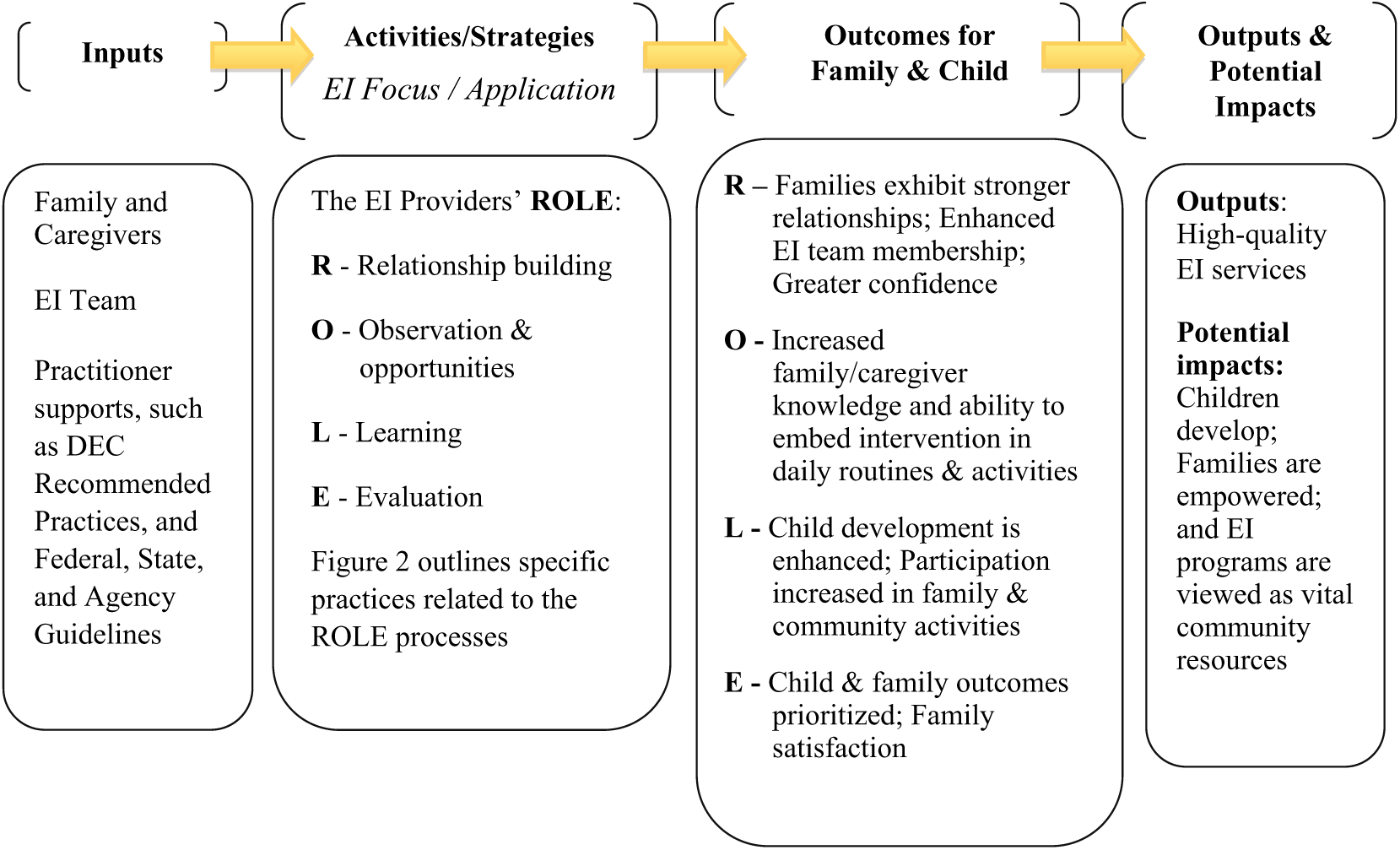
ROLE logic model for early intervention
Using the ROLE Logic Model: Inputs
The Inputs in the ROLE Logic Model include the providers, families, and other programmatic supports that form the “community” within which EI activities are embedded. Successful implementation of intervention that is family-centered requires EI providers to (a) engage in meaningful and respectful relationships with families (Crais, Roy, & Free, 2006; Dunst et al., 2007), (b) observe interactions for meaningful learning opportunities within the context of naturally occurring interactions (Woods et al., 2011), and (c) evaluate the effectiveness of caregiver focused interventions implemented with caregivers and children across settings (Trivette et al., 2010). All members in an EI community are guided by recommended, evidence-based practices and legislative mandates put in place to facilitate achievement of child and family outcomes. As families progress through the various phases of EI, from first contacts to IFSP development, intervention, and to transition, their priorities and concerns evolve and the child’s outcomes change. The need to demonstrate the achievement of functional outcomes is a pressing issue in EI. With guidance from the U.S. Department of Education’s Office of Special Education Programs (OSEP), the ECO Center developed a Child Outcomes Summary and a Family Outcomes Survey to facilitate local, state, and federal data collection, reporting, and program improvement. The Child Outcomes Summary Form allows providers to summarize child development information from multiple sources, including the family. A 7-point scale is used to rate the child’s functioning on each of three outcomes related to positive social-emotional skills, acquiring and using knowledge and skills, and taking appropriate action to meet needs (ECO Center, 2006). Section A of the Family Outcomes Survey includes 24 items related to how a family supports their child’s needs (ECO Center, 2010).
Using the ROLE Logic Model: EI Activities/Strategies to Achieve Family and Child Outcomes
The following sections illustrate how the ROLE Logic Model Activities and Strategies can be used by EI providers to achieve family and child outcomes within family and community activities. While each component of ROLE is considered by the EI provider during a visit, there will likely be times when one aspect serves as the priority based on the needs of the child and family, the activities or routines taking place, and the phase in the EI process. Examples of how the ROLE logic model helps Maya, the EI provider in the opening vignette, plan for intervention with Eva, Tucker, Jessica, Jaylen, and Zachary in different settings, routines, and activities are used to illustrate implementation of the ROLE logic model activities in diverse settings. Each illustration shows how Maya uses the ROLE logic model activities/strategies to promote optimal child and family outcomes. To further assist EI providers in translating the use of the ROLE logic model to practice, a practitioner-friendly ROLE Implementation Checklist is depicted in Figure 2. This checklist provides specific observable strategies that EI providers can choose from to use the ROLE logic model to meet the needs of each child and family.
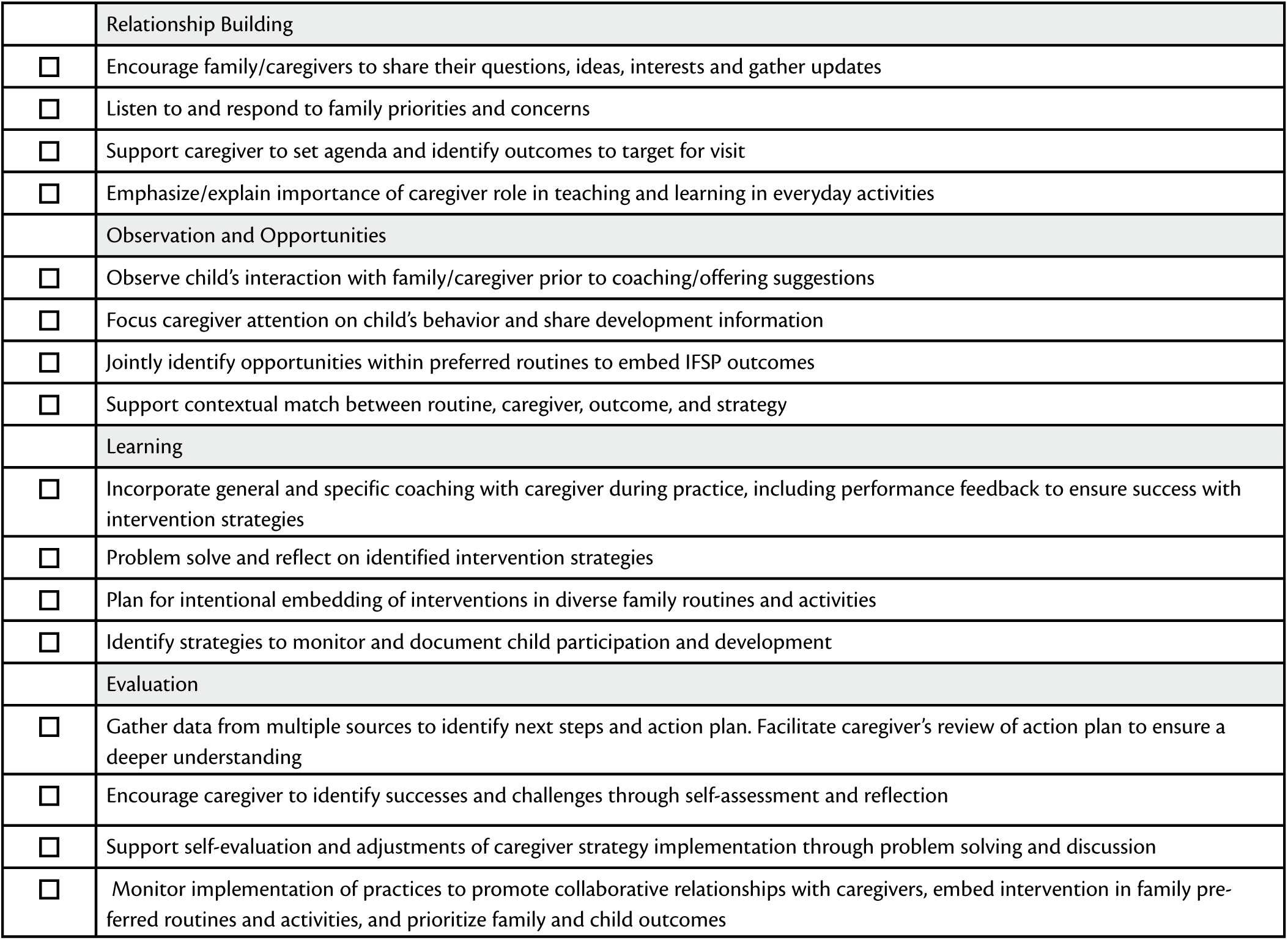
ROLE implementation checklist
Relationship Building
The OSEP Technical Assistance Community of Practice formed a national workgroup that developed a mission statement and key principles acknowledging that the “primary role of a service provider in EI is to work with and support family members and caregivers in children’s lives” and concluding that “all families, with the necessary supports and resources, can enhance their children’s learning and development” (Workgroup on Principles and Practices in Natural Environments, 2007, p. 2). The relationships between an EI provider and participating family members and caregivers also influence the implementation of services. Dempsey and Dunst (2007) stated that relationships between EI providers and parents/caregivers are strongly linked to parent feelings of empowerment and to the effective delivery of supports and services for families and children. EI providers can most effectively share their knowledge, resources, and skills in the context of a mutually respectful and trusting relationship. To strengthen the professional bond with families, EI providers encourage parents, other family members, and caregivers to share their stories, identify their priorities and concerns, and engage in the decision-making process, especially as related to service delivery needs of the child (Edelman, 2004). These activities/strategies are particularly consistent with DEC Recommended Practices within Strand 1 on Assessment that focus on professional and family collaboration, identifying the individual needs of children and families, providing useful information, and sharing information in respectful useful ways (Sandall et al., 2005). The supportive EI provider can help family members and caregivers develop the capacity to serve as leaders on the EI team as Maya does in this continuation of the opening vignette:
Eva, a 9-month-old with Down syndrome, lies on the floor of her family’s apartment located in a bustling downtown area and engages everyone with her bright eyes, big smile, and gurgling sounds. Eva’s mother, Yvonne, smiles nervously as Maya joins her on the couch so she can easily converse with the family while observing Eva. Yvonne, her husband, Raul, and Eva live with Yvonne’s mother, Rosa, in her small apartment. Yvonne and Raul can speak and understand most English and are consciously trying to use English with Eva. Rosa, who is another primary caregiver for Eva, is concerned because she primarily speaks Spanish. As Maya and Yvonne talk, Rosa frequently interjects in Spanish, especially as the two discuss Eva’s daily routines and activities. Yvonne’s participation decreases to translating her mother’s opinions rather than describing her priorities and ideas to support Eva. Maya realizes that Yvonne is perceptive and observant of Eva’s needs, and is also interested in Rosa’s opinions and concerns. Maya wants to respect the family dynamics and roles, while developing a relationship with Yvonne that will facilitate the family’s meaningful engagement with the Part C EI system and ensure best possible outcomes for Eva.
Activities/strategies to encourage relationship building
To get to know Eva, Yvonne, and their family better, Maya focused on the Relationship Building aspect of the ROLE logic model. Using her ROLE Implementation Checklist (Figure 2), Maya encouraged Yvonne to share ideas and interests, ask questions, and include her mother’s comments as she listened carefully. Maya used Yvonne’s examples to illustrate that she was already supporting Eva’s learning in everyday activities and that many of the strategies both Yvonne and Rosa were using were very important for her development. During the next few visits, Maya began each session using open-ended questions to encourage Yvonne to share what she and Eva were doing, to discuss the family’s concerns, their priorities and interests, and to gain insights about the roles and responsibilities of each member in her family. Through her conversations, she learned details about Eva’s difficult birth and subsequent medical challenges, including heart surgery and intense treatments for pneumonia. When asked about her dreams for Eva, Yvonne said that she wanted Eva to be “like the other kids in the building” while Raul was more specific in listing that he wanted Eva sitting up, playing, and communicating better. Rosa reminded the team of the family’s desire to ensure that Eva be able to go to “regular” school. This information helped Maya understand and respond to the family’s priorities and concerns by collaboratively identifying potential IFSP outcomes for Eva, including independent sitting during play routines and increasing her use of gestures and sounds. Maya also focused on sharing information about the importance of family and caregiver roles in teaching and learning by sharing print materials in Spanish and English so everyone in the family was included. This new role seemed to increase Yvonne’s confidence in taking care of Eva.
“The focus on building relationships helps the family view the EI provider as a caring and trustworthy person who listens to their concerns, values their opinions, and respects their choices.”
Family and child outcomes as a result of relationship building
By listening, acknowledging family priorities, enhancing competence through linguistically and culturally appropriate information sharing, and building community connections, Maya was able to build a solid relationship with Eva’s family as a foundation for their active engagement and involvement in EI and enhance existing and new family relationships. The focus on building relationships helps the family view the EI provider as a caring and trustworthy person who listens to their concerns, values their opinions, and respects their choices. Demonstrating the family’s value on the EI team helps the family gain a sense of team membership and increases their confidence (Kelly, Zuckerman, & Rosenblatt, 2008). The term relationship also implies a focus on the bonds within the family, which relates to the positive social-emotional skills outcome on the Child Outcomes Summary Form (ECO Center, 2006). By focusing on child and family strengths, EI providers are positioned to influence overall enjoyment and satisfaction (Edelman, 2004).
Observation and Opportunities
To facilitate an environment that supports caregiver/parent learning, EI providers may benefit from adopting a “watch and join” stance (Woods & Lindeman, 2008). By observing interactions in daily routines, EI providers obtain information about the strategies that parents/caregivers are already using to support child development and participation and can identify preferred routines for intervention and join in with caregivers to embed a child’s IFSP outcomes. A survey of 298 early care and intervention professionals indicated that observing child and parent/primary caregiver interactions was the top-ranked, most important clinical skill related to reflective practices (Tomlin, Sturm, & Koch, 2009).
Observation also leads to identifying opportunities for the introduction of new learning strategies or opportunities when existing strategies can be used more frequently within routines. Observation and the identification of learning opportunities are activities/strategies particularly consistent with DEC Recommended Practices within Strand 2 on Child Focused Interventions, which highlight promoting active engagement, learning, participation, and membership; using data to individualize and adapt practices; and addressing child needs within and across environments, activities, and routines (Sandall et al., 2005). In Maya’s second visit of the day at Tucker’s child care center, one can see how she observes classroom activities, consults with the caregiver, and embeds opportunities for peer engagement with another child.
Tucker is a happy 2.5-year-old who enjoys socializing with his peers. His mom, Catherine, a school nurse, is well versed in Tucker’s medical needs related to cerebral palsy. Catherine stayed at home with him until he was 2 years old and participated in weekly EI sessions. She returned to work 6 months ago and Tucker is attending a child care center. Tucker enjoys going to “school” and loves the attention from child care teachers and staff and other children. Because of Tucker’s developmental needs in the gross and fine motor domains, adult support is needed for mobility, transfers, feeding, and manipulating objects. His teachers are willing to provide the extra hands-on time he needs throughout the day; however, they have commented on several occasions how much they appreciate the time they have free to work with other children in the class when Maya comes to the center to serve Tucker. Maya’s late morning visit allows the teachers to concentrate on other children playing in centers and to prepare the lunch trays. While that may help the teachers, Maya feels as though her time in the classroom is not maximizing the potential benefits of EI services for Tucker. Plus, working with Tucker independently doesn’t allow Maya to build her relationship with Tucker’s main caregivers or enhance relationships between Tucker, his teachers, and peers.
Activities/strategies to encourage observation and opportunities
Maya knows from her ROLE Implementation Checklist (Figure 2) that observing interactions between Tucker and his teachers is necessary to offer strategies to address specific developmental and social outcomes. On this day, Maya begins her visit by observing Tucker during center time activities. Maya sees that Tucker is attempting to play in the block center by himself. Maya then approaches the lead teacher, Ms. Erica, to ask if there is another child who might enjoy playing in the block center with Tucker. Ms. Erica mentioned that Harper, one of Tucker’s classmates, was having difficulty sharing earlier in the day and that she really wanted to teach Harper to “use her words.” In response to this concern, Maya suggested that the two children play together in the block center to provide opportunities for fine motor play and social communication exchanges. Once Ms. Erica, Tucker, and Harper settled into their play, Maya observed the natural interactions between the children and teacher briefly. This allowed her to comment on how well Ms. Erica supported Tucker’s developmental motor needs through proper seating, arrangement of materials, and physical assistance as needed to stack blocks. Maya encouraged Ms. Erica to set up the environment for Harper to take turns with Tucker. Ms Erica agreed that the children could work together to build a block structure by selecting different blocks by size and color. This plan would give Harper opportunities to negotiate verbally while Tucker used functional motor skills, and they both had fun. Maya and Ms. Erica had a successful session by embedding learning opportunities and increasing Tucker’s participation in a regularly scheduled classroom activity. Realizing that the late morning time frame is when the teachers must start getting ready for lunch, Maya offered to adjust her schedule to come earlier on another day of the week. Ms. Erica appreciated Maya’s understanding and identified a time in her day when she had greater opportunity to interact with Maya and Tucker together.
“The family/caregiver’s knowledge and ability to embed the child’s goals across the day facilitates generalization of learned skills and greater opportunity for participation in community, social, and recreational activities.”
Family and child outcomes related to observation and opportunities
Observing the naturally occurring routines of the child and family/caregiver allows the EI provider to talk about the specific ways caregivers already help the child learn and grow and to identify opportunities for increasing participation throughout daily routines and activities (Woods & Lindeman, 2008). By sharing her observations with Ms. Erica, Maya was able to provide positive feedback to her about strategies that were working well to support Tucker’s skills in classroom activities. Maya and Ms. Erica were then able to discuss and identify additional opportunities for learning. The family/caregiver’s knowledge and ability to embed the child’s goals across the day facilitates generalization of learned skills and greater opportunity for participation in community, social, and recreational activities. In addition, increased opportunities for participation should support the child’s development of friendships and contribute to feelings of independence. Maya’s ability to observe the classroom situation and identify opportunities for engagement and learning helped promote the child’s development across all three outcomes identified on the Child Outcomes Summary Form (ECO Center, 2006).
Learning
An important family outcome is to enhance the competence of parents/caregivers in meeting their child’s developmental needs. Supporting the caregiver’s learning is critical to successful EI (Woods et al., 2011). EI providers can use a range of strategies that not only address the child’s outcomes but also match the caregiver’s learning style and preferences, thus building his or her competence in addressing the child’s goals in familiar and novel routines. This is accomplished through interventions that use a triadic approach, meaning the provider addresses the child’s needs by supporting the caregiver–child dyad (McCollum, Gooler, Appl, & Yates, 2001). During triadic interactions, EI providers offer information about child development and coach the caregiver on the use of strategies to enhance child development and participation. Triadic intervention is consistent with DEC Recommended Practices in Strand 3 on Family-Based Practices and Strand 4 on Interdisciplinary Models (Sandall et al., 2005), which highlight shared responsibility and collaboration between families and professionals, strengthening family functioning, and child learning within the context of interaction with family/caregivers during regular routines. In Maya’s third visit of the day, family-based practices are at the forefront.
Maya smiles as she knocks on the door of Jessica and Jaylen’s grandma’s house; she can hear them playing in the living room waiting for her arrival. But rather than joining in their toy play today, Maya asks Mrs. Jackson what she was doing in the kitchen and then, upon hearing that she was making cookies, asks if everyone could join her. While a bit unsure about how everyone would fit in the small space, Mrs. Jackson noted that with the girls crawling now and getting into everything, she found them frequently under foot. With the girls in their high chairs observing and sampling the cookie baking, Maya and Mrs. Jackson discussed what the girls could and probably shouldn’t get involved in, considering time and safety concerns. Their problem solving expanded to identifying ways to support generalization of current goals into a new environment, such as using different objects (e.g., plastic storage containers and lids) for stacking and sorting. Mrs. Jackson found a drawer in her cupboards that was “safe” for the girls to explore at just the right height for pulling up to stand, a new goal that Maya had hoped could be started.
Activities/strategies to encourage learning
Maya used learning strategies listed in the ROLE Implementation Checklist (Figure 2) to support learning for both the twins and their grandma during the home visit. First, she listened to Mrs. Jackson’s concerns and helped her identify options for the twins’ participation in her kitchen routines. While initially somewhat unsure about the idea of the girls in the kitchen, Mrs. Jackson agreed it was inevitable and came to the conclusion herself that it was better to prepare for their involvement rather than to “waste time trying to keep them out!” Maya’s sincere praise about the strategies Mrs. Jackson was already using to support her grandchildren encouraged her to try something new. Maya joined in with the cookie baking and guided Mrs. Jackson to identify what worried her and how she could alleviate some of her concerns. By observing, Maya was able to make suggestions that built upon what Mrs. Jackson was already doing and ones she could try immediately to see if they worked. While grandma stirred the cookie batter, each girl had her own set of measuring spoons, cups, and small plastic containers for play. Brainstorming together encouraged Mrs. Jackson to build on her current skills as a foundation for new learning, to contribute to the development of a new routine, and to specify what she did not think would work. This helped Maya identify strategies that were both acceptable and likely to be used. Mrs. Jackson also had Maya’s support to practice and then reflect on what worked and what didn’t. Jaylen crawled over to the towel drawer located away from the oven and the high traffic doorway. Maya and Mrs. Jackson tested the drawer for height and strength before Jaylen got to test it out. With Jaylen’s success, Jessica got the opportunity to join her in learning to pull up to stand. This practice helped Mrs. Jackson develop a plan that she could use between Maya’s visits. By the end of the visit, Jaylen and Jessica had more places and opportunities to explore and play and they had a new goal, pulling up to stand, to support their participation in routines throughout the day. On the way to the door, Maya helped the girls use the couch and the coffee table to support their pulling up to stand and engage in toy play, leaving Mrs. Jackson shaking her head in awe of her “pretty smart little princesses!” Maya built upon her relationship and observations to engage Mrs. Jackson in learning new ways to increase the twins’ participation and independence and encouraged her to reflect on how she could use the same strategies to solve similar problems or concerns.
“When EI providers use triadic intervention to support learning, family members and other caregivers increase their knowledge of child development and learn strategies for supporting participation and embedding child learning outcomes.”
Family and child outcomes related to learning
Grandma’s big smile as Maya left provided data supporting the success of the visit. In addition, Maya had data related to the twins’ goals of functional play, turn taking, and vocalizing. Maya also gathered data from Mrs. Jackson about current priorities and progress between visits. Then, she engaged in performance feedback to help Mrs. Jackson learn how to arrange the environment to support the twins’ continued practice in a new routine—helping grandma cook. By focusing on the learning element within the ROLE logic model, children have opportunities to participate and experience developmental achievements that lead to greater independence, both of which are related to knowledge and skill development and meeting needs outcomes on the Child Outcomes Summary Form (ECO Center, 2006). When EI providers use triadic intervention to support learning, family members and other caregivers increase their knowledge of child development and learn strategies for supporting participation and embedding child learning outcomes.
Evaluation
Providers of EI are responsible for ensuring that child and family outcomes are met in a timely manner. Reflective practice encourages EI providers to assess the effectiveness of techniques used to share information and to support child and adult learning. Evaluation is integral throughout each visit to support progress monitoring and development of effective interventions, and to promote caregiver capacity building that supports the child’s learning. Evaluation activities/strategies are consistent with DEC Recommended Practices (Sandall et al., 2005) in multiple strands, including (a) Strand 1 on Assessment, which focuses on gathering and sharing information and identifying the individual needs of children and families; (b) Strand 2 on Child Focused Interventions, which suggests using ongoing data to individualize and adapt practices to meet each child’s changing nature; (c) Strand 3 on Family-Based Practices, which practices encourage a strengths-based approach; and (d) Strand 4 on Interdisciplinary Models, where joint decision making is a critical practice.
Providers also use self-assessment data to determine how effective they are at building relationships, observing, supporting caregiver learning, and ensuring sufficiency of opportunities for the child to make progress. Furthermore, continuous feedback and monitoring of caregiver implementation of intervention through performance feedback, reflective practice, and problem solving enhances caregivers’ ability to maintain and generalize use of their skills across a variety of routines and activities (Woods et al., 2011). When a child’s participation and development can be enhanced, problem solving should be used to identify what has and hasn’t worked and what should be tried in the short and long term. Of course, data collection helps the team identify developmental patterns and to recognize when child outcomes have been met and when plans need modification to better support the child and family. The evaluation component of ROLE is illustrated in Maya’s last visit of the day.
Maya grabs her backpack as she runs up the stairs to meet Mr. and Mrs. Ashley and Zachary. While she has been working with him for 6 months already, this is only the third visit with both parents together. Zachary’s parents are totally committed to participating in his intervention since receiving the diagnosis of ASD, but it hasn’t been easy for either of them and they haven’t always agreed on what Zachary should be working on or how they will participate. Maya is pleased to hear how well using pictures to make choices has been going during snack time and that mom has already made pictures to use for different activities Zachary likes to do with dad. Zachary is having so much success using pictures that Maya wants to be sure both Mr. and Mrs. Ashley have everything they need to keep practicing. Mrs. Ashley reports that Zachary was taking the pictures off the refrigerator to show her what he wanted and also reported that the number of tantrums had reduced so much she could hardly believe it. While dad had not been quite as excited about using pictures as he wanted to hold out for words, he did agree that when Zachary used them, they were able to identify a game to play and start playing without any problems.
Activities/strategies to encourage evaluation
Maya gathered this input from Mr. and Mrs. Ashley before they planned the agenda for the visit so that she could be sure to address concerns that might interfere with Zachary’s opportunities to engage and participate with his parents during the week. By coming after his nap, Maya was able to observe and support Zachary and his mom in using communication pictures during snack time, and also gather data on how mom used the pictures to increase Zachary’s participation and choice making during play activities. The success that Zachary had using pictures during snack time prompted Maya and Zachary’s parents to develop supports for hand washing, and also to encourage the use of pictures to make choices as he transitions into play with dad after cleanup.
Family and child outcomes related to evaluation
As with all her visits for the day, Maya focused on building relationships, observing naturally occurring routines, and creating opportunities for practice to increase learning for both children and families. She prioritized evaluation with Zachary and his parents to provide performance-based feedback to both parents on their successes and to show data to support the use of an augmentative communication system with Zachary in daily activities. Although evaluating was the final element introduced in the ROLE logic model, it is an ongoing practice of assessment and reflection that is interwoven in every interaction with a child and family. By constantly viewing situations with a wide lens, the EI provider helps identify the child’s and family’s needs, prioritizes outcomes, collects progress monitoring data, and identifies appropriate resources for the child and family. Information gained through evaluation should be shared regularly with the family to build their capacity, improve their access to resources, and help them make informed decisions related to their child’s current and future care, all of which are important elements of the Family Outcomes Survey (ECO Center, 2010).
Using the ROLE Logic Model: Outputs and Potential Impacts
In accordance with logic model organization, program “outputs” include the services delivered by the program. In the case of the ROLE logic model, high-quality EI services should be the ultimate output. When individual EI providers apply the ROLE processes, they will be using evidence-based and recommended practices that undergird federal legislation. Collectively, these providers have the potential to enhance child development, empower families, and help EI programs become vital community resources. Because the ROLE logic model is based on evidence-based and recommended practices in EI and tied to child and family outcomes identified by ECO, providers applying this logic model should observe measurable progress in the children and families they serve. Through joint decision making and newly acquired abilities to support their children’s development, families are likely to have higher levels of empowerment and overall satisfaction. Such positive changes in children and families participating in EI can potentially result in the recognition that EI programs are critical to the vitality of communities, which has both legislative and financial implications.
As providers face the need to juggle many tasks across the various phases of the Part C EI process, it is helpful to recognize that core beliefs and evidence about DEC Recommended Practices (Sandall et al., 2005) form an EI provider’s essential ROLE. The ROLE logic model offered here describes a framework for implementing services based on the desire to build supportive relationships, work within the context of everyday routines to observe and enhance opportunities for child learning and caregiver confidence, and evaluate outcomes over time. As any given day in EI offers unique experiences, successes, and even challenges, EI providers need an easy to remember framework for organizing each interaction and the ROLE logic model offers that framework.
Footnotes
Authors’ Note
You may reach Shubha P. Kashinath by e-mail at