




Abstract

It is time for the morning circle and the beginning of another school day! Ms. Sheila and her 18 children, age 3 and 4 years old, in her inclusive preschool classroom are singing to the tune of “London Bridge” while they are moving to the circle area of the classroom: Oh! Good morning, on your square, on your square, on your square, Oh! Good morning on your square, crisscross apple sauce.
Some of the children are singing with a loud, clear voice, looking happily at their peers. Others seem to be more reserved—they are humming the well-known melody and moving their body to the rhythm. By the time the song is over, almost everyone is sitting at their assigned places. With eyes looking excitedly at Ms. Sheila, students seem ready for her cue that will signal the next group activity. At Ms. Sheila’s nod, they start clapping their hands or keeping a steady beat on their laps in a joyful manner. The song “Days of the week” sounds in the room. It seems that making music together lightens their spirit. Children look around happily, making eye contact with their classmates, and beaming at each other.
Mark, a child diagnosed with Autism Spectrum Disorder (ASD) who has limited verbal abilities, is away from the group until the songs begin during circle time. Ms. Sheila has observed that Mark’s limited social communication abilities hinder his participation during group activities. Mark prefers to spend time on his own at the corner of the room looking at his hands instead of joining his peers at the circle area. Attempts to engage Mark often lead to vocal protests, resistance, and even mild aggression. However, Ms. Sheila notices that Mark seems to respond positively to familiar songs by smiling and turning his head to the circle when he hears one of them. Noticing Mark’s positive reaction to familiar songs, Ms. Sheila intentionally incorporates songs, music games, and rhymes in her instructional time to encourage everyone’s participation and allow Mark to join in at his comfort level.
Literature Review
Social experiences provide children with a structured framework in which they explore their abilities, develop new interests, and learn in relation to their environment (Tomasello & Carpenter, 2007). However, young children with ASD, like Mark, often miss important learning opportunities because of the challenges they experience in engagement and group participation (Rosenberg, 2008). ASD is a neurodevelopmental condition characterized by challenges in social communication, fixated interests, and repetitive behavior or activity (American Psychiatric Association, 2013). Social and communication challenges in children with ASD affect their capacity to understand and use nonverbal communicative behaviors, such as gestures and facial expressions. Social challenges also affect their ability to develop and maintain relationships with other communication partners regardless of the children’s level of cognitive or language ability (Carter, Davis, Klin, & Volkmar, 2005; Rubin & Lennon, 2004).
“However, young children with ASD, like Mark, often miss important learning opportunities because of the challenges they experience in engagement and group participation.Music helps develop cognitive skills, is a significant mode of communication, and creates an important context for life skills such as collaboration, cooperation, and group effort.”
Within the school setting, young children with ASD may face more challenges as the social environment becomes more complex (Carnahan, Musti-Rao, & Bailey, 2009). Typical group activities for kindergarten children depend heavily on children’s ability to follow directions, respond verbally to adults’ prompts, take turns, initiate, and sustain peer interactions. Therefore, young children with autism may often be excluded from academic group activities because their social skills are under-developed or delayed (Rao, Beidel, & Murray, 2008). As a result, children with ASD may miss the opportunities that permeate social engagement for relationship-based, active, connected, and meaningful learning (Schneider, Goldstein, & Parker, 2008).
Practice recommendations for educating children with ASD produced by the National Research Council (NRC, 2001), by the Division for Early Childhood (DEC) of the Council for Exceptional Children (Sandall, Hemmeter, Smith, & McLean, 2005), and the National Association for the Education of Young Children (NAEYC; Copple & Bredekamp, 2009) call for promotion of child-initiating learning, inclusive high-quality early childhood programs, and systematic delivery of interventions that support development in functional ways (Schertz, Baker, Hurwitz, & Benner, 2011). Research also supports the inclusion of young children with ASD in early childhood settings, which provide opportunities for meaningful learning embedded in the children’s everyday routines (Wolery, 2005).
Music, Early Childhood, and Young Children With ASD
Music can be one such inclusive strategy that holds the potential to promote children’s engagement and mastery across various learning domains in a contextually meaningful and developmentally appropriate way. The National Association for Music Education (NAfME; Boston, 2000) compiled many of the long-term extrinsic benefits of music for young children. Music helps develop cognitive skills, is a significant mode of communication, and creates an important context for life skills such as collaboration, cooperation, and group effort. Participation in music activities promotes children’s listening and oral language skill development (Hill-Clarke & Robinson, 2004); expression of emotions and focused attention (Custodero, 2005); and young children’s creativity, coordination, and math and literacy achievement (Hallam, 2010). Music in an inclusive environment stimulates the senses, engages the children at different levels according to their abilities, and contributes to a feeling of community because children come together through shared songs, rhymes, chants, and kinesthetic activities (Humpal & Wolf, 2003; Neelly, Kenney, & Wolf, 2000).
Music therapy is also classified as an emerging evidence-based practice by the recent Standards National Project conducted by the National Autism Center (2009). Although some children with ASD may be overstimulated by music or noises, studies in which songs and interactive music making are incorporated in the daily routines of children with ASD report positive results on children’s level of engagement and their academic growth (Carnahan et al., 2009; Lanter & Watson, 2008). Within the school setting, the use of songs has been found effective in assisting young children with ASD to participate in the morning routines (Kern, Wolery, & Aldridge, 2007), in increasing their levels of interactions with other peers (Kern & Aldridge, 2006), and in enhancing their listening and oral language skills (Simpson & Keen, 2011).

The purpose of this article is to describe field-tested and research-based music strategies to increase engagement, academic skills, social skills, and emotional regulation for children with ASD in an inclusive preschool classroom. In the following sections, we present three music strategies: (a) the use of precomposed songs, (b) the use of song-writing, and (c) music stations. These three music strategies are linked to recommended practices for young children with ASD to showcase the effectiveness of embedding music in inclusive early childhood settings to target the needs of children with ASD and engage everyone in an inclusive classroom (Table 1).
Music Strategies for Young Children With ASD
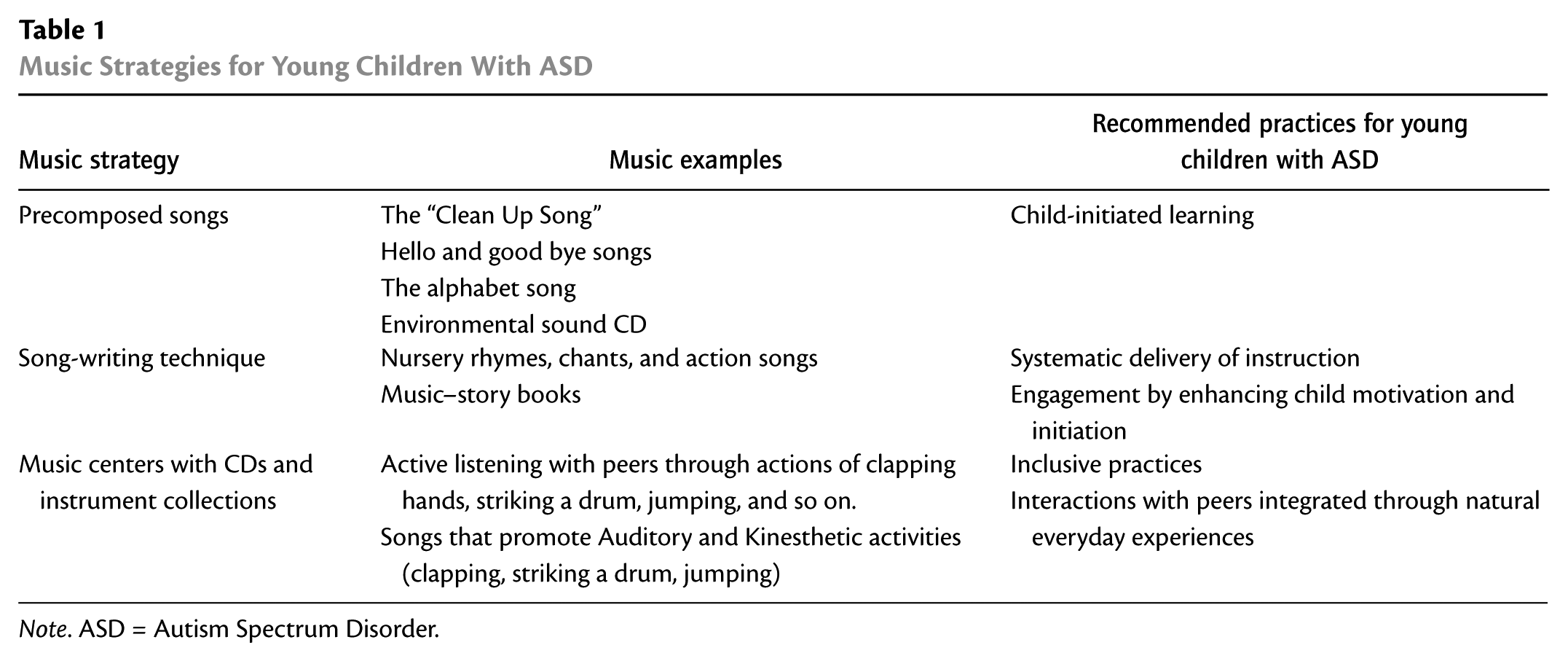
Note. ASD = Autism Spectrum Disorder.
Music Strategies in Inclusive Early Childhood Settings
The Use of Precomposed Songs
The intentional use of songs and active music making during instructional activities (i.e., during book-reading or during circle time) can be one way to promote engagement and learning for all learners in the group, including those with ASD (deVries, 2006; Hallam, 2010; Lanter & Watson, 2008). This is because young children with ASD tend to be more engaged when language is presented in songs during extended language activities (Kaplan & Steele, 2005; Lanter & Watson, 2008). As such, inherent parts of the music-making process can be intentionally used to cue all children and engage children with ASD to the activities presented (Kaplan & Steele, 2005).
“Familiar songs when consistently incorporated into classroom routines, offer structure and predictability while their rhythmic and melodic aspects promote children’s engagement and prolong attention to the instructions offered.”
Precomposed songs to support transition
Transitions can be a challenging process for young children with ASD (Mesibov, Adams, & Klinger, 1997). The use of familiar, precomposed songs is one recommended strategy to support successful transitions of young children with ASD (Furman, 2002; Humpal & Wolf, 2003; Snell, 2002). This is because familiar songs, when consistently incorporated into classroom routines, offer structure and predictability while their rhythmic and melodic aspects promote children’s engagement and prolong attention to the instructions offered (Kern et al., 2007). Tunes like the “Clean up, Clean Up, Everybody Everywhere” song when repeatedly selected for common transitions help children learn when a transition is occurring, where to go, and what to do (Goodman & Williams, 2007).
In Ms. Sheila’s classroom, specific songs are repeatedly used to signal transitions such as the end of free-play time or the beginning of circle time. Moreover, a variety of familiar songs are used throughout the day to engage children and support their transition and the shift focus to a new activity at different parts of the day. Following are two examples on how to use precomposed songs to support transition and engagement for all children.
Frompreferred to nonpreferred activity
It is Friday afternoon and the young children in Ms. Sheila’s room are about to transition to circle time after their free-play period. Four colorful hula-hoops are on the floor in a line making a path for the children to follow to reach the circle area. One of the children’s favorite songs, “5 Little Monkeys,” is softly playing on the CD player. At the sound of the song, Mark, who has been sobbing because of the end of free-play time, walks slowly toward his peers. Ms. Sheila explains to the children who have lined up behind the hula-hoops that they have to concentrate, listen to the rhythm of the song, and hop in each hoop to get to the circle area. Children giggle in anticipation. While children hop one-by-one to the circle, Ms. Sheila directs them to sing along with the CD and clap their hands. Mark confidently claps his hands following the rhythm of the song and waits along with everyone for his turn. Music has helped him redirect his attention to the new activity and participate along with everyone.
Transition to other rooms
Down the corridor, Sara, the teacher assistant is walking with Mark walk back to the classroom.This can be a challenging process for Mark because he often exhibits difficulty with transitions, especially when he has to walk from one part of the building to another. Mark seems to be distracted by the different signs on the walls and the water fountain at the corner of hallway. Part of the challenge is that Mark often stops walking at the water fountain. When Sara attempts to redirect him to walking back to the class, he gets upset, and bends his knees in an attempt to sit down. After observing how Mark enjoys music, Ms. Sheila worked with Mark’s mother to identify some of Mark’s favorite songs. As a new strategy, Ms. Sheila and Sara have been using these songs to support Mark’s transition and his participation in the school activities. When Mark stops walking, Sara loses no time. She goes down to his level and starts singing the “Sunshine” song to get Mark’s attention. At the sound of the song, Mark raises his head, looks at her for a moment and smiles, and then starts walking again following the tempo of the music.

The Use of Song-Writing
Song-writing in the form of modifying the lyrics of a precomposed song can be an excellent opportunity to embed specific learning goals, scaffold children’s participation, and help children practice important academic skills in a clearly structured yet enjoyable manner (Darrow et al., 2009; Humpal & Wolf, 2003; Kern et al., 2007). For example, clapping to the rhythm and keeping a steady beat during a song or a nursery rhyme provide opportunities for auditory focus cues, which in turn can enhance teaching of important early literacy skills such as alphabetic principles, phonological awareness, and vocabulary development (Anvari, Trainor, Woodside, & Levy, 2002; Yopp & Yopp, 2009). In addition, early childhood educators can promote functional understanding of literacy for children with ASD and encourage all children to engage with literacy in a joyful way by creating flip charts with lyrics to use when singing and creating songs with the children (Koppenhaver & Erickson, 2003). In the following section, two examples of how to use song-writing to promote academic skills of all young children, including those with ASD, are described.
Phonological awareness
Noticing that there is still some time before the end of the day, Ms. Sheila decides to devote the time to promote phonological awareness and rhyming in an engaging and joyful way. She picks the rhyme “Humpty Dumpty Sat on a Wall” one of the favorite nursery rhymes of the children in her class. Although Mark has his back to the group, he is swaying to the rhythm of the chant and is clapping his hands along with everyone else. As the children are familiar with this tune, Ms. Sheila suggests that they create a new song for Humpty Dumpty and picture different places he can sit and from which he may fall. The children eagerly raise their hands to provide ideas and they giggle with their suggestions. To promote phonological awareness, Ms. Sheila provides feedback to children’s suggestions (i.e., what rhymes with wall?). Then she begins a new verse, “Humpty Dumpty sat on a . . . ” and she pauses. Mark slowly turns his head toward to the group and his peers and then points at the floor. Ms. Sheila takes advantage of Mark’s action and interprets it as a nonverbal suggestion. She ends the verse with, “Humpty Dumpty sat on the floor.” After the children finish up the rhyme, Ms. Sheila repeats the process to encourage more children share their ideas. Mark actively participates throughout the activity by clapping his hands and smiling along with his peers each time the song is repeated.
Alphabet knowledge and emerging writing
Mark is usually inattentive and engages in self-stimulatory activities instead of following Ms. Sheila’s instructions during large group activities. Ms. Sheila knows that Mark enjoys the tune of “London Bridge” and he is able to participate in this singing game with minimum adult support. As such, Ms. Sheila decides to incorporate the tune when teaching letter recognition and name writing with her group of children. For that purpose, she changes the lyrics of the tune to match the teaching activity. Following the tune of “London Bridge” I hear her sing, “This is how I spell my name, spell my name, spell my name. This is how I spell my name, my dear Brandon!” Brandon, an outgoing cheerful boy who enjoys singing and playing with his peers, stands up when he hears his name. According to the song’s routine, he has to stand up, pick the correct letters from the magnet board, and spell his name out loud. Brandon knows that this is Mark’s favorite tune and he notices that Mark is holding his head up, staring at the board during the activity. When it is time to pick a friend, Brandon picks Mark. Mark, who has been attentive through the song, confidently stands up and picks the letters to spell his name.
Music Stations
Promoting peer interactions
Challenges in understanding social relationships and communication among children with autism often results in a lack of peer interaction and forming friendships (Danko & Buysse, 2002). One strategy that holds the potential to facilitate the involvement and motivation of children with autism to interact with peers is to create interactive music stations inside the classroom or on the playground (Kern et al., 2007; Sussman, 2009). The music station can be in a clear, comfortable area of the room and may include age appropriate CDs and a CD player with a headset and small percussion instruments such as whistles, hand drums, small tambourines, bells, and small xylophones. The early childhood educator could support children’s socialization at a music station by scaffolding children’s participation, modeling ideas for playing with sounds, encouraging exploration and self-expression, and interjecting new music ideas for children to consider (Kemple, Batey, & Hartle, 2004).
“The use of precomposed songs, song-writing, and music stations can be a powerful resource when intentionally used in early childhood settings to promote engagement, academic skills, and emotional regulation of all children.”
Interactive music making
Interactive music making can provide natural cues for children with ASD, which can help them use simple motor actions and anticipate others’ movements in a familiar rote (Walworth, 2007). It also reinforces communication (both verbal and nonverbal), increases attention, and encourages children to listen to others (Gooding, 2011). Music stations may support young children with ASD with peer interaction, social communication, and physical proximity with their peers (Kern & Aldridge, 2006). Music stations also offer opportunities for active listening and problem solving (i.e., match the bells with the same sound), cooperative play, self-expression (i.e., making up songs or taking a leading role in group music making), and socialization among all children in the group. In addition, a selection of slow, quiet background music can help children refocus and cope with tense emotions (Sze & Yu, 2004). In these cases, music stations can offer an emotional outlet and function as an alternative to challenging behaviors (Katagiri, 2009; Schwartz, 2008).
It is a sunny Tuesday morning and everyone is at the playground. A group of children is gathered at the outside music station. As I walk by, I can see children dancing and singing. Mark is sitting close to the music center, holding a small drum in his hands. Mark is particularly good at playing the hand drums and he enjoys using them to accompany songs at the music station. His peers notice that and welcome his participation. Some of them take hand drums and hand bells and join in. The outdoor music station has been a powerful medium to enhance Mark’s interactions with his peers. Instead of spending time on his own at the swing, he now interacts with his peers and exchanges looks and smiles when the music is on, with minimum adult prompts.
Conclusion
The use of precomposed songs, song-writing, and music stations can be a powerful resource when intentionally used in early childhood settings to promote engagement, academic skills, and emotional regulation of all children. Music activities can facilitate social communication in the early childhood setting and provide a frame to initiate and maintain peer interactions, increase attention, and develop appropriate play activities, all of which are important goals for young children with ASD. However, it is important to note that early childhood educators may need to modify the music strategies presented due to challenges some children with ASD have in relation to auditory over-stimulation when hearing music. Modifications may include, but are not limited to, adjusting the volume of the songs played in the classroom, utilizing the rhythmical patterns of each song in contrast to the melodic lines, and using more actions and fewer spoken words to meet each child’s individual needs. Because music activities are a class-wide support, teachers can scaffold and reinforce all children’s learning through engaging and interactive classroom music activities, which promote a naturally inclusive classroom environment to support all learners. As Sara, one of the teacher assistants said, “Now we are singing their way through the day.”
Footnotes
Authors’ Note
You may reach Potheini Vaiouli by e-mail at