



Abstract
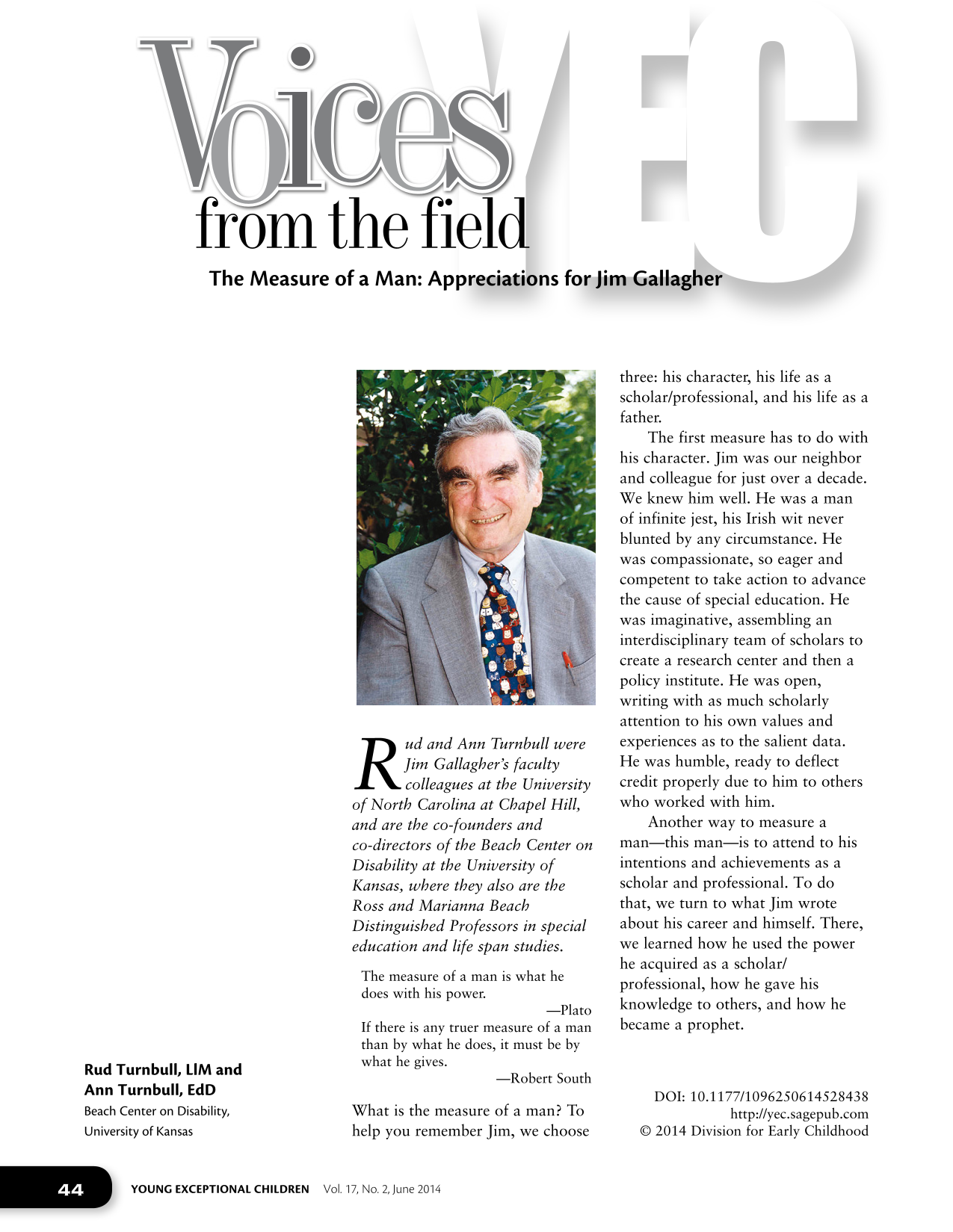

Rud and Ann Turnbull were Jim Gallagher’s faculty colleagues at the University of North Carolina at Chapel Hill, and are the co-founders and co-directors of the Beach Center on Disability at the University of Kansas, where they also are the Ross and Marianna Beach Distinguished Professors in special education and life span studies.
The measure of a man is what he does with his power. If there is any truer measure of a man than by what he does, it must be by what he gives.
What is the measure of a man? To help you remember Jim, we choose three: his character, his life as a scholar/professional, and his life as a father.
The first measure has to do with his character. Jim was our neighbor and colleague for just over a decade. We knew him well. He was a man of infinite jest, his Irish wit never blunted by any circumstance. He was compassionate, so eager and competent to take action to advance the cause of special education. He was imaginative, assembling an interdisciplinary team of scholars to create a research center and then a policy institute. He was open, writing with as much scholarly attention to his own values and experiences as to the salient data. He was humble, ready to deflect credit properly due to him to others who worked with him.
Another way to measure a man—this man—is to attend to his intentions and achievements as a scholar and professional. To do that, we turn to what Jim wrote about his career and himself. There, we learned how he used the power he acquired as a scholar/professional, how he gave his knowledge to others, and how he became a prophet.
Jim acquired the power of knowledge by being a peripatetic scholar/professional: U.S. Navy in World War II; undergraduate, University of Pittsburgh; doctorate, Pennsylvania State University; staff at Southbury Training School, New Haven, and at a residential center for students with severe behavioral disabilities and autism, in Dayton, Ohio; and sequential professorships at Michigan State, Illinois, Stanford (on sabbatical), Duke (on leave), and University of North Carolina at Chapel Hill as professor of education and director of the Frank Porter Graham Child Development Center. Add to those Jim’s roles as first chief of the Bureau of Education for the Handicapped, U.S. Department of Health, Education, and Welfare, and one must conclude that Jim seemed to be everywhere the action was in special education.
His internships at Southbury and in Dayton taught him that “a PhD is no substitute for wisdom or experience” and “how difficult and how valuable truly multidisciplinary action is” (Gallagher, 1978). While at Illinois as Sam Kirk’s colleague, Jim learned
it is possible to operate a large research center and still be a scholar;
it is possible to participate in political life and still maintain one’s professional integrity and respect; and
when concerned with policy, “it is necessary to have a clear sense of your goals and determined presence in pursuing them” and to have deep commitment to the “consequences of research.”
He also discovered something about research in the field of disabilities:
“What we learned on the side was more important than the basic results of the study itself.”
“There are many other dimensions influencing the behavior of children besides what we, as teachers, specifically try to do with them, and that sometimes these outside influences are even more powerful and more pertinent than the direct instruction that we try to provide.”
With respect to especially gifted students, Jim shared his beliefs:
Schools “have relatively little chance of adapting to children of extraordinary ability.”
No curriculum is “teacher-proof.” Instructors’ interests and preferences filter all curriculum materials.
Chief of the Bureau of Education for the Handicapped in the Department of Health, Education, and Welfare, Jim marveled about
the “extraordinary gap between the knowledge of the academic world and the world of political power and influence,” and
the importance of the parents’ movement in influencing policy.
In the late 1970s, Jim anticipated today’s discourse about the respective roles of federal and state governments in education. And, perhaps most importantly, he learned to be cautious: “(P)erhaps the greatest danger to the activist movement in the field of special education has been the outbreak of ‘success’ . . . There is no greater mistake than to think that the battle once won is always won.”
As director of the Frank Porter Graham Child Development Institute, Jim asserted that scientists consistently underestimated the capacities of children with disabilities: “they can do a great deal more than we assume.” Although credited with originating the idea of a special education contract, Jim became “appalled” by Individuals with Disabilities Education Act’s (IDEA) requirement of an Individualized Education Program (IEP) for every child covered by the law Jim believed that the concept of individualized programs should have been field-tested before being required. For the most part, research should precede policy reform and certainly be brought to bear to evaluate policy as implemented.
Jim acquired the power of knowledge by being broadly curious about the education of students with disabilities (especially intellectual disabilities) and of students with exceptional gifts, and then by doing diligent research in psychology and then within multidisciplinary contexts. He augmented the power of his knowledge by championing evidence to develop public policy and then using managerial techniques to implement policy. Jim blended these different interests so that the power of each alone, when summed with the others, exceeded the power of all together. Jim was a difference-maker, powerful because knowledgeable, more powerful because he cared so deeply about people.

Was it the action that drew him, or was he the person who catalyzed the action? There is a bit of both, but much more of the latter. Wherever Jim was, so too was the exciting, energizing buzz of inquiry, discovery, and utility of what one learned. Being peripatetic, then, simply meant seeding the field of education—donating to us, his successors—so that, today, the field is fertile beyond any imagination except, perhaps, Jim’s own. So, the second measure of Jim the man is his power to know and then to use his knowledge in the most beneficent of ways.
There is, however, a third measure for appreciating Jim. It is Jim as a father. In 1956, he asked, “What parent could be completely happy or positively oriented to a child who is quadriplegic, or blind, or severely mentally retarded, or, for that matter, completely normal in every respect.” Note the “completely normal” and, with it, the conjunction of disability and non-disability, the erasure of the boundary that so many professionals (and, thus, parents) draw between their children.
Jim’s analyses of the relationship between parents and professionals were sharp and poignant. In 1978, he and his beloved Rani (Gallagher & Gallagher, 1978) wrote,
“The anxieties and concerns of parents are such that they often want to credit more expertise and capabilities to professionals than they, in fact, possess.”
“. . . treatment programs (for their son who had severe asthma) rested upon some extraordinarily inadequate and poorly done research.”
In a relationship with professionals, a parent “is automatically stripped of any knowledge or expertise that one might otherwise suspect,” because the parent is presumed to be biased for their child.
“. . . one of the mysterious factors . . . regarding professionals is why they consistently have difficulty in working cooperatively with one another to the patient’s benefit.”
Jim and Rani admonished professionals to recognize that parents have needs that professionals should satisfy, namely, needs to
be paid attention to as “outstanding resources” for intervention;
learn about the range of support and treatment facilities for their child as the child progresses through various developmental stages; and
to have a professional who “understands his or her own emotional reactions to the child and the parents.”
So much more could be said about Jim. But his essence—the standard by which we measure a man—is extracted from three aspects. As a person, Jim was witty, compassionate, imaginative, generous, and humble. As a scholar/professional, he was a skilled scientist, an early architect of multidisciplinary centers, and a skilled teacher, giving all he knew and foresaw so that we might fashion a better world. As a parent, he was a man of hard-learned insight who spoke out about how parents and professionals could be trusting partners.
There goes a giant; we live in his shadow.
Our hearts go out to his family, in sorrow for their grief but in gratitude for their husband and father, our dear friend, Jim Gallagher.
Footnotes
Author’s Note
You may reach Rud Turnbull by email at