



Abstract

Vignette: Kayden recently turned 3 years old. He lives at home with his parents and two older siblings. Kayden started receiving Early Intervention services when he was 2 years old. He was referred for an evaluation by his childcare provider who was concerned that Kayden was not talking and was starting to have more temper tantrums while at the center. Now that Kayden is three, he is continuing to receive Early Childhood Special Education (ECSE) services that are provided through an ECSE itinerant teacher. The ECSE teacher visits Kayden at his childcare center once a week and makes a home visit at least once per month. Recently, Kayden’s childcare provider expressed concerns for other children’s safety and the amount of time required of their staff to address Kayden’s behavior. The ECSE teacher and Kayden’s mother are concerned that Kayden will soon be asked to leave the childcare center. Recently, the childcare center adopted a new framework for intervention that is designed to enhance the expertise of the staff at the center to address children’s social emotional development. The ECSE teacher is planning to work within that framework to identify the specific routines that are going well and routines that need additional attention.
The continued need to improve social, emotional, and behavioral outcomes for children young and old is matched by the continued efforts of researchers to provide empirically based information not only about available interventions, but also about the decision-making frameworks that envelop interventions. Multi-tiered systems of support such as Positive Behavior Intervention and Supports (PBIS; Carr et al., 2002) and the Pyramid Model (Fox, Dunlap, Hemmeter, Joseph, & Strain, 2003) are frameworks for organizing interventions and decision making when addressing the differential social, emotional, and behavioral needs of children across a broad array of settings. The types of activities, interventions, and decision making within each framework have long been understood to be theoretically grounded in applied behavior analysis (Carr et al., 2002). When the Pyramid Model was developed for younger children, researchers not only relied on many of the same theoretical and pragmatic features of PBIS but also reinforced the role of the unique developmental needs of young children combined with the diversity of systems providing early care (Hemmeter, Fox, & Doubet, 2006).
“The persistence of challenging behaviors for some children highlights a need and an opportunity to explore several key principles of behavioral intervention that are necessary for effective decision making when more personalized interventions must be layered on top of high-quality universal supports.”
The adoption of PBIS and the Pyramid Model as frameworks for addressing social, emotional, and behavioral development has been guided by descriptions of core features that are important to demonstrate impact and sustain implementation (e.g., Dunlap et al., 2006; Fox et al., 2003; Sugai & Horner, 2008). Implementation guides are based on specific activities and interventions thought to be appropriate to each tier (Barnett et al., 2006; Fox, Carta, Strain, Dunlap, & Hemmeter, 2010). At the first tier, researchers often describe core features of both PBIS and the Pyramid Model as offering universal supports and interventions that not only offer benefit for the vast majority of children, but also create a foundation on which additional, more personalized interventions may be layered. Conceptually, the process of layering on more focused and personalized interventions is represented by researchers as a triangle or a pyramid, similar to Figure 1.

Conceptual model of a multi-tiered system of support with example for mapping behaviors of interest
As the triangle in Figure 1 narrows at the top, this represents two important ideas. First, if universal supports are effectively in place, when implementing systems for large groups of children, secondary prevention strategies and tertiary interventions should only be necessary for an increasingly smaller proportion of children. Or, when addressing persistent challenging behaviors for an individual child, if universal supports are effectively in place, secondary prevention strategies and tertiary interventions should only be necessary for an increasingly smaller proportion of the child’s overall behaviors. For example, as will be described in more detail later, though Figure 1 identifies several of Kayden’s behaviors that are of interest to his teachers and parents, only a few behaviors within specific contexts warrant more focused intervention beyond the universal supports that should already be in place.
The second idea represented by the narrowing of each tier is that interventions that are layered on top of existing universal supports should become increasingly focused on using targeted assessment information to specify appropriate interventions that are personalized to both the needs of the child as well as factors that are relevant to the context in which intervention is being implemented. As described by Dunlap and Fox (2011), the core feature that distinguishes the top tier within each framework is function-based intervention. The information gathering associated with functional assessment and the decision-making process for designing function-based interventions for individual children are complex and highly dynamic across natural routines. Again referring to Figure 1, though some behaviors appear similar, each occurrence within different routines is associated with a different context that requires careful consideration within the decision-making process for designing effective function-based interventions.
The persistence of challenging behaviors for some children highlights a need and an opportunity to explore several key principles of behavioral intervention that are necessary for effective decision making when more personalized interventions must be layered on top of high-quality universal supports. In the absence of expert support, function-based interventions that are considered a core feature of the top tier of PBIS and the Pyramid Model have had limited success within early childhood programs (Johnson, Reichle, & Monn, 2009). Integration of systems, practitioner knowledge and capacity, as well as feasible models for using data to guide decision making are barriers (Dunlap & Fox, 2011). With Kayden’s story as an example, the goal of this article is to begin to build practitioner knowledge and provide a demonstration of a feasible model for using data to guide decision making. There are several behavior analytic features that are essential to the decision-making process when designing function-based intervention plans. Those essential features will now be discussed as the bridge between a functional understanding of a behavior and implementation of an effective and highly personalized behavior intervention plan.
The Bridge to Implementing an Effective Behavioral Intervention
Within a multi-tiered system of support for behaviorally based interventions, the expectation is that steps have been taken to ensure that there is a high-quality environment with appropriate universal supports and instruction within the lower tiers of the framework prior to considering secondary prevention or tertiary intervention strategies. If challenging behavior persists despite high-quality universal supports, then layering on a more personalized intervention plan for specific children becomes necessary. The process of designing a personalized plan begins with a functional behavioral assessment. In other words, some gathering of assessment data is necessary to understand the functional relations between the behavior and the environment so that an effective child-focused intervention may be designed (Dunlap & Fox, 2011). Although a functional understanding of the challenging behavior is an important starting point for child-focused interventions, there are several additional design elements that are necessary to effectively inform the personalized implementation of the intervention. Interventions that are designed based solely on function of the challenging behavior may be missing several additional design features that are influential when explaining why some interventions are effective and others are not. Figure 2 displays several of those design features and decision points that are likely essential to consider for effective behavioral interventions. Each feature of the bridge between functional understanding and effective child-focused intervention will now be discussed in a way that helps practitioners know what to think about and what to do when designing a personalized intervention plan. Knowing that each child’s behavior is uniquely influenced by the natural routines and interactions they experience, readers are encouraged to carefully consider the descriptions of “what to think about” to develop an understanding of the types of information and data that are most relevant to each aspect of the decision-making process. Then, in considering descriptions of “what to do,” readers are encouraged to reflect on how decisions were made and then translated to the design of a personalized intervention plan that, though exemplified with Kayden’s vignette, may be relevant to addressing a broad array of behaviors.
“Interventions that are designed based solely on function of the challenging behavior may be missing several additional design features that are influential when explaining why some interventions are effective and others are not.”

Design features and decision points bridging functional understanding of behavior to effective intervention
Data-Based Decisions as the Overarching Support
What to think about
The bridge to effective intervention planning is supported and made possible by gathering data to guide all decisions around what children need and how effective interventions are in addressing those needs. It is only with data that all other decisions about the design and impact of the intervention should be made. Tools for making data-based decisions may be divided into two broad categories: (a) those best suited for assessment of the behavior and the environmental context surrounding the behavior and (b) those best suited for monitoring changes in the child’s behavior relative to implementation of an intervention. To begin the process of planning a personalized intervention plan, practitioners will need to start by gathering functional assessment data that describe the broad array of natural routines and interactions experienced by children who are in need of a more personalized plan. If approached properly, practitioners will then have data to support their decision making about all other essential features displayed in Figure 2.
What to do
Gathering assessment data that allows for the identification of functional relations between the environment and the behavior includes well-established tools based on indirect assessment such as interviews or rating scales, direct observation, and experimental analysis (O’Neill et al., 1997). Wood and Ferro (2014) provide helpful descriptions of the various tools and how to use each to inform the design of an intervention. Gathering assessment data that allow for monitoring of children’s progress also includes indirect and direct tools. Strategies for collecting data within routines for monitoring progress have been appropriately described by Raver (2003) and in a series of articles by Hojnoski, Gischlar, and Missal (2009a, 2009b) and Gischlar, Hojnoski, and Missal (2009). In designing a data collection system, attending to how data may be used to inform all other decisions that must be made will help the process to be both efficient and immediately relevant to the problem-solving process. The first way in which those data may be used in bridging a functional understanding of behavior to implementation of a child-focused intervention is to carefully consider the antecedents, behaviors, and consequences (ABCs), one behavior and one context at a time.
ABCs Applied One by One
Vignette: Kayden’s ECSE teacher conducted interviews and several observations using an ABC recording sheet that allowed her to record the antecedents (A) that occurred just before certain behaviors, the behaviors (B) of interest, and the consequences (C) that followed the behaviors. She also asked Kayden’s childcare providers and mother to spend just 2 to 3 days filling out a recording sheet of the ABCs during times that were most challenging. When Kayden’s teacher reviewed all of that information, it became clear that there were several examples of Kayden engaging in very appropriate behaviors throughout certain routines. The interviews that the ECSE teacher completed confirmed that at home, predictability and consistency combined with positive and supportive relationships to set a context for appropriate behavior during meals. In addition, despite challenges with peers at the childcare center, Kayden did not regularly engage in problem behavior when playing with his siblings. However, after watching a small portion of that routine, the ECSE teacher noticed that the amount of attention being received and constant access to desired toys were important things to consider for why Kayden’s play skills appeared different at home than at the childcare center. Despite efforts at the childcare center to teach Kayden appropriate turn-taking skills within clear and consistent rules for play, taking toys from other children and screaming when needing to take turns were persistent challenges at the childcare center. Although these routines at childcare may seem similar to those at home when considering the antecedents to the behavior (playing with other children), the ECSE teacher realized that the consequences varied dramatically.
“An essential feature when taking what is learned about the ABCs during assessment and translating that information to real world design of an intervention is that the ABCs should be applied one behavior at a time in one context at a time, rather than applied to a whole child across a whole set of routines.”
What to think about
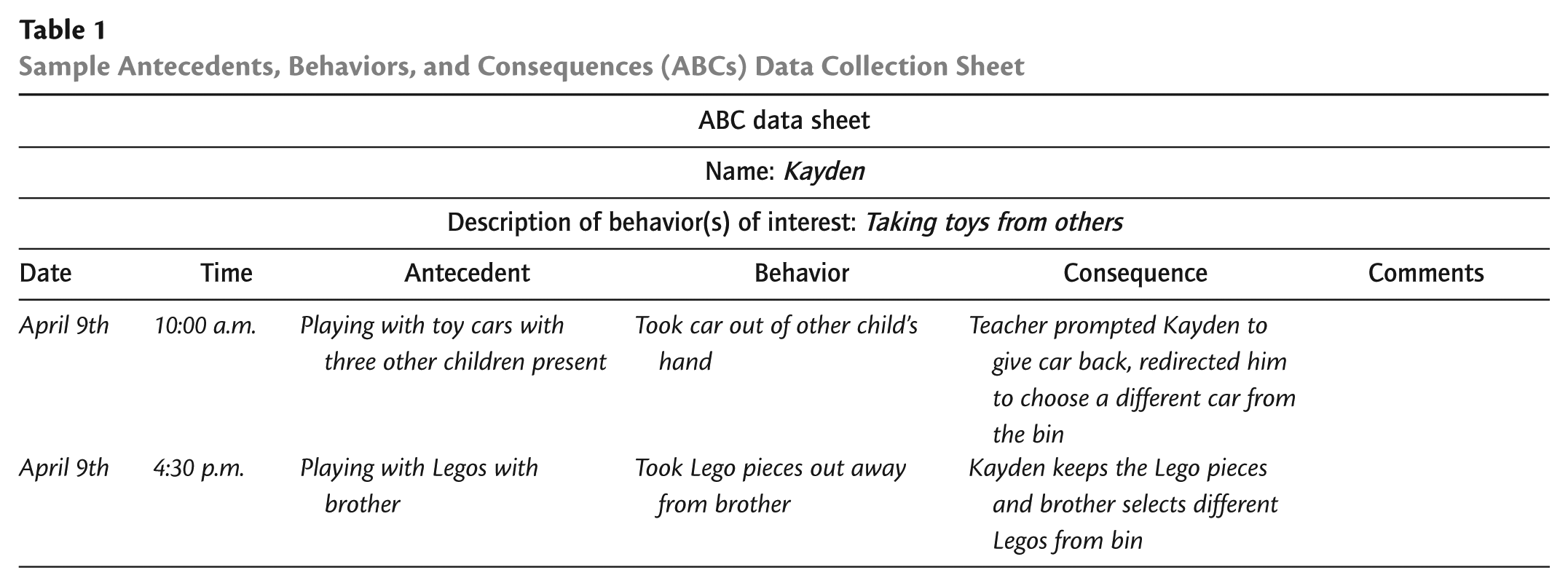
Designing function-based behavior intervention plans is based on an understanding of what predictably precedes and follows the target behavior. Identifying the predictable sequence of ABCs is the cornerstone of functional behavioral assessment (Gresham, Watson, & Skinner, 2001). An example of what an ABC chart may look like to help in determining the ABCs within any given context or routine is provided in Table 1. An essential feature when taking what is learned about the ABCs during assessment and translating that information to real world design of an intervention is that the ABCs should be applied one behavior at a time in one context at a time, rather than applied to a whole child across a whole set of routines. This idea was first presented by Sugai (2011) to remind practitioners and researchers that the context around any given behavior or skill changes from context to context or routine to routine. In other words, the antecedents that precede a challenging behavior and the consequences that reinforce it may be different in each routine. To illustrate this idea, shown in Figure 1, Kayden’s ECSE teacher mapped out her perception of the severity of Kayden’s behavior within the significant routines that comprise a typical day. As she mapped Kayden’s behavior, location of each behavior of interest within the tiers of the pyramid are suggestive of the intensity of supports and personalized attention that may be needed to support Kayden’s development. In addition, she connects the boxes on Figure 1, where she has listed Kayden’s behaviors, with a line to show the sequence of routines across the day. This process will help her to now consider why behaviors that appear similar, may occur in different amounts across different routines or why certain interventions may have no effect.
Sample Antecedents, Behaviors, and Consequences (ABCs) Data Collection Sheet
What to do
At this stage, actions of practitioners should focus on carefully considering the ABCs one behavior and one routine at a time to support decisions in the design and implementation of intervention plans that may need to be different across different routines. The fact that Kayden plays with other children at home might provide a false sense that he actually has good play skills, such as sharing and turn taking. On closer examination of her ABC data included as an example in Table 1, it was clear to the ECSE teacher, however, that though the routines seem comparable, the routine at home actually never creates a situation where Kayden needs to share or turn take. Kayden’s siblings have learned to quickly give up their toys and turns in activities to avoid Kayden’s screaming because when there is conflict with Kayden, they usually receive punishment from mom. At the childcare center, other children may not be so quick to give up a toy or their turn in an activity. In those routines at the center, Kayden’s taking of toys or screaming results in an adult joining in the play to offer teaching of turn taking or redirection to another toy. At first glance, these appear to be very appropriate attempts to teach Kayden new skills. However, given the persistence of the problem behavior, it is possible that the childcare providers are unwittingly doing the exact opposite of what they had intended. By responding to Kayden’s problem behavior with attention (by joining in play) and desired items (by redirecting to a new toy), it is possible that their actions are actually reinforcing the challenging behavior. As demonstrated here, completing an analysis of the ABCs within and across routines will prepare practitioners to select or adapt interventions so that each unique context is considered when designing intervention plans. To then build on what is understood about the ABCs, the next design feature focuses practitioners on deciding what they would like to see the child do instead of the challenging behavior within any given routine (Figure 2).

Alternative Skills to Be Acquired Versus to Be Used
What to think about
The Golden Rule when addressing challenging behavior is that, for every plan in place to reduce or eliminate a challenging behavior, there needs to be a plan for increasing an appropriate alternative behavior. Selection of an appropriate alternative behavior to replace challenging behavior has long been supported when interventions are designed based on a functional behavioral assessment (Petscher, Rey, & Bailey, 2009). The selection of the appropriate alternative behavior is only the first decision to support effective design. The data gathered to support effective design need to address the following: (a) Is this a skill that children do not have, in any form, in their repertoire, in which case the intervention plan needs to include teaching the skill, or (b) is this a skill that children do have in their repertoire but is not being used, in which case, the intervention plan needs to include how the environment will be arranged to reinforce use of the alternative skill as an actual replacement to the challenging behavior. Referring again to Figure 1 as a demonstration of these concepts, consider Kayden’s behavior of throwing toys during cleanup time just before the class goes to the gym.
Vignette: In reflecting on her diagram of Kayden’s behavior, the ECSE teacher has decided that, at the childcare center, addressing Kayden’s behavior during cleanup needs to be a top priority. Her observations of the ABCs for throwing toys during cleanup routines demonstrate that the antecedents to throwing toys are quite predictable. The adults in the center have a very consistent routine for cleanup that starts with giving a transition warning signal 1 minute before cleanup starts. After that minute, the lights are turned off and all adults start singing the cleanup song. To support children’s independence during cleanup, the activity centers are all clearly defined, there are bins and shelves with pictures indicating where to put certain items, and once children finish cleaning up their materials, each would then stand on a shape on the floor to line up to walk to the gym. The consequences for Kayden when he threw toys were also relatively predictable. An adult often provided a reprimand and then, given safety concerns and not wanting to further escalate his behavior, Kayden was usually redirected to go stand on a shape to line up. After observing this pattern occur several times, the ECSE teacher believes that Kayden’s throwing of toys is actually being reinforced. In other words, throwing toys is getting Kayden out of cleaning up and allowing him to more quickly line up before many of the other children.
What to do
At this stage, actions taken by practitioners should focus on determining whether or not children already know the appropriate alternative skills so that an intervention may be designed to either teach or just encourage use of the skill. If there is no evidence to suggest that children know the desired skill, then selecting an intervention to teach the skill is necessary. There are several evidence-based curricula that may be used depending on the skills to be taught. The Institute of Education Sciences What Works Clearinghouse (n.d.) offers information that may be helpful to selecting a packaged curriculum for skill development (http://ies.ed.gov/ncee/wwc/findwhatworks.aspx). In addition to packaged curricula, specific intervention strategies have been identified as having good evidence for effectively teaching skills. A review by Wong et al. (2013), though specific to children with Autism Spectrum Disorders, provides a helpful resource for understanding the evidence base if a practitioner is considering a specific intervention to teach a new skill. To the contrary, if there is evidence that children know the skill, then simple selection of a curriculum or intervention to teach it will not address the issue of why the skill is not being used in a specific context. Although a curriculum or specific intervention may still be helpful, the way in which the intervention is implemented becomes especially important. Careful examination of existing data will again allow practitioners to consider, in the context in which the behavior should be displayed, (a) whether or not the antecedents are arranged so that children know that a certain behavior should be used and (b) whether or not the consequences are arranged so that children are reinforced in a way that motivates future use of a certain behavior.
“If there is evidence that children know the skill, then simple selection of a curriculum or intervention to teach it will not address the issue of why the skill is not being used in a specific context.“
For Kayden, the ECSE teacher reviews her observation data and interview notes to decide whether or not Kayden ever cleans up toys. Table 2 provides an example of how the design of the intervention may be adapted based on whether the goal is to teach a skill or if the goal is to encourage use of a skill. Note that in both cases, the intervention starts the same and includes an intentional effort to rearrange what happens before the challenging behavior occurs. With either approach, the goal is to support the childcare providers to address Kayden’s throwing of toys by preventing it, rather than reacting to it.
Intervention Plans for Teaching or Encouraging Use of a Skill
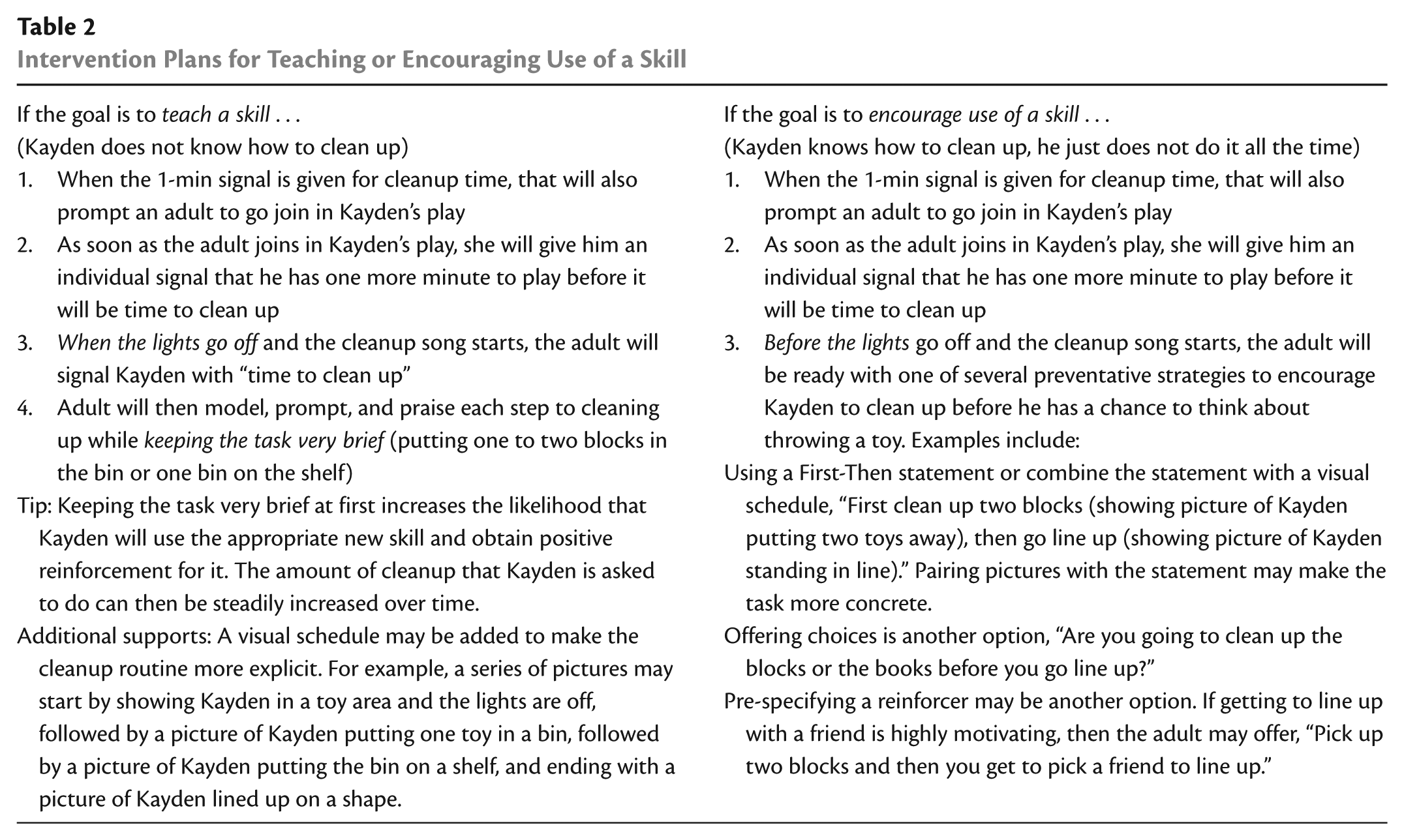
As demonstrated, understanding the ABC’s one routine at a time combined with identifying whether the goal is to teach new skills or encourage use of existing skills points to clear ways that practitioners may personalize intervention plans. So far, some assumptions about more complex behavioral principles have been made in the examples provided. Reinforcement and efficiency represent two of those more complex concepts from the field of applied behavior analysis that will be discussed as the next essential design feature (Figure 2). Although complex, each is important to now consider so that in designing an intervention plan, practitioners are able to plan for how to effectively compete with the reinforcement that has been delivered to challenging behavior.
Reinforcement and Efficiency
What to think about
Effectively replacing a challenging behavior with a socially appropriate alternative is further represented in the next design feature focusing on reinforcement and response efficiency. Envision a balance scale with challenging behavior on one side and the appropriate alternative on the other (Figure 3). Challenging behavior occurs and then persists when it is the most predictable and efficient path to the outcome that is reinforcing the behavior. There is no reason for the appropriate alternative behavior to be used when the scale is tipped in favor of the challenging behavior. In the previous example involving cleanup, there was no reason for Kayden to start to appropriately clean up toys when throwing the toys was less effortful and most efficient when getting to line up for gym was his goal. If practitioners implement an intervention in hopes that an alternative behavior will replace the challenging behavior, then the data collection system needs to help practitioners to address each of the following in their decision making: (a) how often does challenging behavior result in a reinforcing outcome relative to the alternative behavior, (b) what makes the challenging behavior more efficient than the alternative, and (c) what can be done to change the reinforcement and efficiency associated with the challenging behavior to tip the scale to use of the appropriate alternative? Referring again to Kayden’s behavior to illustrate these concepts (Figure 1), now consider Kayden’s screaming and crying while running errands with his mom on the way home from the childcare center.

Balance scale demonstrating how reinforcement and efficiency influences behavior

Vignette: Given the work schedules for Kayden’s parents, the best opportunity that his mother has for running errands, such as grocery shopping, is on her way home after picking up Kayden. Unfortunately, this is consistently a challenging time and Kayden spends much of the time screaming and crying. We know from understanding the ABCs for this behavior in this routine that sometimes there are no errands to run and they go directly home for a snack and play, sometimes there are one or two very quick errands, and sometimes there are errands that take several stops and longer amounts of time. We also know that once screaming and crying start, sometimes mom will give Kayden a snack to help him to get through their last errand or two and sometimes, mom will decide to stop running errands and just go home.
“This idea also highlights that in some situations, to effectively tip the scale in favor of the appropriate behaviors, the effectiveness of an intervention is not always about what you do, it is when you do it.”
What to do
At this stage, actions taken by practitioners should focus first on considering if there are things about the routine in general that may be increasing the likelihood of children engaging in challenging behavior. Then practitioners should consider how the routine may be adjusted to specifically address reinforcement of the desired behaviors. As Kayden’s ECSE teacher reflects on the routine in general, keeping in mind what she understands about universal supports within a multi-tiered system of support, she believes that there are actually some things to consider addressing with his mother to enhance the predictability of this routine as well as her readiness to be responsive to her child’s developmental needs. To enhance predictability, the ECSE teacher has a discussion with Kayden’s mom about whether or not she is able to establish a more predictable pattern for running errands, such as only on Mondays and Wednesdays, so that from Kayden’s perspective, the overall routine becomes more consistent. If that does not seem appropriate or manageable to maintain over time, then it may be helpful to build in visual supports to help make the routine more predictable. Using one picture on Kayden’s backpack each day may help him know when they will and will not be running errands on the way home. Or, when it is already understood that they will be running errands on the way home, using a series of pictures of different stores may help Kayden to know how many stops will be made before going home. The effectiveness of this approach also relies on supporting Kayden’s mom to understand her child’s developmental needs. As a 3 year old, hunger, tiredness, and duration of time in any activity will have an impact on behavior. Coaching Kayden’s mom to consider keeping a small bag in the car with certain items may help the routine become better structured to be responsive to Kayden’s developmental needs. Items might include snacks, toys, or books that may be given to Kayden at the same time as he is told they will be running errands. This approach provides entertainment and distractions that help create a developmentally appropriate foundation on which to then add on additional interventions if needed.
It is very possible that challenging behavior may persist despite these adjustments to the routine. The reasons challenging behavior may persist highlight the importance of now understanding reinforcement and response efficiency when trying to encourage use of desired skills. Reinforcement within intervention delivery may be understood through quality, quantity, frequency, and magnitude. Figure 4 extends our example with Kayden’s screaming and crying while running errands to demonstrate the important features of each dimension of reinforcement when designing an intervention. With each dimension of reinforcement listed on Figure 4 (quality, quantity, frequency, and magnitude), you will note how each is represented by subtle differences in how Kayden’s mother might respond to Kayden’s crying. Each different reaction from Kayden’s mother may have a different effect on how easy or difficult it will be change Kayden’s behavior in this routine. This awareness of the naturally occurring patterns gives practitioners a lot of information to use when trying to arrange an intervention that will encourage Kayden’s use of other, more appropriate skills. In other words, these dimensions of reinforcement may be used to tip the scale toward use of the appropriate behaviors. Tipping the scale is difficult if challenging behavior continues to be more efficient. For example, despite trying to change the dimensions of reinforcement for Kayden so that riding calmly in the car for errands produces high-quality reinforcement, riding calmly for too long may require a lot of effort for a long time before Kayden actually gets reinforced for that behavior (by getting home and obtaining a snack, obtaining toys/fun activities, and/or escaping the car and errand running). Riding quietly in the car is not nearly as efficient as the challenging behavior at producing a snack or putting an end to running errands. This idea also highlights that in some situations, to effectively tip the scale in favor of the appropriate behaviors, the effectiveness of an intervention is not always about what you do, it is when you do it. With that in mind, the final design feature (Figure 2) becomes essential for adopting a preventative approach that combines a plan for how to intervene with when to intervene.

Dimensions of reinforcement with examples relevant to intervention design and implementation
Critical Time/Event/Activity
What to think about
The final design element for effective implementation is what creates an opportunity for practitioners to tip the scale toward enhancing socially appropriate behavior by truly adopting a more preventative approach. Being able to become proactive and preventative is based on the idea that the challenging behavior is understood well enough that practitioners are able to predict when it is most likely to occur and act just before or in conjunction with the circumstances associated with challenging behavior. In examining the circumstances associated with challenging behavior, it is helpful to think in terms of time, events, and activities. When thinking in terms of time, practitioners should gather data that help them identify the smallest and most predictable length of time that will pass before challenging behavior becomes likely, such as when waiting for something or having persisted in something but now being ready to be done. In other cases, practitioners should gather data that help them to identify if challenging behavior occurs in relation to a specific event, such as another child taking a toy or an adult setting a limit for a child’s behavior. In yet other cases, practitioners may find need to gather data that helps them to identify if challenging behavior occurs in relation to an activity, such as cleanup time or getting ready for bed. To show how an understanding of critical time/event/activity may be used to again personalize an intervention plan, consider the example from Figure 1 in which getting ready for bed is a routine for Kayden that is typically associated with screaming and hitting.
“If nothing changes about the routine before the critical time/event/activity is reached, there is a good likelihood of being caught in the same cycle that has been reinforcing challenging behavior.”
Vignette: The functional assessment interview that Kayden’s ECSE teacher conducted with his mom helped identify a predictable pattern in which screaming and hitting usually result in more attention from mom during the bedtime routine. Attention takes the form of repeated prompts from mom, then reprimands, then finally mom lying down in bed with Kayden to ensure that he eventually falls asleep at a reasonable time. Kayden’s mother is trying to be attentive to his developmental needs by getting him to sleep at a reasonable time. Being tired from a busy day, she finds it easiest to just crawl into bed with him. The information from the interview also helped identify that the critical event is the prompt from mom for Kayden to start to get ready for bed. Prior to that prompt, screaming and crying never occur. After the prompt to get ready for bed, at some point between delivery of the prompt and Kayden actually falling asleep, some amount of screaming, crying, and/or hitting will likely occur.
What to do
At this final stage of personalizing an intervention plan, actions taken by practitioners should focus on modifying what happens before the critical time/event/activity is reached. If nothing changes about the routine before the critical time/event/activity is reached, there is a good likelihood of being caught in the same cycle that has been reinforcing challenging behavior. For Kayden, this would include working with Kayden’s mom to reflect on everything that takes place before she delivers a prompt for Kayden to get ready for bed. If nothing changes before she delivers that prompt for bed, she will likely be stuck in the pattern of reacting to challenging behavior instead of having an opportunity to reinforce appropriate alternative behaviors. If there is a shared belief, based on the ABCs, that attention from Kayden’s mom is an important reinforcer in this routine, then the ECSE teacher should discuss ideas with Kayden’s mom for how she may start to incorporate opportunities to give attention to Kayden during appropriate activities that occur just before bedtime. This time should focus on positive interactions with Kayden in mutually enjoyable activities such as playing low-energy games, working on a puzzle, singing a silly song while doing dishes, and so on. This approach may be helpful in decreasing how motivated Kayden may be to engage in challenging behavior to obtain his mother’s attention. Then, just before Kayden’s mom decides that it is time to prompt him to get ready for bed, to now use her attention as a reinforcer for appropriate behavior, she could offer to read a favorite book or sing a favorite song in bed after Kayden puts on his pajamas. Having now specified for Kayden that her attention will continue after he starts to appropriately get ready for bed, she may deliver the prompt for him to actually start to get ready for bed. By attending to Kayden’s need for attention prior to bedtime and being explicit about how her attention will continue once he is ready for bed, the motivation for engaging in challenging behavior within this routine should be reduced.
As demonstrated in this example, the “how to” of an intervention plan that reflects an understanding of the ABCs for specific skills being encouraged through changing the dimensions of reinforcement is now combined with “when to” in timing implementation so a proactive and preventative approach may be adopted. More specifically, beyond just identifying routines and contexts as the “when” for implementation, a more careful consideration of actual time, specific events, or series of activities that directly precede challenging behavior may offer a more precise way for practitioners to consider personalizing implementation of a child-focused intervention plan. In combination, attention to all of these design features provides practitioners with a foundational knowledge of behavior analytic principles that may be used to create more opportunities to teach new skills and encourage use of existing skills, all within the absence of challenging behavior.
Summary
The adoption of multi-tiered systems of support to frame decisions about intervention design and implementation has brought new approaches to serving children with challenging behavior in home, community, and school settings. As researchers continue to develop, evaluate, and refine the application of tiered frameworks to natural settings, there is a need to give careful attention to how decisions are made when addressing severe and persistent challenging behavior. Personalized interventions are necessary to address challenging behaviors that persist despite implementation of high-quality universal supports. Research indicates that the best way to begin the process of personalizing and tailoring interventions is through a functional understanding of the behavior (Dunlap & Fox, 2011; Wood, Ferro, Umbreit, & Liaupsin, 2011).
As research continues to support the necessity of understanding function, it becomes important to bridge the gap between research and implementation by exploring additional aspects of intervention design so that we maximize the likelihood of having the desired impact. Bridging the gap between research and effective implementation requires researchers and practitioners to consider if alternative skills need to be learned or just increased, determine how to tip the scales based on understanding reinforcement and efficiency, as well as plan for when it is critical to intervene before the opportunity to be proactive is lost. In combination, understanding these essential design elements will help practitioners create the most effective function-based interventions for children in their everyday routines in their natural environments.
Footnotes
Authors’ Note
You may reach LeAnne D. Johnson by e-mail at