



Abstract

As a now married, then partnered, lesbian who is the birth parent of a wonderful son, Todd, I was extremely concerned that my child might be harmed because my sexual orientation is different than that which is perceived as “normal.” When Todd was about 3-months old, we enrolled him in a child care center. Prior to his birth, my partner and I interviewed the director of the center and made it very clear that we would both be parents to Todd. We then gauged the reaction of the director and assumed that her leadership and progressive attitude would help set the tone for her teachers. We also made sure that we both interacted with various teachers during drop-off and pick-up times . . . We were pleasantly surprised to experience teachers and a center director who had our child and his well-being as their primary focus and we never felt a need to find a different setting for him because of homophobia.
“Schools and teachers must find ways to build trusting and respectful relationships with both the children and same-sex parents to create a positive classroom atmosphere.”
The early childhood special education (ECSE) field requires professionals to respect the diversity of all families, including the growing number of families in which both parents are gay and/or lesbian. 1 The Division for Early Childhood (2009) of the Council for Exceptional Children Code of Ethics (2009) stated, “We shall provide services and supports to children and families in a fair and equitable manner while respecting families’ culture, race, language, socioeconomic status, marital status, and sexual orientation” (para. 7). The importance of valuing the diversity of families has been recognized in ECSE for decades. However, the diversity of family structures in the United States has changed over the past few decades. One change comes from the growing number of same-sex couple households. According to statistics provided by the U.S. Census Bureau’s (2013) American Community Survey, an estimated 726,600 same-sex couple households existed in the United States in 2013, with an estimated 252,000 of those households composed of same-sex spouses. This is an increase from the estimated 594,000 same-sex couple households in 2010. These data are a rough estimate, as the number of same-sex households can be particularly difficult to identify for a number of reasons. First, data may be affected by the U.S. Census Bureau measurement strategy not accurately capturing various forms of relationships (Lewis, Bates, & Streeter, 2015). While gays and lesbians are increasingly accepted in the United States, many are still reluctant to be open about their sexual orientation due to fears of hostility, discrimination, and marginalization (Becker & Todd, 2013; Brunner, 2013).
Nevertheless, with the recent U.S. Supreme Court decision (Obergefell et al. v. Hodges, Director, Ohio Department of Health et al., 2015) making same-sex marriage a right nationwide, it is likely that the number of same-sex couple parented households will increase. This change requires professionals to be aware of and responsive to the unique needs of these families. In this way, the experiences of young children with same-sex parents and their families will be as positive as the experience of the mother quoted above.
Same-Sex Parented Families
Approximately 33% of female same-sex couple households and 22% of male same-sex couple households reported at least one child under the age of 18 living in the home (U.S. Census Bureau, 2014). These same-sex parented families are diverse in multiple ways including age of parents, race, educational attainment, and income (U.S. Census Bureau, 2013). Same-sex parented families also are diverse in how the families are formed. Most families with same-sex parents are formed when gay and lesbian couples unite, bringing their child(ren) from previous heterosexual relationships and marriages into these unions. These families make up the majority of same-sex parented family types and include biological, step, and adopted children. Another type of same-sex parented family is formed through the planning of children through artificial insemination, surrogacy, or adoption (Wells, 2011). These family structures are less prevalent because of the high costs associated with artificial insemination and surrogacy, and because laws often hinder the formation of legal families for same-sex couples through adoption (Gates, Badgett, Macomber, & Chambers, 2007).

Children of Same-Sex Parents
Although research suggests that lesbian mothers and gay fathers provide healthy and supportive environments for the children they are raising (Armesto, 2002; Patterson, 2000), there has been debate over the development of children living with same-sex parents. Concerns center around gender identity development, sexual orientation, and the social-emotional development of children raised by same-sex parents. Table 1 contains the identification and description of web-based resources about research on the effects of same-sex parenting on children’s development.
Web-Based Resources: Research on Outcomes of Same-Sex Parenting

Gender Identity Development
Multiple studies have provided conclusive evidence that children raised by gay and lesbian parents are not any more likely to develop confusion in their gender identity than children from traditionally heterosexual families. In the 1970s and 1980s, studies were conducted to help determine custody issues of a growing number of children whose gay or lesbian parents were divorcing out of heterosexual marriages. Results of these studies showed no differences in either gender role identity or in identity confusion between children being raised by lesbian mothers and those being raised by single heterosexual mothers (Fitzgerald, 1999; Gottman, 1989; Patterson, 2006). Similar findings for gay fathers were reported in published reviews of the literature (Tasker, 2010; Tasker & Patterson, 2007). In sum, the chances that gay and lesbian parents will raise children who will be confused in their gender identity have not been proven (Gottman, 1989; Patterson, 2006; Tasker & Patterson, 2007).
Sexual Orientation
Studies have shown that the likelihood of children being raised by same-sex parents being gay or lesbian is the same as those being raised in heterosexual households (Golombok & Tasker, 1996). Wainright, Russell, and Patterson (2004) also concluded that the sexual behaviors and romantic relationships of adolescents with same-sex parents is not different than those of adolescents being raised by heterosexual parents.
Social-Emotional Development
Studies have shown no differences in a child’s emotional development, self-concept, or behavioral adjustment as the result of living in a same-sex parented household compared with children raised in heterosexual households (Golombok, Spencer, & Rutter, 1983; Gottman, 1989; Green, Mandel, Hotvedt, Gray, & Smith, 1986; Patterson, 2006; Rimalower & Caty, 2009). These studies showed positive social development in children being raised in households where the parents are gay and lesbian. The peer relationships and social development of these children in their schools and communities are typically positive, with the rate of teasing and bullying experienced being comparable with that of children being raised in heterosexual homes. Although a substantial number of children raised by lesbian mothers have reported regularly hearing anti-gay sentiments from their peers and have acknowledged the awareness of prejudices against their parents based on sexual orientation, there is no evidence that these negative experiences affect a child’s overall adjustment (Gartrell, Deck, Rodas, Peyser, & Banks, 2005). Furthermore, in a review of studies dating back to the mid-1990s, Patterson (2006) concluded that a child’s self-concept is not affected based on the sexual orientation of the parents, nor are their preferences for gender-specific playmates and activities.
The main factor in a child’s positive general development is not in the sexual orientation of the parents, but in the quality of the relationship between the parent(s) and their child(ren) (Patterson, 2006). The findings of these studies are echoed in the words of the American Psychological Association when it states in its resolution on Sexual Orientation, Parents, & Children, “Overall, results of research suggest that the development, adjustment, and well-being of children with lesbian and gay parents do not differ markedly from that of children with heterosexual parents” (Paige, 2005, para. 3).
Creating a Welcoming Classroom Environment
Although homosexuality is becoming more accepted in areas throughout our country (Becker & Todd, 2013), studies have shown that families headed by same-sex parents may face discrimination and harassment at school because of the sexual orientation of the parents. Sexually biased language is the most prominent type of discrimination and harassment in schools (Clarke, Kitzinger, & Potter, 2004; Ryan & Martin, 2000), indicating that not all schools are safe and welcoming places for family members of same-sex parented households. In the remainder of this article, we provide suggestions for how early childhood (EC) special educators can create environments free of harassment and discrimination that are welcoming to all children and families with a focus on families of same-sex parents. Table 2 provides a list and description of resources that will help teachers develop EC settings that welcome children and parents from same-sex parented families.
Web-Based Resources to Create a Welcoming Environment

Note. APA = American Psychological Association; NAEYC = National Association for the Education of Young Children.

Examining Personal Attitudes
ECSE educators who wish to create a classroom climate without prejudice and discrimination must first be aware of their own attitudes toward gay and lesbian parenting. Derman-Sparks and Edwards (2010) described understanding personal attitudes as a “developmental journey” during which time teachers learn to create a “world of justice and peace for all children” (p. 20). They suggest the journey involves understanding personal stereotypes, discomforts, and biases, as well as those expressed by educational institutions as reflected in the policies and practices of those institutions. ECSE teachers may wish to complete a questionnaire to help provide a framework for examining personal attitudes. Two online surveys that might be helpful are (a) Attitudes Toward Differences Survey: The Riddle Scale (https://www.mnsu.edu/lgbtc/handouts/the-riddle-scale.doc; Frías-Navarro, 2009; Riddle, 1994) and (b) The Scale of Beliefs About Children’s Adjustment in Same-Sex Families (http://www.mauracullen.com/wp-content/uploads/2010/11/Attitudes-Toward-Difference-Survey.pdf) (Frias-Navarro, 2009). Talking with a mentor teacher or other trusted colleague about attitudes that emerged from completion of the survey(s) might help ECSE teachers understand and respond in professionally ethical ways to their individual biases and attitudes.
If an ECSE teacher realizes that he or she is less than accepting of same-sex parented families, the contact hypothesis (Allport, 1954) may provide some guidance. This hypothesis states that prejudice can be reduced by interactions between different groups, allowing individuals to confront beliefs held about the group for whom negative attitudes are held. It might, therefore, be helpful for the ECSE teacher to increase professional contact with gay and lesbian headed families. This can be done by, for example, being available to speak with the parents during drop-off or pick-up of the child, increasing telephone contact with the parent to discuss their child’s progress, inviting the parents to volunteer in the classroom, and making efforts to interact with the parents during open house and other program activities.
Other methods shown to be effective in fostering positive attitudes are exposure to visual media that portrays gay and lesbian individuals (Levina, Waldo, & Fitzgerald, 2000) and training focused on awareness (as discussed below; Roberson, Kulik, & Pepper, 2001). The Advocate: Gay News, LGBT Rights, Politics, and Entertainment (an online news and entertainment magazine) identified the 10 best lesbian, gay, bisexual, and transgender (LGBT) films of 2015 (http://www.advocate.com/film/2015/12/22/10-best-lgbt-films-2015) and the LGBT Sundance films of 2016 (http://www.advocate.com/arts-entertainment/2016/1/21/lgbt-films-sundance-2016) in recent editions of the magazine. The ECSE teacher might wish to invite his or her mentor or other trusted colleague to view movies together to help facilitate a discussion of beliefs and attitudes toward same-sex parented families. Keeping a reflective journal about interactions with gay and lesbian parents and thoughts about movies viewed can help clarify thoughts about attitudes.
Recognizing personal bias is the first step to engaging in behaviors that meet the obligation of ECSE educators to adhere to ethical standards requiring services be provided to all children and families in a fair and ethical manner. The individual beliefs of teachers should not affect the safety, security, or development of any individual child (Burt, Gelnaw, & Lesser, 2010).
Designing the Physical Environment
An EC classroom should be intentionally designed to be inclusive of all children and families, taking in consideration the variety in ability, race, ethnicity, social class, and family constellations including families with same-sex parents. The lack of classroom materials that represent same-sex parent families gives children the “feeling or belief that people who are non-heterosexual are (or should be) invisible and unimportant” (Hermann-Wilmarth, 2007, p. 349).
Classroom decorations, posters, and pictures should depict a wide variety of family configurations, including gay and lesbian couples. Posters of men and women assuming community roles and posters of men and women engaging in domestic tasks in nongender-stereotypic ways also promotes acceptance. As pre-made posters and pictures that represent diverse family structures can be difficult to find, teachers should not overlook the option of making their own classroom decorations to represent children from varying family constellations. The posters and pictures can be hung not only in the classroom but also in the office, meeting rooms, and hallways. Using real family pictures of children and their families is a positive, welcoming, and inclusive way to decorate an EC classroom.
Picture and story books that portray same-sex families are an important part of an EC environment, as young children in EC classroom settings that provide picture and story books portraying same-sex parented families are able to understand families from multiple and diverse perspectives (Burt et al., 2010; Kelly, 2012). Books of this nature also help others gain a broader understanding of family diversity (Souto-Manning & Hermann-Wilmarth, 2008). All children deserve to have books that are reflective of their culture and family. These books are self-affirming for children who are members of minority family configurations such as those with same-sex parents (Smolkin & Young, 2011). In addition to books that are available from a number of publishers (see Table 2), another way to include books that depict a variety of family configurations is to allow children to make their own “family books” that are read and displayed in the classroom library.
Toys are another physical aspect of the EC classroom that should be examined when designing a classroom setting inclusive of same-sex parented families. Adequate numbers and variety of dolls of both genders should be available for macro-dramatic play. For example, there should be enough male dolls available for children to have several families of two male parents. In addition, dress-up clothes traditionally thought of as gender-specific (e.g., pink ballerina dresses, Superman capes) and gender-neutral (e.g., baseball caps, T-shirts) should be available. Materials for micro-dramatic play similarly should include adequate numbers of small figures of people of different genders, as well as materials for play in a variety of settings that tend to be gender neutral (i.e., houses, farms, and airplanes).


Making All Children Feel Welcome
ECSE educators have the responsibility to assure that all children feel welcome in their programs. For young children with same-sex parents, teachers should refer to the child’s parents using the same words the children use. Most children will be happy to share the names of everyone in their families, but if children are unwilling or unable to do this, ECSE teachers may wish to ask the parents how to refer to family members. Then, teachers should be sure to use these terms when interacting with parents and/or talking with children about their family members.
To help all children of same-sex parents feel welcome, children should not be directed into gender stereotypical play behaviors but, rather, encouraged to engage in appropriate play of their choice. Goldberg, Kashy, and Smith (2012) found that “girls and boys in same-gender parent families in the U.S. were significantly less differentiated (stereotyped) in their play behavior than girls and boys in heterosexual-parent families,” and that children “engaging in less gender-typed play behavior may be associated with positive outcomes in children” (para. 45). These findings suggest that teachers of young children should support and encourage young children when they engage in and display non-stereotypical gender play behaviors and language. That is, children who wish in their sociodramatic play to assign family membership to two mothers, one boy, and one dog should be allowed to do so without correction from teachers or peers.
ECSE teachers may wish to carefully evaluate classroom language and activities to be sure they reflect an inclusive attitude toward same-sex parents. When making holiday gifts or cards, are they made for “parents” or for “mother and father?” Are children asked to have their “mother” bring in cookies for a party? Are “mother’s day” and “father’s day” celebrated or is “family day” celebrated? When the term family is discussed, is it defined not as a mother and a father and brothers and sisters, but rather from a broader perspective as a constellations of people who care about each other?
If peers respond to other children in a prejudicial way in relation to same-sex parented families, teachers should not ignore such behavior, but, rather, respond calmly and clearly in a manner similar to that when responding to racism, sexism, or discrimination against children with disabilities. An appropriate teacher response is to (a) state what was observed, (b) set limits that it is not acceptable to make fun of or exclude others because of who they are, and (c) provide needed emotional support to all children involved. Then, it is important to step back and try to understand the motivation behind the child’s discriminatory behavior and help the child understand and change their behavior to be more welcoming of all peers (Derman-Sparks & Edwards, 2010).
Interacting and Communicating With Parents
Young children with and without disabilities benefit from family involvement in their education. Family involvement is recognized as a component of high-quality early education, as well as the foundation for providing services for young children with disabilities. Young children who have parents actively involved in their education demonstrate greater readiness for school, as well as more positive interactions with peers and adults. Furthermore, such participation is associated with child language, self-help, social, motor, and adaptive skills. In addition, more engaged parents tend to be more satisfied with their child’s early education. These benefits tend to persist over time (e.g., Mantizicopoulos, 2003; McWayne, Hampton, Fantuzzo, Cohen, & Sekino, 2004).
Supporting gay and lesbian parents
Parents are more likely to become involved when there is an environment created that makes them feel comfortable and welcome, and when their involvement in their child’s education is expected. However, families headed by gay and lesbian parents reported in a recent national study (Kosciw & Diaz, 2008; Larrabee & Kim, 2010) that they felt unwelcome in their child’s school and that their family configuration was not recognized and acknowledged. They also expressed that they did not feel able to fully participate in their child’s education because of their sexual orientation. If the same-sex parents have a child with a disability in an inclusive setting, they may feel even more marginalized from other families. However, parent and family involvement is a critical component of a successful inclusive EC program (Xu & Filler, 2008). In addition, because the prevalence of disability is greater in gays and lesbians than in heterosexuals (Fredriksen-Goldsen, Hyun-Jun, & Barkan, 2012), it is possible that a same-sex parent may themselves be disabled, resulting in further isolation (Harley, Nowak, Gassaway, & Savage, 2002; Thompson, Bryson, & de Castell, 2001). The climate of the school, including formal and informal policies, is an important influence on parental participation in inclusive settings. ECSE teachers can encourage participation by forming parent–professional partnerships based on open communication, trust, and shared philosophies about children and schooling (Soodak & Erwin, 2000).
ECSE teachers may wish to have an honest and open conversation with same-sex parents to find out how the family wishes to be spoken about, how family members should be identified, and how to respond if a child asks why their classmate has two fathers/two mothers. Teachers may also want to ask parents the terms their child uses in talking about their family. And, of critical importance, teachers should find out if the family wishes to be open about their family constellation. Parents may also be able to suggest resources that would be helpful for the teacher. In addition, ECSE teachers may want to make an effort to individually and directly invite same-sex parents to participate in program activities along with other parents. The personal invitation may help gay and lesbian parents feel more welcome to become a part of the program community.
Confronting bias
Research has shown that teachers often feel discomfort toward families with gay and lesbian parents. This feeling of discomfort may keep teachers and staff from intervening with and addressing instances of sexually biased language and homophobic bullying because of either their own personal biases or their anxiety and discomfort in addressing a socially sensitive topic (Maney & Cain, 1997; Ryan & Martin, 2000; Wolfe, 2006). However, adhering to DEC Code of Ethics requires teachers to support the inclusion of all children and families. If a parent makes a derogatory statement about the inclusion of gay and lesbian families, the ECSE teacher should confront the bias and talk privately with the parent who made the statement. Conceptualizing the conversation as a “slippery egg” conversation might help (Child Care Resources, n.d.; National Association for the Education of Young Children, 1998). Slippery egg conversations are conversations that make teachers nervous and family members upset. Suggestions for how to effectively have these difficult conversations with families include (a) making your statement gently, being clear and concise; (b) listening carefully to the parent and reflecting on what you hear; and (c) searching out common ground. It is also important to plan for such discussions by having information available. For example, information from the resources provided in Tables 1 and 2 might be summarized into a pamphlet to help reassure parents that their child’s development will not be impacted and that program quality will not be compromised. Having a copy of the program philosophy and polices that support the inclusion of same-sex parented families into the program should also be available for discussion. While the ECSE teacher may not change the opinions of any parent, it is important to communicate clearly that all children and families are welcome in the program.
Program Policies and Procedures
EC program policies and procedures need to address the issue of same-sex parented families in a way that is welcoming to all types of family configurations (Ryan & Martin, 2000). The value of actively including all families and children should be clearly stated in any written policies and procedures distributed to families and staff. Using gender-neutral language in speech, on school forms, in school newsletters, on school websites, and in school letters will help same-sex parents and families feel more welcomed and comfortable in the programs (Burt et al., 2010). Enrollment and other forms should replace the words “mother” and “father,” with “parents” or “family members” (Fox, 2007). Letters home should, by ECSE teachers, be addressed in the same fashion. School administrators, teachers, and staff must make a concerted effort to include all family structures in conversations related to families.
Schools may choose to address issues of same-sex parented families through anti-bias training for all school personnel along with “the writing, dissemination, and discussion of administrative policy on issues of gender, sexual orientation, and diverse family constellations” (Ryan & Martin, 2000, p. 212). Table 3 contains a description of online resources for providing effective professional development to develop schools that are welcoming to same-sex parenting families. This professional development and open discussion among faculty and staff may contribute greatly to creating EC programs that are inclusive of all families.
Web-Based Resources: Providing Professional Development
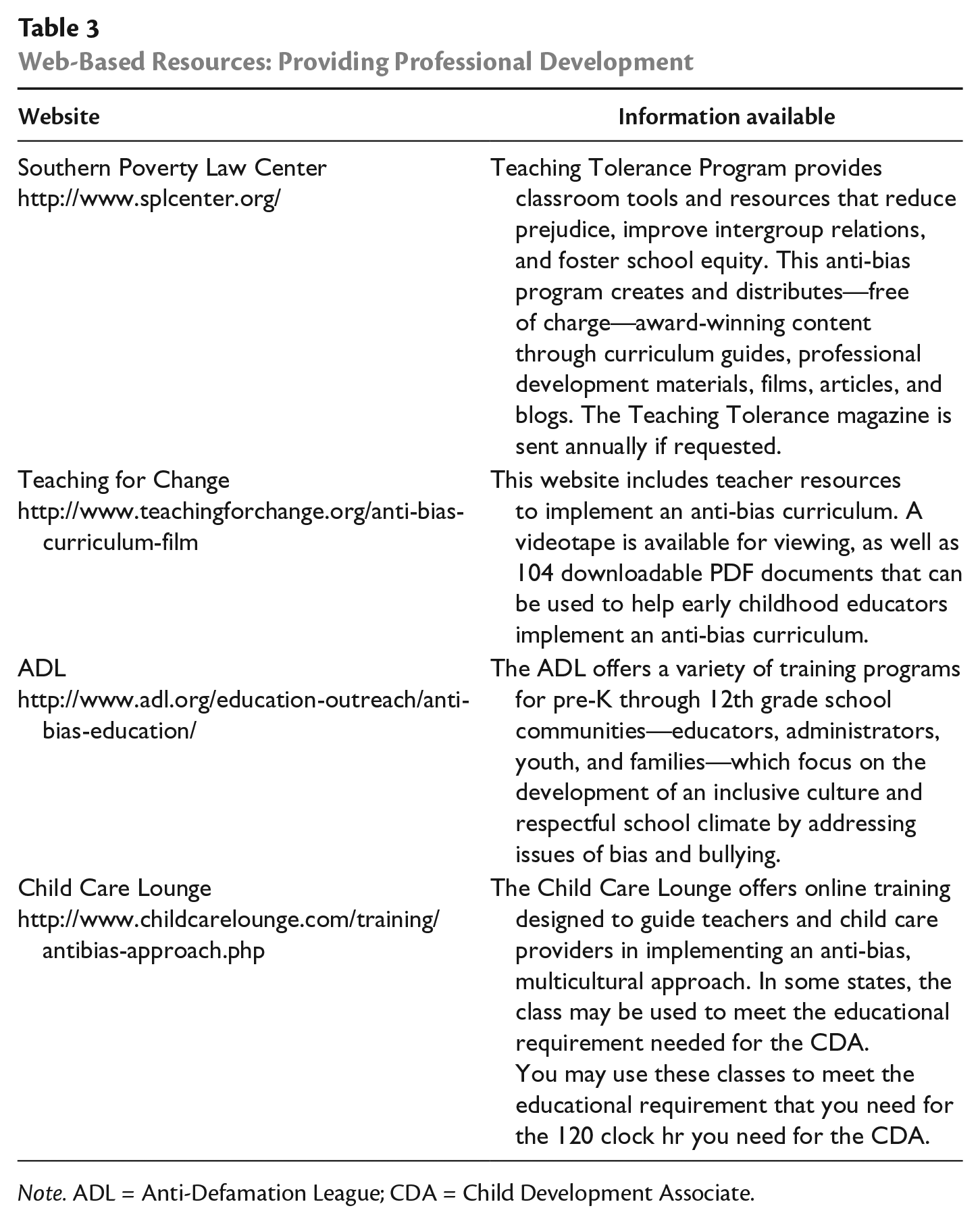
Note. ADL = Anti-Defamation League; CDA = Child Development Associate.
Conclusion
As more children of families with same-sex parents enter EC programs, to be consistent with the mandates of professional ethics, schools and teachers must find ways to build trusting and respectful relationships with both the children and same-sex parents to create a positive classroom atmosphere where children can develop and thrive and parents can feel comfortable participating in their child’s education. Teachers, administrators, and parents must all be willing to examine and reflect upon their own attitudes and beliefs and openly communicate their concerns and needs in a respectful manner to create welcoming EC environments for all children and families.
Footnotes
Authors’ Note
You may reach Jackie M. Davis, MSEd, by e-mail at