



Abstract

Connor and Sam are classmates attending an inclusive preschool in their local community. Both Connor and Sam have a diagnosis of autism, which has affected the ways they participate during play opportunities in their classroom. When other children approach him during play, Connor typically ignores their attempts or moves away to prevent them from taking his toys. Connor’s favorite television show is Sesame Street and his play often involves lining up Sesame Street toys. Although Connor has some basic communication skills, during play he tends to use delayed echolalia revolving around dialogue from Sesame Street. Sam often wanders around the room by himself during free play or relies on a single play scheme in which he and the other children pretend to be in a restaurant. Although Sam’s communication is more developed than Connor’s, he always takes on the role of waiter and has a hard time developing play for other characters. Sam and Connor’s teachers recognize that both boys may need support in their pretend play and are wondering what strategies they can use to help them.
Decades of research have illustrated the linguistic, social, and cognitive growth that occurs in the context of play (e.g., Baron-Cohen, 1987; Lifter, Foster-Sanda, Arzamarski, Briesch, & McClure, 2011; Lillard et al., 2013; Ungerer & Sigman, 1984). Through play, children experiment with and expand language such that both language and play become more complex over time. A 2-year old playing with his baby doll might say, “baby eat” while feeding the doll, whereas a 4-year old engaged in a similar activity might say, “Now baby, it is time to eat your peas.” Indeed, as children get older and play becomes more complex, language provides an avenue for acting out roles within a play scheme (Freeman Davidson, 2006). A child playing veterinarian might say, “Poor puppy, you are going to need a shot” and use this language to define her or his role, whereas a firefighter might say, “I’ll save you!” By using language in this way, children explore verbally what they know about their surroundings and practice and refine language skills.
Play also provides opportunities to practice and gain important social skills. During play with peers, children learn to establish shared knowledge to act out jointly controlled play scripts. This process provides opportunities for taking others’ perspectives and modifying one’s point of view based on others’ experiences (Nelson & Seidman, 1984). Children also learn how to join a peer group, enter an ongoing play activity, manage disagreements, and support one another during social conflicts (Ladd, 2005). As play progresses, these skills become more complex and refined to accommodate ever-evolving age-appropriate social demands.
“One strategy for supporting the play of children with autism is peer-mediated interventions in which play is facilitated by typically developing peers instead of adults.”
Play also lends itself to the development of important cognitive skills such as the ability to understand and extract meaning from the environment and develop abstract and symbolic thought (Lillard et al., 2013). Specifically, play initially serves as an avenue for exploration of objects. As children interact with objects in their environment, understanding of the objects’ properties and uses increases. Once a child understands how an object works, they can then begin to experiment and explore different uses such that creativity and flexibility in play responses emerge (Bruner, 1973).
“…research has demonstrated that peers are more effective than adults at supporting social and play behaviors in children with autism.”
Many of the skills learned and practiced through play are those with which children with a diagnosis of autism need additional support. Indeed, difficulties with language, social skills, and even an understanding of the appropriate uses of toys and objects are defining characteristics of children with autism (American Psychiatric Association, 2013; Jarrold, 2003). Furthermore, research has demonstrated that children with autism often have delays and differences in their play such that pretend play is either entirely absent, or delayed and lacking in complexity and variation (Stanley & Konstantareas, 2007). Thus, children with autism not only experience delays in crucial developmental skills, but also miss opportunities to learn and practice these skills in the context of play. As such, cognitive and behavioral delays of children in this population may become confounded by difficulties with play.
One strategy for supporting the play of children with autism is peer-mediated interventions in which play is facilitated by typically developing peers instead of adults (Wolfberg, 2009). Indeed, research has demonstrated that peers are more effective than adults at supporting social and play behaviors in children with autism (Lord & Hopkins, 1986). When comparing a teacher-directed play condition, a no teacher play condition, and a condition with teacher guidance, Shores, Hester, and Strain (1976) found that teacher guidance produced the most child–child interactions. They also found that no teacher involvement produced more child–child interactions than the condition with active teacher involvement. Additionally, Meyer et al. (1987) examined levels of teacher intrusion on the play between children with autism and typically developing peers. They found that less teacher intrusion was associated with higher levels of toy contact, appropriate play, and cooperative play from the children with autism.
In the recommended practices for instruction (2014), the Division for Early Childhood (DEC) of the Council for Exceptional Children (CEC; i.e., INS8) specifies the need for practitioners to “use peer-mediated intervention to teach skills and to promote child engagement and learning” (p. 12). Because engagement and participation in play is so important for children with autism as a means of developing communication, social skills, and an understanding of the environment, and because play in this population is learned best through peer mediation, it is crucial that practitioners can implement peer-mediated strategies that support the play of children with autism. The remainder of this article provides a summary of play development and how it may differ for children with autism. Based on this foundational knowledge, specific guidance is provided on how practitioners can use peers to support the play of their classmates with autism.
“Many of the skills learned and practiced through play are those with which children with a diagnosis of autism need additional support. Indeed, difficulties with language, social skills, and even an understanding of the appropriate uses of toys and objects are defining characteristics of children with autism.”
The Development of Play
Play during typical development begins in infancy and consists entirely of sensorimotor exploration. During this time, object and toy use is characterized by actions such as mouthing, banging, pushing, and turning as ways to explore physical properties such as touch, taste, sound, and colors (Wolfberg, 2009). Once a child reaches approximately 9 to 12 months of age, play begins to encompass actions that move beyond sensorimotor exploration. McCune-Nicolich (1981) proposed five levels of pretend play that typically develop by the time a child reaches 30 months of age, each of which is described in the following sections.
Level 1: Functional Object Use (9-12 Months)
Children’s pretend play begins around 9 to 12 months of age, but actually emerges without the presence of play at all and instead begins as a child learns the functional use of objects in her or his environment. Indeed, when children can use objects according to their function, such as touch their hair with a comb or use a cup to drink, they are demonstrating knowledge of what the object is and what it is used for. Level 1 is an important step toward the development of play, as play with an object cannot progress unless the child understands the object’s function. Until the object can be used functionally to achieve the goal for which it was designed (e.g., use a cup to quench thirst), it cannot be used according to its functional use in play, and play with that object will not move past sensorimotor exploration. As noted in Table 1, a child with autism may have difficulties learning the functional use of objects because of delays in language and social skills. As such, they may spend more time engaged in manipulative play, and their play may become stalled at the sensorimotor level (Ungerer & Sigman, 1984).
Skills Across the Levels of Play

Level 2: Functional Pretend Play (12 Months)
Level 2 of pretend play occurs when a child uses objects conventionally for play instead of to obtain an outcome according to their functional use. For example, children can “drink” from an empty cup, “sleep,” or “brush” their hair, however, only actions and objects experienced in their daily routines are carried out in play (eating, drinking, sleeping) and play actions are only directed to the self and not toward others such as parents or dolls. As illustrated in Table 1, children with autism may display continued difficulty learning the functional use of objects and thus may demonstrate less functional pretend play and increased sensorimotor play as compared with their peers.
Levels 3, 4, and 5: Complex Pretend Play (12-24 Months)
Once pretend behaviors develop, play continues to become more complex. At Level 3, children begin engaging in play schemes directed toward others and can engage in play acts that are not part of their own daily routine such as imitating an adult cleaning or talking on the telephone. Eventually, children can begin to string play acts together and combine them into play sequences such as feed the baby, clean the baby, and put the baby to bed (Level 4). Around 24 months play abilities advance to Level 5 and children begin to engage in internally generated play in which objects and events do not have to be present for the child to begin a play scheme. Necessary props are sought out to use in the play activity and children begin substituting objects for one another (banana for telephone) and treating inanimate objects as animate (e.g., pretend the baby can feed herself or himself instead of carrying the action out on the baby). At these levels, children with autism tend to use a narrower range of functional play acts, less object substitution, and fewer play acts directed toward others as a result of continued difficulties with language and social skills development (Baron-Cohen, 1987; Williams, Reddy, & Costall, 2001).
Level 6: Narrative-Based Play (30-42 Months)
Although not included in McCune-Nicholich’s (1981) five levels of play, one final stage develops around 30 to 42 months of age in which children begin to rely less on the use of props and more on the use of language to narrate play, take on varying play roles, and integrate several play schemes into one play episode with multiple characters and participants (Wolfberg, 2009). Table 1 provides a more detailed description of how language progresses across all six levels of play and the differences in play displayed by children with autism. However, children with autism rarely engage in play at level six, usually due to language delays that prevent complex narration. Returning to Connor, Sam, and their teacher, understanding play across all six levels can be useful when determining children’s current play abilities and identifying learning targets on which to focus support and intervention.
Connor and Sam’s educational team is eager to find ways to support their play but first must determine their current play levels. Although Connor has some language, he does not engage in joint attention and can only name a few objects in his environment. As such, his play consists of sensorimotor exploration and actions at Level 1. Play goals for Connor should focus on Levels 2 and 3 in which Connor begins to use some objects conventionally for play and combine two play acts into a sequence such as feed the baby and put the baby to bed.
Sam’s language is only slightly behind his peers developmentally, and he does engage in some play at Level 3, however, his play is more restrictive and less varied than would be expected and almost always revolves around the same restaurant scheme. Although his classmates engage in play at Levels 5 and 6 by generating elaborate play scripts with multiple characters, Sam needs support stringing play acts together and varying acts to develop novel play schemes. Sam’s teachers decide his play goals should focus on supporting more elaborate and varied play in Levels 4 and 5, and that Sam should have opportunities to practice taking on roles during imaginative play at Level 6.
Using Peers to Support Play
Much of the research examining peer-mediated play has been conducted in the context of play groups consisting of approximately two peers to one child with autism (e.g., Kohler, Greteman, Raschke, & Highnam, 2007) and research advocates for higher or equal ratios of peers to children with autism. Furthermore, any child with autism can benefit from peer-mediated play interventions regardless of ability, and research on peer-mediated play in early childhood settings has included children with a range of language and cognitive skills (Ganz & Flores, 2008; Hundert, Rowe, & Harrison, 2014). As such, all children with autism exhibiting delays in play should be included in a play group regardless of language or cognitive abilities. Once play intervention goals have been identified, there are several additional decisions to address including the selection of toys, selection of peers, and establishing the role of adults.
“Toys such as dolls and doll accessories, kitchen and grocery items, dress up clothes, doll houses, doctor kits, and animal and people figurines are all examples of toys that foster pretend play…”
Considerations for Selecting Toys
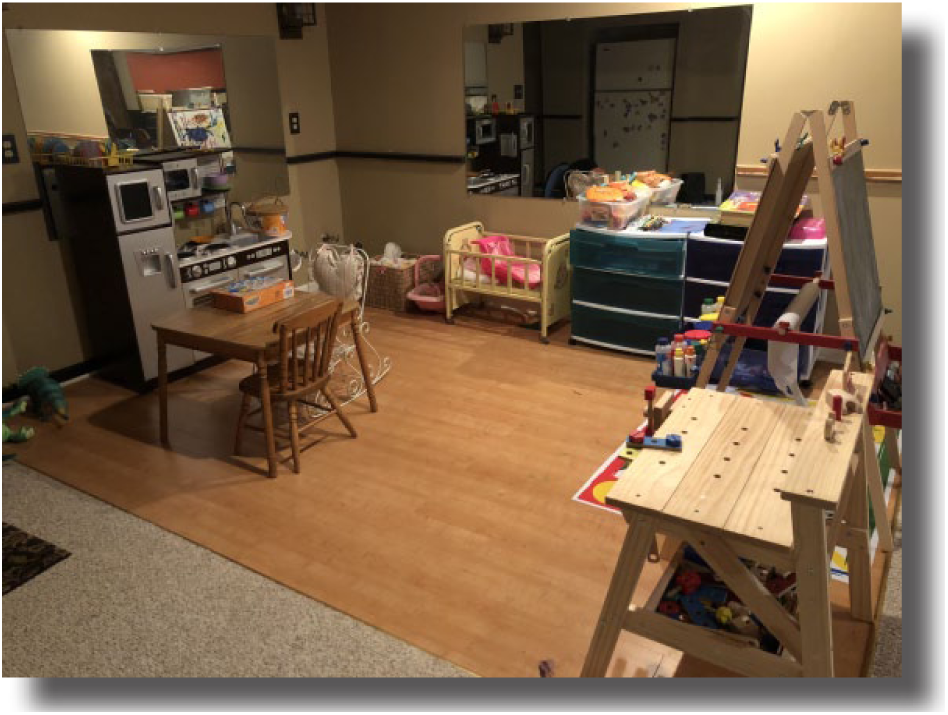
Because all children have varying preferences and those preferences can change day to day or week to week, it is important to include a large variety of toys that can foster a range of play activities. Toys such as dolls and doll accessories, kitchen and grocery items, dress up clothes, doll houses, doctor kits, and animal and people figurines are all examples of toys that foster pretend play across all six levels described above. In addition, while toys that foster pretend play are particularly important, there are many other play activities that promote important social and communication skills between children with autism and their peers such as trains and cars, board games, bubbles, blocks, puppets, and balls (Driscoll & Carter, 2009). Finally, it is important that teachers select toys and materials representative of the diverse experiences of the children and families in the classroom. Toys and objects that are relevant to some children’s experiences may not be relevant for others. As such, selecting toys children are likely to experience at home and in their community, while also choosing materials with the purpose of expanding children’s understanding of others and introducing them to new routines and concepts will enrich the play experience for all children involved (Durden, Escalante, & Blitch, 2015).
Providing a large variety of toys not only keeps the play activities interesting and fun, but it also allows the adult to rotate toys in and out of the play area to ensure novelty. In addition, some teachers choose to pull out one or two sets of toys at a time to focus the play on one activity. This can be helpful for groups that consistently have difficulty maintaining focus on an activity for extended periods and require extra help from the adult to get started and play together. Focusing on one or two sets can also be helpful when attempting to expand the play interests and repertoire of the child with autism who may be interested in a limited number of activities and gravitates toward those regardless of what other group members are playing with.
Selecting and Prepping the Peers
When choosing peers, it is helpful to consider the interests of the child with autism and include classmates with whom those interests are shared. In addition, including a mix of boys and girls will allow for a broader range of play and play interests, and peers should be chosen based on social and adaptive abilities. Specifically, peers whose language and social skills are commensurate with their chronological age, who can handle conflict and communicate needs and feelings to teachers and other children in an age-appropriate manner, and who can model age-appropriate social skills such as turn-taking, extended interactions, and cooperative play are ideal play partners. In addition, peers who are respectful and open-minded, but not overly domineering and directive in their approach make for the best play mates (Wolfberg, 2003). Such children typically respond in the most appropriate and effective manner to the initiations or their classmates with autism, do a better job of recognizing their classmates’ interests, and can disengage from their own play activities to join the play of others. Finally, and most importantly, peers should be children with whom the child with autism is comfortable.
Once Connor and Sam’s educational team identified their play goals they began recruiting peers to participate in the play groups. Connor’s group consisted of one boy, Elijah, and one girl, Olivia. Olivia was outgoing, social, and frequently attempted to initiate and interact with Connor. Elijah was a quiet boy who Connor tolerated playing next to and with whom he even attempted to interact on occasion. Sam’s group also consisted of one boy, Jose, and one girl, Cora, who were chosen because of their interest in the “pretend” area of the classroom. This was important given Sam’s goals of engaging in more elaborate play and taking on different roles. Connor and Sam’s groups each met twice a week during centers time and recess/snack. During recess and snack, the group started by having a snack together and then moved immediately into play.
English, Goldstein, Shafer, and Kaczmarek (1997) recommended one or more pretraining sessions with peers before beginning play intervention to familiarize them with some of the ways their classmates with autism might attempt to communicate. They also recommend peers be taught strategies for responding to their classmates’ communicative attempts and given some lessons on what it means to be a friend. Specifically, the authors have developed a Buddy Skills program in which peers are taught to stay with their friend (go where they go and play with what they are playing with), play with their friend (play with the same toys, take turns, invite them to play), and talk to their friend (talk about the toys they are using together).
Wolfberg (2003) also recommended that practitioners meet with peers before play groups begin to review peers’ roles and responsibilities within the group. Specifically, peers are taught that their role is to help their classmates with autism become better at playing with toys and interacting and playing with other children. As such, peers are taught to notice which toys their classmates are playing with, join the activity, and initiate and attempt interactions based on the activity. It is particularly important for peers to understand that their classmate with autism may not always answer back, but that they can keep trying, and should make sure they are playing and having fun too (Whitaker, 2004). These increased opportunities to observe and engage in appropriate play and social interaction facilitated by peers often lead to positive changes for the child with autism.
Role of Adults
Although peers provide increased play and social opportunities, adults are present to help peers navigate these interactions and support their ability to engage with their classmates with autism. In addition, children with autism do not necessarily receive instruction in play skills from the adults. Instead, adults provide support so that peers can better understand, and become comfortable with the actions, interests, and behavior of their classmates with autism. Thus, natural play interactions are learned from more frequent and improved interactions from peers, instead of through instruction from adults.
In her Integrated Play Groups Model, Wolfberg (2003) outlined three levels of adult guidance that can be used to support peer-mediated play depending on the needs of the children and the difficulty level of the play in which they are engaging: maximum, intermediate, and minimal. The following will outline the adult behaviors that should occur in each level, however, it is important to note that while most of the support is provided to peers to facilitate initiations and play with classmates with autism, some support is provided to children with autism as well. Examples of support provided by adults can be found in Table 2.
Levels of Adult Support in Play Groups

Maximum support
This level of support may require several more intrusive actions on the part of the adult to generate play. According to Wolfberg (2003), this can include assigning roles in play schemes (e.g., chef, waiter, customer), scripting dialogue and actions based on assigned roles, and setting up play materials that can prompt play to begin (e.g., table, plates, napkins, play food). This level of support may be required for children who are less familiar with each other, newly formed play groups, or for children whose goals focus on more advanced levels of play that require more imagination, language, and collaboration.
At first, Sam’s play was difficult to support, as he was ready to learn more complicated play. His group initially required the maximum level of adult mediation, and Sam benefited from scripts and role assignments. To move away from the restaurant scheme Sam was comfortable with, his teacher decided to begin play groups with grocery store items. She set out a cash register, shelves of different kinds of food, a cart and basket, and a table to serve as a checkout counter. She also provided wallets with play money and credit cards for making purchases. Finally, she set up the kitchen area so shoppers could take their food home and put it away.
Before beginning the play group, Sam’s teacher assigned roles to each member. Sam was given the role of checkout person, whereas Cora and Jose were given the role of shoppers. Although Cora and Jose immediately knew which props to use for their roles, Sam needed guidance from the teacher as to where he should stand, the actions he should engage in, and the words he should say. After approximately 5 or 10 min, roles were switched. After watching his peers play the role of shopper, Sam needed slightly less support regarding his props, actions, and words to use when he played the shopper. Using these support strategies, multiple play schemes were established over several weeks of play until Sam could elaborate on his roles and change the sequence of events on his own. Adult support could then be reduced to intermediate and minimal levels.
Intermediate support
This level of support does not require the adult to help generate play, but instead to guide and ensure children with autism are engaged, peers are initiating and responding to their friends, and play continues to progress (Wolfberg, 2003). At this stage, support might include offering suggestions regarding the action taking place (e.g., Sara, why don’t you use that pad of paper to take Megan’s order?), asking questions that help the children decide what to play (e.g., Fern, do you see what Xavier is doing? What do you think he wants to play right now?), commenting on the play that is taking place (e.g., The baby’s still in the bathtub but no one got her dressed), and changing the focus of the play as children lose interest in one play scheme and struggle with moving on to another (e.g., Maybe it’s time for the restaurant to close so the family can go home for bed).
Minimal support
Support at this stage requires very little adult involvement. Wolfberg (2003) encouraged practitioners to allow play to continue freely with little or no intrusion, and while it is important for adults to remain present in case more support becomes necessary, remembering the ways adult intrusion can interfere with and diminish children’s play can be a helpful reminder to allow play to develop freely. Minimal support is needed when both peers and the classmate with autism are engaged in play and interacting with each other. Although these interactions might look different based on the language and communication abilities of the child with autism, it is best for adults to stand back and let the children engage and learn from one another when play and interactions are occurring without adult support.
To develop Connor’s play, teachers only needed to use strategies from the intermediate and minimal levels of support. At first, his teachers frequently had to prompt peers to take notice of what he was playing with or might be interested in, and often had to make suggestions regarding ways to interact with him or play with the toys he was interested in. However, once his peers were coached to initiate with and respond to Connor’s interests, he quickly became interested in his peers and picked up several play actions based on the functional uses of items.
Concluding Thoughts
Given the role of play in language and social development, it is important for early childhood educators to understand the ages at which different types of play develop, especially considering some of the most complex play is mastered by the time a child reaches the age of 4 years. In addition, understanding how play develops through early childhood allows practitioners to plan and implement play interventions as a place to promote growth in both social and communicative skills and in enhancing the complexity of play itself. This is particularly important for children with autism whose difficulties with social and communication skills can be exacerbated by their difficulties with play. Using peer mediation to teach play skills to children with autism will support their play, language, and cognitive growth via the use of an evidence-based practice, and has the potential to foster friendships between peers who are typically developing and their classmates with autism.
Footnotes
Authors’ Note
You may reach Mary Beth Patry by email at