




Abstract

To the Editor:
The monitoring of hollow-process challenge devices (HPCD) is critical for safe release of lumen instruments after sterilization in pressure steam sterilizers.1,2 With increased use of precision lumen instruments in clinical settings, rapid sterilization cycles (often omitting drying steps) are frequently employed. We observed significant variability in HPCD chemical monitoring outcomes despite consistent physical parameters during consecutive rapid cycles. Preliminary findings implicated residual moisture accumulation in HPCDs. Therefore, this study investigates the impact of residual moisture within HPCDs on chemical monitoring outcomes, aiming to optimize quality assurance protocols for rapid sterilization cycles and enhance the accuracy of instrument release decisions.
Materials and Methods
Equipment
Experiments were conducted using a Canadian-manufactured compact pressure steam sterilizer with a rapid sterilization cycle: six positive-pressure pulses followed by 134°C for 6 min (total cycle duration: 14 min), omitting the drying phase.
HPCD models
Two HPCD models from GKE were selected, featuring 2 mm diameters and lengths of 300 mm and 1,500 mm, respectively.
Pre-treatment protocols
Prior to testing, HPCDs underwent five pre-treatment protocols: (1) full drying (baseline dry state); (2) drying + rapid sterilization (natural condensate retention post-cycle); (3)–(5) drying + addition of 1 μL, 5 μL, and 10 μL sterile purified water to simulate fixed residual moisture levels. HPCD drying was achieved via a separate sterilizer’s dedicated drying program (negative-pressure vacuum, 20 min).
Testing protocols
Chemical indicator strips were inserted into HPCD terminals, sealed, and placed near the sterilizer exhaust port. Rapid cycles were run without load, and results were recorded with three repeated trials per condition.
Results
General impact of residual moisture
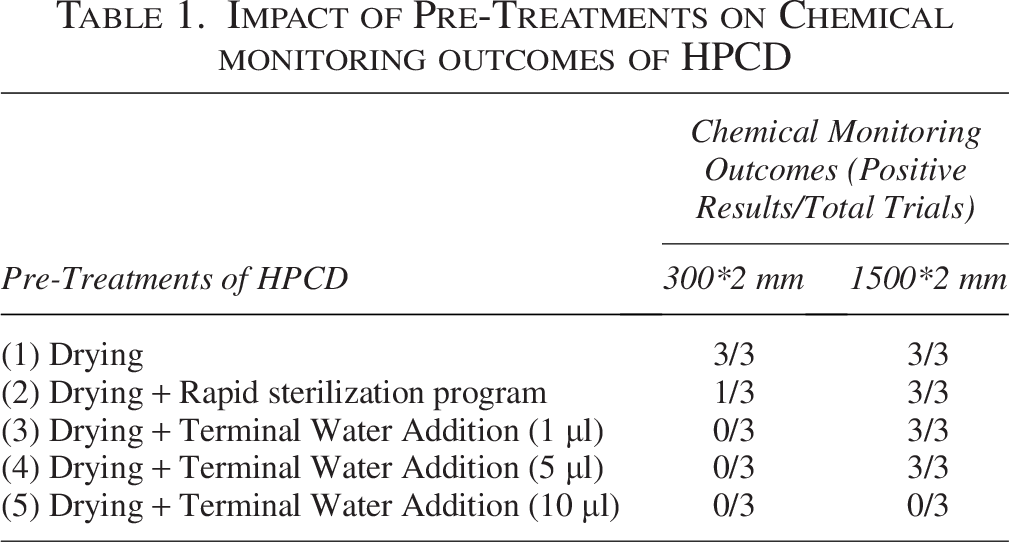
Residual moisture significantly affected chemical monitoring reliability, with distinct variability observed between 300 mm and 1,500 mm HPCDs (Table 1).
300 mm HPCD performance
Fully dried 300 mm HPCD consistently showed positive results (3/3 trials), whereas non-dried devices exhibited only 1/3 positive outcomes. The addition of 1–10 μL water universally resulted in negative monitoring outcomes across all tested conditions (0/3 positive).
1,500 mm HPCD performance
The 1,500 mm HPCD demonstrated stable positive results regardless of drying status (3/3 trials). While 1 μL and 5 μL added water had no impact on monitoring accuracy (3/3 positive), 10 μL addition induced negative outcomes (0/3 positive).
Discussion
As a critical validation method for the efficacy of pressure steam sterilization, chemical monitoring plays an irreplaceable quality control role in the sterilization of reusable medical devices by providing real-time feedback on key parameters (temperature, time, steam penetration, etc.), as mandated by multiple national standards for every sterilization cycle.3,4 However, the reliability of its monitoring performance is highly dependent on operational standardization, where even minor environmental interference may lead to result deviations.
This study reveals the potential risks of conducting sterilization efficacy monitoring with HPCDs in non-dried states. Results demonstrate that the monitoring outcomes for 300 mm HPCDs exhibit significant variability under non-dried conditions, whereas consistent results are achieved after drying, indicating that residual moisture interferes with the colorimetric reaction of chemical indicators. Notably, trace water residues as low as 1 μL and 10 μL can induce false-negative results in 300 mm and 1,500 mm HPCDs, respectively, leading to the erroneous release of under-sterilized lumen instruments. Such minute moisture levels (corresponding to mass changes of merely 1 mg and 10 mg) far exceed the sensitivity thresholds of conventional weighing equipment. This finding directly challenges the prevailing clinical practice of “focusing solely on monitoring outcomes while neglecting HPCD pre-treatment protocols.”
The color transition of chemical indicators relies on the synergistic effects of temperature, time, and steam. Residual moisture at the terminal ends of HPCDs (e.g., due to inadequate drying post-rapid sterilization) may alter the localized environment (temperature, humidity, steam distribution, etc.), prematurely triggering the indicator’s colorimetric threshold before actual sterilization conditions are met. Consequently, health care institutions must implement mandatory drying protocols for HPCDs within rapid sterilization cycles to eliminate risks of monitoring failure caused by environmental interference.
Impact of Pre-Treatments on Chemical monitoring outcomes of HPCD
Conclusions
Rapid cycles retain condensate in HPCDs (≥1 μL), shortening chemical indicators’ color change pathways and causing false negatives. Mandatory drying protocols must be integrated into rapid sterilization programs, particularly for short-lumen devices (300 mm).
Footnotes
Author Disclosure Statement
No competing financial interests exist.
Funding Information
This work was supported by the Zhejiang Science and Technology Plan for Disease Prevention and Control (Project No. 2025JK031) and the Zhejiang Provincial Key Laboratory Construction Project (Project No. 2024ZY01026).