



Abstract
This article reports the findings of a study that examined Hong Kong online users who use travel websites for travel planning and online travel experience sharing. The empirical findings from a large-scale domestic survey conducted in 2010 reveal that 32.7% of the respondents had used at least one travel website for travel planning in the past 2 years. In addition, 24.5% of these respondents had shared their travel experience online. On the whole, the travel website users were young, highly educated, and had a high level of personal income. In general, the propensity to share travel experiences decreased with age. In contrast, education level up to college/university level positively influenced the respondents’ willingness to share travel experiences, but the propensity decreased with higher levels of education. This study, although limited in scope, will be of interest to academic researchers and industry practitioners who are seeking to better understand the behavior of travelers using the Internet.
As the Internet has revolutionized the ways that tourism-related information is distributed and searched for, researchers have emphasized its impact on travel and tourism (Buhalis & Law, 2008; Cheung & Law; 2009; Xiang & Gretzel, 2010). Without any temporal or spatial constraints, the Internet allows potential travelers to search for information on tourism products with low search costs. Some researchers have stated that the Internet is now playing a crucial role during travel planning, leading to an increasing use of the channel prior to trips (Choi, Lehto, & O’Leary, 2007; Pan & Fesenmaier, 2006; Xiang & Fesenmaier, 2006).
Social network websites where consumer-generated content is communicated (such as TripAdvisor and Facebook) have recently gained in popularity among potential travelers (Lo, McKercher, Lo, Cheung, & Law, 2010). These websites have changed the way that travelers evaluate information available on the Internet (Cox, Burgess, Sellitto, & Buultjens, 2009) by enabling them to post and share travel-related experiences in textual, audio, or visual formats, thus proliferating online interpersonal influences (Senecal & Nantel, 2004) and electronic word-of-mouth (eWOM; Goldsmith, 2006). As social networking empowers individual travelers, they can portray, reconstruct, and relive their tourism experience through the online channel (Pudliner, 2007; Tussyadiah & Fesenmaier, 2009; Xiang & Gretzel, 2010). With the growing popularity of online travel planning and experience sharing, published articles in the tourism and hospitality literature have examined travel websites to compare demographics (such as gender differences), motivations for use (such as uncertainty avoidance), and contributions (such as efficacy). However, only a limited number of published articles have focused on the demographic profile of travelers who use websites for planning and information sharing at the same time. This study thus contributes to fill in the void of the topic.
Background
Findings from prior studies have shown that the Internet is an important information source for travel planning (Choi et al., 2007; Pan & Fesenmaier, 2006; Xiang & Fesenmaier, 2006), particularly because of its convenience and speed (Cheung & Law, 2009). Pan and Fesenmaier (2006) found that 95% of online users trust information from Internet sources. In Hong Kong, the empirical findings of a recently conducted study show that the number of travel website users (e-browsers and e-buyers) has steadily increased in Hong Kong (Cheung & Law, 2009).
In the past decade, various studies were conducted on online information searches, focusing on demographic characteristics (D. Y. Kim, Lehto, & Morrison, 2007; W. G. Kim, Lee, & Hiemstra, 2004; Luo, Feng, & Cai, 2005) and cultural influence (Chen, 2000; Gursoy & Umbreit, 2004; Money & Crotts, 2003). Gender has been established as a significant antecedent of attitude toward website functionality (D. Y. Kim et al., 2007) and of involvement in a virtual community (W. G. Kim et al., 2004). In addition, Luo et al. (2005) found that tourists’ Internet use differs between genders and among different levels of household income.
Another body of research has examined cultural influence on travel website use (Chen, 2000; Gursoy & Umbreit, 2004; Money & Crotts, 2003). Money and Crotts (2003) investigated the impact of an uncertainty-averse culture on Internet information searches but found no difference in use of travel websites between a lower uncertainty avoidance culture (Germany) and a higher uncertainty avoidance culture (Japan). Prior research findings thus suggest that a cultural- and country-specific investigation on travel website use would be necessary.
As previously noted, eWOM plays a critical role in tourism purchases because of the intangible nature of tourism products and services. The popularity of eWOM channels has meant that consumer opinions have become more influential in purchase decisions than the information provided by suppliers (Litvin, Goldsmith, & Pan, 2008). Various studies have been conducted to examine the impact of the valence of eWOM on website readers’ attitudes in different contexts. For instance, Cheng, Lam, and Hsu (2006) identified that attitudes toward social norms and perceived control over negative eWOM communication play significant roles in negative eWOM intention. Similarly, Laczniak, DeCarlo, and Ramaswami (2001) found that negative WOM has a negative relationship with brand evaluation. Interestingly, Vermeulen and Seegers (2009) found both negative and positive eWOM can enhance consumers’ consideration of a hotel simply by increasing their awareness of that hotel.
In another study, Sidali, Schulze, and Spiller (2009) examined the impact of online reviews on the choice of holiday accommodation and found more than 80% of the respondents purchased accommodation promoted by e-reviews. Similarly, Hennig-Thurau (2005) argued that consumers have a high level of reliance on information from online sources even though many e-reviews are anonymous.
Although prior studies have examined the importance and impact of eWOM on hospitality and tourism purchase decision making (Cox et al., 2009; Litvin et al., 2008; Xiang & Gretzel, 2010), the characteristics of travelers who use travel websites for planning and, more important for posttrip experience sharing, are still largely unknown. In the existing tourism literature, a few studies have focused on travelers’ online experience sharing. For instance, Wang and Fesenmaier (2003) found that efficacy (e.g., helping others and sharing enjoyment) is the major motivation for travelers to make contributions to the online community. Similarly, Gretzel, Yoo, and Purifoy (2007) found that online reviewers post for altruistic reasons. Heung (2003) compared Internet users and non-Internet users for travel information and booking and found differences in some demographic characteristics. Given the importance of the cultural approach to travel website use, prior research studies, however, did not explicitly examine Hong Kong residents.
Comparatively little research has investigated the demographic characteristics of travelers who share their travel experiences online. Gretzel et al. (2007) found that the authors of online reviews are most likely to be men and younger than 35 years. Given that the behavior of tourists in searching for information online is well documented in terms of demographic profile, the ability to match the propensity to share online with certain characteristics will be useful to both researchers and practitioners alike.
Method and Findings
A large-scale survey on outbound leisure travel was conducted among Hong Kong residents in March 2010. Using an assisted random-digit dialing method, a sample list of Hong Kong residential telephone numbers was generated. Data were collected through telephone interviews with adult Hong Kong residents after screening the sample for Internet experience. After dialing 14,983 telephone lines, 1,708 respondents completed the less than 15-minute survey, and 1,697 usable answer sets were received.
The answers to two questions from the survey and the demographic information collected are relevant to this study. The first question asked respondents whether they had used any travel websites for travel planning in the previous 2 years. Prior studies have revealed 2 years is an appropriate time for respondents to remember their online experience (Cheung & Law, 2009; Law & Wong, 2003). As noninformation seekers are unlikely to become information creators, the respondents who responded positively to the first question were then asked to indicate whether they had shared travel experiences online. Demographic information including gender, age, income, and education level was also collected.
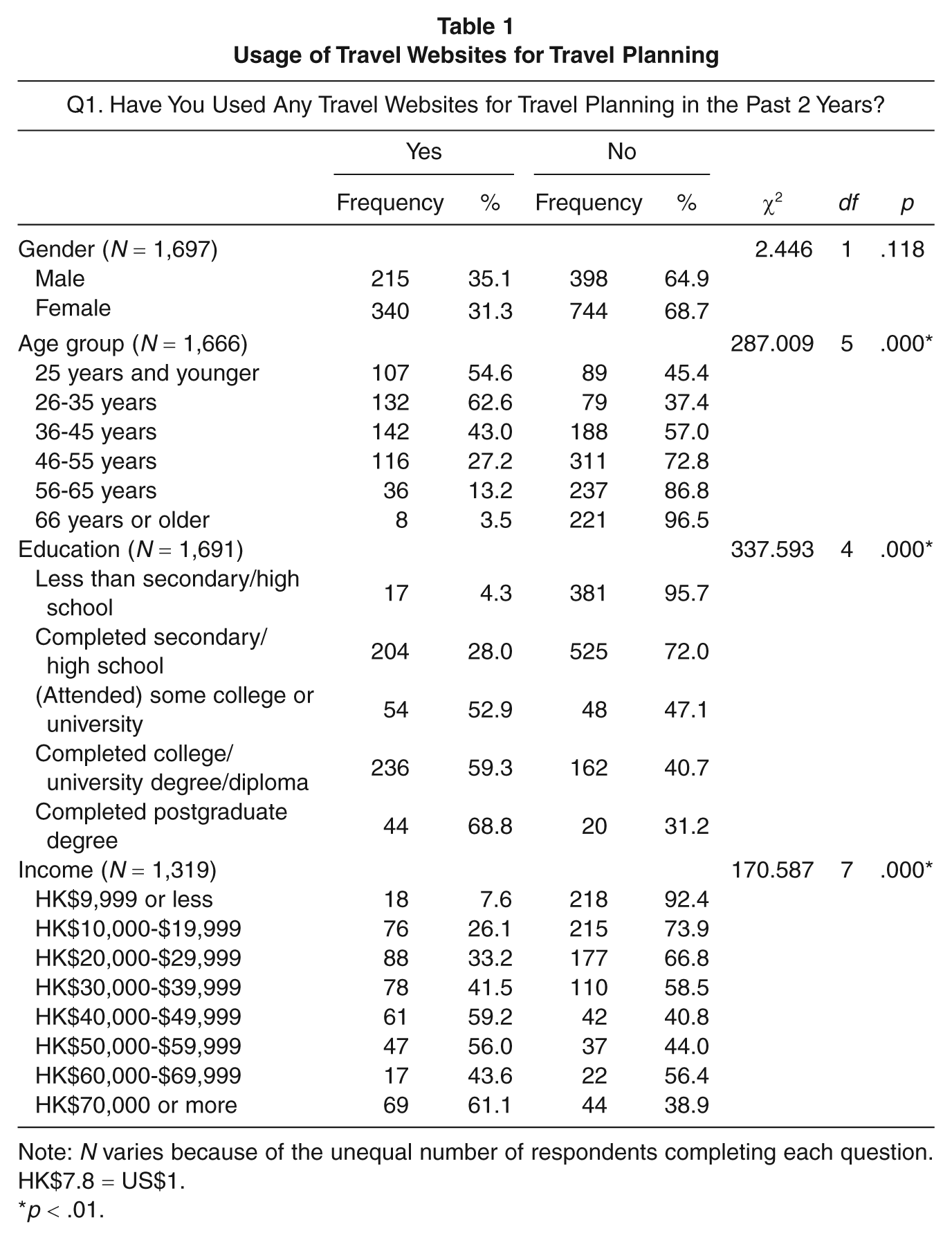
Table 1 shows the demographic profile of the respondents in relation to the first question. Of the 1,697 respondents who answered that question, 555 (32.7%) used at least one travel website for travel planning in the past 2 years. Chi-square tests were conducted to examine the differences between the users and nonusers of travel websites for planning. The results indicate no significant difference in gender, χ2(1, N = 1,697) = 2.446, p > .05, but significant differences in age, χ2(5, N = 1,666) = 287.009, p < .05, education, χ2(4, N = 1,691) = 337.593, p < .05, and personal income, χ2(7, N = 1,319) = 170.587, p < .05. Specifically, travel website users were relatively young, highly educated, and had high personal income. This is similar to the findings of a previous study that found Internet users were young and highly educated (Ratchford, Lee, & Talukdar, 2003). However, it differs from the studies conducted by Heung (2003) and Cheung and Law (2009), which found that there was no difference between age groups in terms of users and nonusers of travel websites.
Usage of Travel Websites for Travel Planning
Note: N varies because of the unequal number of respondents completing each question. HK$7.8 = US$1.
p < .01.
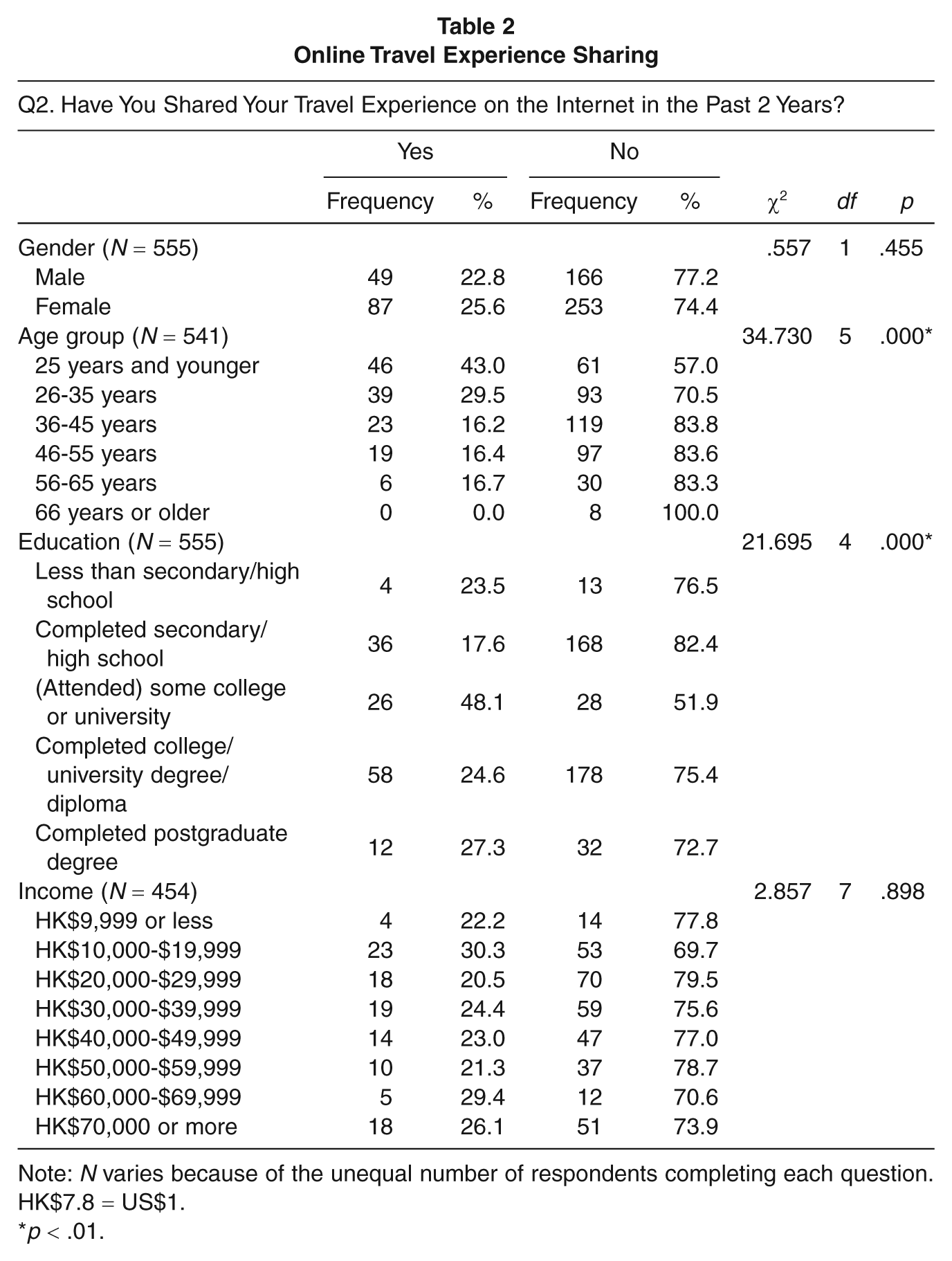
Table 2 summarizes the demographic profiles of the travelers who had and had not shared travel information online. Of the 555 respondents, 136 (24.5%) had shared their travel experiences online. In terms of age, 62.5% of these travelers were younger than 35 years. Chi-square tests tested the relationship between these two groups of travelers. No significant differences were found in gender, χ2(1, N = 555) = 0.557, p = .455, or income, χ2(7, N = 454) = 2.857, p = .898. However, significant differences were found in age, χ2(5, N = 541) = 34.73, p < .05, and education, χ2(4, N = 555) = 21.695, p < .05, between these two groups of respondents. Apparently, younger respondents were more willing to share their travel experiences with others than were older respondents. In addition, the propensity to share travel experiences increased as education level increased until college/university level, and then decreased.
Online Travel Experience Sharing
Note: N varies because of the unequal number of respondents completing each question. HK$7.8 = US$1.
p < .01.
Conclusions and Implications
This study analyzed the characteristics of Hong Kong travelers who use travel websites for planning and the Internet for posttrip experience sharing. The findings reveal that travelers who are young, well educated, and have high incomes are more likely to use travel websites for travel planning. Of those that post, young travelers are also more willing to share their travel experiences online.
Wang and Fesenmaier (2004) advocate that it is critical for travel websites to have a large user base to keep the impetus of online communication. Hospitality and tourism managers therefore need to understand the profiles of information seekers and content creators. The findings of this study suggest that young Hong Kong travelers with higher education are both travel information receivers and producers online. Moreover, based on the demographic profile of the travelers using travel websites for planning, online marketers can practice strategies to appeal to these people. For example, as travelers with higher income tend to use travel websites for their travel planning, online marketers should consider introducing quality products at the high end of the pricing range because potential consumers with high incomes are normally less price sensitive.
Although the small number of travelers who shared their travel experience on websites makes it difficult to generalize our findings to travelers at large, the perceptions of the Hong Kong travelers are insightful. As a whole, this study has demonstrated the existence of an interest in online planning and information sharing on the Internet. The findings will thus enrich the knowledge of practitioners in Hong Kong’s hospitality and tourism industries, and possibly elsewhere.
In terms of further studies, researchers could investigate the reasons for, and the processes by which, travelers share their travel experiences online. It will also be important to find out the types of communication channels these travelers use. As stated previously, the Internet serves as a major source of information for consumers, who specifically trust information from consumer-generated media rather than from service providers (Choi et al., 2007; Pan & Fesenmaier, 2006; Xiang & Fesenmaier, 2006). Moreover, negative eWOM has a stronger impact on consumers’ purchase decision making than does positive eWOM (Litvin et al., 2008). Travelers can easily post negative comments on travel websites, through which negative comments can be easily distributed to all users. A challenge for hospitality and tourism managers thus emerges, as it is difficulty for managers to address all negative comments online and prevent them from being disseminated. In addition, a natural extension of this study would be to expand the number of questions asked and to repeat the survey with travel website users in other geographical regions. Future research endeavors could also compare and contrast the cultural differences among users in different parts of the world, as well as temporal changes in demographic characteristics.
Footnotes
Authors’ Note:
The authors would like to thank the three anonymous reviewers for their constructive comments on the early versions of this article. This study was partly supported by an internal grant funded by the Hong Kong Polytechnic University.