



Abstract
The sufficiency of theory of planned behavior (TPB) is still being questioned although the model was validated in predicting a wide range of intentions and behaviors. Based on a comprehensive literature review, an extended TPB model of tourists was proposed to investigate relations among constructs of the model with the addition of motivation and actual behavior. An instrument was developed based on previous tourism and marketing studies as well as focus groups. A two-wave data collection was implemented, with data collected from 1,524 Beijing, Shanghai, and Guangzhou residents in Stage 1 and 311 respondents from the same cohort in Stage 2. Results of the study demonstrated that the extended TPB model with tourist motivation fit the data relatively well, explaining 5% more of the variation in behavioral intention in comparison with a base model without motivation. However, the model with both tourist motivation and actual behavior was not tenable, despite a marginal relationship found between behavioral intention and actual tourist behavior using regression analysis. The findings warrant further research examining the predictive power of behavioral intention on actual behavior.
Keywords
Motivation for travel and the developmental process of a traveler’s behavior are two ongoing research themes for tourism researchers. To take adequate actions in tourism marketing or planning, one must understand which motivational factors influence individuals’ travel decisions, how attitudes are formed, and how various reference groups affect travel behaviors (e.g., Moutinho, 1987). Thus, numerous studies on tourist motivation and behaviors could be found in the literature. Researchers have paid considerable attention to tourist motivation (Crompton, 1979; Dann, 1981; Fodness, 1994; Uysal & Hagan, 1993). Some behavioral theories were also adopted to investigate how tourist motivations help develop travelers’ attitudes and how these attitudes lead to behavioral intentions in choosing a travel destination (Lam & Hsu, 2004, 2006; March & Woodside, 2005a).
One of the often-researched consumer behavior formation models is the theory of planned behavior (TPB) (Ajzen, 1988, 1991), which is an extension of the theory of reasoned action (TRA) (Fishbein & Ajzen, 1975). TPB considers both social (i.e., subjective norm) and psychological (i.e., attitudes) factors in the consumers’ decision-making process and has been accepted and used to predict individuals’ behaviors in hotel selection (Buttle & Bok, 1996), destination choice (Lam & Hsu, 2006), and social psychology studies (Conner, Kirk, Cade, & Barrett, 2001). These previous studies paid particular attention to the relationship between travelers’ attitudes and behavior intentions, which could only predict a person’s “attempt” to perform a particular behavior but not the actual performance of the behavior (March & Woodside, 2005b). Little research could be found investigating how travelers’ motivation influences their attitudes and behavioral intentions and subsequently determines their actual behaviors in choosing an international travel destination.
The current study attempted to investigate the travelers’ behavior formation process in visiting a destination and to test an extended model of the TPB. Specifically, travel motivation and actual behavior were added to the TPB model, which enriches the connotation of TPB, so that the travel behavior formation process can be more thoroughly examined. A two-wave data collection process was adopted to obtain data from a sample of potential mainland Chinese travelers to Hong Kong, which enabled the empirical testing of the extended TPB model. As Chinese outbound tourism is playing an unprecedented important role in the global tourism industry (Cai, Li, & Knutson, 2007) and China’s outbound market continues to grow in size and sophistication, Chinese travelers’ behavior formation process in visiting a destination demands a deeper level of investigation.
The specific objectives of the study were to (a) investigate how different motivation factors contribute to the formation of attitude; (b) examine the impacts of motivation factors, attitude, perceived behavioral control, and subjective norm on behavioral intention; and (c) explore the influence of attitude and behavioral intention on actual behavior. The study makes a contribution to the theoretical development of travel behavior formation by enhancing the sufficiency of a commonly accepted consumer behavior model. Results of the study also provide practical implications for the tourism industry in terms of marketing, operations, and planning.
An Extended TPB Model
Theory of Reasoned Action/Theory of Planned Behavior
TRA was proposed by Fishbein and Ajzen (1975) for the purpose of explaining rational or volitional human behaviors, which states that a person’s volitional behavior can be predicted directly from the person’s behavioral intention. By identifying behavioral precursors (i.e., attitudes and subjective norm) and understanding their role in the context of a focal behavior, researchers have attempted to develop suggestions for influencing and altering the target consumer behavior and predict their various social behaviors (Sheppard, Hartwick, & Warshaw, 1988; van den Putte, 1991). Nevertheless, these research efforts have often resulted in divergent views on the behavior formation process of consumers. The TRA, in particular, has undergone various modifications and alternative conceptualizations. A meta-analytic study by Sheppard et al. (1988) disclosed that less than 20% of the 87 examined studies used Fishbein and Ajzen’s (1975) model as it was originally intended to be used.
Thus, an extension of the TRA, known as the TPB, was then proposed by Ajzen (1988, 1991) to predict behaviors not under complete volitional control. The basic propositions of TPB are that people are likely to perform a particular type of behavior if they believe that such behavior will lead to a particular and valuable outcome, that their important referents will value and approve the behavior, and that they have the necessary abilities, resources, and opportunities to carry out such behavior (Ajzen, 1985; Conner, Warren, & Close, 1999). TPB is especially applicable to behaviors that are not entirely under personal control (Corby, Schnedier-Jamner, & Wolitski, 1996), and the theory itself encompasses the relatively thoughtful process involved in considering personal costs and benefits of engaging in various kinds of behavior (Petty, Unnava, & Stratham, 1991).
Compared with TRA, TPB postulates a set of relations among attitude, subjective norm, perceived behavioral control, and behavioral intention. An attitude is a person’s positively or negatively valued predisposition, created by learning and experience, to respond and behave in a consistent way toward certain defined targets, such as a product or a tourist destination. In the context of tourism, attitude is the predispositions or feelings toward a travel destination or service, based on multiple perceived product attributes (Moutinho, 1987). Subjective norm refers to an individual’s perception of social references, or relevant others’ beliefs that he or she should or should not perform such behavior. Because people always turn to particular groups for their standards of judgment, any person(s) served as a reference group could have a key influence on individuals’ beliefs, attitudes, and choices (Moutinho, 1987). Perceived behavioral control is about an individual’s perceptions of his or her ability to perform a given behavior. Several resources or opportunities could dictate the likelihood of behavioral achievement (Ajzen, 1991), such as facilitating factors (Triandis, 1977), the context of opportunity (Sarver, 1983), available resources (Liska, 1984), and action control (Kuhl, 1985). The inclusion of perceived behavioral control provides information about the potential constraints on the action as perceived by the actor. Although behavioral intention could be defined as an individual’s attempt or plan to perform a particular behavior (Swan, 1981), it represents an individual’s expectancies about a particular behavior in a given setting and can be operationalized as the likelihood to act (Fishbein & Ajzen, 1975). Many studies on destination choice intention were conducted based on the TPB model (e.g., Lam & Hsu, 2004, 2006; B. Sparks & Pan, 2009), which proclaim that behavioral intention is a consequence of attitude, subjective norm, and perceived behavioral control (Ajzen, 1991).
TPB has been applied to examine a variety of social behaviors (e.g., Ajzen, 1991; Armitage & Conner, 2001; Conner & Sparks, 1996; P. Sparks, 1994; van den Putte, 1991) with strong predictive utility, especially for those that are not entirely under personal control (Corby et al., 1996). Although the efficacy of the model has been validated in predicting a wide range of intentions and behaviors, its sufficiency in predicting tourist behaviors is still being questioned. In addition to attitude, subjective norm, and perceived behavioral control, some scholars also argue that additional constructs, such as the achievement of personal goals (Perugini & Bagozzi, 2001), self-identity processes (P. Sparks & Shepherd, 1992), moral norms (Parker, Manstead, & Stradling, 1995), anticipated emotions (Parker et al., 1995; Perugini & Bagozzi, 2001; Richard, van der Pligt, & de Vries, 1995), past behaviors (Lam & Hsu, 2006; Oh & Hsu, 2001; Quellette & Wood, 1998), and visitors’ satisfaction (Baker & Crompton, 2000; Cronin & Taylor, 1994), might enhance the TPB’s predictive power. Most importantly, there have been some criticisms for the neglect of the motivation construct. Bagozzi and Nataraajan (2000) argued that although attitude, subjective norm, and perceived behavioral control provide reasons for action, they lack the motivational impetus for “energizing” the act. Generally speaking, TPB has been widely used in social psychology, and the model has been supported by many studies (Perugini & Bagozzi, 2001).
Tourist Motivation
The study of travel motivation is the starting point of any effort to gain the knowledge of travel behavior; therefore, it has been an important topic in the leisure and tourism literature since the 1960s when tourism became a focus of academic study in various disciplines. Many researchers believe tourist motivation is derived from the influence of travelers’ inner personality (e.g., M. Jackson, White, & Schmierer, 2000; Lazarus, 1991; Madrigal, 1995), psychographic characteristics (e.g., Iso-Ahola, 1982; Pearce, 1993), and outside social/cultural forces (e.g., Dann, 1981; Huang & Hsu, 2005). Many researchers explored tourists’ motivation from social, psychological, and cultural views. Although numerous studies on the topic of tourist motivation are available, a universally agreed-on conceptualization of the tourist motivation construct was still lacking (Fodness, 1994), especially in the context of non-Western cultures. Most of the existing conceptual and empirical schemes of tourist motivation were developed and tested using samples from developed societies and in Western cultures (e.g., Bansal & Eiselt, 2004; Dann, 1977; Iso-Ahola, 1982; Pearce, 1988; Pearce & Caltabiano, 1983), although there have been successful but limited attempts to apply these models in non-Western developed societies such as Japan (Cai & Combrink, 2000; Cha, McCleary, & Uysal, 1995) and Taiwan (Jang, Yu, & Pearson, 2003).
Taking China as a non-Western developing country, motivation studies on Chinese outbound tourists have been a very recent phenomenon. Hong Kong as one of the largest recipients of Chinese outbound tourists received the most attention in tourist motivation studies from academia (Hsu & Lam, 2003; Huang & Hsu, 2005; Zhang & Lam, 1999). Instead of directly applying tourism motivation models conceptualized in developed Western societies, a model that places the study of motivation in relation to expectation and attitude was proposed in a recent study by Hsu, Cai, and Li (2010) on mainland Chinese outbound tourists. Four motivation factors identified from 19 items in the study included Knowledge, Relaxation, Novelty, and Shopping.
Model Proposition
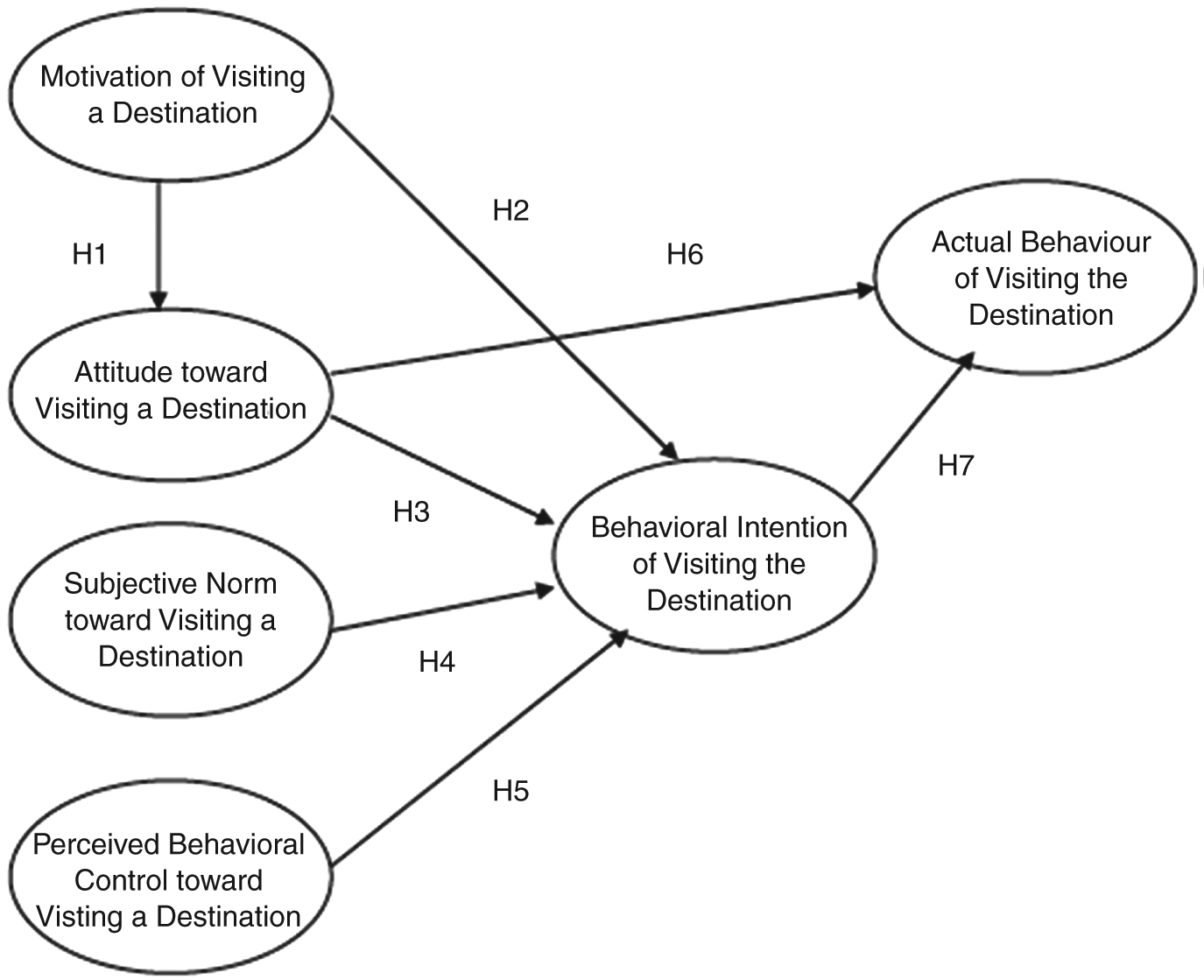
Although TPB model was adopted by some researchers in hospitality and tourism studies, few have simultaneously examined the nature of the motivation–attitude–behavior relationship and the role of behavioral facilitators. The current study attempted to test the applicability of the TPB with the addition of the motivation and actual behavior in a tourism context. The conceptual model of the current study is illustrated in Figure 1. In line with the study objectives, the model, in which seven hypotheses were formulated, was empirically tested.
Proposed Model Based on TPB
Motivation contributes to the understanding of the formation and change of attitude (Katz, 1960). Theoretically, motivation is cognitive in nature in that it is an interaction of motives and situation. Attitude, as a theoretical construct, is commonly believed to include three components: cognitive, affective, and conative (Fishbein, 1967). However, when using attitude to predict behavioral intention or actual behavior, researchers tend to view it as a relatively simple unidimensional concept containing only the affective component (Ajzen, 1991). In the present study, we follow the traditional research stream to apply attitude as an affective construct. According to TPB, an individual’s attitude is determined by behavioral belief, implying that cognitive motivation may influence affective attitude (Ajzen, 1991). Behavioral belief is usually measured (e.g., Lam & Hsu, 2006) as respondents’ belief that the target act will enable them to accomplish certain outcomes (i.e., expectation). However, attitudinal measurements in TPB are not suitable for representing the motivation component of attitude (Bagozzi, 1986). Most tourist motivation studies measured the construct by asking respondents the reason why they visit a destination or what they would like to do when visiting a destination and is multidimensional by nature. Very few studies have investigated the relationship between travel motivation and attitude (e.g., Beard & Ragheb, 1983; Lam & Hsu, 2004, 2006). Hsu et al. (2010) found that motivation has a mediating effect on the relationship between expectation and attitude.
The relationship between motivation and travel intention to a destination has not been well documented. Ajzen (1991) argued, however, intentions capture the motivational factors that influence a behavior and indicate how hard people are willing to try or how much effort they would exert to perform the behavior. This implies that motivation is related to behavioral intention. Adding a separate motivational component to the TPB will provide an alternative model that allows an in-depth understanding of travelers’ motivation and its influence on the travel behavior formation process. Therefore, the following two hypotheses were proposed:
Hypothesis 1: Tourists’ motivation of visiting a destination has a direct effect on their attitude toward visiting the destination.
Hypothesis 2: Tourists’ motivation of visiting a destination has a direct effect on their behavioral intention of visiting the destination.
Most of the work on destination choice intention (e.g., Lam & Hsu, 2004, 2006; B. Sparks & Pan, 2009) has been conducted based on the TPB model, which proclaims that behavioral intention is a consequence of attitude, subjective norm, and perceived behavioral control (Ajzen, 1991). For instance, Lam and Hsu (2004, 2006) conducted two empirical studies with 328 mainland Chinese travelers (2004) and 390 Taiwanese tourists (2006) to predict intention of destination selection. In these studies, attitude and perceived behavioral control were found to be related to mainland Chinese’s behavioral intention of visiting Hong Kong, whereas for Taiwanese, subjective norm and perceived behavioral control were found to be related to their behavioral intention of choosing a destination. Similarly, B. Sparks and Pan (2009) found that subjective norm and perceived behavioral control were correlated with behavior intention of mainland Chinese in choosing Australia as a destination. Although an individual’s subjective norm and perceived behavioral control affect the target future behavior, they do so only indirectly through behavioral intention (Ajzen, 1991; Fishbein & Ajzen, 1975). Therefore, the following three hypotheses were proposed:
Hypotheses 3 to 5: Tourists’ attitude (Hypothesis 3), subjective norm (Hypothesis 4), and perceived behavioral control (Hypothesis 5) of visiting a destination have a direct effect on their behavioral intention of visiting the destination.
Fishbein and Ajzen’s (1975) original conceptualization asserts that the effect of attitude on future behavior is completely mediated by intention, and they did not establish the relationship between attitude and actual behavior (Conner & Armitage, 1998). Nevertheless, researchers still discovered that, in addition to an indirect influence through intention, attitude can influence future behavior directly (Bagozzi & Yi, 1989; Bentler & Speckart, 1981; Golob, 2003; Liska, 1984). Past studies in this regard could be found in the tourism literature. For example, Pike (2006) conducted a longitudinal examination of destination decision sets in the context of short break holidays by car in Queensland, Australia. Two rounds of questionnaire survey were administered in a 3-month interval. The first round survey intended to identify destination preferences whereas the second examined actual travel and destination revisit preferences. The findings indicated a general consistency between attitude and behavior in the short term. Similarly, Lepp (2007) found that residents’ positive attitude toward tourism would lead to actual protourism behavior in Bigodi Village, Uganda. Thus, the following hypothesis was formed:
Hypothesis 6: Tourists’ attitude toward visiting a destination has a direct effect on their actual behavior of visiting the destination.
The TPB seems to deal adequately with the relationship among attitude, subjective norm, perceived behavioral control, and intention, but the question of how an intention is implemented in actual behavior has largely been ignored (Gärling, Gillholm, & Gärling, 1998). Similarly, Eagly and Chaiken (1993) criticized the TPB for not clarifying the exact nature of the relation between intention and behavior, although research has explored how intentions may guide the performance of behavior (Gollwitzer, 1993; Heckhausen, 1991; Kuhl, 1985). Some meta-analyses of the TPB indicated that intention and perceived behavioral control only account for 34% of the variation to explain behavior (Godin & Kok, 1996; Sutton, 1998). According to Fishbein and Ajzen (1975), behavioral intention is considered as the immediate determinant and best predictor of behavior among all the antecedents of behavior. The TPB theorized that intention results in behavior when there is an opportunity to act (Ajzen, 1985). Thus, a construct of actual behavior was added in the proposed model and a hypothesis was proposed:
Hypothesis 7: Tourists’ behavioral intention of visiting a destination has a direct effect on their actual behavior of visiting the destination.
Method
Instrument Development
The instrument was developed based on focus group interviews and literature review. Five focus groups were conducted in Guangzhou and Beijing to identify participants’ motivation to visit Hong Kong. Each group consisted of 6 to 9 participants and lasted for an average of 45 minutes. The participants were evenly distributed in terms of gender. Half were between 30 and 39 years of age, and three quarters were married. The participants were well educated, with 78% having a college degree or above. More than one quarter of the participants had visited Hong Kong before, with 70% being Guangzhou residents because of geographical proximity. Twenty-seven motivation items were generated from focus group results. These 27 motivation items were then combined with measurements from previous research (e.g., Crompton, 1979; Dann, 1981; Fodness, 1994; Hsu & Lam, 2003; Jang & Cai, 2002; Zhang & Lam, 1999) with a total of 38 items generated for pilot studies. Two pilot studies were conducted in mainland China with 204 and 186 respondents, respectively, to reduce and refine the motivation items with factor analyses and reliability tests. Items on attitude, subjective norm, and perceived behavior control were adapted from Lam and Hsu (2004). The survey instrument was designed in English and translated into Chinese using a blind translation-back-translation method (Brislin, 1976). The translated version was reviewed by several tourism researchers with competencies in both languages to ensure accuracy of translation.
All motivation items shared an umbrella question stem: “If you were to visit Hong Kong in the near future, you would visit it because you’d like to . . .” The attitude construct was measured by six statements that began with “From all your knowledge about Hong Kong, you think the visit would be . . .” The six statements were enjoyable, pleasant, worthwhile, satisfying, fascinating, and rewarding. Three statements were asked to measure subjective norm: “Most people who are important to you think you should visit Hong Kong in the near future,” “The people in your life whose opinions you value would approve your visiting to Hong Kong in the near future,” and “Most people who are important to you would visit Hong Kong in the near future.” Five statements were used to measure perceived behavioral control. A sample statement was, “Whether or not to visit Hong Kong in the near future is completely up to you.”
Behavior intention and actual behavior were measured in two different surveys. Behavior intention of visiting Hong Kong in the Wave 1 questionnaire included four statements mainly adapted from Lam and Hsu (2004), which were “You intend to visit Hong Kong in the next 6 months,” “You plan to visit Hong Kong in the next 6 months,” “You want to visit Hong Kong in the next 6 months,” and “You probably will visit Hong Kong in the next 6 months.” The actual behavior in the Wave 2 questionnaire was measured with one statement: “How many times did you visit Hong Kong in the past 6 months?” Except for actual behavior, all the above items used the same 7-point Likert-type scale, ranging from strongly agree (7) to strongly disagree (1).
Two-Wave Data Collection
An empirical study was conducted to test the proposed model and hypotheses. The sampling frame consisted of mainland Chinese individuals who have shown interest in travel. The data used in this study were collected in three major cities of Beijing, Shanghai, and Guangzhou, China. These three cities were selected for their residents’ trendsetting status in lifestyles and higher income and, therefore, higher propensities to travel (Hsu & Crotts, 2006). The three cities also have a broad geographic representation of China and include both long- and short-haul potential mainland Chinese travelers to Hong Kong.
To accomplish the research objectives, a two-stage survey procedure was performed to collect data. Stage 1 aimed to collect data on reasons of visiting Hong Kong (motivation), attitude toward visiting Hong Kong, groups or individuals whose views might influence respondents’ visit to Hong Kong (subjective norm), the degree of control over a future visit (perceived behavioral control), likelihood of visiting Hong Kong in the next 6 months (behavioral intention), and demographic characteristics. In Stage 2 data collection, in addition to motivation, subjective norm, and perceived behavioral control, frequency of visit to Hong Kong in the past 6 months was added to collect information on actual behavior.
For Stage 1 data collection, respondents were chosen based on a convenience sampling method. A group of trained interviewers were stationed at airport terminals, train stations, shopping malls, and outside travel agencies. Once respondents agreed to participate in the survey, the purpose of the study was explained and a self-administered questionnaire was distributed to them for completion on site. As a result, 1,514 completed surveys were retained as the sample of the study. Respondents were asked to provide name, phone number, mailing address, and e-mail address for a follow-up survey in 6 months.
Wave 2 data collection was conducted 6 months after the initial survey. Respondents of the first data collection were contacted by postal and/or e-mail to be invited to complete the follow-up questionnaire. A total of 995 questionnaires were successfully sent (i.e., were not returned) by postal mail and 528 by e-mail. Follow-up phone calls were made to remind participants of the questionnaire sent. Unique coding was used to make sure that each respondent can only return the second questionnaire once. No participant was found to return both the postal and e-mail surveys. A total of 311 questionnaires were returned, with an overall response rate of 21.4%.
Data Analysis
Data were analyzed using SPSS and LISREL. Data were first screened by checking the descriptive statistics. Because structural equation modeling (SEM) requires that the data should not extremely violate the assumption of normality, both univariate and multivariate normality were tested. The skewness statistics ranged from −1.324 to −0.100 and the kurtosis statistics from −0.933 to 2.480. Because none of the absolute values of univariate skewness exceeded 2 and none of the absolute values of univariate kurtosis exceeded 3, the data should not be treated as extremely violating normality according to Kline’s (1998) criteria. Therefore, no data transformation was attempted.
Following the data screening, the Wave 1 sample was randomly split into two halves, one as calibration sample (n = 784) and the other as validation sample (n = 730). Exploratory factor analyses (EFAs) were run with the calibration sample on each of the research constructs in the proposed model except actual behavior. Subsequently, confirmatory factor analyses (CFAs) were run with the validation sample to see whether the underlying factorial structures (measurement models) still hold, with adjustments being made where necessary. Once the measurement models were identified, the overall measurement model was tested, followed by the test of the proposed structural model, with both using the validation sample.
To test the extended TBP model including actual behavior, the two-wave data were merged together. The new data set contains Wave 1 data for motivation, attitude, subjective norm, and perceived behavioral control and Wave 2 data for actual behavior with an effective sample size of 311. Because of the substantial reduction of sample size in the Wave 2 data, the originally proposed model cannot be tested using the full structural model with all the observed variables. The model was very complicated with the inclusion of the motivation factors (latent variables) and their measurement indicators. A sample size of 311 was considered too small to ensure stable model estimation (Kline, 1998). An alternative solution was sought. Each latent variable (e.g., motivation factors, attitude, subjective norm, perceived behavioral control, and visit intention) was replaced by a proxy variable. Values of the proxy variables were calculated by the following formula (Field, 2009):

where Pi is the ith latent variable, Iij is the jth indicator’s observed score in the ith latent variable, Fij is the standardized factor loading of the jth indicator’s observed score in the ith latent variable, and n is the number of indicator variables for the ith latent variable. The model with the proxy variables and actual behavior appeared to be a pure path model without latent variables. The path model was then tested to see whether it fits the data.
This study adopted maximum likelihood as the estimation method in all SEM analyses. Chi-square, ratio of chi-square to degrees of freedom (dfs), root mean square error of approximation (RMSEA), standardized root mean square residual (RMR), goodness-of-fit index (GFI), normed fit index (NFI), and comparative fit index (CFI) were adopted as multiple model fit criteria (Diamantopoulos & Siguaw, 2000). The cutoff point of χ2/df was set at 3:1 (Jöreskog & Sörbom, 1989), and the cutoff points of RMSEA, standardized RMR, GFI, NFI, and CFI were .08, .05, .90, .90, .90, respectively (Byrne, 1998; Diamantopoulos & Siguaw, 2000).
Results
The characteristics of respondents from Wave 1 are shown in Table 1. The sample was evenly distributed between males and females. About 73% of the respondents were between 18 and 29 years old. Respondents were well educated, with nearly 70% of them holding a college or higher education level, and one third of them being white-collar workers. Only 13% of the respondents had visited Hong Kong before. The age and occupation profile of respondents from Wave 2 was similar to that of Wave 1, with 77% between 18 and 29 years old and white-collar workers (47%) representing the most popular occupation.
Profile of Wave 1 Survey Participants (n = 1,514)
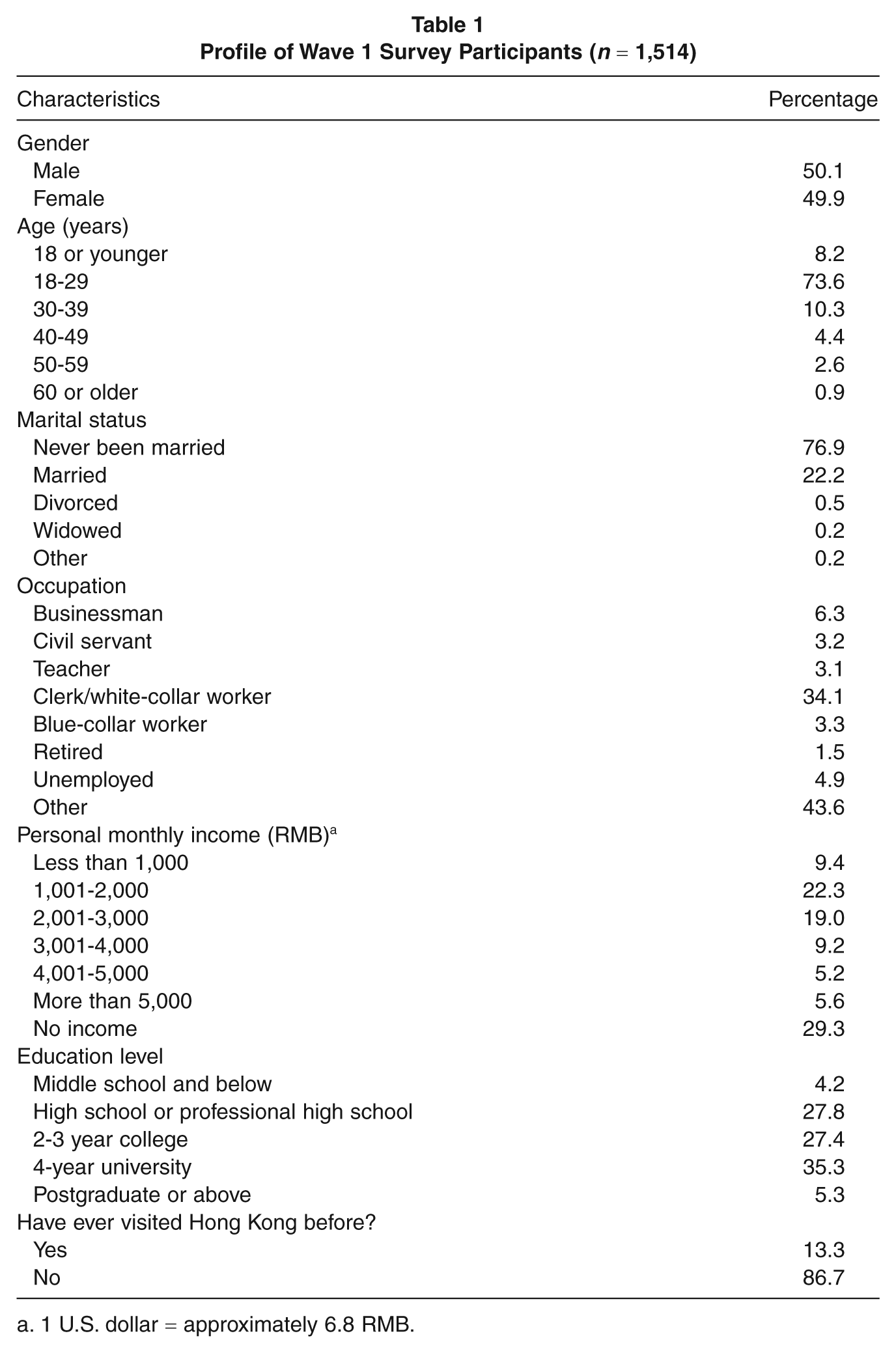
1 U.S. dollar = approximately 6.8 RMB.
Measurement of Motivation
EFA was conducted to extract underlying dimensions of motivation with the calibration sample (n = 784). A principal component method with varimax rotation was used. To control the number of factors extracted, a minimum eigenvalue of 1 was used. Items exhibiting low factor loadings (≤.40), high cross-loadings (>.40), or low communalities (<0.50) would be removed as a principle (Hair, Anderson, Tatham, & Black, 2002). The factor analysis reached a solution of four factors without deleting any items. The four factors were labeled as Knowledge, Relaxation, Novelty, and Shopping (Table 2). A Cronbach’s alpha reliability test was run and all factors showed acceptable levels of reliability.
Factor Analyses of Motivation Items

Note: EFA = exploratory factor analysis; CFA = confirmatory factor analysis; KMO = Kaiser–Meyer–Olkin measure; GFI = goodness-of-fit index; RMR = root mean square residual; CFI = comparative fit index; NFI = normed fit index; RMSEA = root mean square error of approximation; SMC = squared multiple correlation.
After identifying the underlying motivation factors, the factorial structure was tested using CFA with the validation sample (n = 730). The measurement model with all items did not seem to have a satisfactory fit with the data (χ2/df = 6.31, RMSEA = .085, standardized RMR = .068, GFI = .88, NFI = .90, CFI = .91). Five measurement items were then removed from the model, as suggested by the modification indices and their lack of utility to serve as a highly reliable measurement indicator either because of low loading or double loading. These items were “enjoy natural and urban landscape in Hong Kong” from the Knowledge factor, “release work pressure” from the Relaxation factor, and “experience a metropolitan city,” “feel the magnificence of the city’s skyscrapers,” and “visit cultural and historical attractions” from the Novelty factor.
Measurements of Other Latent Variables
The same procedure was applied to test the measurement models of attitude, subjective norm (SN), perceived behavioral control (PBC), and behavioral intention (BI). EFA was run with the calibration sample first to identify the underlying latent structure and then the latent structure was due for CFA and further adjustment to find a suitable measurement model for each latent variable. As shown in Table 3, two attitude items, with the semantic words of “fascinating” and “rewarding,” were removed from the attitude measurement because of redundancy. Two perceived behavioral control variables with the reversed wording (“It is difficult for you to visit Hong Kong in the near future” and “It is impossible for you to visit Hong Kong in the near future”) were found to lie on a different underlying factorial dimension from the other three items in the EFA. The result was probably because of the reversed wording. With an acceptable reliability of the three statements loaded on the primary factor, the two reversed items were removed. Similarly, one behavioral intention item, “You want to visit Hong Kong in the next 6 months,” was removed in the CFA process.
Factor Analyses of Attitude, Subjective Norm, Perceived Behavioral Control, and Behavior Intention

Note: EFA = exploratory factor analysis; CFA = confirmatory factor analysis; KMO = Kaiser–Meyer–Olkin measure; CFI = comparative fit index; GFI = goodness-of-fit index; RMR = root mean square residual; NFI = normed fit index; RMSEA = root mean square error of approximation; SMC = squared multiple correlation.
Overall Measurement and Structural Models Without Actual Behavior
An overall measurement model was tested with all latent variables (four motivation factors, attitude, PBC, SN, BI) except actual behavior using the validation sample (n = 730). All latent variables were specified to freely correlate with each other. The overall measurement model was found to fit the data very well (χ2/df = 2.81, RMSEA = .050, standardized RMR = .048, GFI = .92, NFI = .94, CFI = .96). Following the two-step model testing procedure commonly used in SEM (Byrne, 1998; Kline, 1998), the proposed structural model can then be tested.
The proposed structural model without actual behavior was tested by allowing causal relationships as proposed among the latent variables. The structural model was found to fit the data well (χ2/df = 2.83, RMSEA = .050, standardized RMR = .049, GFI = .92, NFI = .94, CFI = .96) and explained 42% (R 2) of the total variation in behavioral intention, demonstrating a strong explanatory power of the proposed model (Cohen, 1988). To test whether adding the motivation construct improved the proposed model’s explanatory power, the base TPB model without motivation was further tested. The results also showed a good model fit (χ2/df = 2.36, RMSEA = .043, other fit indices not produced by LISREL because of missing data). However, the base model only explained 37% (R 2) of the variation in behavioral intention, with path coefficients slightly increased (Attitude → BI: β = .209; SN → BI: β = .349; PBC → BI: β = .241). This finding reinforces the necessity of extending the base TPB model in different applied areas of behavioral sciences to improve its explanatory power, which prompted the current study.
As shown in Table 4 and Figure 2, all motivation factors had a significant positive effect on attitude. The result thus supported Hypothesis 1. However, only Shopping as a motivation factor posted a significant influence on behavioral intention; the other three motivation factors did not affect behavioral intention. Thus, Hypothesis 2 can only be partially supported. As expected, subjective norm had a very salient effect (β = .315) on behavioral intention, so did perceived behavioral control (β = .171), albeit in a lesser magnitude. In contrast, attitude was found to have an effect on behavioral intention; however, judging from the path coefficient (β = .095), the effect appeared only marginal. These findings generally supported Hypotheses 3 to 5. The proposed model explained 33% of the variable for attitude and 42% of that for behavioral intention, which indicated that the explanatory power of the model was quite satisfactory.
Path Analysis Results of the Proposed Model
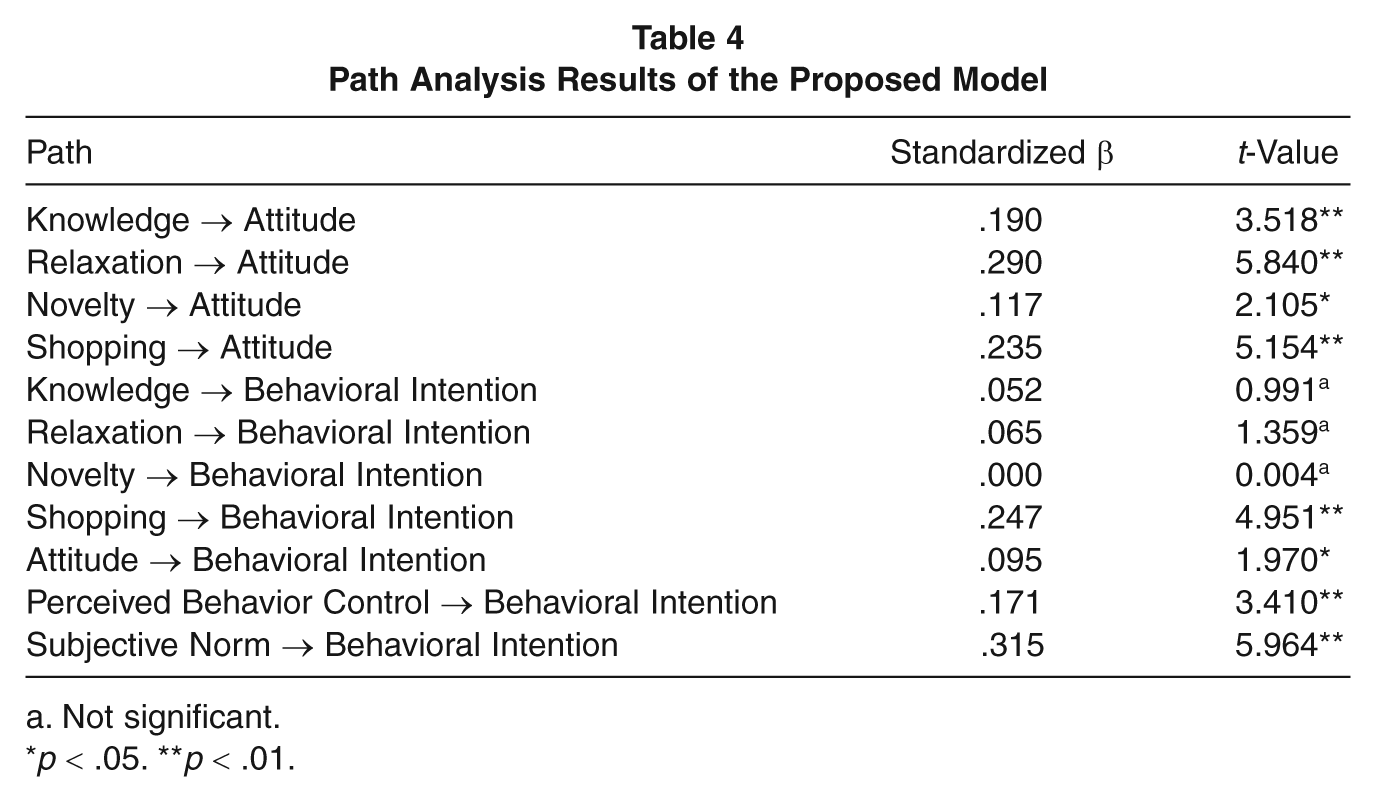
Not significant.
p < .05. **p < .01.
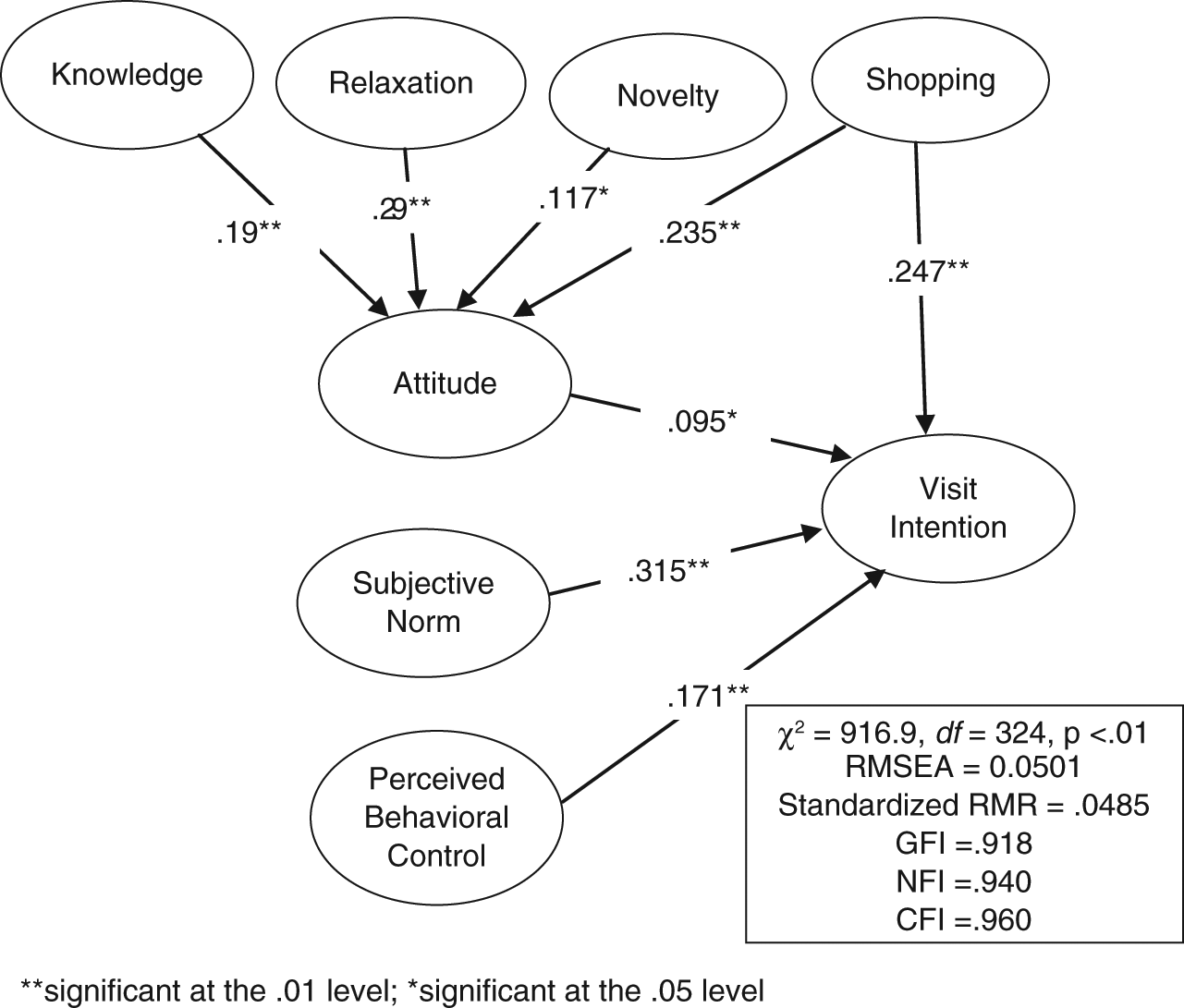
Structural Model Without Actual Behavior
Testing the Structural Model With Actual Behavior
The combined two-wave data were used to test the structural model with actual behavior (Figure 1). Considering the limitation with the sample size, proxy variables were calculated and used in the final path model with actual behavior. Actual behavior was measured by respondents’ number of visits to Hong Kong during the 6-month interval between Wave 1 and Wave 2 data collection. Among the 311 respondents, 43 (13.8%) had actualized their travel to Hong Kong during the 6-month interval. Of those with realized behaviors, 31 (72%) traveled to Hong Kong once, 7 (16%) traveled to Hong Kong twice, 4 (9%) traveled three times, and 1 (2.3%) traveled six times. A cross-tab chi-square test showed that respondents from Guangzhou were more likely to have realized travels than those from Beijing and Shanghai (χ2 = 23.14, p < .01).
Despite the researchers’ effort to simplify the model structure by using proxy aggregated variables, the model did not converge with the data in the path analysis. LISREL outputs displayed a warning message that the covariance matrix to be analyzed was not positive definite. Alternatively, regression analysis was applied to test whether actual behavior can be explained by behavioral intention and/or attitude. Results of the first regression analysis with intention as the independent variable and actual behavior as the dependent variable showed that behavioral intention was correlated with actual behavior (β = .135, p < .001). However, the explanatory power of behavioral intention on actual behavior was very limited (R 2 = .048). The second regression analysis was run with intention and attitude as independent variables and actual behavior as the dependent variable. Attitude (β = .044, p = .445) was insignificant whereas behavior intention was significant but again with limited explanatory power (β = .128, p = .001, R 2 = .051). The results provided evidence to support Hypothesis 7 but reject Hypothesis 6. Caution should be taken not to overstate the findings because the method switch from SEM to regression only serves to test specific hypotheses, not the structural model. It seemed that when including actual behavior, structural relations among the variables of interest are less salient.
Repeated-measure t tests were used to see whether significant changes occurred between the two data collection points. Seven of the 20 motivation items, 2 of the 6 attitude items, 4 of the 5 PBC items, and 3 of the 4 SN items exhibited significant changes between the two measurements. This finding suggests that unobservable events between the two data collection administrations may have produced changes in major research constructs of interest, which may in turn reduce the prediction power of the extended TPB model with actual behavior.
Discussion and Conclusion
Using TPB as the theoretical framework, this study identified gaps in the literature and proposed an extended model to be tested in an emerging market. In this regard, this study makes significant academic and practical contributions in the following aspects.
Results of this study demonstrated the utility of TPB as a conceptual framework in analyzing the behavior of visiting a destination among potential visitors. Subjective norm, perceived behavioral control, and attitude all had direct and positive impact on behavioral intention. Important referents’ suggestions or evaluations of visiting a destination have a greater influence in choosing the destination than perceived behavior control. Attitude does play a role in behavioral intention, but the effect can only be regarded as marginal. Results of this study mostly parallel that of Lam and Hsu (2006) who found that among Taiwanese respondents, subject norm (b = .37, p < .01) had the strongest influence on behavior intention, followed by perceived behavior control (b = .19, p < .05). In their study, however, the path between attitude and behavior intention was insignificant. The concurrence of the present study and Lam and Hsu’s in subjective norm’s relatively strong predictive power may be attributed to the collectivistic culture where both studies collected data. In a collectivistic culture like the Chinese, people may be more subject to social norm influences than those from a dominantly individualistic culture. In contrast, some TPB application studies in Western contexts found that the relationship between subjective norm and behavior intention was not well established (e.g., B. Sparks, 2007).
This study also contributed to the extension of TPB. Although motivation plays an important role in the formation and changing of attitude (Katz, 1960), very few studies have well examined the relationship between travel motivation and attitude or travel intention (e.g., Beard & Ragheb, 1983; Lam & Hsu, 2004, 2006). Adding a separate motivation component, with four motivation factors derived in this study context, to the TPB provided an alternative model that allows an in-depth understanding of travelers’ motivation of visiting a destination and its influence on the travel behavior formation process. Results showed that the extended TPB model with the addition of tourist motivation held with the study sample. For mainland Chinese travelers, the motivation of Shopping as a significant predictor of their intention of visiting Hong Kong has been demonstrated.
The TPB seems to deal adequately with the relationship between attitude and intention; however, the question of how an intention is actualized as a behavior has largely been ignored (Eagly & Chaiken, 1993; Gärling et al., 1998). Although behavior intention was to predict actual behavior, it is the actual behavior, not the likelihood of the behavior to be carried out, that makes a difference for practitioners. Thus, the establishment of relationships among motivation, attitude, subjective norm, perceived behavioral control, and behavior intention as well as actual behavior would make a significant contribution to both theory and practice. A two-wave data collection procedure was adopted to obtain the actual behavior data. However, no evidence could be generated from the data to support the extended model with both tourist motivation and actual behavior included despite that the data did support a relationship between behavioral intention and actual behavior.
Some studies also found that actual behavior cannot be sufficiently predicted by intention using the TPB model. For instance, Paris and Van Den Broucke (2008), in examining drivers’ speeding behavior, noted that the actual speeding behavior was not significantly predicted by intention and perceived control. Arnold et al. (2006) insightfully suggested that more attention should be directed to differences in people’s circumstances when using a TPB model to predict behavior, particularly regarding past decisions and behavior, and to obstacles in implementing an intention.
Discrepancies in relationship between intention and actual behavior found in numerous past studies also led Ajzen and colleagues to consider underlying sociopsychological attributes such as hypothetical bias (Ajzen, Brown, & Carvajal, 2004). Ajzen et al. (2004) argued that intention could well resemble a hypothetical reaction which tends to inflate respondents’ perception of the occurrence of their real behavior. The hypothetical bias could be an explanation of the inaccuracy of intention’s prediction of behavior. Using an experimental research design, Ajzen et al. introduced a remedy concept, corrective entreaty, and found that after explaining the sociopsychological mechanism of hypothetical bias to participants, their subsequent intention responses became more realistic and the predictive power of intention on behavior increased significantly.
The present study revealed a very marginal predictive capacity of intention on actual behavior. Behavioral intention can only explain 5% of the variance in actual behavior using regression analysis. Hypothetical bias as identified by Ajzen et al. (2004) may be one reason for such a low percentage. Considering the study context, we also speculate that other factors may have caused intention’s low predictive power. As Chinese still value outbound travel as high-end consumption that can enhance one’s prestige and social status, they may respond more favorably to the intention questions.
Besides behavioral intention, other factors may play more decisive roles in determining the actual behavior. For example, travel constraints may explain the deviation of actual behavior from intention (E. L. Jackson, 1988; E. L. Jackson, Crawford, & Godbey, 1993). Prior studies incorporating actual behavior in the TPB model suggested that past habitual behavior could contribute to the prediction of actual behavior (Mullan & Wong, 2009; Verbeke & Vackier, 2005). In our study, 87% of the Wave 1 respondents had never visited Hong Kong. To most respondents, especially those from far away cities of Beijing and Shanghai, visiting Hong Kong could hardly be regarded as a habitual behavior. Research also indicated that frequency and recency of prior buying behavior predicts the subsequent purchase incidence (De Cannière, De Pelsmacker, & Geuens, 2009). In the case of the current study, only 9% of those who had never visited Hong Kong made the visit in the 6-month period between data collections; however, among those who had visited in the past, 53% visited again (some for multiple times) in the same period, which supports the results of the above-reviewed studies. Thus, the overall lack of prior behavior may explain the inability to predict actual behavior in the present study.
Another academic contribution of this study lies in its special study context. Unlike most of the prominent travel behavior models developed in Western societies or developed countries, this article reported the applicability of a model based on the TPB in a developing country and non-Western society. China has achieved the most impressive development and become a new yet prosperous tourism outbound market in the past two decades. Because of the very different social, cultural, political, and economic background, the characteristics of Chinese outbound travelers are distinctive from those of Western society. However, the exploration of Chinese outbound market seemed insufficient in the tourism literature (Cai, 2007; Cai et al., 2007). Compared with Western countries where wealth is greatest among those aged 45 to 54 years, Chinese growing affluence will be concentrated among those aged 25 to 44 years, to which the majority of respondents in the current study belonged. This is in large because of the one-child policy and the unparalleled level of support in education by the Chinese government. With up to 500 million consumers, this group of people, who like to travel and shop, has become the backbone of consumption across China (Ernst & Young, 2005). Therefore, an investigation into the outbound travel behavior of young and middle-aged Chinese tourists can help destination marketers and managers better understand the characteristics of the market and communicate with them more effectively accordingly.
Based on the findings of the study, some salient implications can be derived. As overseas travel becomes more common for the mainstream consumer market, social influence from referent members of mainland Chinese residents becomes an important factor in making travel decisions. Thus, marketing and public relations campaigns should not only be directed toward potential travelers but also the general public in forming a positive destination image among all members of the society so that positive influence can be exerted on potential travelers through subjective norm. Image campaigns, rather than result-specific promotions, could serve this purpose. Communication messages should also encourage positive word of mouth, whether based on actual visit experience in the past or general image formed through media exposure.
Acknowledged as the “shopping paradise” by mainland Chinese residents, regardless of whether or not they had visited this city (Huang & Hsu, 2005), Hong Kong has an overall image of duty-free, world-famous luxury goods and abundant branded clothing and electronic products. Shopping is not only a motivation factor but also a signature attraction of Hong Kong. Because the Individual Visit Scheme has been extended to more Chinese cities, the number and proportion of independent and repeat travelers increased annually. According to Hong Kong Tourism Board, the proportion of independent and repeat Chinese travelers reached 55.5% in 2007 for the first time (Hong Kong Tourism Board, 2008), which demonstrated free independent travelers as the primary form of outbound travelers to Hong Kong. Comparing with tour groups, independent travelers usually have greater flexibility and financial means in shopping. But the advantage of shopping in Hong Kong may be weakened with the development and change of global macroeconomic environment, which will influence the behavior intention of traveling to Hong Kong. For example, after China’s entry into the World Trade Organization, custom duties of most import commodities have been lowered gradually. Some of the Chinese coastal cities may become good shopping destinations in the future when high-quality products can be purchased at similar prices. For the sake of Hong Kong tourism industry’s sustainable development, Hong Kong’s tourism and retail trades need to work together to enhance tourists’ shopping experience by offering the most attractive product mix, enjoyable shopping environment, and top-notch service quality. Positive and negative implications of the shopping motivation serving as a relatively strong predictor of behavior intention need to be further studied in detail.
Perceived behavior control was also found to be an important predictor of behavior intention. Marketing communication with potential visitors should stress the fact that visiting Hong Kong is easy, hassle free, and within their own control.
This study empirically investigated the ability of behavioral intention in predicting actual behavior in a tourism context. Results showed that a satisfactory model cannot be generated with the actual behavior included as a study construct. Future studies should further explore the relationship between behavior intention and actual behavior to verify the results of this study. Among the Wave 2 respondents, 84% had not actualized their intention in the past 6 months. The low actualization rate may be because of the short time interval between the two data collection points. Thus, a longer lap in data collection points could allow respondents more chance to realize their intention. Testing the model separately for repeat and first time visitors would also generate insights on the role of past behavior on future behavior within the TPB framework. Other factors, such as economic, situational, and other personal issues, could also have interfered with the predictive ability of behavior intention on actual behavior. The practical contribution to Hong Kong was at the same time the limitation of this present study. Similar research efforts are warranted to verify the validity of the model for other destinations and other traveler markets.
Footnotes
Authors’ Note:
The work described in this article was supported by a grant from The Hong Kong Polytechnic University (Project No. G-YG47).