



Abstract
In an industry plagued by high failure rates and exorbitant amounts spent on marketing, restaurants must find ways to increase the effectiveness of their advertising. The purpose of this study is to explore how verbal smell references in restaurants’ radio advertisements (e.g., “You can almost smell the smoky and delicious aroma of your steak grilling to perfection”) affect consumers’ perceived ability to “almost taste” and “almost smell” the advertised product, affective response, and purchase intentions. In a between-subjects experiment conducted on undergraduate students, this research finds that a verbal smell reference in a radio ad significantly influences a potential consumer’s ability to almost smell and almost taste the advertised product. The smell reference also significantly affects individuals’ affective responses to the ad and purchase intent for the product. Interestingly, this research also finds that the level of “brand excitement” associated with the advertised brand perfectly mediates the relationship between the verbal smell reference and affective responses. From a managerial perspective, these results seem to indicate that verbal smell descriptions in restaurant radio ads can be associated with a number of desirable outcomes.
Few would refute that the restaurant industry is big business. As with most big business, the industry makes sizeable investments in advertising. In the United States, the amount spent on advertising in the restaurants industry continues to grow; roughly $3.89 billion was spent on advertising in 2008 alone (Nielsen Company, 2009). Despite these sizable advertising expenditures, restaurant failure rates are quite high. Parsa, Self, Nijite, and King (2005) report that 26.2% of restaurants fail during their first year of operation and 59.7% fail by Year 3.
Myriad forces drive this high restaurant failure rate (Kim & Gu, 2006), but one contributing factor is advertising clutter (Magnini, Garcia, & Honeycutt, 2010). With the continuing integration of technology into everyday life, consumers are being exposed to increasing amounts of advertising on a daily basis (Marsden, 2006; Pringle, 2004). Consumers, in turn, create mental blocks in an attempt to block this clutter (Rumbo, 2002). In other words, consumers sometimes feel overwhelmed by the constant tsunami of advertising messages and, consequently, consciously and subconsciously psychologically tune out the vast majority (Speck & Elliot, 1997). Because of this increasing clutter and the resulting consumer coping, marketers are experiencing difficulty in making their target consumers aware of their advertisements (Pieters, Warlop, & Wedel, 2002). Although advertising clutter is one of the most publicized issues in the advertising industry (McClellan, 2005; Steinberg, 2009), the common response strategy pursued by advertisers is not changing the effectiveness of advertisements but instead increasing their frequency (Rotfeld, 2006). This increased frequency, in turn, triggers even more spending on the production of additional advertisements across various mediums and decreases the realized returned revenues (Marsden, 2006). From a pragmatic perspective, every advertisement produced, regardless of medium, is intended to be received by one or more of the human senses (e.g., television → visual and auditory; radio → auditory).
Regarding the human senses, perceptions of surroundings depend on information simultaneously reaching the senses (Maravita, Spence, & Driver, 2003). Perceptions of food, for example, are often developed through the confluence of sensory stimuli. For instance, research finds that, in some respects, humans do eat with their eyes (B. Rolls, Roe, Kral, Meengs, & Wall, 2002; Wansink & Park, 2001). Nevertheless, little research to date has examined whether advertisements can subconsciously evoke sensory thoughts of taste or smell. Can, for example, a verbal smell description in a radio ad influence consumer perceptions? If so, would the effects hold if the radio ad also incorporated congruent cooking sounds (e.g., the sound of a steak grilling in a steak house ad)? These are viable research questions given the role of the subconscious in susceptibility to advertising: “When he [Freud] . . . said that consciousness is the tip of the mental iceberg, he was short of the mark quite a bit—it may be more the size of a snowball on top of that iceberg” (Wilson, 2002, p. 6). In fact, existing research demonstrates that advertisements can evoke perceived sight and touch sensory thoughts through pictorial and textual content (Lee, Gretzel, & Law, 2009; Magnini & Gaskins, 2010; Magnini & Karande, 2010; Walters, Sparks, & Herington, 2007); however, there is little research that explicitly examines whether advertisements can evoke a sensory taste or smell response.
Extending the above discussion, linkages between the senses and emotions can also influence judgment sentiments. A study conducted by Schifferstein and Tanudjaja (2004) demonstrates a relationship between emotions and the human senses that leads to positive affective responses (Peck & Wiggins, 2006). Although radio advertising is a strong medium for evoking sensory responses (Russell & Lane, 1990), there is still a dearth of research addressing how advertising can creatively draw on consumers’ senses to elicit the desired responses. In response to this apparent gap in our inquiry, the purpose of this study is to explore how verbal smell references and congruent cooking sounds in radio food advertisements affect consumer sensory perceptions, affective response, and purchase intentions. Given the high failure rate in the restaurant industry (coupled with the simultaneous high levels of advertising expenditures), evidently any research that explores how restaurant advertising can be more effective in evoking intended consumer responses is both theoretically and managerially pertinent.
Literature Review and Hypothesis Development
The study of sensory perception within the marketing discipline has traditionally focused on the visual component (for a review, see Krishna, 2007). Nevertheless, emerging research is increasingly finding that many types of sensory information can be communicated to potential consumers in well-crafted advertisements (Elder & Krishna, 2009; Magnini & Gaskins, 2010; Magnini & Karande, 2010). A series of experiments conducted by Elder and Krishna (2009) within the context of the packaged food industry, for example, find that advertising copy can significantly influence consumers’ sensory thoughts and perceived taste of the given food. In a different context, Magnini and Gaskins (2010) demonstrate that inserting a written touch reference into a print ad (e.g., “Visit the Newstead Cove Resort, and feel the soothing Caribbean sand and water as you walk on our pristine award-winning beach”) influences consumers’ affective responses toward the advertisement. In the same year, Magnini and Karande (2010) also demonstrate that a written smell reference in a print advertisement (e.g., “Ecotourism at its Finest . . . Recreate, Rejuvenate, and Enjoy the Fragrant Mountain Air at the Graham Hotel”) can influence individuals’ affective responses to the advertisement. Thus, using these studies as our foundation, this research seeks to extend these findings to another advertising channel: radio adverting. That is, we seek to extend existing knowledge by positing that a verbal smell reference can influence a listener’s ability to “almost smell” the advertised product.
The notion that a verbal smell reference on a radio advertisement can aid a consumer’s perceived ability to “almost smell” the advertised item is also theoretically anchored in a body of physiology research spawning five decades. More specifically, numerous researchers find that auditory stimuli have the ability to transmit useful information about an item’s properties (Foster, 1956; Gaver, 1993; Miśkiewicz & Letowski, 1999; Norman, 1998). As Calvert, Spence, and Stein (2004) state,
There can be no doubt that our senses are designed to function in concert and that our brains are organized to use the information they derive from their various sensory channels cooperatively in order to enhance the probability that objects and event will be detected rapidly, identified correctly, and responded to correctly. (p. xi)
For our empirical analysis, however, since some radio restaurant ads incorporate cooking sound effects and some do not, we deemed it appropriate to produce two additional treatments conditions with the background sound of steak grilling (one condition with the verbal smell reference and one without) so that we could incorporate this congruent cooking sound as a covariate in our model when testing each of our hypotheses. That stated, as depicted in Figure 1, based on these streams of logic, the following hypothesis is offered:
Hypothesis 1: Using a verbal smell reference in a radio food advertisement will positively influence the listener’s perceived ability to “almost smell” the food when listening to the advertisement.

Predicted Relationships
Second, regarding the potential influence of the verbal smell reference and taste, we extend the above logic to contend that a verbal smell reference in a radio ad can also influence a listener’s ability to “almost taste” the advertised product. We make this contention because recent neurophysiological research lends even further support to the contention that every human sense plays a role in stimulating taste (E. Rolls, 2005; Small & Jones-Gotman, 2001). Smell and taste, in particular, go hand in hand (Elder & Krishna, 2009; Small & Prescott, 2005). In other words, smell is the key accompanying sense for taste (Dalton, Doolittle, Nagata, & Breslin, 2000; Small & Prescott, 2005). In fact, the nexus between taste and smell is so robust that without smell, when eating, it is difficult to tell the difference between an apple and a potato or between wine and apple juice (Herz, 2007). These distinctions are difficult to make without the sense of smell because olfaction affects taste both before and after food enters the mouth (Rozin, 1982). This body of research serves as theoretical anchoring for the contention that a verbal smell reference in an ad can have a positive influence on a consumer’s ability to almost taste the advertised food.
Hypothesis 2: Using a verbal smell reference in a radio food advertisement will positively influence the listener’s perceived ability to “almost taste” the food when listening to the advertisement.
Third, emotions, specific feelings, moods, or evaluations are defined as affective responses (Peter & Olsen, 2002) that affect the attitudes and behavior of an individual (Peck & Wiggins, 2006). Since there is known to be a strong relationship between the human senses and emotions (Schifferstein & Tanudjaja, 2004), this research predicts that a verbal smell reference in an ad can stimulate positive affect toward the advertisement. This research, in particular, contends that the verbal smell references contained in an ad might create a more exciting feel surrounding the advertised restaurant as opposed to a restaurant that does not employ verbal smell references. In fact, any exposure that an individual has to a brand influences his or her brand personality perceptions (Magnini, Miller, & Kim, 2011; Plummer, 1985). The brand excitement spawned by the smell reference may, in turn, lead to positive affect. This logic is supported by an emerging body of research that suggests that “staging” a brand to draw on one’s senses can influence perceptions of the brand’s personality (Lindstrom, 2005; Magnini & Parker, 2009; Magnini & Thelen, 2008).
The notion that a verbal smell reference in an ad can have a positive influence on consumers’ affective responses to the ad is supported by another body of research as well. That is, according to MacKenzie and Lutz (1989), one’s attitude toward an ad is determined by the credibility and perception of the ad, the attitude toward the advertiser and advertising, and mood. Of these determinants, our focus is on ad perception, which is defined as a complex assortment of consumer perceptions stimulated by an advertisement, including beliefs associated with the ad but not with the brand (Lutz, MacKenzie, & Belch, 1983). Therefore, because there is a strong relationship between olfactory perceptions and human emotion, and the relationship between the olfactory sense and human emotion is stronger than for any of the other senses (Schifferstein & Tanudjaja, 2004), and because positive emotions are linked to positive affective responses (Peter & Olsen, 2002), we predict that a verbal smell reference in a radio ad can exert a positive influence on consumers’ affective responses toward the advertisement.
Hypothesis 3: Using a verbal smell reference in a radio food advertisement will positively influence the listener’s affective response to the advertisement.
Fourth, this research contends that a verbal smell reference in an ad can positively influence consumers’ purchase intentions. Much research exists showing the correlation between information gathered from sensory perception and experiences and its effect on attitude toward a brand (Mattila, 2001) and human behavior (Peck & Wiggins, 2006; Schifferstein & Tanudjaja, 2004). Research also demonstrates the effect of sensory stimuli on an individual’s reactions moderated by past experiences associated with such stimuli in satisfying their needs (Dalgleish & Power, 2007; Leventhal & Scherer, 1987). Olfactory perceptions and emotional influences have a stronger relationship than any other human function (Schifferstein & Tanudjaja, 2004). Research suggests that those who have positive affective responses toward an advertisement will also have positive attitudes toward the advertisement and the brand, which leads to higher purchase intent (D. Aaker, Stayman, & Hagerty, 1986; Batra, 1984). Moreover, the notion that affective attitudes serve as a significant predictor of behavioral intentions is also supported by the widely cited theory of planned behavior (TPB). According to TPB, individual’s attitudes interact with subjective norms and perceived behavioral control (controllability) to drive behavior intentions (Ajzen, 1985, 1991). Therefore, this research controls for the effects of subjective norms and behavioral control (included as covariates in our analyses) and tests the influence of the verbal smell reference on purchase intent. Thus, the following research hypothesis is offered:
Hypothesis 4: Using a verbal smell reference in a radio food advertisement will positively influence the listener’s purchase intent.
Method
Design
The research hypotheses were tested through the use of a between-subjects experimental design in which subjects were randomly assigned to one of four treatment conditions. One treatment condition involved subjects listening to a restaurant radio commercial with a verbal smell reference and congruent cooking sounds (steak grilling), the second treatment condition involved subjects listening to the identical restaurant radio commercial with the congruent cooking sounds but without the verbal smell reference, the third treatment condition was the identical radio commercial with the verbal smell reference but no cooking sounds, and the fourth treatment condition was the commercial without the verbal smell reference and without the cooking sounds. In each treatment condition, after listening to the radio advertisement, subjects were asked to complete a paper-and-pencil survey. As will be explained, we deemed it necessary to create two treatments with cooking sounds because some restaurant firms use these sounds in their radio advertisements. Thus, in our modeling, the congruent cooking sound variable will be represented as a covariate.
A steak house served as the context of the radio advertisement, the smell described in the ad (the verbal smell reference) was a steak grilling, and the sample population for the experiment was undergraduate students because it was thought that this population could relate to these stimuli (this is empirically validated in the pretests). As detailed in the following descriptions of Pretests 1 and 2, procedures for validating the use of the chosen experimental setting, sample population, and verbal smell reference manipulation were all done according to guidelines established by Perdue and Summers (1986).
Pretest 1: Generation and Smell Reference Descriptors and Assessment of Sample Adequacy
The purposes of Pretest 1 were to (a) generate smell adjectives through a qualitative research iteration whereby respondents listened to the sound of steak grilling and listed adjectives that described the sound they had heard and (b) test if the sample population could adequately relate to the context of the experiment (Perdue & Summers, 1986). Thus, a questionnaire was developed for this pretest in which subjects were asked to provide adjectives describing the sound of the streak grilling and to provide frequency information regarding how often they visit steak houses or full-service restaurants to consume steak. Twenty-three nonvegetarian undergraduate students at a large university located in the Southeastern region of the United States completed the five question survey. Of the respondents, 52.2% were female, and the average age was 22 years. Of the items that were selected by respondents to describe the sounds of steak grilling, “smoky,” “juicy,” and “delicious” were the most frequent. Of the respondents, 91.3% visited steak houses at least once per year and 100% full-service restaurants at least once per year. All but two, or 91.3%, ate steak at least once per year. These figures serve as evidence that this sample population (undergraduate students) can adequately relate to the experimental setting (steak houses).
Pretest 2: Manipulation Check and Recheck of Sample Adequacy
The purposes of Pretest 2 were to quantitatively validate the smell adjectives derived from Pretest 1 and to retest the adequacy of the sample population. In other words, Pretest 2 serves as a manipulation check for the verbal smell reference. In Pretest 2, 22 nonvegetarian students completed the eight-question survey. Of the respondents, 67.9% were female, and the average age was 22. Of the adjectives generated in Pretest 1, the respondents indicated that“delicious” and “smoky” best described the smell of a steak grilling. More specifically, on a 7-point Likert-type scale anchored with strongly disagree (1) and strongly agree (7), when asked to react to “The word delicious describes the smell of a steak grilling,” the statement earned a 5.25 (SD = 1.35). Similarly, on a 7-point Likert-type scale anchored with strongly disagree (1) and strongly agree (7), when asked to react to “The word smoky describes the smell of a steak grilling,” the statement earned a 5.11 (SD = 1.67). Of the adjectives most frequently generated in Pretest I, delicious and smoky performed the best in this empirical validation. (The other word tested in Pretest 2I was juicy: M = 4.21, SD = 1.57).
In addition, 75% of the respondents visit steak houses at least once per year, and 100% visit full-service restaurants at least once per year. All but three, or 89.3%, consume steak at least once per year. These frequency statistics serve as further validation that this sample population (undergraduate students) can adequately relate to the experimental setting (steak houses).
Measurement of Variables in the Main Study
Being able to “almost smell” from a given sensory stimuli
Being able to “almost smell” the advertised product served as a dependent variable (DV) in this experimental design and was measured using a 7-point Likert-type scale anchored with strongly disagree (1) and strongly agree (7) by asking respondents if they could almost smell steak grilling after listening to the radio advertisement.
Being able to “almost taste” from a given sensory stimuli
Being able to “almost taste” the advertised product served as a DV in this experimental design and was measured using a 7-point Likert-type scale anchored with strongly disagree (1) and strongly agree (7) by asking respondents if they could almost taste steak grilling after listening to the radio advertisement.
Consumer’s affective response toward the advertisement
Affective response also served as a DV in this experimental design. Consistent with a previous study by Madden, Allen, and Twible (1988), consumers’ affective responses to the advertisement was operationalized as the mean response to the following items: enjoyable, likeable, persuasive, and interesting on 7-point Likert-type scales anchored with strongly disagree (1) and strongly agree (7). The reliability of these four items was good with a Cronbach’s alpha of .89.
Purchase intent
Purchase intent served as the final DV in this experimental design. Consistent with a previous study by Grohmann (2009), purchase intent was measured by asking respondents how likely and probable would be their visit to a restaurant in the near future based on the advertisement, using 7-point Likert-type scales anchored with very unlikely and very improbable (1) and very likely and very probable (7), respectively. This measure exhibited adequate reliability with a Cronbach’s alpha of .96.
Verbal smell reference
Verbal smell reference served as an independent variable (IV) and was manipulated in this experimental design as being either present or absent in the radio advertisement. Consistent with the guideposts established by Perdue and Summers (1986), the adequacy of the verbal smell reference was established through the use of Pretests 1 and 2. As a result of Pretests 1 and 2, the following phrase was inserted into the radio commercial with the smell reference: “You can almost smell the smoky and delicious aroma of your steak grilling to perfection.”
Congruent cooking sounds
Since some radio restaurant ads incorporate cooking sound effects and some do not, we deemed it appropriate to produce two additional treatments conditions with the background sound of steak grilling (one condition with the verbal smell reference and one without) so that we could incorporate this variable as a covariate in our model. Stated differently, “congruent cooking sounds” served as a covariate and was manipulated in this experimental design as being either present or absent in the radio advertisement.
Attitude toward the act
Since according to the theory of planned behavior (Ajzen, 1985) a consumer’s attitude toward an act can influence his or her behavior (e.g., purchase intent), we included this construct as a covariate in our study when testing our purchase intent prediction (Hypothesis 4). Attitude toward the act was measured using five items developed by Ajzen (2001) anchored on 7-point semantic differential scales. As designed by Ajzen, the scale contains both affective attitude items (e.g., unpleasant to pleasant) and instrumental attitude measures (e.g., harmful to beneficial). This measure exhibited adequate reliability with a Cronbach’s alpha of .91.
Controllability
Since according to the theory of planned behavior (Ajzen, 1985) a consumer’s perception of controllability can influence his or her behavior (e.g., purchase intent), we included this construct as a covariate in our study when testing our purchase intent prediction (Hypothesis 4). The three items used to measure behavioral control were developed by Rhodes and Courneya (2003) and were presented to respondents on 7-point Likert-type scales: (1) “Whether or not you eat at steak houses regularly is entirely up to you” (strongly disagree to strongly agree); (2) “How much personal control do you feel you have about eating at steak houses regularly?” (very little control to complete control); and (3) “How much do you feel that eating at steak houses regularly is beyond your control?” (not at all to very much). The reliability of these three items was good with a Cronbach’s alpha of .88.
Subjective norms
Since according to the theory of planned behavior (Ajzen, 1985) a consumer’s subjective norms can influence his or her behavior (e.g., purchase intent), we included this construct as a covariate in our study when testing our purchase intent hypothesis (Hypothesis 4). Although the wording was tailored to fit the project at hand, this construct was captured using the items suggested by Ajzen (2002) (“Those people who care about you would be pleased if you generally try to avoid eating at steak houses” [strongly disagree to strongly agree]; “Most people close to you generally try to avoid eating at steak houses” [strongly disagree to strongly agree]”). This measure exhibited adequate reliability with a Cronbach’s alpha of .77.
Brand excitement
In the literature review, contained within the logic leading up to Hypothesis 1, this research contended that one of the reasons why verbal smell references can result in positive affective responses is because verbal smell references can trigger brand excitement. In other words, the logic describes a causal chain in which excitement mediates the relationship between verbal smell references and affective responses. Thus, this research used the brand excitement component of J. Aaker’s (1997) brand personality scale to operationalize this construct. This brand excitement construct is composed of 11 descriptive items, such as “daring,” trendy,” and “spirited.” Respondents were asked to indicate their level of agreement as to whether the words describe the advertised restaurant on 7-point Likert-type scales anchored with strongly disagree and strongly agree. The reliability of these 11 items was good with a Cronbach’s alpha of .92.
Experimental realism
According to the experimental design guideposts brought forth by Perdue and Summers (1986), a laboratory experiment must demonstrate adequate realism in the eyes of the participating subjects. To assess the realism of this experiment, respondents were asked to respond to the following item on a 7-point Likert-type scale anchored with strongly disagree and strongly agree: “This radio ad is realistic.”
Main Study Sample Characteristics
To test our hypotheses, a between-subjects experiment was conducted on a sample of 165 students at a large university located in the Southeastern region of the United States. The subjects were offered a small amount of extra course credit in exchange for their participation. The average age of the respondents was 22 years, and of them, 59% were female. Consistent with the findings of Pretests 1 and 2, 96% of the respondents in the main study visit steak houses at least once per year, and 99% visit full-service restaurants at least once per year. All but three, or 95%, consume steak at least once per year. These frequency statistics serve as further validation that this sample population (undergraduate students) can adequately relate to the experimental setting (steak houses).
Regarding the particulars of the experimental design execution, a researcher entered undergraduate hospitality management classes and told the students present in the classrooms that they could earn a small amount of extra credit by listening to a radio ad and then responding to a survey regarding their reactions to the ad. It was stressed that students could earn an equivalent amount of extra credit points in the form of an alternate assignment if they chose to opt out of participation in the research project. The researcher visited four different class sections so that each treatment condition was administered to the students randomly assigned to enrollment in the course sections (one treatment condition per course section). The students were completely unaware that multiple experimental treatment conditions were being tested. In debriefing conversations, the subjects were unable to guess the purpose of the research. In these debriefing conversations, the purpose of the research was not divulged, but the students were also asked not to discuss the research project with their peers in other course sections. It is also prudent to note that these students did not participate in this research within an advertising or marketing course nor were they primed to respond in a particular fashion through prior course material coverage.
Using the above approach, of the 165 participants, 47 were randomly assigned to the no verbal smell reference/cooking sound condition, 44 were randomly assigned to the no verbal smell reference/no cooking sound condition, 36 were randomly assigned to the verbal smell reference/cooking sound condition, and 36 were randomly assigned to the verbal smell reference/no cooking sound condition. The radio commercials earned a mean realism rating of 4.82.
Results
Hypothesis Testing
To test Hypotheses 1 to 3, a multivariate analysis of variance (MANOVA) was calculated, but only after the assumptions of MANOVA were found to be met (Hair, Anderson, Tatham, & Black, 1998; Hair, Bush, & Ortinau, 2006). Regarding these assumptions, first, the IVs are categorical variables (presence/absence of smell reference). Second, the DVs are interval variables (Likert-type scales). Third, the assumption of homoscedasticity was tested using Box’s M test. The null hypothesis, equality of covariances, was not rejected, because Box’s M = 15.445 (p = .671), thus supporting the equality of covariance or homoscedasticity assumption. Fourth, regarding sample size, there are more observations than DVs in every cell. Fifth, there are no outliers in the experimental cells. Sixth, to test the assumption of equivalent experimental cell sizes, three linear regression models were calculated with the same DVs (one DV per regression model) and IV as the MANOVA model, and consistent results were yielded.
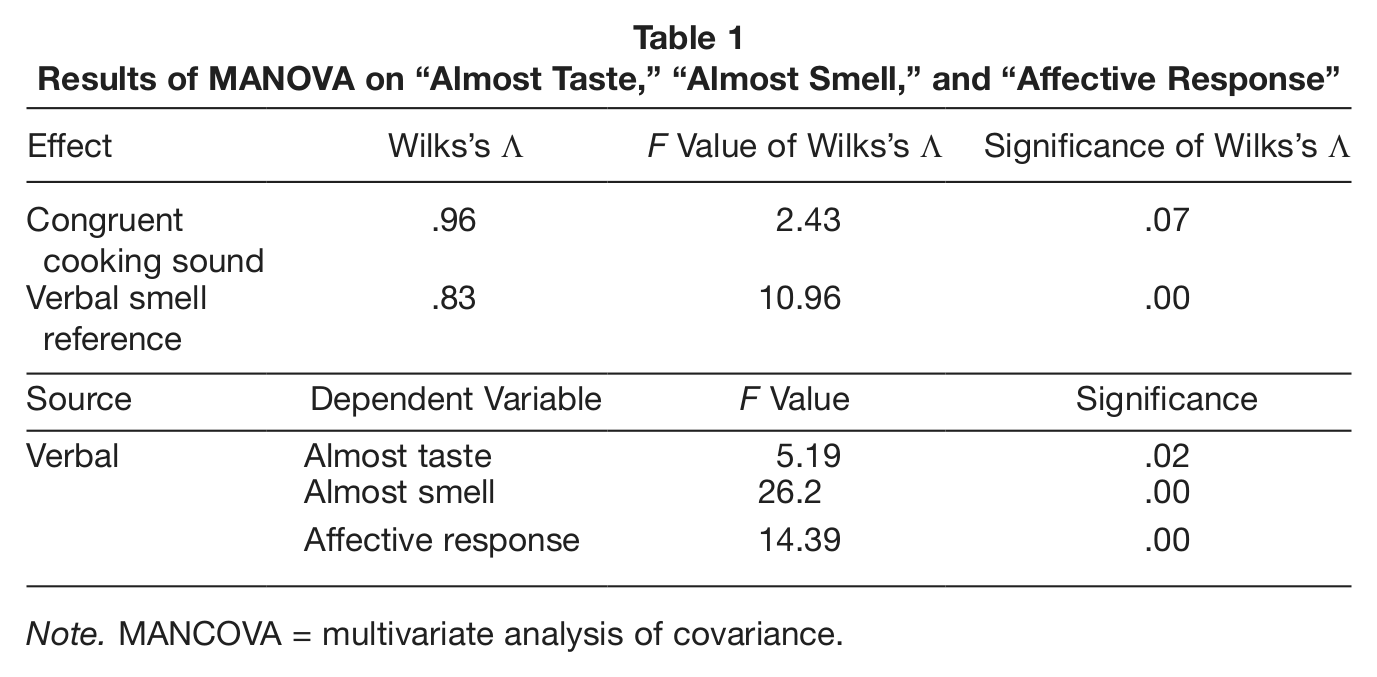
Upon meeting the above assumptions, in the MANOVA model, `almost smell,' `almost taste,' and affective response served as dependent measures, the verbal smell reference (present or absent) served as a fixed factor, and the congruent cooking sound served as a covariate (see Table 1). MANOVA was used because the DVs are related to each other (correlations between each of the DVs are all significant at the .01 level). A significant effect of the verbal smell reference was found (Λ3,158 = 0.828, p = .000). Follow-up univariate ANOVAs indicate that a verbal smell reference in an ad significantly enhances an individual’s ability to almost smell an advertised food (F1,158 = 26.2, p = .000, partial η2 = 0.14). Therefore, Hypothesis 1 is supported: Using a verbal smell reference in a radio food advertisement positively influences the listener’s perceived ability to almost smell the food when listening to the advertisement. The estimated marginal mean of the “almost smell” DV for Verbal referenceAbsent = 2.91 versus 4.00 for Verbal referencePresent.
Results of MANOVA on “Almost Taste,” “Almost Smell,” and “Affective Response”
Note. MANCOVA = multivariate analysis of covariance.
In addition, follow-up univariate ANOVAs also reveal that a verbal smell reference in an ad significantly enhances an individual’s ability to almost taste an advertised food (F1,158 = 5.19, p = .024, partial η2 = 0.03). Therefore, Hypothesis 2 is supported: Using a verbal smell reference in a radio food advertisement positively influences the listener’s perceived ability to almost taste the food when listening to the advertisement. The estimated marginal mean of the “almost taste” DV for Verbal referenceAbsent = 3.4 versus 3.9 for Verbal referencePresent.
The ANOVA results also indicate that a verbal smell reference in an ad significantly enhances an individual’s affective response to an advertisement associated with that smell (F1,158 = 14.39, p = .000, partial η2 =.08). Thus, Hypothesis 3 is supported: Using a verbal smell reference in a radio food advertisement positively influences the listener’s affective response to the advertisement. The estimated marginal mean of the affective response DV for Verbal referenceAbsent = 3.54 versus 4.27 for Verbal referencePresent.
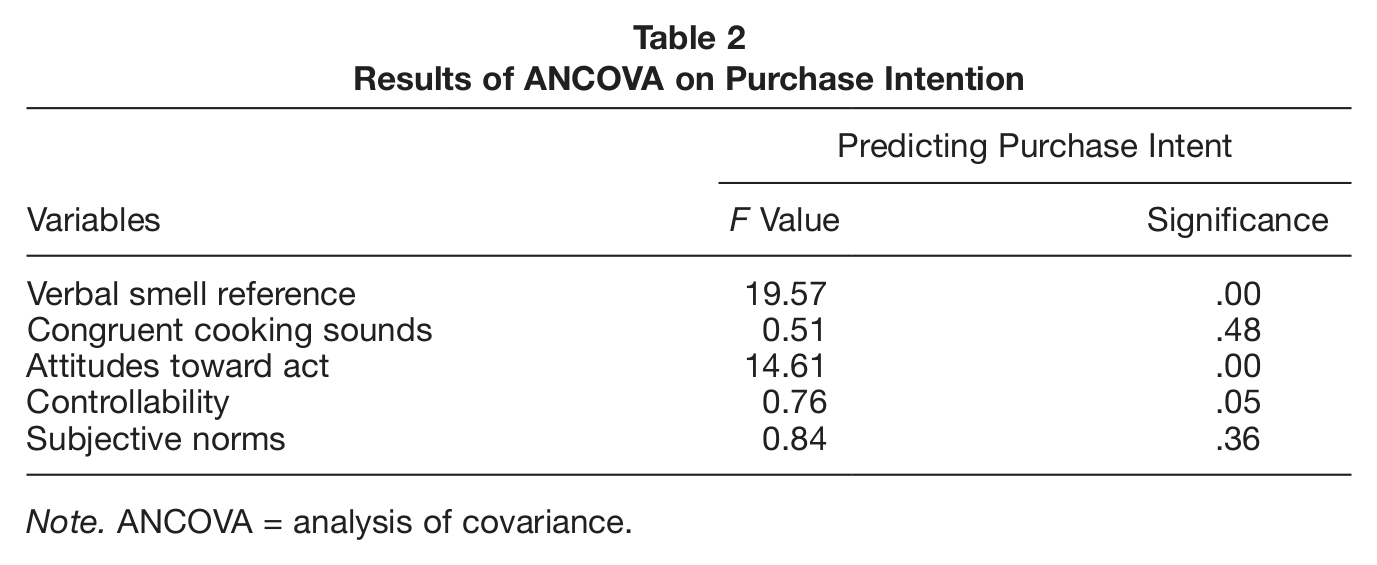
Because of the potentially intervening influences of the components of the TPB, a separate analysis of covariance (ANCOVA) was calculated for the purchase intent prediction (Hypothesis 4). In this model, verbal smell reference served as the independent variable; purchase intent served as the dependent variable, the components of TPB (controllability, attitude toward the act, and subjective norms) and congruent cooking sounds served as covariates (see Table 2). Results indicate that when controlling for these three components of TPB, which are known to influence consumers’ purchase intentions, a verbal smell reference does have a significant influence on purchase intent (F1,156 = 19.57, p = .000, partial η2 = 0.12). Therefore, Hypothesis 4 is supported: Using a verbal smell reference in a radio food advertisement positively influences the listener’s purchase intent. The estimated marginal mean of the purchase intent DV for Verbal referenceAbsent = 3.46 versus 4.38 for Verbal referencePresent.
Results of ANCOVA on Purchase Intention
Note. ANCOVA = analysis of covariance.
Further Testing the Theoretical Support for Hypothesis 3
To test the brand excitement mediation between the verbal smell reference and affective response, this research employed Baron and Kenny’s (1986) procedure. The procedure calls for the calculation of a series of three linear regression models. The procedure mandates that (a) the IV significantly influences the mediator, (b) the IV significantly influences that the DV, and (c) the mediator influences the DV when both the IVs and the DVs are in the model. If these conditions hold in the predicted direction, then the effect of the IV on the DV should be less in the third regression model than in the second (Baron & Kenny, 1986). Perfect mediation holds if the IV has no significant effect on the DV when the mediator is controlled (third regression).
Before conducting the Baron and Kenny (1986) procedure, it was verified that the data did not violate any of the assumptions of linear regression (Hair et al., 1998; Hair et al., 2006). That is, (a) there is a linear relationship between the DVs and IVs, (b) there is no serial correlation between the error terms (interdependence), (c) the error terms have constant variance (homoscedasticity), and (4) the errors are normally distributed.
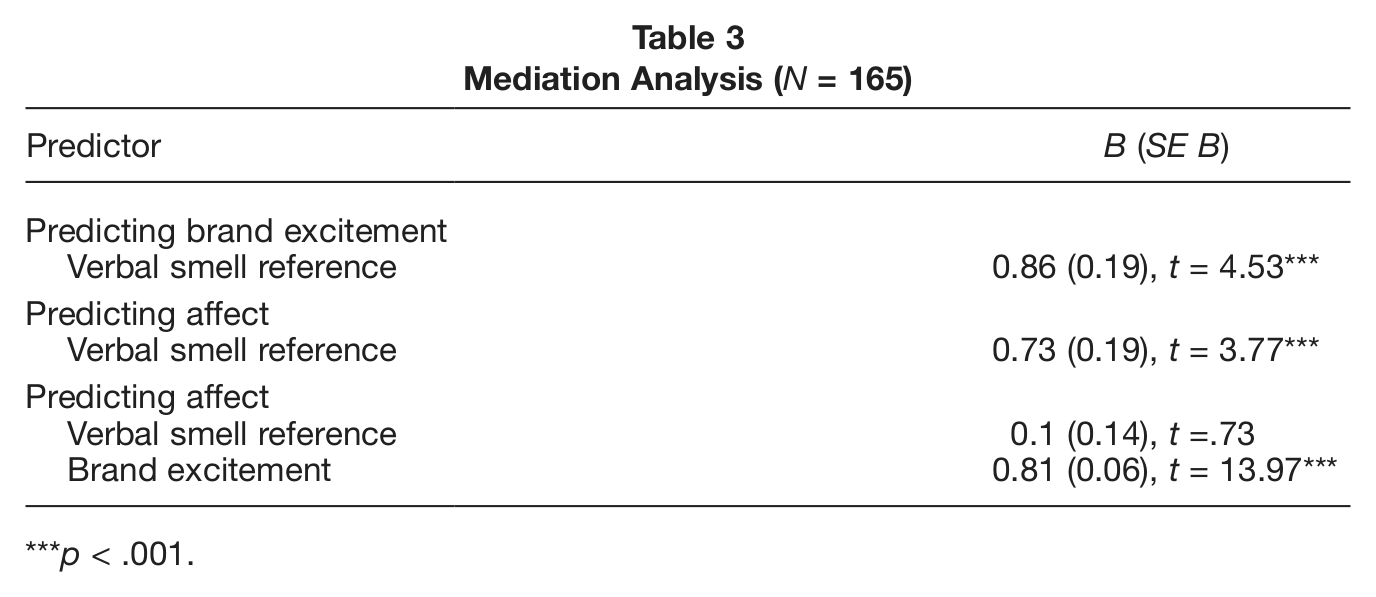
The results of Baron and Kenny’s (1986) procedures are shown in Table 3. Regression analysis indicated that the effect of the verbal smell reference on brand excitement was significant (t = 4.53, p < .001). Next, the effect of verbal smell reference on affective response was significant (t = 3.77, p < .001). Furthermore, brand excitement significantly influenced affective response (t = 13.97, p < .001), and verbal smell reference in the same equation did not significantly influence affective response (t = 0.728, p = .47). This combination of findings indicates perfect mediation (Baron & Kenny, 1986).
Mediation Analysis (N = 165)
p < .001.
Discussion
This research finds that a verbal smell reference in a radio ad significantly influences a potential consumer’s ability to almost smell and almost taste the advertised product. The smell reference also significantly affects individuals’ affective responses to the ad and purchase intent for the product. Interestingly, this research also found that the level of brand excitement associated with the advertised brand perfectly mediates the relationship between the verbal smell reference and the affective responses. By examining the link between verbal smell references and radio advertising, this study makes several contributions to the literature on advertisement design and efficacy, and sensory stimuli’s effects on consumers. First, this research extends Elder and Krishna’s (2009) findings by incorporating verbal stimuli in the form of radio advertising in place of visual advertising. Likewise, this research fills the gap mentioned by Magnini and Gaskins (2010), which states a need for research linking verbal smell references to a consumer’s affective response.
The predictions surrounding a verbal smell reference’s influence on outcome variables are novel contentions in the academic literature. The significant influence that the verbal smell reference exerted on all four measured consequences in this study (almost taste, almost smell, affective response, and purchase intent) advances our existing body of knowledge. The interconnections between human modalities appear formidable: The audio description of an olfactory stimulus does produce significant outcomes according to these results. The fact that smell is the strongest human modality (Schifferstein & Tanudjaja, 2004) likely, in part, drove these reactions of potential consumers listening to the experimental advertisements.
The smell reference → brand excitement → affective response causal chain has never been examined in the extant literature, but the perfect mediation found in this research serves to extend our knowledge. That is, according to the literature search described herein, brand personality literature has rarely, if ever, been cross-pollinated with sensory advertising research. The mediation uncovered in this research aids our understanding of the influence of verbal smell references on affective responses and hopefully opens the door for further fusion of these disparate streams of literature.
Furthermore, the empirical research presented herein augments D. Aakeret al.’s (1986) findings. By limiting the exposure to visual stimuli through the use of audio stimuli, this study shows that advertisements with sensory stimuli can still be effective with consumers without complete sensory exposure. It is often thought that if an individual possesses a physical handicap limiting one of his or her senses, then his or her alternate senses strengthen as a natural means of compensation. Although this research did not test audio in conjunction with visual, the verbal smell reference certainly appears to be a useful advertising tactic in an audio-only format. Magnini and Gaskins (2010) and Magnini and Karande (2010) tested the written smell references in print ads and found that they exert positive outcomes on consumer affect and behavior; this research now advances this body of inquiry to include smell references in an audio format.
From a managerial perspective, research with the intended focus of exploring how restaurant advertising can be more effective is pragmatically relevant because of the high failure rates of restaurants and high advertising expenditures. Practice is usually wiser than theory: Restaurateurs have long been aware of the strong influence of smells on consumer psychology within a restaurant’s physical environment. For decades, it has been common practice in the industry to vent appetizing smells from the kitchen to the front-of-house and to offer ample circulation for the expulsion of negative smells from the physical environment (e.g., smells associated with used fryer oil and the dishwashing areas). The findings of this investigation, however, reveal that verbal smell references are linked to the consumer’s ability to almost smell and almost taste the food being cooked. Hence, managers should keep the interconnections between diners’ modalities near the top of their minds when developing advertising strategies.
In addition, the results suggest that verbal smell references positively influence the listener’s affective response to the ad, in addition to positively influencing their purchase intent. Therefore, managers and advertisers within the restaurant industry may consider incorporating verbal smell references into their advertisements. Incorporating a verbal smell reference is relatively straightforward: First, consumers can be polled to derive adjectives that best describe the smell of the advertised food being cooked, and second, a verbal smell reference is written using the adjectives and inserted into the advertising copy. From an anecdotal perspective, using verbal smell references does not currently appear to be a common practice but is associated with potential value. Often the first mover on an advertising strategic initiative has greater results than the laggard. That is, if perhaps most restaurant ads eventually begin to incorporate smell references, the margin of their utility might shrink; thus, managers are encouraged to consider the results brought forth here.
The verbal smell reference → brand excitement → affective response causal chain suggests a couple of things to managers. First, conceptualizing these linkages enhances the understanding of how the influence of a verbal smell reference works. Stated differently, managers who understand a “process” should have an advantage over managers who cannot conceptualize the same process, particularly one that relates to consumers’ reactions to advertising stimuli. Second, the final portion of the causal chain tells managers that perceptions of brand excitement are an antecedent to positive affect. Managers should, therefore, investigate additional means to communicate a sense of brand excitement through their marketing communications.
The findings of this study must be tempered with certain limitations. As with any experimental design, extending results beyond the instruments, context, and sample used in the experiment must be done cautiously. Regarding the experimental instrument, although the radio advertisements used in this study were of professional quality, the classroom sound systems through which they were broadcast in this experiment were not of high audio quality. As a result of this factor, all the estimated marginal means found in this study are in the marginal range, with none performing exceptionally well. Although this sound quality consideration serves as a limitation of the research, few alternatives are available for better audio quality in an experimental setting because permitting subjects to participate in uncontrolled settings raises the possibility of experimental contamination due to a number of extraneous variables (e.g., variations in the sound quality of individual personal computers). In terms of sample and context, using different samples and settings, future studies could work toward increasing the generalizability of these findings in this pragmatically and theoretically rich area of inquiry.