



Abstract
This research applied a fuzzy analytic hierarchy process (AHP) to explore the criteria required for the selection of an overseas travel intermediary (OTI) for group package tours (GPTs). Selecting an OTI is a complex decision for host travel agencies, especially the choice of evaluation criteria for GPTs. Therefore, this study adopts an AHP method and further integrates a fuzzy set theory into the assessment of the selection criteria. This work collected 20 selection criteria from literature reviews, focus group, and the Delphi technique. Criteria were categorized into four dimensions, namely service capabilities, payment conditions and cost, reputation, and interactive relationships. Twenty-two general managers from different travel agencies were asked to weigh up and rank the overall criteria by applying a fuzzy AHP. The results could provide travel agencies with objective and suitable criteria for the selection of OTIs for GPTs.
Keywords
Introduction
In the Asia region, such as China, Japan, Korea, Hong Kong, and Taiwan, the group package tour (GPT) is one of the main modes of foreign travel (e.g., Meng, 2010; Wang, Hsieh, & Chen, 2002; Wang, Hsieh, & Huan, 2000). GPT is a tourism product that customers pay for as a single price to the travel agency prior to the trip. The travel agency will then arrange commercial transportation, accommodation, meals, sightseeing, and entertainment (Morrison, 1989). Teng (2005) indicated that nearly 90% of Chinese outbound tourists visit Southeast Asia with the service of a GPT. Thus, a GPT is the main form of business for many travel agencies administering outbound travel.
The tourism distribution of a package tour mainly consists of three channel members: suppliers, intermediaries, and consumers (Pearce, 2008). Intermediaries act as a bridge between suppliers and consumers. Lin, Lee, and Chen (2009) divided intermediaries into the host travel agency and the destination tour operator. However, Pearce (2008) separated intermediaries further into the wholesaler, retailer, and inbound tour operator. Most Taiwanese host travel agencies not only belong to the wholesaler category but they also act partly as retailers in the tourism distribution chain. This is because some Taiwanese retailers are capable of organizing and conducting tours independently. Therefore, this study deals with the relationship between the Taiwanese host travel agencies and destination tour operators. Generally, the destination tour operator is considered to be an overseas travel intermediary (hereafter abbreviated OTI) for the host travel agency. The host travel agencies usually depend on the OTIs’ advice on organizing package tours because of their familiarity of the destination (Pearce, Tan, & Schott, 2007). Consequently, Lin et al. (2009) proposed the OTI position within the tourism distribution chain, which is highlighted in Figure 1.

The Role of the Overseas Travel Intermediary in the Tourism Distribution System
In the outbound travel market, most Asian travel agencies must rely on OTIs to provide outbound-related GPT services (Gartner & Bachri, 1994; Wang et al., 2000; Wang et al., 2002). As a consequence of the existence of more than 3,000 travel agencies in Taiwan, many of which are small scale, Taiwanese host travel agencies have difficulties when consulting with suppliers overseas, thus relying much more on the assistance of OTIs. Reid and Pearce (2008) pointed out that a host travel agency may use an OTI or other local representative, particularly for some long-haul foreign destinations when unfamiliarity with the place, language, cultural differences and/or political situations necessitate their use or when specialized local knowledge is required for certain products. Additionally, the host travel agency could use the services and coordination provided by OTIs to reduce operational costs, risk, and required working capital (Sheldon, 1986). Moreover, the host travel agency cannot directly control the quality of outbound GPTs supplied by OTIs (Lin et al., 2009). Thus, selecting the ideal OTI is a critical decision for a host travel agency.
From a supply chain perspective, the selection of OTIs by travel agencies can be taken as a supplier-selection issue. A supplier is defined as a maintenance service provider for companies (Chan, Chan, Ip, & Lau, 2007). An OTI provides a service about GPT practice and destination-related knowledge for the travel agency. Recently, the relationship between travel agencies and OTIs has been increasingly attended to by researchers. For instance, Lin et al. (2009) evaluated the service performance of OTIs from the host travel agency’s viewpoint. When a buyer builds a long-term relationship with a supplier, a company’s supply chain generates a tough barrier for competitors to break through (Choi & Hartley, 1996). Therefore, the effective selection of a supplier can create competitive advantages for a company and has a positive impact on a company’s performance (Hsu, Kannan, Leong, & Tan, 2006).
Many studies have proposed certain criteria on how to select a supplier in different industries, such as manufacturing, high-technology, electronics, and airline companies (Chan & Chan, 2004; Chan et al., 2007; Chen, Lin, & Huang, 2006; Gencer & Gurpinar, 2007; Şen, Başligil, Şen, & Baraçli, 2008). Several studies have pointed out the rules for selecting suppliers in the tourism industry (Kim & Boo, 2010; Pearce, 2007). However, there has been little attention paid to the selection criteria for OTIs from the perspective of the host travel agency.
Lin et al. (2009) emphasized that host travel agencies should be prudent when obtaining appropriate OTIs to ensure that good service quality is maintained on outbound GPTs. However, the selection of a proper OTI, which suits the needs of the travel agency, is a complex task. A framework for evaluating the selection of OTIs may provide some useful insights to help supervisors make a decision. Therefore, the purpose of this study is to explore the selection criteria of OTIs for GPTs and establish an evaluative framework.
It should be realized that the importance of each selection criterion is completely unequal and that human judgments are subjective and ambiguous (Tsaur & Wang, 2007; Wang, Cheng, & Cheng, 2009). Moreover, it is essential to clarify the importance of criteria when companies own limited resources. Therefore, the present research applies a fuzzy analytic hierarchy process (AHP) to objectively calculate the weights of the criteria.
Supplier-Selection Criteria
Since the 1960s, researchers have attempted to propose criteria for supplier selection. Dickson (1966) identified 23 potential vendor-selection criteria considered by purchasing managers. Other studies have identified selection criteria for different industries. Chan and Chan (2004) proposed a framework that included 20 criteria for selecting suppliers in the advanced technology industry. Jharkharia and Shankar (2007) suggested 16 criteria to select service providers for logistics. Chan et al. (2007) constructed an evaluation model comprising of 14 criteria and 36 subcriteria for airline companies when selecting suppliers. Furthermore, Şen et al. (2008) viewed 49 supplier selection criteria as important to consider during the supplier selection process in the electronics business.
Hospitality and tourism studies applied selected criteria for either supplier selection or buyer–seller relationships from its own literature reviews. In terms of supplier selection, Reid and Riegel (1989) offered 20 criteria for selecting suppliers in the foodservice industry, and results showed that accurate and on-time delivery, consistent quality with reasonable prices, and a willingness to work together were the critical principles among those criteria. In exploring factors that influence offshore intermediaries’ selection of New Zealand’s suppliers in Australia, Great Britain, and the USA, Pearce (2007) found that factors were related to the product (including market fit, market demand, and product quality), to people (the attributes of the suppliers themselves), and to pricing. Kim and Boo (2010) found 15 criteria, such as the ability of the supplier to provide quality specifications, the social bonds with the supplier, and so on, when analyzing meeting planners’ supplier-selection criteria.
On the other hand, buyer–supplier relationships have been discussed in the travel and foodservice industries, such as Japanese wholesalers and Australian suppliers (March, 1997), Taiwanese retailer and wholesaler travel agencies (Tsaur, Yung, & Lin, 2006), and restaurants and suppliers (Crotts, Coppage, & Andibo, 2001). Interestingly, a study looks into how consumers select travel agencies for package tours. The research discovers six factors: interactive agent quality, formal communication, overall convenience, pricing, product features, and image. Among the attributes, agency reputation is ranked as the most important attribute (Heung & Chu, 2000). By focusing on OTIs’ selection criteria from the perspective of travel agency managers, this study may provide fresh findings which are different from those criteria established in other industries.
The Framework for OTI Selection Criteria
The process of establishing a framework for OTI selection criteria was divided into two separate parts. In Part 1, the evaluation dimensions and criteria of OTI selection were determined using a literature review, a focus group, and the Delphi technique. A series of selection-related criteria was collected from the literature concerning supplier selection. The focus group consisted of three senior travel managers and two scholars and was conducted to modify, add, and delete criteria. Finally, 20 travel managers were invited to participate in an expert survey to assess criteria suitability and confirm the final selection criteria. The second part used the fuzzy AHP to judge the appropriate weighting for each criterion and establish an evaluation framework.
Part 1: Development of Selection Criteria
Initial evaluation criteria
For the host travel agency, the OTI is a kind of upstream firm. The relationship between the host travel agency and the OTI can be considered as buyer and supplier. Accordingly, some supplier-selection criteria may be appropriate when selecting OTIs.
Consequently, this study reviewed the existing literature related to supplier selection within the fields of tourism and other disciplines, and then collected 20 criteria (e.g., Chan & Chan, 2004; Chan et al., 2007; Jharkharia & Shankar, 2007; Kim & Boo, 2010; Pearce, 2007; Şen et al., 2008). Subsequently, a focus group was conducted by inviting three senior travel managers (from a travel agency that administers outbound travel) and two scholars (specializing in travel agency management) to participate in focus interviews. The purpose of the focus group was to establish the selection criteria by deleting and modifying the criteria arising from the literature as well as adding new evaluation criteria. This focus group was composed of three sessions. During the first session, discussions among the experts captured the consensus for deleting seven criteria that were unfit for selecting OTIs. These were technical capability, performance history, size and quality of fixed assets, geographical location, the number of personnel, labor relations record, and employee satisfaction level. In the second session, the experts reviewed each criterion retained after the first session, and modified them to be applicable for travel agencies. Furthermore, the experts explained the definitions and relevance of the OTI selection criterion in detail, based on their practical experience. In the third session, the experts were required to answer an open question: “Except for the above criterion, are there any other factors that can determine the selection of OTIs?” Twelve additional evaluation criteria were attained in this session. After discussions among the experts, a total of 25 criteria and explanations were reserved to develop a Delphi questionnaire in the next phase.
Final selection criteria
Final criteria for OTI selection was established using the Delphi technique. The Delphi technique is a unique method of eliciting and refining group judgment based on the idea that a group of experts is better than a single expert when exact knowledge is not available (Kaynak & Macauley, 1984). Taylor and Judd (1989) consider that the most important step of the Delphi technique is selecting the experts. An expert is someone who has knowledge of, or who has acquired special skills in, a particular subject (Mitchell, 1991). Selection of OTI is a practical problem for the host travel agency. This study selected experts who are travel managers and product-line managers in travel agencies operating outbound GPTs. Murry and Hammons (1995) suggested that the Delphi technique must summarize expert opinions on a range from 10 to 30. Therefore, 14 general managers and 6 product-line managers from different companies were invited to participate in an expert survey. These experts were asked for their opinions on the 25 evaluation criteria, in accordance with the Delphi survey method. Anchors of the 5-point Likert-type scale, ranging from strongly agree, agree, neutral, disagree, to strongly disagree, were used to explore the suitability of each criterion.
The first round began in September 2010 and all questionnaires were returned. According to the recommendation of Taylor and Judd (1989), open questions were added in order to collect more information that could beneficially clarify the topic. Suitability was adopted as the basis for criterion selection. For a criterion, a median within the range of “agree” to “strongly agree” would indicate that more than 50% of the participants agreed to choose it (Tsaur, Lin, & Lin, 2006). Five criteria were eliminated and these were industry experience, position in the industry, reasonable payment policy, popularization of branch office, and foreign exchange rate. No new criterion was added. The final 20 criteria were used for the next investigation.
The second round of the survey began in December 2010. Removing the items on openness, the questionnaire contents were the same except for the number of criteria. The results from the first round were also provided to participants. Twenty questionnaires were returned and a t test was used to determine whether or not the experts’ opinions on the first and second rounds were similar. The results exhibited that a significance level of α = .05 was reached, and the p value of all criteria exceeded .05. The research showed that there was no significant difference in the mean scores between Round 1 and Round 2; the experts had reached a consensus on all criteria. Thus, further rounds would not produce any extra divergence of opinions. Finally, this study categorized the 20 criteria into four dimensions, based on previous literature and the experts’ opinions. A detailed definition and relevance of the criteria in OTI selection are shown in Table 1.
Selection Criteria of Overseas Travel Intermediary (OTI)

Part 2: Fuzzy Analytic Hierarchy Process
Selecting suppliers is a multicriteria decision-making issue (Chan et al., 2007; Şen et al., 2008). This study incorporates the AHP (Saaty, 1980) and fuzzy set theory (Zadeh, 1965) to evaluate the performance of each criterion.
The AHP proposed by Saaty (1980) is a flexible, quantitative method for selecting between alternatives, based on their relative performance with respect to one or more criteria of interest (Vahidnia, Alesheikh, & Alimohammadi, 2009). The AHP could transform complex problems into a simple hierarchic structure. The hierarchy is constructed through pairwise comparisons of individual judgments, rather than attempting to prioritize an entire list of criteria (Saaty, 1980).
However, the AHP is often criticized for its inability to incorporate the inherent uncertainty and imprecision associated with mapping the decision makers’ perceptions to exact numbers (Deng, 1999). Also, the AHP cannot reflect human thinking (Kahraman, Cebeci, & Ulukan, 2003). Since ambiguity is a common characteristic of decision-making problems, fuzzy set theory was proposed by Zadeh (1965) to deal with vague human thought. Moreover, some studies have combined the fuzzy theory with the AHP to compensate for this limitation (Hsu, Lee, & Kreng, 2010; Kahraman et al., 2003; Lin et al., 2009; Vahidnia et al., 2009). The Fuzzy AHP allows decision makers to express approximate or flexible preferences using fuzzy numbers where adding fuzziness to the input implies adding fuzziness to the judgment (Feng, 1995; Vahidnia et al., 2009). Therefore, the present research adopts the notions of Lin et al. (2009) to analyze data and reach a consensus among experts. Moreover, the eigenvector method is used to calculate the weights of each criterion. Fuzzy AHP applications in this study are elaborated as follows.
The AHP uses the pairwise comparison method to rank, in order, the alternatives of a problem that are formulated and solved in a hierarchical structure, as in Formula (1). Let C1, C2, . . ., Cn be the set of elements, while aij represents a quantified judgment on a pair of elements Ci, Cj. The elements of a given level are mutually independent, but comparable with the elements of the same level. The relative importance of two elements is rated using a scale with the values 1, 3, 5, 7, and 9, where 1 refers to equally important, 3 denotes slightly more important, 5 equals strongly more important, 7 represents demonstrably more important, and 9 for absolutely more important. This yields an n × n matrix A, as follows:
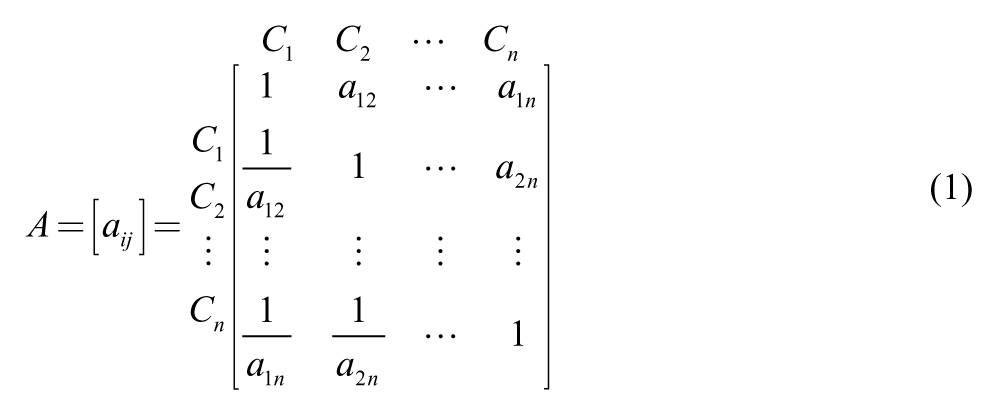
where aij = 1 and aij = 1/aji; i, j = 1, 2, . . ., n.
Consequently, the fuzzy AHP substitutes a specific figure for aij with triangular fuzzy numbers aij, implying that triangular fuzzy numbers are substituted into the pairwise comparison matrix to deal with criteria measurement and determine the fuzzy consensus problem in judgment. Various α-cuts are then converted for calculation. The relative weights of the elements of each level are calculated as follows:
Establishment of triangular fuzzy numbers
This study uses geometric mean as the mode for triangular fuzzy numbers where the mean of membership is equal to 1. Where U denotes the maximum numerical value for a consensus among experts, and L is the minimum numerical value, M is the geometric mean, which represents the consensus of most experts. Thus, the values within L and U refer to the possibilities for diverse consensuses (Figure 2).
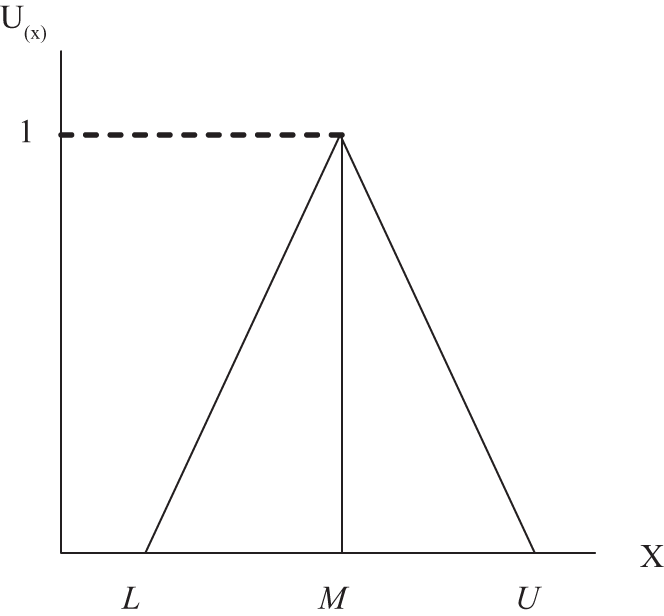
Triangular Fuzzy Numbers
Fuzzy numbers should be used to combine fragmented expert opinions, while each number in the pairwise comparison matrix portrays the subjective judgment of decision makers and is a vague concept. The triangular fuzzy numbers are set up as follows:




where Bijk represents a judgment of expert k for the relative importance of two criteria Ci and Cj.
Establishment of a fuzzy pairwise comparison matrix
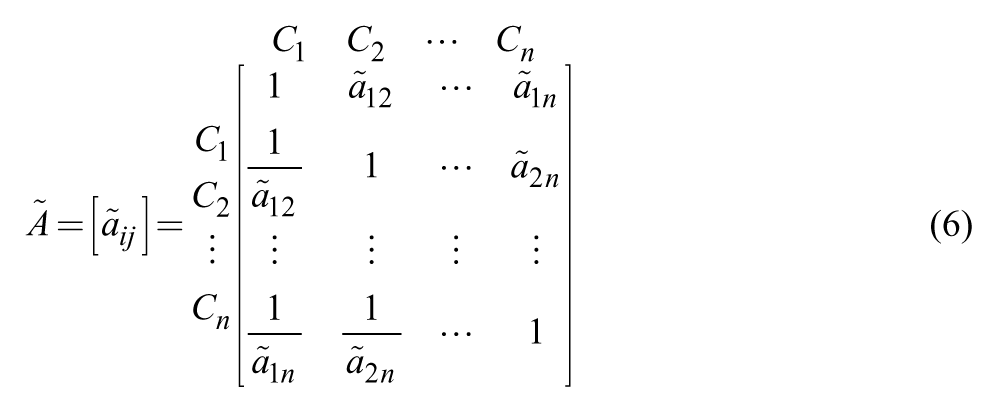
where denotes a triangular fuzzy matrix for the relative importance of two criteria C1 and C2. Meanwhile, represents the triangular fuzzy numbers in Formulae (2) to (5).
Defuzzification
Although various methods are available for defuzzification, this study adopted the method derived from Lin et al. (2009), as well as Liou and Wang (1992). As shown in Equation (7), this method can explicitly state fuzzy perception (Chang, Wu, & Chen, 2008). On account of the ability of this method to clearly present the preference (α) and risk tolerance (λ) of decision makers, it can completely identify with the risks they face in different situations.
In particular, α can be viewed as a stable or variable condition (Lin et al., 2009). The range of uncertainty is the greatest when α = 0. Meanwhile, the decision-making environment stabilizes when increasing α while, simultaneously, the variance for decision making decreases. Besides, α value is a number between 0 and 1, as well as normally set as the following 10 numbers, 0.1, 0.2, . . ., 1 for uncertainty emulation in the analysis. Additionally, whereas α = 0 represents the upper bound Uij and lower bound Lij of triangular fuzzy numbers, α = 1 represents the geometric mean Mij in triangular fuzzy numbers, and λ can be viewed as the degree of pessimism among decision makers (Chang et al., 2008). When λ is 0, the decision makers are optimistic and the upper bound Uij of the triangular fuzzy number is given. Conversely, when λ is 1, the decision makers are pessimistic and the expert consensus is the lower bound Lij of the triangular fuzzy number. λ ranges from 0 to1 and is usually set as 0.1, 0.2, 0.5, 0.7, and 0.9 to emulate the mental state of the decision maker.

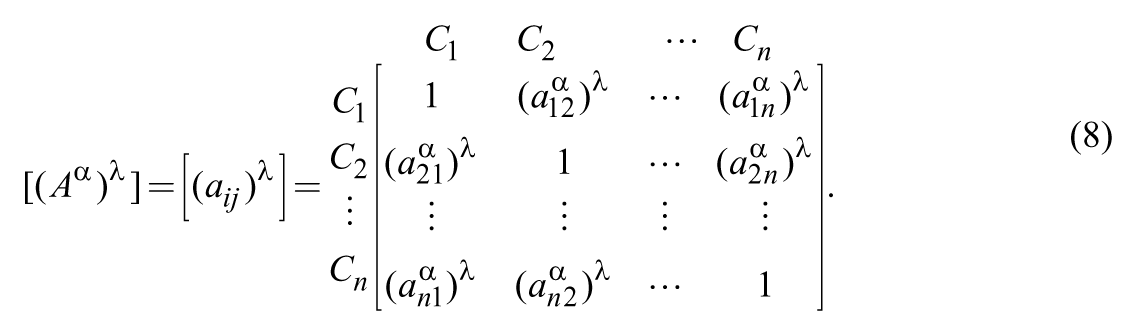
where represents the left-end value of α-cut for aij and represents the right-end value of α-cut for aij. The single pairwise comparison matrix is expressed in Equation (8):
Calculation of eigenvalue and eigenvector
In particular,


where W denotes the eigenvector of
Consistency test
Saaty (1980) provides a consistency index (CI) to measure any inconsistency within the judgments in each pairwise comparison matrix, as well as for the entire hierarchy. The CI is formulated as follows:

where λ–max is the maximum eigenvalue, and n is the dimension of matrix.
The consistency ratio (CR) was introduced to aid the decision on revising the matrix or not. It is defined as the ratio of the CI to the so-called random index (RI), which is a CI of randomly generated matrices:

For n = 3, the required CR should be less than 0.05. For n = 4 it should be less than 0.08 and for n ≥ 5 it should be less than 0.10 to get a sufficiently consistent matrix. Otherwise the matrix should be revised (Saaty, 1980).
Empirical Study of Evaluation Framework
The 22 major host travel agencies in Taiwan with a high volume of outbound GPTs were chosen as the subjects of this empirical study. Considering the notion of Pearce (2008), compared with long-haul markets, host travel agencies might neglect the assistance of an OTI in the short-haul markets and directly consult with overseas suppliers to source GPT. Therefore, European OTIs acted as the targets for evaluation of the selection criteria by Taiwanese host travel agencies. Because European markets are much further away and more different in culture and language for Taiwanese host travel agencies, they depend more on OTIs. The criteria were weighted based on answers provided by travel agency representatives. The framework development procedures are described in the following sections.
Step 1: Define the Evaluative Dimensions and Criteria
Here, the evaluation dimensions and criteria used to select the ideal OTI are obtained and defined using a literature review and a focus group. Furthermore, the Delphi method confirms the whole evaluation framework. Detailed explanation of dimensions and criteria are presented in Table 1.
Step 2: Establish Hierarchy Structure
Based on the experts’ opinions and suggestions, OTI optimal selection is defined and evaluated based on three levels: Level 1 is the top goal level, indicative of an ideal OTI; Level 2 represents the eight evaluation dimensions for selecting an OTI; and last, 20 selection criteria are included in Level 3 of the whole hierarchical structure, as shown in Figure 3.

A Hierarchical Structure With Relative Weights for the Evaluation
Step 3: Establish the Triangular Fuzzy Pairwise Comparison Matrix
This study established the triangular fuzzy numbers using Formulae (2) to (5). The AHP questionnaire was administered to a sample of 22 respondents comprising general managers from different travel agencies, with each respondent making a pairwise comparison of the decision elements and giving them relative scores.
Step 4: Perform Defuzzification Using Formula (7) and Establish the Pairwise Comparison Matrix
Tables 2 and 3 describe the aggregate pairwise comparison matrices for Levels 2 and 3. Considering the diagonal as the center line, the number in the upper triangle is the reciprocal of the reversed triangle, which represents the relative importance between these two criteria. For instance, 3.146 in Table 3 means A1 is 3.146 times more important than A2. Those numerics were calculated through Formula (7), taking the “service ability” dimension as an example, such as in Table 3; when α and γ are both 0.5, defuzzification is performed, as follows:

Aggregate Pairwise Comparison Matrix for Level 2
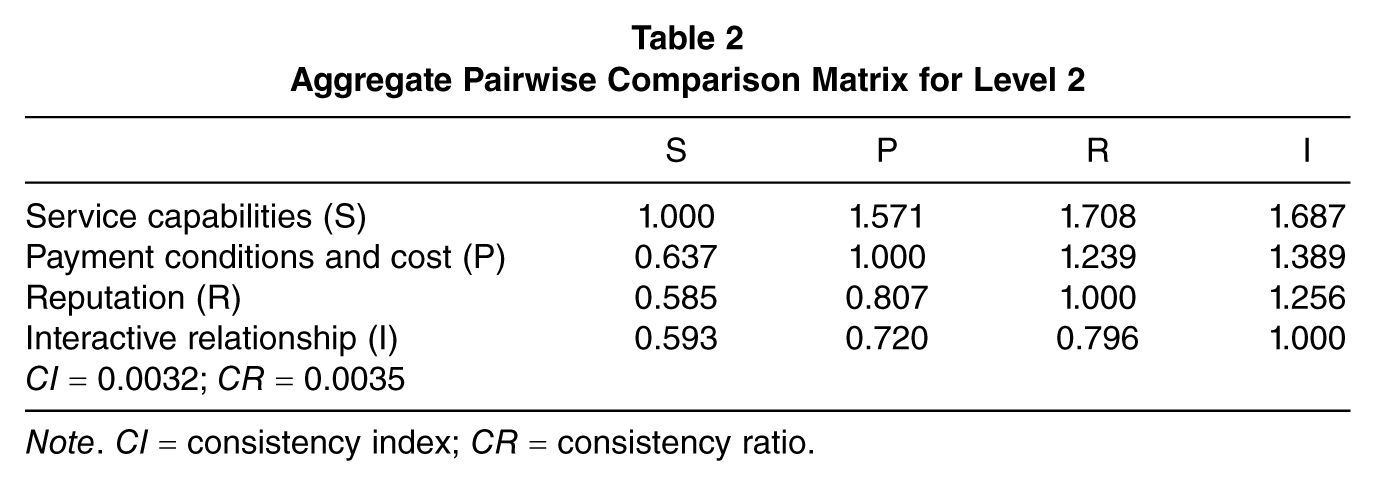
Note. CI = consistency index; CR = consistency ratio.
Service Capabilities Aggregate Pairwise Comparison Matrix for Level 3
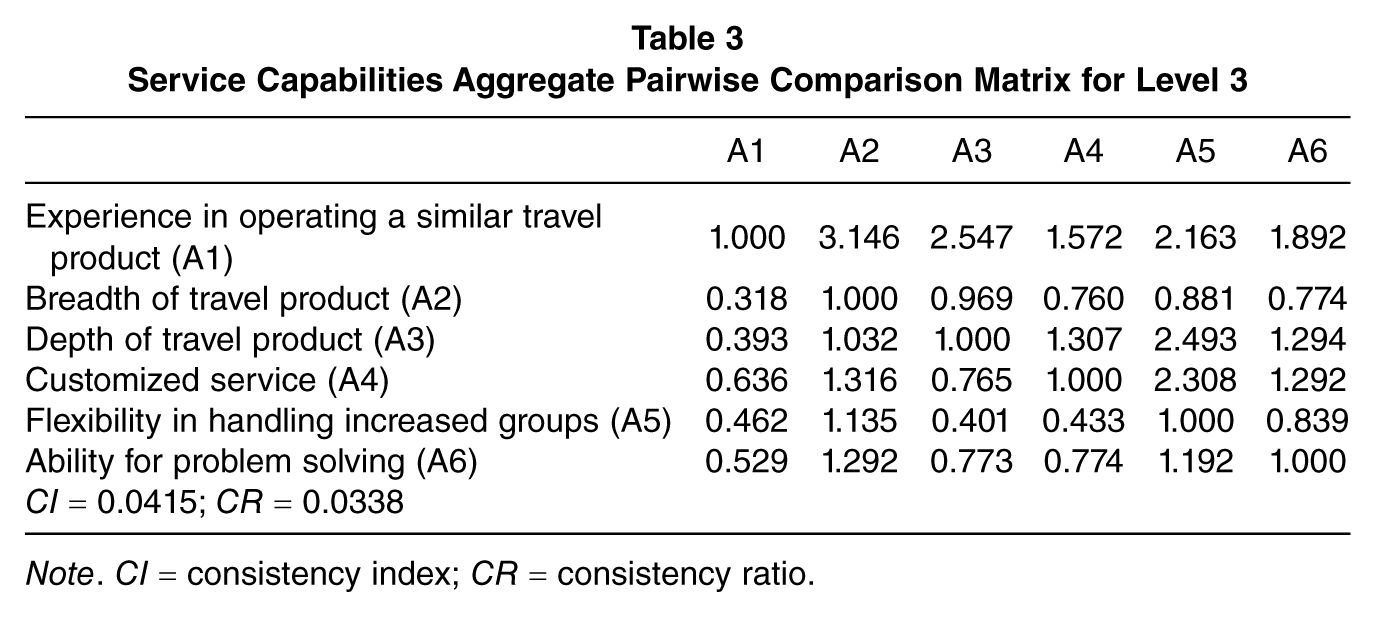
Note. CI = consistency index; CR = consistency ratio.
Step 5: Calculate the Eigenvalue and Eigenvector
Based on the environmental uncertainty for selecting an OTI, α-cut and λ were subjectively determined by experts. This study decided to take the middle road, and further assigned 0.5 as the value of λ and α, depending on the opinions of the travel agency’s administrators. Finally, the eigenvalues and eigenvector of each pairwise comparison matrix were calculated using Formulae (9) and (10).
Step 6: Consistency Test
The consistency of each comparison matrix was tested using Formulae (11) and (12). The results of the consistency test show that the CRs of the comparison matrix from each of the 22 experts are all smaller than “0.1,” indicating “consistency.” For instance, the CRs in Tables 2 and 3 are individually 0.0035 and 0.0338. Therefore, we accept the estimate of the eigenvector for each pairwise comparison matrix.
Step 7: Estimate the Relative Weights of the Criteria for Each Level
Perform eigenvalues and eigenvectors using Formulae (11) and (12) and estimate the relative weights of each criterion by 22 evaluators. The relative weights of the four selection dimensions and 20 criteria are shown in Table 4.
Weights of Overall Level and Rank of Criteria
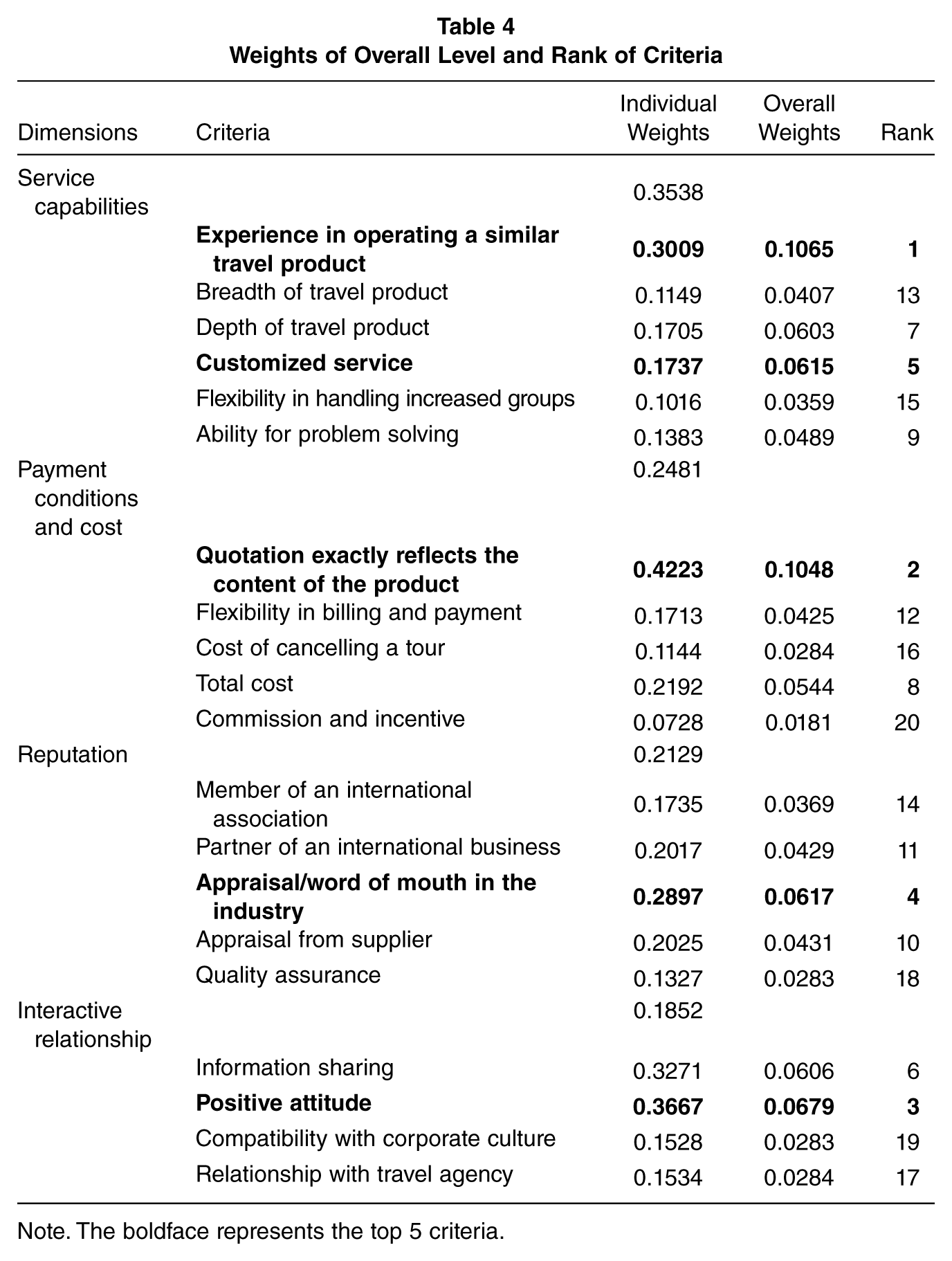
Note. The boldface represents the top 5 criteria.
Step 8: Calculate the Weights of Overall Levels
Table 4 presents the overall scores and priorities for each criterion. Fuzzy AHP results indicate the top five criteria as experience in operating a similar travel product (0.1065), the quotation exactly reflects the content of the product (0.1048), positive attitude (0.0679), appraisal/word of mouth in the industry (0.0617), and customized service (0.0615).
Discussion and Conclusions
This study reveals some significant findings among the four evaluation dimensions. The service capabilities dimension, related to the product and operations of an overseas tour operator, is the most important criterion. Following this are payment conditions and cost, which is related to finance; reputation, which is related to external characteristics; and interactive relationship, which is related to the relationship between the buyer and the supplier. The result is similar to that of Pearce (2007), regarding offshore wholesalers selecting suppliers in New Zealand. Product/service, price, reputation, and people were determinants for selecting OTI. However, OTIs play the role of connecting host travel agencies and suppliers in the tourism distribution chain. Therefore, this research offers particular criteria in selecting overseas tour operators from the perspective of host travel agencies, whereas Pearce’s research provides factors for overseas intermediaries in selecting New Zealand’s suppliers, which include helicopter operators, coach companies, hotels, and so on. Thus, factors of service capability such as experience, customized service, and flexibility are taken into serious consideration in this research context.
Service capabilities is the most considerable factor among the four evaluative dimensions. The result is in line with previous studies where the operational capability of the provider was considered more important than other selection criteria (e.g., financial performance and long-term relationships) by companies (Jharkharia & Shankar, 2007; Kim & Boo, 2010). According to Kim and Boo (2010), meeting planners focus mainly on the ability of the supplier when they make a selection decision. OTIs represent the overseas service extension of the host travel agency. Customers who are exposed to poor service at an overseas destination can directly complain about the host travel agency. The role of the OTI determines the competitive advantage of the travel agency. Therefore, service capability becomes a key determinant for selecting OTIs.
Among the 20 selection criteria of OTIs, the most important criteria are experience in operating a similar travel product, quotation exactly reflects the content of the product, positive attitude, appraisal/word of mouth in the industry, and customized service. It should be noted that the first four criteria, individually, come from different dimensions. These results imply that OTI selection requires multiple evaluation dimensions rather than dependence on one specific criterion. This result is inconsistent with previous studies as experience in operating a similar product was not the most important criterion in the selection of a logistics service provider (Jharkharia & Shankar, 2007) or a telecommunications system supplier (Tam & Tummala, 2001). Because a travel agency takes on more quality risk, the optimal manner of avoidance is to choose an experienced OTI who has operated a similar travel product. Furthermore, it could reduce the quality risks of the GPT due to the long-term operating experience of the OTI representative who has a stable relationship with cooperating suppliers (e.g., hotels, restaurants, and coach companies, etc.).
Quotation exactly reflects the content of the product is a key factor in selecting an OTI. In practice, host travel agencies ask for quotations from OTIs before organizing a tour. The exact quotation shows the product value and the OTI’s operating ability, which will affect the profitability of the host travel agency. Besides, a quotation that adequately reflects product content could avoid any time wasted when confirming trip details and could reduce payment disputes.
A positive attitude is the most important criterion in the dimension of interactive relationships. Supplier attitude is always a consideration criterion for selection (Pearce, 2007; Şen et al., 2008). As Pearce (2007) mentioned, some intermediaries underlined the importance of a supplier’s keenness. Travel agencies need a coordinated OTI to properly handle overseas tours. The host travel agency must confirm and make contact with the overseas travel agency to discuss itinerary details and the number of people, as well as special requirements and preferences of the tour members, before the tour leaves the home country. The host travel agency can be assured of the OTI if it expresses an active attitude and priority treatment during communication between each other. The frequency of contact with the OTI very often continues even when the itinerary has ended. Therefore, an OTI’s positive attitude is an important factor for the host travel agency.
Appraisal/word of mouth in the industry is the most important criterion in the reputation dimension. A social network will be shaped among travel agencies. Sometimes, it is good to directly ask for the opinions of other travel agencies when confronted with the problems of OTI selection. In practice, host travel agencies usually collaborate with the agencies at the destination. Travel agencies evaluate the specialization and reliability of OTIs by using their cooperation experiences. It is possible for host travel agencies to mutually exchange information and experiences for selecting OTIs. Therefore, appraisal/word of mouth in the industry is an important factor for host travel agencies.
Finally, customized service is the second most important factor in the service capabilities dimension. The result is consistent with those reported in previous studies as customized service is one of the consideration factors for selecting logistics service providers (Jharkharia & Shankar, 2007). OTIs are familiar with their local travel products, but the planned products show distinct characteristics based on the advantages and limitations of the destination agency’s resources. OTIs that have a customized service are able to modify their local itinerary according to the demands of the host travel agency in order to represent the GPT product features.
It is worth mentioning that commission and incentive is the criterion with the lowest weight. Commission generally comes from the airline company instead of OTIs when host travel agencies source GPT. Although OTIs might provide host travel agencies with the incentive for building a commercial relationship, the criterion is not vital. Considering that, long term, OTIs cooperate with hotels, restaurants, and stores in the tourism distribution chain, they might obtain extra commission in the process and greater opportunities. OTIs tend to give discounts to allow host travel agencies a good price in order to create a competitive advantage, instead of offering extra commission. Consequently, commission and incentives are considered less important for host travel agencies when selecting an OTI.
This research also draws attention to the similarity between the consumers’ selection criteria for travel agencies (Heung & Chu, 2000) and that of the travel agencies in choosing overseas travel intermediaries. Both studies find that reputation is a prominent factor in choosing suppliers in travel industry. In the context of intangible service, reputation may be a serious purchase concern of the buyers. Furthermore, the interactive relationship plays a critical role in the selection process. In delivering tour service, there are many intermediaries involved in the process. Only with an interactive relationship can all the knots be well connected through quality communication.
According to the research results and discussion above, this study not only gives clarity to the evaluation criteria used by managers of travel agencies but also builds an objective evaluation model of OTI selection to help resolve the problems that travel agencies face. Finally, apart from establishing a clear set of evaluation criteria and a model for travel managers, the research results also expand our knowledge of overseas intermediary selection in tourism distribution and GPT theories.
Limitations and Directions for Future Research
Host travel agencies must understand how to select ideal overseas representatives for their GPTs in order to ensure the highest quality of outbound tours. Although the construction of selection criteria for OTIs was developed using a rigorous procedure in this study, some limitations still remain. First, this research takes European OTIs as the evaluation object. However, Lo and Lam (2004) demonstrated significant differences in the selection criteria between long-haul and short-haul outbound GPTs. On the other hand, host travel agencies may have various considerations when selecting OTIs located in different regions. Therefore, these criteria weight results may merely suit the selection of European OTIs for host travel agencies. Future research can investigate the weight of OTI selection criteria for short-haul destinations or in the Asian region and compare the differences between long-haul and short-haul destinations. In addition, the weight of the evaluation criteria can be readily influenced by many factors, such as company size, operational characteristics, views of top management, and the changing environment (Chan et al., 2007). Subsequent researchers can further explore the differences in the selection criteria by looking at the size of the travel agencies or the decision motivations of the managers.