



Abstract
Enhancing consumer value is an increasingly important trend in tourism and hospitality, yet the process remains poorly understood by researchers and managers. Wine tourism destinations, wineries, and cellar doors provide the perfect setting for investigating consumer value as they involve a range of attributes. Review and analysis of previous studies reveals the key attributes that must be provided, the most important involving excellent service quality and the setting and surroundings of each winery visited. Significantly, value-for-money is not an attribute sought by wine tourists, indicating that quality wine producers may receive a premium for their product through the provision of valuable wine consumer experiences. Thirteen extant studies of wine tourism experiences across a range of wine regions are meta-analyzed to identify and classify the key attributes. Studies are both qualitative and quantitative, and both approaches provided findings that are merged into a single matrix of key attribute types. The management and research implications for wine tourism are then discussed, as well as the limitations of analysis that combines qualitative and quantitative findings in multiple locations over time.
Introduction
The wine tourism and cellar door experience is shaped by complex interactions of visitors and the service staff, the wine product, the cellar door setting, winery management systems, and other winery attributes. Unlike product marketing where consumer value is created at the point of exchange, wine tourism service encounters comprise a series of interactions whereby value can be created and extracted at multiple points before, during, and even after the winery/wine region visit. Furthermore, the service encounter can be managed and personalized by engaging with wine tourists and responding to the key attributes that they seek. Thus, the identification of key attributes in the wine tourism experience is a necessary prerequisite to enhancing wine consumer value.
This article will explore consumer value research in wine tourism experiences and discuss the implications for wine tourism research and management. To identify the key attributes that comprise the wine tourism experience, a modified meta-analysis of the findings of a range of wine tourism experience studies in various wine regions of the world that define, categorize, and prioritize the various attributes that constitute those experiences is conducted. The challenge for wineries is not only to add value through provision of these attributes but also to avoid subtracting value through nonprovision to those that desire these attributes as components of the wine tourism experience. Extending the mathematical metaphor further, adding value at each point in the service encounter may result in an accumulation and multiplication of perceived value by wine consumers, especially if this occurs at a number of wineries during a wine tour through a wine region. Regional and winery brand recognition and loyalty leading to repeat sales and visits will be the outcome of value multiplication through valuable wine tourism experiences. However, wine consumer value must be provided consistently across all wine tourism market segments, so that there is no division between the value perceived by say, older and younger wine tourists (Charters & Fountain, 2006) or male and female wine tourists (Getz, Brown, & Havitz, 2005). To further our understanding of consumer value in wine tourism, a set of proposed values and the corresponding attributes sought and provided by wine tourists and wineries is reviewed. This list of attributes could inform the development of new tools and systems for understanding and operationalizing the delivery of consumer value for both wine tourism businesses and their customers.
Charters and Menival (2011) found that creating consumer value in a quality wine region such as Champagne can not only increase brand equity and revenue for small wineries but also foster tourism across the destination. However, the process for enhancing consumer value, beyond the provision of quality wine, remains poorly understood by small producers who consider wine tourism as simply a sales tool. Enhanced wine tourism experiences can have ongoing benefits for wineries and wine regions in the form of destination and product loyalty, increased brand equity, and repeat sales (Alonso & Liu, 2011; Carlsen & Charters, 2006; Kivella & Crotts, 2006). However, a detailed understanding of the key attributes sought by wine tourists and the consumer values associated with those attributes remain as prerequisites for enhancing value in wine tourism.
Literature Review
By definition, wine tourism is an experience of “. . . visitation to vineyards, wineries, wine festivals and wine shows for which grape wine tasting and/or experiencing the attributes of a grape wine region are the prime motivating factors for visitor [authors’ italics] (Hall, Sharples, Cambourne, & Macionis, 2000). Mitchell and Hall (2006) also review the nature of the wine tourism experience and identify it as an emergent theme in wine tourism research. Whereas the setting and service quality for wine tourism will vary from region to region, the nature and value of the wine tourism experience is a common and universal theme in research. Hence, wine tourism researchers have recognized that the creation of pleasurable, memorable, educational, and sensorial experiences is the raison d’être for developing wine tourism (Cambourne, Macionis, Hall, & Sharples, 2000; Carmichael, 2005; Charters, Fountain, & Fish, 2009; Griffin & Loersch, 2006; Pikkemaat, Peters, Boksberger, & Secco, 2009; Roberts & Sparks, 2006). Wine, food, tourism, and the arts collectively comprise the core elements of the wine tourism product and provide the lifestyle package that wine tourists seek to experience (Carlsen & Charters, 2006). Consequently, there have been a number of quantitative and qualitative studies from the consumer and industry perspective that investigate the wine tourism experience using predetermined variables, elements, factors, components, or attributes—most notably not only from Australia and New Zealand but also from around the globe. This considerable amount of research applies various methodologies and analyses not only physical, tangible, perceptual, and intangible attributes but also multiple cultural settings. Subsequent selected studies are presented thematically and discussed critically.
Roberts and Sparks (2006) provide insights into the factors that enhance the wine tourist’s experiences through focus groups in three states of Australia: Queensland, Victoria, and South Australia. They identified eight enhancement factors that comprise the “total” wine tourism experience:
Authenticity of Experience
Value for Money
Service Interactions
Setting and Surroundings
Product Offerings
Information Dissemination
Personal Growth—Learning Experiences
Indulgence—Lifestyle
Thach and Olsen (2006) employed participant observation in the form of “secret shoppers” to monitor and evaluate their customer-oriented processes of Californian tasting rooms and cellar doors. They proposed and tested a five-stage professional sales model for winery visitor centers involving (a) Introduction, (b) Needs Assessment, (c) Building Trust, (d) Purchase Assistance, and (e) Ongoing Relationships. There testing indicates that Californian wineries have “. . . a lot of work that needs to be done to improve the visitor experience” (p. 35). Areas that need attention include the telling the story of the winery by way of introduction, engaging visitors in conversation to identify their needs, making sales suggestions, and establishing a meaningful relationship based on trust. Wineries also need to train staff to promote wine clubs, invite visitors to make a return visit, and engage in other ongoing relationship activities rather than just “. . . pouring wine and telling a canned refrain about each” (p. 35).
Orsolini and Boksberger (2009) and Pikkemaat et al. (2009) surveyed wine tourists in Switzerland, Austria, and Northern Italy to identify factors that were important in their experience. Four dimensions of the experience realm of Pine and Gilmore (1999), that is, entertainment, education, escape, and aesthetics were tested:
Entertainment: Wine events, wine tours in vineyards with tastings, cultural events theming wine
Education: Learning about wine and its production (guided tours, wine courses), learning about wine culture (wine and gastronomy), learning about wine history (wine museum)
Escape: Guided tours through vineyards, participating in the wine production process, sport activities combined with wine (wine hiking)
Aesthetic: Landscape is dominated by wine, good signage and information in the region, well-tended wine bars and wine shops
Of these, aesthetic attributes, such as landscape (88.2%), signage (88.3%), and cellar doors (84.9%), were considered to be most important to the wine tourism experience, although wine tours and tastings (88.5%) were also important entertainment experiences. Similarly, Griffin and Loersch (2006) find that staff attributes including their friendliness, knowledge, understanding, and provision of personal attention were expected in wine tourism experiences. Also, the setting and service of the wine in a clean and well-presented tasting room with an enjoyable atmosphere is also to be expected by wine tourists to the emerging wine regions of Canberra. Some convenience attributes including having adequate signage and car parking were also important.
Applying a more qualitative approach, Charters and Fountain (2006) and Charters et al. (2009) found important differences in expectations and experiences not only between genders but also between generations and cultures. Charters et al. (2009) used a phenomenological approach researching the wine tourism experience offered by tasting rooms and cellar doors in Australia and New Zealand. They find that the four service experience components identified by Pine and Gilmore (1999) are all encapsulated in wine tourism experiences: aesthetics, education, entertainment, and escape. Staff encounters were found to be crucial components of the winery experience and establishing a “real” connection with customers based on a sense of passion and commitment for the wine they presented for tasting not only made the experience more authentic but also increased sales and brand loyalty. However, the wine tourism experience was a confluence of aesthetics, service, and hospitality that was complex and variable according to customer expectations and wine knowledge so that not all customers can experience a winery in the same way. Issues around the scale of winery, charging a fee for tastings, and the tension between commerciality and emotional engagement of visitors further confound our understanding of wine tourism experiences. They conclude that all winery tasting room visitors look for “a genuine, or real, encounter with the winery and the winery staff” (p. 129) to perceive a memorable and worthwhile experience.
Carlsen (2011) examined the wine tourism experience using participant observation techniques to map service quality at three stages of the winery visit: approach and entry, the cellar door, departure and other observations. Observers were instructed to use all five senses in making their observations, that is, the look, smell, sound, taste, and feel of the experience. Physical evidence and staff interactions were also recorded and invisible management processes were implied. Based on the observations, each of the three wineries studied provided a distinct theme, sensorial experience, and level of service quality. The technique of service mapping provided winery and cellar door managers with useful and unique insights into the totality of the cellar door visitor experience.
O’Neill and Charters (2006) find that perceptions of cellar door quality decayed over time, in a longitudinal study of cellar door visitors in Margaret River, Western Australia. Based on a modified SERVQUAL instrument applied to cellar door service at 12 wineries in a two-stage survey, they have identified and grouped together key components of the cellar door experience based on 22 explanatory variables. Factor analysis of these variables revealed five groupings of attributes, four of which were related to intangible service quality dimensions:
Empathy: The ability of staff to make visitors feel welcome and at ease
Reliability: Providing a consistent level of service
Response: Ability of staff to meet guests needs
Assurance: Providing a sense of security to customers
The fifth attribute, Tangibles, related to the physical attributes of the winery, including signage, decor, and facilities. Of the five factors, Empathy had the highest explanatory power, highlighting the importance of service quality in the wine tourism experience.
Carmichael (2005) studied wine tourism in the Niagara Region by using a differentiated conceptualization of the wine tourism experience. She analyzed wine tourists’ perceptions of the wine touring experience at different geographical scales for different geographical elements. It combines regional setting and activity site scales (spatial dimensions) with physical elements (natural and built environment) and human elements (social interaction environment). According to the findings, wine tourists differentiate between wine region experiences (where rural landscape [5.79], ease of access [5.55], good signage [5.54], and variety of wineries [5.53] are important) and winery site experiences (where service quality and quality of products are rated most important).
Sensation seeking by wine tourists was investigated by Galloway, Mitchell, Getz, Crouch, and Ong (2008) in Australia using the psychological construct of “Enduring Involvement” based on personal needs, values, and interests. Factor analysis of 46 variables comprising 20 wine and winery-related features, 14 broader features of the wine region, and 12 visit experiences and emotions produced explanatory groupings for each set of features. Interestingly the four factors based on visit experiences and emotions—Self-knowledge, Stimulation, Indulgence, and Relaxation—had the highest explanatory percentage (67.9%), indicating that understanding the experiential dimension of wine tourism is just as important as the tangible features of the wine, wineries, and wine regions in wine tourism. The study concluded that about half of the wine tourists could be classified as high sensation seekers and that they have different behaviors and preferences, in terms of wine tourism, than low sensation seekers.
Wine tourism is indeed an international phenomenon (Carlsen & Charters, 2006), and a study of wine tourism in Taiwan (Pan, Su, & Chiang, 2008) indicates the ubiquitous aspects of wine tourism as an important inclusion in the overall visitor experience. They found two categories of wineries in Taiwan, generic wine outlets built purely for display and sale of wine and European wineries that had additional aesthetic features designed to create atmospheric cues that stimulate purchase and presumably, pleasant experiences. Atmospheric elements can be tangible (exterior, interior, design, and display elements) or intangible (social attributes of staff and visitors), and both were proposed to have a bearing not only on customers’ emotion and purchase behavior but also perceptions of customer value. However, results were ambiguous, and no direct link could be established between atmosphere and purchasing behavior. Nonetheless, significant levels of importance and satisfaction were found for tangible Exterior, Interior, Design, Display factors, and intangible Participant factors and these were higher in European than generic wineries.
The overall experience of wine tourists in South Africa has been the focus of a number of studies (Loubser, 2004; Tassiopoulos & Haydam, 2006). The latter found that quality of wines, together with the overall experience, rated highly in terms of importance and satisfaction according to a survey of 165 mainly younger, female wine tourists (Tassiopoulos & Haydam, 2006). Important components of the overall experience included road, signage information and promotional material, quality service at the cellar door, and quality wines. Another important dimension was socializing with friends and relatives, especially for those who made multiple visits to wineries.
Method
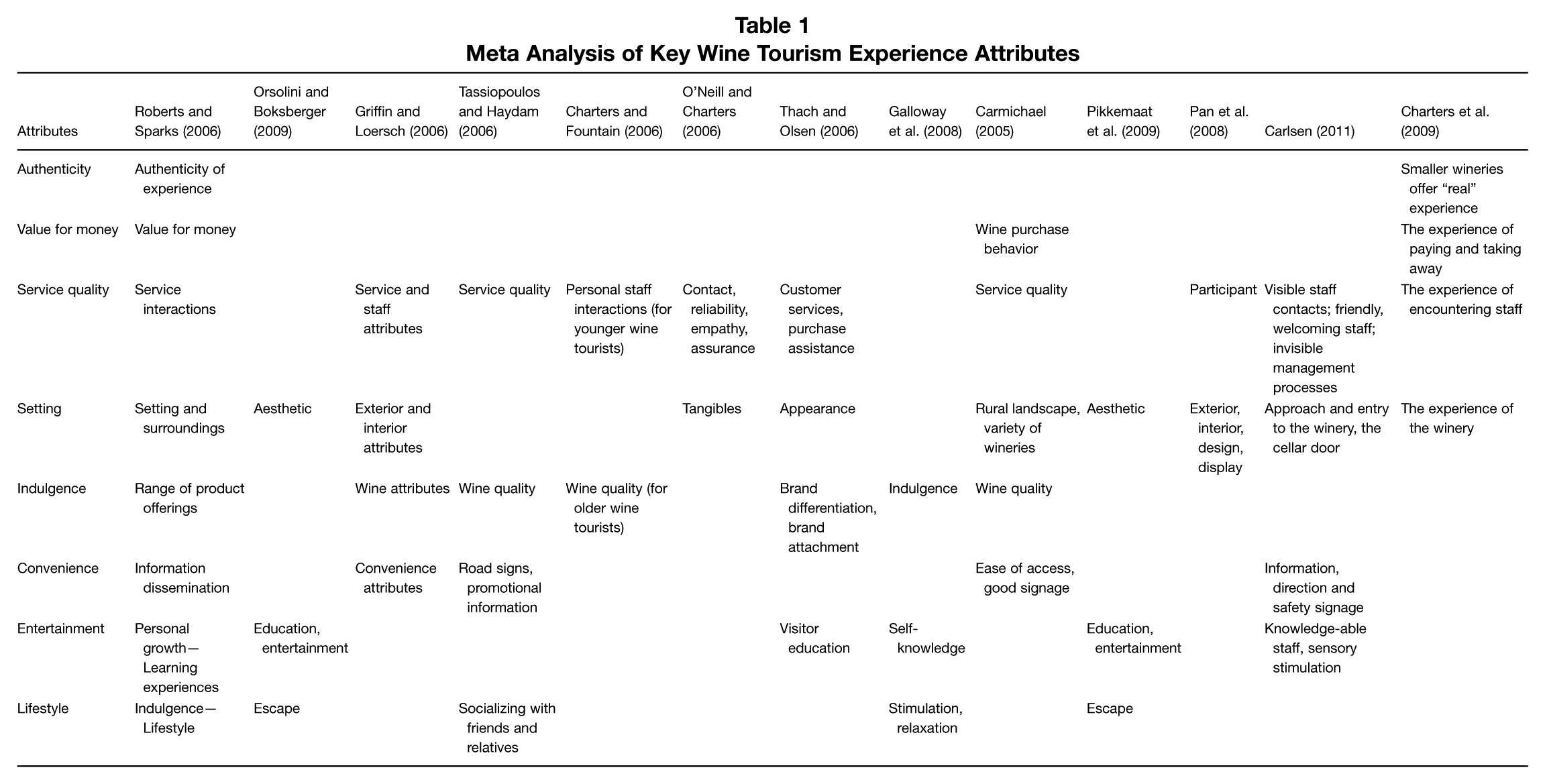
The modified meta-analysis of wine tourism experience research includes both quantitative and qualitative studies. Quantitative analysis techniques ranged from descriptive analysis of dichotomous choice variables (Orsolini & Boksberger, 2009), Likert-type scale variables (Griffin & Loersch, 2006; Tassiopoulos & Haydam, 2006), factor analysis (Pan et al., 2008; Tassiopoulos & Haydam, 2006), and multiple regression analysis (O’Neill & Charters, 2006). Qualitative research employed focus groups (Roberts & Sparks, 2006) or participant observation methods (Carlsen, 2011; Charters & Fountain, 2006; Thach & Olsen, 2006). To merge and analyze the data and identify the key importance variables, a decision rule to analyze those quantitative variables that were rated or ranked as important (i.e., a “yes” in dichotomous choice data sets, an importance score higher than the midpoint of the Likert-type scale data or factors with Eigen values greater than one in multiple regression analysis) was applied. For the qualitative studies, those factors or attributes considered as important by focus groups or identified by participant observers are included in the modified meta-analysis (Table 1). These data are categorized into eight wine tourism experience attributes and the frequency of variables in each category emerges from the meta-analysis.
Meta Analysis of Key Wine Tourism Experience Attributes
Findings
It is evident from the frequency of variables identified in Table 1 that two key attributes emerge as critical to the wine tourism experience: service quality and setting. Entertainment in the form of education and information is also an important attribute. Other variables relating to authenticity, wine quality, and value for money occur less frequently in studies of wine tourism experiences. This provides some focus for wine tourism researchers as to the key attributes of the wine tourism experience from the wine consumer’s perspective. In particular, understanding the service encounter and service quality is essential.
It is important to recognize that the concept of value extends beyond mere value-for-money in wine tourism. This is supported by the finding that only 1 of the 13 studies found that value-for-money was an important attribute. Likewise, authenticity of the experience was only found to be important in one study, but is included in the final analysis of wine tourism experience attributes (Table 1) as it considered to desirable from the perspective of at least some wine tourists and wine businesses.
Analyzing consumer choice, Sheth, Newman, and Gross (1991) proposed following consumer value typology:
Functional value: The perceived utility through the possession of salient functional, utilitarian, or physical attributes
Social value: The perceived utility through the association with positively or negatively stereotyped demographic, socioeconomic, and cultural–ethnic groups
Conditional value: The perceived utility through the presence of antecedent physical or social contingencies in a specific situation
Emotional value: The perceived utility through the creation or perpetuation of feelings or affective states
Epistemic value: The perceived utility through the arousal of curiosity, the provision of novelty, and/or the satisfaction of a desire for knowledge
Based on the preceding findings and frequency of occurrence of setting and service attributes in wine tourism studies, it is clear that functional value is derived from the functional, utilitarian, and physical attributes of wineries and cellar doors. However, functionality could be confused with formality in the terms of the physical appearance of the winery and the service procedures of staff. In some cases, larger wineries with an overt sales function were considered to be confronting and may in fact detract from the value of the winery experience (Carlsen, 2011). Likewise, positive social value may be derived from being associated with wine, tourism, and lifestyle experiences in wine regions, but the level of individual customer expectations and self-assessed wine knowledge would certainly have a bearing on the extent to which social value can be derived from wine tourism experiences. Conditional value is also beyond the purview of winery and cellar door managers as it is the visitors that determine the social groupings and interactions in a wine tour situation.
Hence, the most important attributes of wine tourism experiences related to consumer value that are within the locus of control of management are the last two value types, that is, emotional value and epistemic value. The implications of these forms of consumer value and the combination of attributes for wine tourism research and management are discussed below.
Implications for Wine Tourism Research
Wine tourism is essentially a sensorial experience and as such should affect an emotional response, as Galloway et al. (2008), Pan et al. (2008), and Charters, Fountain and Fish (2009) have found. Hence, there is a need for future wine tourism research to consider that complex interactions in wine and tourism experiences combine to evoke enduring involvement based on the inherent needs, values, and interests of wine tourists (Galloway et al., 2008). Also, the multiplicity of service encounters that comprise a wine tourism experience, over time and at various wineries not only add to the complexity but also have a cumulative effect in terms of enhancing (or indeed reducing) perceived consumer value in wine tourism experiences. Finally, the interactions of the attributes that generate consumer value should also be considered in future wine tourism experience research.
One way of conceptualizing value in the wine tourism experience is by considering them as relational exchanges or transactions between a supplier and a customer in which each party gives up “something of value” in return for “something of greater value” (Holbrook, 1999). Expanding on the behavioral nature of perceived value, Holbrook (1999, p. 22) defined perceived value as an “interactive relativistic preference experience” and therefore proposed a typology of perceived value based on three dichotomies (self-oriented vs. other-oriented, active vs. reactive, and extrinsic vs. intrinsic). This value typology consists of eight types of consumer value (Holbrook, 1999):
Efficiency (Output/Input Ratio or Convenience): The perceived value from an active transformation of means in pursuit of a self-oriented end
Excellence (Quality): The perceived value associated with a distanced apprehension or receptive admiration
Politics (Success): The perceived value of one’s own consumption experience as a mean to achieve a favorable response from someone else
Esteem (Reputation): The perceived value from the reactive contemplation of one’s own status as reflected in a probative opinion of others
Play (Fun): The perceived value of an active self-oriented experience enjoyed for its own sake
Aesthetics (Beauty): The perceived value of an essentially reactive appreciation and as an end itself
Morality (Virtue): The perceived value from an ethical action favoring others
Spirituality (Faith or Ecstasy): The perceived value of a devotional experience
Subsequently, it can be argued that a combination of these eight types of value comprises, to a greater or lesser extent, the wine tourism experience. Previous research in the context of wine tourism supports the importance of service excellence and aesthetics (see Table 1), but the interaction of these attributes has not been analyzed. In terms enhancing the wine tourism experience, this would require, for example, a study of the cumulative effects of excellent wine service quality in aesthetically pleasing settings and surroundings at multiple wineries over time.
Galloway et al. associate the intensity of sensation seeking with factors such as wine purchase behavior, consumption, and visitation, with the higher sensation seekers being more emotionally involved in these experiences. Pan et al. found that the atmospheric cues provided in the design aesthetics of cellar doors elicit emotional responses, which then positively relate directly to purchase behavior. Emotional responses can also be attained through authentic and genuine engagement with customers, beyond a mere commercial transaction relationship, as Charters et al. (2008) confirm. Hence, wineries and cellar door managers have need for a deeper understanding of the range of options available for evoking an emotional response as part of the customer experience, through design, aesthetics, atmosphere, and engagement with wine tourists.
Epistemic value is derived from the educational and entertainment attributes such as learning about wines and novel experiences at wineries has been identified in previous studies (Ali-Knight & Charters, 1999; Charters & Ali-Knight, 2000). Education provides an opportunity to add epistemic value for those with a desire to enhance or demonstrate their wine knowledge and interest in wine. Epistemic value in wine tourism can be provided through entertaining themed winery events, tours, and cultural experiences (Orsolini & Boksberger, 2009). Visitor education was also found to be a key component of the wine tourism experience and trained and knowledgeable staff have a key role to play (Carlsen, 2011; Thach & Olsen, 2006). Wine education in the form of winery tours, wine-making courses, wine and gastronomy, and wine history are also important sources of epistemic value (Orsolini & Boksberger, 2009) that require further investigation in future wine tourism and consumer value research.
Implications for Wine Tourism Management
To operationalize these attributes, new tools and technologies make it possible for wineries to promote those attributes that they provide (through websites, email lists, and other communication channels) in advance, thereby engaging the wine tourist in a more informed and interactive wine tourism experience. This would be a marked improvement on the current wine tourism experiences, which are chosen almost at random by wine consumers who may be largely uniformed of the value until they arrive in the wine region or at the winery or cellar door. Currently, the potential for mismatch between the desired wine consumer experience and the offerings of the winery businesses is high, resulting in a concomitant risk of subtracting value from the wine tourism experience. The availability of most, if not all, of the desired attributes in a wine tourism experience is critical to the maximization of value in wine tourism experiences. Most important, the provision of these attributes at multiple points during the subsequent wine tourism experience will not only add value but can potentially multiply the perceived value, especially when delivered by several wineries during a regional wine tour. Furthermore, the provision of information uniformly to all potential wine tourists through a well-designed, accessible, and current Internet platform avoids the division of value in favor of specific individuals or market segments while others remain unaware of the opportunities to add or multiply consumer value in wine tourism experiences.
Limitations
There are several limitations to the analysis of values identified in extant studies through both quantitative and qualitative research, whereas meta-analysis would normally be applied to quantitative data sets only. The studies were also published at various times over the last 5 years and were conducted across a range of wine regions, so there is likely to be a range of temporal and geographic factors that also influence consumer value in each region. Thus, the qualitative, temporal, and geographic nature of this analysis limits the ability to generalize and apply the findings across all wine regions.
One could also argue that the eight attributes identified in the analysis do not represent all forms of consumer value derived from wine tourism and that other attributes should be considered. However, given the relevance of these attributes, focusing on them as a baseline set of core values should inform future wine tourism research and management.
Conclusions
This instability of both wine consumer expectations and perceptions over time should alert researchers to the limitations of cross-sectional studies and the need for a more longitudinal approach to understanding cellar door visitors. There are also some salient implications for cellar door operators that need to ensure the highest quality service as wine consumer satisfaction and loyalty over time is important. For some, particularly the young and inexperienced wine consumer, the cellar door can be a daunting and intimidating environment. The challenge for researchers and operators is to understand the needs of their customers and how best to meet them and make the wine tourism experience educational, enjoyable, and memorable for all the right reasons. Indeed, the future of many small wineries may depend on getting the cellar door experience right, based on a complete understanding of the values sought by wine tourists in each setting and context.
The key attributes that have been found to constitute the wine tourism experience have identified through a modified meta-analysis, and the overall findings indicate that the two attributes most often cited in extant studies relate to service encounters and the setting and surroundings. Hence, the cellar door setting and staff knowledge, ability, and skill in all aspects of wine service are the essential ingredients in enhancing consumer value in the wine tourism experience. These two attributes provide the most prospective means of enhancing the emotional and epistemic values that were found to be associated with the wine tourism experience.
Wine tourism attributes can be used to add consumer value in the wine tourism experiences, and value can take many forms. An understanding of value from the wine consumer’s perspective provides wineries with an opportunity to verify that they are indeed providing the products, services, and settings conducive to consumer value creation in wine tourism.