



Abstract
Electronic word-of-mouth has become a driving force for hospitality businesses. Achieving customer loyalty is a primary goal of hospitality businesses, and reward programs are one mechanism for doing so. Customer-based communication channels have the potential to undermine or support these efforts. This study investigated attitudes toward hotel loyalty programs among members of flyertalk.com, a forum for frequent travelers. A content analysis of 1,519 comments from members of five major hotel programs was conducted. The core categories that emerged were program experience, value, process, obtaining status, company-created communication, customer-created communication, and defection motivators and inhibitors. A paradigm model indicated that communication is the most important loyalty antecedent, and that all antecedents influence loyalty via the program experience. The emergent relationships suggest that managers should actively monitor online channels and take action to correct issues that cause member frustration and dissatisfaction. Otherwise, these problems can escalate through the rapid spread of electronic word-of-mouth.
As with traditional word-of-mouth, electronic word-of-mouth (eWOM) has become crucial to the marketing mix. The importance of online travel forums as a conduit for consumers to share their experiences is ever-increasing. More than ever, consumers are relying on these self-reports as part of their purchase decision-making process. Electronic self-reports offer a goldmine of data for marketers that can provide greater insight into the consumer than traditional data collection methods (Kozinets, 2002; Reid, 1996; Xun & Reynolds, 2010).
There exists a large body of literature on customer loyalty for hospitality and other businesses. Antecedents to loyalty have been demonstrated, including commitment, satisfaction, service quality, trust, value, and communication (Ball, Coelho, & Machás, 2004; Wilkins, Merrilees, & Herington, 2010). Despite the fact that reward programs are one of the primary mechanisms for building loyalty, hospitality research has not focused on the role of these antecedents in building loyalty for reward program members. Those studies that have considered loyalty programs have not done so among the programs’ most valued members, the frequent travelers (Mattila, 2006; Tanford, Raab, & Kim, 2011), and have not investigated all the antecedents. Thus, although researchers are focusing on developing the “right” model of loyalty formation, there is limited knowledge about how this process works for those customers that bring in the most revenue.
For the most part, previous studies have used quantitative survey research methods to investigate loyalty determinants and behaviors. Although survey research is valuable for identifying relationships, it is constrained by the variables defined by the researcher. By examining only nondirected, voluntary, and unconstrained communication by hotel loyalty program members in an online environment, this study supports the emergence of themes potentially not yet realized. It enables the researcher to enter the minds of participants without any set parameters, supporting a true exploration of their thoughts on hotel loyalty programs.
Hotel reward programs are intended to increase loyalty by rewarding frequent customers and building long-term relationships (Shoemaker & Lewis, 1999). Given the proliferation of similar programs for hospitality businesses, some researchers have questioned their effectiveness in achieving these goals (Voorhees, McCall, & Calantone, 2011). One way to evaluate their success is to investigate loyalty antecedents and behaviors among reward program members. The primary method of communication among frequent travelers is through online travel forums, including cruiscritic.com, tripadvisor.com, and flyertalk.com. These forums provide a rich source of data with which to investigate loyalty. This study provides a unique perspective of hotel loyalty program members through a content analysis of eWOM on flyertalk.com. Through a grounded theory approach, the research provides new insight into the minds of reward members and identifies prevalent themes and patterns that cannot be obtained using predetermined variables (Creswell, 2007; Strauss & Corbin, 1997). Hotel program members’ self-reported experiences are used as data to construct and validate the emergent theory, which is described in the resulting paradigm model. The paradigm model links antecedents, situational conditions, and consequences to the phenomenon of interest (Strauss & Corbin, 1998). The theory described in the model may be further tested through a quantitative research approach, determining its generalizability to a larger sample or population (Creswell, 2007).
Literature Review
The Importance of eWOM
Numerous online travel forums exist, with more popular examples providing member service ratings and reviews (“posted review”) such as yelp.com and tripadvisor.com. Flyertalk.com goes beyond reviews. Rather it is a popular interactive online community (“discussion forum”) that focuses discussion on travel-related loyalty reward programs. Its members are a diverse group, from business travelers to mileage junkies. Discussions include opinions about loyalty program experiences, travel tips, and how to maximize program points or miles.
Obtaining market research data from online communities is not only considered an efficient method of data collection but also “more naturalistic and unobtrusive” than other methods such as focus groups and interviews (Kozinets, 2002). Furthermore, compared with traditional normative and quantitative approaches, it can offer greater insight regarding “consumers' needs and wants, choices, symbolic meanings and more” (Xun & Reynolds, 2010, p. 18). In fact, it has been argued that people may be more open and honest online than in real life (Reid, 1996).
eWOM is defined as “any positive or negative statement made by potential, actual, or former customers about a product or company, which is made available to a multitude of people and institutions via the Internet” (Hennig-Thurau, Gwinner, Walsh, & Gremler, 2004, p. 39). As with traditional word-of-mouth, eWOM is one of the most influential elements in the marketing mix. Because eWOM data are generated by the consumer, it offers a reflective quality that cannot necessarily be obtained through other means. Furthermore, eWOM differs from traditional word-of-mouth in that it offers a vast variety of ways for consumers to share information anonymously, without geographical or time constraints. Other differences include the lack of physical cues to assess the identity of others and the permanence of online conversations (Gelb & Sundaram, 2002; Kiecker & Cowles, 2001). It is vital to note, however, that eWOM is often a form of advertising where the content is manipulated by companies, and thus not all content can be considered consumer opinion. Online forums such as tripadvisor.com have recently implemented systems with which they preview each review prior to posting it. This process improves the integrity of the information by ensuring that it is customer-generated content.
Defining Customer Loyalty
For hotels, loyalty has been characterized as “the likelihood of a customer’s returning to a hotel and that person’s willingness to behave as a partner to the organization” (Shoemaker & Lewis, 1999, p. 349). Loyalty is rarely an observable construct, and therefore must be inferred from other indices. Intentions to return or visit regularly are often used to measure loyalty for lodging businesses (e.g., Clemes, Gan, & Ren, 2011; Gracia, Bakker, & Grau, 2011; Kim, Jin-Sun, & Kim, 2008; Skogland & Sigauw, 2004; Wilkins et al., 2010). Positive word-of-mouth is another common loyalty indicator, which involves saying favorable things about the business or recommending it to others (Clemes et al., 2011; Gracia et al., 2011; Hu, Huang, & Chen, 2010; Skogland & Sigauw, 2004). Willingness to collaborate with management to improve or promote the business is also associated with loyalty behavior (Baloglu, 2002; Bowen & Shoemaker, 2003). More direct indicators of loyalty involve actual behavior, which for hotels can be expressed as frequency of visits, that is, loyal customers will routinely stay at a particular hotel (Shoemaker & Lewis, 1999; Skogland & Sigauw, 2004). However, percentage of visits to a particular brand may be a better indicator of loyalty, since it captures preferences for that brand versus competitors (Baloglu, 2002; Tideswell & Fredline, 2004).
With the proliferation of online forums, customer reviews, and the like, these behavioral indicators can be expressed and observed online. eWOM is a more powerful force than traditional word-of-mouth because of its widespread use and availability, making it not only a loyalty indicator but also a loyalty driver. Equally important is NWOM, or negative word-of-mouth, which can be triggered by a bad experience with a business, causing customers to say negative things about the business or recommend against patronage (Gracia et al., 2011; Jones, Reynolds, Mothersbaugh, & Beatty, 2007). The ramifications of NWOM are becoming more widespread through the use of online reviews and traveler forums such as the one investigated in this research (Barsky & Nash, 2009). Although most studies investigate loyalty as a positive behavior, it is also essential to consider disloyalty, that is, intentions to switch brands (Han, Back, & Kim, 2011; Tanford et al., 2011). Loyalty reward programs are intended to prevent switching, but may not be sufficient for doing so (Baloglu, 2002; Hu et al., 2010; Tanford et al., 2011). Certain antecedents may be needed to create the right conditions for loyalty development.
Antecedents of Customer Loyalty
Although there is no consensus regarding the factors that actually determine loyalty (Agustin & Singh, 2005), some of the more frequently examined antecedents in the hospitality literature include service quality, value, satisfaction, commitment, communication, and trust (Shoemaker & Lewis, 1999; Wilkins et al., 2010).
In general, it is believed that the better the perceived service quality, the more a customer intends to repurchase from a service provider (Baker & Crompton, 2000; Bolton & Drew, 1991; Lee & Cunningham, 2001). In the lodging literature, service quality is typically evaluated in terms of performance measures that reflect service dimensions (Wilkins et al., 2010). In Wilkins et al.’s study of luxury hotel guests, quality staff, personalization, and speedy service made up an overall service experience dimension, whereas in Clemes et al.’s (2011) study of the motel industry, service quality consisted of interaction quality, physical environment quality, and outcome quality. In both these studies, service quality influenced behavioral loyalty indirectly via its impact on satisfaction. However, service quality was a direct predictor of behavioral loyalty in a model produced by Lee and Back (2010). The role of service quality in hotel loyalty has been investigated using qualitative, content-analysis methodology similar to the current approach. Hotel guests were asked to describe “what does loyalty to a hotel mean to you” in a study by Mason, Tideswell, and Roberts (2006). An “implied contract,” including an unstated service-level agreement was the second, most frequent response, after return visits, whereas service quality per se was mentioned less frequently. In an analysis of online hotel reviews on a U.K. website, poor customer service was one of the primary dissatisfiers, but good service was not a positive contributor to loyalty (Ramanathan & Ramanathan, 2011). Since customer service is a frequent topic of discussion on hotel review websites, it was expected to appear as a dimension in the current analysis.
Value is another important antecedent of customer loyalty, as customers with high value perceptions are strongly motivated to repatronize a business (Yang & Peterson, 2004). Customer perceived value perceptions result from evaluating the relative rewards and sacrifices associated with the offering (Yang & Peterson, 2004). Previous research differs on whether value has a direct impact on loyalty, or an indirect/moderating effect on the satisfaction–loyalty relationship (Anderson & Srinivasan, 2003; Lam, Shankar, Erramilli, & Murthy, 2004; Sirdeshmukh, Singh, & Sabol, 2002; Yang & Peterson, 2004). However, in Wilkins et al.’s (2010) model of hotel loyalty, perceived value did not significantly influence loyalty in either a direct or indirect manner. In Ramanathan and Ramanthan’s (2011) analysis of online hotel reviews, value for the money was the primary attribute associated with return intentions, and was frequently mentioned in Mason et al.’s (2006) qualitative study of hotel guests.
The role of commitment in loyalty has been well researched in the marketing literature. Affective commitment (emotional attachment) is well documented as a determinant of loyalty in hospitality studies (e.g., Bowen & Shoemaker, 2003; Mattila, 2001, 2006; Tanford et al., 2011) and its influence is more pronounced than other forms of commitment. On the other hand, value commitment is characterized by the perceived value of benefits a customer receives, such as those from the provider’s reward program. Value commitment can be less enduring and associated with greater price sensitivity and willingness to switch hotels than affective commitment (Mattila, 2006; Tanford et al., 2011). The current research investigates frequent travelers who are reward program members, and thus should have developed a certain level of commitment to their program sponsor. Manifestations of both types of commitment are expected in their comments, each of which may have different implications for loyalty behavior.
Trust is an important antecedent to loyalty, because customers trust businesses they patronize to do the right thing. Any increase in customer trust will lead to commitment and customer loyalty (Shoemaker, Lewis, & Yesawich, 2007). The concept of trust is considered an inherent characteristic of any valuable social interaction, and due to the relational orientation, it has become a popular topic in loyalty marketing (Morgan & Hunt, 1994). Furthermore, commitment and trust are major constructs of relationship marketing, with trust being a strong determinant of commitment in various types of relationships (Berry & Parasuraman, 1991; Bowen & Shoemaker, 1998; Morgan & Hunt, 1994; Sharma & Patterson, 2000). A low level of trust leads to less favorable attitudes and behaviors, whereas a high level of trust leads to a more favorable attitude toward the exchange partner, thereby affecting the desire to remain loyal and cooperate with that partner (Bowen & Shoemaker, 1998; Morgan & Hunt, 1994; Sharma & Patterson, 2000). Trust is closely aligned with emotional commitment in building loyalty for hospitality businesses such as casinos (Baloglu, 2002; Sui & Baloglu, 2003) and hotels (Bowen & Shoemaker, 2003). Therefore, it could be a subtheme of that construct in frequent travelers’ online discussions.
Communication is also considered an antecedent of customer loyalty (Anderson & Narus, 1990; Ndubisi & Chan, 2005). Interpersonal connections between customers and hotels through communication are important to the success of loyalty programs (Shoemaker & Lewis, 1999). Communication involves keeping in touch with customers on a regular basis, providing timely and accurate information and updates on services or products, and proactive communication to handle conflicts (Ndubisi & Chan, 2005). Communication in the form of customer education may also affect loyalty. The more educated the customers, the more involved they can be with the product. Because involvement has been shown to be a loyalty indicator, Antonios (2011) proposed that education, thereby communication, is an antecedent of loyalty. The dynamic nature of reward membership makes ongoing, relevant communication vital, whereas poor/lack of communication could be a source of dissatisfaction expressed through online forums. Compared with other antecedents, the role of communication has been largely overlooked in hospitality loyalty studies.
Satisfaction has often been demonstrated as a positive loyalty determinant (Anderson & Srinivasan, 2003; Bowen & Chen, 2001; Lam et al., 2004; Yang & Peterson, 2004). Satisfaction is the overall affective response resulting from the service experience (Oliver, 1981). According to Oliver (1980), if actual services performance is lower than the expectation, it will bring dissatisfaction to customers, whereas satisfaction occurs when actual services performed are higher than the expectations. Satisfied customers will make return visits; therefore, it is important to keep these customers. Earlier studies viewed loyalty as a type of long-term effect that is closely associated with satisfaction (Oliver, 1997) or described loyalty as an antecedent of repeat visitors’ satisfaction (Petrick & Backman, 1999). More recent studies emphasized the need to first satisfy customers in order to achieve loyalty (McAlexander, Kim, & Roberts, 2003; Lam et al., 2004). This relationship has been demonstrated in numerous hotel studies, where satisfaction was a significant antecedent for future visit intentions and other loyalty indicators (Clemes et al., 2011; Hu et al., 2010; Kandampully & Hu, 2007; Kandampully & Suhartanto, 2000; Matzler, Renzl, & Rothenberger, 2006). In addition, perceived service quality of each element of the service encounter is related to overall satisfaction with the product or service (Danaher & Mattsson, 1994). As noted previously, satisfaction also mediates the effect of service quality and other variables on loyalty. As such, satisfaction with the hotel and its reward program are expected to be themes observed in multiple emergent categories.
Loyalty Programs for Hotels
Loyalty programs are implemented to reward valuable customers, generate information in order to understand and serve the customer more effectively, manipulate consumer behavior, and defend against the competition (O’Malley, 1998). Loyalty programs have two main goals: (a) to increase sales revenues by increasing purchase levels and (b) to maintain the current customer base by strengthening the bond between the customer and the brand (Uncles, Dowling, & Hammond, 2003). The literature also emphasizes the difference between frequency and loyalty programs. The goal of frequency programs is to build repeat business, whereas the objective of loyalty programs is to build emotional brand attachment (Shoemaker & Lewis, 1999). It is this emotional bond that most affects guest perceptions of hotel loyalty programs (Mattila, 2006). These studies suggest that emotional commitment is a key factor in loyalty program effectiveness, just as it is one of the most important loyalty antecedents.
To be effective, loyalty programs and the rewards they offer must be perceived as valuable by customers (Hu et al., 2010; Shoemaker & Lewis, 1999). Indeed, value perceptions are also key loyalty antecedents. It has been argued that current reward structures do not maximize the potential value of hotel loyalty programs, and that a more data-driven approach is needed (Voorhees et al., 2011). The effectiveness of hotel loyalty programs is affected by numerous factors, which McCall and Voorhees (2010) classified into three categories: program structure, reward structure, and customer–program fit. Program structure includes reward tiers, which create aspirations to achieve higher tier levels in order to receive greater benefits and recognition (Loveman, 2003). Elite tier levels are associated with feelings of status and superiority; however, these can diminish if the size of the elite tier increases (Drèze & Nunes, 2009). Furthermore, customers’ behavior changes as they transition between tiers; in fact, members are known to accelerate their purchase frequency and magnitude as their arrival at the next tier approaches (Shoemaker & Lewis, 1999). Reward structure includes the type, magnitude, and frequency of rewards. Immediate rewards have been shown to be more effective than delayed rewards in perceived value of hotel reward program (Hu et al., 2010). With respect to reward type, Verhoef (2003) suggests that monetary-based rewards are most preferred by customers, whereas McCall and Voorhees (2010) found that special, treatment-based rewards had limited impact on relationship quality. This finding would seem to be in contrast to the argument that reward programs must build customer relationships in order to be effective (Shoemaker & Lewis, 1999).
Customer factors reflect the fit with the program to customer needs and spending patterns, as well as their perceived role in the loyalty program (McCall & Voorhees, 2010). It has been argued that current tier structures do not take customer needs into account, resulting in suboptimal performance (Voorhees et al., 2011). They suggest that multiple dimensions should be considered, of which three; psychographics, referrals, and brand engagement, are particularly relevant to the online traveler community. Psychographics involve attitudes, interests, and opinions, all of which are expressed through online forums. Referrals are the extent to which customers recommend the business to others, which are by definition communicated through word-of-mouth, including eWOM. Brand engagement provides opportunities to foster loyalty through greater contact with the company, which can occur through “participation in emerging social media environments” (Voorhees et al., 2011, p. 8). Programs need to “determine more competitive individual benefit elements that are truly valued by guests and cannot be easily imitated by competitors” (Shanshan, Wilco, & Eric, 2011, p. 325). One way to achieve this is to examine members’ self-reports of their hotel loyalty program experiences.
Objectives
This study investigates the extent to which program attributes identified in the literature emerge as important loyalty determinants in the self-reported data of hotel reward program members. It also investigates whether the antecedents of loyalty are discussed and linked to behavioral loyalty and/or switching intentions. However, the study is not limited to previously documented variables, as the qualitative technique allows new themes to emerge without forcing a structure to the data. As such, it provides an opportunity to extend beyond existing research to arrive at a deeper understanding of reward programs and customer loyalty. A paradigm model, which incorporates known and emergent categories, provides a theoretical framework that could fuel new directions in loyalty research.
Method
Sample and Procedure
Data consisted of self-reports from members of the top hotel loyalty programs (Hilton Honors, Starwood Preferred Guest, Marriott Rewards, Hyatt Gold Passport, and Accor) posted on flyertalk.com from January to June 2011. This popular interactive website features discussions and chat boards that cover up-to-date travel information for all travelers—from leisure to business. Members of this website have posted nearly one million comments regarding hospitality loyalty programs. The sample included more than 30,000 lines of text and was taken from the most recent post to the oldest post within the time period for each program until saturation was reached. A theoretical sampling method (Glaser & Strauss, 1967) was used to develop an exhaustive set of categories. Theoretical sampling differs from statistical sampling, since the process is iterative and driven by the categories that emerge. It may require different sample sizes to exhaust each category. It is vital to note that this sample consists largely of program members who wish to discuss their experiences openly, and not those who prefer to remain silent. Unlike statistical sampling, the sample is not representative of the entire membership of hotel loyalty programs. Furthermore, the purpose of theoretical sampling is to maximize the potential for discovering or exploring new and emerging concepts (Taylor & Bogdan, 1998; Pace, 2004). Posts from members of all levels of hotel frequent-guest loyalty status were included, from entry level to the highest elite levels.
Content analysis was performed to discover emerging themes from the self-reported data. The use of content analysis is supported as “a search for general statements about relationships and underlying themes” (Strauss & Corbin, 1997). Content analysis is considered a useful technique for allowing researchers to discover the focus of individual, group, institutional, or social attention (Weber, 1990). Content analysis has been used successfully to analyze web-based content from travel-related websites (Choi, Lehto, & Morrison, 2007; Wan, 2002), customer reviews (Yang & Peterson, 2004), consumer comments (Qu, Zhang, & Li, 2008), and many other applications. Atlas.ti was used to conduct the analysis.
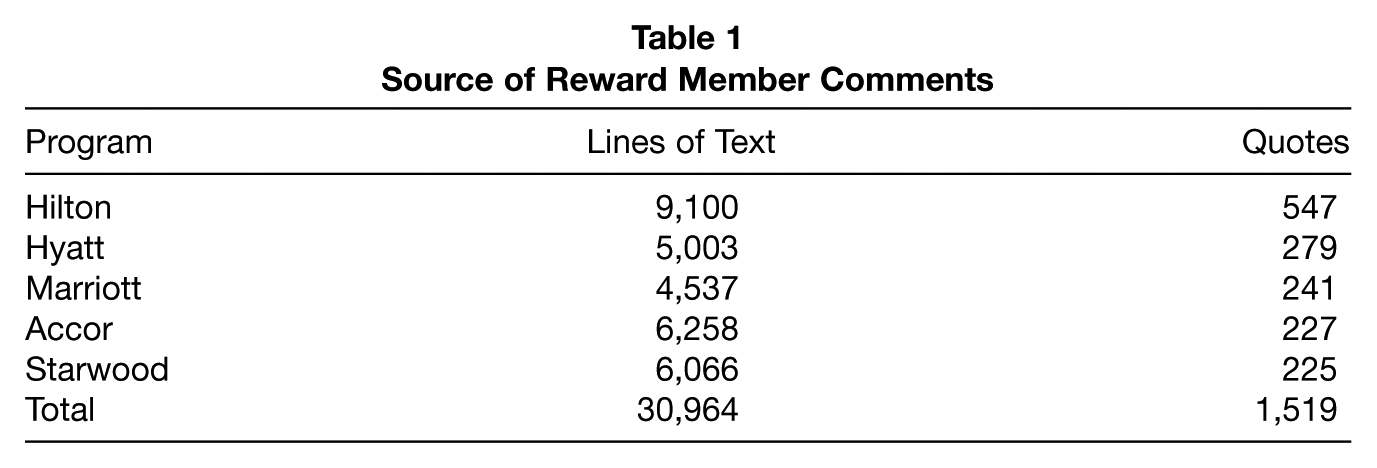
The content analysis involved three phases: (a) identifying codes within categories, (b) relating codes to one another to identify emergent themes, and (c) constructing a paradigm model of member perspectives of hotel loyalty programs and detecting new constructs and patterns associated with program loyalty. The purpose of Phase 1, or open coding, is to identify salient topics worthy of closer study and explanation. Phase 1 data collection included posts from flyertalk.com specific to members of Hilton Honors, Starwood Preferred Guest, Marriott Rewards, Hyatt Gold Passport, and Accor loyalty programs. When coding the data, an inductive categorization method was used that identified recurring themes that emerged from the self-reports of each loyalty program group (Spiggle, 1994). A priori codes were not used. The initial analysis involved open coding, with one coder identifying and categorizing member opinions of different hotel loyalty programs using a constant comparative method. This phase resulted in an initial list of 230 codes and 1,519 quotations from the five hotel groups. Table 1 summarizes the number of quotes and lines of text analyzed for each brand. Theme, or the expression of an idea, was used as the coding unit (Minichiello, Aroni, Timewell, & Alexander, 1990). Each code represented a single theme or idea relevant to the study, no matter the length of the text. The optimal sample size was determined when the content analysis reached saturation during open coding, that is, no new categories were identified.
Source of Reward Member Comments
Interrater reliability was achieved during secondary analysis, where two additional raters who were familiar with the loyalty literature analyzed and recoded the data. Care was taken to ensure that latent content was not disregarded, and the researchers came to a consensus on the emerging categories. The output consists of emerging codes and their categories along with frequency of mention, which is often considered to indicate the importance of each topic. It is important to note, however, that frequency of mention does not necessarily translate to importance or meaning. Relying solely on frequency of mention often ignores context, distinctive individual cases, latent structure of sense, and things not directly apparent in the text (Bernard & Ryan, 1998; Ritsert, 1972). “Researchers must be cautious not to take or claim magnitudes as findings in themselves” (Berg, 2001, p. 243). Furthermore, because many forum members post about the same topic multiple times, the researchers felt it was essential to go beyond automated coding and frequency in order to avoid any misinterpretation of importance.
In Phase 2, axial coding resulted in emergent themes within the seven core categories. Core categories are themes that are composed of statements or ideas from related subcategories. A complete list of core categories and the subcategories within them is provided in Table 2. Frequencies are provided for discrete categories; however, counts are not meaningful for those categories that overlap multiple themes. For example, eWOM and consumer-to-consumer (C2C) communication encompass most of what is posted on the site. Axial coding is the process of relating codes (categories and properties) to each other, through a combination of inductive and deductive thinking. The purpose is to discover causal patterns in the data through examining consequences, conditions, interactions, and processes. Although it is not possible to draw causal conclusions, the analysis allows the researcher infer causal conditions, as well as intervening conditions, as categories around the core phenomenon (Strauss & Corbin, 1997). In Stage 3, the core categories and key subcategories were used to construct a paradigm model, which displays the relationships among them.
Core Categories and Subcategories
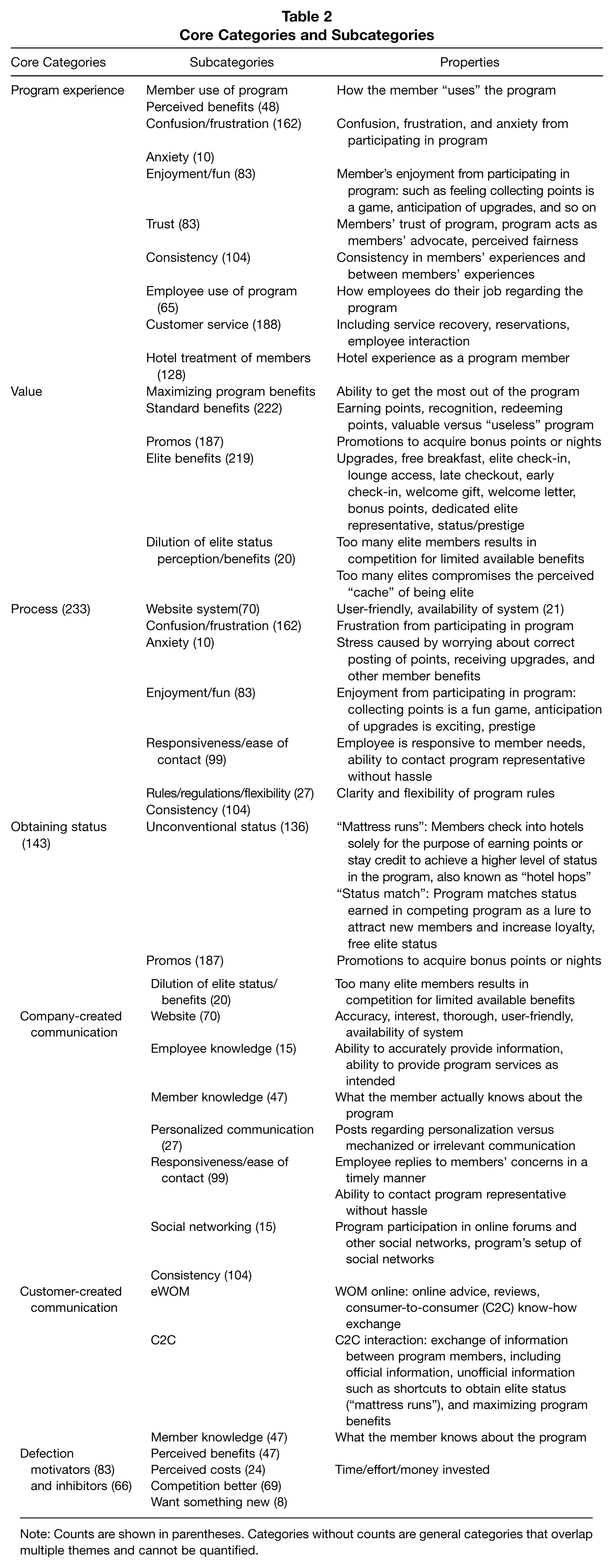
Note: Counts are shown in parentheses. Categories without counts are general categories that overlap multiple themes and cannot be quantified.
Several measures were taken to ensure that the analysis met appropriate standards for qualitative research. The coding team consisted of four researchers—one with years of experience as a member of flyertalk.com and a member of numerous hotel loyalty programs at various tiers. This supports the need for qualitative research to involve persistent observation and prolonged engagement in the field (Lincoln & Guba, 1985). Verification strategies (Morse, Barrett, Mayan, Olson, & Spiers, 2002) were used to establish reliability and validity of the data. The study had methodological coherence, in that comments were sampled based on their applicability to reward member loyalty. The sample was appropriate, in that it was drawn from a pool of opinionated reward program members. The data were collected and analyzed concurrently using a constant comparative approach. Interpretation was iterative, leading to a theoretically grounded approach.
Results
Antecedents to Loyalty
The study revealed that the antecedents to customer loyalty discussed in the literature are important to loyalty program members. Member comments are provided in Table 3 to illustrate the attitudes that were expressed in each antecedent category. Two of these (value, communication) represent core themes, whereas the others are subcategories. Throughout this discussion, counts are provided in parentheses to show the frequency of specific response categories. However, it should be noted that frequency does not always equal importance, and that one comment could be coded in multiple categories. To protect company anonymity, [brand] and [program] are substituted for names of specific brands and reward programs used in the comments.
Sample Comments Illustrating Loyalty Antecedents

Service quality
Service quality was perceived as important, which was reflected in the frequency count of the applicable codes. Out of 1,519 total quotes, the emergent service quality categories were process (233), customer service (188), program (114), and nonprogram (73) hotel experience and reservations (32). Frustration with the process was the most frequently mentioned service problem. For example, members were frustrated with the web sites going down, inability to get through by telephone, reservations not going through, and inaccurate point accounting. In fact, a thread of complaints about inability to access reservations online has been ongoing for 8 years. Other comments should be a heads up to operators that customer confusion and frustration with the website could be affecting sales. Lack of responsiveness of employees was another of the most frequently appearing customer service issues. On the other hand, the special service that comes with elite status can provide a powerful incentive for customers to increase their business with a particular brand.
Perceived value
The analysis found that value-related categories were topics of great interest among online forum members. However, value for money was not the most crucial aspect of these discussions. Hotel loyalty program members were mostly interested in maximizing their program-related benefits. Emergent value-related categories were standard benefits (222), elite benefits (219), promotions (183), and dilution of elite status (20). All these themes center on the desire to maximize program benefits. Comments suggest that some program members will remain loyal as long as they feel that the program offers them consistent value beyond promotions.
However, program value alone may not be sufficient to maintain loyalty, because even program members could get a better value, at the same or different brand, by booking through other channels. In addition, program practices such as allowing easier access to elite status through fast track or status match promotions decrease the availability of benefits and the “elite effect” of tiered status, reducing members’ value perceptions. Customers perceive that the availability of limited benefits, such as upgrades and reward redemption, will be diluted due to the increased number of elite members competing for these benefits.
Commitment
As noted in the literature review, commitment can be either affective or value-based. Affective commitment-related categories that emerged in this study include both positive (enjoyment: 80), and negative (frustration: 68) manifestations. The analysis also provided insight into the relationship between affective commitment and perceived value. Attitudes of some members with previous elite status shifted from affective commitment to value-driven decisions. Some members reported that they prefer the value of discount pricing to receiving elite benefits, and some actually felt less frustration not worrying about receiving the appropriate elite benefits. On the other hand, loyalty program status seems to work as intended as some loyalty program members state that their loyalty is in fact based on their elite membership status. As one member stated, “I love my status–my status is why I am so loyal to [brand].”
Members enjoy playing the game of maximizing their benefits, such as receiving upgrades, accumulation of elite status and points, and so on. Some engage in “hotel hops” or “mattress runs” where they check into hotels simply for the purpose of accumulating points. However, this excitement can erode loyalty if the current program is no longer a challenge. This was stated as a reason for belonging to multiple reward programs.
Trust
This study revealed several emergent categories related to trust: inconsistencies (74), broken promises (24), dishonest practices (29), and advocacy (3), that is, actions of program and hotel employees who provide promised benefits and act as member advocates. One of the most common findings in regard to trust was that firms did not fulfill their promises, which resulted in distrust and intention to defect. Best-rate guarantees are a frequent source of distrust and frustration, which can cause members to switch programs. Advocacy can be developed when the company responds to members’ needs on the discussion site. One person replied to the [program] rep by saying, “It’s great having you on this board. Looking forward to the changes, which sound like they will be good for Diamonds.” Advocacy can also arise when a program representative intervenes on behalf of an elite member. Such action can mitigate lack of trust that arises from not receiving expected benefits.
Communication
Communication and trust are closely linked. Friendly communication is not sufficient; members must have confidence that the information is accurate. The emergent dimensions of company-created communication revealed in this study are consistency of messaging (104), employee responsiveness (99), website (70), member awareness of rules (47), employee knowledge (15), and program’s participation in social networking (11). Members expressed displeasure with mechanical communication such as automated response systems.
Many members reported that program representatives are far more responsive to questions and comments made on social media than through traditional means such as e-mail, telephone, and face-to-face interactions. In fact, programs that do not provide official social media representatives for online forums are often criticized for their lack of concern and responsiveness. However, programs that do provide such representation are often highly regarded by members and have the potential to further increase affective commitment by building personal relationships with members. In fact, one hotel program has a specific e-mail address dedicated to communication with flyertalk.com members, which allows them to not only addresses customer problems but also generate positive PR via member comments. In other words, company-created communication has the ability to affect customer-created communication in a positive manner. Additionally, members often find that the service they experience via social media contact surpasses that which they experience through traditional channels: “At least our [program] Concierge here on Flyertalk provides top notch services” illustrates not only communication but also advocacy, which is an element of trust.
Satisfaction
Satisfaction-related themes were intertwined with other antecedents, in particular those that are under the direct control of the company. Customer service was one of the most common sources of satisfaction/dissatisfaction, which is not surprising given the link between service quality and satisfaction documented in the literature (e.g., Danaher & Mattsson, 1994). Confusion and frustration were also frequently mentioned, leading to dissatisfaction. Within the process category, frustration was again a top dissatisfier, whereas responsiveness could affect satisfaction in either a positive or negative direction. Several categories of company-created communication, including website attributes, employee ability to provide accurate information, and consistency can all influence satisfaction or dissatisfaction with the program. Furthermore, customer-created communications produces expectations, which could lead to dissatisfaction if not met by the program.
From antecedents to consequences
Ultimately, the antecedents of loyalty should lead to loyalty behavior (if positive) or switching behavior (if negative). A total of 66 comments specifically stated that they would remain loyal, whereas 83 indicated plans to defect. In most cases, these intentions were explicitly tied to one or more loyalty antecedents, as the examples shown at the end of Table 3 illustrate. Poor service, devaluation of program value, lack of management integrity, and poor communication influenced decisions to switch brand alliances or reduce patronage of a particular brand. On the other hand, satisfaction with multiple program attributes can motivate loyalty even if competitors offer special promotions. Status, and its associated benefits and privileges, are instrumental in building loyalty through commitment.
Paradigm Model
The antecedents discussed above are just a part of the loyalty process. Because of space limitations, examples of every emergent construct from the study cannot be provided. However, they have been incorporated into an integrated model that is displayed in Figure 1. In the model, the core categories are program experience, value, process, obtaining status, company-created communication, customer-created communication, and defection motivators and inhibitors. Table 2 shows all the codes from which each core category was developed. Everything else in the model is centered on these constructs. Loyalty and defection are the outcomes of all the relationships revealed in the model. Arrows indicate the direction of relationships, and words describe this relationship. The words “are part of” mean that one category is a subcategory of the other and “is a” means that the category represents one instance of the larger category. The word “contradicts” means that the categories represent two perspectives on the same dimension, which may or may not be consistent. The word “impacts” implies that one category leads to the other, whereas “associated with” means that the two categories are related. However, it is important to note that the paradigm model is in essence a proposed model that describes the interrelationships of categories as interpreted and developed by the researcher (Creswell, 2007). Therefore, true causality cannot be determined.
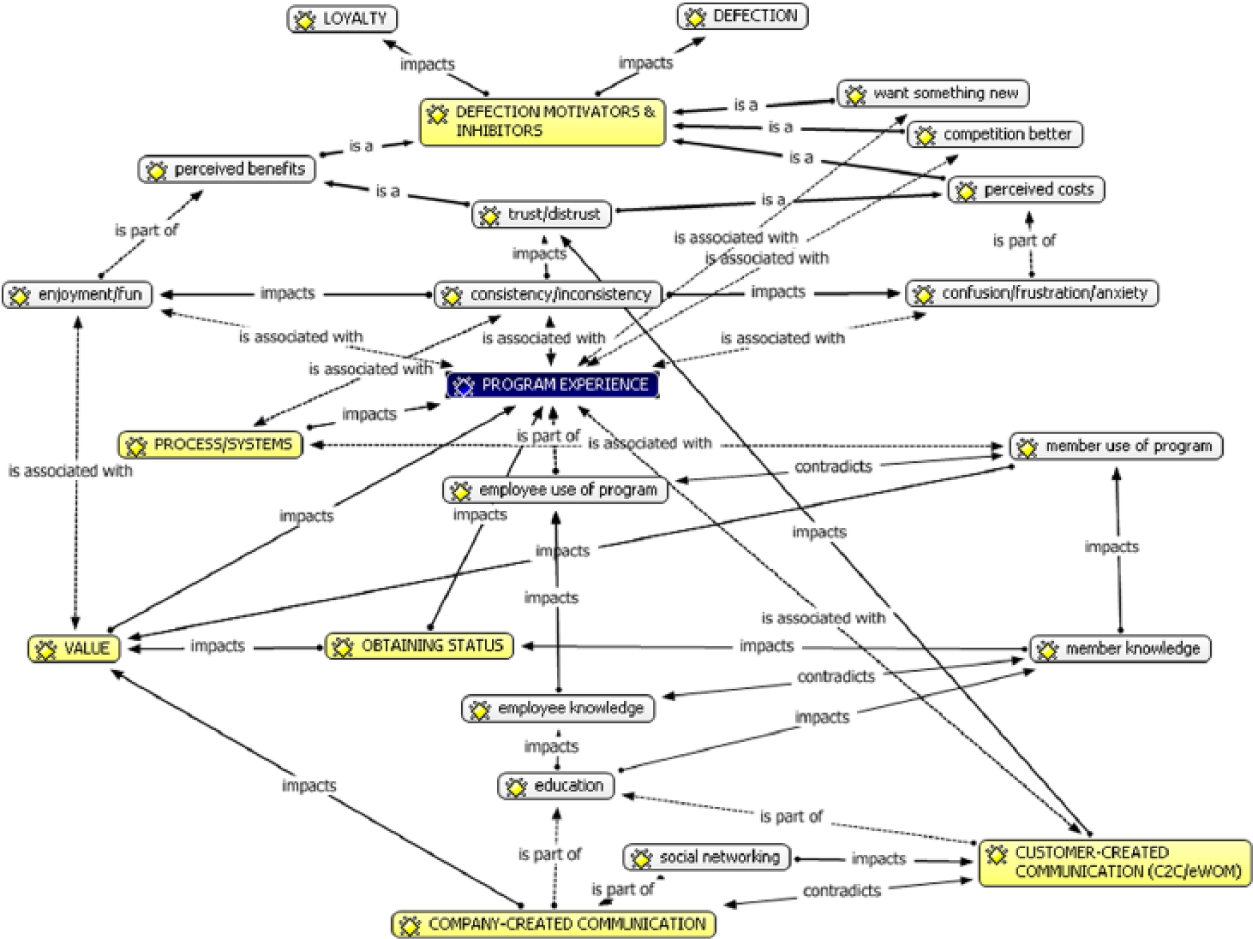
Paradigm Model
It all starts with communication. Initially marketing efforts drive official program communication (company-created) sending messages to members, potential members, and employees about specifics of the program. When the program is new there is only one source of information—the company. Therefore, employees and members share the same knowledge and for the most part have a common understanding of how the program works.
As members become more experienced in the program they begin to share information with other members resulting in eWOM and C2C know-how exchange. The value of the program was frequently discussed in terms of both standard benefits and elite benefits. eWOM often presents information that is not mentioned in the company-created program information, such as loopholes to maximize program benefits. This influences perceived value, which affects program experience and enjoyment. eWOM also reinforces opinions of members, for example, “This thread just reinforces for me that [brand] customer service bites.” This can produce a spiraling effect whereby trust, or more often, distrust, is perpetuated by the two-way relationship between program experience and customer-created communication.
Two separate information sources now exist, often resulting in confusion, frustration, and anxiety, as contradictions occur between expectations of members and actions of employees. According to the analysis, members often appeared more knowledgeable than employees because of the information shared via eWOM. This is evident from member statements that the information received through flyertalk.com is more accurate than information provided by their hotel program. Furthermore, members are able to easily compare their experiences with those of fellow members bringing up issues of perceived fairness and consistency, as well as creating more informed customers who have a better idea of what to expect from the program. The differences in understanding between customers and employees mean that the two groups sometimes use the program differently.
Savvy companies recognize the potential harm or benefit of social networking and choose to infiltrate what are primarily C2C forums. Members find that program representatives are often more helpful when they participate in C2C forums then they are when contacted through standard methods such as e-mail, telephone, and program websites. Programs with official representatives participating in the forums often receive high accolades, whereas those without are often perceived as apathetic toward member concerns.
Many members are obsessed with status. Knowledge gleaned from both company and customer communications gives members tips for obtaining elite status through both conventional and unconventional means. One one hand, some members want to learn about strategies such as mattress runs or status match programs. On the other hand, witnessing this behavior often frustrates and insults behaviorally loyal members who earned their status the hard way. This affects the perceived value of elite status and detracts from the program experience.
Issues related to process and service influence the way members experience and use the program. The website can be a source of informative enjoyment, but it also annoys members when it does not function properly or provide the right content. Ability to contact program representatives, and their responsiveness once contacted, has a major impact on satisfaction. Clarity and flexibility of program rules is vital to the program experience.
All these themes contribute to loyalty and/or defection. Program experience is the central core category. It affects trust/distrust, which lead to perceived benefits and costs. Benefits inhibit defection, whereas costs can motivate defection for a competitive program that offers more value. Customer communication also leads directly to trust/distrust, as well as contributing to loyalty/defection indirectly through program experience. Although not a core category, the tendency for some members to want something new continually can motivate defection to a competitor just for novelty purposes. All of the other core categories contribute to loyalty/defection indirectly through their relationship with program experience.
Discussion and Implications
Using a content analysis of member comments on flyertalk.com, this study provides insight that was not previously available about how reward programs “work” among frequent travelers. Developing loyalty among these guests is of paramount importance to hotel operators, yet hospitality loyalty research rarely considers loyalty programs, let alone their most active members. Using a grounded theory approach, themes were allowed to emerge from the data, without imposing any predetermined structure based on the literature. Nonetheless, antecedents of loyalty that have been documented in nonreward contexts emerged, although only value and communication formed core categories. Moreover, other core categories involved reward program characteristics including program experience, process, and status. Thus, loyalty antecedents alone do not explain loyalty among reward program members. However, member comments did include statements reflecting all six antecedents discussed in the literature, although many of these were captured within a larger category. Statements that explicitly linked each antecedent to loyalty or defection behavior were also revealed supporting relationships obtained in quantitative loyalty studies.
Compared with other loyalty antecedents, communication has received limited attention in hospitality research, yet this study suggests that it is critical for loyalty program effectiveness. As the current study shows, program experience depends largely on how customers and employees understand and ultimately use the program. Previous research indicates that effective relationship marketing communication requires providing trustworthy information, fulfilling promises and responding to service delivery problems (Ndubisi & Chan, 2005). These themes were prevalent throughout the current analysis, and companies’ failure to execute them was a common source of distrust and dissatisfaction with the program. Technological advances have increased the role played by communication in customer experience by advancing both company-managed and customer-created communication efforts. Company-created communication directly and indirectly relates to loyalty program experiences, including aspects of service quality. With the proliferation of electronic communication, it should play a pivotal role in future loyalty studies.
Hotel loyalty literature presents service quality as an important antecedent to loyalty, which may include quality staff, personalization, speedy service, interaction quality, physical environment quality, and outcome quality (Clemes et al., 2011). Service quality was a theme apparent in several core categories, in particular, program experience and process. Problems in these areas were major impediments to meeting program members’ expected service standards. To prevent frustration, confusion, and anxiety because of inconsistent and cumbersome processes, management should engage in both preventative and corrective actions. Careful website management is crucial because website failure can affect customers’ self-efficacy by making them feel helpless and unsure of themselves. Management must ensure that inventory search engines are properly serviced so that program members can receive the 24-hour service they expect and the company will not lose revenues. In the case of technical difficulties, a crisis management plan should be implemented, such as using off-duty reservation agents who can step in and immediately access the system from home. Another process defect that management needs to address is inaccurate and delayed posting of points, often causing major member anxiety and frustration and potentially resulting in program distrust. Management should provide service recovery measures such as bonus points for the above mentioned service failures. In addition, management must not ignore the impact of unpublished practices and promotions such as status matches and status purchasing. Management needs to track whether these practices lead to loyalty or only short-term behaviors. After all, it is not enough to bring in “warm bodies” if program promotions do not create true loyalty, especially since these promotions may alienate program members who achieved status the hard way. Therefore, managers must guarantee that these practices do not dilute the availability of benefits to customers who have earned their status. One solution would be to offer a dual level for each elite tier where those who have earned status have priority. Moreover, management needs to revise the common rule of awarding status based on stays rather than nights in order to reduce guests’ frustrations and companies’ transaction costs resulting from “hotel hopping.”
The impact of eWOM on the attitudes of members was evident in this study. Many members find eWOM to be more accurate, enjoyable, personable, and responsive than company-created communication. In fact, because of the instant reach of eWOM, members find that program representatives are often more helpful when they participate in C2C forums than they are when contacted through company-created communication efforts. eWOM can be highly damaging to companies, as customers’ negative experiences get perpetuated through ongoing discussions that are not under the companies’ control. In order to diffuse these negative impacts, management should actively monitor online reviews and participate in online forums. Management also needs ensure that company communication provides members with the appropriate service and content, in order to prevent members from disregarding company-created communication in favor of customer-created communication.
The influence of individual members on social media should be considered by management. For example, a person with a large social network can affect the opinions and behaviors of other members by simply posting a minor comment. Management can trace members’ individual social media impact through means such as klout.com and prioritize actions accordingly. By participating in C2C-based social media, management can not only be more responsive to members, but proactively influence the C2C forum by increasing two-way interactive communication between members and the program. In fact, members often embrace program representatives as member advocates as long as there is a sense of benevolence and the representative is knowledgeable. Members come to view such representatives as “partners” in the same online community that was created for the benefit of members rather than the program. This has the potential to increase members’ trust and ultimately influences attitudinal loyalty. On the other hand, this study revealed that disloyalty can result from the absence of such interaction.
The reviewed hotel literature shows a controversy in the relationship between perceived value and loyalty of hotel guests. For example, Wilkins et al. (2010) found that perceived value did not significantly influence loyalty, and Tanford et al. (2011) found that emotional commitment was a stronger deterrent to defection than value commitment On the other hand, in Ramanathan and Ramanthan’s (2011) analysis of online hotel reviews, value for the money was the primary attribute associated with return intentions to a hotel. In the current study, program value served as a core category, and one of the main topics discussed was how to maximize program benefits. Members seek out this information from informal communication channels as it is not readily provided by company-created communication. By improving the content and access to information provided through the company, management can attract more members to company communication channels and have greater control over program messaging. Furthermore, programs can increase trust of members by providing accurate and useful information in a manner showing the desire for members to receive maximum benefit from the program—in essence, creating a stronger partnership. In addition, management must monitor this type of communication and correct inaccurate information.
Affective commitment is one of the most pervasive determinants of loyalty in hospitality studies (e.g., Bowen & Shoemaker, 2003), whereas value commitment, based on reward program benefits, can be less enduring than affective commitment (Mattila, 2006; Tanford et al., 2011). In the current study, members felt that if they maximized their benefits, they developed an emotional bond to the program; therefore, value commitment was necessary before emotional commitment could be achieved. Since benefit maximization was mainly achieved through information obtained from C2C channels, members may form this affective commitment with the C2C channel instead of the hotel. Managers must provide extensive information to their program members on how to maximize benefits in order to build a direct emotional link with customers. Otherwise, they could lose these customers before a lasting relationship has been developed.
Customers need to trust the firm they patronize, as high levels of customer trust are positively correlated to commitment and customer loyalty (Baloglu, 2002, Shoemaker et al., 2007). Conversely, low levels of trust can lead to less favorable attitudes and behaviors (Bowen & Shoemaker, 1998; Morgan & Hunt, 1994). The current research found that the level of trust experienced by program members was more strongly related to eWOM than company-created communication. In fact, customer-created communication was the only core category that linked directly to trust. This furthers the argument that management needs to be engaged in C2C forums and other eWOM platforms. Finally, one of the most emphasized examples of distrust reported by program members was the violation of the best rate guarantee. Management has to truly monitor that the stipulations of this guarantee are simple, fair, and clear and that the “guarantee” is honored. Indeed, all program rules should be presented in such a manner.
Limitations and Future Research
The study has some limitations that should be addressed in future research. The study investigated five hotel brands on one online forum, which represents the most active group of reward program members who choose to express their opinions. Therefore, it is not representative of all members, all hotels, or other websites. Future research using content from other online communication sites should be used to validate and extend these findings. For example, an analysis of customer reviews could be used to identify issues that affect loyalty for a broader spectrum of hotel guests.
Although data collection involved nonparticipant observation of the online community’s comments, in qualitative research, the researcher is a participant—both in sampling and analysis. Qualitative research is inherently interpretive, representing the researchers’ personal and theoretical understanding of the phenomenon being examined. Therefore, results are affected by the researchers’ previous experience, interpretation of the data, and theoretical sampling, and are not generalizable. Likewise, the paradigm model represents a proposed set of relationships among themes, which include causal conditions that are subject to researcher interpretation (Creswell, 2007; Strauss & Corbin, 1997). However, as with other research techniques where directionality is inferred (e.g., regression, structural equation modeling), true causality cannot be determined.
Content analysis is a qualitative approach that is by definition somewhat subjective. A robust computer application (Atlas.ti) was used to classify the data, and appropriate measures were taken to verify category reliability. Nonetheless, some variations would be likely if another research team were to undertake a similar study. A logical next step would be to validate the findings using quantitative methodology. The content analysis developed a rich set of categories, including some that are new to the hospitality loyalty domain, and the paradigm model suggested a pattern of relationships that could be tested empirically. A survey questionnaire could be constructed on which reward program members rate the different categories on quantitative scales, along with their loyalty and/or defection intentions. Using this information, the relative contribution of antecedents to loyalty expressed through eWOM could be measured. A causal modeling approach could be used to evaluate the relationships postulated in the paradigm model.
eWOM is overtaking traditional methods as a source of information on travel and hospitality. In addition to online forums and reviews, social media is a powerful force whose role in hospitality is still taking shape. The online space is like a huge repository of data waiting to be analyzed. Many of the key concepts in hospitality, including loyalty, satisfaction, service, and so on, are being communicated through online channels. The current research provides new insight into several of these aspects from the perspective of hotel reward program members. Although it can be challenging and time-consuming, an increase in the analysis of eWOM is called for to understand what truly motivates today’s customers.
Footnotes
Authors’ Note:
This research was partially funded by the Conrad N. Hilton Foundation, the Caesars Foundation, and the William F. Harrah College of Hotel Administration.