



Abstract
Given that the quality of the interpersonal interaction between customers and hospitality employees plays a critical role in customer satisfaction, both the concepts of emotion in the workplace and service orientation toward customers have attracted a great deal of interest in the hospitality industry. However, although the two concepts have strong theoretical relevance to one another, research about what emotional factors affect employee service-oriented commitments is lacking. This empirical study investigated the roles and compared the effects of emotional determinants that affect service orientation of hotel managers and line employees. Data were collected from 309 customer-contact hotel managers and line employees in the United States. Results of hierarchical regression analysis revealed that display rule perception, emotional intelligence, and sense of accomplishment have positive effects, whereas depersonalization has a negative effect, on service orientation. The results of this study also indicated that for line employees, display rule perception and depersonalization have more influence on predicting service orientation than for managers, whereas depersonalization has no effect on service orientation for managers. Emotional exhaustion had no significant effect on service orientation for either group. Managerial implications and suggestions for future research are provided.
Keywords
Introduction
Recently, along with overall growth in the service economy, increased competition among hotel companies and brands has forced organizations to strive to set themselves apart from the competitors. Hotel companies eagerly seek new ways to satisfy customers with a variety of differentiation strategies using both products and amenities. For example, in many hotels, complimentary breakfasts are already standard features, so hotels have started to offer breakfasts with more extensive menu selections at better prices. Also, many hotels have invested in cutting-edge technologies to enhance the experience of the Gen X and Gen Y demographics (Sullivan, 2012). Furthermore, many companies have designed stylish new or refurbished hotels and offer rooms with all the amenities of full-service hotels at a lower price to satisfy younger, more mobile business travelers who want both style and affordability. In response to intense competition and escalating customer demands, hotel companies’ customer satisfaction efforts using products and amenities are expected to continue.
However, despite the effectiveness of such efforts, hospitality operators and researchers commonly point out that delivering quality service by customer contact staff is crucial to customer satisfaction and thus should become a much more salient concern of hotel companies. This is especially true because the personal interaction component of services is often a primary determinant of the customer’s overall satisfaction; customers often form impressions of their service experience and the service providers based on the quality of service received from customer contact employees, not products or amenities offered by the service organization (Hartline, Maxham, & O’Mckee, 2000; Hayes, Ninemeier, & Miller, 2012). Given this, service orientation (SO) has significant implications for hotel practitioners. SO refers to how a customer-contact service employee regards customer needs and expectations. It represents a service employee’s affective attitudinal inclination or commitment to provide superior service to customers through help, responsiveness, courtesy, and consideration (Cha, 2005; Hogan, Hogan, & Busch, 1984; Susskind, Kacmar, & Borchgrevink, 2003). A service employee who has high SO tends to put the customers’ interests first and try to help his/her customers make purchase decisions that will satisfy their needs (Brown, Mowen, Donavan, & Licata, 2002).
Employee SO is more important for the hospitality industry than other manufacturing and non-service-oriented industries because of the industry’s unique characteristics: labor-intensiveness and service inseparability (Grönroos, 1990; Hayes et al., 2012). In the hospitality industry, providing quality products and services cannot be done by machines, so reliance on human labor for successful operations is heavier than in any other industries (Schneider & Bowen, 1992). Also, customers’ evaluation of service, overall satisfaction/dissatisfaction, and willingness to revisit are profoundly affected by the attitudes and behavior of customer-contact employees (Bitner, Booms, & Tetreault, 1990; Parasuraman, Berry, & Zeithaml, 1991; Schneider & Bowen, 1993). Therefore, as a primary means of influencing attitudes and behaviors, hotel employees’ SO is an essential, sustainable determinant that makes a difference in the success or failure of a hotel company; accordingly, appropriate management of hotel employees’ SO is more important in hospitality organization than in other industries.
Reflecting its remarkable importance in the industry, the topic of SO has generated considerable research in hospitality academia. To date, however, most SO studies have tended to focus on the marketing perspective, particularly at the organizational level (Saura, Contri, Taulet, & Velazquez, 2005). Review of the SO literature reveals that most of the SO studies have focused on the beneficial effects of SO on a firm’s economic success: specifically on customer satisfaction and loyalty, purchase intention, and organizational performance and profitability (e.g., Donavan, Brown, & Mowen, 2004; Hennig-Thurau & Thurau, 2003; Macintosh, 2007; Rogelberg & Creamer, 1994). Only a few studies have looked into the concept of SO at the individual level, focusing on employees who actually deliver service and thus have a decisive influence on customer service experience and overall service evaluation (Daniel & Darby, 1997; Farrell & Oczkowski, 2009; Susskind, Borchgrevink, Brymer, & Kacmar, 2000).
In addition, and more important, although some studies have found possible determinants of SO at the individual level, such as personal traits and affectivity (e.g., Hoffman & Ingram 1991; Jones, Busch, & Dacin, 2003; Peccei & Rosenthal, 1997, 2000), little research has considered the hospitality job from the emotional labor perspective. Unlike employees in other industries, hospitality employees engage in emotional labor. During the everyday face-to-face and voice-to-voice interactions with customers, hospitality employees regulate their genuine emotions to evoke a certain emotional response or suppress feelings so they can express the organizationally desired outward countenance in compliance with the implicitly/explicitly prescribed display rules (Hochschild, 1983). For example, hospitality employees must maintain a friendly, polite, and helpful attitude even in situations that normally elicit negative emotional reactions such as handling impatient, demanding, or irate customers, hectic work pace, and so on (Pizam, 2004). According to research, this emotional labor may have positive or negative consequences such as emotional dissonance (feelings of inauthenticity), emotional distress, cynical attitudes toward customers, and/or feelings of personal accomplishment (Brotheridge & Lee, 2003; Harris & Reynolds, 2004; Zapf, 2002). Therefore, these emotional by-products and inherent elements of hospitality service jobs may substantially influence the forming of employees’ job-related attitudes such as employee SO.
Although emotion is a critical aspect of hospitality jobs, little is known about the emotion-related factors influencing SO. Thus, exploring emotional factors that influence SO is meaningful, especially in the hospitality context. Therefore, this study aims to broaden our conceptualization of SO by investigating possible determinants of SO at the individual level among hospitality employees. The specific objective of this study is twofold: to examine the relationships between the emotional factors of hospitality service and employees’ attitudinal SO and to test the differences between frontline employees and managers in those relationships.
For the first objective, we posit that employee perceptions of the organization’s emotional display rules, emotional intelligence, and/or sense of accomplishment positively influence SO whereas employee feelings of emotional exhaustion and/or cynicism toward work and customers negatively affect SO. These five factors have been discussed as either antecedents or consequences of emotional labor in prior studies. More specifically, display rule perception and emotional intelligence are regarded as antecedents of emotional labor (Hochschild, 1983; Mikolajczak, Menil, & Luminet, 2007) whereas emotional exhaustion, depersonalization, and sense of personal accomplishment are regarded as outcomes of emotional labor (Brotheridge & Grandey, 2002; Kim, 2008). Therefore, we argue that these factors, as determinants and by-products of emotional labor, would also affect SO of hospitality employees. For the second objective, we posit notable differences between employees and managers because managers in hospitality have different emotional contact with customers than employees, especially in frequency and duration of contact (Bitner, 1990; Morris, 2003; Schneider & Bowen, 1993).
Following this introduction, this article briefly reviews the main constructs used in the present study. The article then develops the hypotheses on the relationships of interest. Research design and methods are then presented followed by the findings of the study and implications for research and practice. The article concludes with an acknowledgment of certain limitations and proposals for future research.
Literature Review
Service Orientation
In a broad sense, SO is defined as the tendency of a service provider to meet customer needs and expectations of service offerings (Donavan et al., 2004; Hartline et al., 2000; Hennig-Thurau, 2004; Kelly, 1992). A further review of the literature reveals that SO has been conceptualized at two levels, depending on organizational-level (i.e., service-oriented organization) and individual-level constructs (i.e., service-oriented individual). As an organizational-level construct, SO represents the extent to which an organization is service oriented in terms of internal characteristics such as policies, practices, and procedures (Cha, 2005; Lytle, Hom, & Mokwa, 1998; Stock & Hoyer, 2005). Thus, the dimensions of SO at the organizational level include organizational support such as service standards, encouragement of service, training, design of service systems, and organizational philosophies/procedures for optimal service delivery (Dienhart, Gregoire, Downey, & Knight, 1992). Consequently, research on the organizational level of SO (e.g., Bowen, Siehl, & Schneider, 1989; Homburg & Pflesser, 2000; Kennedy, Goolsby, & Arnould, 2003; Lytle et al., 1998; Rindfleisch & Moorman, 2003) has focused on the concept of “service climate” or “market orientation,” which fundamentally establishes norms or cultures of organizational actions with a firm’s customers, employees, and competitors (Stock & Hoyer, 2005).
In contrast, as an individual-level construct, SO refers to the importance a customer-contact service employee places on his or her customers’ needs and expectations (Cran, 1994; Hogan et al., 1984). This definition uses three different dimensions based on types of measurement: innate (dispositional) SO, attitudinal SO, and behavioral SO (Cha, 2005). Innate or dispositional SO is an individual’s natural tendency or predisposition to provide superior service through a genuine desire to satisfy customers’ needs and enjoyment in doing so (Brown et al., 2002). This type of SO is an inborn trait, so it can be measured using personality measures (e.g., Service Orientation Index) consisting of three personality elements: adjustment, sociability, and likeability (Hogan et al., 1984).
SO also refers to a service-oriented attitude in the literature. This definition involves employees’ attitudinal beliefs or understanding of how important service quality is for customers (Cha, 2005). It also involves the willingness to put forth time and effort to satisfy customers, or the affective commitment to continuously improve service quality for the benefit of customers (Cha, 2005; Kelly, 1992; Susskind et al., 2003). In the hospitality context, Susskind et al. (2000) and Susskind, Kacmar, and Borchgrevink (2007) adopted the construct of attitudinal SO and measured hotel employees’ general commitment toward customer satisfaction.
Hennig-Thurau and Thurau (2003) adopted a behavioral approach to SO. In their study, SO was defined as the extent to which the service employee’s behavior during employee–consumer interaction adequately meets customer needs. It describes service employees’ customer-oriented skills and motivation to serve customers. Peccei and Rosenthal (1997) viewed SO as employee engagement in continuous improvement as well as exertion on behalf of customers. Service-oriented organizational citizenship behavior, defined as discretionary, extra-role service performance to help coworkers with service-related duties and to deliver extra care and special attention, has also been included in the recent literature as a behavioral SO.
In this study, we adopted the attitudinal approach at the individual level for two reasons. First, previous studies by Susskind et al. (2000, 2003) used the attitudinal construct of SO in a hotel setting. Those studies are similar to this study in that they examined the antecedent and consequence relationships of SO with employee perceptions of standards for service delivery, work-related attitudes (e.g., job satisfaction and organizational commitment), and organizational support (Susskind et al., 2000, 2003). By using the same conceptualization and level of analysis for SO, we expect our study to expand the conceptual model proposed in those studies. Second, attitudes are more enduring and stable than behaviors (Williams & Wiener, 1996). Thus, if companies want to ensure long-term, continuous, and stable SO among employees, they must focus on ensuring service-oriented attitudes, not just behaviors (Stock & Hoyer, 2005). Focusing only on behavior could lead to superficial SO, where employees visibly engage in service-oriented behaviors but are not committed to these behaviors internally (Peccei & Rosenthal, 1997). By examining the possible antecedents of attitudinal SO instead of behavioral SO, we expect the findings of this study to provide more practical implications for management.
Display Rules
Emotional display rules are defined as societal standards for the appropriate appearance of particular emotions, attitudes, and behaviors in particular situations (Ekman & Friesen, 1975). Social conventions such as expressing sadness at a funeral or happiness at a wedding are examples of such display rules. In the hospitality context, employees are responsible for frequent face-to-face, voice-to-voice interactions with guests. Thus, in hospitality, display rules refer to norms or standards that an organization prescribes for appropriate expression of emotions and attitudes during interpersonal service transactions (Ashforth & Humphrey, 1993; Hochschild, 1983). Display rules guide the appropriate service delivery behaviors of employees in the transaction with the customers as the foundation on which services are produced, delivered, and evaluated (Ashforth & Humphrey, 1993; Morris & Feldman, 1996; Susskind et al., 2007). Display rules also teach which emotions employees express and when and in what ways emotions must be displayed.
Display rules are mainly presented through a firm’s human resources practices in selecting (e.g., job requirements) and training (e.g., training manual) employees, as well as in feedback (e.g., rewards and punishments) and performance appraisals (e.g., employee handbooks). Display rules are also embodied in organizational philosophies, values, and culture such as mission statements and core values (Ashkanasy, 2002; Rafaeli & Sutton, 1987; Zapf, 2002). For example, Marriott’s core values include employee attention to detail and pride in focusing on their guests by saying “. . . we know that our guests can count on our unique blend of quality, consistency, personalized service and recognition almost anywhere in the world . . .” (Marriott International, 2012). Also, Southwest Airlines’ customer service commitment (i.e., display rules) is reflected in their mission statement: “The mission of Southwest Airlines is dedication to the highest quality of Customer service delivered with a sense of warmth, friendliness, individual pride, and Company Spirit” (Southwest Airlines, 2012).
Because of the nature of hospitality service, display rules in hospitality organizations require employees to exhibit positive emotions and suppress negative ones. For example, hospitality employees are required to greet customers with friendly smiles and a welcoming tone, following a prescribed sequence of service actions throughout interaction with customers. They are even required to remain polite and friendly in unpleasant situations that normally give rise to negative emotional reactions; irate customers or hectic work pace are examples of this (Pizam, 2004). Since display rules generally emphasize the publicly observable side of positive emotions rather than the actual feelings of employees, display rules are significantly linked to emotional labor. Brotheridge and Grandey (2002) found strong relationships between display rule perceptions and emotional labor. When employees were more committed to display rules, they perceived more demands to express positive emotions, and thus engage in emotional labor.
Display Rules and Service Orientation
Previous studies have indicated a significant relationship between employee perceptions of display rule and their SO. For example, according to Liao and Chuang (2004), when service standards (i.e., display rules) exist, employees have come to understand that desired customer service is expected, evaluated, and rewarded; other things being equal, they are more likely to engage in good service commitment. Susskind et al. (2007) also indicated that restaurant employees who reported high service standards (i.e., display rules) are more likely to show high levels of SO because perceptions of standards for service lay the foundation for how individuals view their jobs as service providers. Additionally, according to Peccei and Rossenthal (1997), employees who have clear knowledge and perceptions of what high-quality customer service entails and how it can best be provided are more likely to report strong commitment to customer service. Through clear awareness of the service standards, service employees may find service activities satisfying and enjoyable in their own right and/or feel a normative obligation to engage in continuous effort on behalf of customers. Expectations of intrinsic satisfaction and/or internalized sense of service values and norms for customers may prompt employees to provide high-quality service. Another study by Susskind et al. (2000) suggested that the perceived presence of standards for service delivery in a hotel service environment leads employees to a higher level of commitment to their customers. When employees become more conscious of and responsive to the organizational goals for service and the value that service standards have in their service delivery process, they can better control and develop the service commitment to meet those goals (Susskind et al., 2007). Furthermore, Salancik and Pfeffer (1978) suggested that a normative SO may develop as service employees are congruent with the service goals specified in organizational standards and principles. In addition to empirical studies, some experimental evidence supports the relationship between display rules and employee SO. An experimental study of bank employees by Elizur (1987) revealed that continuous feedback on employees’ emotional display influenced their levels of service commitment toward customers. Bank employees who continuously perceived the importance of positive customer relations from the use of smiles, eye contact, and positive verbal communication through regular feedback from the management showed higher levels of courteous behaviors far more frequently (Ford & Etienne, 1994). These arguments suggest the following hypothesis:
Hypothesis 1: Perceived display rules have a positive relationship with attitudinal service orientation.
Emotional Intelligence
Unlike the concept of general intelligence, emotional intelligence is defined as “the ability to perceive emotions, to access and generate emotions so as to assist thoughts, to understand emotions and emotional knowledge, and to reflectively regulate emotions so as to promote emotional and intellectual growth” (Mayer & Salovey, 1997, p. 5). This definition has been considered to be the most widely accepted definition for much of the research on emotional intelligence (Carmeli & Josman, 2006). Mayer and Salovey (1997) have suggested that emotional intelligence consists of four dimensions: (a) emotional perception—the ability to accurately perceive, recognize, and express emotions in one’s self and others; (b) emotional facilitation—the ability to generate emotions to facilitate and prioritize thoughts; (c) emotional understanding—the ability to comprehend complex emotions and to distinguish complicated interrelationships among emotions; and (d) emotional management—ability to regulate and alter emotions in self and others in a desired direction.
Since the early 1990s, the concept of emotional intelligence has received great attention from researchers and practitioners alike in the organizational behavior literature (Carmeli, 2003). The growing body of research has been mainly devoted to examining the importance of emotional intelligence for successful performance of service employees (e.g., Carmeli, 2003; Langhorn, 2004; Lyons & Schneider, 2005; Sy, Tram, & O’Hara, 2006). Especially in the hospitality domain, scholars tend to view emotional intelligence as a factor with potential to contribute to more positive attitudes and behaviors in hospitality employees’ emotional labor (Brotheridge, 2006; Cavelzani, Lee, Locatelli, Monti, & Villamira, 2003; Johnson & Spector, 2007). Underlying this research interest is the view that employees with higher levels of emotional intelligence tend to be more successful in their service delivery job than less emotionally intelligent employees because emotionally intelligent employees can perceive and interpret emotions of self and others accurately, use such emotional knowledge to facilitate thoughts and actions, and easily regulate their own emotions in accordance with a given situation (Mayer & Salovey, 1997); these emotional intelligence dimensions provide employees with the ability to perceive the need to frequently display emotions as part of their work role and thus help perform emotional labor in response to these situational demands (Brotheridge, 2006; Opengart, 2005). In line with this, Prati, Liu, Perrewé, and Ferris’s study (2009) on the interaction effect of emotional intelligence and emotional labor found that emotional intelligence attenuated the positive relationship between emotional labor and depressed mood at work among customer service employees. They reasoned that service providers with high emotional intelligence can better align their levels of emotional engagement with the emotional demands of the job, efficiently and effectively fulfill organizational requirements of emotional display, and recover quickly from adverse effects of emotional labor.
Emotional Intelligence and Service Orientation
The direct relationship between emotional intelligence and SO has rarely been examined in the literature (e.g., Rozell, Pettijohn, & Parker, 2004). However, from the established literature about the relationships between subcomponents of emotional intelligence (e.g., ability to appraise self and other’s emotions) and service behaviors (e.g., Bernstein & Davis, 1982; Bettencourt, Gwinner, & Meuter, 2001; Brems, 1989; Davis, 1983; Widmier, 2002), we may expect that emotional intelligence can be an important determinant of SO. Given that SO involves the commitment of the service provider to take the customer’s perspective visually (i.e., the employee understands what the customer sees or perceives), cognitively (i.e., the employee understands what the customer thinks), or emotionally (i.e., the employee understands what the customer feels; Hennig-Thurau, 2004), individuals with emotional intelligence are better equipped to contribute to a positive service experience for the customer because they tend to be more sensitive to the feelings and emotions of others, more in tune with the feelings of others, and adapt their emotions to the needs of customers (Johnson & Spector, 2007; Mayer & Salovey, 1995). According to Brown et al. (2002), employees who are empathetic with their customers want to satisfy customers through the service they provide because they derive personal satisfaction from being able to help others. Similarly, Weitz (1979) argued that service employees who can recognize and anticipate others’ thoughts and feelings (i.e., perspective taking) have more appreciation of their customers’ needs and therefore, can better select the optimal course of action to meet the needs of their customers. Bettencourt et al. (2001) also argued that cognitively empathetic employees tend to engage in appropriate service delivery behaviors and offer more suggestions to improve service because they can understand customers’ viewpoint and predict customers’ expectations. According to Widmier (2002), employees who are high in empathic concern share their customers’ emotions because their concern for customers creates a desire to maximize vicarious pleasure by satisfying the customer; however, in contrast, employees with low levels of empathic concern care little for their customers’ emotions (Davis, 1983). Therefore, given that the emotional perception dimension of emotional intelligence represents an understanding of the feelings and emotions of others, we argue that this emotional intelligence dimension is closely related to SO, as SO requires affective service commitment for the benefit of others, that is, customers (Kelly, 1992; Susskind et al., 2003).
In addition, other emotional intelligence dimensions may also create a higher level of affective commitment to the organization. For example, according to Carmeli (2003), the ability to regulate and alter one’s own emotions in a desired direction (i.e., emotional management dimension) means individuals know how to avoid dysfunctional emotions and can use emotions adaptively to alleviate feelings of frustration in service encounters with customers. Thus, given that SO arises when employees enjoy interacting with customers (Brown et al., 2002), the ability to reinforce and maintain a good state of mind may improve employee affective attitudes about their jobs, thus ultimately increasing their SO. Also, according to Mayer and Salovey (1995), emotionally intelligent people typically can regulate their emotions to be consistent to situational demands. People with this ability also tend to be positive and present outward emotions that are desirable to other people. Modassir and Singh (2008) had similar results. Given that emotional intelligence refers to the process of regulating the feelings and emotions to express socially desirable emotions (Ashforth & Humphrey, 1993; Grandey, 2000), employees with high emotional intelligence are likely to respond better to customers in service encounters than employees with low emotional intelligence. Therefore,
Hypothesis 2: Emotional intelligence has a positive relationship with attitudinal service orientation.
Emotional Exhaustion and Depersonalization
Emotional exhaustion refers to feeling emotionally overextended, fatigued, and drained by the emotional demands of one’s work (Maslach, Jackson, & Leiter, 1996). Depersonalization is a defensive response where individuals hold negative and cynical attitudes, in this case, toward those to whom they render a service (Pienaar & Willemse, 2008). In these psychological states, people feel emotionally and physically depleted, lack energy and feel extremely tired, and feel drained of psychological resources; they also reduce their emotional and cognitive involvement by detaching themselves, developing an impersonal view of others, and thus treat customers as objects (Maslach & Jackson, 1986).
Hospitality employees are likely to become emotionally exhausted and suffer depersonalization because they interact frequently and repeatedly with customers in their everyday work place. Typically, they must suppress or hide genuine emotions and express inauthentic emotion and, because of this emotional labor, lose psychological energy and resources, which causes emotional exhaustion and depersonalization (Brotheridge & Grandey, 2002). This relational mechanism has been suggested in previous research (e.g., Brotheridge & Grandey, 2002; Kim, 2008; Zapf, 2002). The theoretical framework for these relationships was conservation of resources theory (Hobfoll, 1989). According to the conservation of resources theory, people strive to obtain, build, and protect that which they value (e.g., resources), and psychological stress occurs when these resources are lost, threatened with loss, or if individuals fail to replenish resources after significant investment (Hobfoll, 1989). Because emotional labor entails suppressing genuine emotion and expressing inauthentic emotion, employees may feel repetitive mismatches between felt and expressed emotions during the service interaction (Grandey, 2000). This emotional dissonance is inherently stressful; it causes service employees to become alienated from their genuine feelings (Erickson & Wharton, 1997). Since emotional dissonance uses psychological energy, when a situation induces frequent, emotionally charged face-to-face or voice-to-voice interactions in which employees must be inauthentic over time, they may feel fatigue or depleted of psychological energy and resources (i.e., emotional exhaustion). To cope with this feeling, employees may choose to distance themselves from customers by objectifying or depersonalizing them (Brotheridge & Grandey, 2002).
Prior research shows that emotional exhaustion and depersonalization can have deleterious consequences for customer service. For example, Maslach and Jackson (1986) suggested that burnout can lead to decreased quality of service and lower job performance in general. The meta-analysis by R. T. Lee and Ashforth (1996) also found that exhausted workers lack the willingness to interact with other people, and thus, manifest lower levels of commitment and a greater likelihood of leaving their jobs. Cordes and Dougherty (1993) and Kahill (1988) suggested that emotional exhaustion and cynicism lead to negative employee attitudes or behavior toward customers, work, and the organization, including diminished service quality. In a study of child care workers, Maslach and Pines (1977) found that workers who suffered higher levels of emotional exhaustion and depersonalization were more impatient and moody, less tolerant and more likely to withdraw from clients. Therefore, because all these consequences of emotional exhaustion and depersonalization can affect SO, we formulate the following hypotheses:
Hypothesis 3: Emotional exhaustion has a negative relationship with attitudinal service orientation.
Hypothesis 4: Depersonalization has a negative relationship with attitudinal service orientation.
Sense of Accomplishment
Although detrimental consequences of emotional dissonance have been relatively salient in previous emotional labor literature, research also reported beneficial consequence of emotional labor (Ashforth & Humphrey, 1993; Brotheridge & Lee, 2002; Zapf, 2002). Research showed that employees may follow display rules by actively changing their internal thoughts and feelings to match the feelings they are expected or required to show (Grandey, 1998; Kruml & Geddes, 2000). Whereas simple manipulation of observable outward expressions called surface acting may generate or increase emotional dissonance, emotional effort known as deep acting may buffer the effects of emotional dissonance because deep acting helps invoke the emotions and change the psychological arousal and mental construction of the feeling state (Giardini & Frese, 2006; Kruml & Geddes, 2000).
In the emotional labor literature, surface acting is generally considered to have negative consequences as it causes emotional dissonance (Brotheridge & Grandey, 2002; Hochschild, 1983; Lee & Ok, 2012). On the other hand, the deep acting emotional labor may increase employees’ sense of accomplishment (Lee & Ok, 2012). For example, Adelmann (1995) suggested that expressions of emotions may have positive outcomes like a sense of personal accomplishment. Emotional contagion effect or facial feedback mechanisms may support this relationship between emotional labor and sense of accomplishment (Hatfield, Caccioppo, & Rapson, 1994; Pugh, 2001). According to Hatfield, Cacioppo, and Rapson (1994), people tend to “mimic and synchronize facial expressions, vocalizations, postures, and movements with those of another person and, consequently, to converge emotionally” (p. 5). That is, during each interpersonal transaction, when one individual displays positive emotions to the other, the other person will catch the positive emotion and respond with it in return. Therefore, in Adelman’s study (1995), the positive emotions displayed by service employees may inspire customers to experience positive emotions and satisfaction, which may, in turn, create positive moods and feelings among employees, subsequently generating still higher levels of accomplishment (Carmeli, 2003; Grandey, 2000). Supporting this notion, in an empirical study of hotel employees, Lee and Ok (2012) also documented that emotional effort or deep acting is positively associated with personal accomplishment and job satisfaction. Hotel employees who try to understand customers’ emotions and sincerely express themselves may feel a heightened sense of self-efficacy, professionalism, and personal accomplishment because they may perceive favorable reactions of customers with reduced emotional dissonance and experience positive feelings from the successful fulfillment of their task.
Given the positive relationship between deep acting and the feeling of accomplishment, it is reasonable that hospitality employees’ positive feeling of accomplishment that arises from successful performance of emotional labor works as an intrinsic motivator that inspires people to expend more effort in, and be more committed to, their customer service job (Saxe & Weitz, 1982). According to Van Eck Peluchette (1993), employees who experience a level of success in their work are more likely to see themselves as competent and effective in their work, so they invest more in their performance. Furthermore, McDonald and Siegall (1992) also argued that because a sense of accomplishment and feelings of competence make the job more enjoyable, service employees can and will adapt to meet customer needs and requests. Previous research saw the sense of accomplishment as an intrinsic reward that motivates SO. Likewise, according to Spiro and Weitz (1990), employee adaptability (i.e., service employees’ ability to adjust their attitudes and behaviors to fulfill the needs and requests of their customers) increases when employees perceive that rewards are the result of their own behavior. Similarly, Hartline and Ferrell (1996) and Schneider and Bowen (1993) noted that the service passion (i.e., service-oriented behavior) of service employees is influenced by rewards for their contributions to customer satisfaction. It is therefore reasonable to expect that, as an intrinsic reward, a sense of accomplishment may have a positive relationship with a service-oriented attitude. Taken together, hospitality employees who have achieved something worthwhile at work by engaging in emotional labor may experience a continuing sense of personal accomplishment; this positive emotional reaction can be rewarding, diminishing the employees’ negative affect, and making the job enjoyable, so they are motivated to improve their affective attitudes toward customers with increased service commitment. Therefore,
Hypothesis 5: A sense of accomplishment has a positive relationship with attitudinal service orientation.
Demographic Factors as Control Variables
Demographic characteristics such as gender, age, industry tenure, education level, and employment status were included in this study as covariates because previous research showed that they had significant effects on SO (Kim, McCahon, & Miller, 2003; O’Hara, Boles, & Johnston, 1991; Saxe & Weitz, 1982; Widmier, 2002). Groves (1992) reported that females tended to have a more personal focus on service and viewed service as less stressful under pressure than males. He also reported that employees attending college and part-time workers had significantly higher scores on the personal focus factor. Saxe and Weitz (1982) found that experienced sales representatives showed higher level of SO behavior than those with less experience because experienced sales representatives are more familiar with customer needs. Therefore, to ensure that the relationships between variables were not confounded, gender, age, industry tenure, education level, and employment status were included as control variables in testing the hypothesized relationships.
Method
Sample and Procedure
The study used convenience samples of customer-contact service employees working for hotels in the United States. We approached approximately 1,200 hotel managers, human resources directors, general managers, regional managers, executives, and owners through various hospitality-business online social networking and forum sites on LinkedIn. We sent e-mail letters to these members requesting them to forward the invitation e-mail to their employees along with the URL link to the university’s survey site. Employees who wished to participate in the survey were instructed to access the survey site at any time. Screening questions were added to strictly control the participant eligibility and, thus, increase the validity of responses. Participants were asked if they (a) are at least 18 years of age, (b) are employed by a hotel in the United States, and (c) communicate routinely with customers at work. The survey was defaulted to end if participants did not meet these criteria. To maximize the response rate, $5 gift cards were provided for those who completed the survey. The average time to complete the survey was 10 minutes 20 seconds. Of 356 responses, 47 responses were deleted; either those participants were disqualified (n = 15) or respondents did not complete the survey (n = 32). Our final analysis used 309 responses.
Measures
Various measures validated in previous research were adopted. Employee attitudinal SO was measured using a six-item scale, with one item from Butcher (1994), “I feel that the needs of our customers always come first,” added to the five items developed by Susskind et al. (2003, 2007); these scales tapped the attitudinal SO and were widely used in prior research (e.g., Cha, 2005; Susskind et al., 2003, 2007). The pilot test conducted for this study showed Cronbach’s alpha of .92, demonstrating good levels of internal consistency (Nunnally, 1978). Employee emotional intelligence was measured using the Wong and Law Emotional Intelligence Scale (WLEIS; Wong & Law, 2002). This 16-item scale assesses four components of emotional intelligence that Mayer and Salovey (1997) conceptualized: self-emotion appraisal, other-emotion appraisal, use of emotion, and regulation of emotion. Cronbach’s alphas for these four subscales were .79, .74, .77, and .84, respectively, in a study by Cheung and Tang (2009). Employee perceptions of display rule demand was measured with seven items used in Diefendorff, Croyle, and Gosserand (2005). Previous studies using the same scale reported that it forms a single factor with acceptable reliability: .75 (Diefendorff et al., 2005). For all these constructs, participants rated each item on a 7-point Likert-type scale (1 = strongly disagree; 7 = strongly agree). Emotional exhaustion was assessed using the seven items from the Maslach Burnout Inventory (MBI; Maslach & Jackson, 1986). The scale measures how often employees feel emotional exhaustion. Depersonalization was assessed with the five items from the MBI (Maslach & Jackson, 1986). The scale measures how often the employees feel depersonalization. Sense of accomplishment was measured with the seven items from the MBI (Maslach & Jackson, 1986). The scale measures how often employees feel a sense of accomplishment. For the subdimensions of burnout, a 7-point Likert-type scale was used, ranging from 1 = never to 7 = daily. Cronbach’s alpha for these three subscales ranged from .82 to .94 according to previous research (e.g., Karatepe & Uludag, 2008; Kim, Shin, & Ubreight, 2007).
Using Statistical Package for Social Science (SPSS) Version 17.0, a principal component analysis on the 42 items was conducted to check for the presence of conceptual overlap across the measures. The results of the principal component analysis with a varimax orthogonal rotation showed that each of the identified components generally represented well the constructs used in our study without conceptual overlap. Although one item in personal accomplishment (“In my work, I deal with emotional problems very calmly”) was cross-loading, it was retained because substantial collinearity was not present. Table 1 presents the scale means, standard deviations, reliabilities, and correlations for the study variables. The reliability tests showed that these measurements demonstrated adequate levels of internal consistency reliability with α values well above the suggested cutoff of .70 (Nunnally, 1978).
Descriptive Statistics, Reliabilities, and Correlations of All Variables.
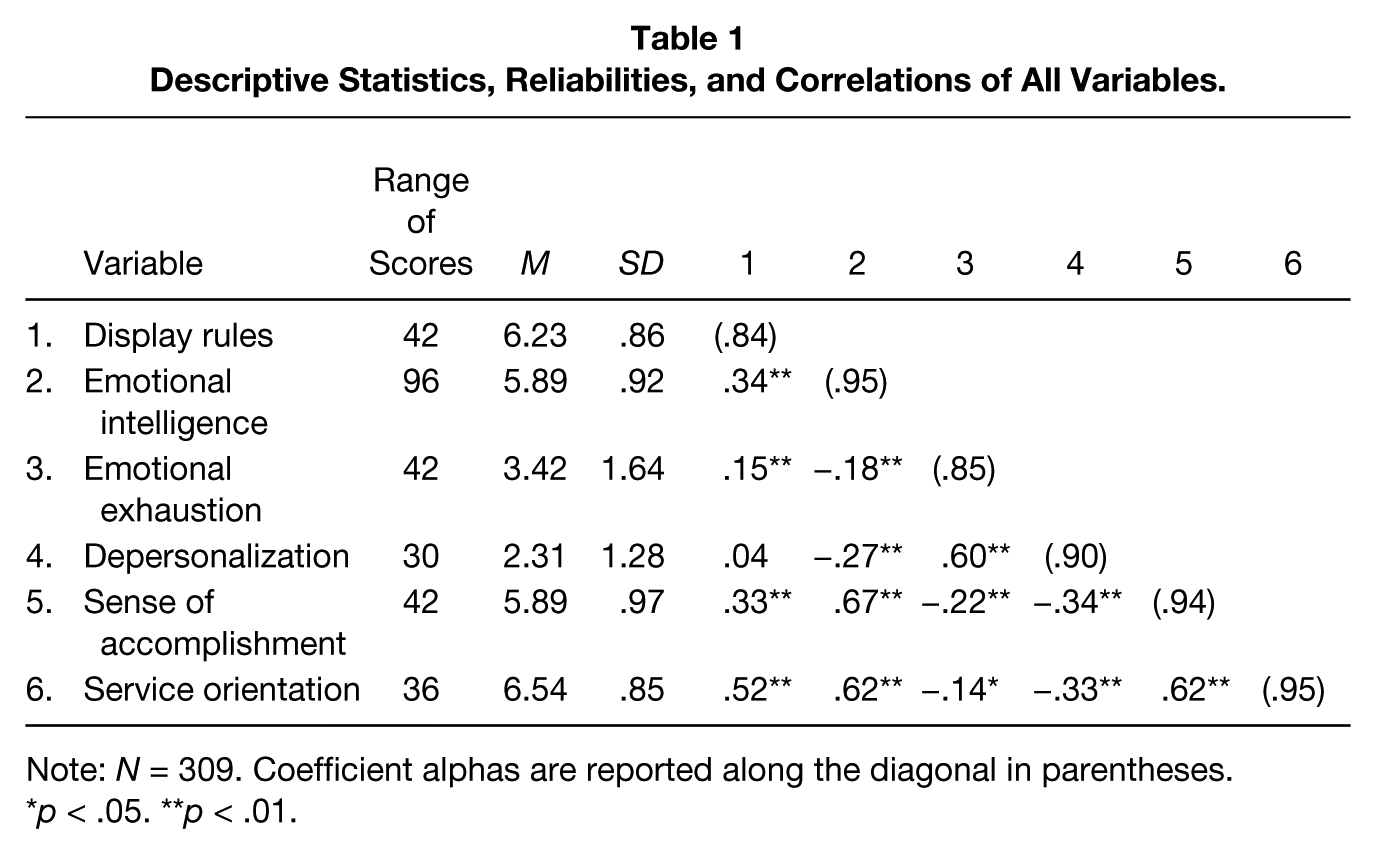
Note: N = 309. Coefficient alphas are reported along the diagonal in parentheses.
p < .05. **p < .01.
Data Analysis and Results
Data Examination
Before the main data analysis, dependent and independent variables were examined for accuracy of data entry, missing values, outliers, and fit between their distributions and the assumptions of multivariate analysis. No missing value was found. A total of 12 univariate outliers and multivariate outliers identified using standard z score at the critical value of ±4 (Hair, Black, Babin, & Anderson, 2010) and Mahalanobis distance (D2) with degrees of freedom equal to the number of variables (Tabachinick & Fidell, 2007) were retained for further analysis because they did not significantly distort the results of this study and are representative of the population of this study (Hair et al., 2010). Furthermore, based on results of the Kolmogorov–Smirnov test, data transformations were performed on each variable as a remedy for nonnormality and reduced the values of skewness and kurtosis. However, the distribution of two variables (i.e., SO and display rule perception) was not substantially improved. Further remedies were not performed because the large sample size of this study reduces the detrimental effects of nonnormality, and therefore the effects of the nonnormal variables on the main analysis are negligible (Hair et al., 2010). Finally, correlation between independent variables and tolerance/variance inflation factor (VIF) were examined to check for multicollinearity. The bivariate correlations between the independent variables were less than .7 and all VIF values for each independent variable ranged from 1.24 to 2.03, both indicating no substantial collinearity (Field, 2009).
Characteristics of Respondents
Of the 309 employees who participated in the study, 57.6% (n = 178) were female. Approximately 35% (n = 109) of the respondents were between 20 and 29 years old, and 27.2% (n = 84) were between 30 and 39 years old. Slightly more than half of the respondents had completed a 4-year college degree (50.8%, n = 157), followed by 2-year college graduates (25.9%, n = 80). For industry tenure, 68% (n = 210) of the respondents had been working in the hospitality industry more than 5 years whereas only 6.1% (n = 19) had been employed less than 1 year. Most respondents (93.2%, n = 288) were full-time employees. More than half of the respondents worked in the front office (52.8%, n = 163), followed by sales (16.8%, n = 52) and the food and beverage departments (15.2%, n = 47). Line employees comprised 43% (n = 133) of respondents whereas the rest were managers (56%, n = 176).
Hypothesis Tests
Using SPSS Version 17.0, a four-step hierarchical regression analysis was performed to test hypotheses. Hierarchical regression was used because this procedure allows us to evaluate the relationship between a set of independent variables and the dependent variable, controlling for the impact of control variables or a different set of independent variables on the dependent variable (Howitt & Cramer, 2008). Therefore, to examine unique effects of emotional labor factors on SO, SO was regressed on demographic factors (Step 1), perceived display rules (Step 2), emotional intelligence (Step 3), a sense of accomplishment, emotional exhaustion, and depersonalization (Step 4). Table 2 shows the results of the four-step hierarchical regression analyses and beta estimates for the full regression model for the study.
Results of Hierarchical Regression Analysis.

p < .05. **p < .01. ***p < .001.
Results of hierarchical regression showed that the main effects of the independent variables explained 59% of the variance on SO. The hierarchical regression analyses also revealed that no demographic variable in Model 1 was significant, although each explained unique variance of 5.3% in SO. In Model 2, display rules significantly contributed to predicting SO (ΔR2 = .26, β = .35, p < .001) when demographic variables were controlled for, thereby confirming Hypothesis 1. The R2 change associated with the display rule perception (from Model 1 to Model 2) was .26. In other words, adding the display rule perception factor explained an additional 26% of the variances in SO. Thus, the more hotel employees perceive the organizational display rules, the higher their SO. Emotional intelligence, added in Model 3, significantly related to SO (ΔR2 = .21, β = .28, p < .001) beyond the variance accounted for by demographic controls and the display rule perception. More specifically, the hierarchical regression Model 3 that includes emotional intelligence with control variables and display rule perceptions significantly improved the explanation of variance (Δ21%) on SO. Hypothesis 2 is therefore supported, indicating that higher emotional intelligence of employees resulted in higher SO. Finally in Model 4, emotional exhaustion, depersonalization, and sense of accomplishment were entered, but only depersonalization (β = −.20, p < .001) and sense of accomplishment (β = .22, p < .001) were significant in explaining additional variance (ΔR2 = .07) in SO. These results confirm Hypotheses 4 and 5, indicating that higher depersonalization results in lower SO whereas a higher sense of accomplishment leads to higher SO. However, emotional exhaustion was not significantly related to SO (β = .02).
Slope Tests
Slope tests (Clogg, Petkova, & Haritou, 1995; Paternoster, Brame, Mazerolle, & Piquero, 1998) were conducted to further discover if there is a significant difference among effects of the predictors on SO between managers and line employees. According to previous research (Ashforth & Humphrey, 1993; Morris & Feldman, 1996), situational factors such as frequency of face or voice contact, variety of emotional expression, and attentiveness to required display rules may change the likelihood to engage in emotional labor. For example, line employees should experience more emotional labor than managers because they have more frequent direct contact with customers. In contrast, customer contact may be more effortful for managers who have relatively longer interaction per customer interaction than line employees. Such differences should mean that the effects of emotional elements in this study (i.e., predictors) on SO may also differ between managers and line employees.
To examine the difference in the effect of the predictor variables on SO, we generated regression equations from the hierarchical regression models for each group, with


where X1 = display rules perception, X2 = emotional intelligence, X3 = emotional exhaustion, X4 = depersonalization, and X5 = sense of accomplishment, and then compared each regression coefficient of the predictor variables (i.e., slopes) between the manager group and line employee group to test the null hypothesis Ho: bm = be, where bm is each of the regression coefficients for managers, and be for line employees. The results of this test are presented in Table 3.
Results of Slope Test for Difference in Regression Coefficients.
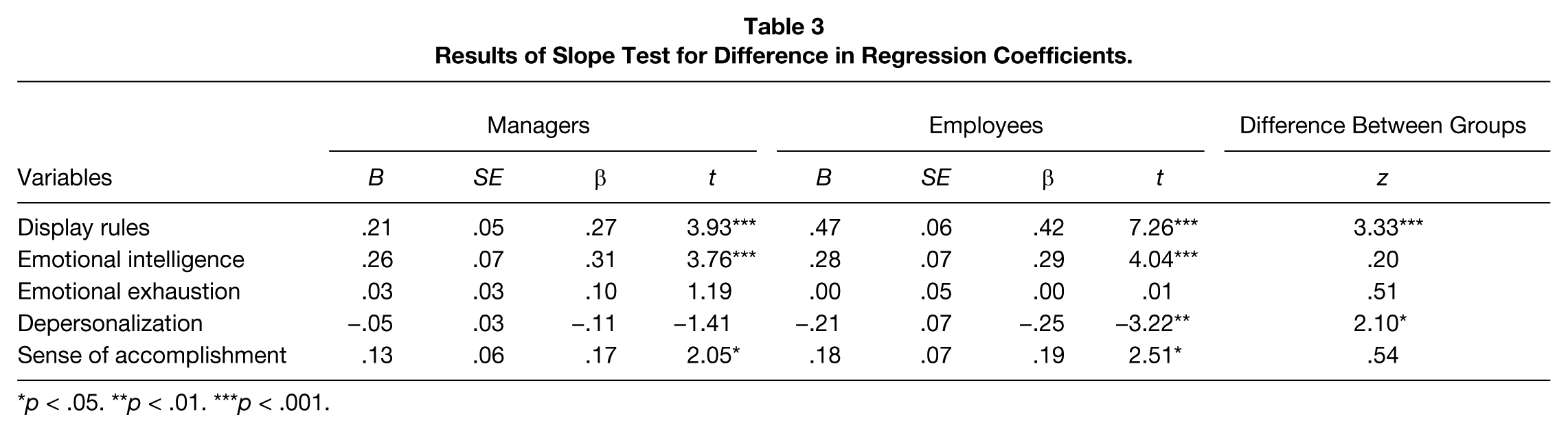
p < .05. **p < .01. ***p < .001.
The results revealed significant differences for the effect of display rules (Β = .21, p < .001) and depersonalization (Β = .47, p < .001) on SO between the two groups. The effect of display rules on SO for line employees was significantly higher than for managers (z = 3.33, p < .001). The results also indicate that the effect of depersonalization on SO for line employees differs for managers and employees (z = 2.10, p < .05); depersonalization is significantly more pronounced among line employees than among managers. For emotional intelligence and sense of accomplishment, however, although these emotional dimensions had a significant positive effect on the SO of both managers and line employees, the effect is similar for both managers (Β = .26, t = 3.76, p < .001) and line employees (Β = .28, t = 4.04, p < .001). Finally, for both groups, emotional exhaustion was not significant in predicting SO.
Discussion
This study examined the antecedent role of emotional elements on hotel employees’ SO. We hypothesized that service display rules, emotional intelligence, emotional exhaustion, depersonalization, and sense of accomplishment are associated with SO. Through an analysis of hierarchical regression models, we found that certain key emotional factors do affect SO. Consistent with previous findings and theories, most hypotheses were supported.
One key finding of this study was that, among the emotional elements, perception of display rules was the most influential in enhancing employee SO. This finding is consistent with previous studies conducted by Peccei and Rossenthal (1997) and Susskind et al. (2003, 2007), who found that perceptions of organizational service standards or clear understanding of customer service was positively associated with SO. These results indicate that hotel employees who are well aware of the service standard in their organization are more committed to providing customer-oriented service. That is, organizations’ service standards shape the way employees view their service-related jobs and duties; clear awareness and understanding of customer service performance provides employees with a priority in their job performance and constitutes important work goals for the employee. This study also found that perception of display rules was more influential among line employees than managers in enhancing SO. This finding can be explained by the difference in the extent of job authorization between the two groups. Line employees interact more frequently and repetitively with customers than managers. They also have less autonomy and authority than managers in doing their job. Thus, line employees may rely more on certain organization rules than their own discretion, and consequently this higher reliance on display rules could influence their service attitude to customers as an important factor.
As proposed, the results of our study also showed that emotional intelligence predicts SO. This finding supports the notion that prior research documented (e.g., Johnson & Spector, 2007; Mayer & Salovey, 1995; Modassir & Singh, 2008). That is, emotionally intelligent employees have an ability to easily sense and acknowledge the affective states of others, to know what emotional display is appropriate for a given situation, and to modify their emotional states and responses quickly in positive, enjoyable directions (Brotheridge, 2006; Carmeli, 2003; Grandey, 2000); thus, employees with these abilities are more likely to understand and meet the special needs of customers, showing strong SO toward customers. Comparing the effect of emotional intelligence on SO revealed that emotional intelligence had a significant positive effect on both managers and line employees, but the two groups were not significantly different. Therefore, although managers and line employees differ in the frequency, duration, and intensity of emotional interactions with customers at work, emotional intelligence is equally indispensible to building and strengthening SO because their jobs inherently involve direct emotional interactions.
The findings about the relationship between emotional intelligence and SO provide support for how emotional intelligence can lead to the positive form of emotional labor. According to previous research, emotional intelligence is negatively related to emotional dissonance (i.e., surface acting) whereas emotional intelligence is positively linked with employees’ effortful emotional behavior (i.e., deep acting; Brotheridge, 2006; Lee & Ok, 2012; Prati et al., 2009). This positive relationship between emotional intelligence and deep acting is probably because of SO. The high level of SO predisposes individuals to think and act in ways that encourage positive and/or discourage negative emotional experiences of customers. Accordingly, employees with high SO may show sincere concern for customers, and thus choose to deeply modify internal feelings to be consistent with display rules instead of simply manipulating their outward expression, a major source of emotional dissonance. As a theoretical implication, a future study may consider building an extensive and integrative path model of emotional intelligence, SO, and emotional labor to clarify the beneficial role of SO in choosing deep acting or surface acting emotional labor behaviors.
Depersonalization had a negative effect on SO, but emotional exhaustion did not explain a significant amount of variance in SO. This result can be explained by the burnout process proposed by Maslach and Jackson (1986). According to Maslach and Jackson (1986), emotional exhaustion is the first phase of burnout, a response to the emotional stressors of the job. When employees reach this point of extreme exhaustion because of the depletion of psychological resources, they reduce their emotional and cognitive involvement with the job by withdrawing themselves from their work. This leads to the second phase of burnout, that is, depersonalization. When service employees use depersonalization as a form of coping in response to high levels of emotional exhaustion, they tend to be less responsive to and less involved with the needs of their customers (i.e., lowered SO; Maslach et al., 1996; Singh, 2000; Singh & Goolsby, 1994). In other words, employees’ SO may not go down until the depersonalization phase occurs; it goes down with the depersonalization phase. Thus, based on this result, we may expect that emotional exhaustion is an antecedent of depersonalization; instead of emotional exhaustion, depersonalization actually leads to reduced SO. This expectation obviously provides a theoretical ground for further studies about the mediating role of the burnout process from a different point of view. More specifically, although the present study viewed these burnout dimensions as separate factors that may affect SO independently, future studies may want to consider them as a set of affective responses that progress on a continuum (Maslach & Jackson, 1986). Therefore, combined with the conservation of resources theory (Hobfoll, 1989), future investigations may verify how relationships between job stressors and SO exist via the sequential process of these burnout dimensions.
Comparing managers and line employees for the effect of depersonalization on SO showed that whereas depersonalization does not influence SO among managers, it was a significant predictor among line employees. This mixed result may be explained by the different job responsibilities of each group. Line employees continually engage in more intense, face-to-face interactions with customers than managers do. The interactions are often inherently difficult, upsetting, and emotionally charged; accordingly, line employees are likely to have higher levels of stress, and this may cause employees to detach themselves from customers, leading to reduced SO. In contrast, however, managers’ main responsibilities focus more on backing up their employees, providing service in support of employees rather than directly assisting customers. Thus, managers have relatively less chance for contact with customers than line employees. Because of this lower frequency of customer interaction, managers are less likely to suffer stress due to customers and consequently rarely experience depersonalization. Therefore, depersonalization does not affect managers’ SO.
Finally, our study also found that a sense of accomplishment among employees was positively related to SO. As in previous studies (e.g., Lee & Ok, 2012; McDonald & Siegall; 1992; Saxe & Weitz, 1982; Van Eck Peluchette, 1993), employees who succeed in their work are more likely to enjoy their performance, role, and job, and thus, become motivated to improve their performance. Increasing commitment to customers may be one response to the feeling of accomplishment. The job demands–resources model can explain this finding, suggesting that the availability of resources encourages motivation and leads to positive attitudes, behavior, and well-being while reducing the impact of job demands and the associated physiological and psychological strain such as burnout. High job demands or negative aspects of work, on the other hand, may deplete employees’ physiological and/or psychological resources and lead to burnout (Bakker & Demerouti, 2007). Emotional demands or emotional dissonance involved in surface acting may lead to feelings of emotional depletion and the burnout syndromes of emotional exhaustion and depersonalization, although a sense of personal accomplishment in emotionally demanding situations may motivate and increase service commitment. The job demands–resources model was recently introduced to the academic community as part of an emerging research trend that focuses on optimal functioning of human strengths, states of pleasure, and positive experiences at work (i.e., positive psychology, Bakker & Demerouti, 2007; Luthans, 2002; Seligman & Csikszentmihalyi, 2000), and our study provides empirical evidence as a basis for further investigations: the constructive role of positive emotional factors in emotional labor.
In addition to the relationship between a sense of accomplishment and SO, we also found that managers and line employees show no differences in the effect of sense of accomplishment on SO. Therefore, feeling a sense of accomplishment is essential for both groups to building customer-oriented service attitudes. Regardless of the difference in job responsibilities, SO of both managers and line employees may increase as they feel personal accomplishment in their service engagement. Given that their job involves providing service to customers, a service-oriented attitude would be a natural consequence of feeling personal achievement.
Managerial Implications
Our findings provide several implications for effectively managing the customer orientation of service employees. Although display rules may themselves be at fault because they require artificial regulation of emotions, which may lead to emotional dissonance (e.g., Ashforth & Humphrey, 1993; Hochschild, 1983; Morris & Feldman, 1996), the results of our study, as we hypothesized, show that the actual perception of the display rules contributes significantly to SO. Therefore, intentionally reducing display rules on the ground that they are counterproductive may not be realistic among hospitality organizations today. Instead, hotel operators should use display rules to improve service without creating emotional dissonance. To do this, management should create display rules that center on solutions, not forcing positive emotions. Management could emphasize that display rules are a reasonable expectation for service interactions and have constructive functions for all stakeholders: customers, organization, and employees (McConnell, 2003). When employees are continuously reminded that display rules are functional (i.e., display rules are provided as guidance, teaching proper emotional expression in service encounters), employees may learn quality customer service standards and internalize the display rules more easily, thereby increasing the likelihood of SO among employees.
Display rules can be disseminated through organizational philosophies and culture, so employees who are aligned with the organizational environment and values may well perceive implicit display rules without needing enforcement (Zapf, 2002). Therefore, organizations may want to articulate their orientation to service in their mission statement or core values. Incorporating display rules into their culture to promote service values among employees may also motivate employees to accept and embrace display rules to guide them in performing their jobs. Training and incentive programs may also help employees acknowledge the importance and favorable functions of display rules, especially when employees feel neutral or less than positively toward the rules. It should be possible to develop better attitudes through incentives and rewards.
Our study highlights emotional intelligence as another important element affecting SO. Thus, hotels should try to retain emotionally intelligent hotel employees. Our study indicates that employees who are emotionally intelligent tend to be better equipped to mitigate the negative impact of emotional labor in service interactions. One practical way for hotels to do this is to recruit and hire emotionally intelligent employees. For this, hotel organizations may want to assess an applicant’s level of emotional intelligence and select those with a greater proclivity for service-oriented commitment.
Although selecting new employees with high emotional intelligence can be readily done during the initial selection process, current employees should not be ignored. Their emotional intelligence level can be reinforced by developing training programs that enhance emotional intelligence (Groves, McEnrue, & Shen, 2006; Slaski & Cartwright, 2003; Taylor, 2002). These training programs should center on empathy and understanding the customer, as well as developing customer relationships.
Our study further confirmed that sense of accomplishment is important to SO, a finding in previous studies. Thus, hotels should provide employees with regular and positive feedback and recognition for quality customer service to help motivate them to improve. Both formal and informal rewards should be considered for employees who respond well to customers. Frontline service staff are often the least rewarded, with relatively low pay, which is a major reason for employee service failure (Harris & Ogbonna, 2009). Thus, implementing a reward and recognition system will make employees feel a sense of accomplishment, through which they increase their SO. Empowerment is frequently cited as a key to increasing motivation, accomplishment, and productivity (e.g., Sternberg, 1992; Stock & Hoyer, 2005), so management may also need to provide employees with the authority to make decisions about quality issues directly affecting customer service.
Our study also calls attention to depersonalization and its role in reducing SO. Thus, another implication focuses on strategies that hospitality organizations can implement to minimize depersonalization. Given that depersonalization occurs after emotional exhaustion, a burnout syndrome that occurs when psychological resources are depleted (Jackson, Schwab, & Schuler, 1986), hotels should strive to support their employees emotionally to replenish and save their psychological resources. For this, management should pay careful attention to their employees, listening to work-related concerns to detect signs of emotional exhaustion and depersonalization. Implementing counseling programs can also help employees acquire or recharge valuable emotional resources as the programs can help employees and managers share experiences and skills with each other. Such sessions can also provide useful information on performing emotional labor effectively in emotionally charged service interactions. Furthermore, hospitality organizations may offer access to organizationally supported stress management/emotional health service as part of an employee benefit package. Through this benefit, service employees can develop skills for managing psychological resources and preventing harmful stress reactions, preventing the burnout that reduces SO. Again, increased autonomy with broader authority to solve problems in service encounters may not only increase a sense of accomplishment but also decrease depersonalization as it gives employees more choices in their decision making (Sternberg, 1992; Stock & Hoyer, 2005). Thus, management may consider empowering customer-contact staff, giving them the flexibility they need to cope with an emotionally demanding service encounter.
Our study illustrates the differences between managers and employees in the emotional elements that influence SO; display rules and depersonalization influence line employees more than managers. Because service performance problems often stem from failing to understand people in different organizational levels and roles, these differences may cause organizational problems (McConnell, 2003). Therefore, hotel operators must consider such differences when establishing and implementing the company’s service standard or when designing and planning job responsibilities and work arrangements. Organizations should also encourage their employees and managers to understand the differences in their roles to minimize any discrepancies and increase service commitment.
Limitations and Suggestions for Future Research
We acknowledge several limitations in our research. The primary limitation is the use of a cross-sectional design, which constrains inferences concerning causality (Bobko & Stone-Romero, 1998). Thus, we do not know whether the findings of this study are random or persist over time. Future research should include longitudinal designs to shed further light on the causal influences of emotional elements on SO. Also, the directions of the relationships hypothesized and examined in this study were derived based on the existing theoretical and empirical backgrounds. However, bidirectional relationships are also possible as noted by Babakus, Yavas, and Ashill (2009); SO may be a critical resource that helps employees conserve cognitive and emotional resources and thus serves as a source of resilience that increases personal accomplishment and prevents distress and depersonalization. Further investigation would verify the directions of the relationships in this study.
The second limitation involves sample sizes, which were small and different for each position group. Specifically, the number of managers (n = 176) was relatively higher than the number of line employees (n = 133), and the small samples of both managers and line employees may have reduced the power to detect the relationships among variables. We, thus, might not find significant differences between the two groups.
Moreover, the findings of this research were based exclusively on data collected using self-report questionnaires, so another concern with the findings is the possibility that responses may have been affected by common method variance in statistical analysis (Podsakoff, MacKenzie, Lee, & Podsakoff, 2003). Although some researchers argue that the best approach to measure respondents’ subjective state of mind, disposition, or attitude is through self-reporting (e.g., Howard, 1994; Schmitt, 1994; Spector, 1994; Wallbott & Scherer, 1989), the self-reporting methodology may generate exaggerated relationships among variables. To ensure that our measures had adequate discriminant and convergent validity and that the findings were not greatly undermined by common method variance, we performed Harman’s one-factor test for common method variance (Podsakoff et al., 2003) and found that the self-report measures did not significantly affect our findings. Nonetheless, the influence of same-source variance on these results cannot be completely ruled out. Therefore, we recommend that future research should adopt more diverse strategies or use a combination of multiple sources to capture employee perceptions, traits, and attitudes.
A final limitation in this study concerns the generalizability of the findings. The data for this study were collected from hotel employees and managers in the United States. More than half of the respondents in this study (n = 176, 57.0%) were from upscale, brand name hotels. Thus, the findings of this study may not generalize to other cultures or other hotel environments such as budget/economy hotels and independent hotels. Research in other settings or geographical areas might yield different results, so it would be useful to replicate this study in different settings to establish the validity and generalizability of the present findings across different hospitality contexts.