



Abstract
The current study adopted cluster and discriminant analyses to investigate how differentially upscale restaurant customers view (a) the four dimensions of restaurant quality (price fairness, food quality, service quality, and physical environment), (b) the three dimensions of relational benefits (confidence benefits, social benefits, and special treatment benefits), and (c) revisit intentions and favorable reciprocal behaviors as proxies for customer reciprocity when customers perceive different levels (high vs. low) of relationship marketing investment (RMI). When customers perceived high RMI, they (high-RMI customers) evaluated all the aforementioned factors positively. By contrast, customers who experienced low RMI (low-RMI customers) rated the same factors negatively. High- and low-RMI customers were best distinguished by service quality, confidence benefits, and favorable reciprocal behaviors. Understanding the distinction between high- and low-RMI customers will shed light on how operators of upscale restaurants develop and reinforce perceived RMI to achieve favorable customer reciprocity.
The number of relationship marketing studies has been increasing in the hospitality literature because regular/loyal customers significantly contribute to high profit margin and revenue, positive referral, and continuing customer reciprocity (Morgan & Hunt, 1994; Reichheld & Sasser, 1990; Rigby, Reichheld, & Schefter, 2002). Relationship marketing is defined as “all marketing activities directed toward establishing, developing, and maintaining successful relational exchanges” (Morgan & Hunt, 1994, p. 22). This definition connotes that firms invest in continuing relational exchanges to develop and sustain long-lasting relationships with highly profitable or loyal customers (Sheth, 1996). A popular form of relationship marketing is offering special treatments to regular customers through loyalty/reward programs. The underlying concept of relationship marketing involves investing in developing and enhancing relationships with customers to cultivate an enduring bond with them (Gwinner, Gremler, & Bitner, 1998; Hennig-Thurau, Gwinner, & Gremler, 2002; Peppers & Rogers, 2004).
Strategic approaches in relationship marketing are necessary in the service industry (Palmatier, Dant, Grewal, & Evans, 2006; Vargo & Lusch, 2004), wherein services are regarded as perishable, intangible, and heterogeneous. This situation increases the perceived risk of customers toward service offering (Zeithaml & Bitner, 1996). Firms in the service industry, wherein numerous competitors provide alternatives and adopt similar pricing and distribution policies, should cater to the dynamic needs of customers by differentiating and customizing their strategies (Vargo & Lusch, 2004). De Wulf, Odekerken-Schroder, & Iacobucci (2001) advocate that firms should invest more in implementing sustainable relationship marketing to enhance their customized value and competitive edge. When the relationship marketing investment (RMI) of a firm is highly recognized by customers, feelings of gratitude and satisfaction are likely to be evoked among them (Palmatier, Jarvis, Bechkoff, & Kardes, 2009); thus, long-lasting relationships with the firm are established (Smith & Barclay, 1997). Consequently, customer perception of RMI serves as an essential mechanism of relationship marketing.
Relationship marketing is also extensively discussed in the hospitality literature. For example, researchers have delved into the notions of the reward/loyalty program (McCall & Voorhees, 2010; Tanford, Raab, & Kim, 2011), relationship quality (Hyun, 2010; W. G. Kim & Cha, 2002; W. G. Kim, Lee, & Yoo, 2006), relational benefits (W. Kim & Ok, 2009), and customer relationship management (Wu & Chen, 2012; Wu & Lu, 2012). These prior studies demonstrate the significant role of relationship marketing by exploring the antecedents and consequences of relationship quality, roles of relational benefits in relational exchanges, and effects of customer relationship management on business success.
In the current study, the unexplored aspect of relationship marketing in the hospitality literature is further examined through an investigation of how upscale restaurant customers differentially view (a) the four dimensions of restaurant quality (price fairness, food quality, service quality, and physical environment), (b) the three dimensions of relational benefits (confidence benefits, social benefits, and special treatment benefits), and (c) revisit intentions and favorable reciprocal behaviors as proxies for customer reciprocity when customers perceive different RMI levels (high- vs. low-RMI customers). As shown in Figure 1, the current study addresses the degree to which the four dimensions of restaurant quality and the three dimensions of relational benefits influence RMI perception of upscale restaurant customers. Although upscale restaurant operators agree that RMI is important, they may not be aware of which dimension of restaurant qualities and relationship benefits contributes the most (or the least) to customer RMI recognition. In addition, this study demonstrates the link of RMI with customer reciprocity by showing the extent to which RMI is associated differently with favorable reciprocal behaviors and revisit intentions. An understanding of the distinction between high- and low-RMI customers is expected to present valuable implications on the effective implementation of relationship marketing activities for retaining highly valued customers.
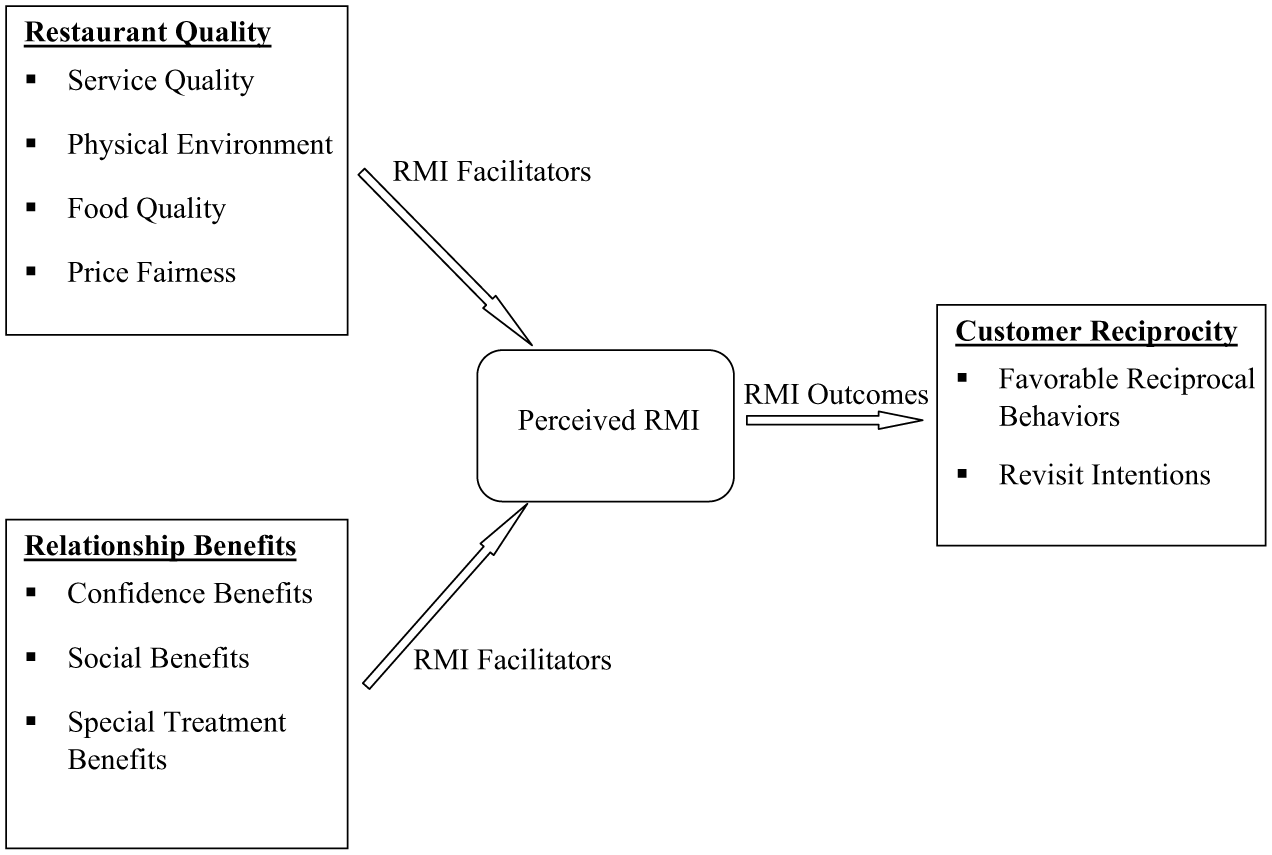
Conceptual Framework
Literature Review
RMI
RMI is defined as “a consumer’s perception of the extent to which a retailer devotes resources, efforts, and attention aimed at maintaining or enhancing relationships with regular customers that do not have outside value and cannot be recovered if these relationships are terminated” (De Wulf, Odekerken-Schröder, & Iacobucci, 2001, p. 35). Similarly, Palmatier et al. (2006, p. 140) conceptualize RMI as “the time, effort, and resources that sellers invest in building stronger relationships.” These definitions suggest that service providers evoke high RMI perceptions when they offer more “resources, efforts, and attention aimed at maintaining or enhancing relationships with regular customers” (Blau, 1964; Smith & Barclay, 1997). A positive RMI perception allows service providers to impress their customers (Hart & Johnson, 1999), thus encouraging the latter to maintain enduring relationships and exchange long-lasting reciprocity with the former (Smith & Barclay, 1997). Perceived RMI helps arouse expectations of reciprocity among customers, which, in turn, serves as a supportive basis for sustaining a relationship with a service firm (Ganesan, 1994). This argument is empirically supported by the finding that RMI contributes to the performance of a seller, including share of wallet, sales, and profit (Palmatier et al., 2006). Thus, RMI can be deemed as a key mechanism for fueling relationship marketing activities.
To explore the role of RMI in upscale restaurants, the current study examines the association between relational benefits, restaurant quality dimensions (physical environment, food quality, service quality, and price fairness), and customer reciprocity (revisit intentions and favorable reciprocal behaviors) and RMI from the perspectives of high- vs. low-RMI customers based on the following grounds. First, the importance of restaurant quality dimensions adopted in the current study is manifested well in restaurant quality, service, and cleanliness (QSC) inspections. QSC inspections are inspection systems for evaluating the operational performance of restaurants to maintain quality for customer satisfaction (DiPietro, Parsa, & Gregory, 2011). The restaurant quality dimensions adopted in this study are covered by QSC inspections and can be considered as resources that restaurants should invest in to build relationships with customers. The relationship benefits offered by service firms to regular customers are also seen as investments critical to sustaining long-term relationships with customers (Hennig-Thurau et al., 2002). Therefore, the current study posits that quality dimensions and relational benefits can be viewed as “resources, efforts, and attention aimed at maintaining or enhancing relationships with regular customers” (De Wulf et al., 2001, p. 35).
Moreover, previous studies have determined that restaurant quality dimensions and relationship benefits can predict relationship quality in luxury restaurants (W. G. Kim et al., 2006; Meng & Elliott, 2008). The aforementioned studies consider restaurant quality and relationship benefits as relationship management activities that boost relationship quality. Relationship quality refers to relationship strength; it shows customer perceptions of the extent to which their expectations and desires are satisfied by their relationship with service providers (Jarvelin & Lehtinen, 1996; W. G. Kim et al., 2006). A high relationship quality suggests that customers trust and rely on the performance of service providers (Wong & Sohal, 2002). In addition, Mimouni-Chaabane and Volle (2010) find that RMI serves as a significant antecedent to relationship quality, thus advocating the concept that customers probably perceive high relationship quality when they experience the resources and efforts dedicated by a firm in maintaining relationships with its patrons. Thus, the aforementioned research suggests that RMI has a mediating role in the relationship between quality dimensions/relational benefits and relationship quality. In other words, restaurant quality and relationship benefits are considered as “resources, efforts, and attention” directed at strengthening relationships with customers. As such, these benefits contribute to customer RMI perception, which affects relationship quality.
Second, the objective of RMI is maintaining and strengthening relationships with customers, that is, customer reciprocity. The principle of reciprocity posits that individuals feel psychologically obligated to reciprocate a favor given to them, and that a feeling of pleasure is generated by reciprocity (Buck, 2004; Dahl, Honea, & Manchanda, 2005). This principle connotes that customers who perceive RMI from a restaurant are likely to return the favor by engaging in reciprocity. Thus, the current study adopts revisit intentions and favorable reciprocal behaviors as proxies for customer reciprocity to investigate the association between RMI and customer reciprocity.
Relationship Benefits
Relational benefits are defined as “the benefits consumers receive apart from the core service” (Hennig-Thurau et al., 2002, p. 230) in return for their enduring relationship with a service provider. This definition suggests that regular customers are likely to enjoy additional benefits because of their long-term commitment with a service firm, whereas infrequent patrons have minimal access to such benefits. Both parties (patrons and sellers) should commit to and benefit from each other to achieve successful relational exchanges. Hennig-Thurau et al. (2002) argue that relational benefits are essential for developing and cultivating long-lasting relationships with loyal customers. Bove and Johnson (2000) state that the strength of customer relationship with a restaurant is significantly affected by the amount and features of the relational benefits offered by the restaurant.
The concept of relational benefits is extensively discussed in the typology of Gwinner et al. (1998), who empirically determine that relational benefits comprise three dimensions, namely, social, confidence, and special treatment benefits. Social benefits result from personal ties and bonds based on a long-lasting buyer–seller relationship (Berry, 1995). Such benefits are considered as psychosocial benefits and include emotions of personal recognition, friendship, rapport, familiarity, and social support (Barnes, 1994; Berry, 1995). These emotions are instrumental in eliminating emotional distance with service providers through social bonds created by sustaining relationships (Gwinner et al., 1998; Reynolds & Beatty, 1999). Patrons highly value social benefits within the context of relationship marketing because relationship development cannot proceed without social interactions (Beatty, Mayer, Coleman, Reynolds, & Lee, 1996). Previous studies (W. Kim & Ok, 2009; Mattila, 2001; Shoemaker & Lewis, 1999) contend that unlike frequency programs, social benefits are considered as true loyalty programs that allow customers to develop emotional attachments to service firms, such as hotels and restaurants. Consequently, emotionally bonded customers develop affective commitment to a restaurant and practice positive reciprocity with it by giving referrals and not switching to another restaurant (W. Kim & Ok, 2009; Mattila, 2001; Shoemaker & Lewis, 1999). Social benefits or attachments can be deemed as major components of genuine loyalty programs in the restaurant industry, wherein interaction with customers is inevitable (Mattila, 2001).
Confidence benefits (such as low risk, trust) are also considered as important relational benefits. Long-term reciprocity enables customers to perceive low risk or feel less anxiety toward a service provider, thereby enhancing trust on the reliability and integrity of the provider (Gwinner et al., 1998) and making accurate predictions regarding service experience (Yen & Gwinner, 2003). Gwinner et al. (1998) states that if all variables are equal, then customers will rely on confidence benefits when choosing an alternative service firm (Gwinner et al., 1998).
Firms capitalize more on special/preferential treatment benefits because relationship marketing is intended inherently to treat customers differentially (Peppers & Rogers, 2004). Special treatment benefits, known as economic incentive–based preferential treatments, include discounts, free upgrades, complimentary services, and product/service rewards presented through loyalty programs; in such programs, economic incentives and customized services are offered to customers based on cumulative transactions (Lacey, Suh, & Morgan, 2007). Special treatment benefits are usually given to regular/selected customers (Gwinner et al., 1998). As such, these benefits are perceived as a part of a service package available only to selected valued customers (Reynolds & Beatty, 1999). This preferential offering makes customers feel privileged, important, and appreciated (Lewis, 2004). Special treatment benefits are effective strategies for stimulating relationships with profitable customers (Reynolds & Beatty, 1999). However, these benefits are limited in their capacity for earning true loyalty from customers. Customers enjoy preferential treatment from frequency programs based on their patronage; hence, they develop a functional interest in the rewards being offered by the programs rather than an emotional bond with the service providers (Mattila, 2001; Shoemaker & Lewis, 1999). Consequently, these customers are likely to switch to another restaurant when they are offered a better frequency program because of their low emotional commitment. The current study examines which dimension of relational benefits contributes the most (or the least) to customer RMI perception by considering the distinction between high- and low-RMI customers.
Dimensions of Restaurant Quality
Prior studies on restaurants (Almanza, Jaffe, & Lin, 1994; Han & Ryu, 2009; W. G. Kim et al., 2009; Ryu, Han, & Kim, 2008; Ryu & Jang, 2007) adopt quality attributes and identify their effects on satisfaction and behavioral intentions/loyalty. These attributes generally fall into two domains: tangible and intangible factors (W. G. Kim et al., 2006). Tangible factors include physical environment and food quality, whereas intangible factors comprise service quality and price fairness. These factors serve as significant barometers of restaurant quality because they are empirically positive antecedents of perceived value, image, satisfaction, and behavioral intentions. In examining the association between restaurant quality and RMI by comparing high- and low-RMI customers in the current study, the aforementioned factors, apart from relational benefits, are considered as “the time, effort, and resources” that a restaurant should invest in to sustain relationships.
Price fairness
The concept of price is reviewed as objective and perceived (subjective) prices. Objective price represents the monetary figure (an objective external characteristic) of a product/service (Dodds, Monroe, & Grewal, 1991). Perceived price results from internalized price impression, wherein individuals subjectively assess prices based on product/service quality information (Jacoby & Olson, 1977; Oh, 2000). Objective price becomes acceptable to customers only when the internalized price impression is valid to them (Oh, 2000). Price fairness is achieved when customers perceive the price of a particular offer as “right, just, or legitimate versus wrong, unjust, or illegitimate” (Campbell, 2007, p. 261). The concept of price fairness is developed into distributive and procedural price fairness based on justice theory (Homburg, Totzek, & Kramer, in press). Distributive price fairness signifies fairness of a particular outcome (such as a transaction). Procedural price fairness concerns the process that results in the outcome. Perceived price is a reliable indicator of product/service quality; thus, customer perception of price fairness enhances relationship quality between luxury restaurants and customers, and leads to customer loyalty (W. G. Kim et al., 2006; Meng & Elliott, 2008). By contrast, if customers regard a price as absurd to the extent that they feel cheated, they become dissatisfied and fail to develop relationships with service providers (Franciosi, Kujal, Michelitsch, Smith, & Deng, 1995; Urbany, Madden, & Dickson, 1989).
Food quality
Food quality is obviously perceived as a core restaurant product that significantly affects dining experience. Mattila (2001) and Soriano (2002) empirically find that food quality contributes the most to customer loyalty/revisit intention, followed by service quality. This finding conversely implies that a high level of customer dissatisfaction probably results from failure in food quality. Food quality is inherently related to basic customer needs; hence, food service failure is known as “core service failure” (Yang & Mattila, 2012), which will likely disrupt customer relationship with a restaurant.
Service quality
The importance of service quality is manifested in the concept of SERVQUAL: reliability, responsiveness, assurance, and empathy (Parasuraman, Zeithaml, & Berry, 1988). Customers observe the uniqueness and superiority of a service firm through its service quality (Yoo, Donthu, & Lee, 2000), which increases satisfaction with, trust in, and commitment to the firm (Bove & Johnson, 2000; Kelley, 1992). W. G. Kim et al. (2006) state that service quality is particularly critical to the relationship quality between upscale restaurants and their customers because such patrons tend to have high criteria for responsiveness, friendliness, courtesy, and knowledge. Similarly, Andaleeb and Conway (2006) argue that service quality results in customer satisfaction more than food quality or physical environment in full-service restaurants. A holistic dining experience is significantly affected by the interaction with and the service provided by the restaurant staff; thus service quality is deemed crucial for developing and sustaining customer relationship.
Physical environment
Atmospherics are intended to enhance customer feeling and consumption experience (Levy & Weitz, 2007); thus, physical environment (including elegant dining equipment, attractive exterior and interior, sophisticated lighting and sound) affects the emotions, attitudes, and behaviors of diners (Yűksel & Yűksel, 2002). Prior studies (W. G. Kim, Ng, & Kim, 2009; Mattila & Wirtz, 2001) report that physical environment enhances customer satisfaction, thus lending empirical support to the servicescape logic (Bitner, 1992). This logic dictates that physical surroundings significantly affect customer experience; hence, an attractive and unique physical environment design is highly noticeable and perceived as a common signature of an upscale restaurant. This factor is seen as an important component of restaurant investment with regard to catering to patrons.
Customer Reciprocity: Revisit Intentions and Favorable Reciprocal Behaviors
Revisit intentions have been perceived as attitudinal loyalty or behavioral intentions in explaining the intent of customers to avail of products/services (Ajzen, 1991). The concept of behavioral intentions depends on attitude formation. In particular, three constituents compose an attitude, as identified by Bagozzi (1978) and Breckler (1984). These constituents are (a) cognition (beliefs) or individual beliefs and knowledge about objects; (b) affect (feeling) or emotional reactions, such as feelings and moods; and (c) conation (behavioral intention), a consequence of cognition and affect and acknowledged as a behavioral intention with verbal statements. Oliver (1999) identifies three phases of loyalty evolution by adopting the notion of attitude formation: (a) cognitive loyalty, which becomes evident when customers gain prior knowledge or experiential information on products/services; (b) affective loyalty, which occurs when consumers accumulate favorable experiences through certain products/services and, thus, perceive positive feelings toward these products/services; and (c) conative loyalty, which is established when the behavioral intentions of consumers toward a firm are strengthened. The current study adopts intention to repurchase from the previous literature (Cronin & Taylor, 1992) to operationalize revisit intentions.
The concept of favorable reciprocal behaviors (such as “I have patronized the restaurant based on its extra effort to satisfy me.”) is well represented by behavioral gratitude. The latter refers to “the act of giving in return, which helps create a cycle of reciprocity between giving and countergiving and contributes to the ongoing construction of a relationship” (Palmatier et al., 2009, pp. 2-3). Favorable reciprocal behaviors signify customer reciprocation when customers feel grateful for the benefits/extra efforts provided by a service provider and return the benefits by patronizing the provider (Morales, 2005). As noted previously, RMI reflects resources and efforts designed to sustain relationships with customers. The desired consequence of RMI is positive relational exchanges between a restaurant and its customers, which can be reflected by revisit intentions (future reciprocity) and favorable reciprocal behaviors (actual reciprocity). The current study employs revisit intentions and favorable reciprocal behaviors to determine the reciprocation type (future or actual) that is closely associated with RMI by exploring the differential association between the two factors and high- versus low-RMI patrons.
Methodology
Data Collection
To determine population trait (such as upscale restaurant customers who perceive RMI through the relational benefits they experience), upscale restaurant customers with membership cards were contacted for the survey. A nationally recognized upscale restaurant brand in Seoul, Korea, supported the current study and offered a free drink coupon to those who participated in the survey. The surveyed restaurant issues membership cards to selected customers based on their consumption bills. A customer enjoys a 20% discount on food and beverage (F&B) consumption upon presenting the card and accumulates points for redeeming future rewards. In addition, the restaurant staff is trained to greet regular customers by their names whenever possible. A voucher for a free meal is periodically mailed to regular customers with membership cards. The voucher value varies with past consumption levels. Two branches of this upscale restaurant brand were sampled for 25 days. A survey was conducted while customers were having dessert or waiting for the bill. Customers who did not have membership cards were not included in the survey. A total of 350 questionnaires were distributed to each branch, and the same number of respondents was randomly contacted during lunch and dinner to achieve wide distribution of samples. Data refining process yielded 297 valid responses for data analysis.
Survey participants were asked to share their demographic profiles. The gender ratio of the respondents was 41% males to 59% females. The average household annual income in South Korea as of December 2012 was US$44,184 (Bloomberg, 2013); thus, most respondents had relatively high economic status based on annual household income: (a) US$24,001 to US$48,000 (21%), (b) US$48,001 to US$72,000 (35%), (c) US$72,001 to US$96,000 (28%), and (d) more than US$96,000 (9%). In addition, many participants attained high educational levels: bachelor’s degree (72%), master’s degree (8%), and doctoral degree (4%). The age profile was as follows: (a) 26 years to 35 years (21%), (b) 36 years to 45 years (35%), (c) 46 years to 55 years (30%), and (d) over 55 years (8%).
Operationalization of Constructs
Study scales (Table 1) were adapted from the extensive literature review. For example, relationship benefit scales (such as “I get a discount or a special deal that most customers don’t get.”) were taken from the studies of Hennig-Thurau et al. (2002) and Gwinner et al. (1998), whereas measurements of restaurant quality factors were adopted from several previous studies on restaurants (Almanza et al., 1994; Han & Ryu, 2009; W. G. Kim et al., 2006, 2009; Ryu et al., 2008; Ryu & Jang, 2007). RMI measures (such as “The restaurant devotes time and effort to our relationship.”) were derived from the works of Palmatier et al. (2009) and De Wulf et al. (2001). Favorable reciprocal behaviors (such as “I have patronized the restaurant because of its extra effort to satisfy me.”) were operationalized as a subset of scales from Morales (2005) and Palmatier et al. (2009). Moreover, with regard to operationalizing revisit intentions in a restaurant, the present study was based on the literature of consumer behavior and marketing (Cronin & Taylor, 1992; Oliver, 1999). Three trained graduate students pretested the questionnaire by conducting personal interviews with 36 restaurant customers. Construct scales were mixed to eliminate halo effects. Customers were asked to explain and answer each question to validate the instructions and scales. Moreover, they were requested to point out any issue related to the survey. Consequently, the pretest led to the refinement of the wording and the clarification of scales in the final questionnaire. Each item was operationalized based on a 7-point Likert scale with an anchor of 1 = strongly disagree and 7 = strongly agree.
Results of Confirmatory Factor Analysis
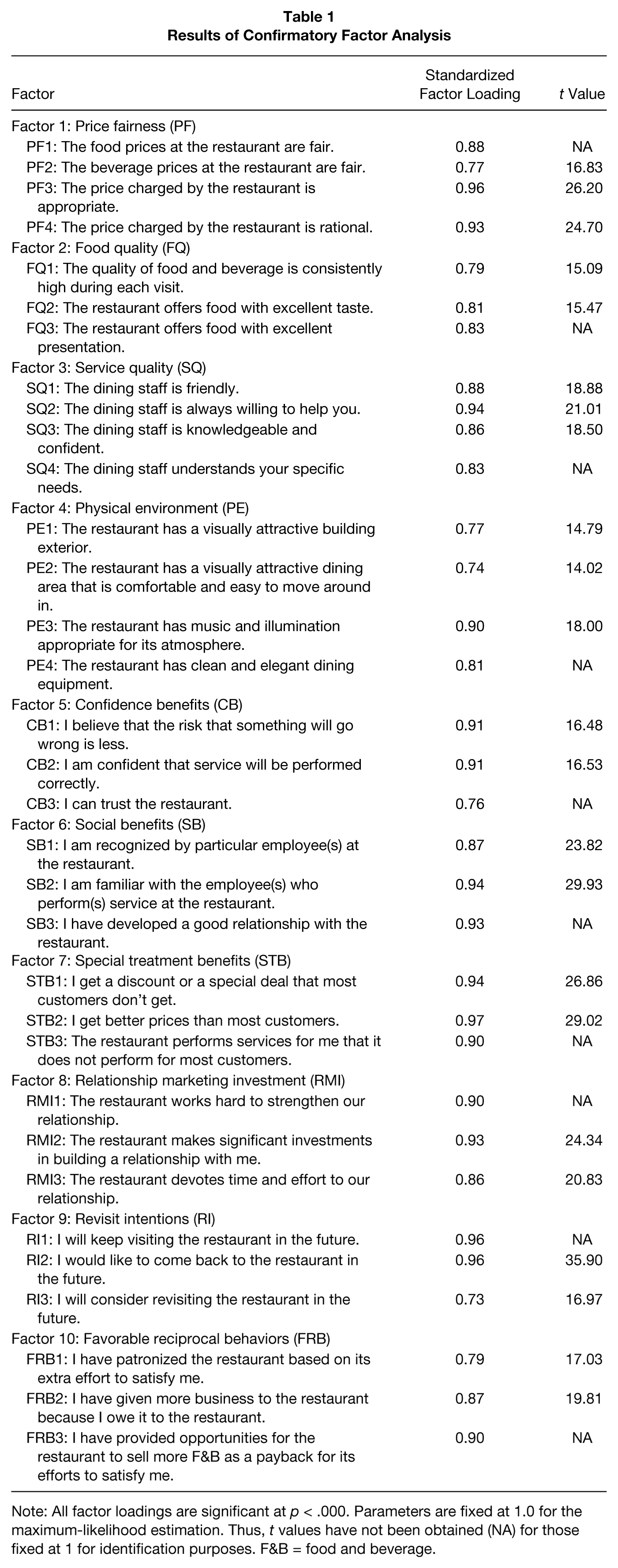
Note: All factor loadings are significant at p < .000. Parameters are fixed at 1.0 for the maximum-likelihood estimation. Thus, t values have not been obtained (NA) for those fixed at 1 for identification purposes. F&B = food and beverage.
Results
Testing for Measurement Reliability and Validity
The cutoff point of 0.7 Cronbach’s alpha (Nunnally, 1978) was used, and the reliability of all constructs was shown to be acceptable: price fairness (0.93), food quality (0.85), service quality (0.92), confidence benefits (0.89), social benefits (0.93), special treatment benefits (0.95), RMI (0.92), revisit intentions (0.91), and favorable reciprocal behaviors (0.88).
Convergent validity was adequate because all average variance extracted (AVEs) exceeded 0.5 (Fornell & Larcker, 1981), as shown in Table 2. In addition, factor loadings in Table 1, which were all significant at p < .05, further supported convergent validity (Anderson & Gerbing, 1988). Discriminant validity was also supported because the AVE for each construct was higher than the squared correlation coefficients of their corresponding interfactors (Fornell & Larcker, 1981). Furthermore, the proposed measurement items were found to fit observed data according to goodness-of-fit indices (χ2 = 947.3, df = 450, root mean square error of approximation = 0.06, comparative fit index = 0.94, non-normed fit index = 0.93).
Correlations (Squared Correlations), Reliability, AVE, and Mean
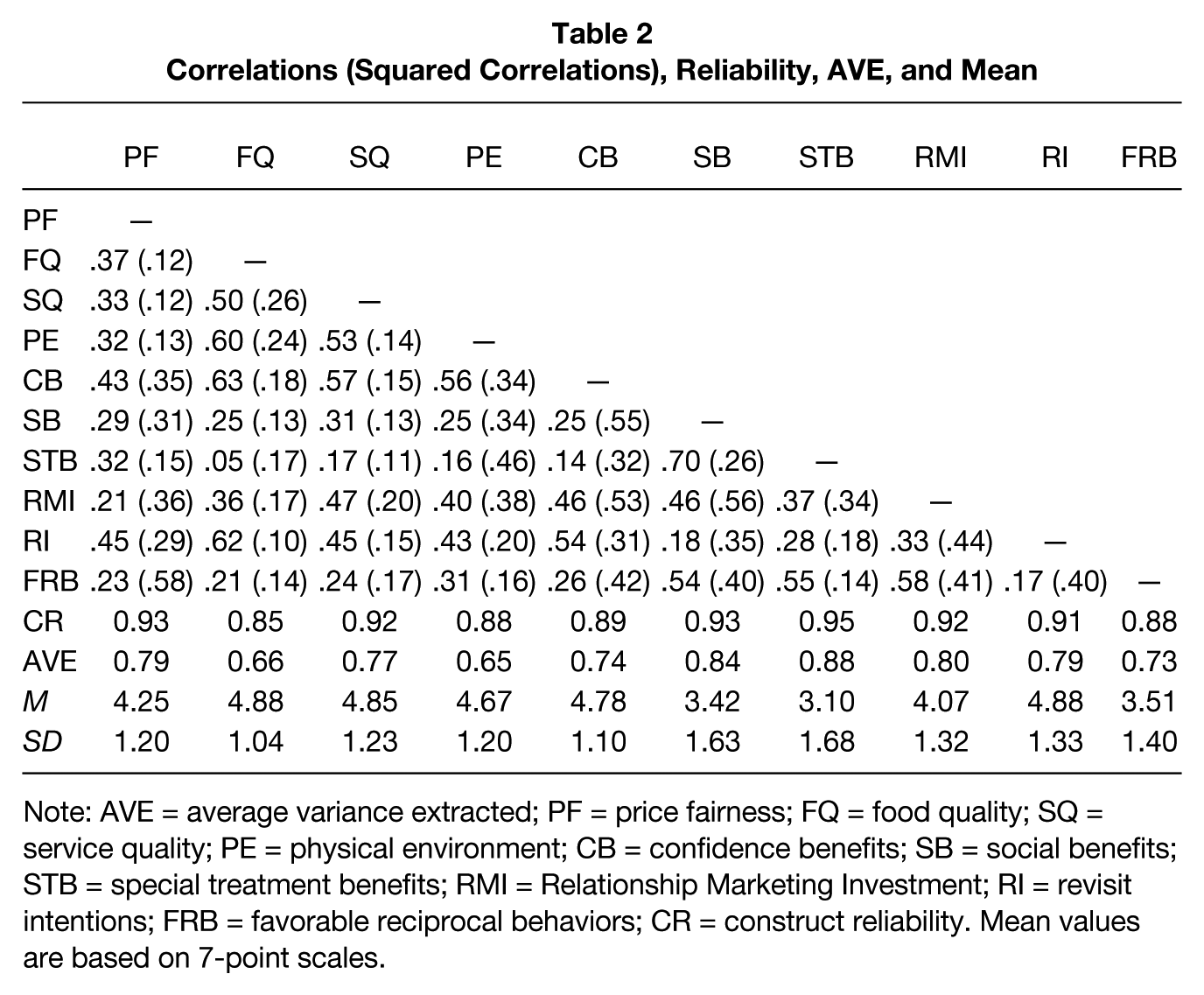
Note: AVE = average variance extracted; PF = price fairness; FQ = food quality; SQ = service quality; PE = physical environment; CB = confidence benefits; SB = social benefits; STB = special treatment benefits; RMI = Relationship Marketing Investment; RI = revisit intentions; FRB = favorable reciprocal behaviors; CR = construct reliability. Mean values are based on 7-point scales.
Cluster and Discriminant Analyses for RMI
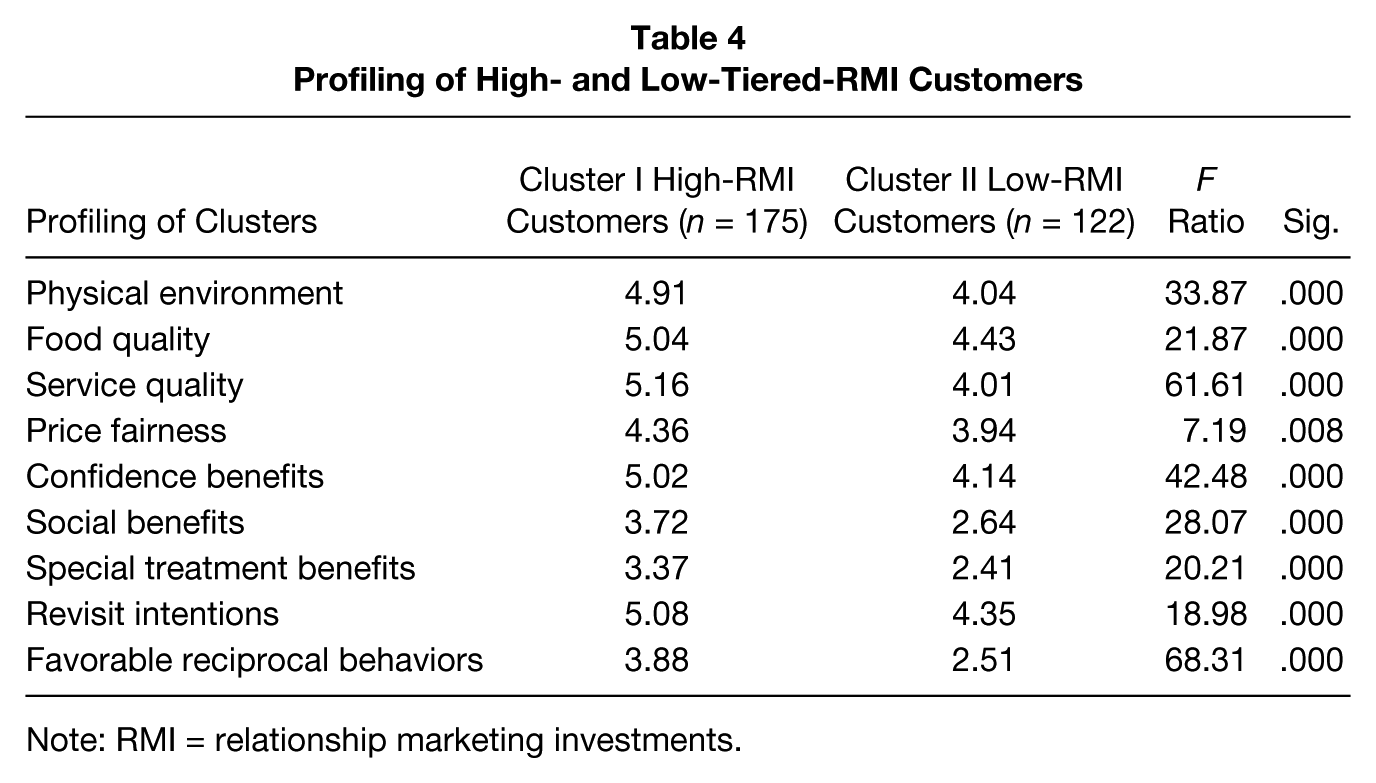
Cluster analysis is conducted when a sample needs to be categorized into a small number of homogeneous (mutually exclusive) groups based on similar traits (Hair, Anderson, Tatham, & Black, 1998). In particular, a combination of cluster and discriminant analyses is often performed in the hospitality and tourism literature (e.g., Correia, Silva, & Moço, 2008; Tan & Lo, 2008) when prior research requires distinction among different entities (individuals or objects). In the current study, cluster analysis was conducted to classify a sample into homogeneous customer subgroups based on RMI. Two clusters resulted from a hierarchical procedure (Tables 3 and 4) according to both agglomerative and Ward’s methods. The two clusters were Cluster I (n = 175) and Cluster II (n = 122). The mean scores of Cluster I were consistently higher than those of Cluster II across the three RMI scales. Therefore, Clusters I and II were called high- and low-tiered RMI customers, respectively. Moreover, statistical significant differences were found between the mean values of high- and low-tiered RMI customers according to the F ratio.
Cluster and Discriminant Analyses for RMI
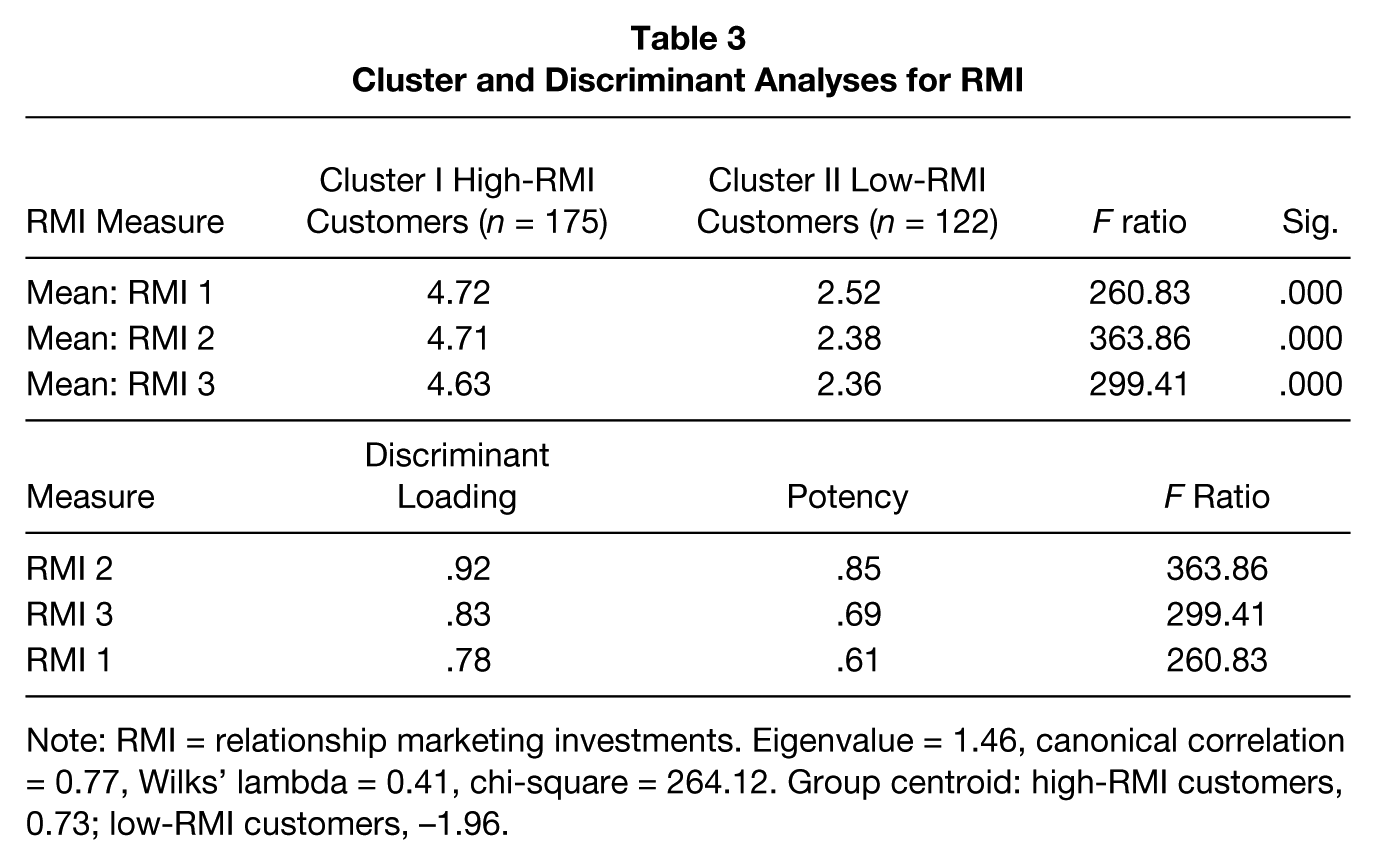
Note: RMI = relationship marketing investments. Eigenvalue = 1.46, canonical correlation = 0.77, Wilks’ lambda = 0.41, chi-square = 264.12. Group centroid: high-RMI customers, 0.73; low-RMI customers, –1.96.
Profiling of High- and Low-Tiered-RMI Customers
Note: RMI = relationship marketing investments.
Table 3 presents the centroid or “mean value for the discriminant Z scores of all objects within a group” and the discriminant loading or “simple linear correlation between each independent variable and the discriminant Z score for each discriminant function” (Hair et al., 1998, p. 241). A group centroid indicates the distance between the two groups for each function; hence, such centroid shows the positioning (perception) of high- and low-RMI customers in a discriminant space (Hair et al., 1998). According to the group centroid values in Table 3, high-RMI customers displayed a positive perception (0.73) of RMI measures, whereas the low-RMI group exhibited a negative perception (–1.96). The discriminant loading indicates the relationship strength between clusters (high and low RMI) and RMI measures. Moreover, the discriminant loading signifies that high- and low-RMI customers were best distinguished by RMI 2 (0.92), then by RMI 3 (0.83), and finally, by RMI 1 (0.78). Similarly, the potency index and F ratio reflected the degree of discriminating power through RMI measures.
Profiling High- and Low-Tiered-RMI Customers
The profiles of high- and low-RMI customer groups were derived from the following factors: restaurant quality, relationship benefits, and customer reciprocity. The mean difference among each factor in the two groups was tested using ANOVA. F ratio (Table 4) indicates that the mean value of each factor is significantly different between high- and low-RMI groups. Moreover, high-RMI customers evaluated all factors more favorably than low-RMI customers.
Multiple Discriminant Analysis
Multiple discriminant analysis was performed using the stepwise approach to identify factors that best distinguish between high- and low-tiered RMI customers. Restaurant quality, relational benefits, and customer reciprocity were examined via discriminant analysis. During the analysis, this study identified the factor from each domain that best distinguished high-RMI customers from low-RMI customers. Box’s M statistic was checked to assess the equality of the covariance matrices of all factors among RMI groups (Hair et al., 1998). Equal covariance matrices (p > .05) were supported among the groups.
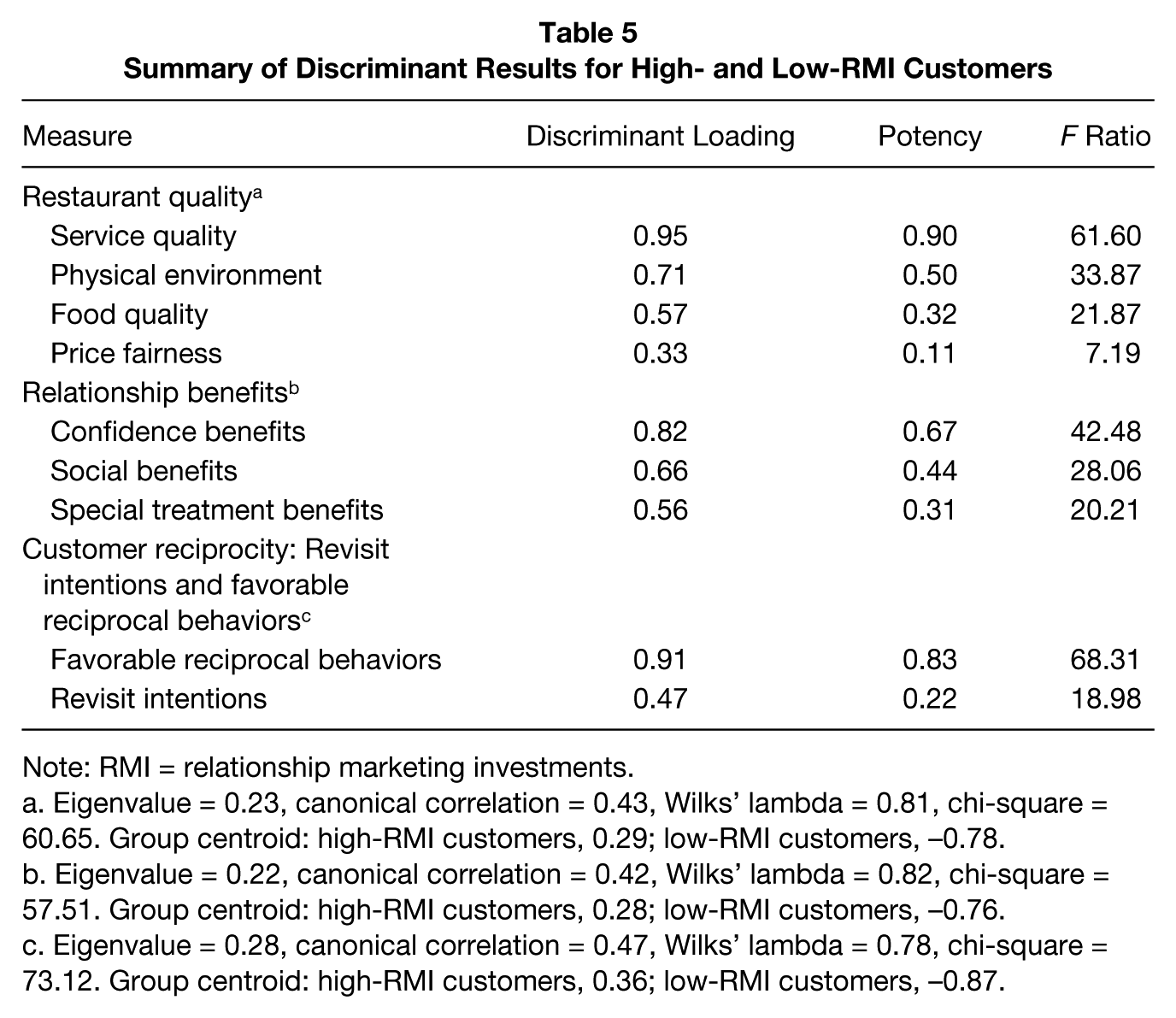
High-RMI customers displayed positive perception (0.29, 0.28, and 0.36) across the three domains, whereas low-RMI customers exhibited negative perception (−0.78, −0.76, and −0.87) according to the group centroid values in Table 5. When the discriminant loading was considered within the context of restaurant quality, high- and low-RMI customers were primarily distinguished by service quality (0.95), followed by physical environment (0.71), then food quality (0.57), and finally, price fairness (0.33). In terms of relationship benefits, high- and low-RMI customers were primarily discriminated by confidence benefits (0.82), followed by social benefits (0.66), and finally, special treatment benefits (0.56). In terms of customer reciprocity, high- and low-RMI customers were primarily discriminated by favorable reciprocal behaviors (0.91), followed by revisit intentions (0.47).
Summary of Discriminant Results for High- and Low-RMI Customers
Note: RMI = relationship marketing investments.
Eigenvalue = 0.23, canonical correlation = 0.43, Wilks’ lambda = 0.81, chi-square = 60.65. Group centroid: high-RMI customers, 0.29; low-RMI customers, –0.78.
Eigenvalue = 0.22, canonical correlation = 0.42, Wilks’ lambda = 0.82, chi-square = 57.51. Group centroid: high-RMI customers, 0.28; low-RMI customers, –0.76.
Eigenvalue = 0.28, canonical correlation = 0.47, Wilks’ lambda = 0.78, chi-square = 73.12. Group centroid: high-RMI customers, 0.36; low-RMI customers, –0.87.
Similar to the discriminant loading value, the potency index and F ratio (Table 5) from each domain indicated which factor is the most (or the least) related to high- and low-RMI clusters. Service quality, confidence benefits, and favorable reciprocal behaviors served as the strongest distinguishers between high- and low-RMI groups from the three domains based on the discriminant loading value, potency index, and F ratio. This finding implies that these factors best distinguished between high- and low-RMI customers.
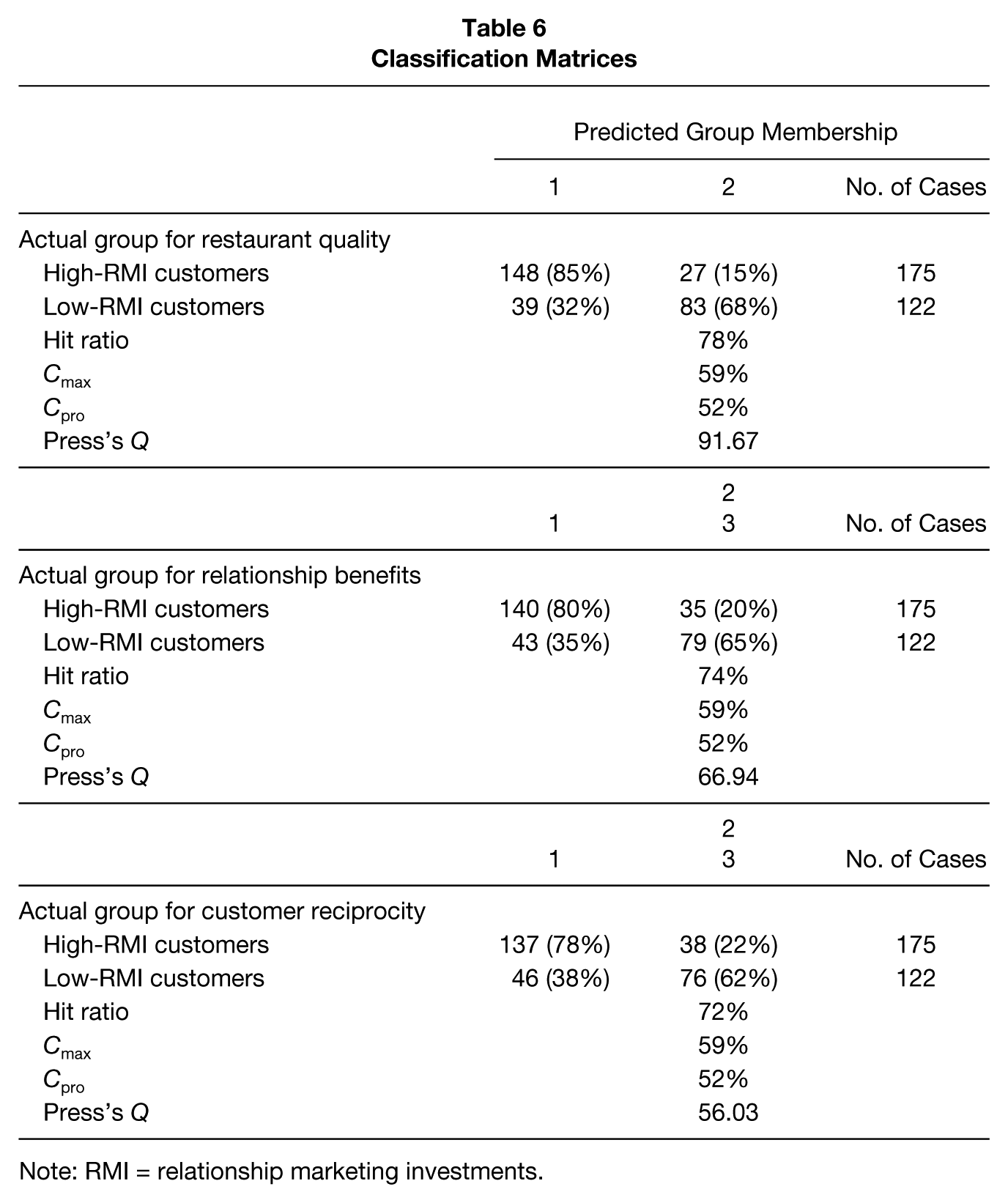
Table 6 presents the classification matrices for each of the three domains. These matrices were assessed to verify the discriminant function. Meanwhile, the hit ratio reflected the extent to which the discriminant function could correctly classify respondents for the sample. Maximum chance criterion (Cmax) and proportional chance criterion (Cpro) displayed the level of correctness when all observations were assigned to the clusters. Hit ratio was significantly greater than Cmax and Cpro across the three domains. Approximately one third or more of low-RMI customers were misclassified; thus the discriminant function exhibited an acceptable level of classification accuracy.
Classification Matrices
Note: RMI = relationship marketing investments.
Discussion and Conclusion
Theoretical and Managerial Implications
This study aimed to examine the role of RMI with regard to how customers of upscale restaurants recognize RMI that evokes favorable customer reciprocity. Unlike previous relationship marketing hospitality research that explored relationship quality, relational benefits, and loyalty programs, the current study offered an expanded view of RMI in upscale restaurants, which invests in sustaining long-lasting relationships with valued customers as a proactive relationship marketing strategy. The relationship marketing of upscale restaurants has not been explored previously from the perspective of RMI. The current study is particularly beneficial to individuals who are in charge of deciding which domains to invest in and how much resource to invest (more or less). Although the findings cannot be directly applied to different industries, the results provide an understanding of how upscale restaurant customers develop RMI perception and how upscale restaurants offer benefits or qualities to develop sustainable relationships with their customers.
Cluster analysis was conducted in the current study to categorize survey participants into high- and low-tiered-RMI customers. The extent to which high- and low-RMI groups evaluated restaurant quality, relationship benefits, and customer reciprocity differently was assessed by discriminant analysis. Service quality, confidence benefits, and favorable reciprocal behaviors from the three domains best distinguished high-RMI groups from low-RMI groups.
High- and low-tiered-RMI customers were best distinguished by service quality, followed by physical environment, food quality, and price fairness, according to the discriminant loadings of restaurant quality dimensions. Service quality and physical environment were found to be stronger distinguishers between high- and low-RMI customers compared with food quality and price fairness given the discriminant loading value. W. G. Kim et al. (2006) implicitly offer empirical support to the aforementioned finding. These researchers report that service quality primarily predicts relationship quality in luxury restaurants. To assess service quality, restaurant patrons engage in interactional service with servers on a face-to-face basis. The high quality of employee service in upscale restaurants is developed over time by constant investments in well-designed service manuals and training. When customers experience employee service failure, they often assume that the restaurant operators have neglected investing in employee training/education. Therefore, customer perception of service quality serves as a yardstick on how much effort and resource an upscale restaurant has dedicated to RMI. With regard to the role of physical environment in RMI, sophisticated and appealing restaurant atmospherics, including the exterior, interior, and utensils, are common features of upscale restaurants. Physical environment is instantly noticeable to diners; thus, they can appreciate RMI level easily through this factor.
In the current study, food quality and price fairness have less significant roles in developing customer RMI perception compared with service quality and physical environment. The probable explanation for this finding is that food is considered as a core restaurant product; thus, diners perceive food quality as a necessary attribute and take it for granted. Customers are less likely to appreciate the role of food quality in evaluating RMI because they regard this factor as a basic attribute. With regard to price fairness, upscale restaurant customers are willing to pay more for a high-quality dining experience; they tend to care more about quality than price or value for money. Thus, price fairness is not a sensitive issue among upscale restaurant patrons and is less consequential to customer RMI perception.
Confidence benefits were found to be the best discriminator for distinguishing between high- and low-RMI patrons, followed by social benefits and special treatment benefits. In other words, confidence benefits contribute to RMI the most, followed by social benefits and special treatment benefits. This result is consistent with that of Gwinner et al. (1998), which advocates that customers perceive confidence benefits as the most significant relational benefit, followed by social and special treatment benefits. This finding can be understood from the concept of discretionary versus contractual RMIs.
Palmatier et al. (2009) state that customers feel grateful for discretionary RMI, whereas contractual RMI triggers less gratitude among customers (Wood, Stewart, & Linley, 2008). Discretionary RMI is represented by confidence benefits (including perceived trust, reliability, and integrity of a restaurant) and social benefits (including friendship and rapport with a customer, and customer recognition). Confidence and social benefits are cultivated over time through mutual respect and trust without imposing requirements on customers. A service firm exercises discretionary efforts and resources for developing relationships with customers. For example, conspicuous recognition stimulates the feeling of being privileged and eminent among customers, thus causing them to appreciate the discretionary investment of a restaurant in employee empowerment programs. In addition, the perceived risk for a restaurant product is high because of simultaneous production and consumption, as well as intangibility. When a restaurant exerts discretionary efforts on a service guarantee policy that enhances customers’ confidence regarding their experience, customers are likely to trust and respect the restaurant. These discretionary efforts, which do not require customers to commit contractually to the restaurant, stimulate customer perception of confidence and social benefits, which, in turn, strengthens perception of discretionary RMI.
Authors of prior research (De Wulf et al., 2001) discover that preferential treatment does not contribute significantly to RMI in the retail industry. These authors argue that special treatment benefits are not as effective as other relationship benefits for developing customer RMI perception. The weak association between special treatment benefits and RMI is construed from the concept of contractual RMI. The surveyed restaurants offer special treatment benefits to customers based on their prior consumption. This contractual reward system binds customers to patronize these restaurants to earn future preferential treatment. Shugan (2005) argues that contractual benefit is not deemed as a genuine loyalty program because it involves customer liability/obligation by requiring patrons to commit their resources to a benefit provider. In a true loyalty program, the benefit supplier commits to customers rather than obligate customers to commit to it. A corresponding customer sacrifice is a prerequisite for special treatment benefits; thus, customers tend to perceive contractual RMI from preferential treatment benefits. This contractual feature causes customers to take special treatment benefits for granted; thus, they perceive less RMI.
Favorable reciprocal behaviors (actual reciprocity) are more powerful than revisit intentions (future reciprocity) in discriminating between high- and low-RMI customers through customer reciprocity. This finding suggests that as customers experience more RMI for sustaining customer relationships, they are likely to feel grateful for such RMI and return the favor by patronizing a restaurant. Thus, RMI is effective in triggering actual reciprocity. However, future reciprocity exhibits weaker capability for distinguishing between customers with high RMI and those with low RMI compared with actual reciprocity. A plausible basis for this phenomenon results from the limitation of revisit intentions in measuring favorable actual reciprocity. Revisit intentions are criticized for not reflecting positive reciprocity or genuine loyalty clearly. Even if customers feel a low level of loyalty toward a service provider, they may exhibit stronger revisit intentions because of high switching costs, the absence of alternatives, and other situational restraints (such as price, accessibility, and so on; Oliver, 1999). The higher mean value of revisit intentions (high RMI, 5.08; low RMI, 4.35) compared with that of favorable reciprocal behaviors (high RMI, 3.88; low RMI, 2.51), as shown in Table 4, may signify the potential drawback of revisit intentions, thus implying that revisit intentions are inflated by personal and situational factors to a certain extent. Future reciprocity may not be a reliable proxy for the consequence of actual RMI perception because revisit intentions are vulnerable to personal and environmental constraints.
Furthermore, customers tend to view the four dimensions of restaurant quality, relationship benefits, and customer reciprocity positively when they perceive a high level of investment of a service firm for maintaining customer relationship. Conversely, low customer RMI perception leads to a negative perception of the same factors. This finding indicates that customers who experience the efforts exerted and resources spent by a restaurant aimed at improving customer relationship are likely to appreciate its RMI through restaurant quality and relational benefits; thus, these customers exercise favorable reciprocation in return for the high RMI. This positive effect of RMI on customer reciprocity is mediated by customer gratitude and satisfaction. Recognition of RMI allows customers to acknowledge the resources spent and efforts exerted by a provider, thus stimulating feelings of gratitude toward the provider (Palmatier et al., 2009). Moreover, customers display a high level of satisfaction with service providers when they receive favors or benefits from them as a result of RMI. Therefore, the potential mediators of gratitude and satisfaction explain the positive association between RMI and customer reciprocity.
The findings have managerial implications for industry practitioners with regard to reinforcing customer RMI perception. For example, ensuring that service quality and confidence benefits will satisfy customer expectations is critical because these factors best distinguish between high- and low-RMI customers. However, the probability of service failure remains because of human imperfection, although a well-trained service staff is likely to deliver quality service. The service guarantee policy (that is, the promise that a payout will be made and service failure will be recovered to customer satisfaction) is an effective strategy for assuring service quality even during service failure. This policy strengthens the perception of service quality and customer confidence that service providers will implement excellent service recovery procedures (McColl, Mattsson, & Morley, 2005).
Two types of service guarantees (specific and unconditional) can be invoked in the context of restaurants. Specific guarantee refers to the commitment of a service firm with regard to specific attributes (such as service time, price, and so on), which helps reduce perceived risk from the performance of particular attributes. Specific guarantees may not be appreciated by the entire customer segments because of heterogeneous preferences (Kashyap, 2001). A specific guarantee implemented based on specific attribute performances is more appropriate for quick service restaurants. As its name suggests, unconditional guarantee (such as “Get It Right or Get It Free!”) implies total customer satisfaction and appeals to a wider customer segment by promising complete service aspects (Callan & Moore, 1998). From the perspective of customers, an unconditional guarantee significantly lowers financial risk by providing comprehensive guarantee on the entire service. Therefore, this service guarantee policy is more effective for upscale restaurant customers who tend to perceive high financial risk. A service guarantee policy should be easy to understand and communicate, relevant to customers, easy to collect on, and trustworthy to be implemented successfully (Wirtz, 1998). A service guarantee policy is conducive to boosting confidence benefits and service quality, thus increasing customer RMI perception.
Employee empowerment is a noteworthy program that offers social benefits to customers (W. Kim & Ok, 2009). An empowerment program allows the service staff to engage in relational exchanges, including self-disclosure and customer recognition; thus, customers experience more social bond with a restaurant and perceive more RMI. The empowerment of staff in offering social benefits requires instrumental support, such as customer relationship management (CRM), which is designed to identify and build enduring relationships with valued restaurant customers. In CRM, a well-designed database allows restaurant staff to keep track of the preferences of customers, thus enabling them to provide customized services, such as greeting customers by name and recommending F&B that the customers will like. The CRM system allows restaurant operators to provide customers with social benefits efficiently, thus fostering relationships with regular patrons.
Another primary support is the system of fair compensation/reward, which is a significant motivator for stimulating desired employee behaviors (Chiang & Birtch, 2008) as well as employee job satisfaction and retention (Arnett, Laverie, & McLane, 2002). This system drives staff to offer better service to regular customers, given that the compensation is linked to staff performance. The establishment of a fair reward program necessitates the development of an effective performance measurement system. Restaurant operators may gain insight into designing an effective performance appraisal system from the case of TRW Automotive. TRW established an online performance management system wherein employees and managers around the world input and review information. This information includes biographical data (educational attainment, experience), performance summary (achievement against stated goals, professional development activities, supervisor assessment), and development summary (future potential/positions from the perspective of the supervisor and employee, demonstrated strength) (Dessler, 2008). Once employees complete the online forms, employees and their managers review and refine the appraisal through meetings or online interactions. This online appraisal system is effective because it makes a firm competitive and ensures employee satisfaction. The system not only offers a transparent process that ensures fair appraisal but also assesses goal-oriented performance and development needs relevant to both the firm and its employees. If the areas and criteria of a performance appraisal system are clearly defined and understood by the employees, and if the employees are fairly assessed, then the system serves as a fundamental basis for fostering employee satisfaction and commitment, thus motivating restaurant staff to interact with customers proactively.
The findings of the current study indicate that intangible attribute performances, including service quality as well as confidence and social benefits, are instrumental in customer RMI recognition, which, in turn, facilitates favorable reciprocal behaviors. Intangible attributes are not easy for other restaurants to duplicate; thus, restaurant management should focus more on these attributes to differentiate their operations from competitors. Consequently, an understanding of the distinction between high- and low-RMI customers sheds light on how upscale restaurant operators develop and reinforce perceived RMI to achieve favorable customer reciprocity.
Future Research and Limitations
In the current study, cluster and discriminant analyses have been conducted to explore the development of RMI and how RMI affects customer reciprocity by distinguishing high-RMI from low-RMI customers. The findings show that high- and low-RMI customers exhibit differential patterns in evaluating restaurant quality, relationship benefits, and customer reciprocity, thus implicitly signifying the moderating role of RMI in customer evaluation. Future studies are recommended to test the moderating effect of RMI using structural equation modeling coupled with group comparison.
The potential drawback of a cross-sectional study may be present in the current study. Although a cross-sectional study reflects the prevalence of the findings of interest from a population, it merely exhibits a snapshot of the population at one particular point in time. When another time frame is selected, the findings of a cross-sectional study may change (Bland, 2001). Moreover, this study adopts nonprobability purposive sampling to select the respondents—upscale restaurant customers with membership. Under the nonprobability sampling, some subjects of a population have no chance of being selected, thus causing exclusion bias (Healey, 1999; Levine et al., 2011). In addition, the results of the current cannot be generalized for the upscale restaurant industry because they are based on a single restaurant brand. Thus, multiple brands should be considered to enhance the external validity of the findings.