



Abstract
This study focuses on domestic tourists at a World Heritage Site located in China and investigates the relationship of three important visitor perceptions (i.e., service fairness, destination image, and service quality) with tourism destination loyalty (i.e., positive word-of-mouth referrals and revisit intentions) through overall destination satisfaction and trust toward destination service providers. The structural equation modeling findings generally support the conceptual model and indicate that service fairness and service quality have a significant and positive impact on overall destination satisfaction and trust toward destination service providers, while destination image has a significant effect on overall destination satisfaction but not on trust toward destination service providers. In addition, the investigated perceptions-loyalty relationships are found to be mediated by overall destination satisfaction, but not necessarily by trust toward destination service providers. The paper includes discussions of the theoretical and managerial implications of the findings.
Introduction
The essence of relationship marketing lies in attracting, maintaining, and enhancing customer relationships (Berry, 1983). Developing loyal customers has been shown to result in a number of positive benefits, such as reducing the amount of investment in marketing efforts to solicit new customers, enhancing customer acquisition, improving customer retention, and increasing brand equity and profit (Smit, Bronner, & Tolboom, 2007). According to Reichheld and Sasser (1990), companies can almost double their profits by retaining just 5% more of their customers via relationship-building strategies. If customers are the most critical asset for a business, then having a clear understanding of what factors lead to customer loyalty should be of concern. Yet destination marketing organizations appear to be lacking strategic intent toward developing a relationship-marketing orientation (Murdy & Pike, 2012).
In tourism, destination loyalty includes positive word-of-mouth referrals and intentions to revisit the destination (Mohamad, Ali, & Ghani, 2011; Oppermann, 2000). As such, these loyalty measures act as key indicators of strategic marketing success and are commonly incorporated in customer research models in the lodging industry (e.g., Back, 2005; Back & Parks, 2003). Unfortunately, researchers point out that relatively little attention has been given to the issue of visitor destination loyalty in the broader tourism literature (Oppermann, 2000; Pike, 2007, 2010). This is of key concern in the highly competitive tourism markets because destinations are increasingly substitutable (Pike, 2007); travelers have an almost unlimited choice of destinations (Murdy & Pike, 2012); and the cost of switching providers is modest (Sandvik & Grønhaug, 2007).
Williams (2006) suggests that the hospitality and tourism industry is unique in that individuals are often totally immersed in an environment, and as such, new realities and identities are created for customers by these experiences—experiences that are critical to both attracting new customers as well as retaining former customers (Yelkur, 2000). Managers of tourism-based organizations need to understand and be concerned about tourists’ perceptions toward a tourism site that result from their experiences. The experiential nature of destination tourism provides a unique context in which to research customer loyalty. Meng and Elliott (2008) state, “relationship quality is increasingly emerging as a strategy for organizations that strive to retain loyal and satisfied customers in today’s highly competitive environment” (p. 509). Understanding the impact of important relationship-building constructs on tourists’ destination loyalty should be of interest to both academics and tourism practitioners (Barros & Assaf, 2012; Chi, 2011; Filo, Chen, King, & Funk, 2013; Ottenbacher & Harrington, 2013).
The present study will help address three identified conceptual tourism destination research gaps. The first gap relates to a lack of published empirical research on destination tourists’ perceptions of important relationship variables and destination loyalty in a causal relationship marketing framework. Given that building customer relationships has been widely recognized as a key to nurturing customer loyalty (Walsh, Hennig-Thurau, Sassenberg, & Bornemann, 2010), the current study extends the existing tourism literature by presenting an integrated model that could shed new light on the understanding of the antecedents and consequences of tourists’ overall destination satisfaction and trust toward destination service providers. The results of this study can assist destination marketers in developing and implementing market-oriented strategies that increase customer satisfaction and trust through tactics that focus on tourists’ perceived service fairness, destination image, and service quality.
The second conceptual research gap stems from a lack of empirical studies with Asian tourists. Asia is predicted to be the world’s largest tourist destination and tourist-generating region by 2020. Notably, until it opened its doors to the outside world in 1978, tourism in China was virtually nonexistent. China has since become a major tourism market (Lee & Sparks, 2007; Qiu & Lam, 2004). China’s tourism authorities have been focusing more attention on developing China’s domestic tourism (Wang & Qu, 2004), and this study specifically investigates domestic Chinese tourists.
The third research gap that this study addresses is the call for more research regarding visitors’ attitudes and behaviors based on experiences at World Heritage Sites (McNamara & Prideaux, 2011), particularly those in China (Su & Wall, 2011). Several studies (e.g., Drost, 1996; Landorf, 2009; Li, Wu, & Cai, 2008) have focused on issues of sustainability and resource management at World Heritage Sites, and the role of World Heritage Sites in attracting foreign tourism (Yang, Lin, & Han, 2010). Little exploration has been undertaken regarding tourists’ loyalty toward World Heritage Sites, particularly those in China.
This research investigates the relationship of three important tourist perceptions (i.e., service fairness, destination image, and service quality) with tourism destination loyalty (i.e., positive word-of-mouth referrals and revisit intentions) through overall destination satisfaction and trust toward destination service providers using a convenience sample of Chinese tourists visiting Wuyi Mountain National Park, a mixed cultural and natural World Heritage Site located on the Eastern coast of China. The theoretical model is tested with structural equation modeling (SEM). In the remainder of this article we provide a brief literature review, develop the hypotheses, and present the results. The article concludes with a discussion of the theoretical and managerial implications of the findings, as well as study limitations and directions for future research.
Overview of the Proposed Model
Figure 1 depicts the proposed causal model. The consumer perceptions of service fairness, destination image, and service quality are modeled as indirect antecedents to the relational benefits of intentions to (a) revisit a tourism destination and (b) engage in positive word-of-mouth referrals. We develop and empirically test a multivariate model in which overall destination satisfaction and trust toward destination service providers act as mediators between the perceptions of tourists and the loyalty variables investigated. The theoretical underpinning of this model is discussed in the following section where we define the constructs presented in Figure 1.
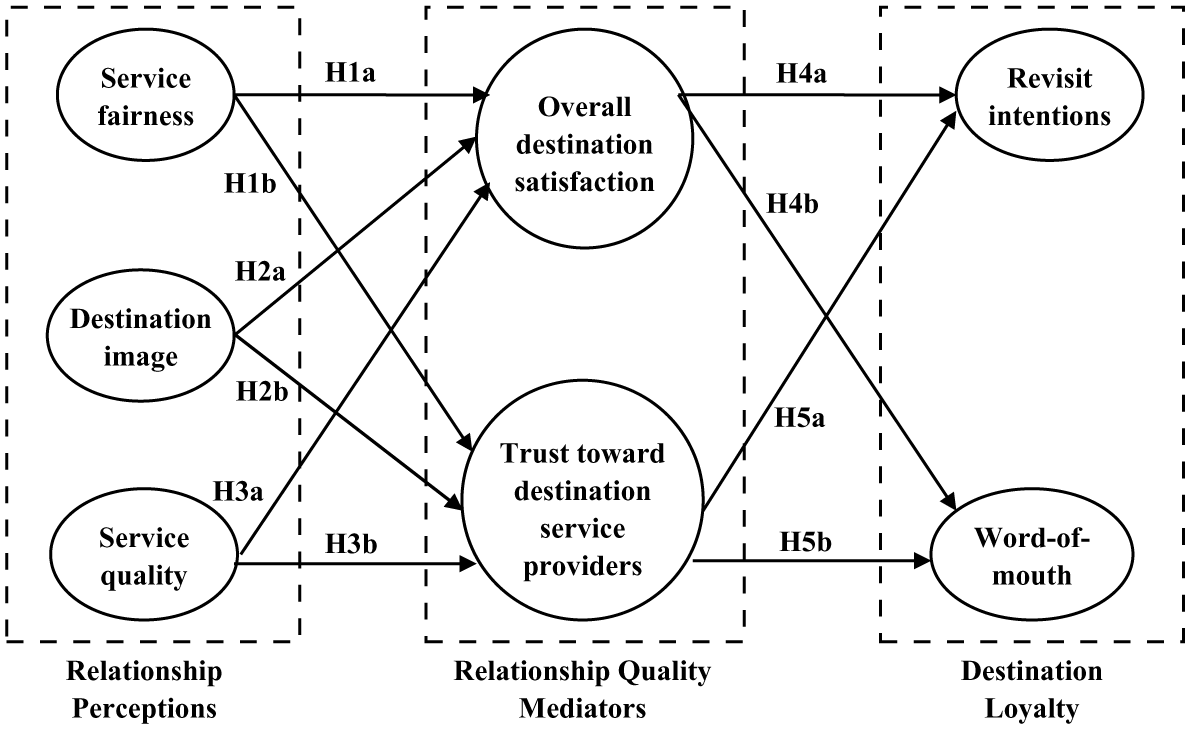
The Conceptual Model
Literature Review and Hypotheses Development
Relationship Quality
Relationship quality is a higher order construct often noted as consisting of satisfaction and trust (Crosby, Evans, & Cowles, 1990; Kim & Cha, 2002; Rauyruen & Miller, 2007). Relationship quality is widely recognized as the key to developing loyal customers (Walsh et al., 2010). In the context of relationship marketing, two of the most commonly investigated relationship quality constructs are satisfaction and trust (e.g., Kim & Cha, 2002; Rauyruen & Miller, 2007). These two constructs are discussed below.
Satisfaction
The creation of customer satisfaction is widely recognized as an important part of building quality relationships (Agusto de Matos, Rossi, Veiga, & Vieira, 2007; Fornell, Mithas, Morgeson, & Krishnan, 2006; Huang, Huang, Hsu, & Chang, 2009). Satisfied customers experience a pleasurable level of consumption-related fulfillment (Oliver, 1981). Comparison of expectations for what will occur in the service experience with perceptions of what actually did transpire leads to the level of satisfaction experienced. This theory of confirmation–disconfirmation defines satisfaction as a postpurchase evaluation assessment regarding a particular purchase encounter. Comparing performance with expectations, three outcomes are possible: (a) when performance matches the standard expectation, confirmation occurs and leads to a neutral feeling, (b) when an outcome exceeds the customer’s expectations, customer satisfaction occurs, and (c) when a negative discrepancy is present between the customer’s anticipated outcome and the actual outcome, dissatisfaction occurs. It is reasonable to assume that this same process occurs with tourists experiencing destinations. Thus, the image of a destination sets tourist expectations prior to the actual visit. Based on the tourist’s perceived travel experiences with the destination, the level of (dis)satisfaction is derived.
Transaction-specific satisfaction refers to a postchoice evaluative judgment of a specific purchase occasion (Bolton & Drew 1991; Singh, 1991). Cumulative satisfaction is “an overall evaluation based on the total purchase and consumption experience with a good or service” (Anderson, Fornell, & Lehmann, 1994, p. 54). Distinguishing between global and transaction-specific evaluations is important as consumers evaluate these aspects differently (Singh, 1991). Several researchers suggest that relative to transaction-specific satisfactions, cumulative customer satisfaction is both a more fundamental indicator of customer experience and a better predictor of consumer’s behavioral intentions (Anderson et al., 1994; Jiang & Rosenbloom, 2005; Tse & Wilton, 1988). Similar to Yuan and Wu (2008), we believe that the cumulative view of satisfaction is consistent with the experiential nature of destination tourism. Therefore, in the tourism context investigated in the current study, satisfaction refers to a tourist’s overall evaluation of a destination (i.e., overall destination satisfaction).
Trust
Trust is “a willingness to rely on an exchange partner in whom one has confidence” (Moorman, Deshpande, & Zaltman, 1993, p. 82). Consumer trust includes both the belief that the trustee has genuine concern for the trustor (Ganesan, 1994) and the belief that the trustee has the required competence to fulfill his/her obligations in the relationship (Singh & Sirdeshmukh, 2000). When one party has confidence in an exchange partner’s reliability and integrity, trust exists (Andreu, Aldás, Bigné, & Mattila, 2010). Without the willingness to trust a potential exchange partner to fulfill his or her obligations, social exchanges cannot develop (Blau, 1964). As such, trust is a required relationship-building component (Ganesan, 1994; Morgan & Hunt, 1994). Similar to Schurr and Ozanne (1985), we define trust as the belief that a party will fulfill his or her obligations in the relationship and specifically examine trust toward destination service providers in a tourism context.
Tourist Perceptions
Service Fairness
Managing consumer perceptions of service fairness is important in building relationships and a key antecedent of relationship quality and associated behavioral intentions (e.g., Chebat & Slusarczyk, 2005; DeWitt, Nguyen, & Marshall, 2008). The terms fairness and justice have generally been treated interchangeably in the service marketing literature (Han, Kwortnik, & Wang, 2008). Conventional service research views customer loyalty as a function of customer perceptions of justice during the service encounter (Smith, Bolton, & Wagner, 1999; Tax, Brown, and Chandrashekaran, 1998). Service researchers (e.g., Bolton, Warlop, & Alba, 2003; Maxham & Netemeyer, 2002; Tax et al., 1998) note that fairness is often tied to the justice of an outcome (i.e., distributive fairness), process (i.e., procedural fairness), or person (i.e., interactional fairness). Distributive fairness focuses on the customer receiving equity in the exchange. Specifically, it is the perceived ratio of outcomes to inputs congruent with those of a comparison (Adams, 1965). Procedural fairness focuses on the perceived fairness of procedures based on the opportunity to provide input and voice, accuracy, and level of consistency (Thibaut & Walker, 1975). Thus, in addition to a fair exchange, customers also expect to be treated fairly in terms of policies, rules, and timeliness. Furthermore, interactional fairness is also a key fairness component as customers need interpersonal treatment that demonstrates empathy, honesty, and courtesy.
Mattila and Cranage (2005) found that “four facets of justice (distributive, procedural, interactive, and informational) are highly linked to post-recovery satisfaction” (p. 271). Lee and Park (2010) noted that informational justice has mostly been disregarded in the services marketing literature and highlighted the important role of informational justice to a post failure situation in service delivery. Informational justice centers on explanations provided to individuals about why outcomes were distributed in a certain way or why certain procedures were used in a certain manner (Colquitt, 2001). Colquitt, Conlon, Wesson, Porter, and Ng (2001) research results suggest that “distributive justice, procedural justice, interpersonal justice, and, to a lesser extent, informational justice each contribute uniquely to the creation of fairness perceptions” (p. 438). Through an analysis of 216 buyer–supplier dyads in China, Liu, Huang, Luo, and Zhao (2012) ascertained that “mutual justice perceptions are important in driving relationship performance and success” (p. 365) and, among the four types of mutual justice perceptions investigated (i.e., distributive, procedural, interpersonal, informational), “the strongest impact on continuous commitment is exerted by informational justice” (p. 363). Informational fairness has also been found to be positively related to customer satisfaction in an Internet banking context (Zhu & Chen, 2012).
Although fairness has been proposed to be a multidimensional construct in the normal service delivery research setting as well as service recovery situations, many researchers measure this concept at a global level, with service fairness referring to a customer’s general perception of the degree of justice involved in a transaction or exchange (DeWitt et al., 2008; Seiders & Berry, 1998). In this current study, we conceptualize service fairness as an overall perception, based on a tourist’s experiences at a destination.
Feelings of satisfaction are commonly thought to be influenced by how well a service encounter adheres to fair and consistent behavioral patterns (Czepiel, Solomon, & Surprenant, 1985). In situations of initial service failure, the perceived fairness of the recovery effort has also been found to influence customer satisfaction (Andreassen, 2000). Several other researchers have also identified perceived service fairness as an important antecedent of customer satisfaction (Chebat & Slusarczyk, 2005; Han et al., 2008; Kau & Loh, 2006). Thus, the following hypothesis is proposed:
Hypothesis 1a: Perceived service fairness has a positive influence on overall destination satisfaction.
Seiders and Berry (1998) note “fairness is a necessary condition for trust, and trust counterbalances the risk and uncertainty endemic to service transactions. Just as perceived unfairness can destroy trust, perceptions of particularly fair treatment can have a positive influence on trust” (p. 9). DeWitt et al. (2008) suggest that trust fully mediates the relationship between perceptions of fairness and loyalty. For example, guest perceptions of service fairness were found to influence trust and loyalty in a lodging context (Kwortnik & Hann, 2011). As Namasivayam and Guchait (2012) state, “in most service transactions where the consumer is dependent on the service provider, trust develops from the helping (or fair) behaviors of the service provider” (p. 188). Thus, it is hypothesized that
Hypothesis 1b: Perceived service fairness has a positive influence on trust toward destination service providers.
Destination Image
Previous reviews of the destination image literature suggest that there are a variety of conceptualizations of this construct (cf., Chon, 1990; Echtner & Ritchie, 1991; Gallarza, Saura, & Garcia, 2002; Tasci, Gartner, & Cavusgil, 2007). Echtner and Ritchie (1993) suggest that both attribute-based and holistic components define destination image. Other researchers suggest that destination image is a defined geographic area (Hall, 2000), whereas Buhalis (2000) indicates that destination image is a subjective interpretation of a place by tourists based on six specific elements: accessibility (the entire transportation system), activities (what consumers will do during their visit and all activities available at the destination), ancillary services (hospitals, banks, etc.), amenities (accommodation and catering facilities), attractions (natural, human-made, heritage, special events), and available packages (prearranged by intermediaries and principals).
The image of a destination can also be defined as “perceptions about the place as reflected by the associations held in tourist memory” (Cai, 2002, p. 723). As such, destination image is a total impression of cognitive and affective evaluations (Baloglu & McCleary, 1999; Qu, Kim, & Im, 2011). These “images represent a simplification of a large number of associations and pieces of information connected with the place. They are the product of the mind trying to process and essentialize huge amounts of data about a place” (Kotler, Haider, & Rein, 1993, p. 141). We concur with Assaker, Vinzi, and O’Connor (2011) that although a tourist’s experience may involve an assortment of constituents, destination image is a holistic perception. Accordingly, the destination image construct is conceptualized as an overall impression that a tourist has about a destination.
Prior research findings suggest that a favorable destination image produces greater tourist satisfaction (Assaker et al., 2011; Chi, 2012; Chi & Qu, 2008; Lee, Lee, & Lee, 2005; Mohamad et al., 2011). C. Wang and Hsu (2010) find that “overall tourism destination image has an indirect impact on behavioral intentions through satisfaction” (p. 829). Lee et al. (2005) argue that individuals who have a favorable destination image in mind are likely to have a positive perception of their on-site experiences, which in turn lead to a higher level of satisfaction. Based on this premise, this study proposes that destination image is an antecedent of overall destination satisfaction as set out in the following hypothesis:
Hypothesis 2a: Destination image has a positive influence on overall destination satisfaction.
Loureiro and González (2008) conducted research in two border regions of Spain and Portugal, and they find that destination image acts as a direct antecedent of trust. Findings in a study on relational exchanges by Sirdeshmukh, Singh, and Sabol (2002) also suggest that image affects trust. Therefore, similar to other types of service offerings, it is anticipated that a World Heritage Site with a positive destination image could reduce tourists’ uncertainty and perceived risk, thus resulting in a higher level of trust toward destination service providers.
Hypothesis 2b: Destination image has a positive influence on trust toward destination service providers.
Service Quality
Service fairness and service quality are interrelated, but these two concepts are distinctive and should not be treated as interchangeable (Seiders & Berry, 1998). Service quality is subjectively perceived by customers during their interaction(s) with a service provider’s offerings (Gronroos, 2000). Parasuraman, Zeithaml, and Berry (1988) define service quality as the consumer’s judgment about a firm’s overall performance, and they view service quality as a multidimensional construct formed through the consumer’s evaluation of a number of service-related attributes. Many studies suggest that service quality is an antecedent of relationship quality, including satisfaction (e.g., Chi & Qu, 2008; Fornell, Johnson, Anderson, Cha, & Bryant, 1996; Petrick, 2004) and trust (e.g., Chiou & Droge, 2006; Gounaris, 2005; Ruyter, Moorman, & Lemmink, 2001).
In the marketing literature, service quality has previously been noted as a key determinant of customer satisfaction (e.g., Fornell et al., 1996; Kozak & Rimmington, 2000; Olorunniwo & Hsu, 2006). In a family-style dinner restaurant context, Babin, Lee, Kim, and Griffin (2005) suggest that higher service quality perceptions elicit greater customer satisfaction. Focusing on the context of U.S. lodging industry, Olorunniwo, Hsu, and Udo’s (2006) research shows that “service quality is an important driver of behavioral intentions, and its indirect effect through customer satisfaction is overwhelmingly larger than the direct effect in generating favorable behavioral intentions” (p. 68). Similarly, high perceptions of service quality have been identified as positively influencing customers’ satisfaction in several hotel studies (Alexandris, Dimitriadis, & Markata, 2002; Clemes, Gan, & Ren, 2011; Ingram & Daskalakis, 1999). Destination tourism-based research has also demonstrated a strong relationship between service quality perceptions and satisfaction. For example, Petrick (2004) surveyed cruise passengers and his study identifies quality as an important antecedent of satisfaction. Thus, the following hypothesis is offered:
Hypothesis 3a: Perceived service quality has a positive influence on overall destination satisfaction.
Ruyter et al. (2001) find that the higher the service quality offered, the more trustworthy a supplier was perceived. Similarly, Gounaris (2005) concludes that the higher the perceived service quality, the greater the degree of trust between a customer and supplier in a business-to-business service setting. In an e-service context, Kim, Kim, and Kim (2009) find that components of “e-quality” significantly affected “e-trust.” If consumers favorably evaluate service during the consumption process, adverse selection and moral hazard concerns are reduced, and the consumers gain confidence in the provider, which increases their trust in the provider (Chiou & Droge, 2006). Thus, the following hypothesis is proposed:
Hypothesis 3b: Perceived service quality has a positive influence on trust toward destination service providers.
Destination Loyalty
Loyalty matters to a tourism destination’s bottom line and is often reflected by tourists’ positive intentions to revisit the destination and their willingness to recommend the destination to those who seek tourism advice (Chi, 2011; Chi & Qu, 2008; Oppermann, 2000; Pike 2010; Yoon & Uysal, 2005). Adverse behavioral intentions would include undesirable customer responses, such as switching and complaint behavior (Lobo, Maritz, & Mehta, 2007). Destination loyalty can be described as the behavioral intentions of tourists to revisit and make positive recommendations about a particular destination to others through word-of-mouth (Mohamad et al., 2011).
Word-of-Mouth
Word-of-mouth communication refers to person-to-person communication between a receiver and a communicator whom the receiver perceives as noncommercial, regarding a brand, a product, or a service (Arndt, 1967). Silverman (1997) notes that, “word of mouth is far and away the most powerful force in the marketplace” (p. 32). The experiential aspect of visiting a tourist destination is highly intangible and, therefore, more difficult to evaluate prior to purchase and consumption. In situations such as this, word-of-mouth referrals are viewed as a reliable source of information that can influence a tourist’s choice of destination (Kozak & Rimmington, 2000; Oppermann, 2000; Qu et al., 2011). Word-of-mouth referrals can have this impact because the information received is more accessible (Herr, Kardes, & Kim, 1991), and the information being provided is viewed as unbiased (Bansal & Voyer, 2000). In addition, accounts of destination experiences provided by travelers allow for easier information retrieval by recipients (Kivela & Crotts, 2009; Tussyadiah, Park, & Fesenmaier, 2011). As potential customers of hospitality businesses are increasingly seeking the opinions of previous customers before making a final purchasing decision (Jeong & Jeon, 2008), we look specifically at intentions to provide positive word-of-mouth in the current study.
Revisit Intentions
A number of tourism-based studies use both word-of-mouth referrals and revisit intentions to measure tourists’ loyalty (e.g., Kim et al., 2009; Petrick, 2004; Qu et al., 2011). Tourism marketers clearly recognize the benefits of developing a base of long-term repeat customers. As an explicit pledge to continue a relationship with a destination, intentions to revisit provide one means of assessing customer loyalty. In this study, we specifically consider the revisit intentions of Chinese tourists to a particular World Heritage Site.
In the service marketing literature, satisfaction has previously been noted as a key determinant of behaviors, such as word-of-mouth referrals and repurchase (e.g., Anderson & Sullivan 1993; Chang & Chang, 2010; Chiou, Droge, & Hanvanich, 2002; Kozak, 2001; Zeithaml, Berry, & Parasuraman, 1996). Tourism-based studies also support that satisfaction is a strong driver of intentions to revisit and to recommend a tourism destination to others (e.g., Back, 2005; Back & Parks, 2003; Chi, 2012; Chi & Qu, 2008; Clemes et al., 2011; Kozak, 2001; Kozak & Rimmington, 2000; Petrick, Morais, & Norman, 2001; Yoon & Uysal, 2005). In particular, recent research suggests that overall satisfaction has a direct and positive impact on destination loyalty (Chi, 2012; Chi & Qu, 2008; Mohamad et al., 2011). Based on these previous findings, the following hypotheses are proposed:
Hypothesis 4a: Overall destination satisfaction has a positive influence on tourists’ intentions to revisit a destination.
Hypothesis 4b: Overall destination satisfaction has a positive influence on tourists’ intentions to recommend a destination (i.e., positive word-of-mouth referrals).
Loyalty is the result of trust (Loureiro & González, 2008; Morgan & Hunt, 1994). Thus, higher levels of trust toward destination service providers should positively influence the tourist’s commitment to a tourism destination as demonstrated by behaviors that support that destination. Kim and Cha (2002) used satisfaction and trust as indicators of hospitality-based relationship quality, and their findings suggest that relationship quality influences both repurchase behavior and word-of-mouth communication. A consumer who holds the belief that a service firm is able to meet her expectations today, as well as in the future, is more likely to return to the service firm (Berry, 1995; Oh, 2002; Walsh et al., 2010). Chi (2012) has pointed out that the antecedent of trust to tourist loyalty needs investigation in addition to overall satisfaction. This study specifically looks at trust toward destination service providers and its impact on the positive word-of-mouth referrals and revisit intentions toward a World Heritage Site. It is postulated that
Hypothesis 5a: Trust toward destination service providers has a positive influence on tourists’ intentions to revisit a destination.
Hypothesis 5b: Trust toward destination service providers has a positive influence on tourists’ intentions to recommend a destination (i.e., positive word-of-mouth referrals).
Overall, it is hypothesized that the relationship of tourist perceptions (i.e., service fairness, destination image, and service quality) to loyalty (i.e., positive word-of-mouth referrals, and intentions to revisit a tourism destination) is indirect through relationship quality (i.e., overall destination satisfaction and trust toward destination service providers).
Research Design and Method
Data Collection
Data for the current study were obtained from Chinese tourists visiting the Wuyi Mountain National Park, a mixed cultural and natural World Heritage Site located on the Eastern coast of China. Mount Wuyi provides a variety of hiking trails, river rafting opportunities, and sightseeing activities. This Heritage Site is a wildlife refuge for a variety of species, including 46 unique species listed by the Convention on International Trade in Endangered Species of Wild Flora and Fauna. Nearby, an ancient town built during the Han dynasty (about 200 BC) is a popular tourism stop as are the remains of several dozen Taoist temples and monasteries. The numerous cultural relics left by scholars, Taoist masters, and Buddhist monks along with the well-preserved natural attractions make tourism a growing industry in the Wuyi Mountain area.
In addition to its beautiful scenery, Wuyi Mountain is famous for its teas. In particular, Wuyi Rock Tea and Oolong are popular tea brands in the area. Commercial activities are somewhat limited around this UNESCO World Natural and Cultural Heritage Site with almost no global brand fast-food restaurants or international hotel and restaurant chains. Although the Wuyi Mountain Heritage Site is suitable for travel year round, it is best known for being a summer resort area.
The researchers approached departing visitors at a few popular areas of the Wuyi Mountain Heritage Site at a variety of times and days over a 1-month period during the summer tourist season in year 2009. No international tourists were solicited to participate in the study. A total of 400 questionnaires were distributed, which yielded 314 fully completed surveys. This nonprobability convenience sample exceeds the sample size criteria of 150 suggested by Hair, Black, Babin, and Anderson (2009) for a model with seven constructs or less, along with modest communalities (.50) and no underidentified constructs.
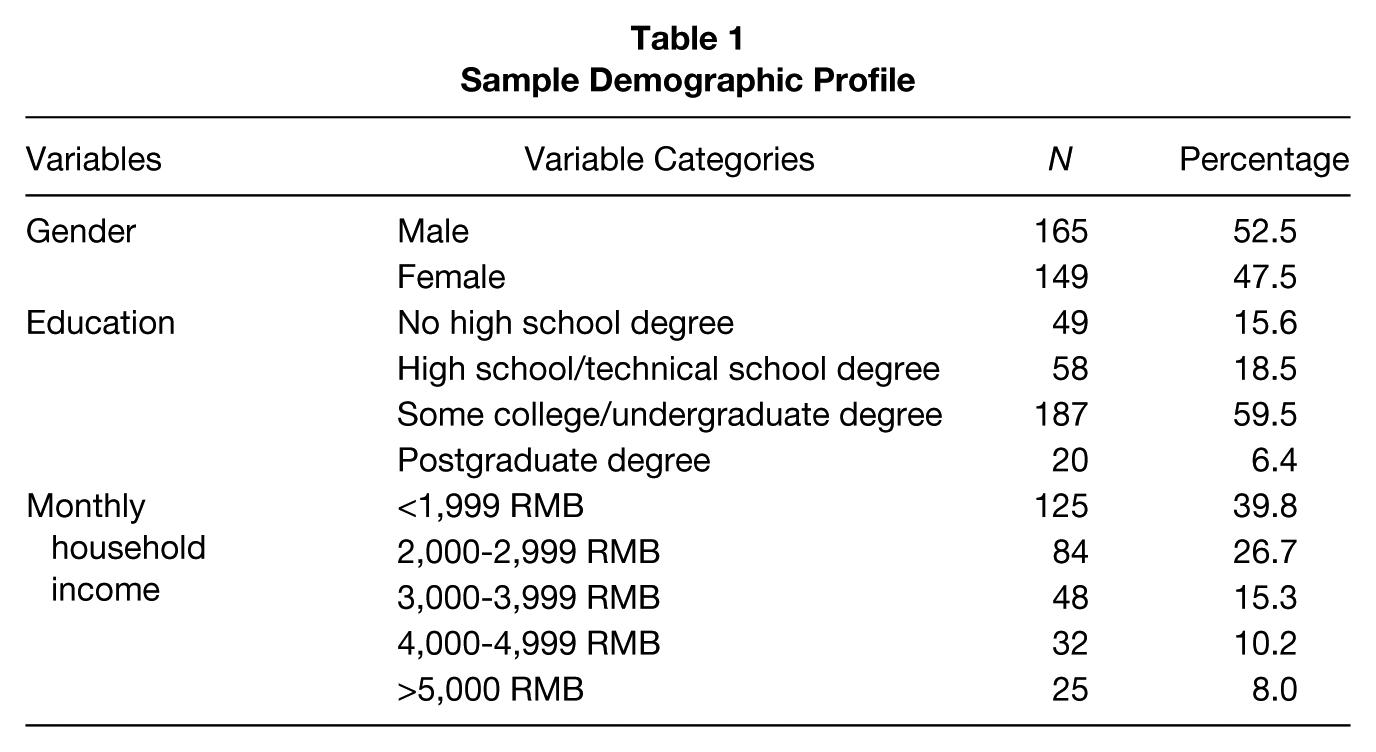
Survey respondents were most likely to have attended college or obtained their undergraduate degree (59.5%), had a monthly household income of less than 3,000 RMB (66.5%), and were slightly more likely to be male (52.5%). There is no a priori reason to expect that other than the number of daily visitors, seasonality would have affected the demographics of the surveyed Chinese tourists. A more complete demographic profile of the respondents is provided in Table 1.
Sample Demographic Profile
Measurement
All constructs were measured with a 5-point, Likert-type, multiple-item scale, anchored with either strongly disagree (1) and strongly agree (5); or very unlikely (1) and very likely (5). A total of 25 items adapted from the marketing and tourism literature were used to capture the seven latent constructs: three exogenous variables (i.e., service fairness, destination image, and service quality) and four endogenous variables (i.e., overall destination satisfaction, trust toward destination service providers, revisit intentions, and positive word-of-mouth referrals). Specifically, perceived service fairness was measured by four items; two items from Leventhal (1980) and one item each from Bies and Moag (1986) and Shapiro, Buttner, and Barry (1994). The three-item destination image scale was adopted from Chen and Tsai (2007). The SERVQUAL scale (Parasuraman et al., 1988) was adapted in this study, with each of the five service quality dimensions measured using a single response item. Overall destination satisfaction was conceptualized as a cumulative, global evaluation based on the tourists’ experience with a destination. Overall destination satisfaction was measured by three items corresponding to Brown, Cowles, and Tuten’s (1996) work. The scale related to trust toward destination service providers consisted of four items adapted from Morgan and Hunt (1994), Wong and Sohal (2002), and Kim et al. (2009). Finally, intentions to revisit and positive word-of-mouth referrals were both captured by three-item scales adapted from Hutchinson, Lai, and Wang (2009).
The questionnaire was first prepared in English and then translated into Chinese by an English–Chinese bilingual speaker. Back translation into English was performed by a second individual, and then the back-translated English version and the original versions were compared. The back translation process used a third [bilingual] individual to identify any content and wording errors to help ensure that differences in response patterns were not due to misinterpretation of questions. When no further changes were recommended, the questionnaire was finalized for use.
Data Analysis and Results
Measurement Model
Following a two-step approach, the measurement model was estimated first and then the structural path model was analyzed to test the hypotheses. The data were fitted to a measurement model using AMOS17.0 to test the reliability, convergent validity (each measure taps facets of the intended construct), and discriminant validity (the constructs are distinct from each other). A variety of goodness-of-fit indices, such as the values for goodness-of-fit index (GFI), comparative fit index (CFI), normed fit index (NFI), incremental fit index (IFI), Tucker–Lewis index (TLI), and root mean square error of approximation (RMSEA) are reported in Table 2. The measurement model was considered acceptable according to the standards suggested by Hu and Bentler (1999): .95 for CFI, IFI, and TLI, .06 for RMSEA. Although Hu and Bentler (1999) noted that these recommended cutoff values are subject to further research, the battery of overall goodness-of-fit indices associated with the measurement model indicated a low chance of model misspecification. Given that the conceptual model was developed on a theoretical base and that the goodness-of-fit indices were not indicative of poor model performance, no respecification of the measurement model was made.
Goodness-of-Fit Indices
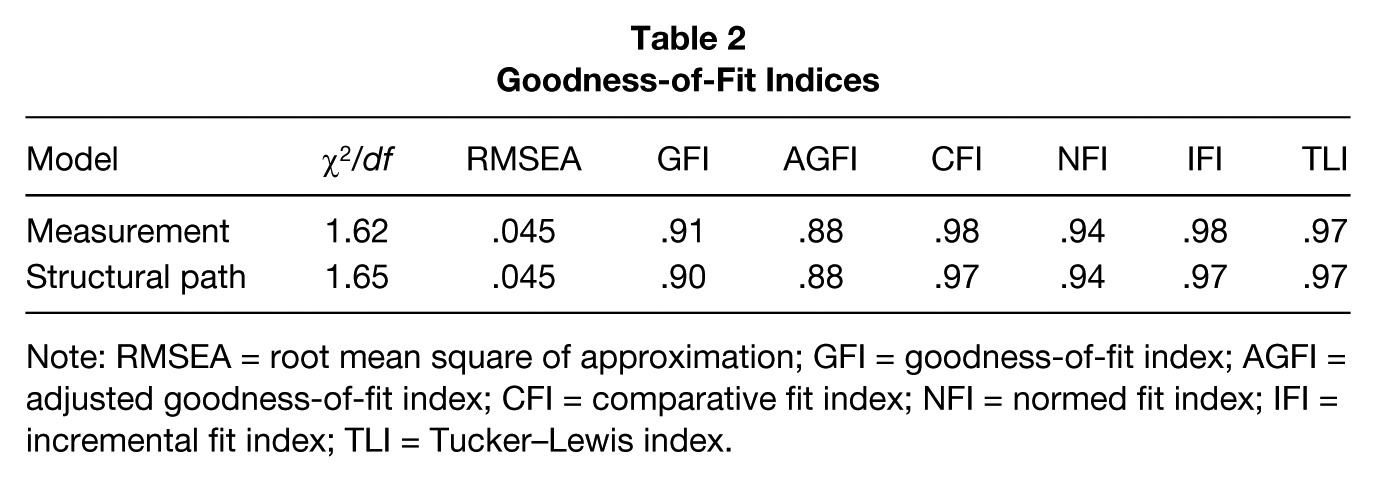
Note: RMSEA = root mean square of approximation; GFI = goodness-of-fit index; AGFI = adjusted goodness-of-fit index; CFI = comparative fit index; NFI = normed fit index; IFI = incremental fit index; TLI = Tucker–Lewis index.
Reliability Testing
Cronbach’s alpha is often used to assess a latent construct’s internal consistency while composite reliability is used to gauge the degree to which items are free from random error and yield consistent results. Cronbach’s alpha values ranged from .89 to .95, all higher than the commonly recommended .70 criterion (Nunnally, 1978). With regard to composite reliability, values varied from .88 to .95 (See Table 3), above the recommended cutoff value of .70 (Fornell & Larcker, 1981; Nunnally & Bernstein, 1994). Findings indicate acceptable reliability for each latent construct that was included in the proposed model.
Confirmatory Factor Analysis
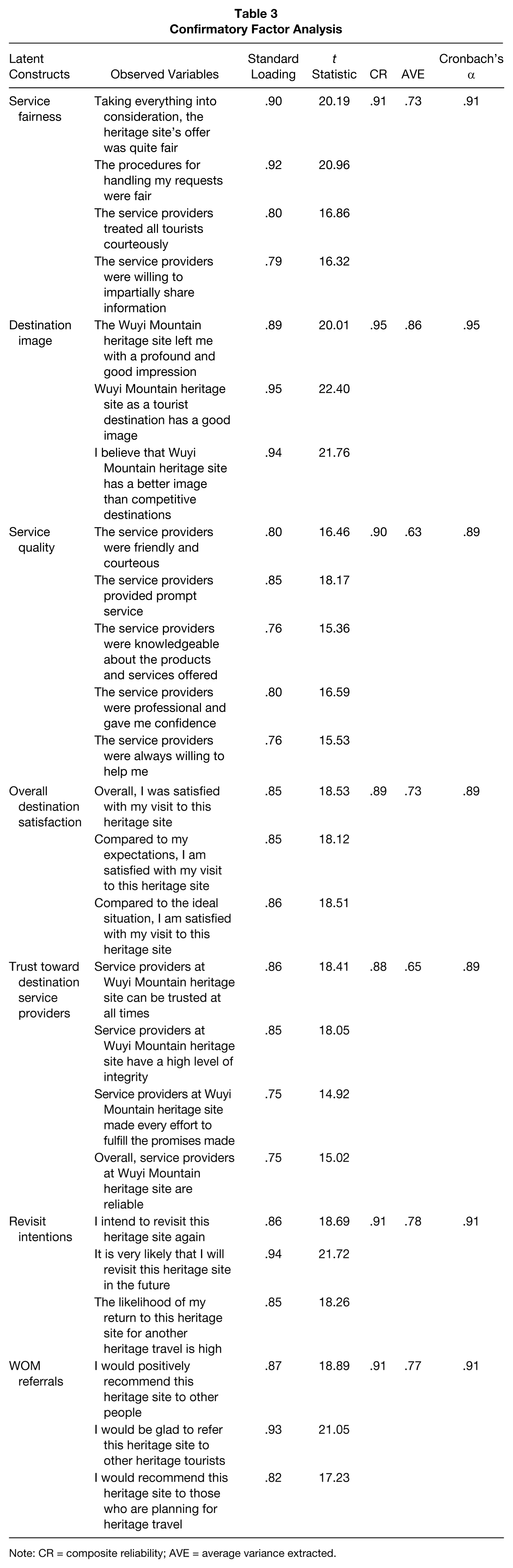
Note: CR = composite reliability; AVE = average variance extracted.
Convergent Validity Testing
Convergent reliability was assessed in terms of the contribution of the measurement items to each corresponding construct. Convergent reliability was considered acceptable if (a) the standardized loading was higher than .50 with a statistically significant t statistic at the .05 significance level (Hair et al., 2009) and (b) the average variance extracted (AVE) exceeded the .50 threshold (Anderson & Gerbing, 1988). As shown in Table 3, the standardized item loadings ranged from .75 to .95. All t statistics were significant at the p < .01 level. Furthermore, all AVE scores were greater than .50, which suggests adequate convergent validity for all the constructs investigated in the present study.
Discriminant Validity Testing
Discriminant validity was investigated to examine differences between the latent variables. Fornell and Larcker (1981) suggest that discriminant validity is established when the square root of AVE for each construct is greater than the correlation coefficient between the construct and all remaining constructs in the model. Table 4 shows the interconstruct correlations in the lower triangle of the matrix and square root of AVE on the diagonal of the matrix. As all the construct correlations are smaller than the square roots of AVE, it is concluded that all the constructs meet the discriminant validity requirement. Subsequently, the structural path model can be assessed to examine the proposed hypotheses.
Correlation Matrix and Average Variance Extracted
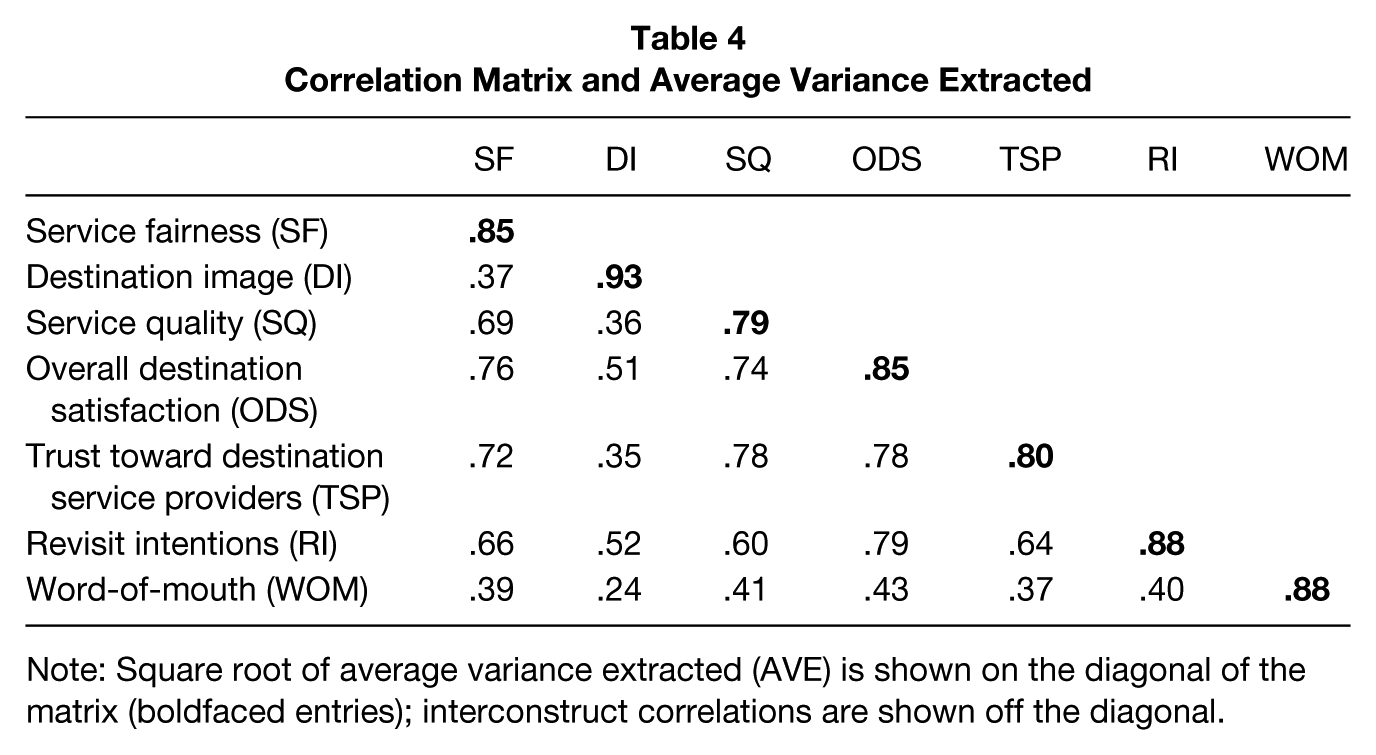
Note: Square root of average variance extracted (AVE) is shown on the diagonal of the matrix (boldfaced entries); interconstruct correlations are shown off the diagonal.
Structural Path Model
The goodness-of-fit indices of the structural path model are shown in Table 2, which revealed acceptable fit to the data: χ2/df = 1.65 < 2, GFI (.90), CFI (.97), NFI (.94), IFI (.97), and TLI (.97) were all at or over .90, and AGFI = .88 > .80, RMSEA = .05 < .08. Standardized path loadings reveal the strength of the relationships between latent variables while the R2 value indicates the amount of variance inherited in the endogenous variable that was explained by the exogenous variables. The standardized path coefficients and t statistics are presented in Figure 2.
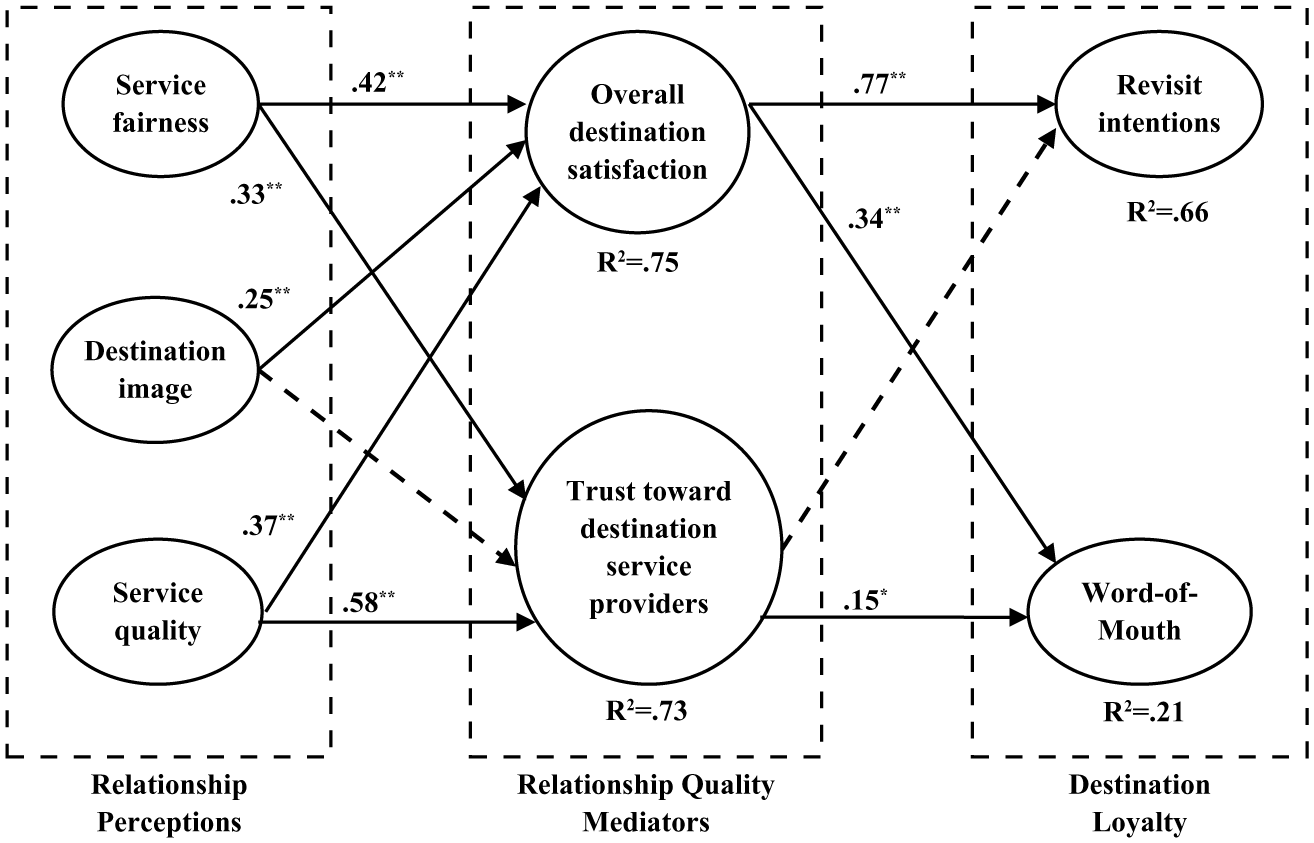
Results of Structural Path Model Testing
As indicated by the path coefficients and associated significance levels, the impact of perceived service fairness on overall destination satisfaction and trust toward destination service providers were both statistically significant (p < .001) with a standardized path coefficient of .42 and .33, respectively. The findings support Hypotheses 1a and 1b. The standardized path loading from destination image to overall destination satisfaction (.25) was also significant (p < .001), but the path between destination image and trust toward destination service providers was not significant (p > .05). That is, Hypothesis 2a was supported but Hypothesis 2b was not supported. The paths from service quality to both overall destination satisfaction (.37) and trust toward destination service providers (.58) were statistically significant (p < .001). Thus, Hypotheses 3a and 3b were supported.
Regarding the impact of relationship quality on loyalty, the standardized path from overall destination satisfaction to intentions to revisit the destination (.77) and positive word-of-mouth referrals (.34) were both statistically significant (p < .001), providing support for Hypotheses 4a and 4b. Hypothesis 5b was supported as the path from trust toward destination service providers to positive word-of-mouth communication was significant (p < .05), but not so the path from trust toward destination service providers to intentions to revisit (p > .05). That is, Hypothesis 5a was not supported.
As shown in Figure 2, the proposed structural path model has acceptable prediction power. The model explained 74.5% of the variance for overall destination satisfaction and 73.4% of the variance for trust toward destination service providers. In terms of loyalty, the model explained 65.8% of the variance in the intentions to revisit dimension and 20.7% in the positive word-of-mouth dimension.
Mediating Effects of Trust and Overall Destination Satisfaction Toward Destination Service Providers
To explore the mediating effects of trust and overall destination satisfaction toward destination service providers, we analyzed the direct and indirect effects of tourist perceptions on loyalty outcomes. Given that SEM has gained in popularity and received increasingly strong support among researchers (Jose, 2013), the method articulated by Hopwood (2007) was adopted to analyze the mediation effect in a SEM framework. Notably, based on the method articulated by Baron and Kenny (1986), Hopwood (2007) pointed out that the structural equation model method has notable advantages in testing the mediating effects. One advantage of using latent, as opposed to observed, variables is that the latent variables tend to estimate the desired concept more reliably, because any variables associated with measurement error in a particular observed variable are unlikely to be shared across other observed variable(s) and thus will not contribute to the score on a shared latent variable (Hopwood, 2007). As such, unreliability and method effects on models of mediation could be ameliorated through the use of SEM (Hopwood, 2007). It is worthy to note that testing the mediating effect in a SEM framework has previously been carried out in the tourism literature (e.g., Cole & Illum, 2006; Iwasaki & Havitz, 2004).
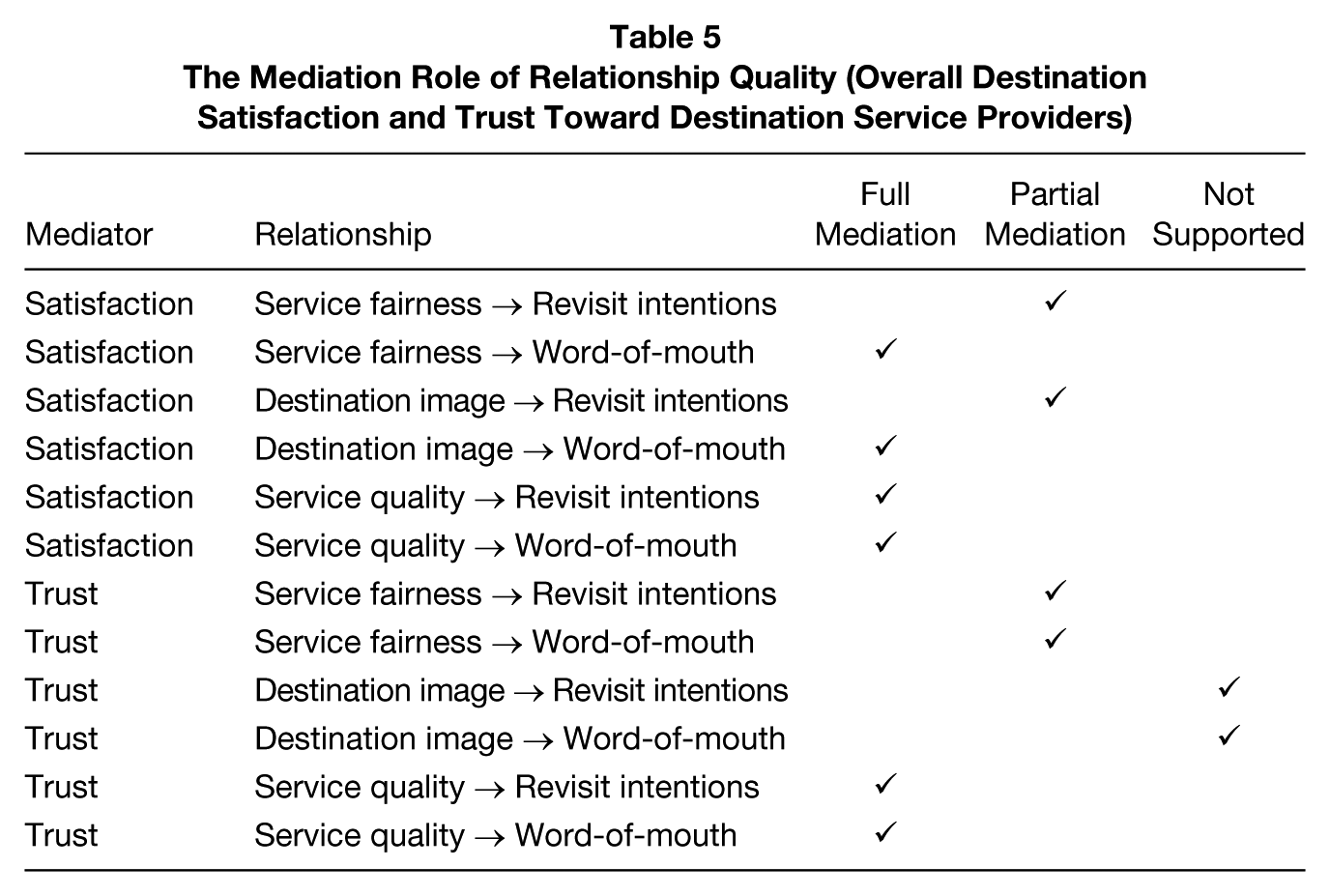
Evidence (see Table 5) confirms the mediation role of overall destination satisfaction but provides only marginal support to the mediation role of trust toward destination service providers in the model. In other words, overall destination satisfaction either partially or fully mediated relationship perceptions (i.e., service fairness, destination image, and service quality) and destination loyalty (i.e., word-of-mouth and intention to revisit). On the other hand, trust toward destination service providers also played a key mediating role in the model, but it did not significantly mediate the relationship between destination image and destination loyalty.
The Mediation Role of Relationship Quality (Overall Destination Satisfaction and Trust Toward Destination Service Providers)
Finally, to explore the mediating effects of trust toward destination service providers and overall destination satisfaction, we also used bootstrapping. Bootstrapping is a nonparametric method that “randomly selects individuals from the original dataset and thereby constructs a new dataset composed of the same number of individuals” and “the bootstrap function performs the dataset construction and data analysis steps multiple times (usually in the high hundreds or low thousands)” (Jose, 2013, p. 115). The bootstrap analysis (please see Table 6) provides additional support to the important mediating role of relationship quality (i.e., overall destination satisfaction and trust) in the tested model.
Bootstrap Results for Indirect Effects of Relationship Quality

Note: This table reports the lower bound and upper bound of 95% confidence interval of the indirect effects. Associated p values are shown within parentheses.
Discussion and Conclusions
Relationship marketing tactics are essential for building mutually beneficial, long-term relationships. This is important for not only more traditional business organizations but also for tourism destinations. The present study provides some needed insight on Chinese domestic tourists while specifically heeding calls for more focus on visitors to World Heritage sites (McNamara & Prideaux, 2011), particularly those in China (Su & Wall, 2011). The current study also extends the existing tourism literature by presenting an integrated model on destination tourists’ perceptions of important relationship variables and destination loyalty in a causal relationship marketing framework, backed by empirical results.
Bigné, Sánchez, and Sánchez (2001) find “quality has a positive influence on satisfaction and intention to return (to the destination)” (p. 607). Findings in this current study further confirm the antecedent role of relationship perceptions in tourism marketing and suggest that providing quality service and treating visitors fairly are positively associated with overall destination satisfaction and trust toward destination service providers for Chinese tourists at a World Heritage Site. Maintaining a strong destination image was found to positively influence overall destination satisfaction but not significantly influence trust toward destination service providers. That is, a favorable destination image may improve the level of overall destination satisfaction, but not necessarily prompt tourists to develop a trustworthy relationship with the destination. Previous findings (e.g., Loureiro & González, 2008) reveal that although destination image can have a positive and significant impact on both destination satisfaction and trust toward destination service providers, the impact of destination image on overall destination satisfaction may be substantially greater than its impact on trust toward destination service providers.
Findings revealed that overall destination satisfaction either partially or fully mediated the relationship between Chinese tourist perceptions and loyalty. A study by Chi and Qu (2008) at a major tourism destination in the state of Arkansas also identifies the full mediation role of overall satisfaction between destination image and destination loyalty. Although trust is also an important relationship element between transaction parties (Ganesan, 1994; Morgan & Hunt, 1994), the mediation role of trust toward destination service providers was not significant between tourist perception and loyalty in four out of six possible combinations in the current study (see Table 5). Overall, a clear mediation role of overall destination satisfaction and a marginal mediation role of trust toward destination service providers in our empirical findings seem to be in line with the work of Loureiro and González (2008), which reveals “the influence of trust on loyalty is lower than the influence of satisfaction on loyalty” (p. 130). In the context of a high-involvement management consulting service, Patterson, Johnson, and Spreng (1997) find a strong link between satisfaction and repurchase intentions (explaining 78% of the variance), and they suggest that satisfaction “is the crucial link in establishing longer-term client relationships and, thus, the strategic well-being of the organization” (p. 14). In this regard, a significant impact of overall destination satisfaction on both intentions to revisit the same site and to spread positive word-of-mouth referrals suggests that the overall destination satisfaction construct may fill the gap of a trust-focused model (Patterson et al., 1997) in the context of an experience-oriented service, such as destination tourism.
Intuitively, we offer two possible explanations for the relatively stronger impact of overall destination satisfaction (than trust toward destination service providers) on tourist loyalty. First, the survey participants in this study were domestic sightseeing tourists whose “relationship” with the Wuyi Mountain destination is likely relatively short term. This context is very different than most other service businesses in which a longer term relationship would be viewed as important (e.g., retail banking, insurance). As we sought to assess issues of trust and return intentions, it would have been important to quantify if the Chinese visitors were first time or repeat visitors, or if they sought to visit a variety of World Heritage Sites. Research exploring the possible moderating effect of tourist travel goals would be valuable. Second, emotional experience attributes in tourism consumption are likely to be of particular relevance. As satisfaction implicitly includes emotional components (Anderson et al., 1994; Oliver, 1981), satisfaction may influence loyalty in a more significant manner than trust in a tourism context. Indeed, Hosany and Gilbert (2010) provide empirical evidence of a direct association between tourists’ emotional experiences and behavioral intentions. The correct interpretation of these findings is currently unclear, but the considerably greater impact of overall destination satisfaction relative to trust toward destination service providers on revisit intentions is worthy of further exploration by future tourism researchers.
Managerial Implications
The findings of the current study shed light on the relative importance of managing tourist perception to build quality relationships and, in turn, to create loyalty. Tourism destination managers should be devoted to building or improving a tourist’s overall destination satisfaction, as satisfied tourists are more likely to revisit the destination and spread positive word-of-mouth referrals. The current study reveals that destination image has a direct impact on overall destination satisfaction and an indirect impact on loyalty through overall destination satisfaction, which is consistent with prior studies (e.g., Assaker et al., 2011; Bigné et al., 2001; Chen & Tsai, 2007; Chi & Qu, 2008; Qu et al., 2011). As “the ‘destination image → satisfaction → behavioral intentions’ relationship appears to be dominant in the mind of Chinese tourists” (C. Wang & Hsu, 2010, p. 837), managers and marketers of destinations must identify and manage the key components of destination image relevant to key target markets.
In addition to destination image, empirical findings in the current study reveal that service fairness and service quality are also significant antecedents to customer relationship quality (i.e., satisfaction and trust) for Chinese tourists toward a World Heritage Site in China. First, the findings of this study indicate that the higher the perceived service quality, the greater the overall destination satisfaction and degree of trust toward destination service providers. Second, perceived service fairness was also found to have a positive influence on relationship performance. Thus, service quality and service fairness are both key drivers of relationship building between tourists and destinations. To improve tourists’ perceived levels of relationship quality, continuous monitoring and auditing of the dimensions that affect satisfaction and trust are important. This can be particularly challenging in the area of tourism destination, as a variety of parties (e.g., the private and public agents, local inhabitants, transportation providers, accommodation enterprises) may need to coordinate and cooperate to provide an overall satisfactory experience (Alonso & Liu, 2012; Barros & Assaf, 2012; Kivela & Crotts, 2006; Kozak, 2004; Rittichainuwat, Qu, & Leong, 2003). The rationale for tracking relationship perceptions is the belief that good performance reflects good practice and that comparing performance both over time, and among service providers and tourist destinations will encourage better performance. Having this type of data can provide managers of destination-based businesses the information needed to keep service personnel informed of best practices related to service fairness and service quality. Creating a tourist-centered service culture based on effective relationship marketing practices can help a tourism destination develop sustainable competitive advantage.
Consistent with prior studies, the current study suggests that overall destination satisfaction is an important antecedent of loyalty. Thus, the results of this study indicate that managers and marketers must emphasize the key role of tourist overall destination satisfaction as positive recommendations by previous visitors are the most reliable information source for potential tourists and are also one of the most sought after types of information for people interested in traveling (Chi & Qu, 2008). For example, given the increasing popularity of social media (e.g., Sina Weibo—the Chinese version of Twitter), it is now possible for parties interested in the effective marketing for the Wuyi Mountain World Heritage Site to track not only tourist complaints received by the local tourist bureau but also posttrip postings by tourists on public social media.
Limitations and Future Research Directions
Throughout the article, the authors argue that loyalty is a single second-order construct consisting of two first-order factors: word-of-mouth and revisit intention. Nonetheless, we used word-of-mouth referrals and revisit intentions as two separate first-order constructs. Chen, Sousa, and West (2005) note that “statistical tests of the fit of a hypothesized, second-order factor normally require that four or more first-order factors are included in the dataset” (p. 473). Given that only two first-order destination loyalty factors were identified in the present study, the often-cited advantage related to second-order factor structure models (e.g., model parsimony) would not be actualized in our study. Although not employing a higher order factor structure in the present study is not necessarily a limitation/weakness, it is clear that better explanatory models that employ additional antecedents of loyalty (e.g., consumption emotions) need to be developed to provide a more profound understanding of tourist behavior responses.
The current study, similar to most other studies, suffers from several limitations that restrict the generalization of the findings and provides potential direction for future research. First, a convenience sampling method was used. Future researchers may want to replicate this research with a random sample in a variety of tourism destinations. Second, the current study failed to collect respondent information that may have provided some additional insights into the findings (e.g., length of stay; whether respondents were first-time visitors or repeat visitors to the Wuyi Mountain World Heritage Site; whether respondents participated in a package tour or they were independent travelers).
Third, the current research did not touch directly on heritage tourism, but rather tested a conceptual causal model via data collected at a World Heritage Site in China. Future researchers should consider investigating whether the intention to revisit for domestic tourists is different from international tourists and what role being a World Heritage Site plays in these decisions. In this regard, we concur with Breakey’s (2012) suggestion that “ultimately such knowledge of visitor characteristics, motivations, and experiences across the various World Heritage Area situations can provide guidance to those responsible for these globally important sites” (p. 92).
Footnotes
Authors’ Note:
This research was supported by the National Science Foundation for Young Scholars of China (Grant No. 71203240), the Foundation for Innovative Research Groups of the National Natural Science Foundation of China (Grant No. 71221061), Social Science Foundation of Hunan Province (Grant No.13YBA339), China Postdoctoral Science Foundation (Grant No. 2013M531820), and the Postdoctoral Science Foundation of Central South University.