




Abstract
The purpose of this study is to explore the personal development and changes brought about by volunteer tourism among Asian students. This study adopts a qualitative inductive approach to collect data from semistructured interviews with 14 participants, an inductive content analysis to analyze the empirical data, and an interpretive paradigm to explain the results. The main finding of this study is that the participants’ volunteering experiences had certain influence on their academic development, daily life, careers, and choice of future tourism activities. Thirteen themes dealing with changes emerged and could be divided into four groups: (a) inner change, (b) change in view of life and the world, (c) change in learning attitude and future career direction, and (d) change in the choice of future tourism activities.
The purpose of this study is to address the gap in knowledge about Asian students’ experiences of volunteer tourism, with a particular focus on the effects of volunteer tourism on Taiwanese students’ academic development, daily life, careers, and future choice of tourism activities. Volunteer tourism is one of the more recent forms of tourism. It is popular among Western Europeans, Americans, Australians, and New Zealanders. Over the past decade, there has been much research and debate on a few aspects of volunteer tourism, including the motives of volunteer tourists (Benson & Seibert, 2009; Broad & Jenkins, 2008; Ooi & Laing, 2010; Tomazos & Butler, 2012); the benefits of volunteer tourism, such as environmental conservation (Campbell & Smith, 2005; Coghlan, 2006; Gray & Campbell, 2007) and better cultural understanding between volunteers and the host community (McGehee & Andereck, 2009; McIntosh & Zahra, 2007; Palacios, 2010); volunteer’s personal growth (Broad, 2003; Lepp, 2008; Simpson, 2004); and the negative impacts of volunteer tourism (Coghlan, 2008; Guttentag, 2009; Söderman & Snead, 2008). Although the range of nationalities represented is growing, most volunteer studies are predominantly linked to Western societies and based on particular historical views (Pearce & Coghlan, 2008). Arguably, the voices of Asian volunteers have been largely ignored. Although Lo and Lee (2011) have responded to such limitation, the extant research of volunteer tourism among Asian volunteers is still deficient.
Lo and Lee (2011) suggested that Generation Y (i.e., those born in 1980 or later), especially gap year tourists (Lyons, Hanley, Wearing, & Neil, 2012), have been the main target group for volunteer tourism. Researchers (Cress & Sax, 1998; Ellis, 2003; Wearing, 2001) have contended and confirmed that students involvement in voluntary works or volunteer tourism projects have positive effects on their personal and academic development both during and after school. A careful review of the extant literature shows that most research (e.g., Heath, 2007; Hudson & Inkson, 2006; Jones, 2004; Palacios, 2010) concerned with individual growth and development through volunteer tourism is mainly based on a Western perspective. The work by Lo and Lee (2011) is an exception, but it involves only seven student participants. In order to gain more insights, it is important to explore the personal development and changes through volunteer tourism among Asian students.
Pearce (1988, 1996) indicated that one’s preference for future tour destination is affected by his or her previous tourism experiences. The majority of volunteer service destinations are located at remote areas with scarce resources. Volunteer tourists to these destinations have to live in an environment that is extremely different from the one they are used to and might also encounter various challenges during the trip. In previous research of the effects of volunteer tourism on participants, the issue of whether one’s volunteer tourism experiences would affect his or her future choice of tourist activities has not been addressed.
To begin with, it should be noted that it is not the intent of this study to engage in a debate regarding postcolonial criticism and/or the volunteer tourist experiences of other culture; this study responds to calls for a better understanding of egoistic and/or self-development and changes in Asian students after volunteer tourism.
Literature Review
Volunteer Tourism
The recent years have seen a rapid growth of volunteer tourism around the world. Volunteer tourism refers to tourists for various reasons, volunteer in an organized way to undertake holidays that might involve aiding or alleviating the material poverty of some groups in society, the restoration of certain environments or research into certain aspects of society or the environment. (Wearing, 2001, p. 1)
Many researchers have proposed their definitions of volunteer tourism or tourists (e.g., Ellis, 2003; McGehee & Santos, 2005; Scheyvens, 2002). Previous research of volunteer tourism (Gray & Campbell, 2007; Hudson & Inkson, 2006; McGehee & Andereck, 2009; McIntosh & Zahra, 2007; Sin, 2009; Tomazos & Butler, 2012) has mainly focused on the following themes: reasons for participation, benefits for developing countries, Western volunteer tourists, cross-cultural understanding between volunteers and the host community, negative impacts of volunteer tourism, justice tourism, a meaningful trip, participants’ self-growth, and value gained from volunteering.
Originally, volunteer tourism was considered quite positive by the public because it could attract travelers with a sense of altruism and who would like to make a difference to their holidays. However, there have been a number of criticisms toward volunteer tourism. Scholars (Coghlan, 2008; Guttentag, 2009; McIntosh & Zahra, 2008; Söderman & Snead 2008) have identified some potential negative impacts of volunteer tourism, including a neglect of locals’ needs, obstruction to work progress and completion of unsatisfactory works, a decrease in employment opportunities and promotion of dependency, reinforcement of conceptualizations of the “other” and rationalizations of poverty, and instigation of cultural changes. Mustonen (2007) doubted that volunteer tourism truly helps and is able to contribute any good at all to the host community since some projects are short-term based. In addition, participants may not always be well prepared before embarking on their volunteer tourism trip. With insufficient preparation, they may just widen the gap between them and those in need, and their relationship with the host community will be very “superficial” (Mustonen, 2007).
Callanan and Thomas (2005) contended that short-term-based volunteer tourists may be less devoted and are likely to join the program merely for fun. For these tourists, the choice of service destination is far more important than the goal of the service project. Hall and Tucker (2004) commented that volunteer tourism is a way for the rich or the Westerners to satisfy their own desires by forcing their way into the lives of the needy around the world, which is sometimes seen as a form of postcolonialism or neocolonialism. Indeed, researchers (Matthews, 2008; Raymond & Hall, 2008) noted that there is such a danger that volunteer tourism may only highlight the inequalities between the developed and developing worlds. Although there are many types of projects offered for volunteers to assist in communities, the extant research has focused primarily on environmental volunteering (Brightsmith, Stronza, & Holle, 2008; Chen & Chen, 2011; Gray & Campbell, 2007).
Personal Development and Change Through Volunteer Tourism
It is documented in many articles that the experiences of volunteer tourism can bring positive changes in both the volunteer tourists themselves (Campbell & Smith, 2005; McGehee & Santos, 2005; Palacios, 2010) and in host communities (Butcher & Smith, 2010; Scheyvens, 2002). Wearing and Neil (2000) explained that the positive changes or development are mainly caused by volunteer tourists’ interaction with the destination’s environment and culture. Darby (1994) and Kolb (1984) considered personal development as a learning process in which one learns to move forward, take challenges and risks, or strive to better himself/herself. Such a concept is compatible with the argument of Kuh, Krehbiel, and MacKay (1988), who probed into the development of attitude, skills, and values as the benefit for individuals. To reap the benefit of such development, people need to have the mindset and will to change. Moreover, individuals need to undergo the process involving analyzing information generated from their experience, modifying their behavior, and reflecting to accept or reject the new experiences (Harlow & Pomfret, 2007). According to Hopkins and Putnam (1993), a willingness to develop confidence, to establish goals, to take some risk, and to develop compassion, tolerance, empathy, and cooperation is one of the characteristics that determine one’s individual development. Heath (2007) conceptualized the above development as “soft skills” and believes that these skills contribute to creating a “personality package” and benefits for individual future careers. The development of soft skills could be viewed as individual’s inner changes (Lo & Lee, 2011).
More evidence associated with personal development and change through volunteer tourism was exemplified as follows. Broad (2003) found in a project conducted in Thailand that the main personal changes that most volunteers experienced were increased knowledge, more confidence in travelling independently, better skills for dealing with challenging situations, better understanding of the self, changed career direction and changed view on their lives and the world. McGehee (2002) found that social movements can facilitate formation of social networks and increase the motivation and intentions of the volunteers to engage in future volunteer activism. This is because participants would like to share their ideas and goals with fellow volunteers. Lepp (2008, p. 98) investigated how different types of volunteers had been affected by their work in a research project conducted in Kenya and concluded that volunteers “developed a new perspective on life at home and discovered an intrinsic need for meanings and purposes of their lives.”
As indicated by Zahra and McIntosh (2007), the process of development induces changes in volunteer tourist’s perceptions about the society, self-identity, and values, and these changes will subsequently influence their lifestyle. However, Sherraden, Lough, and McBride (2008) contend that impact on volunteers varies according to several elements such as volunteer attributes, individual capacity, and length of service. Many studies are exemplified to support the view. Research found that volunteers from North America and Europe tend be young, educated, affluent, and White (Jones, 2004; Powell, Bratovic, & Dolic, 2007). McBride and Lough (2007) suggested that youth with open “gap years” may have significantly more time to engage in volunteering abroad. The majority of studies show that youth tend to volunteer overseas to gain a broader perspective on the world, to contribute to society and help others, have an adventure, take a break from school or work, meet people and have fun, acquire skills, enhance a resume, or get a job (Gaskin, 2004; Powell et al., 2007). In addition, this pattern of tourism is available to only a few people because it is more costly than other types of tourism (Cnaan & Handy, 2005; Tomazos & Butler, 2012). Doubtless, studies suggest that long-term placements have a greater development potential (Spence, 2006), including the potential for exchange of technical skills, knowledge, and experience between volunteers and local residents (Devereux, 2006). Although most extant research has been overwhelmingly positive about the experience of volunteer tourism to participants, Jones (2004) pointed out a number of potential negative impacts of gap-year volunteers. For instance, student tourists may have decreased motivation to continue study or be in debt after a gap year.
On the contrary, even short-term experiences abroad can prepare participants for longer term engagement, future international services (Allum, 2007), and a commitment to social justice (Kadel, 2002). It is extensively documented that volunteering overseas has various positive effects on participants’ academic learning and interpersonal, personal, and professional development (Brown & Lehto, 2005; McIntosh & Zahra, 2007). Studies also suggest that volunteer tourism could foster participants’ global awareness (Palacios, 2010; Pearce & Coghlan, 2008), development of human values (Ellis, 2003), build intercultural understanding (Benson & Seibert, 2009; Palacios, 2010), increase communication abilities (Harlow & Pomfret, 2007), and enhance civic mindedness and leadership skills (Hartman & Rola, 2000; Lo & Lee, 2011). Moreover, research shows that volunteering overseas develops behaviors for living and skills to work in a knowledge-based global economy (Brook, Missingham, Hocking, & Fifer, 2007).
Similarly, Palacios (2010) studied the benefits of short-term group placements for university students in countries like Vietnam, Mexico, and Fiji and found that Australian students had an increased global engagement and intercultural competence after their volunteer trips. From their volunteering experiences, the students gained inspiration about career planning and also learned to provide psychological support to the staff of local organizations. Lo and Lee (2011) conducted a project in China and analyzed the changes reported by volunteer participants. The main changes include changed views of life (e.g., they began to appreciate what they possessed, spend more time with family and love them more, and develop new understanding of life) and the world, improved relationship with local community, teammates, and family members, personal growth and development (e.g., increased persistence and perseverance, improvement of communication skills, development of leadership skill), broadened horizons, and different plans for career, studies, and life direction.
Short-term volunteer tourists are called shallow volunteer tourists, based on Callanan and Thomas (2005). They are more concerned about the welfare of humans alone than the nature as a whole. In addition, they are more concerned about self-development and career/academic achievement than about the welfare of the local community or the project itself. Overall evidence seems to echo Simpson’s (2004) argument that volunteers benefit more than host communities from short-term placements.
Prior research of changes in volunteer tourists is mainly associated with Westerners and has three primary focuses: (a) inner growth, (b) changes in view of life and the world, and (c) changes in future studies and career direction. Furthermore, the research can be divided by subject into Asians and non-Asians based (Broad, 2003; Lepp, 2008; Lo & Lee, 2011; McIntosh & Zahra 2007; Palacios, 2010; Scheyvens, 2002; Wearing, 2001; see Table 1). It seems to suggest that there is little difference between these Asians volunteers and Western ones. A plausible explanation is that Hong Kong used to be governed by the British government. It had been highly influenced by Great Britain in education, social and cultural aspects, and is not inferior to any nation in terms of acquisition and diffusion of information. Hong Kong can be seen as a highly Westernized place. Probably because of this reason, the evidence about perceptions and expectations of volunteer tourism that Lo and Lee (2011) obtained from Hong Kong participants is similar to the findings of previous research.
Comparing and Contrasting Between Development Through Volunteer Tourism Between Asian and Non-Asians
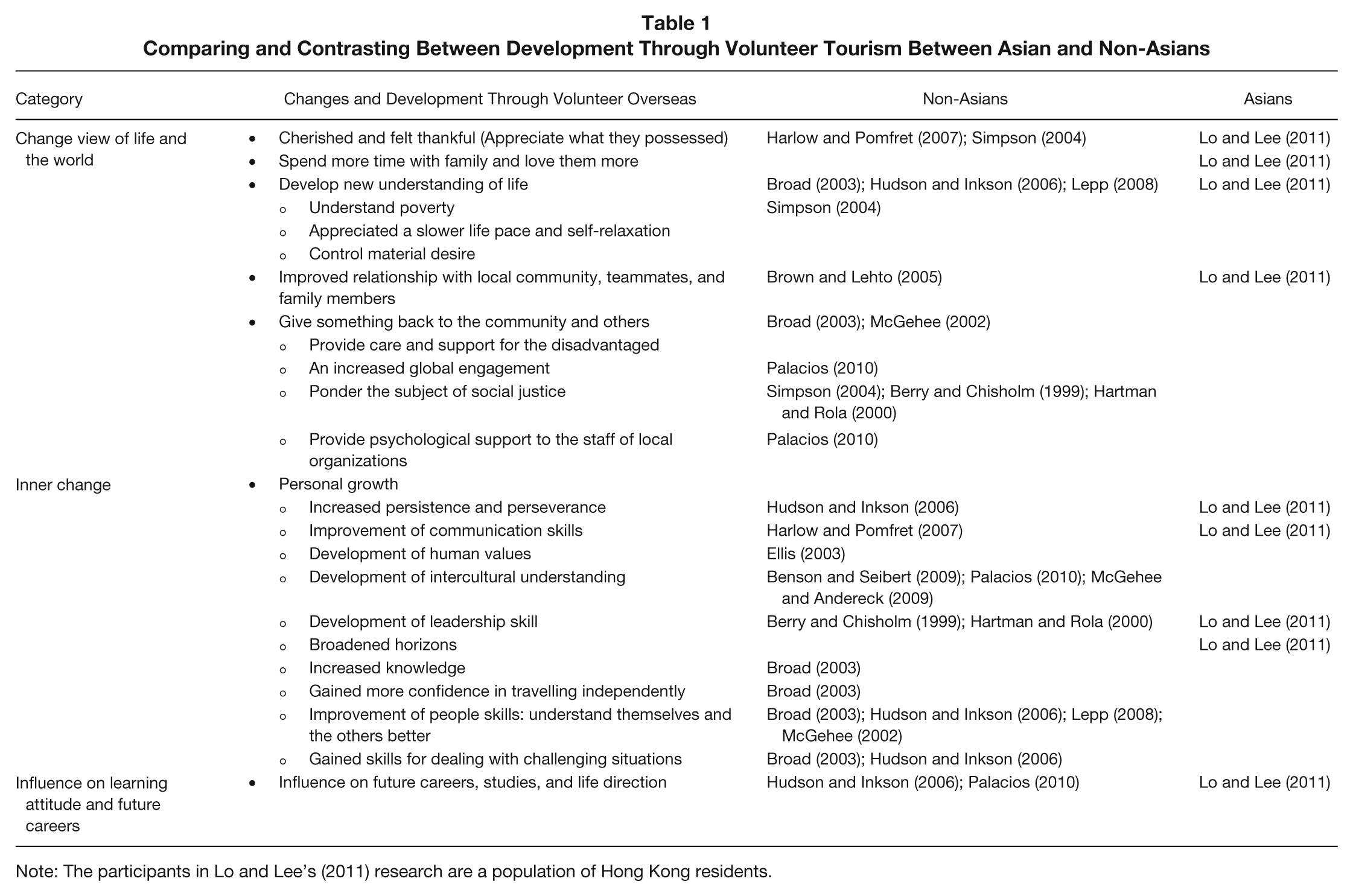
Note: The participants in Lo and Lee’s (2011) research are a population of Hong Kong residents.
Pearce (1988, 1996) argued that previous tourism experience has an impact on participants’ preferences for future destination choice. It has been confirmed that age, gender, income, gender, marital status, education, occupation, lifestyle, pleasure motivation, infrastructure, accessibility, climate, culture of the destination, and time and cost to reach the destination all have a significant effect on tourist’s choice of destination (Awaritefe, 2004; Hsu, Cai, & Wong, 2007; Nicolau & Más, 2006). Basala and Klenosky (2001) recognized language concerns as an important decision maker-specific factor. Apparently, the above-mentioned variables are viewed as important factors that influence an individual’s tourism experience. Despite the abundance of research and debate on personal changes through volunteer tourism, issues such as whether the experience would affect participants’ future choice of tourist activities have not been addressed.
Research Methods
This research aims to address Taiwanese students’ personal dynamics growth and development brought about by volunteer tourism and examine whether one’s volunteer experience has any impact on his or her future choice of tourism pattern and destinations. In order to better capture volunteers’ experiences, in-depth interviews were conducted to collect the posttrip experiences of Taiwanese students who had taken part in an organized short-term international volunteer activity in a developing country. This methodology is consistent with the methodologies of prior research on the nature of volunteer tourists’ experiences (see Simpson, 2004; Sin, 2009; Wearing, 2001). Lyons et al. (2012) pointed out that the extant qualitative case studies of volunteer tourism have relied heavily on snowball and convenience sampling rather than criterion-based purposive sampling. In addition, most research remains focused primarily on the environmental volunteering (Brightsmith et al., 2008; Chen & Chen, 2011; Gray & Campbell, 2007; Wearing, 2001), and very little research is concerned with students who volunteer abroad and engage in short-term teaching and education projects in developing countries. Therefore, the sampling method of this study was designed as follows.
The Participating Foundation and Team
The Eden Social Welfare Foundation, hereafter referred to as the Foundation, is a nonprofit organization (NGO) based in Taiwan. The Foundation was purposely chosen for this study because it provides students a wide range of short-term programs with a variety of goals during summer and winter vacations. These short-term programs are devised according to the demand of underdeveloped areas of the world and include caring for poor children, providing education or assisting local teachers, harvesting agricultural products, building houses, digging wells, providing health education and service, and so on. The Foundation hoped that more youths could participate in volunteer services through volunteer tourism. It launched a project called “Overseas Learning and Travel Service Team” in 2004. The objective of the project was to encourage youths to “travel with love for others and make their holidays more meaningful.” Since 2004, overseas service stations have been set up at many underdeveloped areas of the world, including the Refugee Camp at North Thailand, the Philippines, India, Tibetan tribes, Hui tribes, Kazakhs tribes, Nepal, and Mongolia. The team that the author participated in was chosen because it offered education assistance to schools in developing countries. Except the 3 team leaders, all the 14 volunteer participants were students. These student participants included 1 high school student, 10 undergraduates, and 3 postgraduate students.
Study Site
The service destination was a boarding junior high school that offered education in both Chinese and Tibetan. This school was situated in Tenzhu Tibetan Autonomous County, Gansu Province, China. Tenzhu Tibetan Autonomous County is a remote location enclosed by high mountains and has limited services. In other words, it is not a conventional tourist destination. It has a population of only 12,638 people, with an average annual income of US$90. The school has collaborated with the Foundation on various welfare projects for several years. As of the time of this study, the school had 306 students and 28 staff, 23 of whom were full-time teachers. Three-hundred one of the students chose to stay in the school dormitory because it would take them 2 to 3 hours to come to the school. Without sufficient nutritional supplies, there were always a number of students in need of hospitalization every semester. Because of a lack of resources, the school came to a bottleneck in its development. Limited by poor economic and geographic conditions, students had to live and study in an extraordinarily harsh environment, and most of them might not be able to complete their education.
Data Collection and Analysis
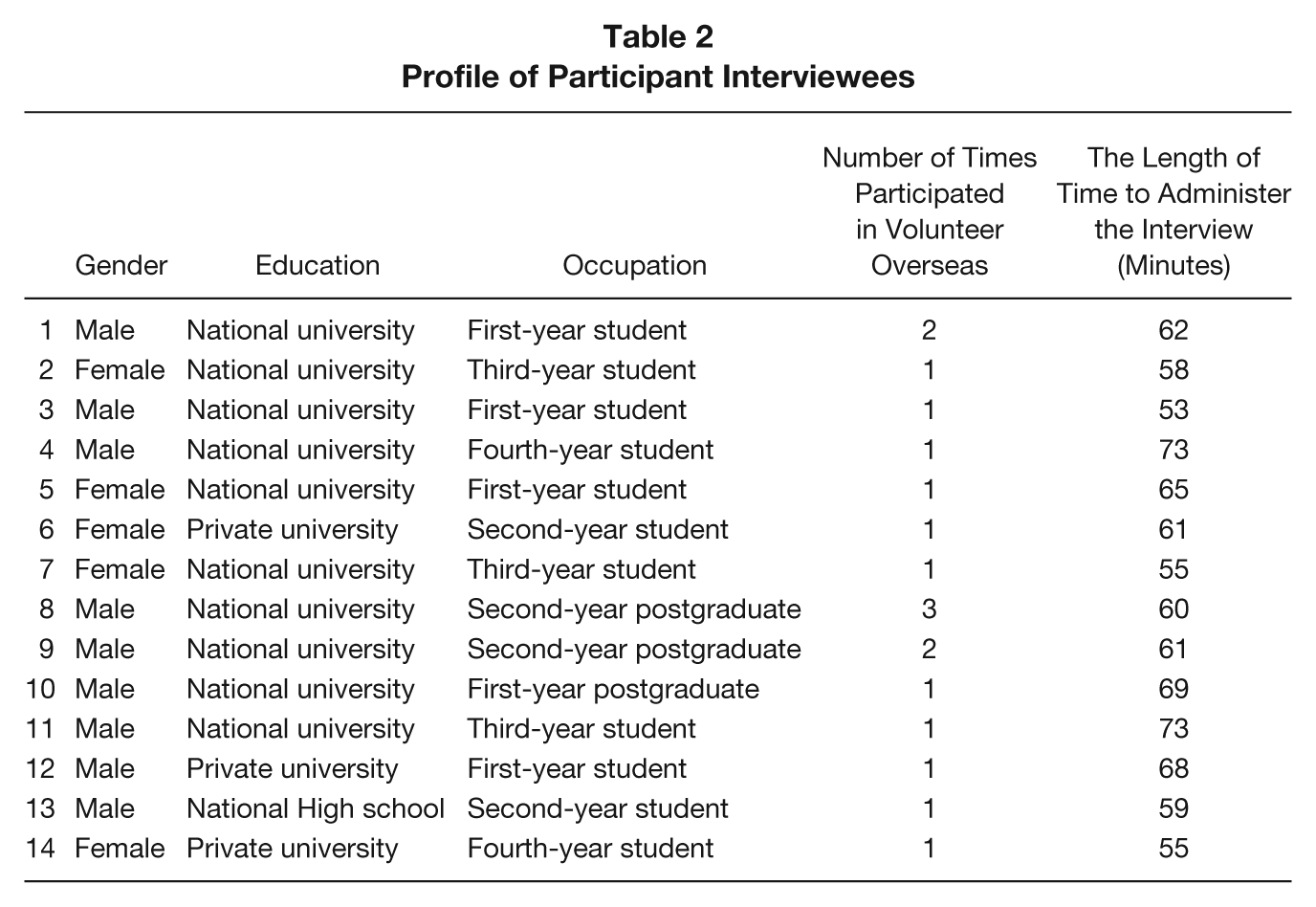
The author participated in a 14-day education development project held by the Foundation. Like all the other members of the team, the author served as a volunteer teacher throughout the 14-day expedition. The 14 volunteer participants in the present study included 9 male students and 5 female students, all aged between 16 and 22. Among these participants, 11 were first-time participants, another 2 had joined similar programs twice, while one had gone through more than three programs. Table 2 shows the profile of the participants in this study and the length of time to administer the interview. The author contacted the 14 teammates 6 months after the trip, requesting them to participate in an individual face-to-face interview. The interview was intended to capture the changes that they have noticed in their learning, life, careers and attitude after the volunteer program. It was believed that volunteers would not immediately notice the impact of the volunteer program on them, usually until they are told about the changes in them by their family or friends. Fortunately, the author managed to gain all the volunteer participants’ opinions through in-depth interviews. Open-ended questions were used in the interview, and the interview processes were recorded and transcribed verbatim. The transcribed text was also sent to the volunteer participants via email to ensure accuracy of the transcription. This process allowed a more detailed analysis of the interview and helped ensure the reliability of the transcription process.
Profile of Participant Interviewees
In this study, the main source of insights came from in-depth interviews carried out in Taiwan. However, the author was aware that she was an observer while volunteering in the service destination. Observation during the trip allows researchers to better capture and reflect a more accurate account of volunteers’ experiences (Sin, 2009). For the needs of this study, observation was undertaken to understand changes in individuals between preexpedition and postexpedition. Bryman (2004) defined participant observation as a participant observer who is engaged in a group for in-depth longitudinal studies of a limited period of time to explore the behavior of the group by observing conversations within the group and with the researcher. Therefore, “researchers must assume social roles that fit into the worlds they are studying” (Adler & Adler, 1987, p. 8). Schostak (2010) stated that participant observation is a method for researchers to gain insights and understandings into the lives of others. Its emphasis is on discovering the meanings that people attach to their actions. It involves observing, interacting, conversing, sharing in work, and leisure routines and interviewing members of the community. All the above processes involve “joining” to know members’ values, reasons for action, and ways of acting (Wilson, 2005).
The author intended to take the perspective of volunteer tourists to see the world through their eyes, to feel what they feel, and to experience what they experience. Because of participation in the studied community, the researcher was in a position to interpret the meanings and possible consequences of actors—behaviors within that specific cultural context (Chambers, 2000). At this point, the method carries some ethical issues and limitations mainly associated with validity and reliability in comparison to the quantitative approach. Sarantakos (1998) reminded researchers that ethics is not an important issue if the research is conducted for a good purpose. More important, they should disclose their identity when entering the private domain of individuals and disclose their research aims and objectives, and they should avoid exploiting the identity of the study participants in the findings (Hussey & Hussey, 1997). The other ethical issue is the occurrence of Hawthorne Effect. According to Bogdewic (1992), members in a tourism context are not likely to modify their behavior in response to the appearance of a researcher studying their behavior. In this study, observations were conducted to capture volunteers’ actual experience rather than to measure or count certain performance in social experiments. Thus, the Hawthorne Effect was not likely to occur. In response to the issues about the reliability, the validity of the data, and the generalizability of the analyses, Mason (2001) suggested that the researcher needs to demonstrate that the data generation and analysis procedures are thorough, careful, honest, and accurately designed. Indeed, some argue that “authenticity” (Silverman, 1993) or “trustworthiness” (Riessman, 1993) rather than reliability are of greater significance. This is seen in this research.
Inductive content analysis, which allows new insights to emerge from the data (Elo & Kyngas, 2008), was employed to analyze the transcripts. The analysis process involves coding and finding patterns and themes (Patton, 2002). A meaningful unit in inductive content analysis is usually a theme (Graneheim & Lundman, 2004). Codes are assigned to text pieces of any size as far as they relate to the theme. The themes, defined as units of analysis in this study, include all the elements associated with participants’ comments on the research question “personal development and changes brought about by volunteer tourism in relation to the influence on their academic development, daily life, careers, and choice of future tourism activities.” The extracted themes and quotations were first translated into English and then evaluated by professional translators through a back-translation procedure to ensure language equivalence (Brislin, 1980).
The study used qualitative case study as a valuable tool and collected data from in-depth interviews to understand the effects of volunteer tourism on Taiwanese students’ academic development, daily life, careers, and future choice of tourism activities. Thirteen themes dealing with changes emerged and were classified into four categories: (a) inner change, (b) change in view of life and the world, (c) change in learning attitude and future careers, and (d) change in the choice of future tourism activities. The themes “have improved communication ability,” “develop stress management skills,” “learn to hear and respect different voices,” and “trust others and admit personal deficiencies” are “soft skills.” Thus, they were placed in the category of “inner” changes. The classification was in the line with the Heath (2007) approach. The themes “learn to cherish and feel thankful,” “control material desire,” “appreciate slower life pace and self-relaxation,” and “provide care and support for the disadvantaged” were placed in the category of “changes in view of life and the world.” The classification method was similar to Lo and Lee’s (2011) approach, mainly associated with change in personal life attitude and give support to others. The themes “adjust personal learning attitude to be humble,” “have an opener view and mind,” and “become more active in learning and dealing with things” were placed in the category of “change in learning attitude and future careers,” because they were mainly associated with individual’s learning attitude and the eventual benefits for individual future careers. The classification was similar to Palacios’s (2010) approach. Change in the choice of future tourism activities is in relation to have different tourism preferences from participants after the volunteer trip, mainly emerging from the data.
Findings
Personal change refers to the process in which an individual encounters and accepts challenges, then experiences changes in attitude and behavior, and finally accepts the changes (Darby, 1994; Harlow & Pomfret, 2007). In the present study, the difficulties and challenges that the volunteer participants encountered came from two main aspects, namely, the environment and the individual. The environmental challenges were mainly associated with a lack of material resources, including water, electricity, food, and outbound transportation vehicles. In addition, classrooms and dormitory were barely usable. In order to avoid causing burdens to the service destination, all participants were asked to bring necessary items from Taiwan. These items included stationeries, teaching facilities, sleeping bags, dining utensils, personal hygiene products, foods (e.g., cookies, instant noodles), and flashlight (power was insufficient in the service area). Besides, volunteer participants had to sleep in the classroom, bathe with no water, wash clothes by the river, use a bucket to carry water for cooking and dishwashing, and eat extremely simple foods.
The individual challenges came mainly from worries over incompatibility of their teaching materials, lack of teaching experiences, adaptation (e.g., to the environment, food, culture, and local people), and self-adjustment. Volunteer participants were not informed of the curriculums the students had before the trip. It was difficult for them to prepare suitable teaching materials for the students. However, they endeavored to prepare for the subjects they were responsible for and managed to let the students experience different ways of learning (e.g., game-based learning and collaborative learning). The volunteers experienced all the above-mentioned difficulties and challenges during the 2-week program. For those who have never participated in any similar program before, such a program would be very stressful. These challenges, however, highlight that the Taiwanese students accepted challenges, then experienced changes in attitude and behavior and finally accepted the changes during volunteer tourism.
Changes Through Volunteer Tourism Within the Taiwanese Sample
Inner change: have improved communication ability; develop stress management skills, learn to hear and respect different voices, trust others, and admit personal deficiencies
Similar to previous research, many of the volunteers said that their communication skills (Harlow & Pomfret, 2007; Lo & Lee, 2011) and stress management ability (Hudson & Inkson, 2006; Lo & Lee, 2011) improved significantly after the volunteer trip. In addition to the above development, some of the volunteers said that they learned to hear and respect different voices through this activity. Respondent 14 said, “Most people see the progress and needs of people in developed nations but not the needs of people in these areas (underdeveloped or poor). No one really understands what they really need.” Respondent 7 had a similar perception. She said, I have a more humble attitude now. I will really try to understand their culture and needs from their standpoint and then examine myself to see what I can offer them. . . . We cannot simply achieve our goals without consideration of their needs.
Respondent 12 stated that he was not used to bothering and relying on others, but he learned to trust coworkers and admit personal deficiencies through the activity. He said, I did not like to bother others. I was very independent. I usually managed to do everything on my own even if I knew the outcome might not be satisfactory. In this activity, I learned to trust coworkers and request for assistance if really needed.
Change in view of life and the world: Learn to cherish and feel thankful, control material desire, appreciate slower life pace and self-relaxation, and provide care and support for the disadvantaged
Many volunteer participants said that because material resources were scarce in the local community, they cherished more deeply what they had possessed after their volunteer trip. Respondent 6 said, Although they had insufficient material resources, I think they lived a happier life than most children in Taiwan. I saw different things from them and also introspected what I have done. . . . Now I feel satisfied with what has been available to me. Compared to the children there, we are very lucky to be able to access so many resources.
Some of the participants narrated that they learned to give, feel thankful, have a positive mind and control their material desire. Respondent 8 said, “Now I feel very thankful and will look at things from positive perspectives. The volunteer program really has had some impact on me.” These findings are consistent with “appreciate what they possessed” mentioned in other studies (Harlow & Pomfret, 2007; Lo & Lee, 2011; Simpson, 2004). All the volunteer tourists interviewed also tended to develop new understanding of life. This is in line with the finding of previous research (Broad, 2003; Hudson & Inkson, 2006; Lo & Lee, 2011). In present study, Respondent 7 remarked that she was not an extravagant person, but “she had very low material desire after the activity and thought that was better for her.” Respondent 4 stated that he used to live a hectic and tense life before the activity but now: “My pace of life is slower now. I used to live a nervous life. I often sat up and slept in the lab. Now, I think I don’t have to live my life that way. I need to slow down the pace of my life.”
Some participants described that the way they look at the world has changed. Respondent 11 “learned to care about the world and think what others may need.” This statement was similar to the finding of other studies (Barbieri, Santos, & Katsube, 2012; Palacios, 2010; Sin, 2009) regarding “assist the community and others.” Similarly, Respondent 7 was deeply touched, saying that he felt the warmth of the teachers and students in the local community. He stated, They did not have much to give. . . . We were short-term visitors, but they wanted to give us everything. I felt that we should be more generous in showing our care to people around us.
Three participants said that they would continue to dedicate themselves to helping people living in poor areas. For instance, Respondent 13 said, We live in an environment with abundant resources, so we may not notice that there are many people living in a completely different environment. Their living environment may be out of our imagination or we intend to neglect them. Through this activity, I have been to one of the places in the world that are still very poor and underdeveloped. I think I will continue to devote myself to helping people in these places in the future.
Change in learning attitude and future careers: Adjust personal learning attitude to be humble, have an opener view and mind, and become more active in learning and dealing with things
The following results echo those of previous studies (Broad & Jenkins, 2008; Brown, 2005; Hudson & Inkson, 2006; Lo & Lee, 2011; Palacios, 2010) that highlighted the influence of volunteering experiences on individual’s future careers, studies, and life direction. All the individual participants stated that despite the extremely poor learning condition in the local community, the local children did not give up learning because they knew studying hard was the only way to a better future. Many of the volunteers said that they examined themselves and changed their attitude “from being arrogant to being humble” and/or “from being passive to being active.” For instance, Respondent 5 recalled, “I attempted to change them when I first got there. Later, I realized that I was unable to change anything at all. Instead, I needed to change myself to be more humble in learning.” Respondent 1 also said that “there is still so much to learn. The more I know, the less I think I know.” Some participants remarked that they were influenced by the active dedication of the students in the local community to learning to become more confident in learning and coping with things. Respondent 12 said, “I like to ask questions now. In the past, I disliked asking questions even though I knew that was not right.” Respondent 5 said he “wanted to be more active in seizing all opportunities available to him” because he was touched by what he saw: The students . . . usually gathered on the corridor in the evening to read books under a small light. They were still studying even when it was time to go to bed. They would ask questions during the tutorial time, which sometimes extended until four in the morning even though they had to get up at six or seven. They wouldn’t go to bed until they found an answer to the question.
Four participants noted that they used to see things with narrow views, but they plan and see the future with an opener mind now. For instance, Respondent 4 said that he always prioritized academic work and viewed studying hard as the only way to a bright future before he went abroad. Now he has changed his view. “I can still live a happy life even if I don’t have outstanding academic achievements. They (i.e., students of the local community) are the best example. I can still achieve something without academic achievements.” Respondent 8 stated: I used to think that being at the frontline is the most direct way of offering help. Now, I will think over if there is any better way to give help to more people. Social services can be managed as efficiently as business services but not for profits at all. I wanted to be an engineer before, but now I’d like to start up a business of my own, which I believe can allow me to make more money and thus be more capable of helping people and giving back in proper ways.
Respondent 10 said that he became “full of ambition and expectations” about the future after the activity. The activity allowed him to contemplate on “how to live a more fulfilled life.” Respondent 12 said that he used to live with no goal, but now . . . I set goals for my future. I plan a number of directions for myself. If one direction doesn’t work, I try another. After this volunteer tourism program, I found that I need to plan some goals for my future and work on them right away. Now I see a clear future of mine.
Change in the choice of future tourism activities: Have different tourism preferences
Eleven of the 14 participants were first-time participants in this kind of overseas volunteer programs. They were asked to evaluate whether this program has had any impact on their choice of future tourism activities (including tour destination, habit, and preference). Table 3 shows the participants’ choices of tourism activities in the future.
Profile of the Choice of Future Tourism Activities

All the participants said that their tourism pattern and choice of tourism destinations have become different after this volunteer trip. For instance, Participants 2, 7, 8, 10, and 13 said that underdeveloped nations or areas will be their primary choice of tourism destination in the future. For instance, Respondent 10 said, I participated in an exchange student program of a U.S. school before. I had good memory of that period of time. Good food and adequate accommodation. However, I had little experience of life from that exchange program. After this volunteering trip, I’ve become more interested in places with more history and culture and where I can have more interaction with local people. The unique experience I’ve gained from this trip has enriched my life. It can always touch the innermost of my heart. Taiwan is a relatively developed nation in almost every aspect. I would not like to visit any place of this kind. I am more interested in places where I can have closer experiences with different histories, cultures and life patterns—places that are still underdeveloped like Nepal.
Respondent 8 stated, “We had to involve ourselves in the local community not as tourists but as volunteer workers. The role we played allowed us to know many things that tourists and even backpackers might not have a chance to explore.” He added, With this experience of volunteering overseas, I think I will choose undeveloped places as the first places to visit in the future. I think people in advanced nations are cold. The distance between people is not how far people are geographically away from each other but depends on whether there are connections between them. If there are connections, you have more feelings for the place they live in. That is why I think it is harder to establish connections with people living in advanced nations.
Except Respondent 5, all of them stated that volunteer tourism or travelling independently will be the pattern of their future tourism activities. Respondent 11 said that he would not participate in volunteer tourism again but also insisted that he would not join any group tour. He said, I don’t want to join group tours, at least not when I am still young. In group tours, everything is well arranged, including food and accommodation. You don’t have to do anything. While I am still young, I think I need to handle as many things as possible for myself. In-depth tour is a must. It allows me to experience local culture.
Only Respondent 5 reported that she will buy a package holiday and visit only developed countries in the future. Interestingly, Respondent 5 was motivated by a personal desire to give back to the disadvantaged. Respondents 12 and 14 were forced by their parents to join the program. Respondent 14 remarked that she “wanted to visit more advanced nations.” In fact, Respondent 14 burst into tears when she found she had to use the extremely simple and door-less toilet from which maggots would keep crawling out. However, after this program, both of them stated that they will choose volunteer tourism in their future trip. “It doesn’t matter if I visit the same place again,” said Respondent 14.
Discussion and Conclusion
This research has highlighted various observations about personal development and changes through volunteer tourism in some Asian students. The empirical evidence shows that volunteer tourism experiences seem to affect volunteer tourism participants’ future choice of tourist activities, at least among those interviewed.
In the aspect of inner change, a number of findings identified in the present study were very similar to the benefits of volunteer tourism discussed in the extant literature. For example, participants had better communication abilities (Harlow & Pomfret, 2007; Lo & Lee, 2011) and better stress management skills (Broad, 2003; Hudson & Inkson, 2006). Two specific findings are as follows: Taiwanese students learned to “trust others and admit his/her deficiencies” and “hear and respect different voices.” The implication of “trust others” in Alexander (2012) and that of “trust others” in the present study are different. “Trust others” in Alexander (2012) means that wildlife volunteers have little control over their environment and everything is new to them. The above-mentioned situation leads them to trust others. Participant 1 (male) in this study reported that he became more willing to trust others and admit his deficiencies because he believed that trusting teammates as a team could create better result and consequently benefit the local community. The study did not intend to explain the findings based on gender. However, traits stereotypically associated with “female,” such as trusting and less assertive, were found among “male” in this study. This finding seems to echo what Alexander (2012) pointed out: “It was surprising to observe a change in willingness to trust and be less assertive among male participants” (p.789). In addition, a change in willingness to hear and respect different voices was found among female participants but not among male ones; a higher willingness to listen (interpersonal skill) is one of the traits typically associated with female (Ryff & Singer, 2005).
In the aspect of having a changed view of life and the world, some results have been identified elsewhere in research of volunteer tourism, such as provided care and support for the disadvantaged (giving some back to the community and others; Palacios, 2010; Simpson, 2004; Sin, 2009), cherished and felt thankful (change view of life; Harlow & Pomfret, 2007; Lo & Lee, 2011; Simpson, 2004). The only high school male student (16 years old) among the participants could better perceive the differences between him and the students in the service destination and feel the pain of having scarce resources. This offers an explanation for why his changes were mostly related to having more gratitude for everything available to him and a persistent intention to help the disadvantaged. The finding that Taiwanese students learned to appreciate a slower life pace and self-relaxation and develop a sense of control of personal material desire is different from the finding of the extant literature. According to Zahra and McIntosh (2007), volunteers can potentially change their worldviews after they return to their home because they directly interact with people living in an extremely difficult environment and short of resources. In this study, participants considered that they had sufficient material resources and discovered that their daily struggles were often trivial compared with the daily struggles of service destination. This explains why the participants would appreciate a slower life pace and self-relaxation and decrease their personal material desire.
In the aspect of the influence on learning attitude and future careers, the findings are consistent with those of most previous research (Broad & Jenkins, 2008; Brown, 2005; Hudson & Inkson, 2006; Lo & Lee, 2011; Palacios, 2010). However, the finding that Taiwanese students learned to adjust personal learning attitude and became more humble and active in learning and dealing with things is inconsistent with the findings of previous literature. As most of these participants were male, their changes were probably associated with the fact that Taiwan is a masculine society (Hofstede & Bond, 1988) where men are expected to take more responsibilities than women. Besides, the influence of the environment and the local students may be another cause of the inconsistency.
From the interview, the author found that participants became more concerned about the people around them, more mature and confident, and clearer of what they will be doing in the future. Many of the volunteer participants stated that they have been more concerned about any news about the service area since they came back. Moreover, an earthquake hit Yushu County of Qinghai Province in 2010. This area is not far from Tenzhu Tibetan Autonomous County, the volunteers’ service area. After the news was reported, many participants worried that the service area might have been affected and tried to offer assistance. Changes (e.g., learn to hear and respect different voices, cherish and feel thankful, control material desire, care and provide support for the disadvantaged, view things with an opener mind, and appreciate a slower life pace and self-relaxation) were reported by Taiwanese students after participating in the volunteer tourism program. Overall, the results seem to suggest that the whole experience is markedly positive and has resulted in individual changes (Broad, 2003; Hudson & Inkson, 2006; Lo & Lee, 2011; Palacios, 2010). It also echoes that student involvement in volunteer works have positive effects on their personal and academic development both during and after school (Cress & Sax, 1998).
As to the choice of future tourism activities, all the participants expressed that the experience has an influence on their choice of future tourism activities (i.e., have different tourism preferences and choice of tourism destination). This finding also differs from the volunteer tourism literature. A plausible explanation is that most of the participants (11 students) have never participated in any similar program before. This experience allowed them to see a needy place in the world and motivated them to further offer care and support to local communities. More important, the goal of the program was accomplished. In addition, we participated in a packaged volunteer program, which could be viewed as an alternative type of individual mass tourism. The Foundation had made a proper arrangement of transportation, service site, service targets, meals, and accommodation for volunteers. The service destination is not a tourist attraction, and the availability of outbound transportation is poor. This means that the participants had more time to get along with local people. They had direct interactions with the local people and received friendly treatments from them. All the aforementioned reasons could be the elements contributing to the volunteers’ preference for “volunteer tourism” as their future travel pattern, “underdeveloped places” as their future choice of tourism destination and independent tour or backpacking as the form of tourism in their future trips to take a deeper dive into local cultures. It also explains why the participants demonstrated a relatively higher level of service commitment.
The finding seemingly implies that the participants intended to switch their roles (individual mass tourist) to explorers or drifters. If they were explorers or drifters, individual tour or backpacking in underdeveloped nations could just fit their intention to take a deeper dive into local cultures. This supports the argument of previous research that the role of the tourist has a strong influence on one’s tourism destination choice (Cohen, 1972; Dalen, 1989; Perreault, Darden, & Darden, 1979). The results also confirm that participants’ future travel style and destination choice would be affected by previous tourism experience (Pearce, 1988, 1996). It should be noted that if the destination studied in this study were a conventional tourist destination, the results about high level of commitment to volunteer work, the choice of tourism activities, development, and personal change might be different.
The research results have some implications for the tourism industry practitioners, related service providers, and NGOs. The study targets a group known as shallow volunteer tourists. Although literature (Callanan & Thomas, 2005) criticizes that shallow volunteer tourists prefer short-term trips (e.g., few weeks), demonstrate few skills, experience low levels of direct contributions to locals, and concerned less about the welfare of local community or project itself. It is admitted that the form of volunteer tourism allows participants to experience life, personal growth and changes, develop more harmonious family relations, foster participants’ social justice and global awareness, and build intercultural understanding. Generation Y is the major human resource for voluntary services (Lo & Lee, 2011) and also the target client of volunteer tourism program organizers (NGO, foundations, tourism operators, and school clubs). In addition, Birdwell (2011) highlighted that younger volunteers were more likely than older volunteers to receive personal development and social development. Therefore, it is recommended that tourism industry practitioners, related service providers, and NGOs develop and launch tours related to volunteering overseas emphasize on more volunteer-minded than vocation-minded trips for youths. This type of trip should be managed to let younger volunteers understand the meanings of volunteering overseas, the mission of the program, needs of the local community, and the knowledge and skills that participants should possess in the first place (Birdwell, 2011). Such preparations can make their trip more meaningful.
The majority of volunteer service destinations are located at remote areas. It offers a great opportunity for youths to explore and see an environment that is extremely different from the one they are used to. As volunteer tourism is prevalent worldwide and very well known in Taiwan, volunteer trips could be introduced to volunteer-minded youths who prefer to travel alone. Domestic nonprofit organizations, schools, and travel companies are also encouraged to form partnerships. In their partnership, nonprofit organizations publish information about the demand for volunteers on their website, service-based clubs in the campus offer training to volunteers to prepare the necessary knowledge and skills in them, and travel companies arrange transportation and accommodation for volunteers, allowing them to travel to the host community by themselves. This kind of arrangement meets students’ need for adventure. Students will be enabled to have deeper experiences with the culture of the host community through close and direct contact with local residents. Their contribution to the host community is also needed by local residents. This tour pattern conforms to the spirit of alternative tourism and facilitates students’ learning and growth through voluntary services.
Limitations and Future Studies
Several limitations need to be acknowledged. First, all participants were interviewed sometime after their overseas trip. Although care was taken to reduce memory bias, the description of their experience may still be affected by the elapse of time. Second, regarding research methods, the overwhelming majority of research is based on case studies (Lyons et al., 2012). While these have contributed enormously to what we know about the field, they do not permit us to draw conclusions about the impact of volunteer tourism. Impact assessments require comparative designs that permit researchers to compare the change of an individual. Rigorous research also requires a pretest/posttest design and standardized impact measures. However, it seems not offered in any volunteer tourism project so far. In addition, Hartman and Rola (2000, p. 21) question that “we do not know whether these changes continue throughout a lifetime, but the short term changes are all positive.” It is because people’s attitudes change over time. Therefore, further investigations are needed along this line of research.
The study assesses the positive benefits of volunteer tourism, with less evidence presented on drawbacks and negative implications for host communities and volunteers. Although assessing negative implications for host communities is not the main purpose of this study, this study has evidence of some potential negative impacts that might be caused by volunteer tourism. The evidence is the author’s reflection brought by the experience because Bringle, Hatcher, and Jones (2012) stressed that personal development or change is a result of individual “reflection” since it is the essence of services abroad. In this case, several Taiwanese volunteer teams will enter this remote community from June to August each year, and each team will stay in the community for 2 weeks. Therefore, students are forced to get used to different volunteers and adapt to new teaching methods every few weeks. They have repetitive experiences of saying goodbye to volunteers and adjusting themselves from June to August each year. Because of lack of resources, constant replacement of volunteers may cause a tremendous impact on the students in the local community. In addition, we (volunteers) helped the Mongolian and Tibetan students in the destination score high on Chinese tests, believing that they could get out of poverty only by studying hard. However, we overlooked the fact that our effort would also accelerate the disappearance of Mongolian and Tibetan cultures. Hence, further investigation into the negative impacts for host communities is needed.
Finally, many studies have highlighted that volunteering experience may be available to only a few people, as this pattern of tourism is more costly than other types of tourism (Cnaan & Handy, 2005; Tomazos & Butler, 2012; Wearing, 2001). However, despite the higher cost of volunteer tourism, the number of participants has never decreased. This statement is supported by the growth of the volunteer tourism market (Lyons & Wearing, 2008). Will this growth of volunteer tourism expedite the development of the so-called altruistic tourism (Mustonen, 2005, 2007; Singh, 2002) into mass tourism or egoistic tourism? As more and more people find it worthwhile to spend money for a “meaningful vocation,” whether volunteer tourism will become an alternative form of tourism for the rich (Hall & Tucker, 2004) or put participants in debt as mentioned by Jones (2004) should be given more thought and further investigation.