




Abstract
The purpose of this study was to investigate the effect of personality types on consumer complaint channels. Respondents completed a survey that depicted four service failure scenarios, each with 11 possible courses of action. The three personality factors measured against the complaint behavior were locus of control, the California Psychological Inventory measure of sociability and Cattell’s 16 personality factors of relaxed versus tense. Factor analysis revealed three complaint channel dimensions: active, passive, and delayed. Sociability produced more active and less passive complaint behavior. Locus of control interacted with relaxed versus tense on the use of passive and delayed complaints. The findings have implications for recognizing and resolving customer complaints for different personality types.
Introduction
Consumer complaint behavior is vital for the hospitality industry, which relies on service to drive customer satisfaction and retention. Consumer complaints are healthy for a business because they allow for correction (Susskind, 2005). With the rise of technology and the digital age, there are new options for guests to express their dissatisfaction when service shortfalls occur. There has been extensive research on why guests complain, and the behavioral, demographic, and personality factors that affect a guest’s propensity to complain (Gountas & Gountas, 2007; Gursoy, McCleary, & Lepsito, 2007; Jones, McCleary, & Lepsito, 2002; Kim & Chen, 2010; Singh, 1990). Personality factors that influence complaint propensity include locus of control, price and quality consciousness, psychological stress, and others (Gursoy et al., 2007; Jones et al., 2002). There has been less research on the channel through which a guest chooses to complain. This issue is becoming increasingly important due to the emergence of social media and online channels that did not exist previously. This research bridges the gap between the research on how personality affects complaint behavior and the channels that consumers choose to present their complaints.
Service shortfalls occur in even the best-run hospitality establishments. Some customers will complain directly to the establishment when the shortfall occurs. Some may never tell the business directly, preferring to use indirect methods of expression such as social media, online reviews, or negative word of mouth (NWOM). Managers have a tendency to focus their time and attention on the guests who complain while they are still in the establishment. This can lead to a lack of attention to the guests who do not complain. The noncomplaining guest may be just as, or even more, dissatisfied than the guest who complains. Armed with new information from this study, managers will have a greater ability to approach customers with a lower probability to complain directly. This will increase the chances of identifying service shortfalls before the guest leaves the establishment. By identifying these shortfalls, management can start service recovery and mitigate consumer alienation. The goal is to create an environment where service shortfalls are expressed to the establishment. This is preferable to other channels that have a greater probability to tarnish an establishment’s reputation, lower the probability of service recovery, and ultimately, lead to lost business and decreased revenue.
Customer complaints that are voiced through Internet channels of social media such as Twitter and Facebook can reach thousands of people immediately. Reviews that are placed on websites such as Urban Spoon, Zagat, and Yelp can reach many potential customers who are in a business’s direct target market. Not only is this immediately damaging, but these reviews have the potential to have long-lasting effects. Negative reviews may be especially damaging in that they reach the population that is interested in trying the product. These potential customers could be swayed by negative feedback. Once the damage is done, it is often very difficult to undo. Many dissatisfied guests leave without lodging a complaint and many of these do not return (Gursoy, McCleary, & Lepsito, 2003; Susskind, 2004, 2005). Instead, they express their dissatisfaction using NWOM (Susskind, 2004, 2005). The old adage was that a satisfied guest will tell 3 people, whereas a dissatisfied guest will tell 20. Now both the satisfied and the dissatisfied have the possibility to tell thousands. Never before has a single customer’s opinion had the ability to influence so many potential customers.
Not all customers have the same propensity to complain, and this may be a function of personality characteristics (Gursoy et al., 2007). It is equally important to know how customers with different personality types complain, since complaint channels influence the degree to which negative information is spread to others and the extent to which resolution is possible. This study contributes to the literature and to industry. It is another step forward in understanding what drives consumer complaint behavior, thereby adding to the body of knowledge on hospitality services management. By understanding the different types of personalities that may or may not complain at the time of the service shortfall, it gives managers a greater ability to approach these guests and create resolution. More important, if it can be determined why certain personality types prefer certain complaint channels, there may be the ability to create channels that are preferred by the guest, but not as damaging to the business.
The objective of this study is to investigate the effects of three personality constructs—locus of control, sociability, and Cattell’s relaxed versus tense personality factor—on complaint channels used by hospitality customers. These or related constructs have been found to influence propensity to complain and each captures a unique personality dimension that could also affect complaint channels. The complaint channels are active (directly to management or employees), passive (only if asked), and delayed (NWOM after the fact), which reflect distinct methods of complaining that may be preferred by certain personality types.
Literature Review
Consumer Complaint Behavior
Consumer complaints are a type of litmus test used to judge the health of a business: “Recovery cannot occur without a complaint” (Singh & Wilkes, 1996, p. 353). Consumer complaints are among the best tools to create corrective action so that future guests do not have the same unpleasant experience. It has been shown that a consumer who experiences a service shortfall often will choose not to alert the business and will not return, or will spread negative publicity about the business (Jones et al., 2002). Some individuals believe that complaining is a necessary, worthwhile, and important function of consumerism whereas others do not (Susskind, 2004). There are several factors that contribute to a guest’s propensity to complain including barriers to complaint, shortfall severity, personality, and expected outcome (Evanschitzky, Brock, & Blut, 2011; Grønhaug & Zaltman, 1981; Jones et al., 2002; Kim & Chen, 2010; Susskind, 2004). It is in a business’s best interest to reduce as many of the barriers to complaints as possible, so that resolution can occur at the time of the shortfall.
Guests complain for many different reasons. Day and Landon (1977) listed three main purposes for filing complaints: seeking redress, complaining, and personal boycott. Seeking redress is when the consumer is looking for a remedy to the shortfall in service. Complaining is defined as communicating dissatisfaction for reasons other than seeking redress (Day & Landon, 1977). Discontinuing the purchase of a given product is personal boycott. Of those who experience a service or product shortfall and do not tell the offending company, the most common response is never to patronize the business again (Phau & Baird, 2008). Consumers can also complain for illegitimate reasons, such as achieving personal gain, habitual complaining, or making unreasonable demands and complaining when they are not met (Z. Huang & Miao, 2013).
The propensity of a guest to complain following a service failure has been at the heart of numerous studies (Evanschitzky et al., 2011; Gursoy et al., 2007; Jones et al., 2002; Kim & Chen, 2010; Susskind, 2004). The main reason for this focus is that businesses want to receive as many of the complaints as possible while there is still time for recovery: “Good service recovery can turn angry customers into loyal ones” (Susskind, 2005, p. 165). About half of all dissatisfied customers choose not to complain directly to the service provider (Gursoy et al., 2007). Guests will not complain if they feel it is not worth the time and effort, they do not know where or how to complain, or they believe that nothing will be done if they complain (Lewis & Morris, 1987). When guests experience a service shortfall and do not complain to the business, they are more likely to show their disapproval in ways that can be much more damaging (Susskind, 2004, 2005).
Several factors can contribute to a guest’s propensity to complain including interpersonal influence, locus of control, psychological stress, and price consciousness (Gursoy et al., 2007; Jones et al., 2002). Many of these factors are outside a business’s control. Locus of control (Rotter, 1966) has been used to predict complaint behavior in several studies (Gursoy et al., 2007; J. Huang & Chang, 2008; Kowalski, 1996). People with an internal locus of control have a higher propensity to complain because they feel they can control the outcome of a bad experience and put an end to their dissatisfaction (Kowalski, 1996). People under psychological stress are likely to remain silent but never return to the establishment, instead choosing to reduce their stress by complaining to others. Low stress customers tend to be more satisfied and not complain at all (Jones et al., 2002). Price consciousness is described as how concerned a person is about the price of a good or service (Gursoy et al., 2007). The more price conscious a person is the higher the propensity to complain. If a person is less price conscious, the individual is unlikely to complain to anyone including the business, which can prove problematic (Gursoy et al., 2007; Jones et al., 2002). Susceptibility to interpersonal influence is how likely an individual is to be influenced by others, including family and friends. People who complain often do so based on the advice from others (Gursoy et al., 2007; Jones et al., 2002; Malafi, 1991).
Consumer Complaint Channels
Consumers have several different channels with which to express their dissatisfaction with a service or product. The four types of complaints identified by Susskind (2006) are face-to-face with manager, face-to-face with employee, written (letter, e-mail, Internet), and comment card. The newest method is through social media, which is becoming increasingly more prevalent. Day and Landon (1977) separated consumer complaint behavior into two distinctions. The first is between action and no action. No action means that when customers experience a shortfall, they do not engage in complaining and remain loyal to the business. The second option of action is separated into either private action or public action. Private action would consist of boycotting the product or brand or engaging in NWOM. A public action would be issuing a third-party complaint or seeking legal action. Singh (1989) expanded on this idea by identifying three possible responses: voice, private, and third party. A voice response would be a customer that is seeking redress, a private party response would be the customer engaging in NWOM, and the third-party response would be taking legal action against the establishment (Butelli, 2007). Hirschman (1970) classified responses to service failure as voice, exit, or loyalty. Voice refers to active, constructive complaining in an attempt to rectify the situation. Exit occurs when customers do not complain and cease or reduce their purchases from the business. Loyalty is a passive response pattern whereby people do not complain but continue to do business with the company.
An experimental study on mobile phone service used service failure scenarios to identify the preferred channels for lodging complaints (Mattila & Wirtz, 2004). One of the scenarios involved a billing error, a situation that called for redress, while the other involved waiting in line followed by rude service, a situation that called for venting. They found that the redress scenario produced a preference for direct face-to-face or phone complaints, whereas the venting scenario led to a preference for a more passive complaint via a letter or e-mail. Mattila and Wirtz included a variable of “shame-proneness,” that is a negative self-evaluation. High shame proneness led to a reduced preference for interactive complaining via phone or in person. This is one of the few studies to show that personality characteristics can influence choice of complaint channels.
In hospitality settings, the service failure typically takes place during the service encounter, where there is an opportunity for immediate action and potential resolution. Borrowing from previous classifications, this study proposes four possible complaint channels: nonaction, active, passive, or delayed complaining. Active channels are defined as complaining directly to management at the time of the service failure, which correspond to voice (Singh, 1989), face-to-face (Susskind, 2006), or public action (Day & Landon, 1977) in established typologies. Passive channels would be complaining only if asked during the encounter, which have not been investigated in the literature. This channel could be very important for the “loyalty” response in Hirschman’s (1970) typology, whereby customers continue to patronize the business when dissatisfied but do not complain. By proactively asking these customers about their service experiences, management could uncover service issues that might otherwise go undetected, thereby increasing the satisfaction of their regular customers. Delayed channels would be complaining after the service situation through negative reviews or feedback. In other typologies, these have been classified as written (Susskind, 2006), private action (Day & Landon, 1977), or private responses (Butelli, 2007; Singh, 1989). Nonaction would be not complaining at all (Day & Landon, 1977), which could result in exit from the business (Hirschman, 1970).
Personality Types
The main personality measures that have been linked to consumer complaint behavior are locus of control (Gursoy et al., 2007; J. Huang & Chang, 2008; Kowalski, 1996), Verbenke emotional types (Gountas & Gountas, 2007), Madrigal personality theories (Frew & Shaw, 1999), psychological stress (Jones et al., 2002), price consciousness, and interpersonal influence (Gursoy et al., 2007, Jones et al., 2002). The three measures chosen for this study are locus of control (Rotter, 1966), the California Psychology Inventory measure of sociability, and Cattell’s 16 PF test of relaxed versus tense. These measures were chosen because they have been shown to influence other aspects of consumer complaint behavior (Frew & Shaw, 1999; Gountas & Gountas, 2007; Gursoy et al., 2007; J. Huang & Chang, 2008; Jones et al., 2002; Kowalski, 1996). All three measures of personality are classic measures that are well grounded in psychology research. The literature described below provides justification for several hypotheses on the effects of these characteristics on preferred consumer complaint channels.
Locus of control is the personality factor that is arguably the most often measured with respect to consumer complaint behavior. Locus of control measures the degree to which people perceive that outcomes are controlled by their own actions versus external forces that are not dependent on their actions (Rotter, 1966). If people perceive that their own actions or characteristics control the events in their lives, they have an internal locus of control. If they perceive that external events outside their control influence the outcome of a situation, they have an external locus of control. People with an external locus of control have a strong belief in luck, chance, or fate.
Research has shown that people with an internal locus of control are more likely to complain in a service failure situation because they believe that complaining will influence the outcome (Kowalski, 1996). An inverse relationship between locus of control and propensity to complain was found using a scaled measure where higher ratings indicated greater external locus of control (Gursoy et al., 2007). Locus of control moderated the relationship between e-service failures (i.e., problems in service delivery over the Internet) and service recovery expectations in research by J. Huang and Chang (2008). Participants with an internal locus of control expected their complaints would achieve problem resolution to a greater extent than those with an external locus of control. A segmentation study showed that “complainers” in service encounters perceived that they had greater control over their environment than “noncomplainers” (Bodey & Grace, 2006). A measure of perceived behavioral control designed specifically for restaurant settings was a strong predictor of intentions to complain using NWOM after a dissatisfactory restaurant experience (Cheng, Lam, & Hsu, 2006).
While locus of control is an enduring characteristic, research suggests that situational attributions of control for service outcomes can affect complaint tendencies and channels. In a restaurant setting, service failures that could be attributed to internal (i.e., customer) or external (i.e., situational) factors produced less NWOM than failures without an explanation provided (Mattila & Ro, 2007). However, neither internal nor external attributions reduced face-to-face complaining behaviors. In cases of product failure, internal attributions can lead to greater complaint behavior as a defensive tactic (Dunn & Dahl, 2012). Attributions of control for service recovery can mitigate complaining behavior if customers can attribute the recovery to the firm, rather than to themselves or an employee (Swanson & Hsu, 2011).
Although research has not investigated the influence of locus of control on complaint channels, the findings on propensity to complain indicate that internal locus of control leads to more active participation in complaint behavior. Therefore, it is expected that participants with an external locus of control will be less likely to complain, and if they do they are expected to use passive or delayed channels:
The measure of sociability used in this study is the California Psychological Inventory (CPI). The CPI consists of 480 true or false questions. The only measure from the CPI test used for this study is the measure of sociability. This test was originally administered to high school students with the number of extracurricular activities the student participated in being the external criterion. Out of 100 questions that were administered, there were 42 that differentiated between the top and bottom quarters of the students (Megargee, 1972). The evolution of the scale led to the number of questions being shortened to 36 questions. Not surprisingly many of the questions ask the respondent how well they enjoy social interaction. Other questions assess poise and self-assurance when dealing with others, while some questions are based on intellectual and cultural interests (Megargee, 1972).
Research investigating sociability as a determinant of complaint behavior is limited; however, one study found that sociability affected complaining via NWOM (Lau & Ng, 2001). Sociability has also been found to be an antecedent of positive WOM in response to a favorable service experience (Ferguson, Paulin, & Bergeron, 2010). A closely related concept, extraversion, has been linked to complaint behavior (Kowalski, 1996). Like extraverts, sociable individuals are more outgoing and expected to be more likely to complain through direct, active channels. It has been shown that the sociability section of the CPI test can be shortened while still revealing accurate information about the personality of an individual (Villani & Wind, 1975). By taking this relatively long test and shortening it, researchers gain the ability to combine this test with other measures to predict preferred channels of consumer complaints. The extraversion scale is significantly longer (57 items in the original) and contains other dimensions, such as impulsivity (Rocklin & Revelle, 1981). Since we are using multiple personality tests in this study, the reduced sociability scale was chosen as the purest and most parsimonious measure. Given the characteristics of sociability and its demonstrated effects on WOM, the following hypotheses were formulated:
R. B. Cattell established the 16 PF questionnaire in 1957 (Cattell & Mead, 2008). Since then it has been used in more than 2,000 publications and has been listed as among the five most used normal-range instruments in research and practice (Butcher & Rouse, 1996). After the original 1949 publication the test has undergone four revisions, with the most recent occurring in 1993. The test measures five separate areas of personality: extraversion, independence, anxiety, self-control, and tough-mindedness. The test is available with several different variations, including one for 12-to-18-year olds, one for employee selection, and an abbreviated version.
The current study uses the shortened version of the relaxed versus tense scale of the 16 PF. Although this scale has not been used to investigate complaint behavior, research indicates that a related concept, psychological stress, is associated with complaining via WOM versus complaining directly to management or the service provider (Jones et al., 2002). Research also suggests that people are more likely to complain under situations of high threat (Dunn & Dahl, 2012), which can temporarily induce a tense state. Moreover, research has demonstrated that anger mediates the effect of dissatisfaction with service failure on complaint behavior, such that people are less likely to complain if anger is controlled (Bougie, Pieters, & Zeelenberg, 2003). In that study, anger led to direct complaining and NWOM but did not affect complaining via a third party. People who are angry are likely to be tense and not relaxed, suggesting that someone with a tense personality is more likely to complain than someone who is relaxed. Like the CPI test for sociability, Cattell’s relaxed versus tense scale can be shortened with the same accuracy (Villani & Wind, 1975). Both shortened scales are on a common metric making them compatible for research using multiple personality characteristics. Although limited, the most consistent finding in the literature is that stress and tenseness, whether temporarily induced or enduring characteristics, are more likely to produce NWOM than other forms of complaining behavior (Bougie et al., 2003; Jones et al., 2002). This led to the hypothesis that the tense personality trait would produce delayed complaints, which primarily involve NWOM in the form of customer reviews.
Method
Subjects
The respondents were 490 undergraduate students in various majors at a university. There have been studies showing the effects of sociodemographic factors on consumer complaint behavior (Day & Landon, 1977). By using a student population the heterogeneity of the sample is reduced, increasing the ability to control other factors that have been shown to influence complaint behavior. The limitation of this sample is that a homogenous sample may not be representative of the overall population. All respondents had to be older than 18 years and have dined at a casual sit-down restaurant in the past 2 months. There are approximately 22,000 undergraduate students at the university, so a sample size of 490 achieves a 4.38% margin of error. The sample was a convenience sample based on the accessibility of classes in which to administer the questionnaire.
Of 610 collected surveys, 490 were usable. Surveys were considered unusable if any of several qualifications were not met. The largest elimination was respondents who had not used restaurant services in the recent past. The survey was also unusable if any of the personality profile or scenario questions were skipped or had inappropriate answers (e.g., circling both choices). Although it was extremely rare, if someone responded to the survey with all of a single answer (e.g., all answers B), that survey was not used.
Instrument
The students completed a written questionnaire that took between 10 and 20 minutes to complete. The first section contained the two screener questions. The second section consisted of four situations, each of which illustrates a service shortfall. The scenarios were designed to represent a variety of typical service failure situations, which included incorrect orders, late/slow service, server indifference, and billing errors. The researchers originally created eight scenarios that involved both restaurant and hotel service failure situations. The scenarios were evaluated by a sample of the target population (approximately 30 university undergraduates) that were not part of the final testing group. Students were asked which of the scenarios they found most realistic and to which they could relate. The pretest revealed that the student sample had more experience with the restaurant settings, so the hotel scenarios were dropped. Minor revisions were made to the restaurant scenarios based on the feedback, resulting in four scenarios that had face validity and were relevant to the target population, thereby meeting the research requirements. In the main study, each participant responded to all four scenarios for purposes of replication, so that the findings would not be limited to a single situation. The complete text of the scenarios is provided in Table 1.
Research Scenarios
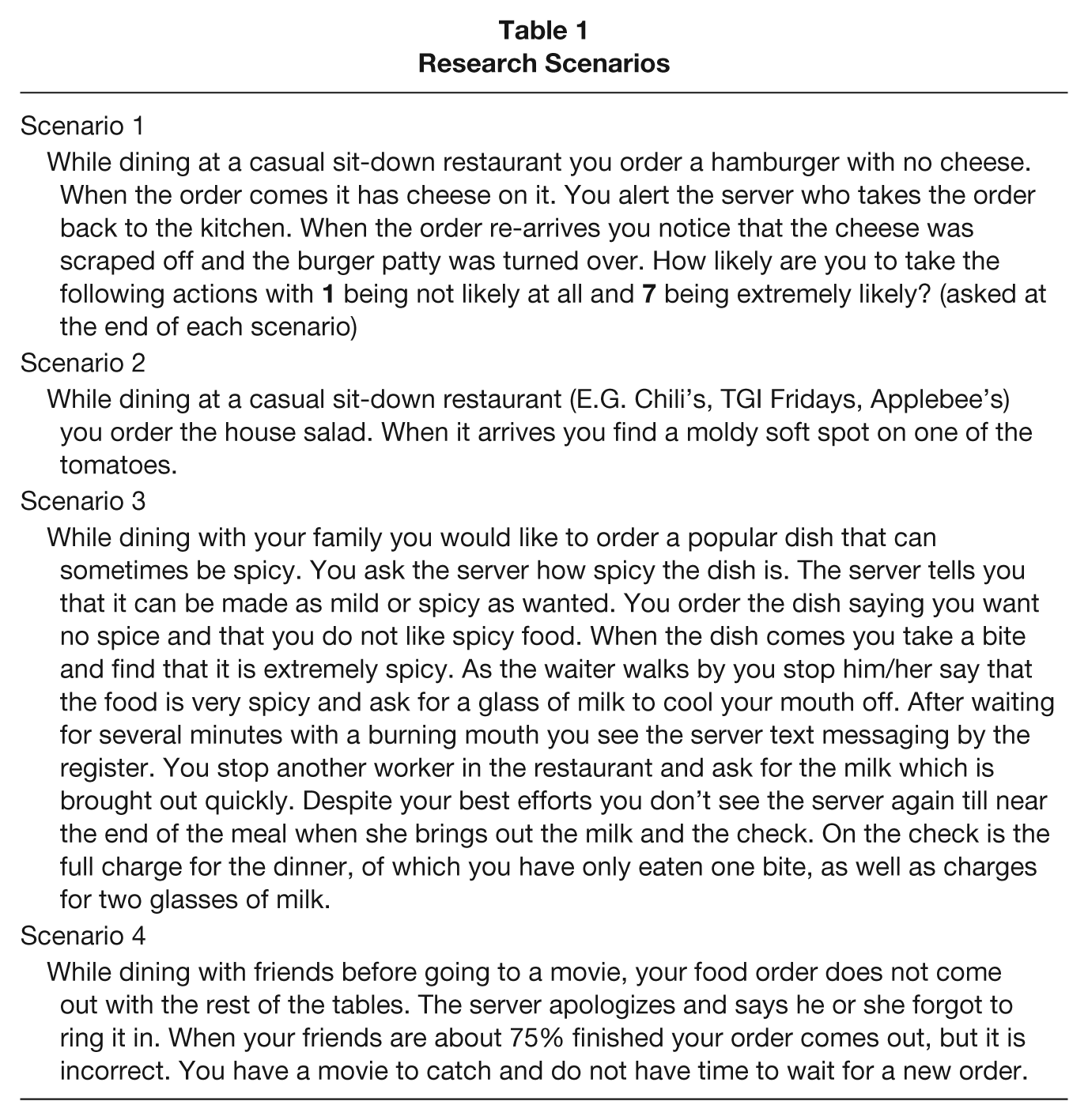
Each service shortfall situation has 11 courses of possible consumer complaint channels. These complaint channels are not mutually exclusive; that is, a customer can follow more than one course of action. Respondents rated their likelihood of each engaging in each action on a numerical rating scale from 1 (extremely unlikely) to 7 (extremely likely). The measurement items, mean ratings and standard deviations of the complaint behaviors for each scenario are provided in Table 2. The 11 possible responses are intended to capture the four proposed complaint channels: nonaction, active, passive, and delayed.
Mean Likelihood of Engaging in Complaint Behaviors

Note: 1 = extremely unlikely, 7 = extremely likely. Standard deviations are in parentheses.
The third set of questions contained the personality measures. The particular scales chosen all had roots in clinical psychology, could be taken with accuracy within a relatively short time period, and measured different areas of personality that have been found to be related to complaint behavior in previous research. Although there are other measures of similar concepts, the ones selected had less overlap and were more parsimonious. The first personality factor measured is locus of control (Rotter, 1966). Rotter’s original questionnaire consisted of 29 questions, of which 6 were filler. The six filler questions were removed to keep the questionnaire a reasonable length. The other 23 questions were presented in their original form, which consists of a forced choice between pairs of items, one of which is internal and one of which is external. Participants were to pick the one that describes their views or opinions of themselves best. Based on their responses the individual can be ranked on the scale of locus of control, which ranges from completely internal to completely external. The second personality measure was the CPI’s measure of sociability. Although the CPI’s full sociability test consists of 36 true or false questions, Villani (1975) created a six-item version rated on 5-point Likert-type disagree–agree scales, on which respondents rate how well the statement describes them. The third personality measure is Cattell’s 16 PF relaxed versus tense scale, for which the shortened version developed by Villani (1975) was also used. The shortened version consists of four questions in a 5-point Likert-type disagree–agree format. It was shown by Villani and Wind (1975) that the modified versions could be used with the same accuracy as the full test. They obtained correlations of .74 (sociability) and .81 (relaxed vs. tense) for the shortened versions and their longer counterparts when using a simple sum of items. Moreover, they obtained high discriminant validity between the three scales of sociability, relaxed versus tense and locus of control, suggesting that each represents a unique construct. Table 3 contains the text of the sociability and relaxed versus tense items. The reader is referred to Rotter (1966) for the Locus of Control scale. The survey concluded with demographic measures.
Sociability and Relaxed Versus Tense Survey Items

Note: Scale is strongly agree, agree, neither agree nor disagree, disagree, strongly disagree.
Design and Analysis
The complaint channels are the dependent variables and the personality types are the independent variables. These were dichotomized at the scale midpoint to form two groups for each personality type. Locus of control consisted of 23 questions each with two possible responses, one of which represents internal and one of which represents external tendencies. The data were recoded so that 1 always corresponded to internal and 2 always corresponded to external. Each respondent then had a number ranging from 23 to 46 with 23 to 34 being labeled internal and 35 to 46 being labeled external. The sociability items were coded so that 5 always corresponded to unsociable and 1 always corresponded to sociable. This created a score for each respondent that ranged from 6 to 30. Any respondent who scored from 6 to 18 was labeled sociable and 19 to 30 was labeled unsociable. Relaxed versus tense was measured with four questions for which 1 corresponded to tense and 5 corresponded to relaxed, creating a summed score of 4 to 20 for each respondent. Any respondent with a score of 4 to 12 was labeled tense and 13 to 20 was labeled relaxed. Given the range of possible scores within groups, it was recognized that participants would have some responses in the opposite category. By splitting each measure at the scale midpoint, groups were created whose predominant tendencies were reflected in their classification.
Factor analysis was conducted to create dimensions of complaint channels. Mean ratings on the factors were analyzed with four 2 × 2 × 2 multivariate analyses of variance (MANOVAs), one for each scenario. The personality traits (locus of control, sociability, and relaxed versus tense) served as the independent variables and the complaint channel dimensions were the dependent variables. Simple effects tests were conducted to pinpoint the source of significant interactions.
Results
Sample Characteristics
The age of the respondents ranged from 18 to 53 years with the majority falling into the 22- to 25-year age group (56%) or 18- to 21-year age group (27%) ranges. There were respondents from all years in school, although the majority ranked as seniors (48%) or juniors (29%), with 16% sophomores and 7% first year. Most respondents were either Caucasian (44%) or Asian (33%) with 23% falling into other categories. The sample contained slightly more females (53%) than males (47%). Table 4 displays the breakdown of participants as a function of the three personality characteristics.
Personality Group Classification

Complaint Channel Factors
A factor analyses was done on the 11 complaint channels in each scenario. The analysis used maximum likelihood extraction and Promax rotation with Kaiser normalization. The number of factors were determined by having an eigenvalue of one or higher. For each of the four scenarios there were three distinct factors, which were comparable across scenarios. The factors have been labeled active, passive, and delayed action. The option of “no complaint action” loaded negatively on the active action factor. According to Tabachnik and Fidell (2007) a loading of .32 and higher is required for factor inclusion. All the factor loadings for retained items exceeded this value, ranging from .483 to .960. For scenario 4, nonaction had a factor loading of −.263 and was not included in further analysis for that scenario. The complaint behavior “verbally tell your friends about the incident after you have left” did not load sufficiently on any of the three factors and was left out of any further analysis. Table 5 displays the factor analysis results.
Factor Analysis of Complaint Behaviors

Active complaint behavior includes alerting the server or manager about the incident at the time it occurs. No complaint behavior is a negative component of active complaint behavior. Passive complaint action entails notifying the server or manager only if asked. Delayed action has the largest number of items and includes negative reviews through various social media channels as well negative comment cards or communication with management after the fact.
Table 6 displays the variance accounted for by each factor and Cronbach’s alpha values showing the internal consistency or reliability of the factors. Nunnally (1978) specifies that reliability statistics should be at least .7, however DeVellis (1991) states that a value of .6, though less desirable, is acceptable. All factors achieved the acceptable cutoff of .6, and all but two exceeded the .7 threshold. Items that loaded on each factor were averaged to create a single measure for each complaint channel as recommended by Hair, Black, Babin, and Anderson (2010). According to Hair et al. (2010), “The most common approach is to take the average of the items in the scale, which gives the researcher complete control over the calculation and facilitates ease of use in subsequent analysis” (p. 126).
Factor Reliability Statistics

Effects of Personality on Complaint Channels
To determine which, if any, of the personality measures had a measurable effect on consumer complaint behavior, a MANOVA was conducted on the three factors for each of the four scenarios. The results of the four MANOVAs are summarized in Table 7, which shows F values, significance tests, and Wilks’s lambda and Pillai’s trace multivariate tests. There was a significant main effect for sociability for three of the four scenarios; Scenario 2 did not exhibit any significant effects. In addition, there were significant interactions between relaxed versus tense and locus of control for Scenarios 1 and 4 and a marginally significant effect (p < .10) for Scenario 3. The Box’s M test evaluates the assumption of homogeneity of variance–covariance matrices across dependent measures. All values were nonsignificant (p > .20 or higher), indicating no violations of the homogeneity assumption for any of the MANOVAs. As shown in Table 4, there were unequal sample sizes in this study. This was because the independent variables were not manipulated, so sample size could not be controlled. Differences in sample size can be problematic if there are unequal variances, such that alpha values are overstated if larger variances occur in larger groups, and understated if larger variances occur in smaller groups (Hair et al., 2010). In this case, there was no evidence of unequal variances and Box’s M values would remain nonsignificant even if they were adjusted. Therefore, the analysis indicates that the data were highly appropriate for MANOVA.
Multivariate Analysis of Variance Results

Note: Between-subjects effects are reported for significant multivariate effects only.
p ≤ .10. *p ≤ .05. **p ≤ .01. ***p ≤ .001.
Once a significant multivariate effect is obtained, the next step is to determine which of the dependent variables are responsible for the overall group differences (Hair et al., 2010). The bottom of Table 7 displays the significance tests for each of the three dependent variables (i.e., complaint channels) for the two multivariate results that were significant. For purposes of comparison, each effect is described as it occurs across the four scenarios.
The effect of sociability was significant on active complaint behavior for every scenario except Scenario 2, and there was a near-significant (p = .054) effect of sociability on passive complaint behavior for Scenario 4. The means and significance tests for these effects are displayed in Table 8. Based on these findings it is apparent that respondents who are sociable are more likely to participate in active complaint behavior, supporting Hypothesis 3. Those who are unsociable are somewhat more likely to participate in passive complaint behavior, providing partial support for Hypothesis 4.
Main Effects of Sociability on Complaint Channel

The main effects for locus of control and relaxed versus tense were not significant, so Hypotheses 1, 2, and 5 were not supported directly. However, only Hypothesis 1 was rejected outright, because locus of control did not affect active complaint channels in any fashion. Locus of control and relaxed versus tense interacted for both passive and delayed channels, providing partial support for Hypotheses 2 and 5. There was a significant Locus of Control × Relaxed versus Tense interaction on passive complaint behaviors for Scenario 1, F(1, 482) = 4.01, p = .046 and Scenario 4, F(1, 482) = 6.94, p = .009. This interaction had an interesting and unexpected effect on passive complaint behavior (see Table 9). Respondents who were “internal-relaxed” and “external-tense” were less likely to use passive complaint channels, whereas the reverse was true if a respondent was “external-relaxed” or “internal-tense.” Simple effects tests indicated that external respondents who were in the relaxed category were significantly more likely than internal to use passive channels for Scenario 4 and marginally higher for Scenario 1. This finding supports Hypothesis 2, but only for relaxed participants. The two locus of control groups were was not significantly different if they were in the tense category.
Locus of Control × Relaxed Versus Tense Interaction on Passive Complaint Behavior

There were marginally significant Locus of Control × Relaxed versus Tense interactions on delayed complaint behavior for Scenario 1, F(1, 482) = 3.14, p = .077 and Scenario 3, F(1, 482) = 3.34, p = .068. Mean ratings for the Scenario 1 interaction are graphed in Figure 1. Analysis of the simple effect of locus of control at each level of relaxed versus tense showed that the effect of locus of control was significant for tense subjects, F(1, 227) = 4.66, p = .032, but not relaxed subjects, F(1, 259) = 0.11, p = .736. Subjects with an external locus of control who were also tense were more likely to engage in delayed complaint behavior than internal-tense subjects, providing partial support for Hypotheses 2 (external > internal) and 5 (tense > relaxed). Relaxed subjects did not differ as a function of locus of control. The interaction for Scenario 3 displayed a different pattern of results as shown in Figure 2. In this case, an analysis of the simple effect of relaxed versus tense at each level of locus of control provided the most meaningful interpretation of the interaction. The effect of relaxed versus tense was significant for internal subjects, F(1, 277) = 4.05, p = .045, but not external, F(1, 209) = 0.46, p = .500. Internal-relaxed subjects were more likely to use delayed complaint channels than internal-tense subjects. External subjects did not differ in their use of delayed complaint channels as a function of relaxed versus tense.
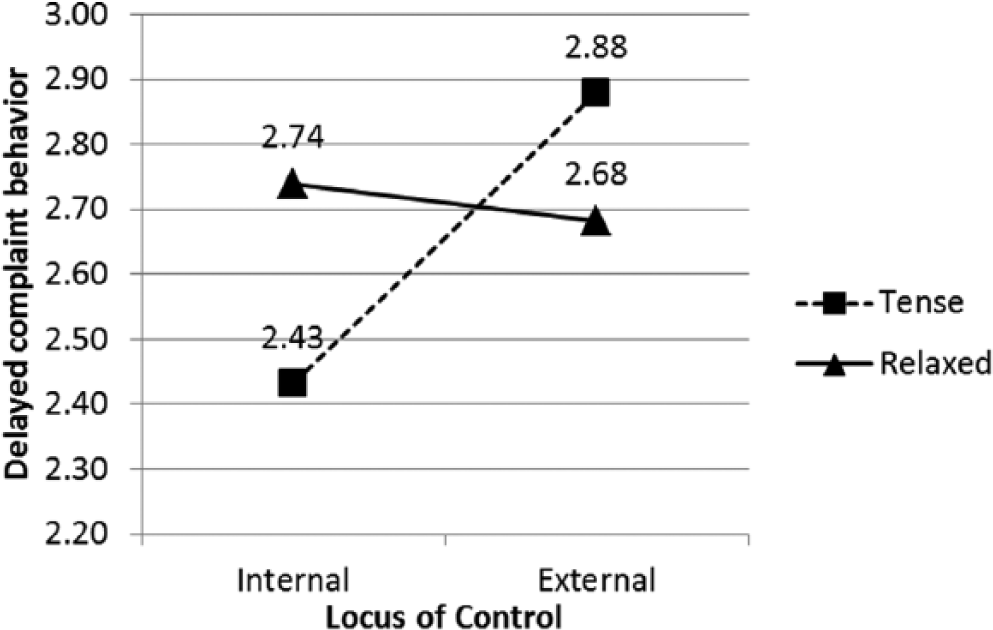
Locus of Control × Relaxed Versus Tense Interaction on Delayed Complaint Behavior, Scenario 1

Locus of Control × Relaxed versus Tense interaction on Delayed Complaint Behavior, Scenario 3
Discussion
The findings support the thesis of this study, which is that personality characteristics influence consumer complaint channels. Three factors emerged that are connected to how and when an individual will engage in complaint behavior. Active complaints are made directly to the source at the time of service failure, whereas passive complaints are made only if asked. After the fact, dissatisfied consumers may use any number of delayed complaint channels. Overall, respondents were less likely to use delayed channels, reducing the challenge that businesses face in complaint resolution. Optimal complaint can be defined as the channels that come to the business and do not reach the outside consumer base. Respondents were more likely to make the server aware of the incident than any other method of complaint behavior, making service recovery possible. However, one item that did not load on any of the factors, telling friends about the incident after leaving, also had high ratings. This form of NWOM can be quite damaging to a business. The fact that NWOM did not load on a particular factor can be attributed to its ability to be used in conjunction with any of the channels (Gursoy et al., 2007).
Table 10 summarizes the hypotheses and indicates whether they were supported fully, partially, or not supported. Hypotheses 1 and 2 predicted that customers displaying an internal locus of control would use active channels, whereas external locus of control customers would use passive or delayed channels. These hypotheses were not supported as there was no main effect for locus of control. However, locus of control interacted with relaxed versus tense providing partial support for Hypothesis 2, in that external respondents were more likely than internal to use passive channels if they were relaxed on the relaxed versus tense scale, and delayed channels if they were tense. The findings add a layer of complexity to the well-documented finding that internal respondents are more likely to complain (Gursoy et al., 2007; J. Huang & Chang, 2008; Kowalski, 1996), suggesting that their preference for complaint channels may depend on other personality characteristics.
Support for Hypotheses

Hypotheses 3 and 4 predicted that customers displaying a high level of sociability would prefer active complaint methods and customers displaying a low level of sociability would prefer passive or delayed channels. The findings supported these hypotheses for both active and passive complaint tendencies. While sociability influenced active and passive complaint behavior, it had no effect on delayed complaint behavior. A less outgoing individual is less likely to prefer face-to-face confrontation and is therefore more likely to use passive complaint methods. However, delayed complaints in the form of negative reviews on social media require active participation but are less confrontational than face-to-face complaints and may be equally preferred by sociable and unsociable people.
Hypothesis 5 predicted that tense customers would be more likely to use delayed complaint channels, which was not supported as there were no main effects for relaxed versus tense. However, the interaction of relaxed versus tense with locus of control showed that tense customers were more likely to use delayed channels if they were also external for Scenario 1, and less likely if they were internal for Scenario 3. Being external and tense were both predicted to increase delayed response, so incompatible characteristics on the two dimensions may inhibit the delayed response tendency.
The complaint channel factors were highly consistent between scenarios, except that no complaint was not part of the active channel for Scenario 4. This suggests that the proposed dimensions provide a meaningful classification of complaint channels. Previous researchers have used active and delayed classifications (Butelli, 2007; Day & Landon, 1977; Singh, 1989; Susskind, 2006), but this was the first to introduce the passive dimension. While the dimensions were consistent, there were some differences in personality effects across scenarios, suggesting that the type of service failure can affect customers’ complaint channel tendencies. There were no effects for Scenario 2, in which there was a moldy spot on a salad tomato. In that situation, the failure could be attributed to the company or cooks rather than the server. Research suggests that external attributions for product/service failures may mitigate complaint behavior (Mattila & Ro, 2007; Swanson & Hsu, 2011). The predicted effects of sociability occurred for all the other scenarios; however, only Scenario 4 produced the predicted use of passive channels by low sociability respondents. In Scenario 4, customers are dining with friends, which places unsociable individuals in a social situation. If asked directly, their tendency not to complain may be offset by the social pressure to do so. Research indicates that customers are more likely to complain when advised to do so by their dining companions (Malafi, 1991).
Although not predicted, the interaction between locus of control and relaxed versus tense is one of the most interesting findings that emerged from this study. The first pattern, which would be expected, is that for the significant factors there is an inverse relationship between passive and delayed complaint channels (Hogan & Nicholson, 1988; Rotter, 1960, 1966). Both internal-tense and external-relaxed are more likely to use passive complaint channels. The opposite occurs in delayed factors from relevant scenarios, for which external-tense and internal-relaxed are more likely to use delayed complaint channels. This interaction was strongest in Scenario 4 and smaller but significant for Scenario 1. In Scenario 1, problem resolution was not satisfactory (the burger was scraped off) and in Scenario 4, there was no time for service recovery because the group must leave for a movie. Lack of or unsatisfactory service recovery may be needed to trigger a passive or delayed response among those who are otherwise less inclined to complain. The possibility and nature of recovery is an intriguing variable to include in future research.
Though there has been very little research on how personality influences complaint channels, it would be expected that certain personality traits would have the same effect regardless of other personality characteristics possessed by an individual (Butcher & Rouse, 1996; Gountas & Gountas, 2007). Despite the vast body of literature on different personality types and expectations of behavior, the authors found no literature that predicted interactions between popular personality measures in service encounters. There is ample opportunity for further study into the interactions of these and other personality traits with regard to consumer complaint behavior.
Implications
The results of this study provide a starting block for understanding consumer complaint behavior in the area of compliant channels. Through greater understanding of the relationship between customer characteristics and consumer complaint behavior, businesses can develop more effective means of complaint resolution. Every guest will respond differently in a service shortfall situation and every service shortfall situation is different and unique, but this research identified specific personality traits that make complaint behavior easier to predict and resolve. The consequence of having a dissatisfied customer continues to grow with the emerging ways that customers can express their dissatisfaction. Although this study investigated three personality dimensions, the implications extend to other customer characteristics such as demographics and attitudes. As the younger, more technology affluent generation grows in purchasing power there may continue to be a rise in popularity of the delayed channels of complaint behavior. Research indicates that customers’ enthusiasm for technology influences their satisfaction with complaint resolution and willingness to return to a hotel (Mattila & Mount, 2003) and this effect may extend to complaint channel preferences.
Although delayed responses were influenced by personality characteristics, they were still relatively unlikely, with mean ratings at or below the midpoint on the 7-point likelihood scale. With the exception of Scenario 3, delayed complaints were rated less likely than no complaint at all; that is, customers are more likely not to complain than to post a negative review or contact management after the fact. However, this does not mean that management should be unconcerned about negative electronic reviews, because delayed responses were more likely for certain personality types. They were more likely for external-tense subjects for Scenario 1 and internal-relaxed for Scenario 3. This finding further suggests that different types of service failures may elicit delayed responses depending on customers’ personal characteristics. Management should not use a one-size-fits-all approach to complaint resolution, but instead be aware of characteristics of both the situation and the customer. Although delayed responses may be less common than direct complaints, they can have a much more widespread impact on the business, reaching thousands of potential new customers. Management should actively monitor review sites such as Yelp!, Zagat, Urban Spoon, and Tripadvisor and respond to negative reviews and online complaints.
Obviously, management and employees cannot ascertain their guests’ personality types when they patronize the business. However, they can be aware that there are certain individuals who want to complain but will only do so if asked (i.e., passive complaint behavior). Employees should be trained to ask if everything was satisfactory and proactively offer resolution in the event of a service failure. A service failure that goes unresolved can result in boycott of the business, or even worse, delayed complaint behavior in the form of online reviews that can affect current and potential customers.
Of the three personality constructs, sociability had the most pervasive effects on complaint channels. Sociability is more easily recognized than the other characteristics, because highly sociable individuals are outgoing and interactive. Employees could be trained to recognize behavioral cues associated with sociability and anticipate their complaint behavior. Highly sociable customers are less problematic because they will actively voice their complaints, but these must be resolved quickly and openly so customers at surrounding tables will not be negatively affected. If there is a service failure involving a less sociable customer, it cannot be assumed that the problem is unimportant because the customer does not speak up. Employees should proactively respond and make sure the situation is resolved even if the customer does not complain.
External locus of control produced passive and delayed complaints depending on the customer’s relaxed versus tense classification. While these are enduring characteristics, research suggests that temporary attributions of control can affect complaint behavior (Mattila & Ro, 2007; Swanson & Hsu, 2011). If management can provide a situational explanation for a service failure situation that satisfies the customer, this can minimize their tendency to complain. For example, Mattila and Ro (2007) found that attributing undercooked food to a recent power failure reduced customers’ tendencies to complain via NWOM. Likewise, just as research shows that induced stress or anger can increase complaining behavior (Bougie et al., 2003; Dunn & Dahl, 2012), induced relaxation could lessen tense personality tendencies. Restaurants can use music or other environmental stimuli to create a relaxing atmosphere. Although prompt service is desirable, employees should be trained to avoid appearing rushed in their interactions with customers. Both these tactics may decrease the likelihood that tense customers will complain via delayed channels.
Limitations and Future Research
There are several limitations for this study. The sample consisted of undergraduate students, which may not accurately represent the target population. However, since they were required to have dined at a casual restaurant recently, they are a segment of the target population. Future research could extend the findings to other populations. The study did not account for any corrective action that may have occurred. Whether and through what channel a customer complains may be affected by whether the resolution, if any, was satisfactory. Future research should investigate the role of personality on complaint behavior following a resolution attempt. Another limitation is that the study used hypothetical scenarios and respondents might not behave the same way in a real situation. Service failure scenarios have been used in other complaint research (e.g., Mattila & Wirtz, 2004), and scenario-based designs are considered valid methods for addressing research questions using quantitative scales (Biggs et al., 2007; Hertzum, 2003). Future research could evaluate how personality characteristics affect complaint channels in actual service failure situations. The research investigated service failures in a casual dining restaurant, and may not apply to other hospitality settings. Future research should investigate the role of personality on complaint channels for other hospitality businesses.
The four scenarios were selected to represent a variety of service failure situations so that the results would not be limited to a single situation. As the focus was on the personality characteristics, there was no attempt to manipulate different types of service failure. There were some inconsistencies in the findings across scenarios, introducing the possibility that personality traits are more likely to manifest in specific situations. Moreover, the different scenarios elicited different levels of complaint likelihood. However, the findings of most interest occurred for all scenarios except Scenario 2. The results consistently showed that sociable individuals are more likely to use active channels, and that locus of control interacts with relaxed versus tense on passive and delayed complaining. There were some nuances of this interaction across scenarios for delayed complaining that provide an intriguing area for future research, whereas the interaction was consistent for passive complaining. In addition, the factor analysis was remarkably similar across scenarios, establishing the dimensions as valid complaint channels. Future research could investigate how specific service failure attributes, such as process versus outcome, affect complaint behavior for different customer types. Situational factors may be especially important for the use of passive and delayed channels.
The research did not take into account participants’ overall propensity to complain, which has been shown to be influenced by personality characteristics (Gursoy et al., 2007; Jones et al., 2002). The tendency to complain could influence whether and through what channel someone will complain. Future research could include propensity to complain as a covariate to isolate the effects of personality on choice of complaint channels.
Future research could investigate preferences for complaint resolution by different personality types. Just as there are multiple complaint channels, there are several different channels of complaint resolution. With the information from this follow-up study, a guide could be created for managers showing the best way to resolve consumer complaints based on how the complaint was presented. Another follow-up study would be an investigation of the probability of consumers using delayed channels after using active or passive channels with limited or no success. Essentially it would be a study of how well an establishment can mitigate NWOM or online word of mouth by understanding personality types for direct consumer complaints. Research could evaluate the effectiveness of management responding to online NWOM expressed through online customer reviews. Future research could also investigate the effect of shortfall severity on consumer complaint channels.
While the personality measures used for this study were carefully chosen, many other personality tests could be used in lieu of locus of control, sociability, and relaxed versus tense. One of the most popular personality measures in business is the Meyers–Briggs, which is based on the Jung personality factors (Butcher & Rouse,1996). Because of its popularity, many managers have taken the test as a way to interact with each other and their employees more effectively. Taking the Myers–Briggs or other personality tests could make managers and employees more sensitive to the personality traits of their customers. Other traits worthy of investigation include introversion–extraversion or assertiveness. Research could also investigate the influence of situationally induced states such as positive and negative emotional states or learned helplessness (Abramson, Seligman, & Teasdale, 1978).
Future research could investigate how demographics such as age affect consumer complaint channel preference. Although not demonstrated in this study, which used college students, one might expect that the younger generation has a higher propensity to use online channels of consumer complaints. By identifying emerging trends early on, the ability is gained to get ahead of the curve and find a solution to these problems before they are detrimental to the industry. Future research could also investigate complaint channels’ differences across nationalities, such as American versus Asian, since different cultures may have different service standards, expectations, and communication preferences.
Consumer complaint behavior is one of the most important issues for the hospitality industry, where service is paramount for customer satisfaction and retention. Through careful understanding of the contributing factors that affect a consumer’s decision of if, where, when, and how to complain, the industry may be able to mitigate the damage that can be caused by service failures. Due to the emerging area of mass media consumer complaint channels, businesses must be more diligent than ever in the identification and resolution of guest complaints. Recognizing the influence of personality characteristics brings businesses one step closer to this goal.
Footnotes
Authors’ Note:
This research received support from the Caesars Foundation.