




Abstract
Bed and Breakfast innkeeping as a form of self-employment is often perceived by aspiring innkeepers as a lifestyle choice that seemingly integrates work and life and enhances personal well-being. On the other hand, innkeeping as a business is known for long work hours and limited escape from work due to the blurred physical and temporal boundaries between work and life. Given the paradox, this exploratory study examined the respite experience (an interval of rest and relief from work) of innkeepers and its effect on subjective well-being. The findings from an online survey among 327 innkeepers in the United States reveal that innkeepers lack short-term respites at regular intervals. Engagement in active and high-effort social or hobby-based respite activities is found to be a primary pathway to an effective respite experience in the absence of psychological detachment from work. The results show that respite experience has a significant effect on an innkeeper’s subjective well-being after controlling for job demands, entrepreneurial motivation, and financial performance of the inn. This research has also identified three clusters of innkeepers (lifestyle innkeepers, seasonal innkeepers, and career innkeepers) based on their respite characteristics and other related operational and individual variables.
Keywords
Introduction
Bed and breakfast (B&B) inns represent a special sector of the lodging industry as the inns are operated by innkeepers who offer personalized services in a home environment (Hsieh & Lin, 2010). B&Bs offer an alternative choice of home-based working conditions in the hospitality industry, attracting many individuals who desire to start their own lodging business (Hsieh, 2010). Instead of being driven solely by financial incentives, more and more innkeepers are pursuing a lifestyle that allows them to spend quality time with family and friends, obtain satisfaction in career attainments and achievements, earn an enjoyable and respectable living, and experience enhanced personal well-being (Lynch, 1994; Vallen & Rande, 2002). Ateljevic and Doorne (2000) used the term lifestyle entrepreneurs to describe such small business owners/operators with a salient lifestyle motive.
Although innkeepers enjoy multiple benefits as self-employees working in a home setting and pursing lifestyle goals, their work and life domains can be undesirably intertwined due to highly blurred work–life conditions such as the lack of spatial, temporal, and relational boundaries between work and personal life (Li, Miao, Zhao, & Lehto, 2013). These conditions can be detrimental (O’Neill & Davis, 2011), leading to excessive emotional exhaustion on the part of the innkeepers (Vallen & Rande, 2002). The long, irregular, and unpredictable work hours coupled with guest expectations regarding availability outside of work hours have been found to be closely associated with the stress of hotel operators (Cleveland et al., 2007; Xiao & O’Neill, 2010). In the case of innkeepers, some consequential outcomes identified by previous studies include excessive job demands, limited personal time, and lack of social interaction outside the inn (Hsieh, 2010; Hsieh & Lin, 2010; Vallen & Rande, 2002). These specificities pertaining to innkeeping accentuate the importance of respites or retreats for B&B innkeepers. Respite refers to an interval of rest and relief from work. It is known to be effective for combatting burnout, recovering from job demands, and replenishing personal resources (Westman & Eden, 1997).
In the hospitality literature, a bulk of work has addressed work–life issues from an organizational and strategic management perspective (Cleveland et al., 2007; Lawson, Davis, Crouter, & O’Neill, 2013; Mulvaney, O’Neill, Cleveland, & Crouter, 2006; Xiao & O’Neill, 2010). Work–life balance is considered as a source of strategic advantage that is reflective of company policy, organizational culture, workplace flexibility, and management style (Mulvaney et al., 2006; Xiao & O’Neill, 2010). Previous research shows that time demand is central to the challenges related to work–life balance in the hospitality industry (Cleveland et al., 2007; Xiao & O’Neill, 2010). Such studies conceptualize work–life issues as a “balance” issue and emphasize the importance of helping hotel managers and employees avail themselves of the family/life domain at the organizational level. However, how individuals spend time to participate in respite activities and how such respite activities affect subjective well-being at the individual level are less understood. Early research has noted that individuals who work longer hours have a different leisure participatory style from those who work fewer hours (Godbey, 1993). Limited research has examined an individual’s respite experience and its effect on subjective well-being. Therefore, addressing work–life issues from a respite perspective is of both theoretical and practical significance. A respite perspective of work–life issues augments the work–life balance perspective by uncovering the “downstream” life outcomes such as respite activities an individual engages in and influences of respite experience on quality of life and overall subjective well-being. Findings from respite research can offer insights and strategies as to how to use respite to bring about positive life outcomes. To that end, the current study intended to systematically assess respite and recovery experiences of innkeepers in their highly integrated work–life conditions and shed light on how such respite experiences influence their subjective well-being. Specifically, the objectives of this study were (1) to investigate the relationships between innkeepers’ specific respite activities and their overall respite experience, (2) to examine the effect of innkeepers’ respite experience on subjective well-being, and (3) to assess the variations among innkeepers in terms of respite experience and subjective well-being.
Literature Review
Theoretical Perspectives on Respite
To examine the effect of respite experience on innkeepers, this study drew on two distinct but compatible theoretical approaches: the conservation of resources theory (COR; Hobfoll, 1989; Hobfoll & Shirom, 1993) and the effort–recovery model (ERM; Meijman & Mulder, 1998). These two predominant theories in respite research postulate different psychological mechanisms through which respites create relief and restoration. Hobfoll’s (1989) COR states that a person aspires to protect and preserve resources. Stress is a reaction to an environment in which there is the threat of a loss of important or scarce resources, an actual loss of resources, or the failure to gain in resources. These resources can include objects, conditions, personal characteristics, or energies that have specific importance to the person (Hobfoll, 1989; Hobfoll & Shirom, 1993). By allowing the restoration of threatened or lost resources or obtaining of new resources, respites offer opportunities for individuals to recover from stress experienced at work (Hobfoll, 1989). B&B innkeepers tend to work long hours (Hsieh, 2010; Hsieh & Lin, 2010) and suffer from emotion burnout (Vallen & Rande, 2002). As a result, they are likely to experience depletion of physical and emotional resources. In addition, by being tied down to the property that limits their social interactions to guests only, innkeepers may lack opportunities to invest in valued sources of social support outside of the workplace (Vallen & Rande, 2002). Following this line of argument, respite is especially important for innkeepers because it offers a major opportunity to regain lost resources and to obtain new resources (Hobfoll, 1989; Hobfoll & Shirom, 1993).
The ERM postulates that effort expenditure to meet work demands yields short-term psychological load reactions (e.g., mental fatigue) and physiological load reactions (e.g., increased heart rate; Meijman & Mulder, 1998). Load reactions will reverse back to baseline levels after a quality respite from work demands, thus the psychophysiological system recovers in advance of the next work period (Geurts & Sonnentag, 2006). When an individual fails to gain timely or complete recovery, the load reactions can further exacerbate, which in return may lead to negative load effects such as persistent sleep difficulties, exhaustion, prolonged fatigue, or chronic tension (Geurts & Sonnentag, 2006; Meijman & Mulder, 1998). Unlike other professionals employed in the hospitality industry, most innkeepers are self-employed and are solely responsible for inn operations, with no or limited full-time or part-time assistance (Hsieh, 2010). It is challenging for innkeepers to set the business completely aside and fully relax for a while when they are the only ones managing the inns, often having numerous pressing tasks at hand. Most likely the load reactions escalate due to their long work hours and high levels of commitment to the inn. In the absence of suitable respites during a busy work day, innkeepers are likely to be exposed to negative load reactions. Subsequently, more effort is required to recuperate from the higher intensity of load reactions, which may make innkeepers’ recovery even more elusive.
While the COR and the ERM (Meijman & Mulder, 1998) propose two complementary processes by which respite creates relief and restoration, the two conceptual frameworks suggest distinctively different pathways to relief and restoration: The ERM suggests that to recover from work, an individual needs to engage in an activity that puts very low demands on his or her cognitive functional system. In contrast, the COR proposes that restoration of resources occurs during respites when other resources are actively invested. In a B&B context in which the boundaries of work and life are blurred, stressors can be results of depletion in physical, social, or psychological resources. It is of theoretical and practical significance to explore which psychological mechanism (recovery or restoration) creates the more favorable respite experience.
Specific Respite Activities and Overall Respite Experience
Sonnentag (2001) classifies the various respite activities into five categories: task-related or work-related activities, household and child care activities, low-effort activities, social activities, and physical activities. Previous research suggested that both task-related activities and household and child care activities tax additionally on an individual’s resources that are similar to those needed for work, and hence they may not be able to facilitate rest and recovery (Sonnentag, 2001). Low-effort activities, such as sleeping, watching TV, and resting on the sofa, rarely draw on resources that are required at work and promote the restoration of these resources (Sonnentag & Zijlstra, 2006). Social activities refer to activities that focus on social contact, such as socializing with family members, friends, and other individuals or groups (Sonnentag, 2001). These activities offer critical opportunities to (re)gain social support, a highly important external resource that helps in the restoration of other resources (Hobfoll, 1989). Physical activities include a wide range of activities of which exercise and sports are examples. Although these activities are not effortless, they tend to use resources different from those required in the work setting. Therefore, low-effort activities, social activities, and physical activities appear to encourage quality recovery because those activities either require less effort or generate additional resources (Hobfoll, 1989; Sonnentag & Zijlstra, 2006).
Researchers have been trying to conceptualize and operationalize respite experience over the past decades. Sonnentag and Fritz (2007) conceptualize respite experience as possessing four underlying attributes: relaxation, mastery experience, control during respite time, and psychological detachment from work. Relaxation is a process associated with activities that require few social demands, use little physical or intellectual effort, and present no challenge to individuals (Tinsley & Eldredge, 1995). Noticeably different from relaxation, mastery experience refers to off-job activities that distract individuals from the job by providing challenging experiences and learning opportunities in other life domains. Individuals encounter control experience during respite when they use their abilities to decide which activity to pursue during respite time, and when and how to pursue it. Going beyond pure physical absence from the workplace during off-job time and abstaining from job-related tasks, psychological detachment from work refers to a state of mind during nonwork time characterized by the absence of job-related activities and thoughts (Sonnentag, Binnewies, & Mojza, 2010). Utz, Lund, Caserta, and Wright (2012), in the context of caregivers’ respite experience, conceptualized respite satisfaction as individuals’ adequacy of respite experience and their satisfaction with how they spend their time during respite (Utz et al., 2012). It captures the cognitive assessment of all underlying attributes and components of the respite experience.
The Relationship Between Respite Experience and Subjective Well-Being
Respite experience helps physical and psychological systems return to their baseline levels and boost general well-being, especially on the subjective aspects (Utz et al., 2012). Subjective well-being represents a person’s affective and cognitive evaluations of his or her life, and it reflects the standards of the individual to determine what constitutes a good life (Diener, 2009). Subjective well-being can encompass a wide range of areas but usually includes measures of life satisfaction, happiness, and positive affect (Diener, 2009). As the most consistent and stable component of subjective well-being, life satisfaction reflects the cognitive evaluation of one’s life and may be directly influenced by affect (Diener, 2009; Diener & Larsen, 1984). In the hospitality context, psychological well-being, a feeling of happiness and satisfaction, is commonly used to assess tourists’ and employees’ subjective well-being (Lin, 2012; Tsaur & Tang, 2012). Accordingly, the present research operationalized innkeepers’ subjective well-being as both life satisfaction and psychological well-being. Life satisfaction represents a global evaluation of innkeepers’ perceived satisfaction toward their current lives (Diener, 2009), while psychological well-being, as a complement to life satisfaction, examines innkeepers’ perceived thriving vis-à-vis the existential challenges and personal development in life (Tsaur & Tang, 2012).
Variances Among Innkeepers in Respite Experience and Subjective Well-Being
There has been limited prior research assessing innkeepers’ respite activities and experiences in relation to their subjective well-being. The uniqueness of innkeepers’ work–life conditions calls for research attention specifically directed at this population segment. Unlike typical employees who have 2-day weekends, legal holidays, and annual paid vacations, B&B innkeepers need to allocate time and create space for their respite (Vallen & Rande, 2002). For example, innkeepers are often not able to enjoy the weekends because weekends are usually the busiest time during the week, especially for inns located in tourism destinations (Hsieh, 2010). On the other hand, many innkeepers as lifestyle entrepreneurs have a certain level of control and flexibility to structure their work around lifestyle choices (Andrews, Baum, & Andrew, 2001; Ateljevic & Doorne, 2000). Innkeepers may be able to arrange regular days off on weekdays when the inns are less busy. In addition, due to the seasonality of the hospitality and tourism industry, some innkeepers can take certain public holidays such as Christmas or Thanksgiving off from work, while others may enjoy a relaxing vacation during the nonpeak season. The present research specifically investigated four types of respite among innkeepers: short breaks during work hours, days off on a weekly basis, public holidays, and vacations. Furthermore, innkeepers’ participation in the four forms of respite and their respite experience are also manifestations of their entrepreneurial and lifestyle choices (Di Domenico, 2005).
Innkeepers may engage in a variety of respite activities that contribute to their overall respite experience. Given the imprecise boundaries between work and life for innkeepers, it is critical to understand what types of respite activities are most conducive to a positive respite experience. In addition, it is of theoretical and practical significance to investigate how innkeepers negotiate respite in a highly integrated work–life condition and how their respite experience affects their subjective well-being. Furthermore, B&B innkeepers with different levels of work pressure or life pursuits may exhibit a varied pattern of respite life. The differences in respite patterns may lead to differences in innkeepers’ overall respite experience and subjective well-being. This study intended to explore how innkeepers differ on work–life dimensions. The research questions of the current research are summarized as below:
Method
Sample and Data Collection
The present study used an online survey to collect data. On approval from the Professional Association of Innkeepers International (PAII), a recruitment e-mail with a link to the online survey was sent to the members of PAII. The recruitment e-mail was sent out in February 2013, with a follow-up reminder about 1 month later. A total of 327 responses were received, with a response rate of 17.17%, indicating a moderately high responses rate among online surveys (Cook, Heath, & Thompson, 2000). There were 213 valid responses collected in the first response wave and 114 responses collected in the second response wave. Chi-square tests were performed on the demographic variables of respondents. The results indicated that gender, age, marital status, and parental status of the respondents did not differ by response wave, with χ2 (1, N = 294) = .685, p > .1; χ2 (4, N = 295) = 1.111, p > .1; χ2 (3, N = 294) = 3.249, p > .1; and χ2 (3, N = 294) = .598, p > .1, respectively. In addition, the results of missing completely at random test (Little, 1988) indicated that the missing values in the present research were missing completely at random, with χ2 (6944) = 6911.47, p > .1.
The demographic characteristics of B&B innkeepers who participated in this study are presented in Table 1. Out of the 327 respondents, 66.4% were females and 69.4% were married couples. Almost 75% of the respondents lived on premises and 67.3% worked more than 40 hours a week as an innkeeper. The demographic characteristics of respondents are consistent with the demographic data from the PAII (2013), which show that 72% of inn owners are married couples and 79% live on premises.
Demographic Characteristics of the Respondents (n = 327)

Measures
Respite Type
Innkeepers’ four types of respite, including on-job short breaks, weekly days off, public holidays, and vacations, were assessed in the study. Respondents were asked to report their frequency in taking each type of respite based on a 7-point Likert-type scale ranging from rarely (1) to frequently (7; see the appendix for measurement items).
Respite Activities
A 20-item activity list, integrating the 19 activities derived from Utz et al.’s (2012) research on caregivers’ respite life and one complementary activity “Email/Internet/Computer use” from Krueger and Mueller’s (2012) study on individuals’ time use and well-being, was used to examine what innkeepers usually do during their respite time. The list includes activities such as sleep, time with friends, exercise, housework, and so on, in all five major categories of respite activities. Innkeepers were asked to rate their participation in each activity using a 7-point Likert-type scale with 1 indicating almost never and 7 indicating almost always.
Respite Experience
Five dimensions of innkeepers’ overall respite experience were measured: relaxation, mastery, control, psychological detachment, and respite satisfaction. Accordingly, four of the dimensions were assessed by four subscales of the Recovery Experience Questionnaire developed by Sonnentag and Fritz (2007; Cronbach’s α = .93, .93, .92, and .85, respectively). Sample items for each of the four subscales were “During respite, I kick back and relax,” “During respite, I learn new things,” “During respite, I feel like I can decide for myself what to do,” and “During after-work hours, I forget about work,” respectively. The measure for the fifth dimension (respite satisfaction) was adapted from Utz et al. (2012; Cronbach’s α = .76) with slight modification to fit the context of this study. The two items were “The amount of respite time I have is adequate to meet my need” and “Overall, I am satisfied with how I use my time during respite.” Responses to the statements of each dimension were averaged to form relaxation, mastery, control, psychological detachment, and respite satisfaction scores. The correlations among these five dimensions ranged from .12 to .55, with p < .05 for all pairs in bivariate correlations. Composite respite experience measure (Cronbach’s α = .90) was therefore used based on their summated mean values.
Subjective Well-Being
Subjective well-being was measured by the five-item Satisfaction With Life Scale (Cronbach’s α = .92) developed by Diener, Emmons, Larsen, and Griffin (1985) and the six-item short version of the Psychological General Well-Being Index (PGWB-S; α = .84) by Grossi et al. (2006). A sample item for Satisfaction With Life Scale is “In most ways my life is close to my ideal,” and a sample item for PGWB-S is “I felt cheerful, lighthearted most of the time.” All responses were on a 7-point Likert-type scale anchored by 1 (strongly disagree) and 7 (strongly agree). Items 1, 3, and 6 in the PGWB-S scale were reverse coded so that higher scores on the scale indicated a higher level of subjective well-being. Responses to the 11 items were averaged to form a subjective well-being score (Cronbach’s α = .91).
Control Variables
Job demands, entrepreneurial motivation, and financial performance were included as control variables for the statistical analyses because earlier research suggested that these variables had certain impact on the subjective well-being (Diener, 2009; Sonnentag et al., 2010). Job demands were assessed with five items (Cronbach’s α = .91) using the Instrument for Stress-Related Job Analysis (Sonnentag et al., 2010). Entrepreneurial motivation was assessed by ratings on three lifestyle-oriented goals (Cronbach’s α = .71) and three business-oriented goals (Cronbach’s α = .81) identified by Getz and Carlsen (2000) and Getz and Petersen (2005). The entrepreneurial motivation score was derived by subtracting the business-orientation score from the lifestyle-orientation score of the same respondent. Financial situation was determined by participants’ responses to two questions: “How well does the current income from the B&B meet your financial needs?” modified from the National Study of the Changing Workforce Survey (Bond, Thompson, Galinsky, & Prottas, 2003) and “How satisfied are you with the financial situation of the B&B?” modified from World Values Study Group (1994; Cronbach’s α = .91). All the control variables were assessed on 7-point Likert-type scale. In addition, innkeepers were instructed to rate the seasonality of their inns on 7-point Likert-type scale with 1 = not seasonal at all and 7 = very seasonal.
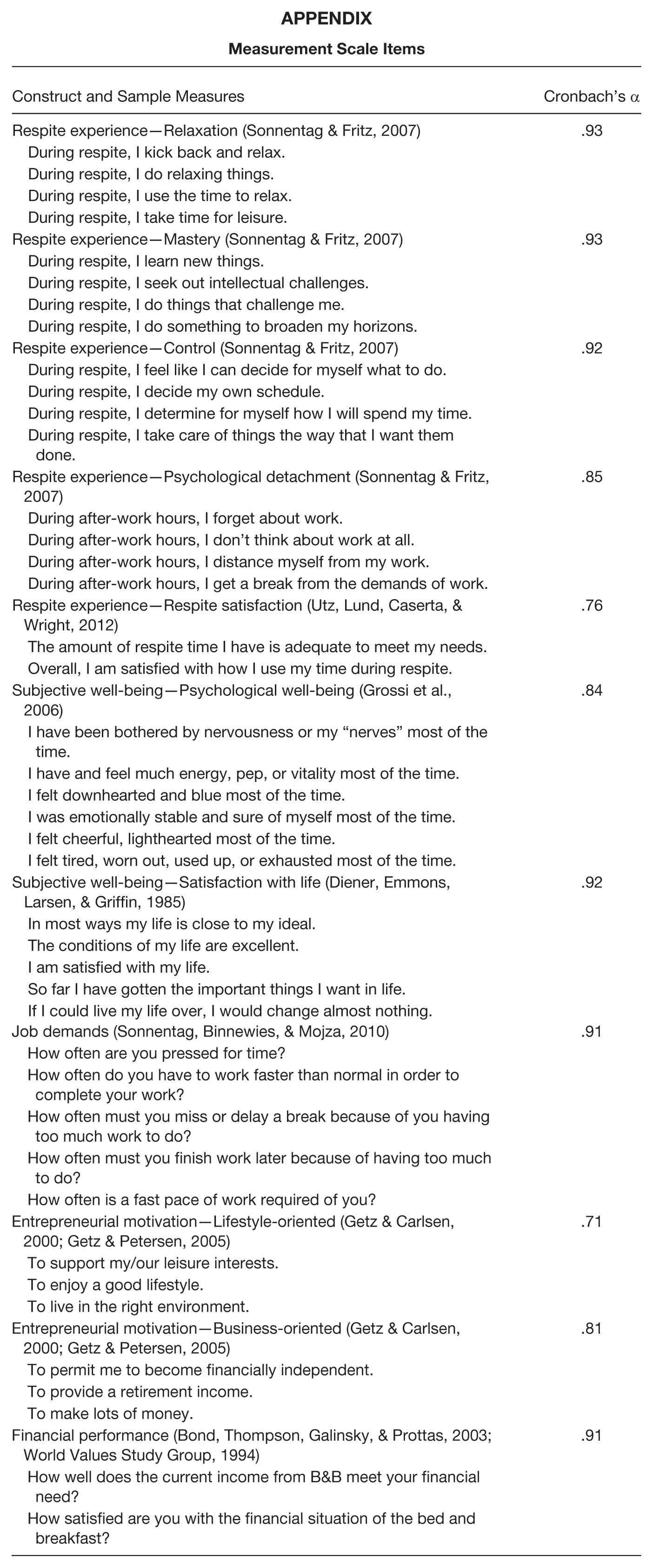
The measurement scales used in this study are presented in the appendix. The means, standard deviations, and intercorrelations among the study variables are presented in Table 2.
Means, Standard Deviations, and Intercorrelations Among Variables

p < .05. **p < .01.
Results
Research Question 1: The Relationships Between Innkeepers’ Specific Respite Activities and Overall Respite Experience
An exploratory factor analysis was performed to identify the dimensions of innkeepers’ respite activities. The minimum eigenvalue of 1.0 criterion and scree plot were used for factor extraction. Also, following Hair, Anderson, Tatham, and Black (1998), items with loadings lower than .40 or loadings higher than .40 on more than one factor were eliminated. As a result of this process, 19 activity items were retained. Five types of respite activities were derived and labeled as social and physical activities, household activities, low-effort activities, well-being oriented activities, and hobbies. Table 3 shows the specific activities in each of the five respite categories. The top two categories of respite activities in which innkeepers engaged were social and physical activities (M = 4.54) and low-effort activities (M = 4.40).
Factor Loadings, Means, and Standard Deviations of Five Types of Respite Activities (n = 327)
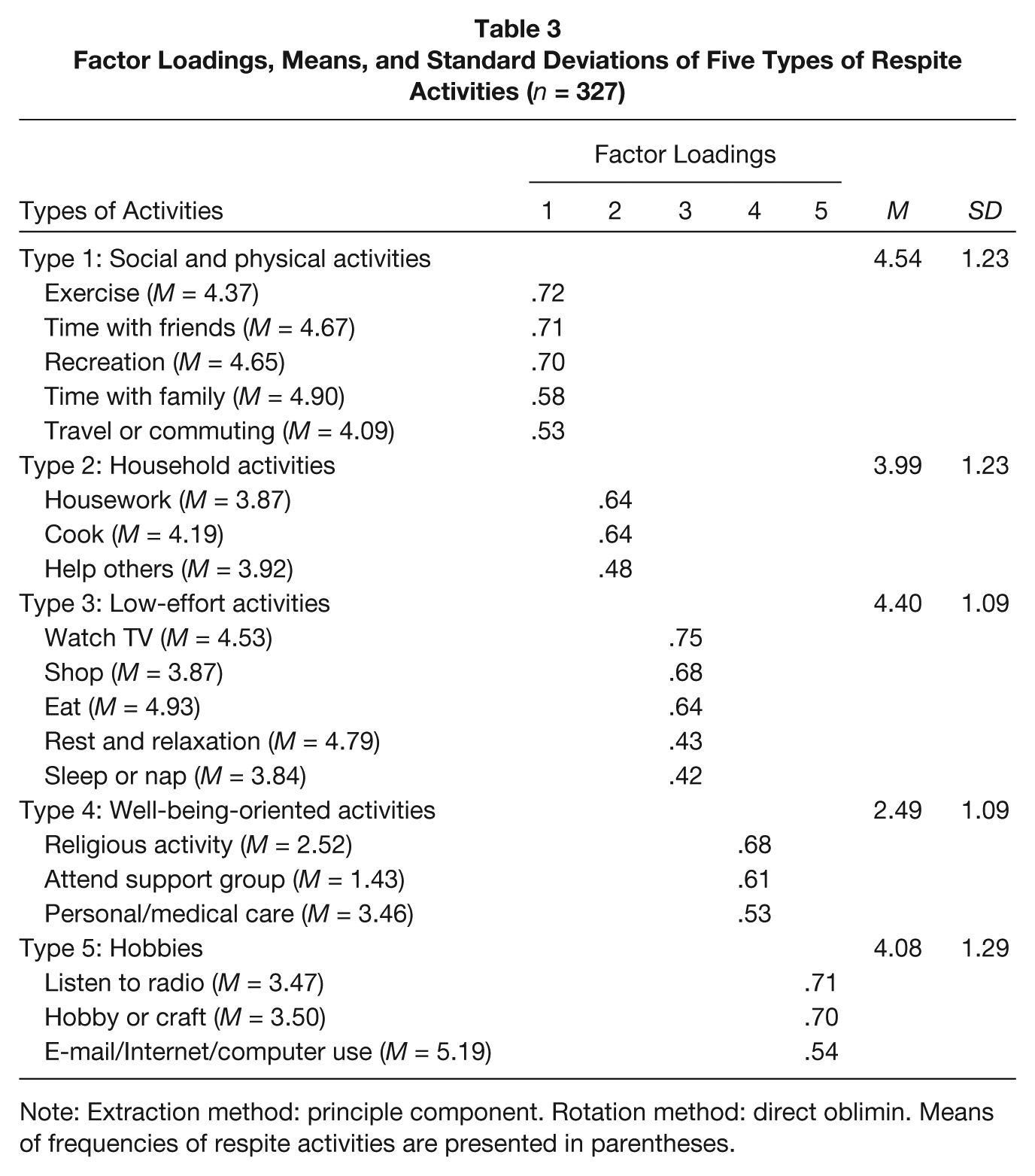
Note: Extraction method: principle component. Rotation method: direct oblimin. Means of frequencies of respite activities are presented in parentheses.
Regarding different types of respite experience, innkeepers reported the highest ratings in control experience (M = 5.35), followed by relaxation experience (M = 5.02), mastery experience (M = 4.44), and respite satisfaction (M = 4.09). They experienced a low level of psychological detachment (M = 2.71). To evaluate the multivariate shared relationships between respite activities and respite experiences, a canonical correlation analysis was conducted using the five types of respite activity variables as predictors of the five respite experience variables. Collectively, the full model is statistically significant using the Wilks’s
Results of Canonical Correlation Analysis

Note: Canonical loadings greater than
p < .001.
Looking at Function 1 (labeled as Gaining New Resources), one sees that the relevant dependent variables are primarily mastery and satisfaction, with control bringing a secondary contribution. In terms of the independent variable set in Function 1, the variables of social and physical activities and hobbies are the primary contributors to the independent variate. All types of activities, with the exception of low-effort activities, are positively related to experience variables. Moving to Function 2 (labeled as Conserving Existing Resources), the canonical loadings in Table 4 suggest that the only dependent variable of relevance is relaxation. As for activities, low-effort activities are the dominant predictor in Function 2, with social and physical activities serving as the secondary contributor. Looking at the canonical loadings for Function 2, we see that low-effort activities are positively related to relaxation experience. It is worth noting that among the five dimensions of respite experience, psychological detachment was the only dimension that did not show significant correlations (−.46 in Function 1, −.11 in Function 2) with any type of respite activities.
Research Question 2: The Effect of Innkeepers’ Respite Experience on Subjective Well-Being
A two-step hierarchical multiple regression analysis was performed to examine the effect of respite experience on subjective well-being. Table 4 shows the results of the hierarchical regression. At Step 1, job demands entrepreneurial motivation and perceived personal financial situation were entered as control variables. At Step 2, respite experience was added to the model. The regression results showed that 34% of the variance in subjective well-being was explained by the model, R2 = .34, F(4, 286) = 36.88, p < .001. Respite experience alone explained 11% of the variance in subjective well-being. Innkeepers’ overall respite experience has a significant positive effect (β = .38, p < .001) on subjective well-being, after controlling for the three control variables. Table 5 presents the results of the hierarchical regression analysis.
Results of Hierarchical Multiple Regression Analysis

Note: aStep 1 degrees of freedom = 3, 287, Step 2 degrees of freedom = 4, 286.
p < .05. **p < .01. ***p < .001.
Research Question 3: Innkeeper Clusters by Respite Experience and Subjective Well-Being
Among the four respite types examined in this study, public holidays was the type of respite innkeepers experienced (M = 5.97) most frequently, followed by vacations (M = 5.16). In terms of shorter respite experience, innkeepers took a moderate number of on-the-job short breaks (M = 4.04). Weekly days off was the least resorted option (M = 2.74). To further explore the different respite patterns among innkeepers, a K-means clustering analysis was performed to classify innkeepers into homogeneous groups based on their frequencies in taking the various types of respite. A total of 327 innkeepers were partitioned into certain clusters in which each innkeeper belonged to the cluster with the nearest mean of respite frequencies. Three clusters were chosen in this study because they distinguished clearly among innkeepers with different respite patterns, had little overlap between each pair of clusters, and presented reasonable interpretations of the clustering analysis. After several iterations, the analysis resulted in final cluster centers. Table 6 presents the results of the final cluster centers from the K-means clustering, as well as the means on frequencies of the four respite types in each cluster. In terms of the number of respondents, 99, 113, and 91 fell into Cluster 1, Cluster 2, and Cluster 3, respectively. Based on the cluster membership information, analysis of variance and multiple pairwise comparisons with Bonferroni method were used to determine whether there were statistically significant cluster differences in terms of the study variables, as shown in Table 7. The three clusters differed in many aspects, including respite experience, subjective well-being, and job demands.
Means on the Frequencies of Respite Types Among the Three Clusters

Note: Final cluster centers in the parentheses.
Characteristics of the Three Clusters on the Study Variables

Note: The letters represent group means for each cluster: Cluster 1 (A), Cluster 2 (B), and Cluster 3 (C). All pairwise comparisons were made with the use of Bonferroni adjustment. Mean differences were significant at the .05 level.
p < .001.
Based on the differences of respite patterns as well as unique characteristics in other life domains, the three distinctive clusters were labeled and described as follows:
The Lifestyle Innkeepers (Cluster 1)
Innkeepers in this cluster are labeled as “the lifestyle innkeepers.” Despite the highly integrated work–life arrangement in a typical B&B setting, this cluster of the innkeepers seems to be characterized by more control and flexibility over work and life. Compared with the other two clusters of innkeepers, innkeepers in this category take each form of respite with moderate to high frequency. They also reported the highest levels of overall respite experience satisfaction and subjective well-being. This cluster of innkeepers, to a great extent, resembles “lifestyle entrepreneurs” who are “concerned with intangible benefits, such as increased time to devote to leisure pursuits or the ability to control the organization of work and leisure” (Di Domenico, 2005, p. 112).
The Seasonal Innkeepers (Cluster 2)
Innkeepers in this cluster take a moderate to frequent amount of respite except the weekly days off. Their situations may be explained by the seasonal nature of the innkeeping business. During peak season, it is difficult for these innkeepers to carve out time for on-the-job short breaks or weekly days off. However, they are able to enjoy more free time for public holidays and vacations during shoulder and low seasons. The seasonal innkeepers reported moderate ratings on respite experience and high ratings on subjective well-being.
The Career Innkeepers (Cluster 3)
Innkeepers in this cluster rarely take frequent or regular respite with the exception of public holidays. It appears that innkeepers in this category only take a break from work on legal holidays. Otherwise, they are almost always on site. The career innkeepers tend to have high job demands and experience the lowest overall respite experience satisfaction and subjective well-being.
Discussion
Innkeeping as a form of self-employment has intuitive appeal of allowing innkeepers to pursue professional and personal aspirations simultaneously in a setting that blends work and life. Is it myth or reality that innkeepers reap the personal well-being benefits associated with innkeeping? The purpose of this research was to advance our understanding of the “life” aspect of innkeeping by examining innkeepers’ respite experience and its effect on personal well-being. The present study revealed three key findings. First, the types of respite activities innkeepers engage in significantly affect their overall respite experience. Active and high-effort respite activities such as social and physical activities and hobbies appear to represent the primary pathways to an overall positive respite experience, especially in the dimensions of mastery, control, and satisfaction. Low-effort activities serve a secondary role in yielding a positive respite experience mainly in the dimension of relaxation. Second, after controlling for the effects of job demands, entrepreneurial motivation, and self-reported financial situation on innkeepers’ subjective well-being, respite experience still explains a significant portion of the variation in subjective well-being. Finally, this research uncovered three clusters of innkeepers based on their respite experience and other work-related variables. Lifestyle innkeepers enjoy the highest level of subjective well-being as compared to that of seasonal innkeepers and career innkeepers.
Theoretical Contribution
This research contributes to the work–life balance literature and hospitality literature in several important ways. First, this research identified certain constraints associated with the mechanism posited by the ERM (Meijman & Mulder, 1998). This research used the ERM and the COR (Hobfoll, 1989; Hobfoll & Shirom, 1993), the two prevailing theories in the work–life balance literature as its theoretical anchors. Findings from this research show that gaining new resources through high-effort nonwork-related activities, part of the mechanism postulated by the COR, is the predominant underlying process of how innkeepers’ respite activities influence well-being. Recovery from effort expenditure resulting from work-related activities, the process suggested by the ERM, only plays a marginal role in influencing innkeepers’ subjective well-being. These findings challenge the assumption associated with the ERM—recovery from effort expenditure is always possible in a given condition. The underlying condition for the ERM mechanism to work is that work and life can be segmented by time and space to allow recovery from effort expenditure at work. In the context of innkeeping, the assumption of explicit boundaries between work and life to allow recovery is challenged. According to the work–family border theory (Clark, 2000), three borders exist between work and life: physical border (work place vs. home), temporal border (work hours vs. nonwork hours), and psychological border (work-related rules vs. nonwork-related rules). Previous research in innkeeping showed that the three types of borders between work and life for innkeepers are weak and highly permeable (Li et al., 2013). When the work–life environment is akin to borderless, the assumption of one’s ability to partition work and life in terms of time (temporal border) and space (physical border) no longer holds. Accordingly, the mechanism described by the ERM fails to meaningfully explain the linkage between respite activities and well-being in the innkeeping context. The findings suggest that the mechanism suggested by the ERM works when the borders between work and life can be reasonably defined and when partition between work and life is viable. When borders between work and life are indistinct and highly permeable, the COR appears to be a more effective framework to depict the underlying mechanism between respite activities and well-being.
Second, the current research identified the relationships between categories of respite activities and dimensions of respite experience, and their impacts on well-being. Findings from this research show that relaxation, mastery, control, and respite satisfaction have significant and positive effects on innkeepers’ evaluation of well-being. However, a more interesting and revealing discovery from this research is that psychological detachment fails to make a significant contribution to the perceived well-being by innkeepers. The null effect of psychological detachment revealed in this study is distinctively different from previous findings (e.g., Sonnentag et al., 2010) that generally suggest that a moderate to high level of psychological detachment through respite activities contributes to positive respite experience and overall well-being. The minimal impact of psychological detachment on well-being in the context of innkeeping reveals the boundary conditions of the positive effect of psychological detachment on well-being. When the boundaries between work and life are clearly defined, psychological detachment from work during respite contributes positively to the respite experience. However, in situations when work and life are highly integrated and almost borderless, such as innkeeping, psychological detachment from work is rarely attainable, making it a less relevant predictor of overall respite experience and subjective well-being. In addition, in the absence of psychological detachment, respite experience such as mastery, control, and satisfaction through high-effort physical, social, and hobby-oriented activities become primary and defining dimensions of an individual’s respite experience. It is important to recognize that such high-effort activities require regular and prolonged engagement with the specific activities to achieve mastery, control, and self-proficiency (Stebbins, 2007), which makes constant short-term respite at regular intervals such as weekly days off critical.
Finally, this research also has important theoretical implications for hospitality lifestyle entrepreneurship. As the results show, work-related factors such as job demands, entrepreneurial motivation, and perceived financial situation of the inn all have significant effects on an innkeeper’s subjective well-being. Yet, even after controlling for such effects, the respite experience still has a robust effect on subjective well-being. The cluster of lifestyle innkeepers, characterized by their regular respite experience in forms of on-the-job breaks, weekly days off, public holidays, and extended vacations, appear to be more lifestyle-oriented and make conscious efforts to define temporal boundaries between work and life even in a highly integrated work–life situation such as innkeeping. Not surprisingly, this particular cluster of innkeepers harvests the most well-being benefits associated with innkeeping as a lifestyle. By contrast, the cluster of career innkeepers who reported lack of regular weekly days off and vacation seem to be more business-oriented and endure the most detrimental effect of the highly integrated work–life condition on well-being. This research provides empirical evidence for the proposition that a highly integrated work–life condition such as innkeeping can lead to either work–life enhancement or work–life interference (Fisher, Bulger, & Smith, 2009), depending partially on how innkeepers shape their respite experience in such a borderless work–life condition.
Practical Implications
The findings from this study shed light on innkeepers’ respite experience and have several important implications for current and prospective B&B innkeepers. One straightforward implication for innkeepers is that conscious effort to set temporary and artificial boundaries between work and life at regular intervals is one of the most viable ways to achieve better well-being in a highly integrated work–life situation such as inkeeping. While innkeeping is a 24/7 business, it is also a form of self-employment that affords flexibility, freedom, and sense of being one’s own boss. Innkeepers are encouraged to consciously define temporal boundaries between work and life to allow short-period respites at regular intervals. In response to an open-ended question in the survey about how innkeepers carve out time and space for short-period respite experiences, participants reported a variety of ways to set work–life boundaries, such as blocking 1 day or 2 days a week for respite or “nothing days” without check-ins or checkouts, although the day does not have to fall on the same day every week; hiring help to cover the inn during off days; or making a conscious effort to take time off during slow days and be physically away from the inn.
To achieve a more productive respite experience and improve one’s subjective well-being, innkeepers are encouraged to actively pursue high-effort social or hobby-based respite activities rather than low-effort passive activities such as rest and relaxation. While the latter may appear intuitive given the job demands of being a self-employed innkeeper, this research suggests that rest and relaxation is not enough for innkeepers to replenish lost resources and gain real well-being benefits. In fact, previous studies have noted that environments and activities that induce a sense of fascination are more conducive to recovery from mental fatigue (Lehto, 2012). In-room rest or static activities such as TV watching may be less effective in arousing such feelings on the part of the innkeepers. This research suggests that it would be more beneficial for innkeepers to engage in more “serious leisure” (Stebbins, 2007). Pursuing meaningful social or hobby-based activities can lead to a higher sense of mastery and control in a highly integrated work–life situation where psychological detachment from work is rarely achievable. Active and high-effort respite activities such as exercising, attending social events, working on projects outside the inn, and other hobbies can help innkeepers temporally disengage from work and offer the “escape” experience when the boundaries between work and life are blurred.
The research also has several practical implications for prospective B&B innkeepers. First, the findings of this study serve as a “reality check” for prospective B&B innkeepers. Due to its relatively low barrier to entry and lifestyle appeal, innkeeping as a type of self-employment is often viewed through rosy lenses by outsiders who enjoy the B&B experience as guests and aspire to become B&B innkeepers. The findings of this study show that while innkeeping does offer lifestyle opportunities, actual pursuit of innkeeping as a lifestyle choice requires conscious effort on the part of innkeepers. Without doing so, innkeeping can easily slip into an all-consuming experience with limited opportunities for respite given its blurred boundaries between work and life. Second, one of the most important things prospective innkeepers can do for themselves is probably to be cognizant about setting artificial boundaries between work and life from the very beginning. For example, at the design stage, prospective innkeepers can decide on setting tangible physical boundaries between guest areas and their own living quarters; in operation, innkeepers should make a conscious effort to set artificial temporal boundaries between work hours (days) and off hours (days) by a variety of ways, such as setting “help yourself” hours for guests or blocking certain days for weekly days off; innkeepers can also set psychological boundaries between work and life by actively pursuing social or hobby-based activities to take their minds off work temporarily but regularly. Finally, prospective innkeepers should also get into the business with a proper mind-set. The findings of this research show that lifestyle innkeepers in general enjoy a discernibly greater level of subjective well-being than that of career innkeepers. The orientation of entrepreneurial motivation appears to play an important role in shaping innkeepers’ respite experience and their subjective well-being. A lifestyle-oriented entrepreneurial motivation is more conducive to the holistic experience of innkeeping as a business and as a lifestyle.
Limitations and Future Research
There are several limitations associated with this research. The first limitation is related to the sample used in this study. The sample was drawn from an innkeeper population primarily located in the United States. As such, the results may reflect the influence of situational factors specific to this region and limit the generalizability of the findings to innkeeper populations in other parts of the world. Second, while B&B innkeeping is a form of home-based self-employment, the work–life situation surrounding B&B innkeepers, such as the strength and permeability of physical, temporal, and psychological work–life borders, differs from other home-based workers, family business owners, or small business owners. Therefore, generalization of the findings to other home-based workers should be made with caution. The third limitation is related to the measurement of perceived financial situation. In this study, participants’ subjective assessment of their financial situation was measured as a proxy for their actual income as well as their spouse’s income and employment (if any). The decision to use subjective measure of income in this study was based on the consideration that innkeepers and/or their spouse’s income can vary considerably based on the geographical locations of the inns, the size of the inns, and the cost of living in different regions. However, it should be recognized that the actual (objective) income levels of innkeepers and their spouse may have an impact on the results of the study. Future study should include both the objective and subjective measures of income to control for its effect on innkeepers’ psychological well-being. Finally, previous studies have suggested significant cross-cultural differences in B&B innkeepers’ work and life balance (Hsieh & Lin, 2010). This research was based on a relatively homogeneous sample of innkeepers in the United States whose work and life experience is largely shaped by the North American culture. In the North America context, the majority of the innkeepers are married couples who own and operate the inns with their spouses. Future studies can further examine B&B innkeepers’ respite experience and subjective well-being using a sample from a distinctively different cultural background.
There are also several interesting avenues for future research on this topic. For example, this study finds that innkeepers’ psychological detachment fails to show a significant influence on their respite experience. Researchers can investigate the factors that affect innkeepers’ psychological detachment and explore explicit strategies to promote a healthy level of psychological detachment during respite. In addition, the effects of the respite activity experience mechanisms on subjective well-being have potential to be further explored. Future studies may assess the effects of different activity experience mechanisms on subjective well-being in the context of B&B innkeeping. Finally, to better understand the similarities and differences among lifestyle innkeepers, seasonal innkeepers, and career innkeepers, future studies can focus on coping strategies in respite life and work–family integration, job history, critical life incidents, initial motivations to enter the business, lifestyle changes, family conditions, and other factors that characterize the uniqueness of each cluster.
In conclusion, this research examined B&B innkeepers’ respite experience and its effect on subjective well-being. The findings of the present study illuminate the unique respite experience by innkeepers in their highly integrated work–life situations and how subjective well-being is influenced by it. It is hoped that the findings from this research may draw more research attention to this important sector in the lodging industry and to offer more practical guidelines to help enhance B&B innkeepers’ quality of life.
Footnotes
Appendix
Measurement Scale Items
| Construct and Sample Measures | Cronbach’s α |
|---|---|
| Respite experience—Relaxation (Sonnentag & Fritz, 2007) | .93 |
| During respite, I kick back and relax. | |
| During respite, I do relaxing things. | |
| During respite, I use the time to relax. | |
| During respite, I take time for leisure. | |
| Respite experience—Mastery (Sonnentag & Fritz, 2007) | .93 |
| During respite, I learn new things. | |
| During respite, I seek out intellectual challenges. | |
| During respite, I do things that challenge me. | |
| During respite, I do something to broaden my horizons. | |
| Respite experience—Control (Sonnentag & Fritz, 2007) | .92 |
| During respite, I feel like I can decide for myself what to do. | |
| During respite, I decide my own schedule. | |
| During respite, I determine for myself how I will spend my time. | |
| During respite, I take care of things the way that I want them done. | |
| Respite experience—Psychological detachment (Sonnentag & Fritz, 2007) | .85 |
| During after-work hours, I forget about work. | |
| During after-work hours, I don’t think about work at all. | |
| During after-work hours, I distance myself from my work. | |
| During after-work hours, I get a break from the demands of work. | |
| Respite experience—Respite satisfaction (Utz, Lund, Caserta, & Wright, 2012) | .76 |
| The amount of respite time I have is adequate to meet my needs. | |
| Overall, I am satisfied with how I use my time during respite. | |
| Subjective well-being—Psychological well-being (Grossi et al., 2006) | .84 |
| I have been bothered by nervousness or my “nerves” most of the time. | |
| I have and feel much energy, pep, or vitality most of the time. | |
| I felt downhearted and blue most of the time. | |
| I was emotionally stable and sure of myself most of the time. | |
| I felt cheerful, lighthearted most of the time. | |
| I felt tired, worn out, used up, or exhausted most of the time. | |
| Subjective well-being—Satisfaction with life (Diener, Emmons, Larsen, & Griffin, 1985) | .92 |
| In most ways my life is close to my ideal. | |
| The conditions of my life are excellent. | |
| I am satisfied with my life. | |
| So far I have gotten the important things I want in life. | |
| If I could live my life over, I would change almost nothing. | |
| Job demands (Sonnentag, Binnewies, & Mojza, 2010) | .91 |
| How often are you pressed for time? | |
| How often do you have to work faster than normal in order to complete your work? | |
| How often must you miss or delay a break because of you having too much work to do? | |
| How often must you finish work later because of having too much to do? | |
| How often is a fast pace of work required of you? | |
| Entrepreneurial motivation—Lifestyle-oriented (Getz & Carlsen, 2000; Getz & Petersen, 2005) | .71 |
| To support my/our leisure interests. | |
| To enjoy a good lifestyle. | |
| To live in the right environment. | |
| Entrepreneurial motivation—Business-oriented (Getz & Carlsen, 2000; Getz & Petersen, 2005) | .81 |
| To permit me to become financially independent. | |
| To provide a retirement income. | |
| To make lots of money. | |
| Financial performance (Bond, Thompson, Galinsky, & Prottas, 2003; World Values Study Group, 1994) | .91 |
| How well does the current income from B&B meet your financial need? | |
| How satisfied are you with the financial situation of the bed and breakfast? |
Authors’ Note:
The authors would like to thank the Professional Association of Innkeepers International for their kind assistance in data collection.