



Abstract
Value cocreation represents a critical element of the service-dominant logic paradigm, which is currently becoming increasingly important in hospitality. A number of recent studies are pointing to the criticality of examining the value cocreation mechanisms in hotels. While value can be cocreated using a variety of methods, mobile commerce offers unique opportunities to lay the foundation of value cocreation in hotels, which can bring substantial benefits for all stakeholders of this process. To understand the how hotel guests develop intentions to cocreate value in hotels using their mobile devices, a conceptual model was developed and validated empirically based on data from U.S. hotel guests. Guests’ perceptions of personalization, trust in the hotel, and their personal innovativeness were found to influence their degree of involvement with mobile devices in hotels, which are instrumental in the development of intentions to engage in specific cocreation behaviors.
Mobile technology and its associated business ecosystem—generically called mobile (m-) commerce—have seen remarkable growth in the hotel industry (Bilgihan, Okumus, Nusair, & Kwun, 2011). Characterized by ubiquity, personalization, portability, and convenience (Wang & Wang, 2010), m-commerce can uniquely and comprehensively mediate the consumer–firm experience, and, thus, can extend the traditional consumer–firm interactions to spheres that are not feasibly replicable outside m-commerce. Such rich interactions represent the fundamental building blocks of value creation in service settings (Vargo & Lusch, 2008), according to the mechanisms defined by the service-dominant logic (SDL) paradigm (Prahalad & Ramaswamy, 2004). The SDL paradigm purports that consumers and firms are always cocreators of value, as they can be involved in a process of continuous innovation and learning (Gouillart, 2014). Accordingly, within the SDL, value is defined as value-in-use, and is created by users while using resources, processes, and outcomes (Grönroos & Voima, 2013). In turn, value cocreation represents the activities of all stakeholders resulting in value, given that some actions contribute independently to value creation while others reflect the actions of stakeholders jointly creating value for one or more stakeholders (Grönroos, 2012).
Since the pioneering work of Prahalad and Ramaswamy (2004) and Vargo and Lusch (2004) challenged the orthodoxy of the marketing thought (Ballantyne & Varey, 2008), the academic literature on SDL and value cocreation followed a continuous evolutionary path (Yi & Gong, 2013), paralleling the development of industrial cocreative practices (e.g., Disney, Microsoft, Aloft; Durugbo & Pawar, 2014). Such abundant research underscores the significance of cocreation to the management and marketing of services in various areas, such as retail (Fujioka, 2009), health (Gill, White, & Cameron, 2011), or transportation (Gebauer, Johnson, & Enquist, 2010). Most research crystalized into one of the three distinct but complementary themes, which, taken together, offer a comprehensive perspective on cocreation.
First, there is a substantial stream of research theorizing the core mechanisms and environments that make cocreation possible. Specifically, research in this stream focuses on the holistic context of cocreation, as it is facilitated by interactions, dialogue (Prahalad & Ramawamy, 2004; Tynan, McKechnie, & Chhuon, 2010), governance mechanisms (Zwass, 2010; Zwick, Bonsu, & Darmody, 2008), processes (Gebauer et al., 2010; Payne, Storbacka, & Frow, 2008), and innovative management techniques (Fujioka, 2009; Lusch & Nambisan, 2015) that give stakeholders access to resources (Andreu, Sánchez, & Mele, 2010). Most notably, within this stream, recent work emphasizes the role of information technology (IT) in facilitating the interactions leading to cocreation (Durugbo & Pawar, 2014; Ind & Coates, 2013).
Second, there is a growing research stream focusing on the outcomes of cocreation, beyond the established ability of firms to develop competitive advantages (Prahalad & Ramaswamy, 2004). Specifically, cocreation was found to influence consumers’ service evaluations (Heidenreich, Wittkowski, Handrich, & Falk, 2014), satisfaction (Ranjan & Read, 2014), attitudes (Navarro, Andreu, & Cervera, 2014), and intentions to purchase (Payne et al., 2008) and repurchase (Dong, Evans, & Zou, 2008). Accordingly, cocreation positively affects not only firms (Prahalad & Ramaswamy, 2004) and consumers (Ranjan & Read, 2014) but also a variety of other stakeholders (Oliveira & Panyik, 2015).
The third, and arguably the most critical theme (Durugbo & Pawar, 2014) aims to elucidate the antecedents of cocreation. While the literature examined mostly service settings (Ranjan & Read, 2014), scholars have illustrated how cocreation is influenced by certain consumer typologies (Füller, Matzler, Hutter, & Hautz, 2012), perceptions of persuasive marketing communications (Gebauer et al., 2010), and collaborative/design efforts or self-service (Prahalad, 2004). Such antecedents were studied from a variety of perspectives, typically by developing and sometimes empirically validating conceptual models that integrate evaluative artifacts of service encounters (e.g., value in use, coproduction; Ranjan & Read, 2014), assessments of benefits (Lorenzo-Romero, Constantinides, & Brünink, 2014), and supply-chain artifacts (Chakraborty & Dobrzykowski, 2014). Although recognized as a useful business philosophy (FitzPatrick, Davey, Muller, & Davey, 2013; Lugosi, 2014; Prebensen, Vittersø, & Dahl, 2013; Schmidt-Rauch & Schwabe, 2014), the cocreation literature in tourism and hospitality is mostly conceptual (Chathoth, Altinay, Harrington, Okumus, & Chan, 2013; Neuhofer, Buhalis, & Ladkin, 2014). Except for a few empirical efforts (e.g., Grissemann & Stockburger-Sauer, 2012), there is limited insight into the antecedents of cocreation, and virtually no insight into the m-commerce processes leading to cocreation in hotels.
Reviewing this vast body of knowledge uncovered three important lacunae. First, there is a major lack of empirical research, especially in examining the antecedents of cocreation in highly experiential settings such as hotels. Most research found it difficult to conceptualize and operationalize such antecedents within the envelope of empirical research, to date leaving some of the proposed theoretical processes unconfirmed (Terblanche, 2014). In this context, an increasing number of scholars (e.g., Cabiddu, Lui, & Piccoli, 2013; Füller et al., 2012; Grissemann & Stokburger-Sauer, 2012; Hoyer, Chandy, Dorotic, Krafft, & Singh, 2010; Yi & Gong, 2013) called for more empirical research that examines the drivers and behavior of individual consumers’ leading to cocreation. Second, while research is flourishing in size and scope (Chathoth et al., 2013; Navarro et al., 2014; Park & Allen, 2013), the domain-specific perspectives integrated within this body of knowledge make the theoretical foundations of cocreation become ambiguous (Ranjan & Read, 2014). There is an acute lack of research clarifying the roles of specific consumers’ characteristics and their perceptions of firm attributes that influence cocreation.
Third, while the importance of IT is emphasized in the cocreation process (Cabiddu et al., 2013), there is little research that explicates how technology-mediated environments facilitate cocreation, especially when technology blends within highly experiential face-to-face interactive service settings, as is the case of m-commerce in hotels. Yet the cocreation paradigm seems to be well aligned with the current hotel m-commerce ecosystem, as it uniquely facilitates rich interactions that represent the locus of value cocreation (Grönroos, 2012). Such interactions are especially critical to value cocreation during the actual hotel stay, when m-commerce facilitates the dialog, access, transparency, and risk-reward evaluations necessary for cocreation better than in other stages of the hotel consumption experience. While there are several studies addressing the role of IT in cocreation (e.g., Handrich & Heidenreich, 2013), there is no research elucidating how the m-commerce environment facilitates value cocreation.
Addressing these critical lacunae, and grounded in the well-established thesis that consumer participation is crucial to cocreation (Füller, Hutter, & Faullant, 2011; Prahalad & Ramaswamy, 2004), which in turn is highly beneficial to consumers and firms, this study draws from the vast cocreation and information systems (IS) literature in order to answer the primordial question: How do consumers develop cocreation intentions in m-commerce in hotels? To this end, this study validated a conceptual model that explicates consumers’ cocreation intentions in the context of m-commerce in hotels based on several antecedents. This study followed two specific objectives: (1) examine the role of consumer involvement as a central element of cocreation and (2) understand the roles of the antecedents of involvement such as perceived security, trust, perceived personalization, personal innovativeness, and need for interaction in shaping consumers’ involvement in using mobile devices to cocreate value.
Review of Literature
Review of Key Concepts
Service-Dominant Logic
The traditional service models are characterized by a major weakness: Consumers become directly involved in the service only after the completion of the service design process, which was accomplished without consumer input or knowledge of their purchasing patterns (Grönroos & Voima, 2013). In contrast, the newer service models that are based on the SDL encourage consumers to become actively involved in defining, customizing, and interacting with the consumption experiences according to their own terms, as they create value for themselves, firms (Chathoth et al., 2013) and others (Fyrberg Yngfalk, 2013). In the hotel industry, the m-commerce service ecosystem distinguishes itself from e-commerce (desktop computer based) and traditional commerce by a series of features, such as portability, ubiquity, and personalization (Chong, Chan, & Ooi, 2012). Taken together, such features reflect underlying mechanisms that uniquely support value creation. As SDL was able to explain value creation grounded in such unique mechanisms, it became the leading approach to study value creation in the marketing theory (Fyrberg Yngfalk, 2013).
Despite the increasing popularity of the SDL, some of its fundamental tenets have recently been challenged, in an effort to rethink the theory and provide an augmented theoretical base that would lend itself to simpler operationalization (Vargo, Maglio, & Akaka, 2008). For example, how firm–consumer interactions predict cocreation remains unknown (Grönroos, 2011). This is attributable to the traditional SDL view, according to which participants to interactions (e.g., firms, consumers, other stakeholders) have convergent goals, thus they coexist in harmony (Echeverri & Skålén, 2011). Yet the harmonious coexistence view was criticized, as it allows certain sociocultural competencies and evolving interests to remain concealed, thus rendering an incomplete depiction of the process by which interactions lead to cocreation (Fyrberg Yngfalk, 2013). Another implicit tenet of the SDL was that participants’ interactions are uniform (Echeverri & Skålén, 2011). This tenet was also challenged recently, as interaction uniformity precludes from understanding a rather valenced value that can result from using, but also possibly misusing resources during cocreation (Fyrberg Yngfalk, 2013). Yet while addressing the challenges discussed above provide a fertile ground for the exploration of the fundamental factors leading to cocreation, to date most research has focused holistically on the soundness of the SDL theory, without a systematic effort to understand the explicit antecedents of cocreation.
Value Creation
Regarded as the core concepts in the SDL, value and its creation were given particular attention during the past two decades, during which two key advancements were noted. First, several authors called for properly defining value and value creation. Thus, despite the conceptual clutter caused by various individual perspectives taken to define value (e.g., benefits vs. costs; Zeithaml, 1988), recent conceptualizations within the context of the SDL approached it from a more holistic and experiential perspective, anchoring value in consumers’ evaluations of their experiences (Helkkula, Kelleher, & Pihlström, 2012), especially when such experiences involve monetary gains resulting from the mutual effort of business partners (Grönroos & Helle, 2010). Accordingly, in hotels, going beyond the traditional benefit–cost perception of value, consumers are likely to form perceptions of value-in-use by assessing the fit between various components of the holistic hotel stay experience (e.g., room atmospherics, foodservice options, ancillary service choices), which can be mediated by the use of their mobile devices and the overall m-commerce ecosystem (Strandvik, Holmlund, & Edvardsson, 2012). Such perceptions of value represent direct consequences of consumers’ ability to access, deploy, and integrate resources (Moran & Goshal, 1999) within a consumption environment that allows for a comprehensive understanding of the interplay between consumers’ needs, roles, resources, and ecosystems (Grönroos & Voima, 2013).
Second, while initially characterized by academic dissent, a principal thesis gained substantial support: that true value creation involves the juxtaposition of the provider and consumer value creation spheres, leading to the development of a joint value sphere, remained central (Grönroos & Voima, 2013). This sphere facilitates joint value creation by consumers inviting providers to interact, and thus assuming both coproducer and value creator roles (Grönroos & Ravald, 2011), which are dialogical at their core. Moreover, some of the fundamental premises of the SDL have also been modified to recognize that (1) the firm’s role moves beyond the provider of an initial value proposition and (2) value is accumulating throughout the value-creation process. Accordingly, the symbiotic relationship between the general hotel consumption environment and the m-commerce ecosystem creates an environment that could be attractive to consumers (e.g., trustworthy, secure, facilitating personalization), which allows for the two spheres to converge toward the joint sphere, in which value is uniquely and fundamentally cocreated and accumulated as a result of interactions via m-commerce.
Cocreation
Cocreation is predicated on multisided interactions, founded on four distinct but interrelated elements: dialog, access, risk-benefits, and transparency (DART; Prahalad & Ramaswamy, 2004). First, dialog involves deep engagement and willingness to act by both parties (Prahalad & Ramaswamy, 2004), which are founded on mutual trust and a willingness to share risk (Terblanche, 2014). The hotel m-commerce ecosystem seamlessly facilitates broad and deep dialog, as it is uniquely positioned to develop faster, more accurate, comprehensive, and personalized guest–hotel information flows. Second, guest–hotel interactions are predicated on guests’ access to new tools facilitating such interactions (Ramaswamy, 2008). m-Commerce provides tools that offer guests unprecedented levels of access that could lead to a complex set of interactions. For example, many hotels are moving from providing asynchronous (differential network parameters between download and upload tasks) to synchronous (similar parameters for both download and upload tasks), thus reducing guests’ frustrations related to uploading digital content online (e.g., self-made videos uploaded by guests on social networking websites while staying in hotels; Phillips, 2014).
The third constitutive dimension of interactions is represented by the risk–reward dyads, reflecting the extent to which the participants in cocreation are in position to assess the risk–reward associated with their interactions. A guest–hotel interaction characterized by dialog, access, and transparency should allow both parties to be in a better position to evaluate the risks and rewards of interacting (Prahalad & Ramaswamy, 2004). Finally, the interactions between guests and hotels must be characterized by transparency (Prahalad & Ramaswamy, 2004), as it enhances the partnerships that are necessary to value cocreation by reflecting the extent to which participants in cocreation exhibit mutual trust (Chakraborty & Dobrzykowski, 2014). In hotels, m-commerce can facilitate transparency better than any other commercial context. For example, mobile devices can provide preference and consumption information to the hotel at the level of the individual guest, in contrast to the most common method used currently of collecting such information at the “traveling party” or “room” level. Such rich information can be more valuable to hotels and guests. Recently, several notable hotel IT vendors, such as Lodging Interactive, Maestro, and ZDirect developed solutions gravitating around the transparency dimension of guest–hotel interactions via mobile devices.
While cocreation reflects the nature of contemporary consumer–firm interactions in hotels via the m-commerce ecosystem, it becomes imperative to understand how consumers adopt their active cocreative roles and act toward creating value together with the firm (Kohler, Fueller, Matzler, & Stieger, 2011). Such cocreative roles are characterized by elements like participation, interactions, and self-service, and span from production to fulfillment and consumption (Kristensson, Matthing, & Johansson, 2008), which together offer a comprehensive view of the process by which value originates, evolves, and is appropriated. Moreover, cocreation is useful in illustrating how various actors’ behaviors are linked to the actors’ innate social structures (Lusch & Vargo, 2006). Cocreation, therefore, constitutes the most appropriate overarching conceptual lens, through which the consumer–firm interactions facilitated by the m-commerce ecosystem leading to a superior value proposition in hotels can be uniquely conceptualized and analyzed (Ranjan & Read, 2014).
Research Hypotheses Development
The conceptual underpinnings of the cocreation literature in mainstream business (Grönroos, 2012, Prahalad & Ramaswamy, 2004; Vargo & Lusch, 2004, 2008) and travel/hospitality (Chathoth et al., 2013; Grissemann & Stokburger-Sauer, 2012; Prebensen, Vittersø, & Dahl, 2013) constituted the main theoretical foundation for this study’s conceptual model. However, apart from the four original DART dimensions of interactions of Prahalad and Ramaswamy’s (2004) conceptualization, the SDL literature does not include truly native conceptual or operational artifacts or point to a unique set of antecedents of cocreation. Unfortunately, the existing dimensions cannot be automatically applied to specific research contexts, as they do not capture the full mechanisms of cocreation within those specific contexts (Yi & Gong, 2013). This shortcoming is attributable to the inherent difficulty of scholars to converge toward unified conceptual definitions of the main SDL constructs (Grönroos & Voima, 2013) and the challenges associated with developing sound operationalizations of such constructs (Grönroos, 2012), which resulted in scarce empirical research in SDL (Payne et al., 2008).
Although authors considered different antecedents of cocreation (e.g., consumer coping in Prebensen & Foss, 2011; macro-environmental, consumer-, product-, and situationally linked conditions in Etgar, 2008; empowerment, enjoyment, and trust in Füller, Mühlbacher, Matzler, & Jawecki, 2009; peer feedback and firm responsiveness in L. Chen, Marsden, & Zhang, 2012) in their conceptual and empirical work, the extant literature does still not provide a set of unequivocal antecedents that are capable of predicting cocreation of value, but rather a disparate list of antecedents that are assumed but rarely empirically validated as influencing cocreation within their respective industrial and task contexts. Yet to be able to capture the main cocreation mechanisms in those specific contexts, native constructs needed to be adapted to other contexts in which cocreation was examined. For example, Grissemann and Stockburger-Sauer (2012) conceptualized cocreation within the context of tourism by using constructs that are innate to tourism marketing, such as satisfaction with a company, loyalty, and customer service expenditures. Similarly, Lorenzo-Romero et al. (2014) studied value cocreation using IS-related benefits to predict consumers’ attitudes toward cocreation, while Olsen and Mai (2013) built their conceptualization of cocreation from a foundation of consumer psychology constructs.
Following a similar approach, as this study conceptualized value cocreation interactions within the explicit context of m-commerce in hotels, the constructs and the set of relationships that form the conceptual model originated in the IS literature (e.g., Vatanasombut, Igbaria, Stylianou, & Rodgers, 2008; Walczuch, Lemmink, & Streukens, 2007; Xu, Lu, Carroll, & Rosson, 2011). While recognizing that cocreation in hotels can extend beyond the particular context of m-commerce, the specific focus of this study on the cocreation mechanisms that are innate to m-commerce warrants the approach taken here to use IS-specific artifacts in the conceptual model. However, such constructs were adapted to reflect the theoretical dimensions of consumer–firm interactions, as originally discussed by Prahalad and Ramaswamy (2004).
The antecedents of cocreation in this study were chosen given that they capture best the full context of the m-commerce ecosystem in hotels from a number of angles. From a task environment viewpoint, there are certain inherent characteristics of the m-commerce ecosystem that act as facilitators of consumers’ involvement. For example, the whole ecosystem is characterized by security concerns (Wu & Wang, 2005). Moreover, building trust in the organization that is perceived to have deployed such ecosystems is paramount (Lin, Lu, Wang, & Wei, 2011). This is why perceived security and trust were added as antecedents of involvement. Also, to characterize the unique capability of the m-commerce ecosystem of facilitating access to only relevant experiences via personalization, perceived personalization was added (Xu et al., 2011). In addition, based on the premise that not all consumers approach a technology-mediated consumption environment similarly because of their inherent differences, two consumer characteristics were added, namely personal innovativeness and the need for interaction.
The dependent constructs used in this study were chosen based on how well they reflect the core interactions that are fundamental to cocreation. Specifically, reflecting primarily dialog and access (Prahalad & Ramaswamy, 2004; Ramaswamy, 2008), consumers’ involvement in accessing hotel products via their mobile devices when staying in hotels is instrumental to developing the interactions that facilitate cocreation (Kristensson et al., 2008). Cocreation intentions were chosen to capture the true character of cocreation (Prahalad & Ramaswamy, 2004), as they comprehensively reflect the dimensionality of value cocreation in hotels using mobile devices (e.g., effort, personalization, information sharing; Handrich & Heidenreich, 2013; Yi & Gong; 2013; Zwass, 2010). In line with the work of Hess, McNab, and Basoglu (2014), Legris, Ingham, and Collerette (2003) and Montazemi and Qahri-Saremi (2015), intentions were used instead of actual behaviors as they have been overwhelmingly validated as the best surrogates of actual behavior. The following sections illustrate in detail the development of this study’s conceptual model and its hypotheses.
Perceived Security
As an increasing amount of information is exchanged in e-/m-commerce, the IS infrastructure must be able to fend off attacks/intrusion (C. Kim, Tao, Shin, & Kim, 2010). Security reflects the extent to which an IS is able to protect the integrity of resources from attacks/intrusion (Shin, 2009). As consumers rarely have the knowledge required to assess the true IS vulnerabilities, security was often conceptualized as perceived security in research using self-reported data, reflecting the extent to which IS users view it as secure (Vatanasombut et al., 2008). The literature validated strong links between the perceptions of security and their prerequisites to engage in behaviors oriented toward an entity or the entire m-commerce ecosystem, especially trust (McCole, Ramsey, & Williams, 2010) and intentions to use IS (Shin, 2009). Such relationships were found to be valid in the context of travel. For example, a relationship between perceived security of mobile devices and trust in airlines has been validated in m-commerce in air travel (Morosan, 2014).
Consumers’ perceptions of security play a critical role in the risk–reward dimension of cocreation interactions, as they offer consumers and firms an opportunity to evaluate accurately the risk–reward relationships stemming from such interactions. m-Commerce ecosystems are characterized by relatively high security concerns, as consumers and firms believe that m-commerce hardware are relatively more vulnerable to breaches as they are radio frequency–based and their small size makes them prone to theft or misplacement (Wu & Wang, 2005). Today’s mobile service protocols and the paralleled consumer habits, such as information synchronization across devices and storage of payment information, facilitate the continuous accumulation and exchange of personal/transaction information stored on mobile devices. The amount of information exchanged during a hotel stay as a result of guest–hotel interactions is also increasing, given the highly fragmented nature of the hotel industry and the transaction density that characterize the hotel stay experience, which can exacerbate consumers’ security concerns (Morosan, 2014). Yet firms can alleviate such concerns by providing secure transaction protocols, technical protections, and security statements (C. Kim et al., 2010), increasing consumers’ trust. Thus, using m-commerce systems that are perceived to be secure and allow for incident-free interactions in hotels should lead to the perception that firms can deploy secure systems that are appropriate for m-commerce interactions, therefore worthy of trust. Thus, on grounds presented above, the following hypothesis was developed:
Hypothesis 1: A hotel guest’s perceived security of mobile devices positively influences his or her trust in hotels offering information/services, or tasks via m-commerce systems.
Trust
Trust refers to the willingness of a party to accept being vulnerable to the actions of another (Mayer, Davis, & Schoorman, 1995). Trust has important connotations in e-/m-commerce, as it helps mediate relationships between parties that transact without prior association (Morosan, 2014) and acts as a buffer addressing the inherent uncertainties of the m-commerce ecosystem (Lin et al., 2011). Most literature accepts the original dimensionality of Mayer et al. (1995), which viewed organizational trust based on ability (skills to exercise influence over the trustor/consumer), benevolence (the trustee organization is interested in the trustor/consumer’s welfare), and integrity (the trustee’s degree of adherence to acceptable principles). While several authors used trust with conceptually similar or reduced dimensions (e.g., credibility and benevolence in Doney & Cannon, 1997; sincerity and competence in Sung & Kim, 2010; benevolence/integrity and ability in J. Chen & Dibb, 2010), most IS research conceptualized trust alongside the three original dimensions and used scales that often combined such dimensions (e.g., Jarvenpaa, Tractinsky, & Vitale, 2000; D. J. Kim, Ferrin, & Rao, 2008; San Martín, Camarero, & San José, 2011), eventually validating trust a strong antecedent of behavior toward a brand (M.-J. Kim, Chung, & Lee, 2011) or a specific IS (Teo & Liu, 2007).
Within SDL, trust is related to the dialog and transparency of interactions (Durugbo & Pawar, 2014) as consumers and firms are able to cocreate based on interactions characterized by integrity and shared risk (Terblanche, 2014). Several authors suggested adding trust as a dimension to cocreation, on which customer–firm connections could be actually founded (Prahalad & Ramaswamy, 2004; Randall, Gravier, & Prybutok, 2011). In the absence of high familiarity with brands and their offering, the multitude of fragmented services, information, and tasks that form the basis of consumer–firm interactions in m-commerce in hotels are inherently regarded with a certain degree of skepticism by consumers. Such skepticism is driven by the innate perceptions of risk of m-commerce (M. C. Lee, 2009). Consumers, however, are likely to engage with the products, services, and experiences as the degree of risk associated with such products/purchases decreases and as trust becomes the mediating mechanism that allows consumers to attenuate their risk perceptions (Teo & Liu, 2007). Thus, trust has a particular connotation to the context of interactive services, as it influences consumers to go on a path leading to behavior toward the service/information or task that contribute to a consumption experience (Randall et al., 2011). That is, using trust as a catalyst, consumers are likely to approach such services, information, tasks via their mobile devices, resulting in direct involvement within the value cocreation environment. Based on these theoretical grounds, the following hypothesis was developed:
Hypothesis 2: A hotel guest’s trust in hotels positively influences his or her level of involvement with information, services, and tasks using mobile devices in hotels.
Perceived Personalization
Fundamentally, personalization refers to the extent to which IS are used to treat consumers on an individual basis by adapting the attributes of a product/service bundle and its corresponding interactions uniquely to individual consumers (Peppers & Rogers, 1996). In the IS literature, perceived personalization reflects users’ perceptions that they can tailor the attributes of an offer to suit their personal specific needs (Xu et al., 2011). Founded on the general belief that personalized services are more valuable for consumers, personalization has important connotations in the hotel industry (C.-H. Lee & Cranage, 2011). For example, personalization can reduce guest misfit costs when guests do not find all attributes of a product/service bundle to be equally relevant to their needs (Syam & Kumar, 2006). Personalization, therefore, stays at the foundation of cocreation of value (Ranjan & Read, 2014), especially via IS, as unprecedented information flows occur between consumers providing personal information and firms modifying the services according to that personal information (Ramaswamy & Ozcan, 2014, as cited in Leavy, 2014), thus facilitating the consumer–firm dialog (Prahalad & Ramswamy, 2004).
The contemporary m-commerce ecosystem offers extraordinary opportunities for personalization in hotels. On the guest’s side, most of today’s mobile devices have been specifically designed to offer personalization opportunities to users, primarily by allowing users to store and easily retrieve use preferences (Zarmpou, Saprikis, Markos, & Vlachopoulou, 2012). On the hotels’ side, the current software applications, including mobile apps and website interfaces are characterized by superior levels of personalization (Nayer, 2012). It is likely that in consumption contexts characterized by high levels of personalization such as the context of m-commerce in hotels, consumers’ personalization could result in value. Therefore, viewing personalization as facilitating a potential benefit (Kristensson et al., 2008), guests are likely to become involved with information, services, and tasks and, thus, become involved in the process of cocreation of value. Accordingly, the following hypothesis was developed:
Hypothesis 3: A hotel guest’s perceived personalization of hotel services via mobile devices positively influences his or her level of involvement with information, services, and tasks using mobile devices in hotels.
Personal Innovativeness
Personal innovativeness is a characteristic of humans reflecting the extent to which they accept novelty (Midgley & Dowling, 1978). As it helps explain consumers’ adoption of innovative products, services, and technologies, personal innovativeness has been used extensively in the marketing literature, especially in segmentation, providing tools for marketers to distinguish between innovative versus noninnovative consumers (Agarwal & Prasad, 1998). It has been conceptualized as either global innovativeness, representing an innate trait of consumers, or as domain-specific innovativeness, which regulates a consumer’s involvement with novel product/services in specific domain contexts. However, the mainstream marketing literature eventually found domain-specific innovativeness to be a better concept in explicating consumers’ use of new products in specific contexts (Goldsmith & Hofacker, 1991), such as the one discussed in this study.
To date, no conceptualizations of personal innovativeness were found within the SDL literature. However, prior conceptualizations of personal innovativeness in the IS literature gravitate toward the thesis that innovative consumers simplify their system of beliefs regarding new IS and their corresponding business settings (Walczuch et al., 2007). Thus, as innovative consumers tend to be more responsive to firms’ offerings than noninnovative consumers (Walczuch et al., 2007), the theoretical insights provided by Prahalad and Ramaswamy (2004) and the subsequent literature (e.g., Terblanche, 2014) seem to suggest that a concept such as personal innovativeness could reflect the dialog and access dimensions of interactions. Accordingly, in a hotel m-commerce context, guests who have an inclination toward IS become likely to use their mobile devices to complete hotel-related tasks, or to engage in an information exchange with the hotel, according to a link between innovativeness and involvement within the task environment. Based on the discussion above, the following hypothesis was developed:
Hypothesis 4: A hotel guest’s personal innovativeness toward IS positively influences his or her level of involvement with information, services, and tasks using mobile devices in hotels.
Need for Interaction
In business contexts with extensive deployment of self-service technologies, most consumer–firm interactions become dominated by IS (Meuter, Ostrom, Bitner, & Roundtree, 2003). Yet the automated processes by which IS facilitate service fulfillment sometimes fail to provide the benefits otherwise obtainable via traditional person-to-person interactions. As a result, even in highly immersive technology environments, some consumers still express a need to interact with service staff (Dabholkar & Bagozzi, 2002). While the emerging literature in SDL and IS is still developing, it does not clearly differentiate between the interactions occurring exclusively within and those outside the IS context of service. That is, while IS facilitate new levels of consumer–firm interactions, such general interactions with the firm via staff or its IS (in lieu or addition to staff) can both be instrumental to value cocreation (Nätti, Pekkarinen, Hartikka, & Holappa, 2014). As traditionally in hotels, guest–hotel interactions originally manifest in direct guest–staff interactions, they are likely to extend as opportunities to interact more deeply become available via service settings in which the staff is replaced or complemented by IS. As a result, guests who like to interact with the hotel via its staff are also likely to extend their interactions with the hotel in the m-commerce context, thus enhancing the dialog that is fundamental to cocreation (Prahalad & Ramaswamy, 2004). Accordingly, the following hypothesis was developed:
Hypothesis 5: A hotel guest’s need for interaction with service staff positively influences his or her level of involvement with information, services, and tasks using mobile devices in hotels.
Involvement and Intentions
Within the SDL paradigm, involvement was deemed critical in understanding consumers’ behavior, as excessive emphasis seems to have been placed on consumers’ responses to products rather than on factors that drive consumers toward products (Grönroos & Voima, 2013). Yet very little research has been conducted to investigate the role of involvement in service settings (Alam, 2006). Generally, involvement has been defined based on (1) cognitive grounds, reflecting the relevance of a product/task as a psychological tie to a consumer, (2) individual state grounds, reflecting the extent to which a given situation may elicit concern of an individual for his or her behavior, and (3) response-based grounds, reflecting individuals’ information processing relative to a product/task (Laaksonen, 1994). The conceptualization of involvement becomes increasingly complex, especially as new types of products and product environments emerge and new ways to interact with product stimuli become available to consumers (San Martín et al., 2011). Although scholars used selectively the definitions presented above to conceptualize involvement in specific e-commerce contexts (San Martín et al., 2011), the conceptualization of involvement with services/tasks using mobile devices in hotels requires all three viewpoints to be considered. Thus, as the cognitive-based (e-commerce involvement reflects a relatively stable response to shopping stimuli) and response-based grounds (responses to stimuli can drive a guest in a hotel to different purchasing paths (Dholakia, 2001)) should be inherently invoked, the unique context of the hotel stay experience required for the individual-state approach needs to be included as well within the conceptualization of involvement in this study.
In hotels, the consumption experience is designed to be unique, and is increasingly characterized by attributes that are adaptable to guests’ specific needs. Such adaptations are becoming norm within the m-commerce ecosystem, where the variety of guest requests and disclosure of personal consumption preferences/information and the corresponding service responses of hotels set up a foundation for cocreation of innovations (Kristensson, Gustafsson, & Archer, 2004). Yet the success of the cocreation process lies in the extent to which guests become involved with hotels in their interactions (Kristensson et al., 2008), as reflected by the dialog and access dimensions of such interactions (Prahalad & Ramaswamy, 2004), and which result in value in use (Grönroos & Voima, 2013). Thus, as guests become increasingly involved with the use of their mobile devices in hotels to interact with the service ecosystem, they increase the likelihood of cocreating value via such interactions (Kristensson et al., 2008). Yet such behavior is often conceptualized as intentions, given that intentions to conduct a behavior are the strongest predictors of actual behavior (Legris et al., 2003), especially when the task environment is not mature yet (Lu, Liu, Yu, & Wang, 2008).
What actually constitutes cocreation behavior seems to be a subject of continuous academic dissent (Chathoth et al., 2013), as scholars developed various conceptualizations of cocreation behavior (e.g., Handrich & Heidenreich, 2013; Ranjan & Reed, 2014). Grounded in the basic premises of Prahalad and Ramaswamy (2004), cocreation of value has been viewed as characterized by behaviors that allow both firms and consumers to interact to produce uniquely created value within the consumer’s contextual consumption experience, which, at its core, is dependent on the level of consumer’s involvement (Chathoth et al., 2013). Thus, the literature has converged toward a number of dimensions (e.g., product/service assessment, effort, personalization, and information sharing) that comprehensively represent cocreation behaviors.
First, the literature views cocreation as reflected by consumers’ approach and assessment of new products/services (Zwass, 2010). In hotels, at the moment of stay the core product has already been purchased, and thus the products/services likely to be bought using mobile devices while on the property represent ancillary products/services, which have the role of enhancing the value of the consumption experience via personalization, eventually helping to assess the viability of customized ancillary products/services (Zwass, 2010). Second, consumers cocreate value via their mobile devices by offering online reviews and updates while staying in hotels. This represents autonomous cocreation, as consumers contribute to the development of declarative content, which is further aggregated, used, and presented systematically (Oliveira & Panyik, 2015; Zwass, 2010). Third, the effort and personalization dimensions of cocreation discussed by Handrich and Heidenreich (2013) and others (e.g., McColl-Kennedy, Vargo, Dagger, & Sweeney, 2009; Oliveira & Panyik, 2015) are also present in the hotel m-commerce ecosystem. For example, creating their own computer networks in the hotel rooms using mobile devices and connecting the devices to other in-room technologies requires effort (e.g., material—being in the possession of the device and software; intellectual effort—know how), representing cocreation (Handrich & Heidenreich, 2013; McColl-Kennedy et al., 2009). Moreover, controlling room atmospherics and accessing specifically designated areas using mobile devices reflects the personalization aspect of cocreation (Handrich & Heidenreich, 2013).
In addition, all mobile device behaviors aimed at interacting with the hotel and accessing products/services have information-sharing connotation, which is representative of cocreation (Handrich & Heidenreich, 2013; Yi & Gong; 2013; Zwass, 2010). Mobile devices are capable of providing geographic location information, information about the type of device, its operating system, and can reveal network broadband consumption (Garvin, 2014). Also, when staying in hotels, consumers are likely to connect their devices to the hotel’s network, relinquishing their connections from their default carrier, which has critical implications for the type and volume of data they exchange (McGarvey, 2014). In sum, the information exchanged using the mobile devices and thus reflecting a consumer’s behavior on the property can lead to generating knowledge about the experiential purposes and latent drivers of behaviors (Sørensen & Jensen, 2015), which allow for a better informational platform to be created with the hotel (Yi & Gong, 2013), allowing the hotel to provide an experience tailored to consumers’ needs and wants (Chathoth et al., 2013).
Thus, within the context of m-commerce in hotels, the following hypothesis was developed:
Hypothesis 6: A hotel guest’s level of involvement with information, services, and tasks using mobile devices in hotels positively influences his or her intentions to engage in cocreation behaviors using mobile devices.
Summarizing the prior discussion, the conceptual model of this study is illustrated in Figure 1.
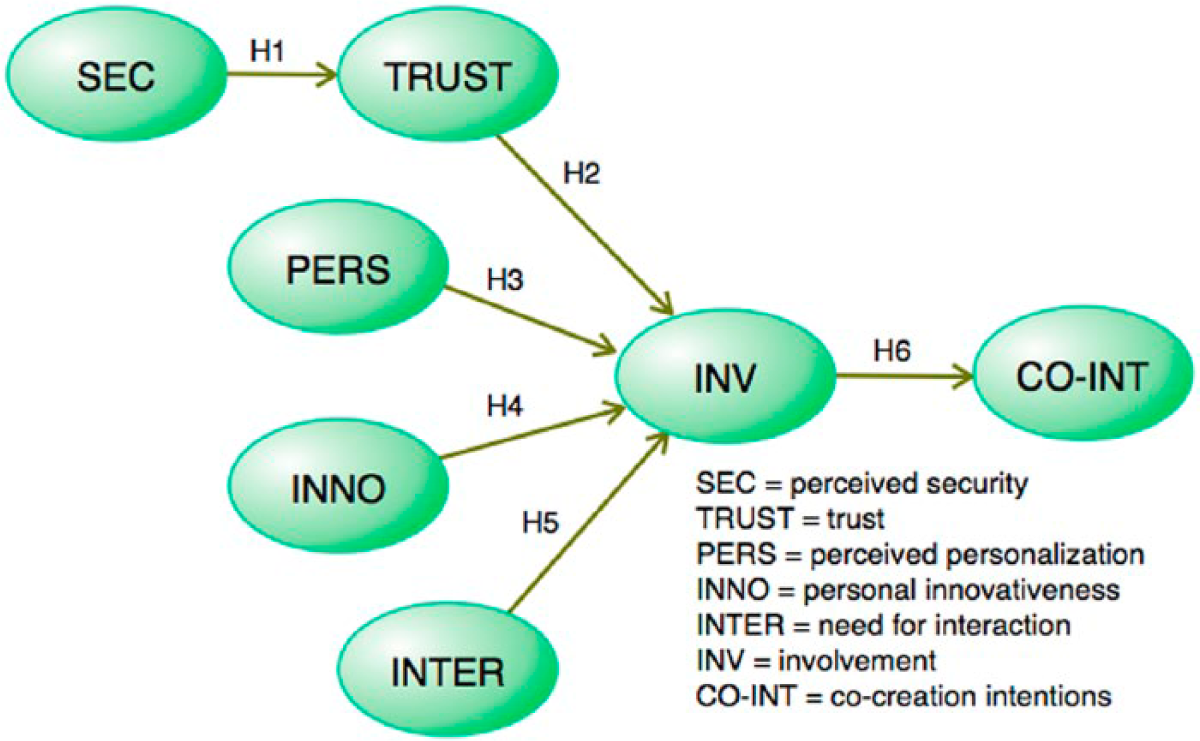
Conceptual Model and Hypotheses
Method
Instrument Design
Scales were developed based on the existing literature on IS and cocreation. The scales, illustrated in the appendix, were adapted to capture the mechanisms of cocreation in the hotel industry using mobile devices. The three-item scale for security was adapted from Vatanasombut et al. (2008) and Walczuch et al. (2007). Trust was measured with three items, reflecting its core dimensions, adapted from the work of Jarvenpaa et al. (2000) and D. J. Kim et al. (2008). Perceived personalization was measured via three items adapted from Xu et al. (2011). Personal innovativeness was measured with three items based on the work of Goldsmith and Hofacker (1991), whereas the need for interaction was measured using three items adapted from Dabholkar and Bagozzi (2002). Involvement was measured with three items adapted from San Martín et al. (2011).
The scale used to measure intentions to cocreate value was developed using the following procedure. Examples of cocreation behaviors outlined in the earlier (e.g., Prahalad & Ramaswamy, 2004) and more recent literature (e.g., Handrich & Heidenreich, 2013; Prebensen & Foss, 2011; Yi & Gong, 2013; Shaw, Bailey, & Williams, 2011; Zwass, 2010) were instrumental in developing an initial list of potential cocreation behaviors in hotels. Such behaviors fit three important criteria: (1) they have to be located far along within the guest–hotel service encounter in hotels (Shaw et al., 2011), (2) guests have to be active operant resources in the cocreation process (Shaw et al., 2011), and (3) they have to be feasibly transferrable to the m-commerce context in hotels in such a way that guests can interact with hotels, while hotels can understand and negotiate such interactions (Etgar, 2008). The initial list included 14 activities, but only 7 items were included in the final analysis, as they fit all three criteria presented above and thus capture well the concept of value cocreation using mobile devices. Items 1 through 3 reflected the evaluation and declarative content development aspects of cocreation (Zwass, 2010). Items 4 through 7 addressed the effort and personalization aspects of cocreation (Handrich & Heidenreich, 2013). All intention items reflected the critical information sharing aspect of cocreation (Handrich & Heidenreich, 2013; Yi & Gong, 2013). In sum, all seven items contributed to comprehensively capturing the cocreation behaviors in hotels using mobile devices.
All constructs were measured using 5-point Likert-type scales, with values ranging from 1 = strongly disagree to 5 = strongly agree. The instrument included a scenario, defining the terms and offering examples of potential information, services, or tasks that could be accessible in hotels via m-commerce to facilitate value cocreation. The survey instrument concluded with two sections including common hotel stay behavior and demographics measures.
Data Collection and Management
The data collection instrument was hosted online by the Qualtrics survey environment. Access services to a panel of general population of U.S. consumers were purchased from a reputable consumer panel company. On a pilot test, an invitation link to the survey was sent to a total of 4,400 potential respondents, of which 357 followed the invitation link. The survey had a filtering question, asking respondents whether they had stayed in a hotel during the past 12 months prior to the study. On filtering and removing the records containing systematic missing values, a total of 317 respondents were kept for further analysis. Since the net response rate was 7.2%, the data set was subjected to nonresponse bias analysis, which was conducted by examining the differences between the responses of early versus late respondents. As no significant differences were found, it was concluded that nonresponse bias was not an issue in this data set (Ary, Jacobs, & Razavieh, 1996).
Results
Descriptive Analyses
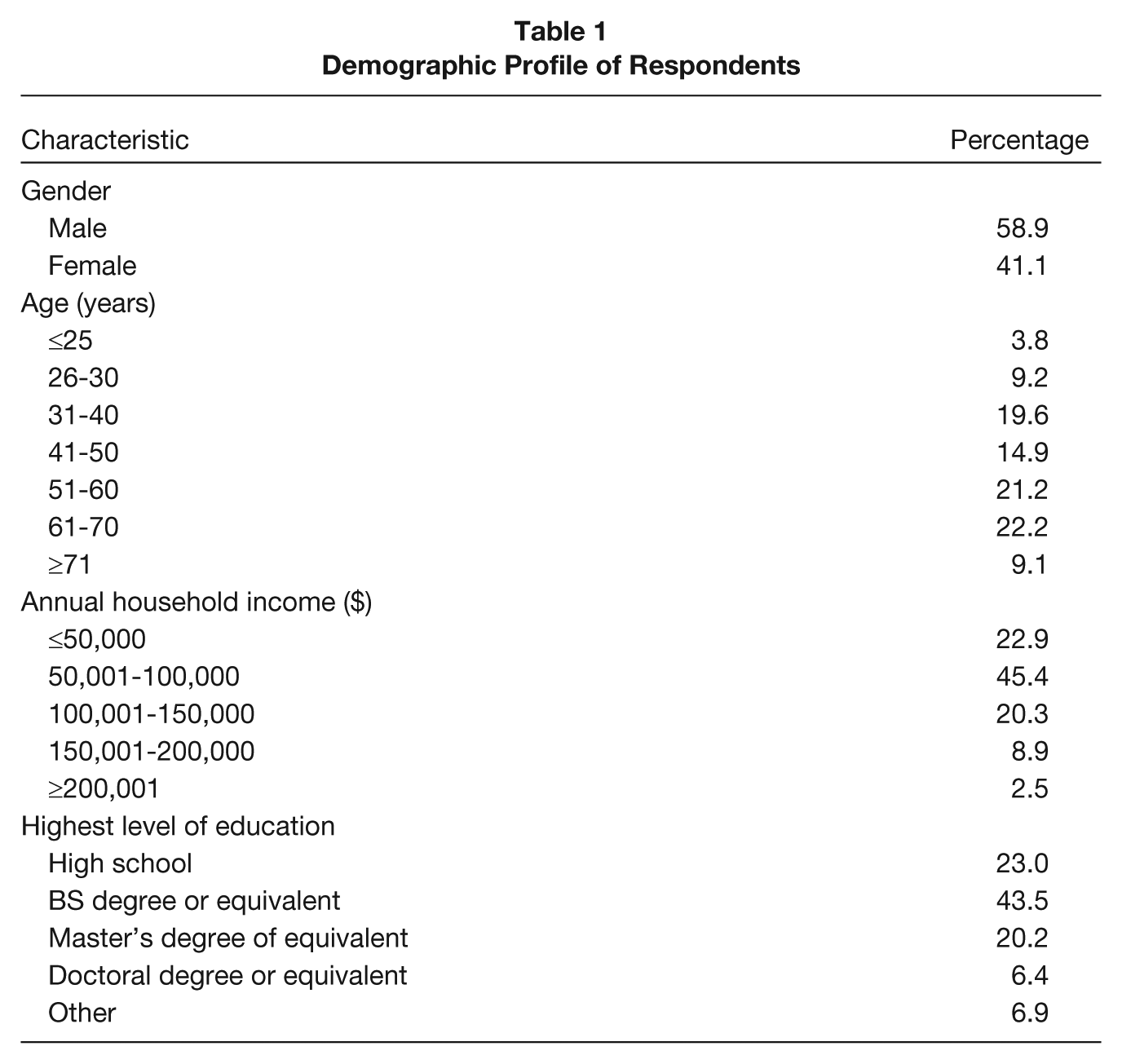
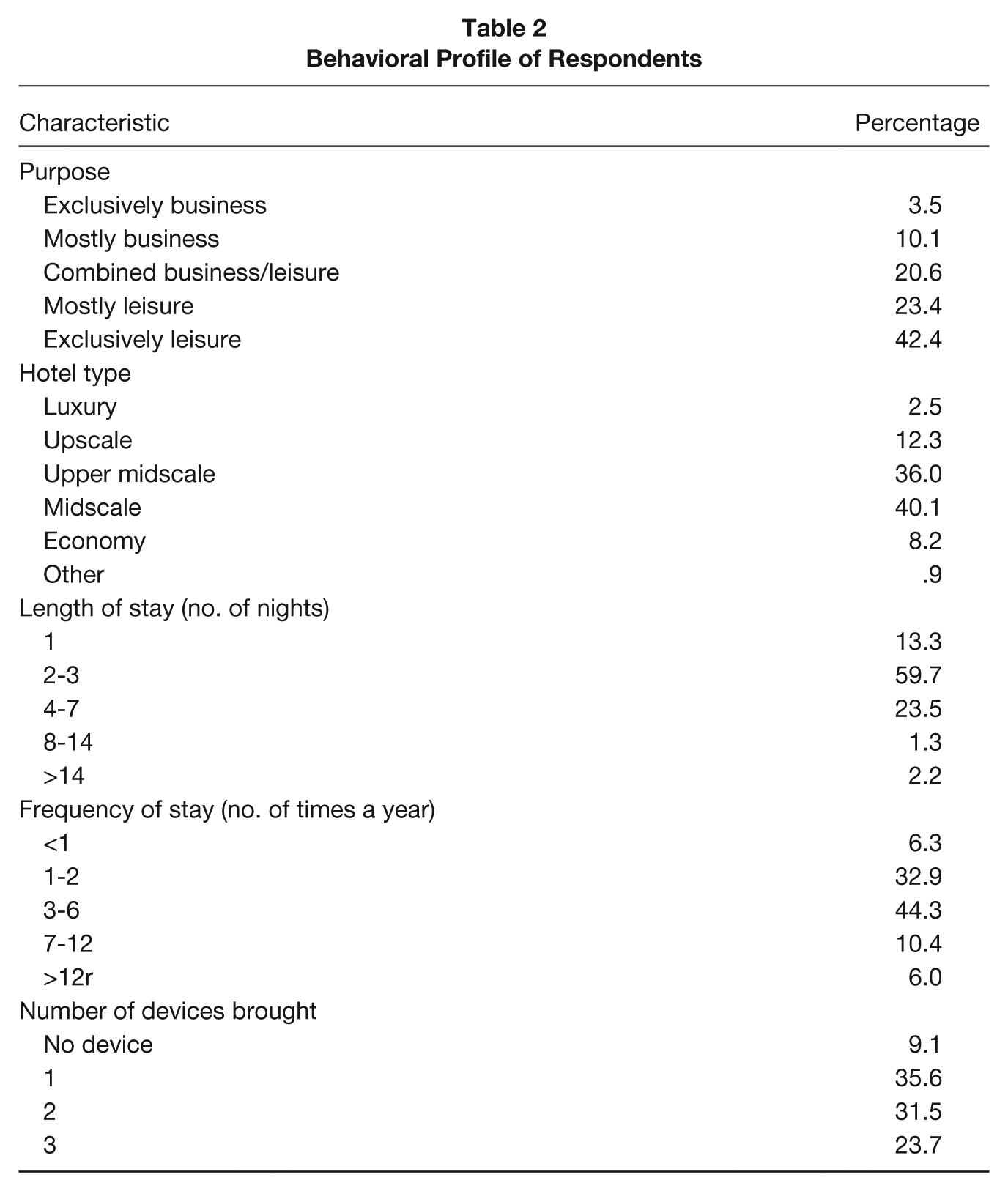
Table 1 illustrates the demographic characteristics of the respondents. Most respondents were male (58.9%) and relatively mature, with most respondents being equally divided throughout the income category spectrum. Most respondents had household incomes relatively higher than the average U.S. values, as 45.4% had incomes between $50,000 and 100,000. Most respondents were also educated, with more than half of them having at least a bachelor’s degree. The behavioral profile of respondents is illustrated in Table 2. Most respondents traveled almost exclusively for leisure (a total of 55.8%) and stayed in upper midscale hotels (36%). Most respondents also had short stays in hotels, as 59.7% of them stayed for 2 to 3 nights, and only 3.5% stayed for more than 8 nights. In terms of their mobile device behavior, almost half of respondents brought at least one mobile device on the property when staying in hotels, whereas about 24% of respondents brought three devices.
Demographic Profile of Respondents
Behavioral Profile of Respondents
Measurement Model Analysis
First, the data set was checked for multivariate normality. Although the analysis indicated that the distribution of each variable used in the model did not depart from univariate normality (West, Finch, & Curran, 1995), checks based on Mardia’s coefficients using Mplus v.5 revealed that the data were not necessarily following a multivariate normal distribution (Mardia, 1970). Thus, subsequent confirmatory factor analysis and structural equation model analyses were conducted using the maximum likelihood estimation and mean-adjusted chi-square tests statistics, which are not sensitive to violations of the assumption of multivariate normality (Muthén & Muthén, 2007). In addition, common method bias was analyzed using a procedure involving loading all items on a single latent factor and assessing fit suggested by Morgan, Kaleka, and Katsikeas (2004), and disconfirmed as a problem in this data set.
The psychometric properties of the measurement model were tested using a confirmatory factor analysis conducted with Mplus v.5 (Muthén & Muthén, 2007). To assess the model’s goodness of fit, a series of absolute and relative indexes were calculated, and compared with recommended benchmarks. The model had a chi-square of 405.01, df = 230 (p < .001), and a normed chi-square of 1.76, and thus indicating good fit (Toh, Lee, & Hu, 2006). Two incremental fit indicators were calculated, namely the comparative fit index (CFI) and the Tucker–Lewis Index (TLI) at .96 and .95 respectively, exceeding the recommended .9 value and thus supporting the good fit of the model (Hair, Black, Babin, & Anderson, 2009). Finally, the root mean square error of approximation (RMSEA) was calculated at .053, and thus situated below the .08 recommended threshold (Browne & Cudeck, 1992). In sum, given the above goodness-of-fit indexes, the model was deemed as fitting properly.
To assess its appropriateness for hypothesis testing, the measurement model was subjected to a test of its psychometric properties, namely reliability, convergent validity, and discriminant validity (Hair et al., 2009; Tables 3 and 4). As a measure of reliability, the composite construct reliability values were calculated for all latent constructs. The lowest value was .833, indicating that the scales had high reliabilities (Hair et al., 2009). The minimum criterion for convergent validity is to have factor loadings for all the items higher than .5 and significant (Hair et al., 2009). The initial confirmatory factor analysis revealed that one of the items measuring need for interaction had a loading lower than .5. As a result, the item was removed from the model, and the model was respecified. On respecification, all items displayed values higher than .5 and were significant, thus demonstrating appropriate convergent validity. In addition, the square multiple correlations (SMC) corresponding to each measurement item were greater than .4, reinforcing the good convergent validity of the model (Hair et al., 2009). Finally, the average variance extracted (AVE) values from each construct were compared with the .5 benchmark, and were found to exceed it (Fornell & Larcker, 1981). Thus, it was concluded that the model had good convergent validity.
Reliability and Validity Analysis
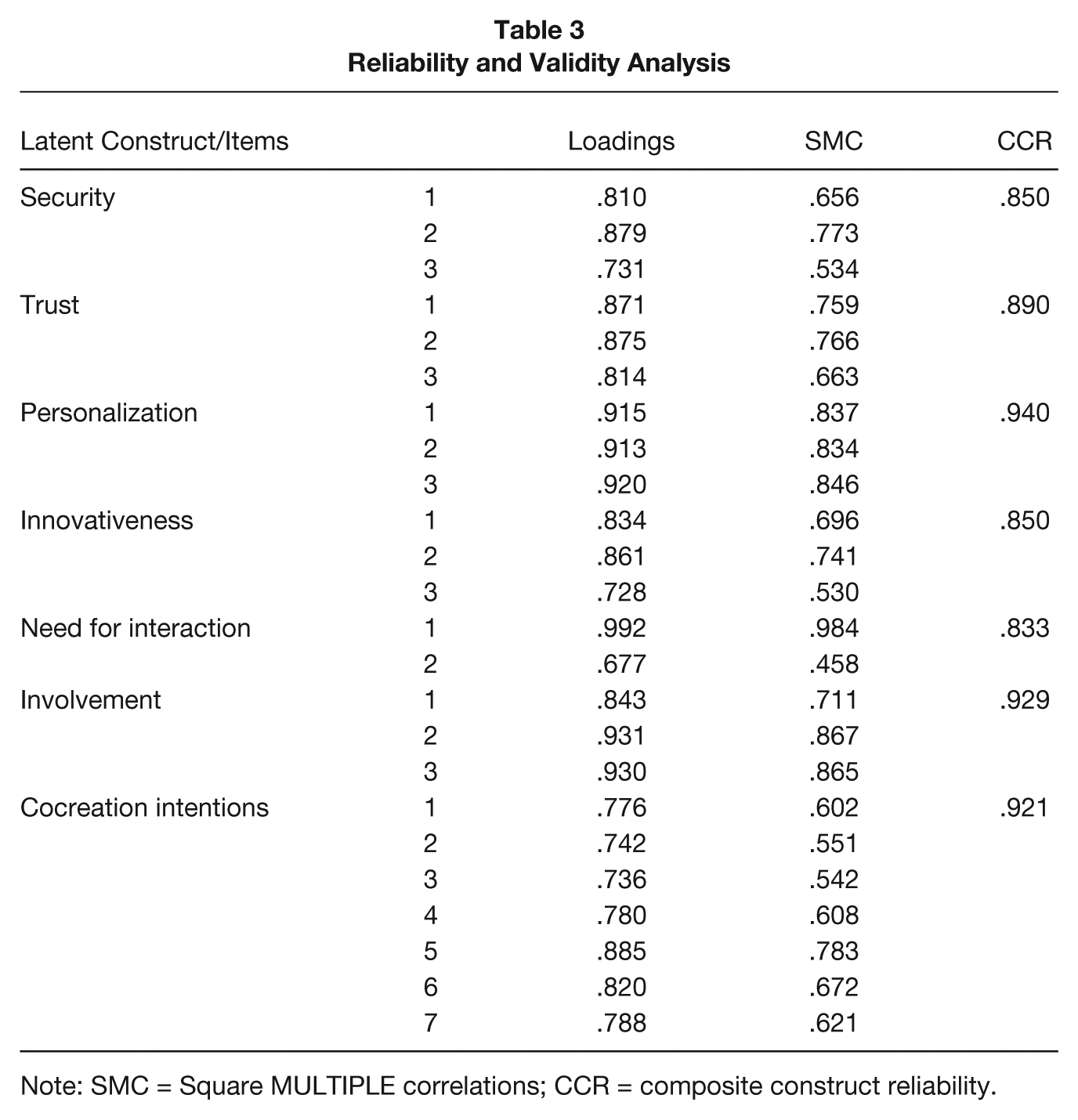
Note: SMC = Square MULTIPLE correlations; CCR = composite construct reliability.
Validity Analysis
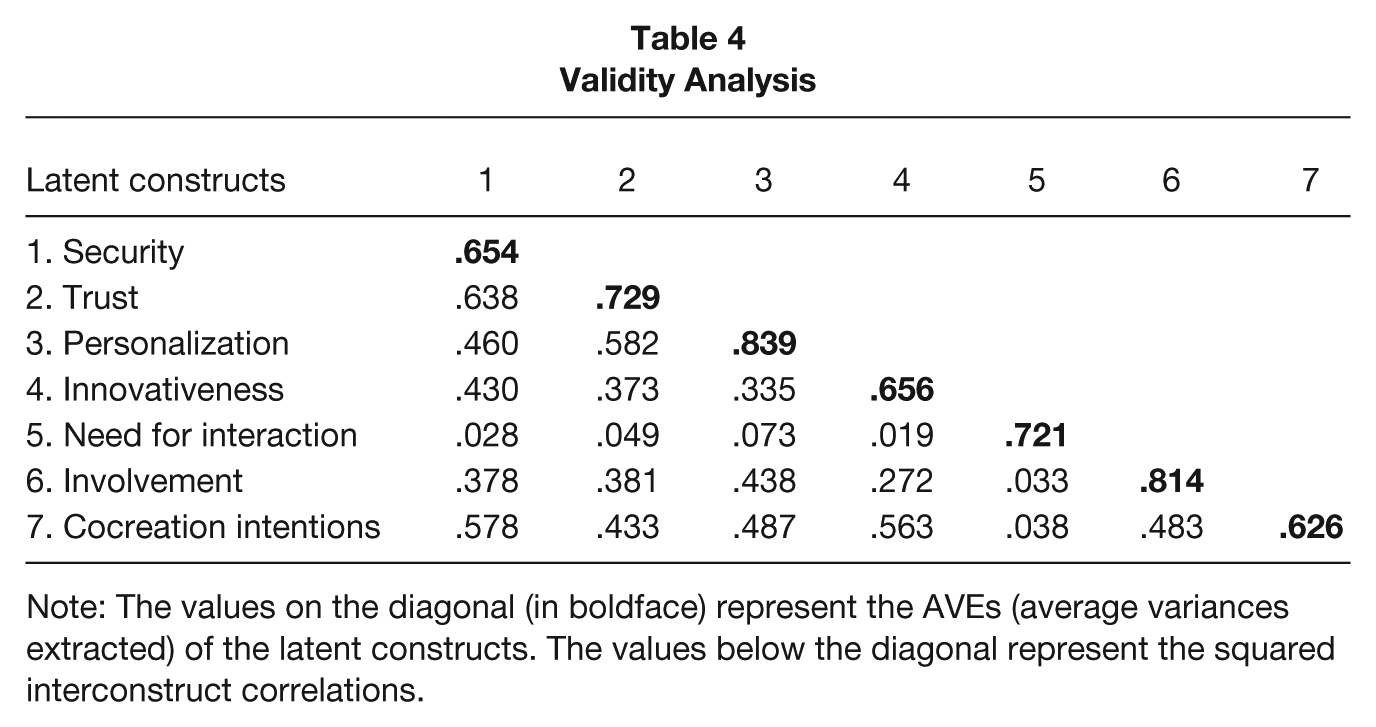
Note: The values on the diagonal (in boldface) represent the AVEs (average variances extracted) of the latent constructs. The values below the diagonal represent the squared interconstruct correlations.
The discriminant validity was assessed by comparing the AVE values to the corresponding squared interconstruct correlations. Table 4 illustrates the AVE values corresponding to each latent construct (on the main diagonal, in bold) and the squared interconstruct correlations (below the diagonal). As all constructs’ AVE values were greater than their corresponding constructs’ squared correlations with all other constructs, it was determined that all constructs had appropriate discriminant validity (Fornell & Larcker, 1981).
Structural Model Analysis
The model was subjected to a goodness-of-fit analysis using the Mplus v.5 package (Figure 2). The model displayed good fit, with a chi-square of 533.56 and df = 239 (p < .001), corresponding to a normed chi-square of 2.23. The CFI, TLI, and RMSEA were computed at .93, .92, and .068, respectively, all being situated within their accepted ranges and, thus, supporting the good fit of the model (Hair et al., 2009). The model validated approximately 52% of the variability of value cocreation intentions, indicating that this model is appropriate for the prediction of hotel guests’ cocreation behavior.
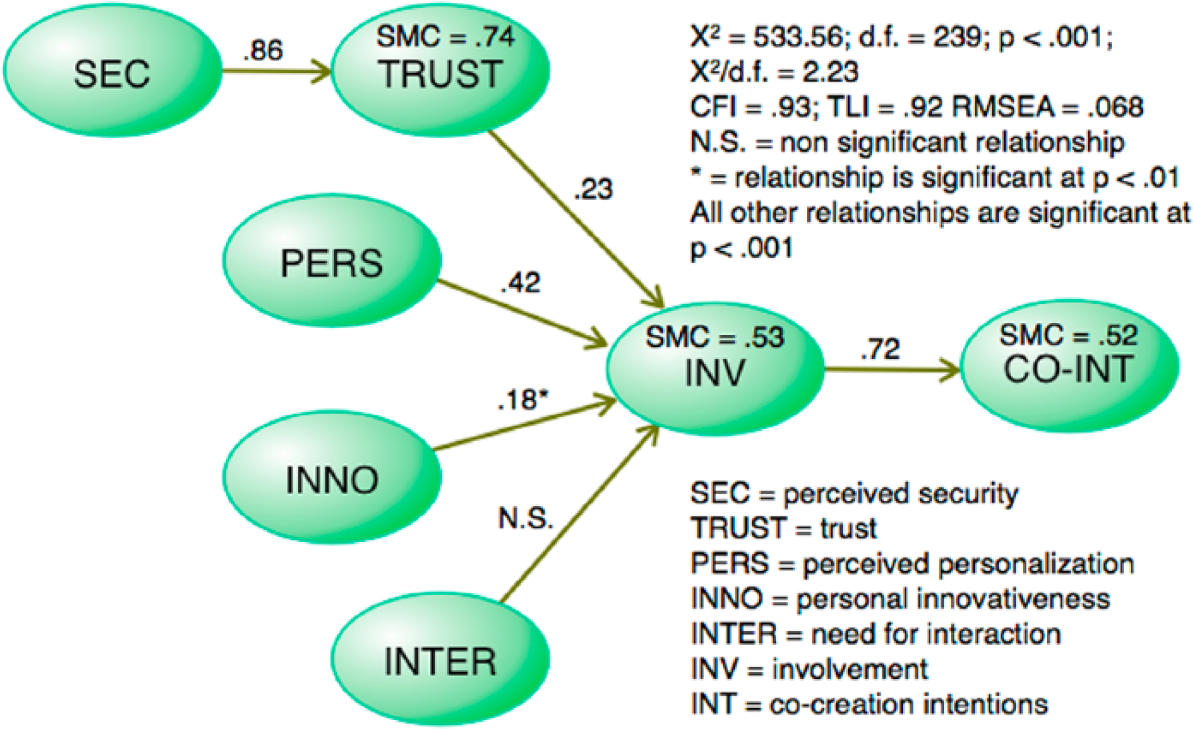
Model Testing Results
The model’s hypotheses were validated in their predicted directions, except for Hypothesis 5, which suggested a relationship between guests’ need for interaction and involvement. Perceived security was found to be a significant predictor of trust (β = .86, p
Discussion
This study set out to examine how guests’ form intentions to cocreate value in the context of m-commerce in hotels. The conceptual model used to test a set of relationships that together explain cocreation intentions was successfully validated, providing evidence that a series of guest perceptions and reflectors of innate characteristics of m-commerce consumption can be used to predict the manner in which guests become involved in value cocreation in highly interactive service ecosystems such as hotels. The validation of this current model extends to m-commerce a fundamental thesis of the SDL, that consumers should be viewed as operant resources in m-commerce as they interact with firms, and the manner in which they integrate operand resources is critical to the success of value cocreation. Moreover, by validating constructs that reflect all four DART dimensions of interactions as antecedents of consumers’ intentions to cocreate value, this study emphasizes that the examination of value cocreation should not divide it conceptually into its constitutive elements, but rather view it holistically through its multiple dimensions.
One critical objective of this study was to examine the role of guest involvement as a central element in cocreation. The relationship between involvement and intentions to cocreate has been validated and found to be strong, which emphasizes the critical role of involvement in the development of cocreative behaviors mediated by mobile devices. It also reinforces the notion that involved guests tend to act as integral parts of the value chain, acting on value propositions initially deployed by hotels, but later codeveloped into hotel stays that aim to be memorable. Moreover, involving guests with direct behavioral consequences signifies that hotel environments fostering cocreation can benefit from developing a culture in which guest behaviors targeting resources commonly integrated by both guests and hotels can lead to value, and further guide stakeholders to superior levels of performance. In turn, such behaviors can eventually be used to drive innovative processes, which could result in novel hotel services, such as sustainable consumption and shared economy. Altogether, this result goes beyond the current SDL literature, as the prior research purporting the role of involvement facilitating cocreation through access and dialog remains to date rather conceptual (Grönroos & Voima, 2013).
Another objective of this study was to examine the role of the antecedents of involvement. The hypothesized predictors (except need for interaction) were validated as significant antecedents of involvement. While the scant literature only validated disparate elements of the full array of antecedents validated in this study, the validation of these relationships simultaneously help extend the theoretical views according to which participation to cocreation reflects (1) the openness of a consumer to move beyond the traditional passive role of receiver of the value proposition (Hutter, Hautz, Fueller, Mueller, & Matzler, 2011) and (2) the capability of the firm–consumer setting (reflected by elements of m-commerce conceptualized in this study) to draw the consumer in the cocreation process (Gebauer et al., 2010). Moreover, the fact that perceived personalization stood out as the strongest predictor of involvement underscores dialog as perhaps the most critical dimension of interactions in the specific context of m-commerce in hotels. Also, the multitude of ways in which personalization can be achieved using mobile devices showcases the role of guests’ talent in finding innovative ways to develop new value from their interactions with hotels. Thus, somewhat surprising, this result attests that in highly experiential service settings where traditional service models and m-commerce ecosystems symbiotically coexist, the core dimensions of cocreation (i.e., DART) are not uniformly converging toward creating unique synergies, but are rather emulating the complex service environment to produce differential effects. Finally, a surprising result was the lack of support for the hypothesized relationship between the need for interaction and involvement, which highlights that consumers’ various levels of attraction toward traditional interactions may not contribute to shaping their cocreation intentions.
Finally, the relationship between perceived security and trust was validated as hypothesized, underscoring the importance of designing a secure system that fosters guests’ engagement with the firm. However, in contrast to the existing literature (McCole et al., 2010; Morosan, 2014), the high magnitude of the effect of security on trust, as well as the high percentage of the variability of trust explained by security (as its sole predictor) was surprising. That is, strong perceptions of security associated with mobile devices used for m-commerce contribute strongly to the development of a platform of trust, which is directly related to the transparency dimension of interactions formative of value cocreation. This finding has unique connotations, as a number of recent electronic security breaches seemed to have affected the trust in the ability of the e-commerce system in hospitality to maintain its integrity. Yet despite the innate perceptions of security attributable to any mobile device, guests would eventually link such perceptions to the corresponding targets of their m-commerce behavior: the direct commercial partner—the hotel, modifying their relative perceptions of trust based on the manner in which they can subjectively assess the security of the commercial setup to which they cocontribute. Furthermore, the strong relationship between security of mobile devices and trust in the business entity also enhances the risk–reward dimension of guest–hotel interactions, leading to value cocreation.
Contributions
This study developed and validated empirically a model that conceptualized value cocreation in hotels using mobile devices. As it contributes to addressing critical gaps in the current literature, this study offers a number of notable theoretical and managerial contributions.
Theoretical Contributions
Overall, this study conceptualized consumers’ involvement with their mobile devices with services, information, and tasks in hotels as the central element in value cocreation and empirically validated a model in which the focal element was involvement. Additionally, this study provided unique insight into the elements of the m-commerce hotel service ecosystem that facilitate guests’ involvement in cocreation. While the quantitative empirical literature in cocreation is scarce in generic service settings (e.g., Edvardsson, Kristensson, Magnusson, & Sundström, 2011) and inexistent in the hospitality literature, this study helps setting up a unique and strong foundation addressing the challenges of conceptualizing and validating empirically cocreation in service settings. Thus, this study contributes to closing the research gap caused by a preponderance of theoretical research not yet empirically validated, and represents a response to the numerous calls from hospitality and mainstream marketing scholars to complement the existing theoretical research by validating it empirically, and thus, to advance the general SDL literature. In addition, by pursuing a quantitative approach in the examination of value cocreation in hotels, this study departed from the current predominantly qualitative approach in studying cocreation in hotels (e.g., Park & Allen, 2013; Shaw et al., 2011) and extended the literature in SDL in hotels.
This study also makes important theoretical contributions to the SDL body of knowledge by examining the antecedents of cocreation. Thus, while the SDL broadens the definition of services, this study represents an initial blueprint for examining the antecedents of cocreation intentions. This study consolidates a critical SDL research theme, which aims at explaining cocreation through the prism of antecedents (Füller et al., 2012), but which does not document studies using antecedents that explain concomitantly the consumption environment and consumer characteristics. For example, by clarifying the role of trust in stimulating consumers’ involvement, this study addresses important calls from SDL scholars according to which trust should be considered an additional dimension to the original DART framework (Randall et al., 2011). In sum, by addressing the lacuna of the lack of research investigating the role of consumer characteristics, this study advances the literature in SDL and general consumer behavior.
Complementarily, this study addressed another important lacuna—that of the lack of research on the role of technology-mediated environments in cocreation. By using specific IS artifacts as antecedents of cocreation, and thus validating the thesis that IS can represent instrumental mechanisms that uniquely facilitate cocreation in service settings (Cabiddu et al., 2013), this study extends the scope of the SDL literature. In addition, by investigating for the first time the development of cocreation behaviors using mobile devices, this study makes a substantial contribution to the current literature in m-commerce, which is poised to become the dominant consumer-facing service ecosystem within the hotel industry. Thus, approaching SDL from the angle of m-commerce, this study addresses a critical shortcoming of the SDL literature—the lack of characterization of the interplay between consumers, firms, and the encounter contexts (Durugbo & Pawar, 2014). As m-commerce is likely to become even more symbiotic with highly experiential service environments, this study represents a useful theoretical base for understanding the mechanisms for value creation in services in which human interaction coexists with self-service technology–based interaction. As m-commerce is increasingly developing in directions congruent with the creativity of users as the ultimate drivers of value, this study also offers a blueprint for understanding the nature of the core relationships that characterize m-commerce, viewed from the angle of consumers’ deployment of interaction talent toward the interactions with the hotels.
Managerial Contributions
In addition to its theoretical contributions, this study offers hotel decision-makers a number of actionable solutions to stimulate and capitalize on value cocreation. First, the validation of trust, perceived personalization, and personal innovativeness as significant antecedents of guest involvement can provide insight into new hotel practices that can result in higher value appropriated by all stakeholders. Specifically, based on information available from their property management and other systems (e.g., wi-fi networks, point of sale), hotels may focus on their innovative guests—those likely to use mobile apps for check-in/checkout, or use electronic resources extensively on the property—and move from simply persuading such guests via promotion to encouraging them to get actively involved in the consumption of their experiences, thus harnessing their talent.
Second, hotels can intensify guests’ level of involvement in (1) breadth, by designing more points of contact with their guests, especially supporting tasks using self-service technology and blending between IS and human-based interactions, thus incentivizing cocreators (e.g., location-based services, personalization of guest-space atmospherics) and (2) depth, by designing deeper levels of interaction, allowing guests to fulfill codesigners roles for their own consumption experiences (e.g., problem solving, gamification, giving certain rewards for completing challenges).
Third, based on the conceptualization of this study in the context of m-commerce, hotel decision-makers can rely on the mobile environment to facilitate the interactions that encourage cocreation. As the mobile environment is expected to play a critical role in the broader e-commerce context, hotels can emphasize the use of mobile devices in interactions that are easily managed by guests, given the familiarity and ease of use of their devices. For example, designing simple interaction interfaces that mimic the familiar logic and layout of the most popular mobile operating systems and application tasks would enhance the ability of consumers to become involved, as little additional learning is required.
Fourth, this study outlines the role of personalization when using mobile devices in hotels. For example, hotels can digitize all aspects of the hotel service experience, unbundle it, use a variety of marketing techniques (e.g., separate and package differently the core experience from the ancillary service experiences), and offer such experiences via mobile apps. Specifically, hotels can involve consumers better in the consumption of ancillary services, which is beneficial to both the guests (by focusing only on the most relevant experiential attributes) and the hotels (increasing cost of distribution relative to core service revenues causing hotels to reorient toward additional revenue streams). Thus, through the cocreation process, guests then can use their own creative talents, their own conceptualization of their needs, and their logic, in integrating resources to repackage and recreate experiences that are relevant to them and can be characterized by value. Moreover, hotels can further develop their mobile apps to offer personalization across the broader travel horizontal, as they can aggregate service experiences that add value to the guest, for example, by allowing guests to obtain mobile boarding passes for airlines using the hotel app.
Limitations and Directions for Further Research
Like all research using self-reported data, this study has a number of limitations. First, the data were collected in the United States and thus it reflects the service culture of the U.S. hotel industry and its corresponding consumer behavior. While the U.S. hotel industry represents an environment founded in rich consumer interactions, where consumers and firms are generally willing to engage, an international perspective will bring to light more complex aspects of value cocreation in hotels. Second, this study reflects the m-commerce context in the United States (e.g., reliable connectivity, rich availability of services, high rate of penetration). Future research could replicate this study internationally, in locations characterized by different penetration rates, m-commerce development, and consumer engagement. Third, while recognizing that value cocreation extends beyond the confines of m-commerce, this study only examined the unique context of m-commerce to keep the operationalization of the m-commerce cocreation mechanisms feasible. Fourth, value cocreation is possible via mobile devices in hotels without guests’ explicit actions. For example, automatic communication between guests’ mobile devices and the hotels’ access points can result in new services being developed by hotels, such as better access to the Internet, better bandwidth and digital entertainment content, and free access to the Internet in lobby. This study has not addressed such issues to limit the list of cocreation intentions to the sphere of consumers’ willing interactions. For example, not all consumers know how to turn on/off location based services on their mobile devices, therefore, they can participate to cocreation unknowingly. Finally, in an effort to represent the general U.S. traveler population, data were collected by using the services of a marketing panel vendor, and may be characterized by self-selection bias or possibly causing unexpected group ratios (e.g., male to female). Therefore, further research should validate the results presented here using replication with different general population samples.
As this study initiates a systematic research agenda that examines value cocreation in hotels using mobile devices, there are abundant opportunities for further research, such as examining value cocreation in the context of social influences or the role of existing pre-cocreation value propositions. As the consumer–firm interactions are dynamic and under continuous evolution, the meaning of value is likely to change as well (Terblanche, 2014). It will be interesting to reexamine value cocreation as the mobile technology evolves into new types of interactions, such as wearable IS connected to the Internet of things.
Conclusions
This study presents a comprehensive view of value cocreation in hotels and confirms that cocreation can emerge from a multitude of permutations and blending of consumer and contextual factors, which are grounded in guests’ perceptions of personalization, but influenced by other perceptions and cognitions. That is, in hotels, in the context of m-commerce, guests could interact with hotels to appropriate superior value, as the resulting personalized consumption experience addresses only the attributes that are valuable to the guests, while disregarding the irrelevant ones. In sum, this study contributed to the extant body of knowledge in value cocreation, m-commerce, and hotel settings by setting up the foundation for a comprehensive conceptualization of cocreated value.
Yet while the hotel service environment is characterized by unique marketing challenges (Morosan, Bowen, & Atwood, 2014), the contributions of this study extend to adjacent sectors of the broader travel system (e.g., tourism, air transportation, foodservice) and other service industries (e.g., education, health care). For example, as IS are increasingly prevalent in facilitating tourists’ interactions (Oliveira & Panyik, 2015), especially when tourists are present at the destination, the mechanisms leading to cocreation that were validated here can be adapted to facilitate cocreation at the destination. For example, using virtual reality, location-based services, encouraging user-generated content, tourist consumption can become more interactive and higher in value. Also, in the air transportation services, IS-based cocreation facilitated by personalization, trust, and innovativeness can increase consumers’ involvement not only with the airline carrier (e.g., by facilitating cocreating value via ancillary services) but also with the other actors of the value chain (e.g., security and border control agencies by participation in trusted traveler programs).
Interestingly, although not studied to date from an SDL angle, foodservice allows IS-based cocreation mechanisms that can be fruitful in the appropriation of value by various stakeholders. Such approaches might include, for example using mobile technologies and use more interactive and information-rich electronic menus, which could represent the starting points for personalized interactions leading to product/experiences that are high in value. Similarly, other service industries can also adapt the framework presented here, as it outlines the antecedents of involvement and intentions to cocreate. Specifically, if starting from understanding the consumers via technology (e.g., different learning styles of students; various treatment and lifestyle decision choices of health care consumers) and allowing for e-/m-commerce ecosystems to safely facilitate consumer–organization interactions, both organizations and consumers can facilitate the development of a service environment high in value.
Footnotes
Appendix
Acknowledgements
The author gratefully acknowledges insightful comments and suggestions in the development of this article from Dr. Agnes DeFranco and Frank Wolfe. This research has been conducted with the support of Hospitality Financial and Technology Professionals (HFTP).