



Abstract
Entertainment is a feature of some tourism settings and acts as a key pull factor for visiting certain destinations. Research-based studies about entertainment and the tourist experience are, however, rather limited. This study pursued this research opportunity and explored international tourists’ experiences in an iconic performance-based entertainment, the Impression Sanjie Liu in southern China. More than 350 tourists’ spontaneous reviews posted on TripAdvisor were analyzed through Leximancer software. It was found that international tourists were generally positive toward the culturally distinctive style of the entertainment. Despite the challenge of comprehending meanings and the language, they were impressed with the grand spectacle, the performances of many people, and the context. The disruptive behavior of other tourists, particularly the domestic Chinese tourists, troubled some international tourists. Implications for both academic research and the tourism entertainment industry are offered.
The context for this study lies at the intersection of several key tourism research topics. In part, the work is concerned with the assessment of tourist attractions which in themselves have been depicted as core to the tourism system and of substantial interest to consumers, managers, and destination marketers (Prebensen, 2012; Prideaux, 2003; Swarbrooke, 1999). The study also addresses several issues in tourist consumer research, notably how to access and interpret the everyday voices and concerns of those who visit attractions (Morgan, Lugosi, & Ritchie, 2010). In this vein of work the use of the online ratings and commentary systems is of special interest for studying tourists’ feedback on facilities. A further theme which lays the contextual foundation for this study is an interest in one kind of tourist attraction: the staging of live outdoor performances.
The broad issue of assessing satisfaction at tourist attractions has been the subject of several reviews and meta-analyses (Pearce & Benckendorff, 2006; Prebensen, 2012). The analysis of the effectiveness of tourist performances and their production; however, are currently not major research areas in either the entertainment or the tourism literature. In his review of all types of entertainment, Moss (2009) pays very little attention to tourism-based performances and shows. There are only a few focused studies of tourism-linked entertainment venues and experiences (Balme, 1998; Ryan & Collins, 2008; Ung & Vong, 2010). The topic area of cultural tourism does emphasize community and social attractions of interest to visitors such as museums, art galleries, festivals and special events, and theatre shows (McKercher & Cross, 2002). Nevertheless, while tourists attend such events with enthusiasm, the work in this area does not provide a body of knowledge about the audience’s perspective on the larger scale performances which are specifically staged and set up for tourism (Pearce, 2012a).
The present study seeks to identify the perspectives of international tourists toward this culturally specialized form of entertainment—the large-scale outdoor performance embodying local stories and traditions. China’s iconic Impression Sanjie Liu show was selected as the case study. The Chinese site was specifically chosen for three reasons. First, as a country China is now one of the four most popular destinations in the world: Despite its short 32-year history of being open to the world, 55.7 million visitors arrived in 2013 (United Nations World Tourism Organization, 2014). The reactions of so many tourists clearly matter both to the tourists themselves and to the businesses and communities they visit. Nevertheless, there are limited research-based studies of international tourists’ responses to the country’s attractions (Leung, Li, Fong, Law, & Lo, 2014; Wu, Wall, & Pearce, 2014; Zhang, Pine, & Zhang, 2000). Second, the particular site considered, the Impression Sanjie Liu show in Yangshuo County, Guilin, is iconic and representative. It is, without any doubt, the most publicized and visited landscape performance in China. Impression Sanjie Liu has received more than 10 million visitors, including two million international tourists (Chinanet, 2014). It has become a model for other cultural performances shows and attractions. Third, through understanding international tourists’ reactions to this significant site it may be possible to better assess the preferences and concerns of the growing number of international tourists to other Asian sites and attractions. Expressed succinctly, in focusing on one iconic tourism performance attraction in China, the research adopts the perspective that the judicious selection of a key case study can provide information beyond the individual attraction and be applicable to many analogous situations (Flyvbjerg, 2006; Yin, 2009).
Literature Review: Entertainment and the Tourist Experience
The meaning of the term entertainment is captured by the Latin roots of the term; literally, enter—among and tenere—hold together (Moss, 2009). A central feature of this activity of holding the interests and attention of a group of people lies in the usually passive nature of the audience. It is performers who do nearly all the work and although cocreation of the experience may occasionally occur, such as when members of the audience briefly join the cast on stage for a specific activity, the role of the tourist crowds is usually simply to watch and hopefully appreciate the shows (Bryman, 2004). The present interest in entertainment lies in the nature of the experiences reported by international tourists to culturally specialized tourism performances.
At a superficial level, the concept of the experience economy provides a ready conceptual home for tourism and entertainment studies. Most writing discussing the experience economy begins with the work of Pine and Gilmore (1999) and juxtaposes the work of these North American authors with that of German thinkers such as Schulze (1995). For the present purposes, we can consider the experience economy as serving the needs of people who wish to collect experiences over time and share and reflect on those experiences with others (Morgan et al., 2010; Ryan, 2010). The experience economy studies are rooted in business research and to some extent were preceded by parallel interests in tourism and leisure studies as reported in the early work of Krippendorf (1987) and Ryan (1997).
It is challenging, however, to extract conceptual value and insights for the assessment of tourism performances and entertainment using the ideas about experience. The work of Pine and Gilmore, and particularly the underlying dimensions they use to categorize types of experience (educational, aesthetic, escapist, and entertainment itself) have been criticized as intuitive and problematic rather than reliably independent and empirically based (McCabe, 2014). It is increasingly being appreciated by a diversity of tourism researchers that there are multiple ways to approach the concept of experience and, by default, the experience economy and tourism performances. There are philosophical positions, sociological summaries and appraisals, and work built on psychological roots (Cohen, 1979; Csikszentmihalyi, 1997; Cutler & Carmichael, 2010; Gnoth & Matteuci, 2014). All the approaches face common issues in how to measure experience, although axiomatically those with a sociological and philosophical orientation are generally more concerned with building sound models which respect previous scholarly traditions rather than directly accessing the thoughts, minds, and accounts of tourists.
The core problem of assessing experiences can be linked to the distinction between emic and etic approaches to research. The etic perspective offers a catalog of factors or dimensions about experience from the point of view of an external observer, usually the researcher (cf. Pike, 1966). In contrast, the emic perspective considers the views of the actual participants and seeks to give them a voice through eliciting their direct views of the tourism situation under investigation. Armed with these two approaches to assessing the qualities and nature of the experience at tourism performances, it is instructive to explore the styles of work which have been conducted in this interest area of the international perspectives on purpose-built tourism performances. Initially two studies stand out in the field.
Ryan and Collins (2008) consider the way one international tourist show in Japan—the Eastern Odyssey performance at the theme park Huis Ten Bosch in Sasebo, Japan—operates across cultural boundaries. The researchers offer some powerful insights about the performance, noting with particular clarity that the audience will bring their own cultural frames and analogous experiences of myths and narratives to interpret the culturally different story lines. They note that several features of the show, the hero and heroine, the comic sidekick, the man in black are interwoven into older Japanese traditions of ritualized performance styles. The nuances linking the older Japanese traditions with contemporary and traditional Western myths may be intentional or may simply exist in the well-furnished minds of some of the audience members, but the success of the performance also works at the level of sheer spectacle with its color and the technology of a concluding laser light show. Ryan and Collins (2008) suggest:
If we are to understand the performance of tourism, and the collectivity of individualistic experiences on the part of an audience, then it becomes necessary to conceive of tourism and production on the premise of things in action within the minds of the participants. (p. 148)
In another study of Western tourists at an Asian site, Saipradist and Staiff (2008) raise similar questions of what meanings non-Asian, non-Buddhist visitors extract from the temples and ritual performances at the world heritage site of Ayutthaya in Thailand. They suggest that the on-site explanations are problematic and that such locations need to rely on the visual and sensory qualities of the experience to promote engagement. Meaning and full understanding of the cultural and spiritual storylines and values may function as secondary considerations compared with the immersion in the color, spectacle, and atmosphere of the attraction space. It is notable that the study by Ryan and Collins and the work of Saipradist and Staiff both use the researchers’ own experiences and analyses of the situation. That is, they adopt etic views, albeit thoughtful, considered and analytical ones, rather than directly assessing the emic-based reactions of other tourists. The opportunity to enrich these key studies through accessing the direct responses of the audience is a powerful direction for the present research.
The key studies in this area have been described as occurring in Japan and Thailand. There are already studies in China of the rich tradition of cultural performances, embracing but not exclusively focused on studies conducted at Impression Sanjie Liu (Song & Cheung, 2010, 2012). In this cumulative set of studies the authors use focus groups and bibliometric analysis to generate a list of overall success factors for the performances. They distinguish between internal factors and external factors; the former consists of storyline and performing, market positioning and marketing strategy, investment and financial support, operation and management, performing team, outdoor venue, indoor and or outdoor stage supporting facilities, continuous improvement and production time. The external factors are presented as collaboration between cultural industries and local tourism, government support, privatization, and social and cultural effect. This existing work provides a broad evaluative framework for assessing the case in question but does not address the specific problems of the international tourists’ responses to these performances as seen by the tourists themselves.
From the above review, it is appropriate to suggest that the knowledge about tourism entertainment is limited. At the broad level there has been relative inattention to the experience of international tourists in visiting key entertainment sites, though entertainment is recognized as a key motive (Wong & Rosenbaum, 2012). As a part of this inattention, a second issue of neglect is the particular topic of large-scale cultural performance–based entertainment which is widely available and often promoted by local destinations as a key attraction. Some analogous studies have been conducted in key Asian locations (Ryan & Collins, 2008; Saipradist & Staiff, 2008; Song & Cheung, 2010, 2012; Ung & Vong, 2010), and they are helpful in enhancing our understanding of the nature of these entertainment offerings, their cross-cultural interpretation challenges, and the overall production and management issues. International tourists, however, have never been specifically considered as the research respondents, and their reactions to these cultural performances have not been analyzed in detail. Finally and importantly, the specific approach of generating perspectives from international tourists’ own voices, effectively implementing an emic study, offers a new pathway to help understand the issues of appreciation and meaning across the cultural divide which different languages and backgrounds generate.
Following the research opportunities identified above, the broad research aim of the current study is to explore international tourists’ experiences of the Impression Sanjie Liu show, one of the most popular entertainment-oriented performance attractions in China. The reviews posted on TripAdvisor function as the emic information inputs for this study. More specifically, as a first aim this study seeks to identify the international tourists’ overall representations of their Impression show experience. The second aim examines how the tourists’ individual and background factors influence their impressions of Impression Sanjie Liu. An associated and broader goal of the work is to identify issues and concerns of generic interest from the specific analysis of this leading tourist performance.
Research Context and Method
Research Context: The Magnificent Show Impression Sanjie Liu
Impression Sanjie Liu is a landscape performance created by the well-known Chinese movie director Zhang Yimou and his team, who also directed the opening and closing ceremonies at the 2008 Beijing Olympics. It is hosted in Yangshuo County, Guilin City, China. The region of Guilin is well known for its mountains and rivers and is considered as a must-visit destination by many international tourists.
The storyline of the show focuses on Sanjie Liu, who is the singing goddess in the legend of the Zhuang people, an ethnic group in China. Sanjie Liu and her hometown have become well known since a classic and popular music film named after her was produced in 1961 (Impression Sanjie Liu, 2014). Impression Sanjie Liu is not a conventional stage show. Rather, it is performed in a superb natural theatre, with 1,654 square meters of the River Li as its stage, with the sky and the 12 mountain peaks along the water’s edge as its backdrop.
The show lasts approximately 70 minutes combining the classical Sanjie Liu’s folk songs and traditional fishing culture themes. The work emphasizes the harmony between human beings and nature. It is a large-scale light-and-sound show with 600 plus actors and actresses involved. Most of these performers are local farmers and fishermen. They each manipulate a light suit or maneuver long bolts of fabric and huge spotlights to create visual effects that one might expect on a computerized screen but not in real life (see the sensory details at https://www.youtube.com/watch?v=5LgYI4aB7Bo). Figure 1 presents the location information, as well as some representative images.

Impression Sanjie Liu: Location and Typical Images
In summary, the performance of Impression Sanjie Liu expresses the beautiful scenery of the Li River, the colorful culture of the ethnic groups in Guangxi, and the rich imagination of the excellent artists in China. Without doubt, it is the most visited entertainment show of its type in China. The show opened to tourists in early 2004. It was so popular that the capacity has been increased from 1,800 seats to 3,700 seats. There are five types of tickets and prices, depending on the location and comfort of the seats. It offers two sets of shows during the peak season (summer), and one during the low season. By early 2014, the show had been performed more than 4,500 times.
Data Collection: TripAdvisor Reviews
The spontaneous English reviews from TripAdvisor provide the data for the current study. Reviews and other naturally occurring materials, including online user-generated content, offer valuable insights about customers (Banyai & Glover, 2012; Leung, Law, van Hoof, & Buhalis, 2013; Pearce, 2012b). The strengths of such material include coverage of all aspects of the experience (Pekar & Ou, 2008), spontaneity (Lu & Stepchenkova, 2012), ecological validity (Kazeminia, Del Chiappa, & Jafari, 2015), the real voices of customers (Zeng & Gerritsen, 2014), low cost and efficiencies in data collection (Kozinets, 2010), and not unimportantly, the ability to exert a powerful influence on other potential tourists (Wu & Pearce, 2014).
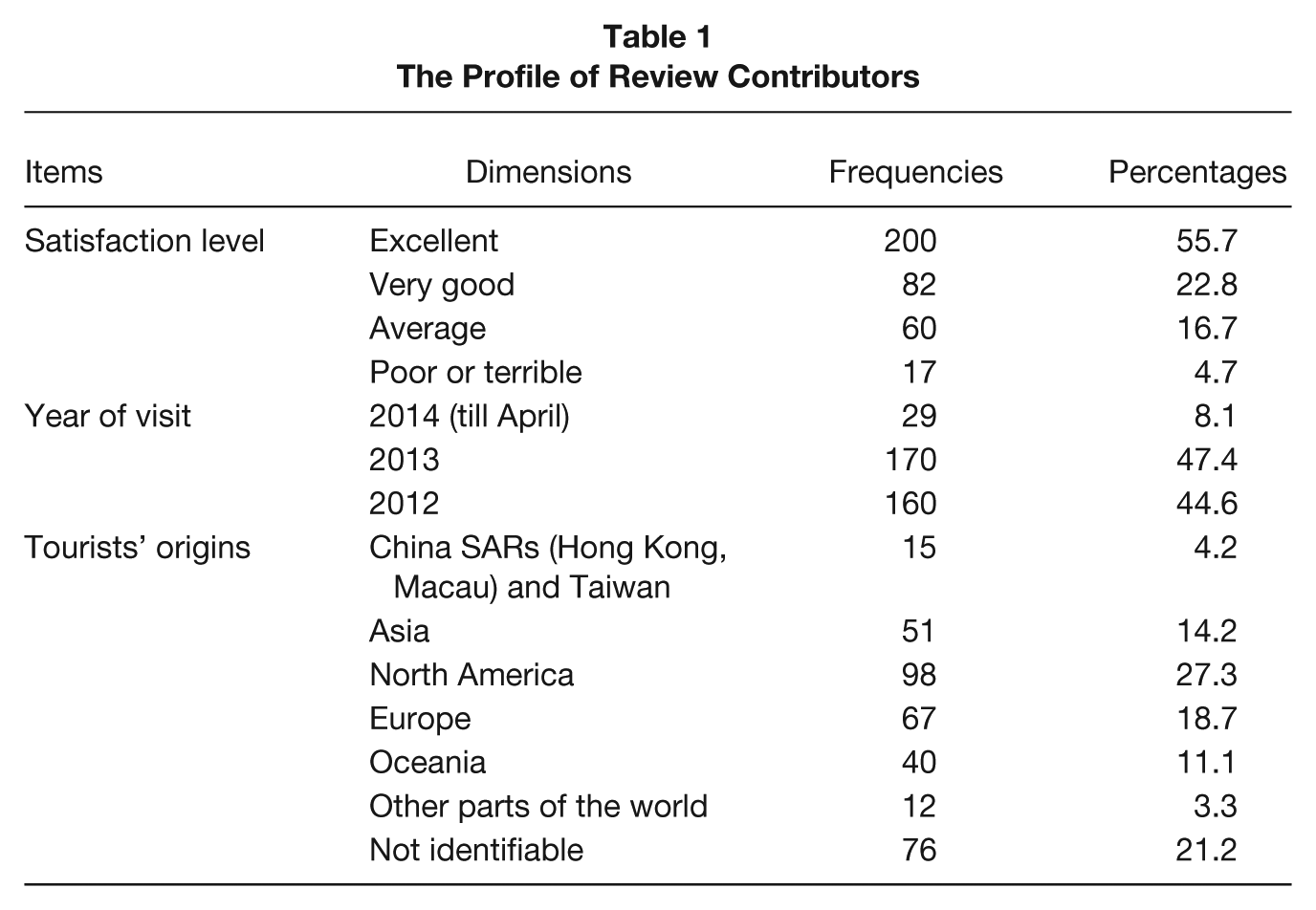
This study chose TripAdvisor as the site among the various review sites (e.g., Google review, Lonely Planet, and VirtualTourist), because of its high use. On April 7, 2014, there were 573 reviews about the Impression Sanjie Liu in various languages. Three hundred and fifty-nine reviews in English, which had been posted after the year 2012, were selected and coded. During the coding process, the origins of the reviewers, the year of the review, their rating score, the title of the review, and the contents of review were all recorded in different columns in an excel document. Table 1 presents the basic information about the reviews under consideration.
The Profile of Review Contributors
Data Analysis Through Leximancer
As a way of accessing the information embedded in the 359 reviews, a relatively new computer-assisted qualitative analysis software, Leximancer (Version 4), was used to analyze the data. Compared with the traditional manual coding scheme, the value of using Leximancer can be summarized under three key headings. First, the technique allowed for the treatment of large amounts of textual data in an efficient way (in this case, 359 reviews, 173,457 words). Second, there were no preexisting assumptions about the meaning of the terms in the Leximancer approach to the data. The program simply searched for the frequency of text linkages, a process which is standardized and without recourse to a researcher-driven view of the material. Third, the Leximancer procedure added a discovery role to processing the textual information. The outcomes from the program thus effectively offered new ways of looking at the data which the researchers could contemplate and which may not have been seen or inductively appreciated when working in a manual coding style. Considered together these three strengths of the Leximancer approach assisted the researchers in dealing with qualitative and user-generated data in an insightful and fresh way, while fulfilling the criteria offered by DeCrop (2004) and others to be transparent and trustworthy in managing the material.
Technically, Leximancer can conduct both the thematic and semantic analysis. Common tasks researchers can perform through using Leximancer include determining the main topics within a text, highlighting how topics relate to each other, and indicating which source files (or individual authors/speakers) contain particular topics (Angus, Rintel, & Wiles 2013). It has been used in 1,050 publications (till January 2015, see http://info.leximancer.com/) and in various areas of social science research, including tourism (Kazeminia et al., 2015; Scott & Smith, 2005; Wu et al., 2014).
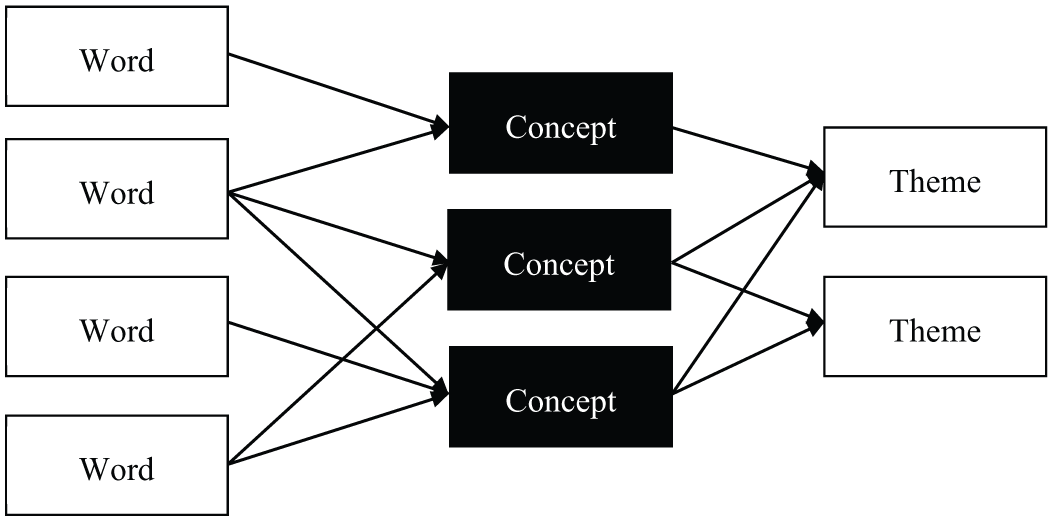
Leximancer (2011) is designed to analyze the text “from words to meaning to insight.” In essence, it uses a quantitative approach to conduct qualitative analysis. It takes word frequency and co-occurrence counts as data (Leximancer, 2011). Specifically, it produces a concept co-occurrence matrix based on the frequency data and the co-occurrence of words. Once a concept is produced, the software identifies a thesaurus of words that are closely related to the concept, thereby generating semantic or definitional content around the concept (Rooney, 2005). Leximancer then groups the concepts into themes based on how often they appear together in a block of text. Figure 2 summarizes the semantic pattern extraction process and also illustrates the three most important units in Leximancer analysis: word, concept, and theme.
Simplified Model of Semantic Pattern Extraction in Leximancer
The final output of the software is a conceptual map which provides a bird’s eye view of the material, representing the main concepts contained within the text as well as information about how they are related (Leximancer, 2011). In the Leximancer concept maps, the concepts are shown as small gray nodes. They are grouped into themes, as indicated by the larger colored circles (see examples in Figures 3 and 4 in the “Research Results” section). The relative position of the circles and dots, as well as their distance from each other, demonstrates the strength of the semantic links among those concepts in the text. It is, however, worth noting that the size of the colored circles do not suggest the importance of the theme. Rather, the color matters, because the themes are heat-mapped to indicate importance. This means that the “hottest” or most important theme appears in red, and the next hottest in orange, and so on (Leximancer, 2011).

International Tourists’ Overall Representation of the Impression Show Experience
Customers’ Representations of the Impression Experience: Different Satisfaction Groups
Research Results
International Tourists’ Impression Show Experience: Key Concepts
Forty-seven concepts, including 3 name-like and 44 word-like concepts, were identified by the Leximancer program at the first stage as being presented in the reviews. Not all of these concepts are reported in the subsequent results, because it is necessary to fine tune the major concept list (Crofts & Bisman, 2010). This adjustment process was not conducted arbitrarily but, rather, was based on co-occurrence frequency as well as a careful assessment of the meaning of the identified concepts. Concepts that were simply destination labels (e.g., China, Yangshuo) were not considered as meaningful for our purposes of assessing tourists’ experience. Similarly, some descriptive words about the time of the performance (e.g., during, take, time, minutes, hour, area, opening), or that suggest misleading meanings (e.g., miss, which mostly means not miss), were deemed to be unhelpful in addressing the research questions. Also some similar concepts were merged (e.g., light and lights). The concepts filtering process was conducted with great caution by checking the exact meaning of each identified concept. For example, “opening” emerged as a concept, but we found that “opening” was always connected with the Beijing Olympic Games, because many tourists introduced the show by indicating that the impression show was organized by Zhang Yi Mou who directed the opening ceremony of the Beijing Olympics. Finally, 36 concepts were kept for further analysis (see Table 2).
Leximancer Concept Frequencies

International Tourists’ Overall Experience With the Impression Show: Key Themes
Figure 3 presents the most common themes and all the 36 concepts listed in Table 2, as well as the frequency of their occurrences and co-occurrences. In detail, “light,” “fantastic,” “performance,” “seats,” “people,” and “impressive” were identified as six dominant themes representing international tourists’ entertainment experiences during the impression show in Yangshuo, China. The connectivity rate for these six themes were 100%, 70%, 35%, 29%, 27%, and 5% respectively. In Leximancer, the connectivity score indicates the relative importance of the themes, with the most important one at 100%.
“Light” is the strongest theme in the narratives of international tourists who watched this show. This single word was mentioned 111 times in the 359 reviews. It describes the general characteristics of the show—a “fantastic” “light” show by “performers” from local villages with the “river” and “mountains” as its “backdrop.” There were multiple reviews capturing this theme of an “awesome light and sound show.” A gentleman from New Zealand observed,
I enjoyed this experience. The mountain peak backdrop was spectacular. The show itself was fantastic to watch. The lighting was excellent. They showcased all four ethnic groups with singing and performances on the river and platforms.
“Fantastic” emerged as an important theme during the tourists’ impression show experience. It defined the overall evaluation of the show. Tourists were impressed with the “fantastic” “experience,” especially the “setting,” the “singing,” and the “music,” even though they cannot fully “understand” the “Chinese” “story.” An American tourist stated,
Most of us might be hard pressed to describe the Sanjie Liu Show for someone who is not of Chinese ancestry. Despite this hardship, simply attend this fantastic extravaganza and be prepared to be amazed and delighted. . . . The scale of the action is overwhelmingly large and the performance is magnificently choreographed. What a spectacular performance! It is truly one of a kind.
“Performance” is the third largest theme. This theme was highly connected with the earlier theme “fantastic” (see the considerable intersections in Figure 3). It was generally about how they “enjoyed” the “fantastic”/“spectacular” “evening”/“night” “performance,” and their value judgment (“worth”). Some typical reviews concerning the assessment of the performance were
I’m not usually into song and dance entertainment but this show was absolutely magnificent: in essence a “son et lumiere” performance . . . but EXTREME. It showcases traditional local culture. Although I didn’t shed tears this time, I still enjoyed it. I admit that there was simply no storyline in the whole performance, yet I would say watching the jaw-dropping visual effect alone worth every dollar and minute you have spent.
The provision and comfort level of physical facilities can greatly influence tourists’ experience. In this study, “seats” emerged as a theme in the spontaneous narratives. “Seats” was picked up 108 times in the total of the 359 reviews. There are different levels of seats available for the impression show, with different “tickets” price. The price for different seats, the tour guide’s interpretation, and different views and facilities, work together to influence tourists’ final choice. Comparisons about the choices were common. A British lady thought highly of show as “best show ever,” commented,
I have seen shows in Vegas, NY and other places but I have never seen anything so amazing! . . . We had seats in an upper box—much more comfortable than the hard plastic seats below. Field glasses were provided so we could see close-ups of the action. . . .
Meanwhile, there are also tourists happy with the seats in the lower section. For example, a Canadian gentleman observed, “Brilliant! My favourite night in China. The cheaper seats were ok. They seem to be closer to the “stage” but alas, don’t have a back rest!”
The fifth largest theme is “people,” which is controversial. On one hand, tourists were impressed that this magnificent show was performed by “local” “people,” mostly farmers and fishermen from the area. Typical reviews include,
This is a spectacular show and very well performed by many, many of the local people. Don’t be misled by that; it was certainly done in a very professional manner. I absolutely loved it, in part because of the traditional Chinese imagery and music against the fantastic karst mountain scenery, and in part because it’s excellent that someone has choreographed the local villagers to take part in this—ordinary fisherman, women and children—to very moving effect.
In contrast, some international tourists were upset with the Chinese domestic tourists’ impolite behavior; for example, being late, talking loudly during the show, blocking other tourists’ views, using cameras/phones/iPads too much, and not appreciating the performers. A tourist who rated her or his experience as “excellent” observed,
So much better than expected. The sound was excellent, especially given the outdoor venue. The light show was incredible. The performers, 600 of them, were fabulous. . . . We did get annoyed at the locals talking quite loudly in their groups during the performance but we had only been in China for a week and after 4 weeks, we came to accept the differences between the Chinese and Australian ways!
The response of feeling annoyed by the behavior of others was not an isolated observation by the Australian lady. There are 47 more reviews, commenting positively on the show while also criticizing the Chinese tourists’ on-site behavior. Typical reviews include,
You get into a huge natural amphitheatre of the water with the mountains around, which is a Wow! . . . We were surprised by the lack of applause, and by the Chinese getting up and leaving before the end. Were they bored, or did they want to get out before the rush? Who knows, but don’t let it put you off! This is not just light and sound . . . My only disappointment was the crowd of people yapping throughout the show then leaving early as you are trying to enjoy this magnificent show.
The last theme is “impressive,” which is closely linked with the “light,” the “fantastic” show, and the overall experience. It was picked up sufficiently often (50 times in the 359 reviews) that it became an independent theme. It was usually stated simply as in the following:
. . . It is like nothing we have ever previously seen and brings a smile every time we recall the various acts, all different, but all extremely impressive.
The findings show that, at an overall level, international tourists enjoy the impression show a great deal, due to the fabulous lighting effects, music and singing, the natural landscape as the stage, and the involvement of 600 local farmers and fishermen as performers. Negative comments do exist. The most prominent of the less positive remarks focused on the manners of the domestic Chinese tourists. Some international tourists were annoyed at the behaviors they witnessed.
A Satisfaction Level Analysis of the Impression Show
In this section, the relationships among the characteristics of the tourists and their experience of the performance were examined. One-way analysis of variance did not support for the influence of the tourists’ origins on their impression show experience. Additionally, tourists visiting from different years were not found to vary in their satisfaction levels. These results were supported in the Leximancer analysis.
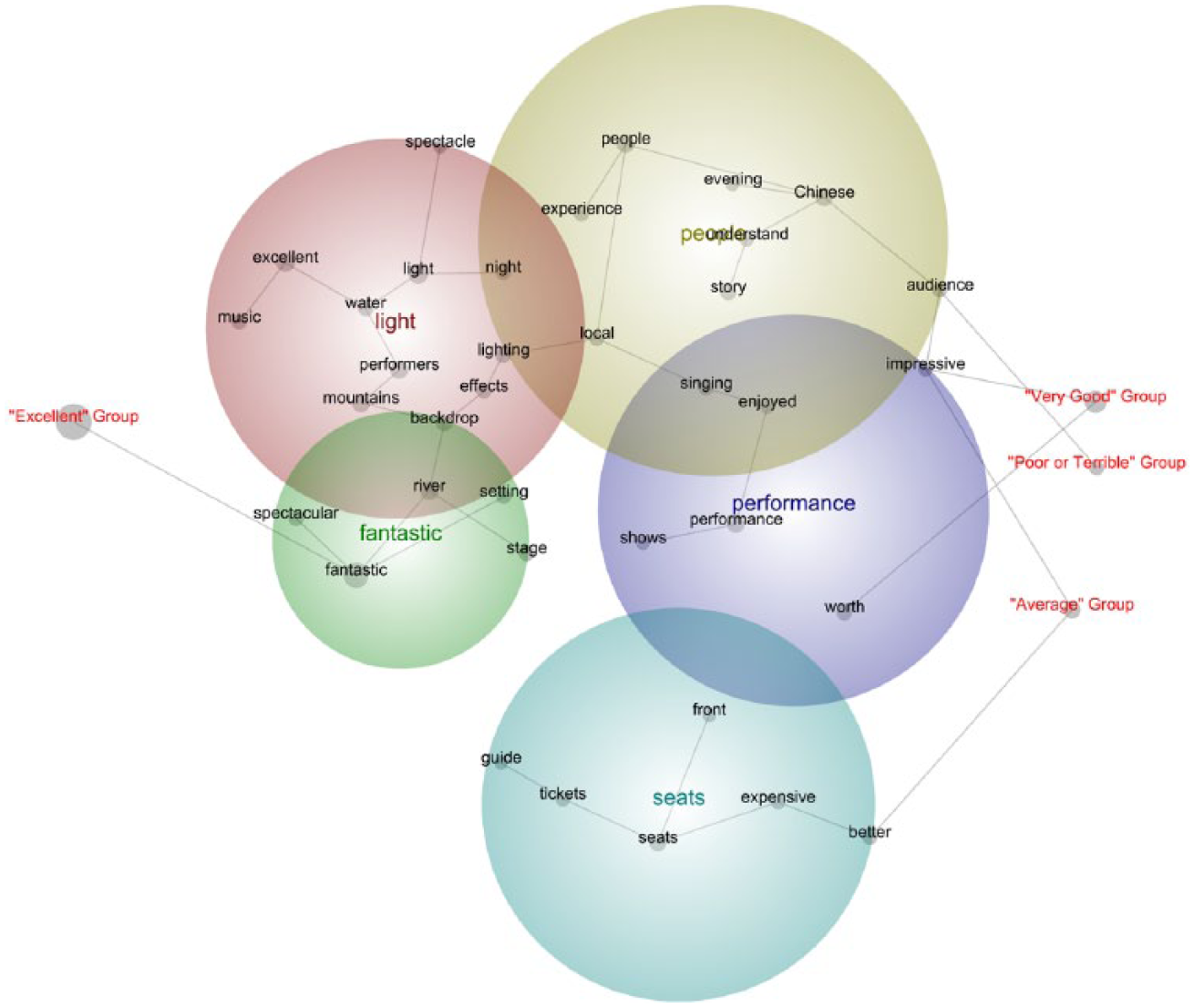
In addition to assessing the influence of the demographic factors on the tourists’ experience, this study also examined whether or not different satisfaction groups viewed the show differently. In the Leximancer analysis, satisfaction levels were inserted into the analysis as mapping concepts and tested individually to assess the impacts on customers’ on-site experiences (see Figure 4). In this set of analysis, five themes were identified: “light” (connectivity rate = 100%), “people” (62%), “fantastic” (60%), “seats” (34%) and “performance” (32%). These themes were closely matched to the themes identified in Figure 3, except that “impressive” was subsumed within the “performance” theme.
Figure 4 indicates that there were some particular concepts and themes closely linked to specific satisfaction groups. A detailed inspection suggests that the group who had provided the rating “excellent” had very different narratives about their impression show experience. This group is linked the most with the “light (viz., connection)” theme and the “fantastic” theme. An assessment of the concept links for this group found that their highest connected concepts were full of music (79% likelihood of co-occurrence), excellent (72%), night (66%), spectacular (66%), guide (63%), fantastic (63%), water (62%), performers (62%), and light (60%). In general, they were the group who were mostly impressed with the light-and-music show itself, including its setting (water, river, and mountains), the performers, and their evaluation (excellent, spectacle, spectacular, and fantastic). Typical comments from this group include the following from an experienced Australian tourist:
I absolutely loved it, in part because of the traditional Chinese imagery and music against the fantastic karst mountain scenery, and in part because it’s excellent that someone has choreographed the local villagers to take part in this—ordinary fisherman, women and children—to very moving effect. . . . I will be recommending it to everyone I know going to Guilin, even if only for the fantastic scene with the fishermen dancing in a sea of red.
It is important to remember that the show is performed in Mandarin. Language issues have been raised by some people, but do not really bother most of the audience. A Swedish tourist observed,
An astonishing show on an absolutely huge stage, using light, sound and the Li river mountain backdrop to create an unforgettable experience. As a Westerner it was hard to understand the finer points of the play, but by just leaning back and absorbing you can get some feeling for the story while just being amazed by the impression.
The other groups who rated their impression show experience as “very good,” “average,” and “poor or terrible,” did not emphasize the themes falling under the concepts of light and fantastic. Instead they paid greater attention to the physical issues (seats), the value for money (worth, expensive, tickets), and the behavior of fellow audience (people, audience). For example, the top concept links for the group providing the “very good” rating were “enjoyed (40% likelihood of co-occurrence), experience (72%), front (seats; 34%), (light) effects (34%), worth (31%), stage (31%), lighting (30%), impressive (30%), and expensive (30%). Typical comments of the three groups were,
This is the first of these shows I have seen and it lived up to my expectations. Incredibly well choreographed & slickly performed in the beautiful Li River landscape. If only Chinese audiences would behave a little more respectfully when in a theatre. (A review rated as “very good”) The show was really pretty. However, the time wasted queuing in three different areas, was irritating. If you have been in China for a while, this should be a matter of norm for you, but if not, be prepared to waste an hour and a half being herded from one line to the next. (A review rated as “average”) We were very excited about this show. However, it failed to live up to its reputation. At only 45 minutes long, it proves to be a very expensive show. The transitions between each scene are slow, you cannot hear the singing properly due to Chinese tourists talking all throughout the show (a common problem) and there is a lack of a climax at the end. Very flat. Don’t bother. (A review rated as “poor”)
Conclusion and Discussion
This study is centrally about international tourists’ experiences of an iconic performance-based entertainment. The study adopted an emic research style to approach international tourists’ views of a grand-scale performance-based entertainment. The case considered was Impression Sanjie Liu, a successful landscape performance show which has attracted more than 10 million tourists, including 2 million international tourists, since its opening in late 2004. Tourists’ spontaneous reviews posted on TripAdvisor were used as the data source. Leximancer software was adopted to analyze the natural unstructured language. While the narratives were analyzed inductively using the software, we have been able to interpret the results with the help of the existing theoretical knowledge related to tourist performance-based entertainment, tourist experiences, and tourist satisfaction.
The analysis suggested that the majority of international tourists enjoyed the large-scale light-and-sound show, which is built on themes integral to Chinese ethnic culture. The key topics international tourists reported were “light,” “fantastic,” “performance,” “seats,” “people,” and “impressive,” International tourists were especially impressed with the spectacle and the context, both components of performance-based shows that had been previously emphasized in studies about tourism performances in Asian tourism contexts (Ryan & Collins, 2008; Saipradist & Staiff, 2008). This study, from the perspective of the tourists reinforced the view that these entertainment-oriented, performance-based shows work best through their color, scale, light, action, and the resulting sense of spectacle. For the most satisfied visitors in particular, the grand spectacle, the performances of so many people, and the context define the achievement and the success of the attraction. Nevertheless, the positive reactions of the majority of the international tourists still mask a problem noted by Ryan and Collins (2008): the difficulty of marrying Asian, and in this context Chinese, mythical story lines with narratives which Western audiences can assimilate into their own world of romantic, adventure, and dramatic scripts. As this kind of finding is confirmed with further study and in other contexts, it may prompt greater attention to the task of providing international tourists with richer and more tailored previsit and on-site interpretive material (cf. Xu, Cui, Ballantyne, & Packer, 2013).
A further complexity about such performances can be identified from the present analysis. In the previous studies, the audiences were small and often heterogeneous, and the behavior patterns of other audience members were not an issue. A different scenario about the annoying behavior of other tourists was an undercurrent of concern in the present study. In the world of tourism in China, where domestic tourists are inevitably in large numbers at all significant attractions, there is scope for tourists from different origins to be annoyed by what they see as disruptive behavior from local tourists (cf. Yagi & Pearce, 2007). These issues of visitor conflict have previously been largely studied within the same cultural groups (Vaske & Donnelly, 2002), but the present set of findings suggest that there is scope for research and management attention in terms of visitor education and control in these varied Chinese contexts (Jin & Pearce, 2011). This finding is of broad interest as the Chinese government has been paying a great deal of attention to Chinese outbound tourists’ good behavior and its influence on its national image (Branigan, 2013). It is also necessary to be aware that international tourists to China are gazing at domestic tourists and residents. Appropriate public behavior, in this case being quiet and considerate during the performance and being respectful to the performers, may affect international visitors’ experiences and social attitudes.
In addition to the analysis of the overall narrative representations of the international tourists’ impression show experience, this study also examined how tourists’ origins influence tourists’ experiences. No significant relationships were indicated. The absence of findings here is potentially a useful result because it suggests that no specific modifications are immediately required to serve the needs of any one specialist group. Additionally, no themes emerged from the reviews that the international audience was troubled by the commercialism of local traditions, a topic sometimes seen as important in studies of other Chinese tourism settings (cf. Swain, 2005).
Impressions by different satisfaction groups, however, were found to be very different. The most satisfied group, 55.7% of the total sample, offered an integrated and holistic view of their experience. The connectivity scores for the concepts underlying their reactions were uniformly high and revealed that their responses were dependent on the interplay of the music, the evening time slot, the context of the river and the water, the role of the performers and the use of the light. These responses are consistent with an expressive and aesthetic reaction describing their satisfaction (Noe, 1999; Pine & Gilmore, 1999). For the other groups whose overall satisfaction was still quite high, the responses were composed of positive responses toward more instrumental components of the experience such as the seats, the value for money, the stage, and the impressive nature of the show. The ratings for these components were moderate rather than high, but the term fantastic was notably missing in their repertoire of responses to the performance. The issue that some commentary on the behavior of other tourists from these groups appears in their reviews indicates that they were also less fully absorbed in the occasion. In terms of theoretical approaches to perception and experience, their mindfulness toward others switches their attention away from mindlessly floating in the passive, dream-like, and sensually rich atmosphere of the presentation (Langer, 2009; Pearce, 2012a). The connection between the lower level of satisfaction and this issue of the behavior of others reinforces the view that this is an issue which is not simply noted as a feature of the experience but a concern which detracts from the impression show.
One concern about the kinds of comments analyzed in this article was raised by a reviewer. These user-generated remarks can be seen as top of the mind or surface evaluations by the tourists. Some may be the product of more earnest reflection but nevertheless it is acknowledged that they comprise a mix of remarks with varying levels of contemplation and at varied times after the performance. Additionally, those who provide the responses can do so in any form and order which they personally choose, thus raising the question of which remarks are more important than others. The point introduces a limitation to the study which is recognized since any kind of managerial response to criticism needs to consider both the importance of the comment to a large number of consumers and the ability of the management to change this feature (Noe, 1999). While acknowledging these concerns, the value of the study persists in two important ways; the concerns identified provide an emic platform for closer analysis of the linked issue of importance while the sheer numbers of people with a particular concern may act as a proxy for the scale of a problem and the need for management to address the issue.
In summary, the present study offers further and original support from the Chinese context that international tourists are impressed by and enjoy the large-scale spectacle performances offered as a part of the Asian cultural style of tourism. The understanding of the performances may be limited but an appreciation of the atmosphere and visual qualities of the events can surmount such difficulties for a large number of tourists. Nevertheless, the potential to build a better understanding as well as manage some of the disruptive behaviors of other on-site tourists may enhance the impression of such lavish and well-orchestrated shows. Unlike some site-specific tourism studies, the value of the present work can be extended beyond the present case, particularly because the performance being studied is a leading example of its kind.
Footnotes
Authors’ Note:
This work was supported by the National Social Science Foundation of China (No. 14CGL024) and the Public Projects Funding of Zhejiang Province (No. 2015C33004).