



Abstract
Individuals use self-imposed mental constraints as a guide to make frequent consumption choices. Recent studies, however, suggest that such mental self-rationing processes may be inefficient. The purpose of this real-life experimental study was to investigate the self-rationing efficiency of households’ repeated purchases. Eating-out expenditures take up over half of the food expenditures among families. This study investigated efficiency of eating-away-from-home budget. The results of this study show the classic response by households of adjusting up the eating-away-from-home budget over time when asked to explicitly declare their budgets, suggesting inefficiency in the mental self-rationing process. We also investigated whether repeated experiences could improve the efficiency of self-rationing and found results to the contrary. Experience was positively related to self-rationing inefficiency. We discuss contributions to the literature in regard to self-rationing of repeated expenses and the implications for practice and policy, especially given that experience could further increase inefficiencies.
Keywords
Introduction
As consumers, we constantly make consumption choices in regard to resources, such as money, food, and time, in the context of certain global constraints. For instance, some of the constraints on consumption choices are annual income, calorie requirements, and life expectancy. Classic conceptualizations of resource consumption are based on our utility-maximizing behavior subject to the current and discounted value of future resources available (Ando & Modigliani, 1963; Bernheim, 1987). In other words, choices are made based on the value that we place on resources now and in the future, based on their discounted values.
A growing body of research in behavioral economics, however, suggests that most consumers may not be using such sophisticated decision-making processes to make current choices (Ikeda, 2016; Thaler, 1990). This is largely because we tend to discount the future more than we should and, therefore, place higher value on current consumption, especially if the future benefits of forgoing current consumption are difficult to evaluate: One such example is saving for retirement (O’Donoghue & Rabin, 1998). Therefore, to avoid overconsumption, as consumers, we tend to use more local constraints to curb current consumption. One such local constraint is mental budgeting (Thaler, 1999) or allocating consumption to categories with certain limits.
Nevertheless, recent evidence suggests that even these mental budgeting techniques may be inefficient to help consumers self-ration their consumption (Wertenbroch, 1998). Furthermore, repeated purchasing decisions could be particularly prone to such self-rationing inefficiencies. Therefore, the purpose of this study was to investigate the level of efficiency of individuals’ self-rationing of repeated and relatively small expenditures, such as eating-away-from-home purchases (e.g., coffee at Starbucks or a gas station, take-away/take-out foods, a meal at a restaurant). Given repeated purchases could increase experience of such transactions, we also investigated whether increased experience would have an impact on self-rationing efficiency.
In this real-life experimental study, we contribute to the discussion of repeated decisions by investigating the self-rationing phenomenon for such purchases as well as the role of experience. Furthermore, because the proportion of eating-out expenditure continues to increase significantly, we discuss the relevance of our findings for the financial well-being of families. We further discuss how more formal (systematic) methods of self-rationing should be preferred over less formal (heuristics) such as mental accounting of frequent purchase expenses. Moreover, that experience does not always play in favor of enhancing self-rationing efficiencies. This study also contributes through a real-life experiment of studying consumer choices in context of eating away from home. It builds on previous literature that has attempted to understand food away from home (FAFH) behavior of different groups of consumers (see Literature Review section). We believe this is the next logical step: to gain a deeper understanding of how individuals view expenditure on eating away from home. Given the continued importance of eating FAFH phenomenon, our study suggests individuals may not be effectively managing their financial budgets, despite making such decisions repeatedly. Our study could have implications on future study to investigate how budgeting inefficiencies may exist in other expenditure behaviors and beyond personal expenditure even in professional contexts.
Background Literature and Research Hypotheses
Eating-Away-From-home Expenditure
In one of the first studies in hospitality to look at FAFH, Hiemstra and Kim (1995) investigated the relationship between socioeconomic and demographic factors and expenditure on food expenditure in restaurants. The data were sourced from the Bureau of Labor Statistics’ Consumer Expenditure Survey. Results of this study found that consumer expenditure on food expenditure in restaurant was explained by income, urbanization, role of women in the household, size of the household, time of the week, and use of credit cards, among other things. One indication of possible self-rationing challenge this study showed was that use of credit cards increased expenditure on food. Later in another study, Cai (1998) investigated whether sociodemographic characteristics could explain an individual’s expenditure on food while on vacation. The study used secondary data reported in the consumer economic survey compiled by the Bureau of Labor Statistics. Key findings of this study were that sociodemographic characteristics such as income sources, size of the household, education, and even home ownership and marriage. In a similar study based on Cai (1998), Jang, Ham, and Hong (2007) investigated how socioeconomic and demographic factors could influence FAFH expenditure of senior households. This study also used the consumer expenditure survey of the U.S. Bureau of Labor Statistics (2015). This study found that sociodemographic characteristics (such as education, urban area, region, and housing tenure) were more helpful in understanding the relationship between expenditure on FAFH. However, the authors also added such relationships could be due to the peculiarities of this particular market. Further studies would be required to understand the FAFH phenomenon in its entirety.
The U.S. Department of Agriculture (2015) reported that FAFH expenditure takes up 49.5% of food expenditure spent in the United States by households. This trend of households’ increasingly choosing to eat out is not new. Guthrie, Lin, and Frazao (2002) compared the eating-away-from-home trend in the 1970s to that of the 1990s and found a significant increase, from 18% to 32%. Their implications emphasized we need to be aware of the increased trend of eating-away-from-home and consumption of high meals with high amount of calories, fat, and low on dietary fiber, calcium, and iron, when developing nutrition education and messaging interventions. While eating away from home continues to increase as a proportion of our food expenditure, recent trends suggest Americans are increasingly eating alone when they eat away from home (NPD Group, 2015). Another report by the Hartman Group (2013) also verifies this trend of eating alone versus with others. Both these studies suggest alone eating is being fueled by the demographic trend of more individuals living alone and changing preferences of eating alone by themselves. Larson, Neumark-Sztainer, Laska, and Story (2011) also focused on the increased use of restaurants in eating out and the negative impact that it would have on healthier eating. Several recent studies have found potential negative dietary implications of increased frequency of eating away from home and the causes (such as hypertension) of eating out (Bezerra Junior, Pereira, & Sichieri, 2015; Kant, Whitley, & Graubard, 2015; H. Liu, Wahl, Seale, & Bai, 2015; Seow, Haaland, & Jafar, 2015). Young families choose to eat out as a coping mechanism related to “long hours and nonstandard hours and schedules” (Devine et al., 2009, p. 365). Over 50% of food budget spent on eating away from home could represent a significant expenditure for many households. Despite the impact eating away from home could have on household finances, we were unable to find studies focused on assessing eating-away-from-home budget at the household level.
The recent reduction in consumer debt is being attributed to changes in consumer behavior, a trend that would hopefully continue to further reduce consumer debt levels (Brown, Haughwout, Lee, & Van Der Klaauw, 2013). As the financial system becomes more complex, researchers and policy makers are concerned that many individuals lack the basic financial education needed to make responsible decisions about their future. In particular, working adults present a “formidable group of individuals” in need of financial education (National Endowment for Financial Education [NEFE], 2002). A significant challenge for individuals is to plan and manage their day-to-day financial decisions (NEFE, 2006).
Studies show that eating prepared FAFH is a potential daily expense that constitutes a constantly increasing component of family financial budgets (Carlson, Kinsey, & Nadav, 2002). Although such individual expenditures are small, their cumulative magnitude over weeks or months can be considerable. Improved understanding of individuals’ decision-making processes and planning behaviors (or lack of) that lead to eating away from home expenditures could provide valuable insight into the daily management strategies of financial decisions. Such an understanding could facilitate the development of effective interventions to help individuals learn positive behavioral habits that they can implement on a daily basis.
Repeated Choices
Ronis, Yates, and Kirscht (1989) defined repeated behavior as “any action that is taken more than one time” (p. 213). They further characterized frequent actions as those taken at least twice a month, and extensive as those taken at least 10 times. The authors described the process of repeated behavior as largely being governed by habits and not attitudes. The importance of understanding mechanisms that influence repeated behavior is evident, given the possibility of automaticity. Early evidence in regard to repeated behavior suggests repeated decisions may even differ from one-time decisions (Ansic & Keasey, 1994).
The mechanisms that drive repeated decisions have been interpreted in recent studies to suggest that individuals may view such decisions differently from those that occur less frequently. For instance, H. H. Liu and Colman (2009) found that participants chose the more ambiguous option more frequently in repeated decisions and risky choices more frequently in one-time decisions. Lejarraga and Gonzalez (2011) investigated effects of feedback in repeated decisions and found feedback to be more relevant in repeated decisions, despite the presence of feedback. In their study, participants overlooked information of descriptions even as the complexity of decisions increased.
In related research, Erev, Ert, and Yechiam (2008) found decreasing sensitivity to losses, in the presence of experience, implies participants were biased toward risk-seeking behavior in repeated decisions. Results of their study suggests experience could reduce sensitivity to losses, thereby encouraging individuals to make risky choices under conditions of repeated decisions. In an attempt to explain the reasons for loss aversion in repeated decisions, Chen and Corter (2014) investigated the differences in the mechanisms between decisions from experience and description-based decisions. Their results suggest that experienced risky gain does not positively reinforce repeated decisions; however, an experienced risky loss negatively affects successive choices.
In summary, studies on repeated decisions have found that: (a) repeated decisions could be governed by different mechanisms than are one-time decisions and (b) experience may be an element of this mechanism, thereby having an impact on repeated behavior. Over time, one would expect experience to increase the risk-taking behavior in repeated decisions.
Self-Rationing and Experience
Self-rationing or self-control as it relates to consumers’ intertemporal utility maximization and dynamism in the choice process is not a new idea. In his seminal paper, Strotz (1955) suggested that consumers’ future behavior may be inconsistent with their future plans. If individuals do not recognize this inconsistency, then it could lead to what Strotz called spendthrifty. Strotz further recognized that individuals would either commit themselves to the plan in some manner or resolve it using a strategy of consistent planning, that is, exercise self-control.
Thaler and Shefrin (1981) addressed the “self-control problem” in the context of intertemporal choice. An individual (treated similar to an organization) is considered to behave rationally (planner) and to be myopic and selfish (doer). In essence, the myopic and selfish behavior of an individual creates a conflict with the planner side, leading to a lack of self-control. While Shefrin and Thaler do not directly address the case of self-control under repeated choices, they do assert that “rules of thumb” to avoid self-control problem would be dynamically stable. Under the no-exception characteristic of these “rules of thumb,” the doer should not have to decide whether the rule is applicable in a particular situation. Furthermore, the consideration of exceptions could reduce the value of rules of thumb in ensuring self-control. Similarly, dynamic stability would not be attained if there are frequent changes to the rule.
In keeping with the economic model of intertemporal choice, Thaler (1980) proposed the concept of mental accounting or mental processes used by individuals to “organize, evaluate, and keep track of financial activities.” Thaler (1999) explicitly discussed the use of budgets as a self-control device to keep track of consumption activities and noted that this budgeting process may vary among households (or individuals). For instance, those households (or individuals) in the lower income category would have more binding budgets than would wealthier families (Thaler, 1999). Heath and Soll (1996) investigated how budget setting and expense tracking change consumer choice. They explained that consumers usually set budgets and track expenses but that the process is not accurate enough to predict real consumption, thereby resulting in overconsumption or underconsumption.
Wertenbroch (1998) noted that, although anecdotal evidence of self-budgeting behavior exists, empirical evidence in controlled settings of self-budgeting (or self-rationing) behavior, and its influence is rare. Other research has found that individuals may be self-rationing their budgets “inefficiently,” causing them to be only partially successful (Carrillo & Mariotti, 2000; Heath & Soll, 1996; Leclerc, Schmitt, & Dubé, 1995). P. J. Liu, Wisdom, Roberto, Liu, and Ubel (2014) explicitly discussed the role of the lack of self-rationing in individual’s food choices when eating away from home. The authors argued for improved food policies that could help guide consumer food decisions. In another groundbreaking research, Veit (2013) argued how public policy influenced the context, and thereby the self-rationing of food in the United States in the early part of the 20th century. While self-rationing or self-control has been recognized as a factor in our food choices, there is much we can understand how this behavior influences our financial and nutrition health. In the current context, of particular interest is the budgeting aspect of self-rationing for small yet frequent expenses.
Research Questions and Hypotheses
Eating away from home can be an impulsive act (Appelhans et al., 2012), highlighting the doer or myopic side of an individual decision maker (Thaler & Shefrin, 1981). If this were the case, then mental budgeting of such expenditures would not be an efficient strategy. Therefore, the overall question this study investigates is whether individuals are efficient in budgeting for FAFH expenditure? In view of past findings, we expect that individuals would demonstrate incorrect (inefficient) budgets over time for certain expenditures. Given the increasing household expenditure on FAFH, overconsumption could reduce the efficiency of the self-rationing process thereby leading to households understating their budgets. We therefore proposed the following hypotheses:
1a. Personal budget between Week 1 and Week 2.
1b. Family budget between Week 1 and Week 2.
1a. Personal budget between Week 1 and Week 2.
1b. Family budget between Week 1 and Week 2.
On the other hand, a simple act of reminding individuals to consciously think about the budget could reduce this incorrectness or inefficiency. We therefore proposed the following hypotheses:
2a. Personal budget.
2b. Family budget.
2a. Personal budget.
2b. Family budget.
Furthermore, given that experiences of repeated decisions could increase risk-taking behavior, we expect decrease in the efficiency of mental budgeting of such expenditures. In particular, given the trend of eating alone (Hartman Group, 2013; NPD Group, 2015), the eating alone experience will affect self-rationing efficiencies more so than family FAFH experiences. We therefore propose the following hypotheses:
3a. Personal budget between Week 1 and Week 2 when eating alone.
3d. Family budget between Week 1 and Week 2 when eating with family.
3a. Personal budget between Week 1 and Week 2 when eating alone.
3d. Family budget between Week 1 and Week 2 when eating with family.
Method
Data and Sample
This study is based on a sample of 60 dual-parent families over a 2-week study period, using a repeated-measures research design. Participants were recruited from the local community of a university town through publicly posted recruitment materials. Approximately 400 dual-parent families responded to these invitations. The recruitment criteria included a requirement to be earning a median or below-median total family income and families that did not have written family financial budgets. As per Thaler (1999), lower income families would demonstrate a bigger challenges of binding budgets than wealthier families. We therefore recruited families in this category. This would suggest no explicit budgeting behavior; therefore, the study’s assumption that the participants were likely engaging in mental accounting of these expenses could be invoked. Additional criteria included parents’ owning cell phones. Individuals who responded to the public invitation to participate in the study were asked to complete an online recruitment form with recruitment criteria questions. If they met the recruitment criteria, then they were invited to continue participating in this study; otherwise they were thanked for their time. The final sample of participants included 60 families who met these criteria. Therefore, the responses to the survey instrument came from the spouse who was volunteered by the families themselves.
Data Collection
Repeated decision data in regard to eating-out behavior was collected over a 2-week period using a combination of online survey questionnaires and cell phone text messages. Participants were asked to complete two or three online survey questionnaires, depending on their randomly assigned group membership. The total sample of 60 families was randomly assigned to one of the two groups: No Treatment, or the control group; Treatment group. Treatment group was asked to consciously declare budget at the end of the first week, and then again at the end of the second week. The control group was not asked to declare a budget at the end of the first week, but was asked to declare a budget at the end of the second week. Therefore, the control group was asked to complete online Survey Questionnaires 1 and 3 only. Treatment Group was asked to complete all three online survey questionnaires. The question referring to declaring a budget at the end of the first week was included in the second questionnaire that was only given to the treatment group and not to the control group.
Independent Variables
Both treatment and control groups were asked to send a text message every weekday (Monday through Friday) of the 2-week study period in response to the following two questions (also sent by text): “Did you consume food or beverage outside your home that was not prepared at home?” (yes = 1, no = 0); and “Are you worried about your financial well-being?” (NEFE, 2006; yes = 1, no = 0). The question on financial well-being was obtained from NEFE consumer surveys. The use of text questions and responses were designed to encourage participation (Axén et al., 2011). A repeated-measures analysis of variance (ANOVA) with a Greenhouse–Geisser correction (along with the post hoc tests using the Bonferroni correction) determined that purchases decreased in Week 2; however, this result was not statistically significant. The responses to the concern question between Week 1 and Week 2 did produce a statistically significant change in concern for financial well-being, F(1, 37) = 5.400, p < .026. Concern for financial well-being reduced from Week 1 to Week 2.
The online survey questionnaires were divided into two main sections. Survey Questionnaire 1 had only the first section, while Survey Questionnaires 2 and 3 included both sections (described as follows). The first section collected demographic information of the participants, such as family income, number of family members, and ages of the children (Jang et al., 2007). The second section collected information related to the family’s eating-out habits and eating-away-from-home expenditure. Two types of questions were included in this section. The first set of questions asked participants about their frequency of eating away from home for different situations or purposes, such as while alone, with family, or with friends. Furthermore, locational aspects of the eating behavior were included in these questions, such as eating at home food that was cooked away from home, eating at work, eating while traveling, or simply eating out. These categories of eating away from home were developed in consultation with experts to ensure the comprehensiveness of responses. Responses were collected as categorical frequency measures that included the following options: never, two to four times a year, once a month, one to two times a week, three times a week or more, and a prefer not to answer option (Ronis et al., 1989).
Dependent Variables
Survey Questionnaire 2 included two additional questions that asked respondents to explicitly state their personal estimated eating-away-from-home budget and their family eating-away-from-home budget. These two questions were then repeated in Survey Questionnaire 3. We wanted to verify whether, after spending money for 2 weeks, those treatment groups adjusted their eating-out budget. The control group also was asked these questions to assess whether there were any differences in eating-out frequencies in Week 2 between the control and treatment groups.
All text message and online survey questionnaire data were received by the research team using third-party software that allowed the data to be directly loaded in a spreadsheet format. The data collection process is presented in Figure 1.

Data Collection With Cell Phones
The first online survey questionnaire was completed at the beginning of the first week. The second online survey questionnaire was completed at the end of the first week, and the third online survey was completed at the end of the second week. Participants were sent laminated stickers to put on their cell phones to encourage them to send daily responses. Finally, each participant was included in a drawing of two cash prizes of up to $250 if he or she completed the entire study. All participants received an added incentive of reimbursement for the cost of unlimited text messaging during the study period.
A total of 60 dual-parent families were included in the study. The final sample for the study was 59 families, as one family dropped out within the first week of the study. The median combined household gross income of the participating families was $60,000 to $79,000. Both spouses were working full time, with 40 hours of paid employment (median value). The average age of the respondents was 35 years and, of their spouses, 37 years. The median education of the respondents was less than high school and, of their spouses, some college/university. The mean personal eating-out weekly budget for the respondent was $25 and, for the family, $66, based on the Survey Questionnaire 3 responses. See Table 1 for descriptive statistics.
Descriptive Statistics
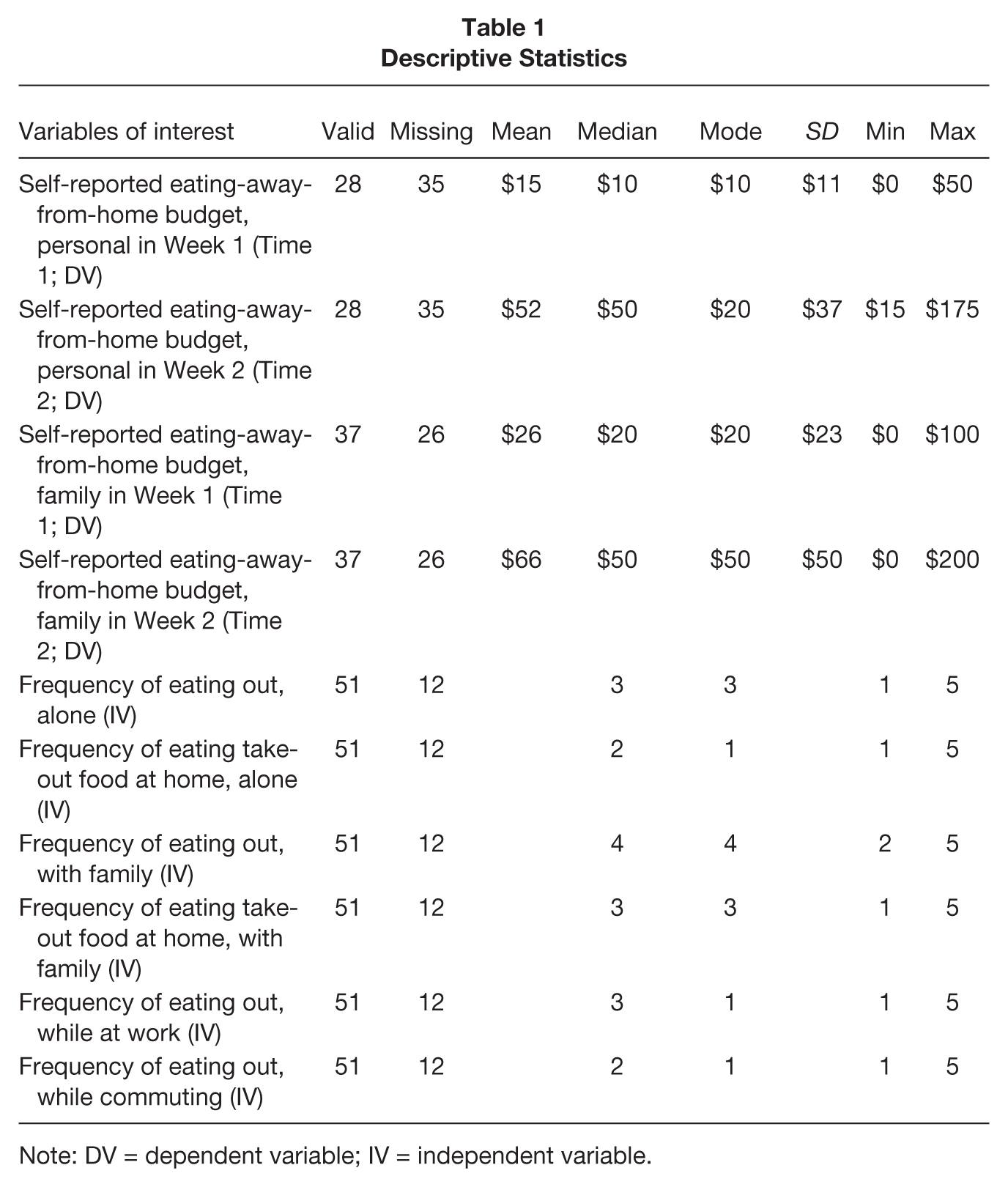
Note: DV = dependent variable; IV = independent variable.
Data Analysis
Data were analyzed using repeated-measures ANOVA of within- and between-subject designs. The variables of interest are described in the following sections. Hypothesis 1 was tested using a within-subject design, and Hypothesis 3 was tested using a between-subject design. As appropriate, one-way, two-way, and three-way interactions were conducted to test Hypothesis 2, given that our main independent variable of interest (eating away from home) had multiple representations. An independent sample t test was conducted to compare the declared budget of second week between the treatment and control groups. Standard statistical tests were conducted to ensure that the underlying assumptions of the repeated measures were met. In context of a within-subject repeated-measures design, the presence of sphericity implies that all correlations among differences among the correlations are constant. However, if there are only two levels to such a within-subjects design (such is the case in our study with two time points), then the sphericity assumption by its very definition is met. Such would not be the case if the study had more than two time points. Therefore, although the sphericity assumption is not considered a problem in the case of two time periods (Statistical Analysis System, 2015), we still used the Greenhouse–Geisser correction to ensure a more accurate significance value. The analysis included post hoc tests using the Bonferroni correction method to counter the problem of multiplicity of hypotheses when making multiple mean comparisons of the data (thereby decreasing the likelihood of a Type I error; Abdi, 2010). Repeated ANOVA with small sample sizes are not uncommon. In a recent study, Hölzel et al. (2011) conducted a repeated ANOVA study over a 2-week time period, similar to this current study, with a treatment sample of N = 18 and a control group of N = 17.
Results
Eating-Away-From-Home Budget (Personal and Family)
A repeated-measures ANOVA with a Greenhouse–Geisser correction determined that the mean self-reported personal eating-away-from-home budget differed statistically significantly between the two time points during the 2-week experiment, F(1, 23) = 31.387, p < .000. Post hoc tests using the Bonferroni correction revealed that Week 1 versus Week 2 elicited a slight increase in the personal self-reported eating-away-from-home budget as compared with Week 1 ($14.13 ± 11.99 vs. $22.83 ± 21.88, respectively), which was statistically significant (p = .000).
Similarly, a repeated-measures ANOVA with a Greenhouse–Geisser correction determined that the mean self-reported family eating-away-from-home budget differed statistically significantly between the two time points during the 2-week experiment, F(1, 23) = 5.892, p < .023. Post hoc tests using the Bonferroni correction revealed that Week 1 versus Week 2 elicited a slight increase in the family self-reported eating-away-from-home budget as compared with Week 1 ($51.46 ± 39 vs. $58.54 ± 48.60, respectively), which was statistically significant (p = .000). The results are presented in Figure 2.
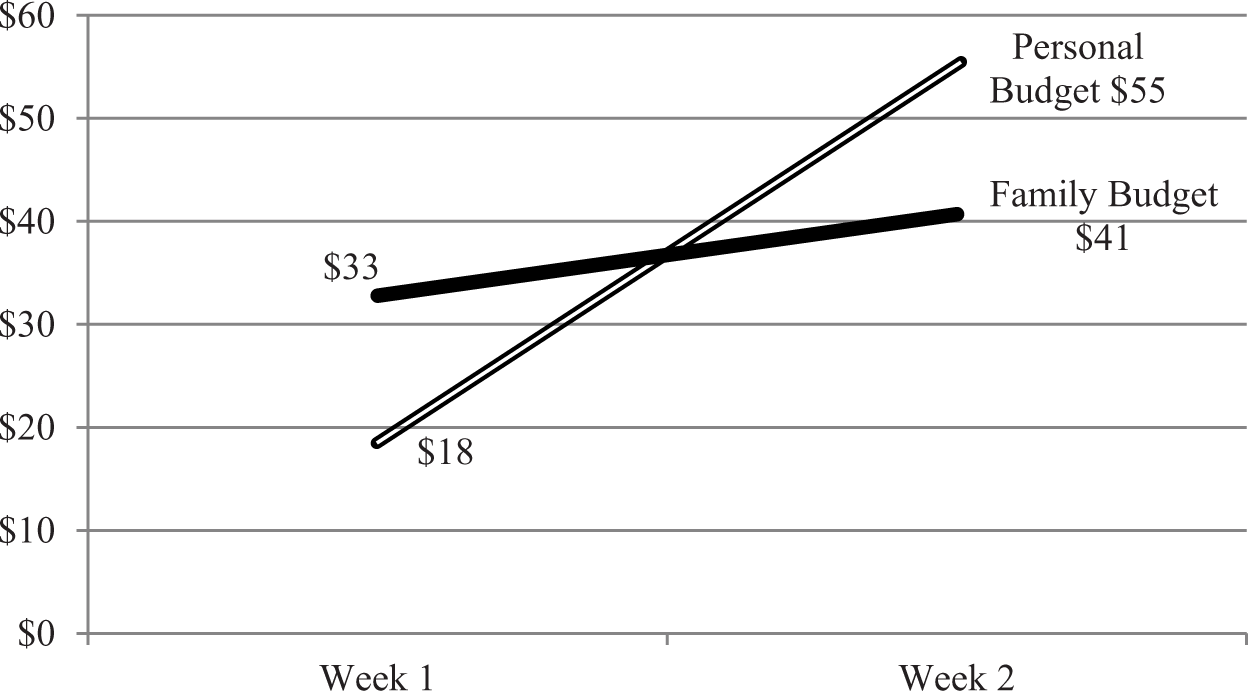
Change in Stated Budget Between Time Period 1 (Week 1) and Time Period 2 (Week 2)
These results together succeed in rejecting Null Hypotheses 1a and 1b. The survey questions inquired participants of the amount of food expenditure on different meals (breakfast, lunch, dinner) when eating away from home. We did not find any statistically significant relationship between the amounts of expenditure on different meals.
In order to test the Null Hypotheses 2a and 2b, an independent sample t test was conducted between the treatment (self-declared budget) and control group (no self-declared budget) to assess whether the self-declared personal and family budgets in Week 2 were statistically significant. These results, however, also were not statistically significant. Together these results fail to reject Null Hypotheses 2a and 2b.
Frequency of Eating Out and Personal Budget
In order to test Hypotheses 3a and 3b, a mixed between-within subjects ANOVA was conducted to compare how the frequency of eating meals alone from restaurants and convenience stores at home (take-out food) has an impact on the self-reported personal eating-away-from-home budget in two time periods (Week 1 and Week 2). There was a significant interaction between the frequencies of eating food prepared at restaurants or convenience stores at home (take-out food) and the difference in the self-reported budget in the two time periods (Week 1 and Week 2), Wilks’s Λ = .63, F(4, 19) = 2.84, p =.05, partial eta squared = .37. There also was a significant difference in the self-reported budget over the two time periods between the frequencies of eating meals from restaurants and convenience stores at home (take-out food). The respondents who ate out (take-away food) more frequently (two to four times a year) than did those who ate out less frequently (never) reported a comparatively higher (M = $46.39, SE = 12.23) personal budget in Week 2. This result was statistically significant in the pairwise comparisons (p = .012).
There also was a statistically significant difference in the self-reported personal budget in the two time periods (Week 1 and Week 2) between the frequencies of eating away from home while at work, F(4,19) = 2.972, p = .046, partial η2 = .39. The respondents who ate out more frequently while at work (three times a week or more) than did those who ate out relatively less frequently while at work (never and one to two times a week) reported a higher (compared with never: M = $53.24, SE = 18.65; compared with one to two times a week: M = $64.23, SE = 19.60) budget in Week 2. This result was statistically significant in the pairwise comparisons (p = .101 and p = .043, respectively). Figure 3 presents personal budget while at work for Week 1 and Week 2 by the frequency of eating away from home. Thus, we found evidence to reject the Null Hypothesis 3a, suggesting that eating-away-from-home personal budget could be different for those eating alone more frequently than less frequently.
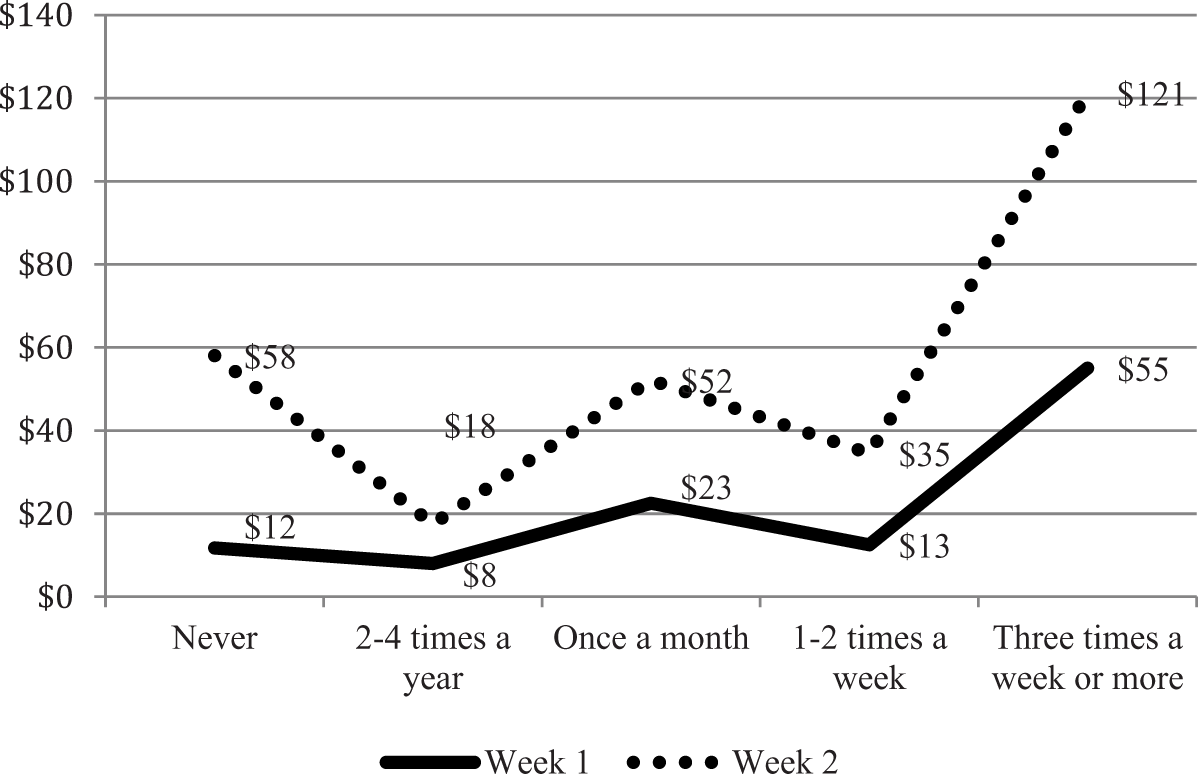
Personal Budget While at Work
Frequency of Eating Out With Family and Family Budget
In order to test Hypothesis 3b, a mixed between–within subjects repeated-measures ANOVA was conducted to compare how the frequency of eating away from home with family has an impact on the self-reported family eating-away-from-home budget in two time periods (Week 1 and Week 2). Results of the repeated ANOVA did not show any statistically significant results. Given these results, we do not find convincing evidence to reject the Null Hypothesis 3b.
Education and Household Income
We also attempted to verify the results of previous studies to assess whether there was a difference in self-reported budgets based on education and household income of the respondents. We did not find any statistically significant difference in the repeated-measures ANOVA.
Discussion
The purpose of this research was to investigate the self-rationing efficiency of young families for their eating-out purchases and whether self-rationing would be affected by the experience of repeated eating-away-from-home decisions. Our main finding was the strong and statistically significant increase in the self-reported eating-out weekly personal and family budgets in Week 2 of the experiment. This is a classic indication of self-rationing inefficiency (Wertenbroch, 1998). In other words, we found that individuals underestimated the amount that they would spend during a week on eating out. Results of our study support an earlier result that Hiemstra and Kim (1995) found of higher expenditure amounts being associated with credit card usage. In a recent study, Ajzerle, Brimble, and Freudenberg (2015) found that personal budgeting can also affect the use of credit card expenditure, specially of those individuals who have budgets but do not follow them effectively. Such findings further indicate the presence of self-rationing inefficiencies in frequent purchasing contexts.
As for making the eating-away-from-home repeated decisions, we found the respondents who ate out more frequently than did those who ate out less frequently reported a higher personal budget in Week 2. This interaction of experience also was statistically significant for the self-reported personal budget. The types of experiences that statistically interacted with personal budget increase in Week 1 included eating food from restaurants at home and eating away from home while at work. The experience of eating away from home, however, did not show a statistically significant interaction for the family budget.
Participants in this study were also asked to report whether they spent money on food prepared away from home every day of the 2-week treatment and whether they were concerned about their financial well-being. While the decrease in purchase frequency of the treatment group in Week 2 was not statistically significant (after declaring the eating away from home budget), the decrease in financial concern was statistically significant. These preliminary results suggest that whether being part of the experiment or whether having a conscious knowledge (after declaring their budget) of eating away from home budget, the participants did feel less concerned about their financial well-being. There is evidence to suggest increased information could reduce stress (pain) by increasing the perception of control among individuals (Williams et al., 2004). Knowing more about their expenditure on eating away from home could have reduced the concerns of study participants.
Unlike previous studies (Cai, 1998; Hiemstra & Kim, 1995; Jang et al., 2007), this study did not find any statistically significant relationship between eating-away-from-home budgeting inefficiency and socioeconomic or demographic factors. The survey questions also asked the respondents demographic questions including income level. None of these demographic variables had a statistically significant relationship with our dependent variable. This could also be due to the limited number of observations or as Jang et al. (2007) had pointed out the characteristic of the market segment. On the other hand, it is possible that budgeting inefficiency is more prevalent across socioeconomic demographic segments than previously understood. Given the importance of FAFH expenditure in our lives, future investigations could continue to focus on these and other aspects of this phenomenon.
Implications for Practice and Policy
Mental accounting is a practical manner in which individuals attempt to self-ration consumption or exert self-control and is prevalent (Reinholtz, Bartels, & Parker, 2015). Research has shown, however, that self-rationing may not always be efficient. Similarly, repeated decisions are numerous in our day-to-day lives, requiring the allocation of financial and nonfinancial resources. One would imagine that experience (through learning) would help make successive repeated decisions more efficiently. The evidence in this study, however, suggests that the experience of repeated behavior may not necessarily lead to efficiency of resource allocation. Furthermore, this inefficiency has implications for the economic, social, and health outcomes of individuals. We do note that only self-reported personal budget interacted with experience, and not the self-reported family budget. While the self-reported family budget in Time 2 (Week 2) did increase, this effect was not significant. Glukhov and Timofeeva (2013) noted that allocating financial resources within the family could be a complex issue, and one that often leads to conflict. We believe this result would be consistent with the premise that individuals may have less clarity over family budgets than over their own personal budgets.
Nutrition is another important resource that individuals attempt to self-ration over time. The outcome of misallocation and, therefore, misconsumption of nutrition could lead to unhealthy outcomes. Another resource that we try to self-ration is time. Implications of misallocated time or the lack of self-control of time allocation could lead to procrastination as well as related health, social, and economic outcomes. Nutrition, time, and money are resources that are repeatedly allocated, sometimes often during a day. Therefore, it would be informative to understand how individuals could leverage experiences through these repeated decisions so that outcomes are more favorable. The mechanism of how experiences interact with repeated decisions and of varying types of resources warrants investigation. It would be useful to understand whether the interaction of experience and self-rationing efficiency in repeated decisions is stable across different resources. If it is not, then it would be valuable to determine the mechanisms that have the potential to undermine individuals’ ability to self-ration and learn from repeated decisions.
This interaction of self-rationing efficiency and experience could also exist in business contexts where individuals are making similar budgetary decisions. Future studies could investigate whether managers display similar inefficiencies. In fact, it would be interesting to investigate the relationship between self-rationing in personal contexts versus those in professional contexts. Would endowment effect play a stronger role than agency incentives in promoting budgetary efficiencies?
Limitations
This research has certain limitations that would require caution in the interpretation and generalization of the study’s findings. Self-rationing outcome was measured over only two time periods during the 2-week study and with a relatively small sample size. Several more time periods could be added to understand whether the inefficiency phenomenon is persistent or whether individuals make adjustments. Even though the sample of this study was diverse, larger samples could be used to investigate the phenomenon, particularly with a focus on gender variability, if any. Repeated expenditure data were not collected in this study. While the initial survey questionnaire did not indicate to the participants that this study was focused on an eating-away-from-home budget, the successive text messages could have guided their behavior and, thereby, had an impact on the potentially larger variance in the observed self-rationing inefficiency. It also might be possible to gather data from participants in a subtle manner, but doing so repeatedly could become challenging. Additionally, due to the experimental design limitations, this study was limited by its scope of including all meals in the eating-out expenditure. Future studies could investigate whether self-rationing differs by the type of restaurant, timing, and other factors. While these factors were included in the survey, and did not show statistically significant results in this study, future studies could further investigate the influence of these aspects of eating-away-from-home on eating-out budgets. This study results also found differences in respondents based on whether they were eating away from home alone or with family. As stated earlier, these results are based on relatively small subsample sizes. Although these preliminary findings suggest individual expenditure may differ while alone or with the family, future studies could look at why such differences may exist, and whether they would be stable over time and in varying contexts. Based on these initial findings, we believe that further research would yield additional findings that have implications for the well-being of consumers.
Footnotes
Author’s Note:
Funding from the Social Science Research Institute, Penn State University, supported this research.