




Abstract
Despite the prominence of customer–employee relationships in service contexts, little empirical research examines the antecedents of rapport in relation to service providers’ attributes. Furthermore, while prior studies examine only piecemeal aspects of employee attributes, this research uses a more encompassing approach by considering multiple attributes simultaneously. The results from a 2 × 2 × 2 between-subjects experimental design suggest that employee eye contact and courtesy are critical components of building customer–employee rapport, and subsequently customer satisfaction, while appearance surprisingly did not affect customer–employee rapport. A significant interaction effect between employee eye contact and courtesy was found. The findings build on the rapport literature and have important managerial implications for high-contact services, such as hospitality and tourism.
Introduction
During the service encounter, both tangible and intangible aspects are essential in how customers judge the service experience. This is especially true in service industries, where the evaluation of a customer’s service experience is highly influenced by the interaction between the service provider and the customer (Kim & Ok, 2010). An employee is not simply a means to provide service and information, but more important, employees’ rapport-building behaviors are crucial components in inducing positive behavioral intentions such as satisfaction (DeWitt & Brady, 2003). Consequently, developing rapport between employees and customers is emphasized by practitioners and scholars (Gremler & Gwinner, 2000) as the positive effect of building customer–employee rapport leads to a win-win strategy for both the firm and customer (DeWitt & Brady, 2003).
Although customer–employee rapport is traditionally considered as a critical factor that directly affects the interaction between the customer and the employee, surprisingly little research examines the antecedents of rapport (Keh, Ren, Hill, & Li, 2013) especially in relation to service providers’ verbal and nonverbal attributes. Customers use various cues about service workers including appearance, emotion, and behavior to form an overall attitude toward the service worker (Soderlund & Julander, 2009). According to Gestalt psychology, although people may perceive discrete stimuli, they respond to their environments holistically (Holahan, 1982). When customers interact with employees, they judge their service based on all attributes that the frontline employee possesses. However, to date, most of the literature focuses on examining a single employee attribute at a time, such as customer orientation skills (Kim & Ok, 2010), physical appearance (Magnini, Baker, & Karande, 2013), aesthetic labor (Tsaur, Luoh, & Syue, 2015), attractiveness (Lynn, 2009), uniform color (Lynn, Giebelhausen, Garcia, Li, & Patumanon, 2016), and employee hospitality (Teng & Chang, 2013). Given the idea that customers face multiple attributes of employees concurrently during the service encounter, it is important to understand how multiple attributes work together on building rapport with the employee (Giebelhausen, Robinson, Sirianni, & Brady, 2014). This is even more critical in hospitality and tourism given the high amount of customer–employee interaction inherent in this context. This fragmentary approach toward employee attributes reveals that there is little understanding of how each attribute increases, decreases, or augments customer–employee rapport. Therefore, as there is a need to examine multiple attributes simultaneously in terms of their relative strengths and interaction effects on rapport, this study contributes theoretically and managerially.
Communication between a service provider and a customer is divided into verbal and nonverbal communications (Baker, 2016; Jung & Yoon, 2011). It is very important to examine nonverbal communication especially in service encounters where the customer and the employee interact, yet there are very few studies in marketing that examine aspects of nonverbal communication (Jung & Yoon, 2011). Two critical employee attributes that are very important in the service encounter are missing in the literature, namely attractiveness and eye contact. Specifically, the effect of employee eye contact, which many service firms requires their employees to display during the service encounter (Chu & Murrmann, 2006), has not been incorporated into the mainstream marketing nor the hospitality literature. Considering the prevalence of technology in frontline service encounters, clarity is needed with respect to when technology functions as a barrier to service exchanges (Giebelhausen et al., 2014). This is especially relevant with regard to employee use of technology and how that may detract from using proper eye contact and developing rapport with the customer. Given the research gap in empirical examination of eye contact, this study investigates this managerially and theoretically important variable.
A second element of nonverbal communication that has received little attention is the impact of attractiveness. There is very little research that examines employee attractiveness as it relates to service (Knežević, Tomka, Bizjak, Fabjan, & Kukulj, 2015; Magnini et al., 2013; Tsaur et al., 2015), yet the appearance of employees and the impact of their appearance is critically important (Keh et al., 2013; Tsaur et al., 2015). Moreover, the few studies that examine the impact of physical appearance (e.g., attractiveness and sexiness) on consumer behavior such as tipping behavior, used employees’ own perceived attractiveness as a predictor (Lynn, 2009). In other words, there is a lack of empirical evidence showing the causal effect of physical attractiveness on consumer behavior by controlling other potential factors. Therefore, this research addresses these gaps by examining appearance using experimental design as it examines the causal effect while controlling for other variables.
Given these gaps in the literature, the main purpose of this study is to focus on customer–service provider rapport as a particular component of customer–employee relationships, and to understand which employee attributes promote the development of customer–employee rapport. In doing so, we examine the main effects of each of the three employee attributes, namely, physical attractiveness, eye contact, and courtesy, and their interaction effect on rapport, and subsequent customer satisfaction. In summary, there is a lack of research that examines attractiveness (Magnini et al., 2013; Tsaur et al., 2015), eye contact (Giebelhausen et al., 2014), and rapport-building behaviors simultaneously (Giebelhausen et al., 2014); as these elements are vital in service contexts, this research contributes both theoretically and managerially.
Literature Review
Customer–Employee Rapport
During service encounters, customers expect certain social outcomes such as a pleasant encounter with the service provider (Giebelhausen et al., 2014). Such pleasing encounters are called customer rapport, which refer to a customer’s perception of having pleasant interactions with a service employee (Gremler & Gwinner, 2000). Customer–employee rapport is important because rapport has a strong influence on customer perceptions of the service delivery (Gremler & Gwinner, 2000). Rapport involves two dimensions: an enjoyable interaction and a personal connection. An enjoyable interaction is an evaluative aspect of enjoyment perceived in the encounter, while personal connection is the consumer’s perception of a strong bond with the employees based on ties (Gremler & Gwinner, 2000). Gremler and Gwinner’s (2008) foundational rapport development behavior construct includes five styles of rapport development behaviors: (a) uncommonly attentive behavior, (b) common grounding behavior, (c) courteous behavior, (d) connecting behavior, and (e) information-sharing behavior. Although the five behavioral components of rapport provide an initial idea of the factors affecting rapport building, nonverbal cues such as facial expression and physical appearance are almost completely missing in the literature and theory. Therefore, this research contributes to rapport research by incorporating two nonverbal cues: eye contact and attractiveness.
In marketing, it is critical to examine nonverbal communication, especially in frontline service encounters because of the high amount of interaction, yet very few studies examine aspects of nonverbal communication in the service marketing literature (Jung & Yoon, 2011). Furthermore, despite the hospitality industry’s awareness of the importance of employee appearance and other facial features (e.g., smiling and eye contact), few empirical studies examine these relationships (Magnini et al., 2013; Soderlund & Julander, 2009). Based on these gaps in the literature, this research examines employee appearance, eye contact, and courtesy as important antecedents of customer–employee rapport and satisfaction.
Employees Appearance
Aesthetic labor, including attractiveness, is particularly important in the services marketing and hospitality literature because of the high amount of customer–employee contact, yet there are few studies that empirically examine how attractiveness directly relates to behavioral intentions (Knežević et al., 2015; Magnini et al., 2013; Tsaur et al., 2015). According to attribution theory, people formulate causal explanations based on information and beliefs about attributes which contribute to an overall evaluation (Ajzen & Fishbein, 1973). People use appearance as an important indicator to predict and classify others (C. S. Lee, Chen, Yu, & Tsui, 2012). In service settings, customers often use employee physical appearance to form impressions and judgments (Sundaram & Webster, 2000). Physical attractiveness is one of the most important factors of nonverbal communication (Peracchio & Luna, 2006) and refers to the extent to which the service personnel is perceived as possessing an appealing and pleasing physical appearance (Ahearne, Gruen, & Jarvis, 1999). Research finds that a service provider’s physical attractiveness significantly affects customer’s perceptions of the service provider’s competence (Magnini et al., 2013), social skill, success, and persuasiveness (Chaiken, 1979). As such, employee attractiveness has an important impact on sales and marketing initiatives such as those in hospitality and tourism.
The likability of an employee facilitates building rapport with the customer. In addition, Gallucci and Meyer (1984) reveal that attractiveness is a socially desirable attribute and people prefer to interact and build relationships with people who are physically attractive. Previous research finds that appearance is one of the critical antecedents of establishing rapport in various contexts (Keh et al., 2013). Thus, it is expected that in a service context, a physically attractive frontline employee will have a positive impact on customer–employee rapport. Consequently, we suggest that
Eye Contact
Although employees and customers communicate with each other both verbally and nonverbally, nonverbal components are likely to dominate service interactions as they account for about 90% of communication (Mehrabian & Williams, 1969). While practitioners prescribe recommendations for eye contact, there is surprisingly little research that provides empirical evidence. With the predominance of nonverbal communication, some service firms provide organizationally desirable display rules in regard to eye contact during the service encounter (Chu & Murrmann, 2006). Interestingly, eye contact is found to be an item in nonverbal communication scales (Ariffin, 2013; Jung & Yoon, 2011; Sundaram & Webster, 2000) but eye contact as a specific tangible element has not been empirically examined in the services and marketing literature.
The empirical examination of eye contact as a rapport builder is even more timely and critical given the rise in the use of technology in service settings. Technology can serve as a barrier to rapport building (Giebelhausen et al., 2014) as it detracts from the employees ability to engage in customer eye contact as their eyes are focused on the technology. In today’s environment, hotel frontline employees use technology during the check in process. While this may aid in increased efficiency, it takes away from the employees’ ability to make eye contact and thus build rapport with the customer. Considering the prevalence of technology in frontline service encounters, clarity is needed with respect to when technology functions as a barrier to service exchanges (Giebelhausen et al., 2014).
Particularly, eye contact is an attentive nonverbal behavior that providers use to let customers know they are paying attention to them (Heintzman, Leathers, Parrott, & Cairns, 1993). While direct eye contact maintained for an appropriate amount of time communicates a sense of interest in the person (Harrigan, Oxman, & Rosenthal, 1985), avoiding customer’s eyes is typically interpreted as expressing disinterest, detachment, and dislike which damage the relationships (Burgoon, Buller, Hale, & Turck, 1984). In addition, eye contact conveys affective meanings during interactions such as warmth and intimacy. Accordingly, engaging with customers via eye contact builds a bond which creates the necessary customer–employee rapport for a positive customer service encounter (Ford & Etienne, 1994). Therefore, we propose that
Employee Courtesy
Employee courtesy is defined as employee activities that are manifested by consumer respect and consideration (Gotlieb, Levy, Grewal, & Lindsey-Mullikin, 2004). Research supports that courtesy is one of the most important attributes for customer–firm relationships and has an important impact on customers’ attitudes. An employee’s courteous behavior has a pivotal impact on forming a positive and genuine relationship with a customer (Macintosh, 2009) and is especially critical for service encounters (Wang, Miao, & Mattila, 2015). For example, a service provider’s politeness and courteousness make customers feel that they are being treated respectfully. This leads to mutual respect between service provider and employee, which is a vital factor in the development of emotional attachment (Hazan & Shaver, 1994). Consequently, manifesting courteous behaviors can form a bond between the service provider and customer which builds a necessary rapport for a positive customer service encounter (Ford & Etienne, 1994). Therefore, we propose that
Interaction Effects
In most high-contact service settings, attributes do not exist in isolation. It is therefore meaningful to go beyond a basic understanding of the main effects of each employee attribute and investigate interaction effects (Keh et al., 2013). The evaluations of one object can color evaluations of other objects related to the first object (Koernig & Page, 2002). For instance, the physical attractiveness of a person in service setting may affect the perception of kindness and responsiveness of service. Prior research indicates that positive attitude displays can enhance a person’s overall attractiveness (Lau, 1982). Similarly, the aesthetic quality of service employees helps enhance a customer’s subjective perception of an employees’ attitude (Ahearne et al., 1999). This is especially true in service settings where the evaluation of a customer’s service experience is highly influenced by the interaction between the service provider and the customer. As customers may determine their responses to the service encounter by the total configuration of stimuli that are provided by the service provider, there is a need to examine all the attributes together simultaneously rather than isolating each attribute in terms of their relative strengths and interactive effects on rapport.
In addition, Howard and Gengler (2001) argue that emotional contagion happens more easily when the receiver likes the sender. Koernig and Page (2002) reveal that service workers’ physical attractiveness has a main effect on the liking of the service worker. Applying this logic, when physically attractive employees display positive attitudes such as courteous behavior or eye contact, the contagion effect would be more likely to occur which will serve to enhance the tendency for customers to build rapport with the employees. In other words, physical attractiveness may enhance the effect of eye contact and courtesy of employees on customer–employee rapport.
Moreover, we assume that the effect of eye contact will exert a much stronger influence on customer–employee rapport when it comes to employee courtesy. Customers tend to perceive positive emotional facial expressions to be more trustworthy and likeable when employees sincerely behave (Harker & Keltner, 2001). Therefore, the presence of eye contact with courteous behavior may lead the customers to perceive employees to be honest which facilitates building rapport with employees. In contrast, a lack of courtesy can negate the effect of displayed eye contact. In other words, customers expect employees to genuinely help them rather than just offering lip service. Therefore,
Although receivers perceive and evaluate nonverbal communication cues holistically, some researchers argue that any one cue may adjust and compensate for others (Burgoon et al., 1984). According to the multiattribute models, when developing an attitude toward an object, people are likely to weigh attributes that they can evaluate more easily than attributes that are more difficult to evaluate (Shostack, 1977). Since employee courtesy is more direct and easy to evaluate than other nonverbal attributes (Gotlieb et al., 2004), employee courtesy is likely to be an attribute that is more heavily weighed on rapport. Similarly, Keh et al. (2013) reveal that customers place more weight on employee helpfulness, which is similar to courteous behavior, than displayed positive emotions. Along with that, this research proposes:
Mediating Role of Customer–Employee Rapport
Satisfaction can be influenced by the amount of communication between the service provider and the customer (Webster & Sundaram, 2009). Previous research supports that increased levels of rapport leads to greater satisfaction in service exchanges (Gremler & Gwinner, 2000). In addition, close personal contact and the sharing of personal information can improve the accuracy of a customer’s expectations, resulting in a closer relationship between expectations and performance, thus generating higher levels of customer satisfaction (Parasuraman, Zeithaml, & Berry, 1985). In turn, a close personal connection can satisfy personal needs by offering customized service to the customer.
Several researchers find that customer–employee relationships have a positive impact on customer satisfaction (Price & Arnould, 1999; Reynolds & Beatty, 1999). Price and Arnould (1999) suggest that the development of commercial friendships between service providers and clients positively affects customer satisfaction. Similarly, Kim and Ok (2010) reveal that customer–employee rapport mediates the effect of customers’ general perception of employee’s customer orientation on customer satisfaction (Figure 1). Therefore,
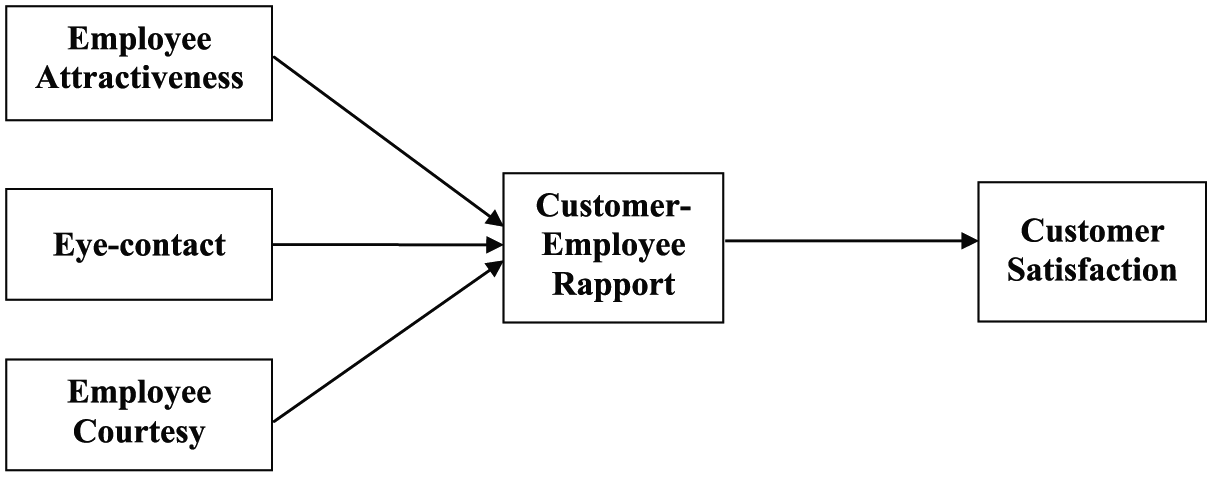
Conceptual Model
Methodology
The purpose of the research is to investigate the main and interaction effects of the three employee attributes. Following previous research (Keh et al., 2013; Lee & Cranage, 2014; Wang & Mattila, 2013), this study employs a scenario-based experiment. More specifically, this research investigates a 2 (attractiveness: attractive vs. unattractive) × 2 (eye contact: present vs. absent) × 2 (courtesy: high vs. low) between-subjects experimental design. The use of scenario-based experimental design specifically allows for a high level of control, the ability to manipulate variables individually, and to uncover the causal effects (Wang & Mattila, 2013).
Experimental Stimuli and Procedures
To manipulate physical attractiveness, a series of pretests were conducted. The use of photos in marketing research is an effective method to gauge appearance and attractiveness (Fisher & Ma, 2014; Keh et al., 2013; Kim & Baker, 2017; Magnini et al., 2013). First, researchers obtained photos of both male and female faces with high and low attractiveness from an Internet stock photographer. Respondents were then shown forward facing headshots of individuals corresponding to levels of attractiveness, and were asked to rate the four variables including clarity (1 = blurry, 11 = clear), background (1 = distracting, 11 = not distracting), age, and attractiveness (1 = not attractiveness at all, 11 = very attractive). We required a mean score above 8.0 for clarity, background, attractiveness either above 8.0 or below 4.0, and age classified in the range between 21 and 35 which is the representative demographics of hotel industry employees to be selected for the final photo. To control potential variables, such as the influence of smiling that can possibly affect rapport, only smiling faces and Caucasian people were used for the stimuli. Based on multiple pretests, the final photos were selected to conduct the main study.
Manipulations of service employee courtesy and eye contact were accomplished through texts as outlined in Giebelhausen et al. (2014), describing a hotel check-in scenario and interaction between a customer and front desk clerk. In the high-courtesy condition, as the customer asks about the hotel facilities, the clerk explains in a very considerate and friendly manner about the detailed information of the hotel facilities, while in the low-courtesy condition, the clerk explains in an inconsiderate and unfriendly manner and gives very brief details. To manipulate eye contact, in the eye contact present condition, the clerk frequently looks up from the desk and makes eye contact with the customer, while in the eye contact absent condition, the clerk does not look up from the desk and does not make eye contact with the customer.
Participants were instructed to imagine that the given photo shows a front desk clerk at a full-service hotel, and to read the accompanying scenario. Then, they are asked to fill out a survey questionnaire by referring only to the written text and photo-based scenario provided. At the end of the survey, participants were asked for their overall feedback in regard to realism, perceptions, and experimental stimuli.
Pilot Test
Since previous research reveals that similar attributes shared between two people such as gender positively influence rapport (Gillis, Bernieri, & Wooten, 1995), we conducted a pilot test before the main study to (a) examine the potential impact of employee gender on the testing hypotheses and (b) check for the salience of the three manipulated employee attribute elements. We conducted two pilot tests of 2 (employee attractiveness; attractive vs. not attractive) × 2 (eye contact: present vs. absent) × 2 (employee courtesy: high vs. low) between-subjects experiment with a variation of employee gender (female vs. male) for the stimuli of employee attractiveness. Participants were recruited from students at a university in the northeast region of the United States, resulting in 72 participants for female employee stimuli and 71 participants for male employee stimuli.
In terms of the manipulation, for physical attractiveness, the participants rated the attractive employee significantly higher than the unattractive employee in both pretests. For eye contact, participants found a significant difference between eye contact present and absent in both pretests. Similarly, for employee courtesy, participants distinguished between high and low courtesy in both groups. Taken together, these results indicate that the manipulation of each of the three employee cues was successful in both female employee group and male employee group, reflecting no impact of employee gender on manipulation. To determine whether there is a different pattern of the hypothesized relationship by using different gender for employee attractiveness stimuli, a three-factor analysis of variance was performed. In both pretests, there was a significantly positive main effect of eye contact (female: F = 10.86, p < .01; male: F = 66.23, p < .001) and courtesy (female: F = 39.82, p < .001; male: F = 186.97, p < .001) on customer–employee rapport, while employees’ attractiveness had no significant effect on customer–employee rapport (female: F = 3.55, p = .63; male: F = 3.56, p = .64). In terms of the interaction effect, only employee eye contact interacted with employee courtesy to influence customer–employee rapport in both groups (female: F = 6.04, p < .05; male: F = 32.28, p < .001). Furthermore, both pretests showed that customer–employee rapport has a significant impact on customer satisfaction (female: β = 0.964, p < .001; male: β = 0.65, p < .001). As two pretests showed a similar pattern in terms of the impact of three employee attributes on customer–employee rapport, and the impact of rapport on customer satisfaction, we chose to utilize female service providers for our experiment stimuli in the main study.
Main Study
Research Design, Sample
A 2 (employee attractive; attractive vs. not attractive) × 2 (eye contact: present vs. absent) × 2 (employee courtesy: high vs. low) between-subjects factorial experiment was used. Three hundred and sixty participants were recruited from Amazon Mechanical Turk, which features a diverse nationwide pool of consumers and provides high-quality data (Buhrmester, Kwang, & Gosling, 2011). Prior hospitality research utilizing experimental design has utilized MTurk to collect data (see Kim & Baker, 2017; Liu & Mattila, 2016; Wu, Shen, Fan, & Mattila, 2017). In addition, as this research examines a hotel check-in scenario, we asked the frequency of nights per year respondents have stayed at a hotel as a screening question and eliminated participants who answered zero. Over 28.5% of respondents stay in a hotel 4 to 6 times per year and 35.5% over 7 times per year. A total of 47% of the respondents were female and 53% were male. The mean age of the sample was 32 years old with the range of 20 to 72 years. More than half of the respondents were White (54.4%), followed by Asian (33.9%).
Measures
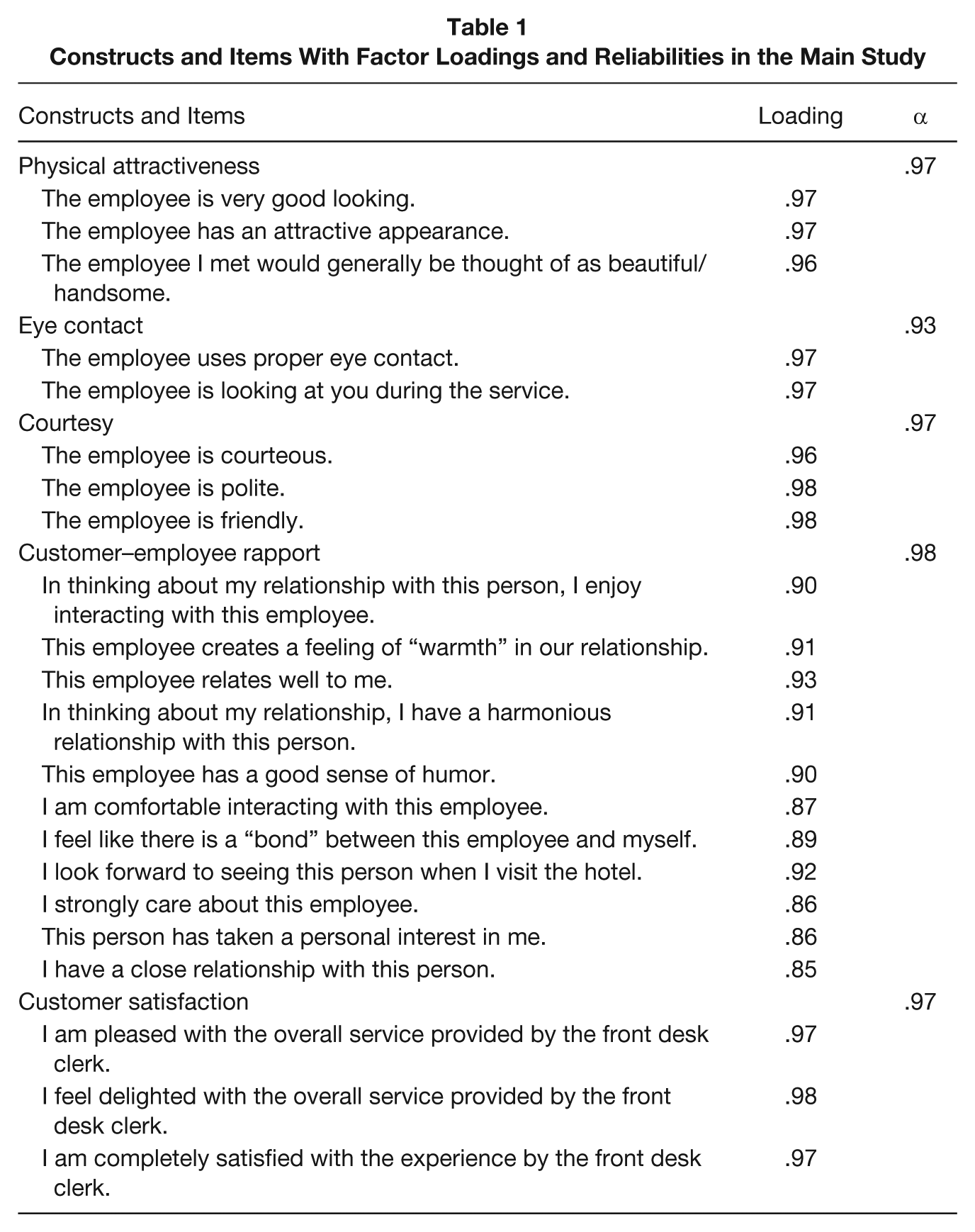
All items were measured using a 7-point Likert-type scale. Three items from Ahearne et al. (1999) were used as a manipulation check for employee physical attractiveness (female: α = .97; male: α = .97). To check manipulation of eye contact, two items from Jung and Yoon (2011) were utilized (female: α = .97; male: α = .91). The manipulation check for employee courtesy was measured using a three-item scale from Gotlieb et al. (2004; female: α = .98; male: α = .97). To measure customer–employee rapport, 11 items from the scale developed by Gremler and Gwinner (2000) were used (female: α = .97; male: α = .97). To measure customer satisfaction, three items from Seiders, Voss, Grewal, and Godfrey (2005) were used (female: α = .98; male: α = .98). Factor analysis and reliability tests are presented in Table 1.
Constructs and Items With Factor Loadings and Reliabilities in the Main Study
Results
Manipulation Checks
A series of independent sample t-tests were conducted to check whether respondents perceived the stimuli as the researchers intended. As expected, the participants rated the attractive employee significantly higher than the unattractive employee (Mattractive condition = 5.77 vs. Munattractive condition = 3.11; t = 18.12, p < .001). For eye contact, participants who were in eye contact present condition rated higher than participants who were in eye contact absent condition (Meye contact present condition = 5.51 vs. Meye contact absent condition = 2.14; t = 19.57, p < .001). Similarly, for employee courtesy, participants distinguished between high and low courtesy (Mhigh courtesy = 5.62 vs. Mlow courtesy = 2.19; t = 21.86, p < .001). Taken together, these results indicate that the manipulation of each of the three employee cues was successful.
Employee Elements on Rapport
A three-factor analysis of covariance was performed to test the effect of three employee elements on customer–employee rapport by controlling respondents’ gender. There was a significant main effect of eye contact (F = 29.35, p < .001) and courtesy (F = 159.93, p < .001) on customer–employee rapport, supporting Hypotheses 2a and 3a (rejecting Hypotheses 20 and 30; Table 2). Participants felt a stronger rapport with the employee who displayed eye contact (M = 3.70, standard error [SE] = 0.10) than with the employee who had no eye contact (M = 2.91, SE = 0.11). Participants also perceived a stronger rapport with employees who were courteous (M = 4.23, SD = 0.10) rather than not courteous (M = 2.40, SE = 0.10). On the other hand, employees’ attractiveness did not significantly influence customer–employee rapport (F = 2.66, p > .01), failing to support Hypothesis 1a (failing to reject Hypothesis 10; Table 2). In terms of the interaction effect, only employee eye contact interacted with employee courtesy to influence customer–employee rapport (F = 6.08, p < .05), supporting Hypothesis 6a (rejecting Hypothesis 60), but failing to support Hypotheses 4a and 5a (failing to reject Hypotheses 40 and 50; Table 2). As indicated in Figure 2, the difference in customer–employee rapport as a result of the employee courtesy was larger under employee eye contact present condition (Mhigh courtesy & eye contact present condition = 4.80 vs. Mlow courtesy & eye contact present condition = 2.62). In other words, the high courtesy of the employee increased customer–employee rapport to a higher level when the employee also presented a higher level of eye contact. In terms of the covariate, gender of respondents reached the level of statistical significance. It is possible that effect might have contributed to the null findings regarding the attractiveness. Future research is needed to examine the impact of respondents’ gender on customer–employee rapport.
Analysis of Covariance Results
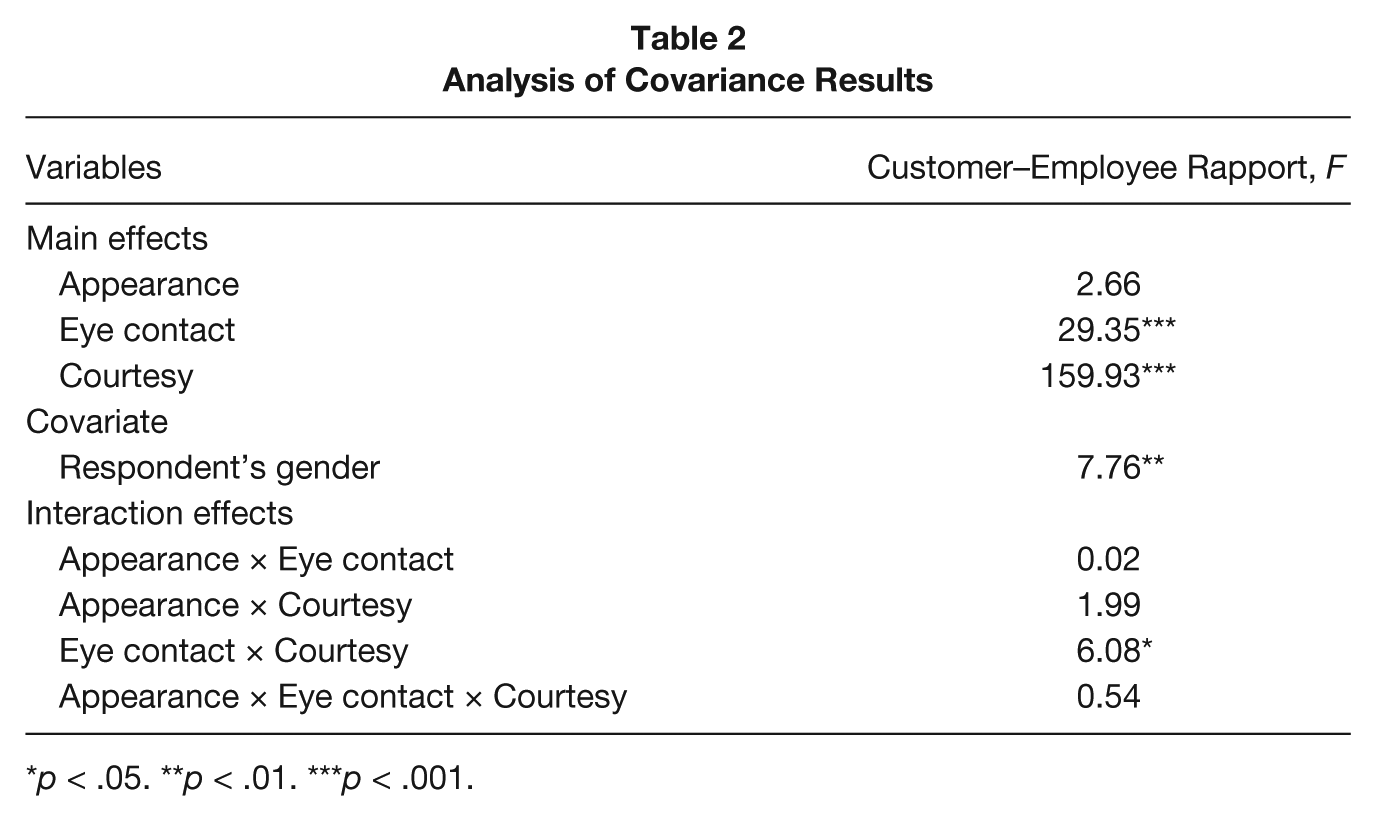
p < .05. **p < .01. ***p < .001.
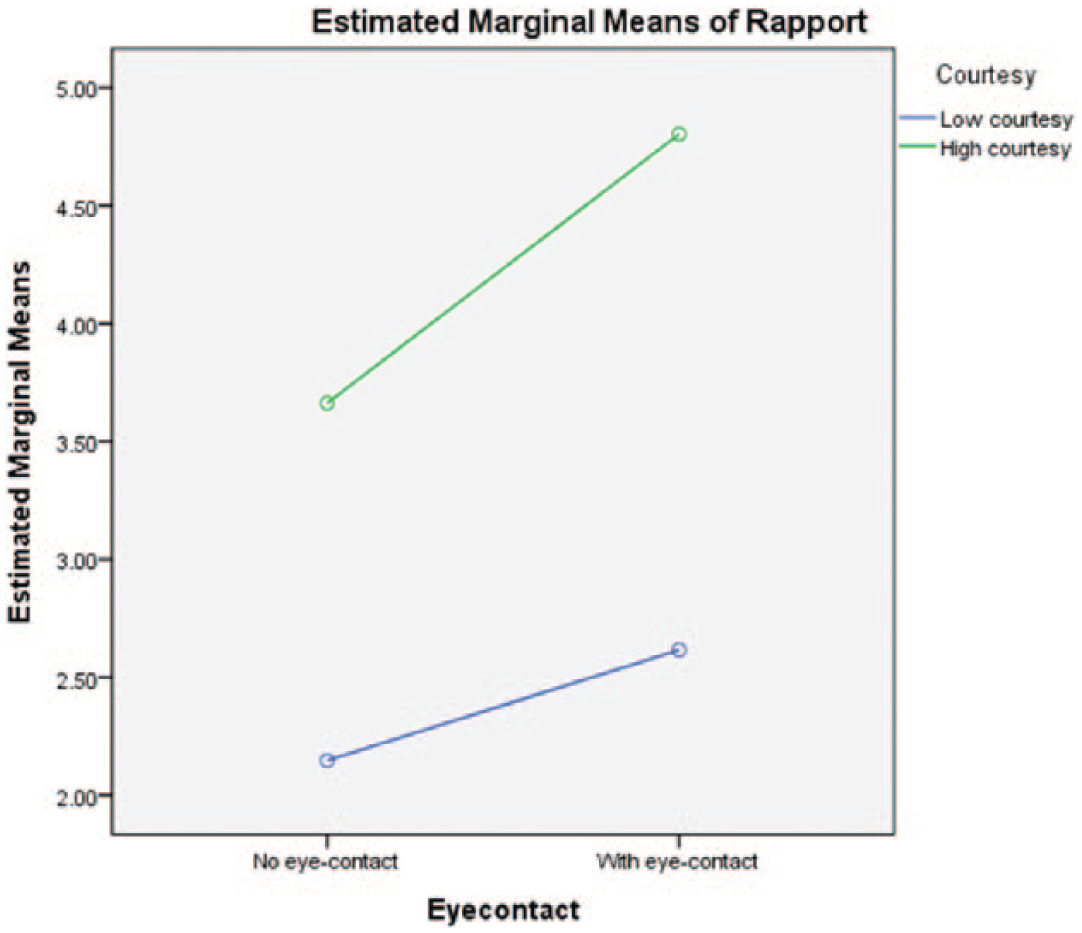
The Interaction Between Eye Contact and Courtesy on Employee–Customer Rapport in the Main Study
Effect Size
To test Hypothesis 7, relative weights analysis was conducted following the procedures in Tonidandel and LeBreton (2011) to partition the explained variance among the experimental factors. A relative weight analysis explains the contribution each predictor variable has on the variance of the dependent variable (Tonidandel & LeBreton, 2011). The relative weight analysis supported the predominance of employee courtesy in explaining customer–employee rapport. The relative weight of courtesy (28.05%; 95% CI [0.197, 0.365]) was significantly higher than the importance of either eye contact (6.13%; 95% CI [0.023, 0.109]) or attractiveness (0.312%; 95% CI [−0.013, 0.018]). The sum of the relative importance of eye contact and attractiveness is about one third as large as courtesy. These results support Hypothesis 7a (reject Hypothesis 70) in that employee courtesy has a stronger effect on customer–employee rapport than either employee appearance or eye contact.
Mediation Effects
To investigate the effect of customer–employee rapport on customer satisfaction, a linear regression analysis was conducted. The results show that customer–employee rapport has a significant impact on customer satisfaction (β = 1.09, p < .001). To further examine the underlying mechanism, we examined whether customer–employee rapport mediates the effect of employee eye contact and courtesy on customer satisfaction. Following Preacher and Hayes (2008), results from bootstrapping procedure that generated a sample size of 5,000 revealed a mediation effect of customer–employee rapport between employee eye contact and customer satisfaction, as the mean indirect effect excluded zero (95% CI [0.5016, 1.2292]), supporting Hypothesis 8(b)a (rejecting Hypothesis 8(b)0). Similarly, customer–employee rapport also mediated the relationship between employee courtesy and customer satisfaction (95% CI [1.5042, 2.0441]), supporting Hypothesis 8(c)a (rejecting Hypothesis 8(c)0). However, customer–employee rapport did not mediate the relationship between attractiveness and customer satisfaction, failing to support Hypothesis 8(a)a (failing to reject Hypothesis 8(a)0). This analysis suggests that customer–employee rapport mediates the effect of employees’ eye contact and courtesy on customer satisfaction.
Discussion
Employee attributes such as physical appearance, eye contact, and courtesy have been taken for granted as service norms for practitioners, without empirically taking into account the effect of physical cues, nonverbal communication cues, and behavioral cues simultaneously. As such, this study may provide insights into the role of service employees’ attributes in driving customer behavior to practitioners and service firms. In many service settings, such as the hospitality industry, which is more labor intensive and requires higher levels of interaction with customers, the quality of service is tied to its frontline provider. The present research provides insights into the role of service employee attributes in driving customer–employee rapport and customer satisfaction. The study results suggest that employee eye contact and courtesy are critical components of building customer–employee rapport. Furthermore, customer–employee rapport mediates the effect of eye contact and courtesy on customer satisfaction. The implication is that employees displaying frequent eye contact and courteous behavior leads to greater customer satisfaction because it enhances building customer–employee rapport. Contrary to our expectation, appearance of the service employee does not significantly affect customer–employee rapport. While employee attractiveness may enhance the service encounter, attractiveness is not a substitute for friendly, courteous service. Although appearance is one of the salient attributes of an employee, when building rapport, customers pay more attention to the nonverbal and behavioral cues of employees. This is supported by the much larger effect size of employee courtesy on customer–employee rapport compared with employee appearance and eye contact. It emphasizes that employee courtesy exerts a greater influence on customer–employee rapport than other two. Furthermore, we find a significant interaction effect between employee eye contact and courtesy on rapport. Specifically, the presence of high courtesy can increase customer–employee rapport to a higher level when employees keep higher eye contact with customers than lesser eye contact.
Theoretical Implications
Our findings provide several critical theoretical implications. First, while previous studies focus on examining one dimension of an employee attribute (Jung & Yoon, 2011), this study provides evidence of the effect of employee’s physical attractiveness, eye contact, and courtesy simultaneously on building customer–employee rapport. In doing so, the findings from this study suggest the differential and interactive effects of the three employee attributes on customer–employee rapport, which was not fully explained by previous studies. Furthermore, despite both practitioners and academics believing employee attributes such as normative scripting behavior leads to positive customer outcomes (Victorino & Bolinger, 2012), there are no empirical studies that test the causal link. By utilizing experimental design and controlling other alternative variables, this study adds methodologically and provides more conclusive evidence on the effect of courtesy and eye contact on rapport and customer satisfaction.
Second, there is a lack of empirical research that examines the influence of nonverbal communication, such as attractiveness and eye contact, in the hospitality industry and the marketing literature. Despite the managerial belief that eye contact is important in service interactions, few empirical studies examine its influence. This is even more critical given that the dependence on technology has naturally decreased the amount of eye contact during the service exchange. As such, this study fills the gap in the literature by empirically examining the influence of eye contact in today’s service environment.
Third, the results demonstrate that employee courtesy exerts a greater influence on customer–employee rapport than physical attractiveness and eye contact. Although nonverbal attributes such as displaying eye contact affects building rapport with customers, employee courteous behavior has the strongest influence on generating rapport with customers. These results support multiattribute models (e.g., Ajzen & Fishbein, 1973) which argue that when developing an attitude toward a service firm, consumers are likely to weigh attributes that they can evaluate more easily than attributes that are more difficult to evaluate. Since employee courteous behavior is a more salient and straightforward attribute than nonverbal attributes (i.e., eye contact, attractiveness), employee courtesy is likely to be an attribute that is heavily weighted when consumers build rapport with employees. This study also finds an interaction effect which implies that the presence of high courtesy can increase customer–employee rapport to a higher level when employees keep high eye contact with customers.
Practical Implications
Given the competitive environment of the service industry, many service firms design service encounters by scripting the way employees interact with customers (Victorino, Verma, & Wardell, 2008). The findings of this study demonstrate that both verbal and nonverbal communication is important in building rapport and satisfaction. As such, firms should seek to implement communication strategies that align with their brand message. For example, JW Marriott Hotel employees were recently trained by the Joffrey Ballet in the importance of elegant body language and attentive eye contact (Baker, 2016). In addition, this research is managerially relevant as it empirically finds that eye contact is still a critical rapport builder especially given the proliferation of technological use, which defers customer–employee eye contact to employee–technology eye contact. Our findings suggest that a firm’s use of frontline technology should be determined with regard to the desired nature of the service interaction between the customer and the employee. This study is the first to empirically find that technology dependence and limited eye contact detracts from customer–employee rapport and satisfaction. In addition, although appearance was not a significant employee attribute on building rapport in our study, the appearance of an employee is not a negligible attribute. Service firms can establish guidelines for employees’ appearance, such as appropriate makeup, grooming, and uniform standards.
One of the important findings of this study is that employee courtesy surpasses attractive appearance and eye contact in enhancing customer–employee rapport. It suggests that managers should strongly emphasize courteous behaviors to build rapport with customers which ultimately leads to higher levels of customer satisfaction. Training materials should emphasize customer respect and attention. In addition, as employee courteous behavior and eye contact have a synergy effect on building customer–employee rapport, managers should explain the benefit of presenting all attributes together and train employees to employ those elements when interacting with customers.
Limitations and Future Research
The study includes several limitations to be supplemented by future studies. Nonverbal behaviors such as eye behaviors are complex in nature. In order to have a high amount of internal validity, and to not introduce other intervening variables, this study used photo and text-based scenarios to manipulate appearance and eye contact. However, future studies may utilize video recording or lab experiment to manipulate additional variables. In addition, future studies can examine other aspects of nonverbal behavior such as eye contact duration, genuine smiling, and other appearance elements. Although we controlled respondents’ gender as a covariate in our analysis, as gender was not a main interest of our research, future studies may take into account the interaction effect between respondent’s gender and service provider’s gender on customer–employee rapport. For instance, male customer might more easily build rapport with female service providers. In addition, although our study controlled for the effect of race by only using Caucasian photos as a stimuli, given that multiculturalism has become a common trend, future studies may examine the effect of race as well as how respondents’ race interacts with the employee race when building rapport. Future research that examines the physical or social servicescape, such as the moderating effects of the physical environment on the relationship between employee attributes and customer outcomes, would also build on this stream of literature. In addition, customer–employee rapport could function as a moderator as well in a sense that it is a relational factor that influences the judgment of others behavior. Finally, with the prevalence of technology use in frontline service encounters, rapport is of interest to researchers and managers as technology functions can be a barrier of building rapport between customer and employee (Giebelhausen et al., 2014). Future research can also explore the impact of employee attributes such as eye contact, courtesy, and appearance on customer evaluation of the service at the intersection of technology usage, and their potential interactive effects.