



Abstract
This study evaluates lodging-context research by addressing the trend in the number of journal publications and the most prolific contributors from 1990 to 2016. To this end, data were collected from 16 leading academic journals. The study results suggest that the number of lodging-context articles from 1990 to 2016 increased significantly and that among the 16 leading journals analyzed, the International Journal of Hospitality Management and the International Journal of Contemporary Hospitality Management were the two most productive journals in publishing lodging-context–related articles. Contributors were identified according to author, institution, and country. Regarding lodging operations classifications, hotels appeared to be the most researched organizations while marketing was found to be the most studied research topic, followed by strategic management. This is the first study offering a bibliometric analysis of lodging-context research in our field.
The main purpose of this study is to investigate the progress in studies focusing on the lodging industry. The importance of the lodging industry is its impact on economic, business, social, and academic environments (Roberts & Shea, 2017). In recent years, interest in studies directly related to lodging or the lodging industry has increased. Scholars often use different terms such as hospitality, lodging, accommodation, hotel, and so on, interchangeably, in their studies. Given this, the current study considers all related terms as lodging-context research or studies. Lodging-context literature is disparate, fragmented, and isolated since studies in this field have been entangled with hospitality studies using theories from other disciplines, such as business and management (Roberts & Shea, 2017). In this respect, Roberts and Shea (2017) quest that lodging-context studies should develop a theory of lodging by exploring hotel guest behavior as the genesis of psychological and/or sociological theories in the tourism field rather than business and management perspectives. Despite this growing interest and the quest, analysis on the status of lodging-context studies is still scarce. Researchers have yet to determine the amount or quality of research focusing on lodging context for researchers, practitioners, and policymakers. Therefore, this study aims to address how we can advance lodging-context research in our field by elucidating the following issues:
Trends in the number of lodging-context publications from year to year and by academic journals
The most prolific contributors of lodging-context research according to author, institution, and country
Lodging-context articles focusing on the types of establishment and management subdisciplines/fields
To achieve these goals, this study employs a bibliometric analysis using data from articles published in 16 leading journals dating from 1990 to 2016. Since then, significant changes have occurred in the hospitality management literature in terms of research type, unit of analysis, method of analysis, and theoretical contribution (Rivera & Pizam, 2015). Following this brief introduction, the first section presents a review of the lodging industry and overview of the evolution in lodging-context studies. Second, the research methodology is described. Next, study results are presented and discussed. Last, the study conclusions are highlighted and suggestions for future research are offered.
Literature Review
Lodging Industry
The history of the lodging industry can be traced back to more than 12,000 years when people started trading and/or traveling from one place to another (Lattin, Lattin, & Lattin, 2014). Due to the limited infrastructure and transportation at that time, traders and/or travelers were required to stay in one or more destinations, which meant that lodging or sleeping accommodations were much needed and became an important business (Lattin et al., 2014). In recent years, lodging operations have been classified into several categories such as hotel, motel, lodge, resort, bed and breakfast, timeshare, and Airbnb (Guttentag, 2015; Lattin et al., 2014; Stutts & Wortman, 2006).
As one of the largest industries in the world, the travel and tourism industry is expected to grow annually. Despite global political and economic issues, the growth of the travel and tourism industry has surpassed the growth of the global economy, in general, for the past 6 years to become one of the largest and fastest-growing economic sectors in the world. By 2030, 1.8 billion tourists are expected to travel worldwide (“UNWTO tourism highlights, 2016 edition,” 2017), and as part of the travel and tourism industry, the number of lodging operations is also expected to grow. In 2016, for example, revenue from the global hotel industry reached US$550 billion from US$457 billion in 2011, and the statistics suggest that the lodging industry is in a healthy state (“The global hotel industry and trends for 2016,” 2015).
Furthermore, as the travel and tourism industry increases, the number of scientific research studies by scholars on lodging also increases (Ryan, 2015). As a result, the number of lodging-context research topics has surged in recent years. Among many research areas in lodging, several areas that have been noted in the recent literature include labor turnover, employee engagement, talent management, customer relationship management, environmental practices, green hotels, recycling, the Internet, online reviews, information search, social media, electronic word-of-mouth communication, customer satisfaction, customer loyalty, strategic planning, competitive advantage, and performance management (Koseoglu, Rahimi, Okumus, & Liu, 2016).
Overview of Evolution in Lodging-Context Studies
Although hospitality includes multiple sectors such as lodging, food service, events, private clubs, and gaming (Roberts & Shea, 2017), previous bibliometric studies have mainly focused on the hospitality industry as a common field (e.g., Hsu, Xiao, & Chen, 2017; Kalargyrou & Costen, 2017; Kim, Lee, & Fairhurst, 2017; King, 2017; Kwok, Xie, & Richards, 2017; Madera, Dawson, Guchait, & Belarmino, 2017). Several previous studies assessed these subindustries of the hospitality industry. For example, DiPietro (2017) presented a critical review of restaurant and food service research published in the last 10 years. Rivera and Pizam (2015) quantitatively evaluated the articles published in the International Journal of Hospitality Management (IJHM) during the years 2000 to 2012. In their study, Rivera and Pizam (2015) investigated the methodological procedures of the papers by sectors, including lodging, food and beverage, other sectors, and tourism (macro). However, as noted above, there has been limited research on how lodging-context research has evolved. To help advance the development of the indigenous theories for lodging and to shift the advancement in these theories, bibliometric studies are needed.
Methodology
Bibliometric Analysis
Bibliometric analysis is a statistical tool to measure the progress, evolution, or growth in a given topic, discipline, or industry (Bouyssou & Marchant, 2011). It collects data from studies such as the number of published scientific works in a given span of years, the matters mostly studied, the universities contributing the most to the field, the number of the authors of the works, keywords used, citations, and co-citations (Koseoglu et al., 2016). This type of analysis helps researchers investigate quantitative and qualitative changes in each research topic and highlight the tendencies in the topic (De Bakker, Groenewegen, & Den Hond, 2005). To conduct the bibliometric analysis of research pertaining to the lodging industry, this study focused on the growth of publications, contributors, and themes discussed in the articles.
Databases and Journals Selection
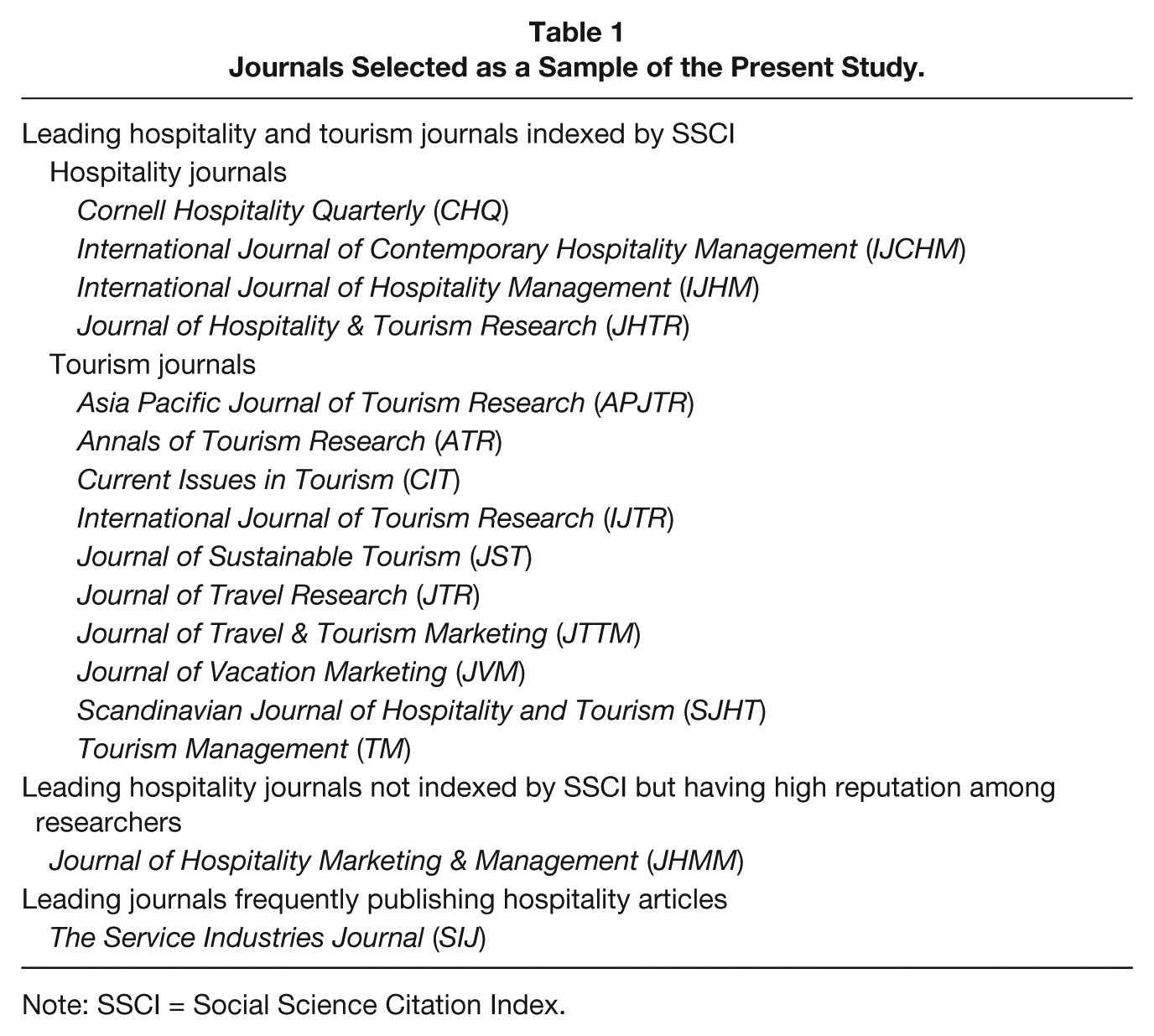
Leading academic journals were selected since they have a peer review process generating “certified knowledge” (Ramos-Rodrigues & Ruis-Navarro, 2004 ). Three methods were used to select journals related to the lodging industry. First, the Social Science Citation Index (SSCI), released in 2017, was used to select the leading hospitality and tourism journals dealing directly with the lodging industry. Second, a few hospitality journals have a high reputation but are not indexed on the SSCI. Hence, the Journal of Hospitality Marketing & Management (JHMM) is considered in this category. Last, many journals that are indexed on the SSCI frequently publish hospitality articles but are not considered as leading hospitality journals. Based on the scope of the Service Industries Journal, it is considered in this category. All journals accepted as a sample of the current study are presented in Table 1.
Journals Selected as a Sample of the Present Study.
Note: SSCI = Social Science Citation Index.
Data Collection
To extract related articles from the selected journals, we first identified keywords reflecting the lodging industry. The keywords included hotel, lodge, lodging, motel, accommodation, timeshare, bed and breakfast, sharing economy, couch surfing, resort, Airbnb, guest house, hostel, condo, cruise, casino, caravan park, and recreational vehicle. Second, two authors of this study scrutinized the titles, keywords, and abstracts of all studies that appeared in the aforementioned journals from January 1990 to the last issue of December 2016. The process of collecting and coding the data began in April 2016 and was completed in March 2017.
Last, the two authors individually verified whether the study was related to the lodging context to ensure data validity and reliability. As a result, a total of 2,647 studies published between 1990 and 2016, including full articles and research notes, were found. Since 2000, it has been claimed that hospitality researchers have become innovators in the field (Rivera & Pizam, 2015). In addition, the number of articles has increased significantly since 2002, as seen Figure 1. Given this, two subperiods (1990-2000 and 2001-2016) were formed for this study.

Number of Lodging-Context Articles by Year
Analysis
A spreadsheet was created to analyze the articles by employing content analysis for each article. It included data about (a) journal title; (b) publication year; (c) themes of articles; (d) contributors including authors, institutions, and countries; and (e) area of articles based on management subdisciplines as indicated in previous bibliometric studies in other fields that followed a similar approach (Rey-Martí, Ribeiro-Soriano, & Palacios-Marqués, 2016). To evaluate the changes in the literature, descriptive analyses were used over the years between 1990 and 2016. The information based on these periods was graphitized to elucidate the state of the art of lodging-context literature.
Results
Number of Lodging-Context Publications per Year
Figure 1 shows that productivity increased in terms of the number of articles related to the lodging industry. To illustrate this trend, a polynomial trendline was assessed using different regression models (linear, logarithmic, exponential, and power law approaches) with dependent (published articles) and independent (article’s year of publication) variables to identify the model that best fits the data (Barrios, Borrego, Vilaginés, Ollé, & Somoza, 2008). The proportion of variance explained was greater in the polynomial model (R2 = 0.9563) than the exponential (R2 = 0.945), power law (R2 = 0.8488), linear (R2 = 0.8873), and logarithmic models (R2 = 0.6243), although all four models were significant.
Lodging-Context Research by Journals
Figure 2 presents the distributions of articles by journals and period as a percentage. The results showed that the number of lodging-context articles by year from 1990 to 2016 increased significantly. Of the 2,647 articles analyzed, IJHM published the highest number of lodging-context articles (26.75%, 708), followed by IJCHM (17.45%, 462), CHQ (10.80%, 286), TM (8.24%, 218), and JHTR (6.20, 164). Among the 16 leading journals analyzed, IJHM and IJCHM were the two most productive and leading journals in publishing lodging-context research with a combined total of 1,170 (44.20%) articles. This shows that there is a significant demand for lodging-context studies. Hence, researchers may (re)take a position to contribute to the field since the increase in demand may continue into the future. Additionally, tourism-oriented journals tended to publish fewer articles per year than hospitality-oriented journals, except for TM. In this group, an increase occurred in recent years, but it is limited. On the other hand, while there are significant decreases in the articles published in JHTR and IJCHM in the second period (2001-2016), the most significant increase emerged in the number of articles published in IJHM.

Percentage of Lodging-Context Articles by Journals as Percentage
Prolific Lodging-Context Scholars
A total of 3,397 authors contributed the 2,647 reviewed articles related to the lodging industry. The most prolific lodging-context author based on appearance is Rob Law, who published 83 articles between 1990 and 2016, followed by Anna S. Mattila (37 articles), Osman M. Karatepe (35), Heesup Han (32), and Wilco W. H. Chan (31). Figure 3 presents the most prolific authors by period based on the number of appearances. While the first period included 19 authors who have at least four articles, the second period included 17 authors who have at least 15 articles. Specifically, during the first period, the most prolific lodging-context author (based on appearance) is Michael Riley, who published 8 articles between 1990 and 2000, followed by Darren Lee-Ross (7), Roger J. Callan (7), and Paul A. Phillips (6). Although Cathy A. Enz, Simon Chak-Keung Wong, and Tom Baum produced a significant amount articles in the second period, none of the authors from the first period appear in the top-ranking list for the second period (the top-ranking list includes authors who have at least 15 appearances). In the second period, the most prolific lodging-context author (based on appearance) is Rob Law (80 articles), followed by Osman M. Karatepe (35), Anna S. Mattila (34), and Heesup Han (32). Many of the authors from the second period do not appear at all in the first period.
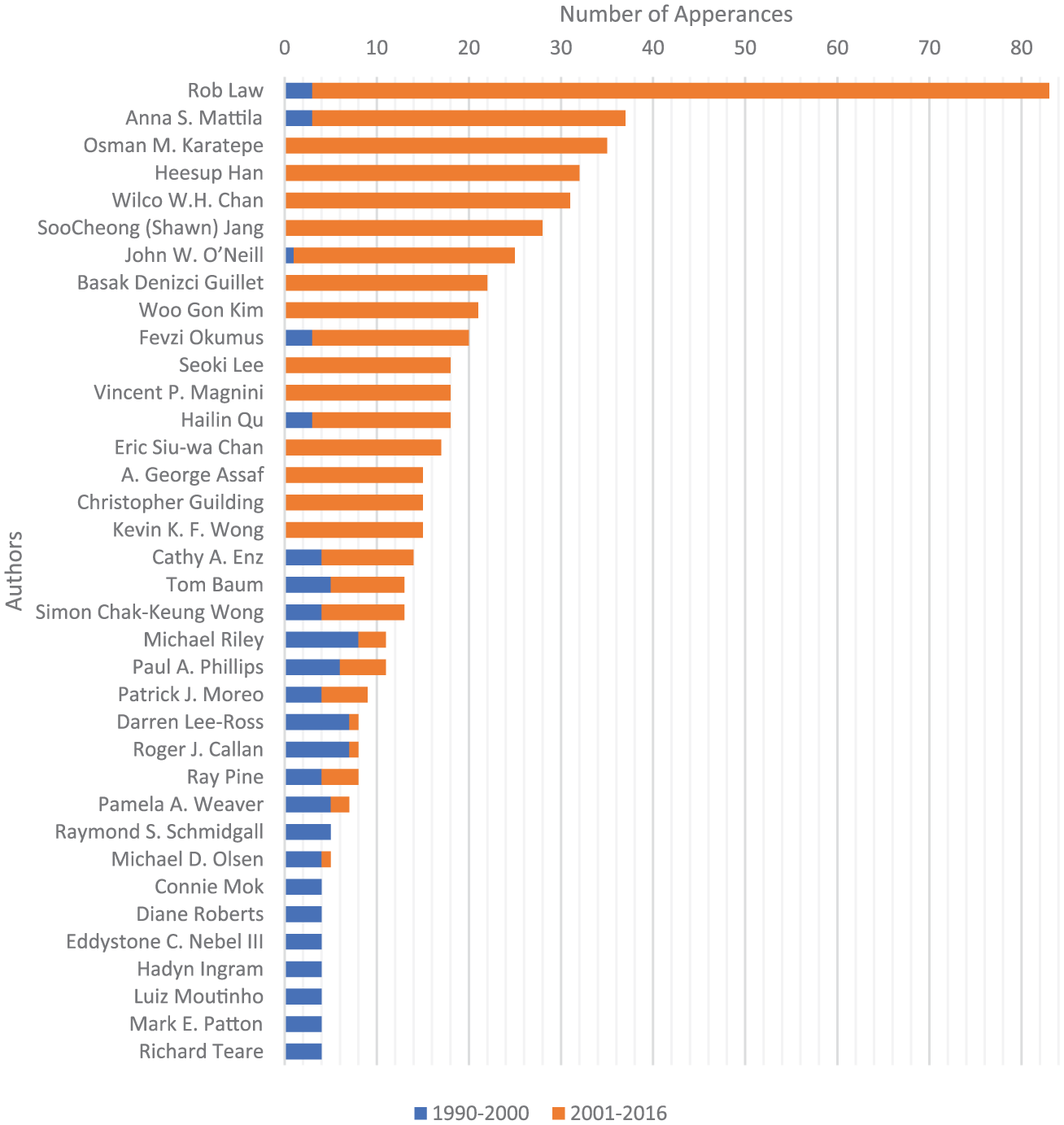
Prolific Lodging-Context Scholars by Period
Leading Institutions and Countries Contributing to Lodging-Context Research
A total of 1,149 institutions from 76 countries contributed to the 2,647 reviewed articles related to the lodging industry. The most prolific institution based on appearance is The Hong Kong Polytechnic University, which published 547 articles between 1990 and 2016, followed by Cornell University (192), Pennsylvania State University (144), Griffith University (142), and Purdue University (116). Figure 4 presents the most prolific institutions by period, based on the number of appearances. The first period includes 25 institutions that have at least six appearances, and the second period includes 43 institutions that have at least 20 appearances. In the first period, the most prolific institution based on appearance is Cornell University, which published 46 articles between 1990 and 2000, followed by Hong Kong Polytechnic University (41), University of Surrey (34), and Michigan State University (29). In the second period, the most prolific institution based on appearance is Hong Kong Polytechnic University (506), followed by Cornell University (146), Griffith University (139), Pennsylvania State University (125), and University of Nevada (93).
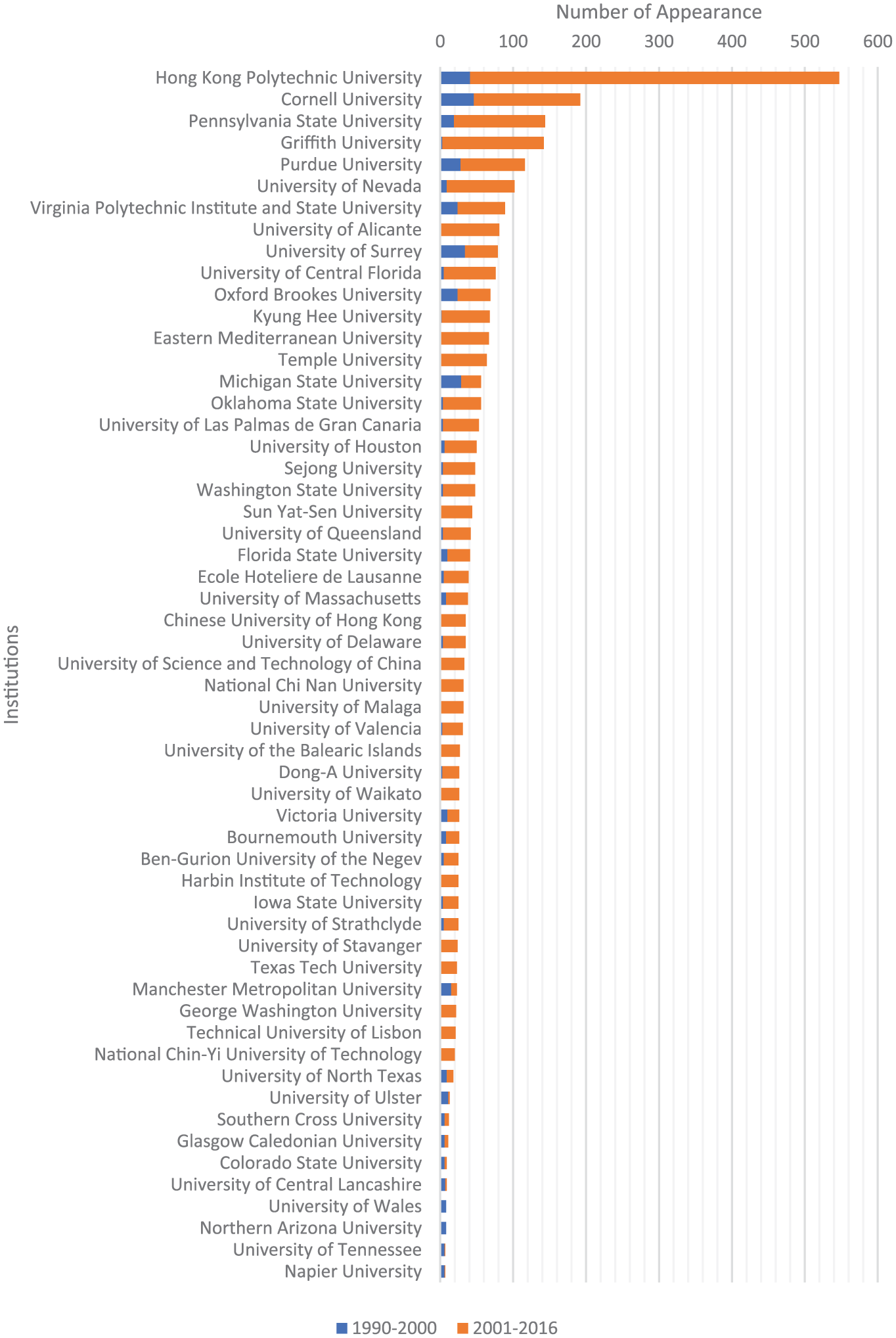
Leading Institutions Producing Lodging-Context Research by Period
Figure 5 lists leading countries (having at least 10 adjusted appearances) based on the number of adjusted appearances and the number of appearances. Adjusted appearance is calculated by considering how many authors were involved in producing an article. For example, if one author produces one article, one credit is given; if two authors produce one article, 0.5 credits are given for each author; and if three authors produce one article, 0.33 credits are given for each author (Furrer, Thomas, & Goussevskaia, 2008). As seen in Figure 5, the most prolific country based on adjusted appearances is the United States (821.41), followed by the United Kingdom (295.57), Hong Kong (256.14), Taiwan (187.89), and Spain (167.82).

Leading Countries in Lodging-Context Research
In terms of author and institution, Rob Law and his institution, The Hong Kong Polytechnic University, both appeared to be the most productive author and institution, while the United States appeared to be the most productive country in producing lodging-context–related research articles. Many leading authors in lodging-context research are from universities located in Asia. One may say that the center of the lodging-context academic community has shifted from West to East, which brings new avenues to researchers. They can investigate why authors from Asian institutions are more prolific than other authors in lodging-context studies. Is it due to policies administrated by Asian universities or the nature of the lodging industries? Do they study the lodging industry specifically in Asia or do they contribute to the knowledge base in other countries or do they produce general lodging-context studies? If they exclusively study the Asian lodging industry, how have the lodging industry and literature been shaped?
Type of Establishments and Management Subfields
Figure 6 outlines the number of articles based on the type of establishment including hotels, motels, hostels, bed and breakfasts, sharing economies, timesharing, caravan parks, serviced apartments, accommodations, resorts, and lodgings based on the studies’ dominant samples or dominant themes. The articles related to hotels are dominant (2,184 out of 2,647), followed by lodging (133), resorts (89), and accommodations (77). There are few articles addressing issues in caravan parks, motels, serviced apartments, sharing economies, hostels, timeshares, bed and breakfasts, and casinos. The number of articles related to hotels was almost the same in both periods. Additionally, while the number of articles related to resorts, lodging, bed and breakfasts, and service apartments decreased, the number of articles related to cruises, accommodations, and casinos increased slightly. To build a theory of lodging (Roberts & Shea, 2017), more studies focusing on bed and breakfasts, casinos, serviced apartments, hostels, caravan parks, and timeshares are needed.
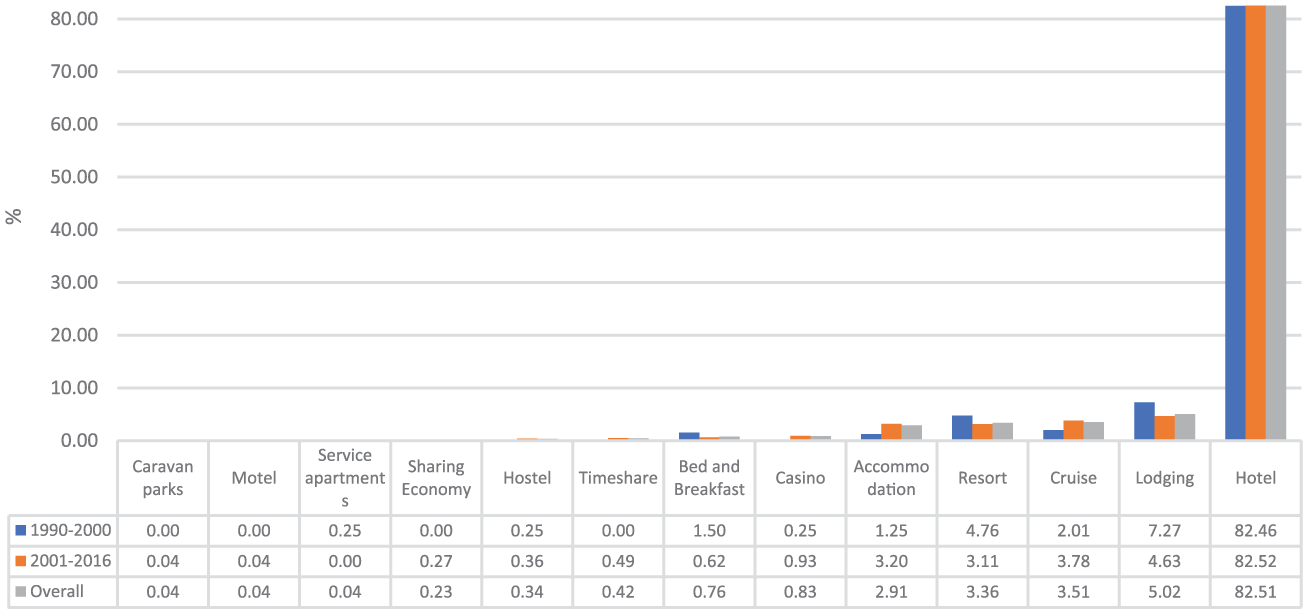
Focus of Articles Based on Type of Establishments
Figure 7 presents the number of articles based on study area including marketing, strategic management, human resource management, organizational behavior, operation, service management, and so on. The most prolific study area is marketing (28.07%, 743 articles), followed by strategic management (19.19%, 508), human resource management (11.45%, 303), and finance and accounting (7.06%, 187). In detail, there are more studies focusing on education, corporate social responsibility, and entrepreneurship. In the second period, the number of studies related to organizational behavior and marketing significantly increased; however, the number of articles related to strategic management, human resource management, and finance and accounting significantly decreased. Marketing studies mainly addressed consumer behavior in the lodging industry. Researchers should consider consumer behavior more from a psychological perspective than a business perspective to emphasize the theory of lodging (Roberts & Shea, 2017).
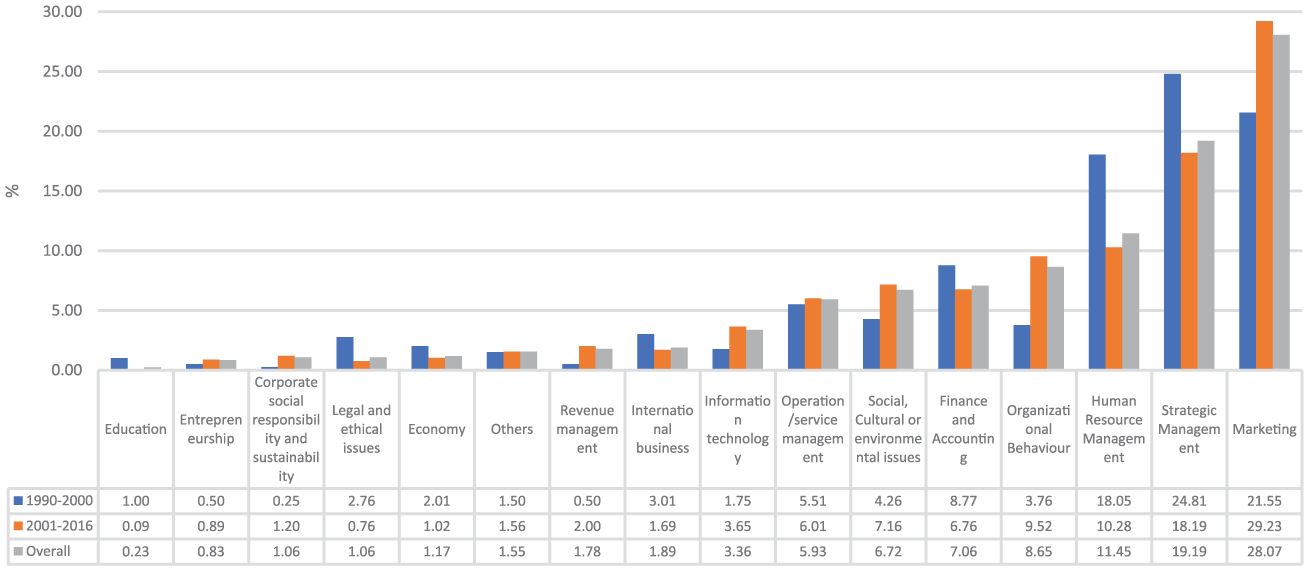
Focus of Articles Based on Management Subdisciplines
Discussion
As one of the first studies in the field, the research findings provide specific implications. The first implication is related to the social identity of the lodging-context academic community. Social identity theory is defined as an “individual’s knowledge that he belongs to certain social groups together with some emotional and value significance to him of this group membership” (Tajfel, 1972, p. 292). To build a social identity, two main motivations are needed: self-enhancement and positive intergroup distinctiveness (Hogg, 2016). Our findings suggest that although there are a significant number of contributors at individual, institutional, and country levels, many of these contributors focus on the hospitality and/or tourism fields rather than directly on the lodging-context field. Additionally, in our experience, these contributors mainly identified themselves as part of hospitality or tourism academic communities even though there are industry-focused associations related to lodging such as the American Hotel & Lodging Association. Therefore, a strong academic community with self-enhancement and positive intergroup distinctiveness is needed to get advancement in the field.
The second implication is related to the types of establishment and management subdisciplines/fields considered in the articles. The areas of research primarily studied in the lodging-context literature we evaluated include those explaining how organizations make more profit or gain a sustainable competitive advantage such as marketing, strategic management, human resource management, and organizational behavior. This is similar to what was reported in Roberts and Shea (2017) and can mostly be explained by publication strategies established by authors, institutions, schools, or journals. Since publications drive academic success among researchers, these topics related to the primary domains of business tend to be most attractive to researchers even though there may be other study topics that could enrich our collective knowledge within the field. To facilitate more progress in the field, dedicated academic communities or special interest groups, research centers, graduate programs, and academic journals with a lodging-context focus should perhaps be established.
Limitations and Future Studies
Similar to most research studies, this study has several limitations. First, data for this study were collected from 16 journals including hospitality, tourism, and business journals. Future studies could collect data from other journals in different fields of study using lodging operations as their subject. This would be helpful in strengthening the findings of this current study. Second, we only took account of articles and research notes in the study. Future work could consider books, book chapters, or proceedings to gain an even greater understanding of lodging-context knowledge to date. Last, we used only frequency analysis to see the overall picture of lodging-context studies. Future studies can use more advanced techniques to investigate the evolution of lodging-context research. Additionally, this field is very fruitful in enhancing review or bibliometric studies since they help with theory development (Koseoglu et al., 2016); therefore, researchers can start conducting bibliometric analyses on lodging-context studies to develop a theory of lodging (Roberts & Shea, 2017). For example, researchers can focus on the evolution of methodologies, themes, or regions in lodging-context studies by employing a systematic review approach. Furthermore, researchers can use advanced bibliometric analyses including co-citation, co-authorship, and co-word analysis to reveal intellectual, social, and conceptual structures of lodging-context studies, respectively.
Conclusion
This study presented a bibliometric analysis of lodging-context research by addressing the trend in the number of publications from year to year according to academic journals; most prolific contributors according to author, institution, and country; and the types of establishment and management subdisciplines/fields. Based on the authors’ knowledge, this is the first study offering a bibliometric analysis of lodging-context research in our field. The majority of the journals were under the SSCI while one of the journals, which was considered to be a prominent journal, was not indexed in SSCI, but was included in the study. A total of 2,647 studies published between 1990 and 2016 from the 16 journals, including full-length articles and research notes, were identified for the purpose of this study. The results from this study provide an overview of the existing information on research studies on lodging from the last 27 years for researchers who are interested in lodging as a research area and the results also provide information regarding prominent journals and authors. The findings should help researchers and professionals identify gaps in literature and practice.
