



Abstract
Understanding the role of the servicescape in the consumption process has become an increasingly important topic in hospitality research. However, while a consensus has been reached regarding the conceptual and operational nature of the physical environment, less is understood about the social aspects of the servicescape. Accordingly, the purpose of this research is to operationalize a multidimensional construct that is reflective of the social phenomena in the consumption environment. Defined in terms of the observable characteristics of the other customers and employees in the service environment, the social servicescape is proposed as a third-order construct composed of three distinct latent factors: customers, employees, and social density. An operationalization in the domain of full-service restaurants supports the proposed specification as a reliable and valid operationalization of the social servicescape. On establishing psychometric stability, nomological validity is established via a quantitative demonstration of the construct’s effect on restaurant consumption behavior.
Understanding the role of environment in the consumption process has become one of the most important and practically relevant streams of research in the hospitality marketing literature (Liu & Jang, 2009). Building on Bitner’s (1992) seminal conceptualization of the servicescape as a function of ambient conditions, spatial layout/functionality, and signs/symbols/artifacts, hundreds of studies have been published confirming the effects of this construct on consumption behavior (Mari & Poggesi, 2013). However, while Bitner’s (1992) model of the servicescape has become the foundation of the contemporary framework linking service environments with consumption behavior, the model has also generated at least some criticism.
Critics of Bitner’s (1992) tripartite servicescape model argue that although the proposed dimensions (i.e., ambience, layout, and signage) are undeniably reflections of the service environment, this dimensionality is exclusively a function of the physical servicescape and ignores the potentially important socially derived aspects of the consumption environment (e.g., Baker, 1987; Tombs & McColl-Kennedy, 2003; Wu, 2007). Such critics further argue that, given the fundamentally social nature of service consumption, the conceptual predominance of the physical environment (at the expense of the social environment) represents a potentially serious gap in the overall conceptualization of the social servicescape construct (see Line, Hanks, & Kim, 2018).
Importantly, this gap has not gone entirely unnoticed in the mainstream services research. For example, there are many streams of research that deal with customer-to-customer interaction (see Nicholls, 2010). However, while such research has significantly advanced the understanding of active social interactions, accounts of passive customer interactions (i.e., mere presence) are much less prevalent in the literature, particularly when it comes to operationalizations of the servicescape. Likewise, there have been occasional attempts to include employee-based dimensionality (e.g., attractiveness, appropriate attire) in the extant operational accounts of the servicescape (Ryu & Jang, 2007; Turley & Milliman, 2000). However, employee inclusion is the exception rather than the rule, leaving most mainstream operationalizations of the servicescape bereft of any socially based dimensionality.
Thus, while a consensus has seemingly been reached regarding the conceptual and operational nature of the physical servicescape, much less is known about the social aspects of the servicescape, especially at an operational level. Accordingly, the purpose of this research is to fill this gap in the literature by operationalizing a multidimensional social servicescape construct that is composed of both customer- and employee-based dimensions simultaneously. Specifically, operational definitions of existing first- and second-order constructs are modeled as reflections of a single higher-order construct (i.e., the social servicescape), and empirically tested in the context of full-service restaurant consumption. The results provide empirical support for the proposed conceptualization of the social servicescape construct. Additionally, tests of nomological validity indicate that the social servicescape is a valid predictor of both consumption emotions and behavior.
Conceptual Background
Social Impact Theory
The notion that other social actors in the environment can have an influence on a focal individual’s thoughts, feelings, attitudes, and behaviors is not a new one. Social impact theory (SIT; Latané, 1981) posits that in any social milieu, the focal individual is influenced by the communications of other actors in the social space and that the level of impact is dependent on the strength, immediacy, and number of other people. According to this theory, the strength of the other actors is often operationalized as a function of their age, social class, depth of relationship, or level in a hierarchy. For example, an older person of high social standing who occupies a position of power would be likely to have more influence on a focal individual than a younger person with no such social capital. Second, immediacy can be characterized in terms of spatial or temporal distance. The more recent a communication is or the closer the social actor is to the target physically, the greater the impact on the target individual. Finally, number is simply defined by the number of other people exerting the influence over the focal individual. The greater the number, the stronger the influence. SIT has been used as a framework to investigate the influence of others in service contexts such as retail (Naylor, Lamberton, & West, 2012), social media (Perez-Vega, Waite, & O’Gorman, 2016), green consumption (Ling, 2013), and sports (Plewa, Carrillat, Mazodier, & Quester, 2016).
In accordance with the tenets of SIT, the conceptualization of the social servicescape is focused on aspects of the service environment that relate to people (i.e., other customers and employees). In a hospitality setting, we propose that the first two tenets of SIT, number and immediacy (in this case, physical distance), can be operationalized by assessing the density of the other customers in the service environment. We also propose that in the absence of any direct interactions with other customers/employees, the focal customer will assess the strength of the others (the third aspect of SIT), by evaluating their similarity to himself and the appropriateness of their behavior in the context.
Taken together, these propositions suggest that in the absence of an actual relationship or any direct interaction, the focal customer’s perceptions, attitudes, and behaviors will be affected by the strength, number, and immediacy of the others in the social servicescape. Thus, the social servicescape is defined in the present research as the perception of the observable characteristics of the other customers and employees in the service environment, including similarity, appearance, behavior, and density. Accordingly, the social servicescape is proposed as a third-order construct reflective of three distinct latent factors: other customers, employees, and social density (see Figure 1).
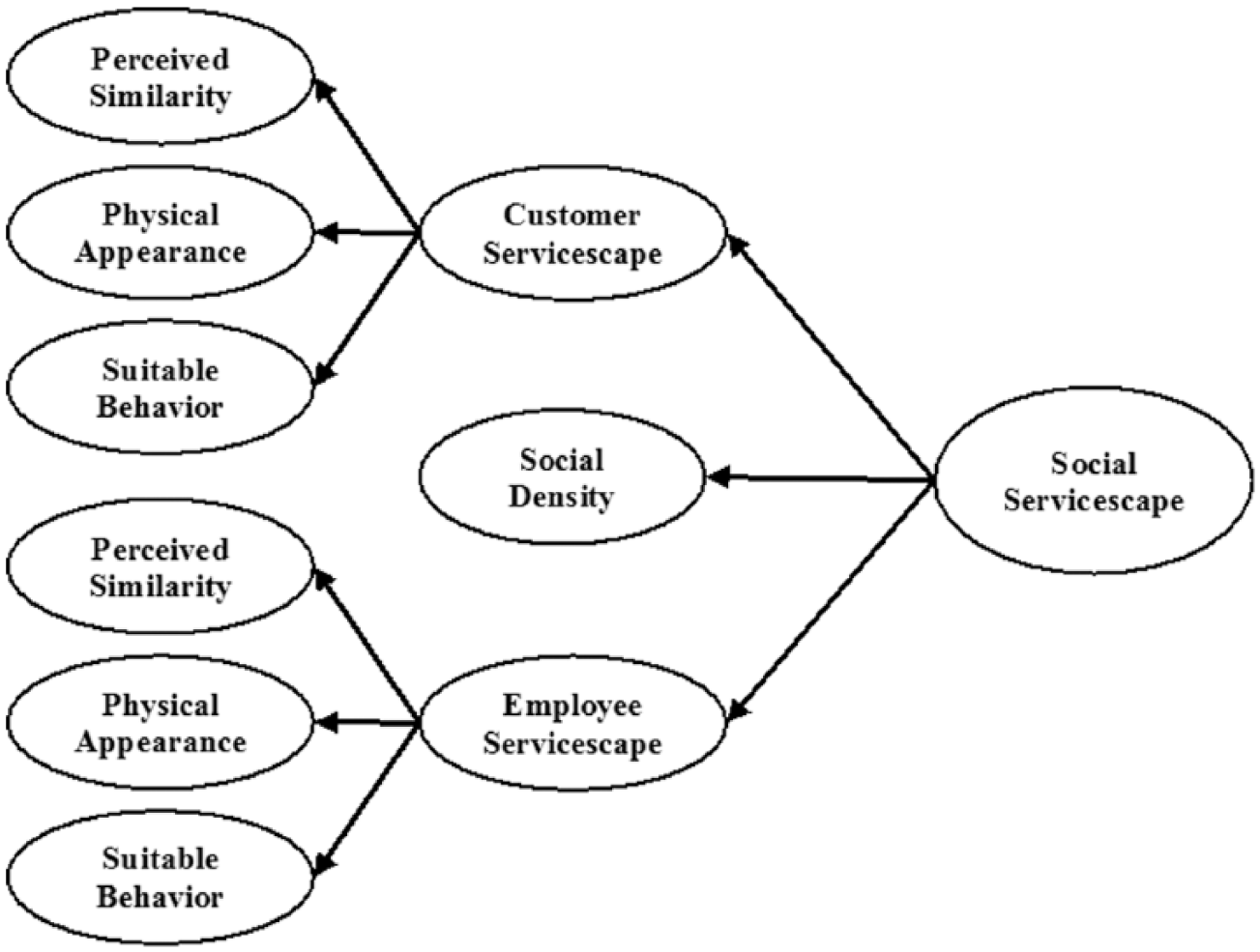
Third-Order Specification of Proposed Social Servicescape Construct
Customer Servicescape
Research into the role of other customers in the service experience gained significant traction with the publication of Baker’s (1987) study, which examined the function of social cues as indicators of the overall service environment. Since that time, research interest in the ways in which customers influence each other has grown significantly (Grove & Fisk, 1997; Hanks, Line, & Kim, 2017; Line et al., 2018; Martin, 1996; Miao & Mattila, 2013), with some schools of thought contending that the presence, characteristics, and behaviors of other customers may even have a stronger impact on the focal customer’s perception of service quality than contact with service providers (Lehtinen & Lehtinen, 1991; Line & Hanks, 2017).
Intercustomer compatibility as a key factor in the consumer experience was initially outlined by Martin (1996). Subsequently, Nicholls (2010) used the term customer-to-customer interaction (CCI) to describe the impact of direct interaction with social others in the service environment. However, even when CCI is passive and customers do not directly interact, the mere presence of others has been found to influence the focal customer’s perceptions of (and reactions to) the overall service experience, including satisfaction and loyalty behaviors (Bitner, 1990; N. Kim & Lee, 2012; Martin & Pranter, 1989).
In light of the dearth of research regarding passive CCI, this study is concerned with other customers as noninteractive (or passive) elements of the social servicescape. In these terms, the focus of this study is on what N. Kim and Lee (2012) call mere presence, or the observations and perceptions of the focal customer regarding the other customers in the service milieu. Specifically, the focal customer’s perception of these other customers is examined using a three-dimensional framework developed by Brocato, Voorhees, and Baker (2012). This framework suggests that in a situation where the CCI is passive (i.e., where the focal customer has no direct interaction with others on which to base opinions), he/she will assess other consumers along the dimensions of perceived similarity, physical appearance, and appropriate behavior.
Perceived Similarity
Perceived similarity is the extent to which a focal customer feels that he/she is similar to the other customers in the service environment (Brocato et al., 2012). Social identity theory contends that people form the social aspect of their identity from having membership in social groups (Tajfel, 1982). In a service context, then, this theory would suggest that customers prefer to surround themselves with other customers who share their characteristics.
The old adage, “birds of a feather flock together,” reflects the idea that people tend to engage socially with other similar individuals (McPherson, Smith-Lovin, & Cook, 2001). When customers feel that they identify with the others surrounding them, they are more likely to evaluate those other customers positively (Brocato et al., 2012). This effect leads to the notion that consumers tend to gravitate toward service environments with which they are most compatible. Stated more simply, customers feel more comfortable in an environment when they are surrounded by people who are similar to themselves (Hanks, Line, & Yang, 2017; Line et al., 2018; Martin & Pranter, 1989).
Physical Appearance
Consumers also make inferences based on the physical appearance of others. Physical appearance can be defined as “the physical characteristics and overall look (i.e., the attributes) of other customers in the service environment” (Brocato et al., 2012, p. 3). The psychology and business literatures are rife with research that demonstrates that (a) individuals are drawn to people whose appearance they like and (b) people tend to ascribe more positive traits to individuals whom they perceive as attractive (Adams, Hicken, & Salehi, 1988; Langlois et al., 2000). Subsequently, attractive people tend to receive more attention, get preferential treatment, and enjoy more popularity and trust (Adams et al., 1988; Gillen & Bernstein, 2015).
Mehrabian and Russell (1974) demonstrated that the physical appearance of others has a direct impact on emotional reactions, such as pleasure, arousal, and dominance. Extending this to the domain of service provision, research shows that consumers prefer being around other customers whose physical appearance they judge to be positive or attractive (McGrath & Otnes, 1995). Because other customers are a tangible indicator of the service environment, these reactions to the physical appearance of other consumers factor into the overall perception of the service environment (Trampe, Stapel, Siero, & Mulder, 2010).
Suitable Behavior
Even when a focal customer has no direct interaction with other customers, the behavior of others is a salient factor in the social environment. Appropriate behavior, in a services context, can be defined as the extent to which a focal customer feels that other customers in the service environment behave appropriately given the consumption context (Brocato et al., 2012). Importantly, however, appropriate behavior is context-dependent and malleable (Martin & Pranter, 1989). Thus, appropriate behavior in a sports bar is vastly different than appropriate behavior at a fine dining restaurant.
The framework behind this notion of appropriate behavior is role theory, which posits that individuals learn behaviors that are appropriate to the roles they hold in a specified social context. Banton (1996) defines a role as “the expected behaviour associated with a social position” (p. 749). Likewise, Goffman (1967) suggested that social interactions between two players are governed by the roles they play, which in turn generates a script regarding that particular interaction. Script theory, by extension, suggests that interactions that are repeated often result in basic expectations about how the interaction should be conducted (Miao, Mattila, & Mount, 2011). In a service context, employees typically have explicitly defined roles and scripts, which they often learn through training with superiors or in orientation. However, customers also have a defined role as well as a set of behavioral expectations that accompany that role (Grove & Fisk, 1997).
When other customers behave (or fail to behave) according to their roles and scripts, it can influence the experience of the focal customer and his or her subsequent evaluation of the service experience (Martin, 1996; Miao et al., 2011). Accordingly, fellow customers can enhance or improve a service experience when they adhere to their roles and scripts (Adelman, Ahuvia, & Goodwin, 1994), or they can ruin a service experience with inappropriate public behavior, even when there is no direct interaction with the focal customer (Parker & Ward, 2000).
Based on the preceding discussion, the role of other customers in the social servicescape is conceptualized as a second-order construct composed of three distinct underlying dimensions. Thus,
Employee Servicescape
Employees are deeply associated with the social aspect of the service encounter. As such, prior research has identified employees as a key component of the focal consumer’s evaluation of his experience (Tombs & McColl-Kennedy, 2003). Using the same framework presented by Brocato et al. (2012), this study is concerned with how the same three aspects of the employee’s presence (perceived similarity, physical appearance, and appropriate behavior) influence the focal customer’s perceptions of the social servicescape.
Again, it is important to note that when considering how employees factor into the social servicescape, the emphasis is on passive, noninteractive assessments. Thus, the social servicescape construct proposed in the present research is distinct from the previously operationalized constructs typically associated with research on service excellence, service quality, and service failures. While the quality of the service provided by the employee to the customer is certainly a key determinant of his or her overall assessment of the service encounter, it is outside of the scope of the specified domain of the social servicescape, which emphasizes the passive elements that contribute to the customer’s impression of the service environment. To reiterate, this study is concerned with passive observations of employees’ similarity, appearance, and behaviors and how they combine to form an overall impression of the social servicescape.
Perceived Similarity
Prior research in the business and psychology literature suggests that a match between customers and employees can result in positive outcomes for both the consumer and the firm. Important examples include similarity–attraction theory (Tsui, Egan, & O’Reilly, 1992), Becker’s (1957) theory of customer discrimination, social-categorization theory (Hogg & Terry, 2000), and social identity theory (Tajfel & Turner, 1986). In each of these examples, familiarity and desire to be near people who are similar to oneself all lead to a preference for being around similar others.
According to these theories, customers prefer to be in a service environment with employees who are similar to themselves, even if they are not directly interacting with these employees. When employees are similar to guests in some key ways, customers may perceive that such similarity can assist employees in intuitively understanding the needs and preferences of the customer (Cox, 1993). For example, employees who share the same background, lifestyle, and location may understand the likes and dislikes, changing needs, and particulars of customer needs better than dissimilar employees. Additionally, consumers prefer employees who are similar because it helps form and maintain their social identity (Tajfel, 1982). Again, customers feel more comfortable in an environment when they are surrounded by people who are similar to themselves (Martin & Pranter, 1989), and this includes employees as well as customers.
Physical Appearance
The perception of an employee’s physical appearance includes such elements as makeup, hair styling, facial hair, dress, and grooming (Ahearne, Gruen, & Jarvis, 1999). Consumers use physical appearance as a heuristic cue for social information (Magnini, Baker, & Karande, 2013). In other words, customers look to an employee’s physical appearance to give them clues as to other, more difficult to discern, traits such as personality or competence. This helps the customer to form opinions about the employee and the firm, on which further judgments are made (Tsaur, Luoh, & Syue, 2015).
In general, people tend to assume that when the appearance of another person is attractive, that individual must possess good personal qualities, including warmth, friendliness, poise, and competence (Chaiken, 1979). For consumers, the physical appearance of the service provider serves as a tangible cue of the quality of the experience, which in turn influences his or her evaluation of the service encounter (Hogg & Terry, 2000). Accordingly, there is ample evidence that customer perceptions of employee appearance are an important part of the overall evaluation of the service environment and the encounter. For example, appearance has been shown to lead to higher sales, increases in purchase intentions, positive attitudes, greater satisfaction levels, higher levels of assurance, and better service quality evaluations (e.g., Bitner, 1990; Magnini et al., 2013). Taken together, this body of evidence points to the importance of the physical appearance of employees as a contributor to the overall perception of the social servicescape.
Suitable Behavior
Because employees are a fundamental part of the service creation and delivery process, their behavior is a key aspect of the social servicescape and, in turn, heavily influences consumer perceptions of service experience (Bitner, 1990). The behavior of employees can either enhance or detract from the quality of the service experience, depending on the appropriateness of the behavior for the given interaction.
Much as is the case with other customers, the appropriateness of employee behavior is context dependent. Employees in a given service encounter have roles to play and scripts to follow, and these roles and scripts are usually well-defined and highly predictable (Brocato et al., 2012). When an employee’s behavior conforms to the role in which he or she has been cast and aligns with the customer’s expectations of the encounter, this leads to positive outcomes such as satisfaction, loyalty, and repurchase (Keaveney, 1995). On the other hand, if an employee deviates from the script, this can lead to negative perceptions on the part of the consumer. It is important to note that this holds true even when the employee is not interacting directly with the focal customer, as employee behavior when interacting with other customers or conducting daily duties is easily observable.
Based on the preceding discussion, the role of employees in the social servicescape is conceptualized as a second-order construct composed of three distinct underlying dimensions. Thus,
Social Density
In addition to the characteristics and behavior of the other people with whom the focal customer is interacting, the volume of people in the service environment (referred to here as social density) plays an important role in the perception of the social servicescape. Human density can be defined as the number of people in a given physical space (Stokols, Rall, Pinner, & Schopler, 1973). Importantly, the desirable level of density is again context dependent. For example, higher density may be expected at a sports arena, while lower density would be more appropriate at a fine dining restaurant or an exclusive retail shop (Eroglu & Harrell, 1986). When there is a mismatch between customer expectations regarding the density of a service venue, this discrepancy can result in negative emotional outcomes such as anger, distrust, and contempt (Hanks, Line & Kim, 2017), as well as affect behavioral outcomes such as satisfaction, revisit intentions, avoidance behaviors, spending levels, and length of stay (Eroglu, Machleit, & Barr, 2005).
The social density of a service environment can have a significant impact on customer perceptions of the service quality, as well. When a customer perceives that a venue is inappropriately crowded, this may adversely influence his or her level of confidence and assurance in the ability of service personnel to provide a quality experience (Hui & Bateson, 1991; Mattila & Hanks, 2012). Accordingly, the density of the service environment is positioned as fundamental to the perception of the social servicescape. Thus,
Method
Data Collection
Measurements of the proposed first-order factors of the proposed construct were organized in an electronic questionnaire and disseminated to users of Amazon Mechanical Turk (MTurk) in the United States. Given the importance of reaching a geographically diverse sample of restaurant consumers, MTurk was deemed an appropriate sampling frame (see Buhrmester, Kwang, & Gosling, 2011, for a more detailed discussion of the use of MTurk). To begin, participants were asked to recall their most recent (dinner) restaurant experience and to enter the name of that restaurant into a text box. Because the purpose of this research was to operationalize a phenomenon related to interpersonal social experiences within the restaurant, participants were instructed not to consider carry out or drive-through dining occasions. The name of the chosen restaurant was then piped into the subsequent operational measurements to maintain context salience and realism.
After providing a referent restaurant, the social servicescape of that restaurant was evoked through the following prompt:
To begin, please think about the other customers that also dine at [piped data: selected restaurant] for dinner. Rather than thinking about any companions that you may dine with, we would like you to think about the other customers in the restaurant that you do not know. What do they look like? How are they dressed? What adjectives would you use to describe them?
After reading the prompt, participants were asked to briefly describe these other customers in open-ended format (i.e., text boxes). A similar process was followed preceding the measurement of the employee servicescape. These descriptive priming processes were designed to ensure that the social servicescape was sufficiently evoked in the respondents’ minds prior to measurement, thus helping minimize recall bias (Bradburn, Rips, & Shevell, 1987).
Measurement
The proposed third-order social servicescape construct was modeled to include two second-order dimensions and one first-order dimension (as previously put forth in Figure 1). First, Brocato et al.’s (2012) other customer scale, consisting of perceived similarity (α = .92), physical appearance (α = .80), and suitable behavior (α = .77), was used to operationalize the second-order customer servicescape construct. Likewise, this same scale was modified for the operationalization of the employee servicescape. The modified scale featured the same operational structure and dimensionality (perceived similarity [α = .93], physical appearance [α = .85], and suitable behavior [α = .92]), but was in reference to the employees as opposed to the other customers. The density construct (α = .96) was operationalized in accordance with Hanks, Line and Kim’s (2017) recommendations.
Throughout the measurement process, a number of steps were taken to reduce the potential effects of common method bias among the measured variables. Specifically, efforts were made to minimize the effects of several of the most common forms of methodologically related error as recommended by Podsakoff, MacKenzie, Lee, and Podsakoff (2003). Additionally, two attention checks (e.g., “please choose ‘somewhat agree’ as your response to this statement”) were embedded in the survey in an effort to reduce the incidence of yea-saying/nay-saying among the respondents. Finally, recall bias was addressed through the previously discussed priming process in which respondents were required to describe the other diners at their selected restaurant. A Harman’s single-factor test indicated that methodologically related biases were likely not a significant source of error in the measurement process.
Profile of Participants
The sampling process resulted in a total of 1,143 responses. However, after accounting for the aforementioned attention check items, 152 of these responses were deemed spurious and subsequently deleted. In terms of sample characteristics, there were slightly fewer males (46.8%) than females (53.1%). Marital status was also roughly equal with 46.7% reporting as single and 43.3% reporting as married. In terms of age, 56.2% were between 18 and 35 years old with another 33.7% between 36 and 55 years old. Minority groups represented slightly less a quarter of the sample (23.3%). In terms of restaurant selection, a majority identified a casual restaurant (65.7%) or an upscale restaurant (23.5%).
Results
Measurement Model
To begin the process of establishing the social servicescape as a third-order latent construct, the psychometric properties of the lower-order dimensions were assessed. First, a measurement model was specified inclusive of the three proposed latent dimensions (i.e., customer servicescape, employee servicescape, and density). The resulting fit indices indicated an acceptable fit of the measurement model to the data (χ2 = 1543.9, df = 285; root mean square error of approximation [RMSEA] = .067; comparative fit index [CFI] = .94; Tucker–Lewis index [TLI] = .94; normed fit index [NFI] = .93). The structure of each first-order factor is provided in Table 1.
The Social Servicescape
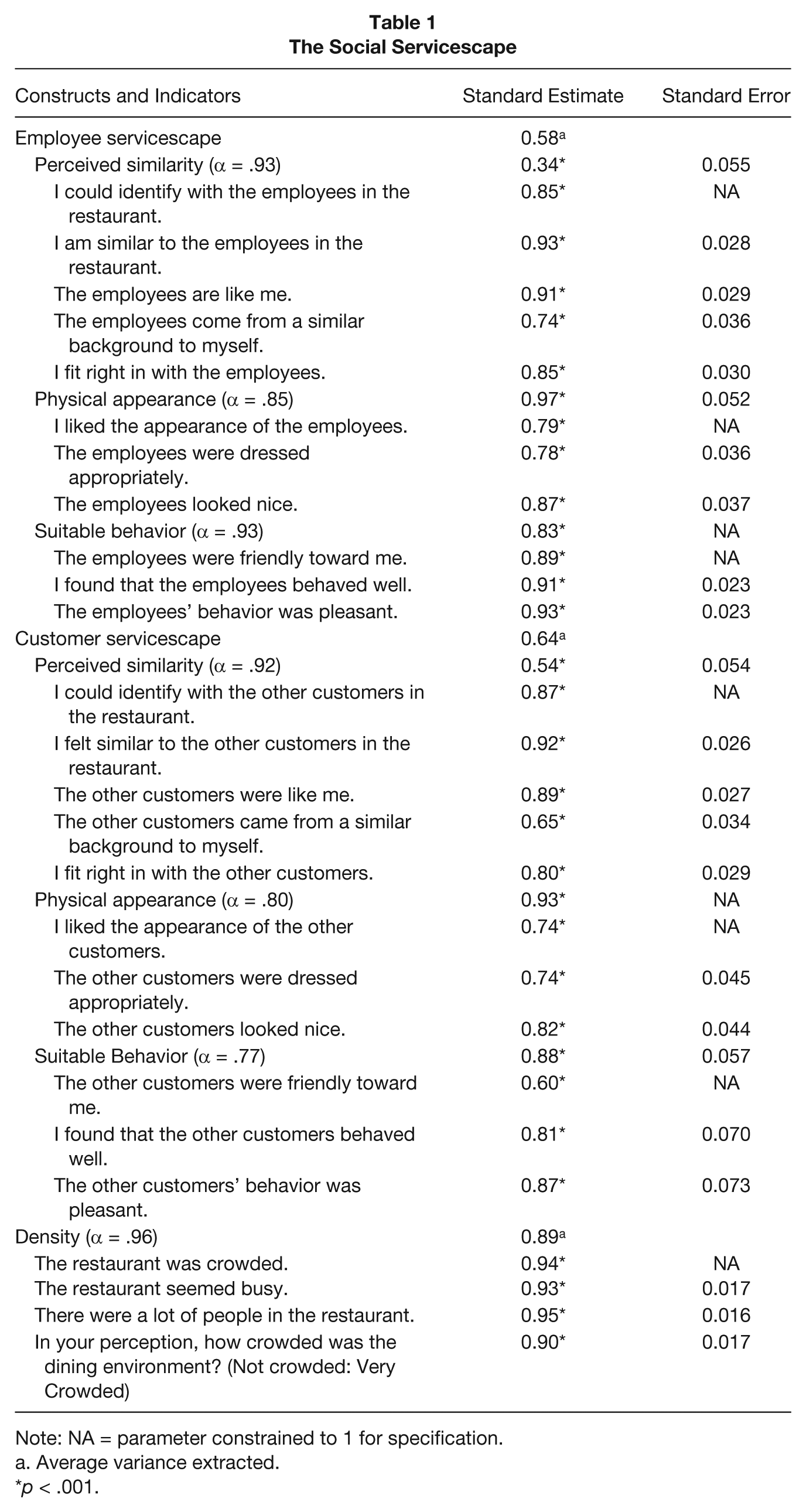
Note: NA = parameter constrained to 1 for specification.
Average variance extracted.
p < .001.
Next, construct validity was assessed according to the process established by Fornell and Larcker (1981). As seen in Table 2, the critical ratio is greater than the average variance extracted (AVE), and both indicators are greater than 0.5 for all three constructs. These results provide robust evidence of convergent validity (Hair, Black, Babin, Anderson, & Tatham, 2006). Additionally, the AVE for each construct is greater than both the maximum squared shared variance and average squared shared variance. These results, combined with the finding that no construct pairs correlate more than 0.5, provide strong evidence of discriminant validity as well (Hair et al., 2006).
Validity Assessment Criteria and Correlation Matrix
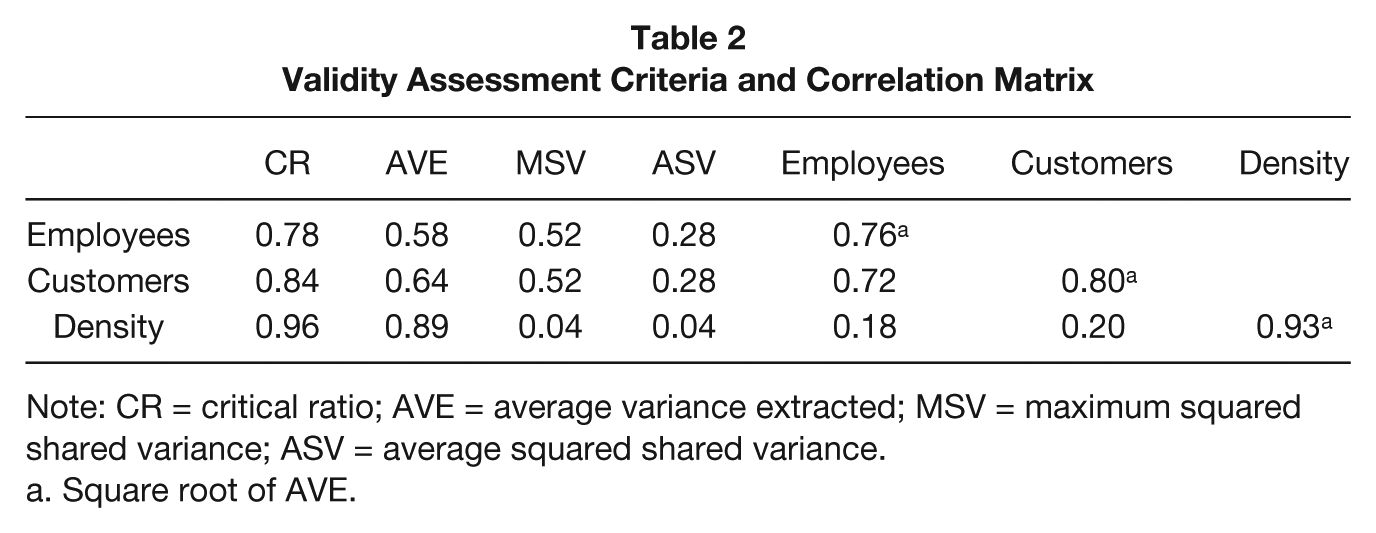
Note: CR = critical ratio; AVE = average variance extracted; MSV = maximum squared shared variance; ASV = average squared shared variance.
Square root of AVE.
Third-Order Specification
After confirming the psychometric soundness of the lower-order constructs in the measurement model, the next task was to establish the multidimensional structure of the social servicescape. Using the operationalizations for each dimension as specified in the measurement model, a confirmatory factor analysis was conducted specifying the proposed third-order structure of the social servicescape. This specification yielded an acceptable fit to the data (χ2 = 1555.3, df = 285; RMSEA = .067; CFI = .94; TLI = .93; NFI = .93). Likewise, all specified path estimates were positive and significant (p < .05). The results of these analyses support the proposed third-order factor structure of the social servicescape construct.
Nomological Validity
An essential part of the existing servicescape framework is the well-documented connection of the construct with consumer-level perceptual and behavioral phenomena (e.g., Bitner, 1992; Han & Ryu, 2009; Heung & Gu, 2012; W. Kim & Moon, 2009; Liu & Jang, 2009; Ryu & Jang, 2007). Because the social servicescape is positioned as an extension of the existing physical servicescape framework, the socially based construct proposed in this research should have a similar impact on such variables. Accordingly, to demonstrate the nomological validity of the proposed social servicescape construct, two structurally based propositions were tested. The first nomological proposal was that the social servicescape should have a significant effect on consumers’ emotional reactions to the dining experience (Liu & Jang, 2009; Ryu & Jang, 2007). Then, from a behavioral perspective, a second proposition suggested that the social servicescape should have a significantly positive effect on experience satisfaction and post consumption word-of-mouth behavior (Han & Ryu, 2009; Heung & Gu, 2012).
To test the relationship between the social servicescape and emotions, a structural equation was specified with parameters linking the third-order specification of the social servicescape with a positive emotions construct (α = .86) and a negative emotions construct (α = .95; see Valenzuela, Mellers, & Strebel, 2010). This specification yielded an acceptable fit to the data (χ2 =3451.7, df = 651; RMSEA = .066; CFI = .92; TLI = .91; NFI = .90). Additionally, as expected, the social servicescape was found to positively affect positive emotions (β = .53, p < .001) and to negatively affect negative emotions (β = −.52, p < .001). These results provide support for the nomological validity of the social servicescape in terms of its expected relationship with emotional responses.
The second test for nomological validity involved an account of the expected relationship between the social servicescape and satisfaction/behavior. Given the well-established relationship between the physical servicescape and behavioral variables such as satisfaction and word of mouth (see Han & Ryu, 2009; Heung & Gu, 2012), it is expected that the social servicescape would exhibit a similar relationship with these constructs. Accordingly, a model was specified linking (a) the social servicescape with experience satisfaction (α = .94) and (b) satisfaction with a measurement of word-of-mouth intention (α = .93; see Zeithaml, Berry, & Parasuraman, 1996). Again, this specification yielded an acceptable fit to the data (χ2 = 2219.7, df = 481; RMSEA = .060; CFI = .94; TLI = .94; NFI = .93) with positive relationships from the social servicescape to satisfaction (β = .72, p < .001) and from satisfaction to word-of-mouth intention (β = .77, p < .001). Again, these results provide support for the nomological validity of the proposed social servicescape construct with regard to its relationship with established behavioral frameworks.
Discussion
Understanding the role of environment in the service consumption process is arguably one of the most theoretically and managerially relevant areas of research in the hospitality and tourism literature (Liu & Jang, 2009). While Bitner’s (1992) classical model is widely hailed as the framework linking physical service environments with consumption behavior, this conceptualization does not recognize importance of the social elements of the consumption environment. Accordingly, the purpose of this study was to operationalize a multidimensional social servicescape construct that accounts for the effects of both customers and employees.
The results of an empirical test of these propositions provided support for the framework. Based on the work of Brocato et al. (2012), it was expected that perceived similarity, physical appearance, and appropriate behavior would contribute to the perception of both other customers and of employees. The results supported this prediction. In other words, even in the absence of direct interaction, a focal customer makes inferences, judgments, or assessments about the other customers and employees in a shared consumption environment based on these three dimensions. Additionally, the density of other customers and employees in the consumption space was demonstrated as a contributor to the evaluation of the social environment. Taken together, these results indicate that customers form a holistic perception of the social servicescape based on a tripartite model consisting of other customers, employees, and social density.
Implications
The results of this study carry significant theoretical implications with regard to the influence of social factors on consumer behavior. The explication of a valid and reliable multidimensional operationalization of the social servicescape construct marks a step forward in the understanding of the ways in which the mere presence of others in the consumption environment can influence the consumer experience. While the idea that other customers and employees contribute to the focal customer’s experience is not new, no study to date has offered a testable model to explain these phenomena. Overall, the results indicate that the proposed construct is a valid predictor of relationships among the focal customer, the social servicescape, and post-consumption evaluations and behaviors.
The findings also carry significance as a springboard for new directions of research. By providing an operationalization of the social servicescape, this research makes possible a number of future studies concerning the relationship of the social servicescape to various environmental and social elements, individual personality traits, and a host of emotional, attitudinal, and behavioral outcomes. In this way, the present study makes an important contribution to consumer behavior theory.
The results also carry implications for hospitality managers and marketers. While intuition has long suggested that customers respond in some way to the others in the service environment, the findings present a broad-based operationalization of the social servicescape that more fully explicates the factors that are influential in the formation of environmental assessments. This information can help hospitality operators in controlling the specific social elements that are most likely to influence customer opinions and behaviors.
Beginning with the employee servicescape, this research provides at least some guidance for restaurant training processes. For example, while many training and orientation programs traditionally focus on the interaction between the employee and the customer, the present study suggests that hospitality managers may also wish to focus on the passive elements of the employee presence, such as their appearance and non–customer-focused behaviors. Regarding the latter, taking steps to manage how employees interact with each other (especially when in view of the customer) may be particularly beneficial. Based on the findings of the present research, it appears that customers notice/assess passive employee behavior in the same way that they notice/assess décor or lighting. Thus, by training employees to remember that the customer is always watching, restaurant managers may actually be able to leverage passive employee behavior into a positive part of the customer experience.
Regarding the customer servicescape, this study underlines the importance of controlling the customer mix, as customer-to-customer similarity is a key component of the social servicescape. Conventional methods of attracting homogenous customers through the use of such mechanisms as targeted marketing and advertisements, rate structures, and dress codes are recommended; however, it may also be possible for restaurateurs to actually manufacture a feeling of homogeneity as well. For example, restaurants could attempt to identify common cultural bonds among their target customers (e.g., sports teams, art, pop culture, politics) and then use this information to strategically theme the physical environment in a way that stimulates a common conversation throughout the restaurant. Naturally, employees would be trained to engage with customers regarding the thematic content and perhaps even stimulate conversation among customers.
Finally, this research provides evidence that the elements of the social servicescape do not exist in isolation. Rather, employees, customers, and density can be seen as interconnected environmental phenomena that must be managed holistically. This would suggest that managers should begin to think about how decisions that affect one part of the social servicescape will affect evaluations of the broader social environment. For example, consider how, in the recommendation above, elements of the employee servicescape were used to drive perceptions the customer servicescape. Given the multidimensional nature of the social servicescape construct, such interactions between the customer servicescape, the employee servicescape, and customer density are likely to be quite common. Our research suggests that managers who understand the interconnected nature of these phenomena can create synergies among them that facilitate positive emotional reactions, satisfaction, and post-consumption word-of-mouth promotion.
Limitations and Future Research
Although this research makes a number of important contributions to hospitality theory and practice, it is not without limitations. First, it should be noted that the operationalization of the social servicescape put forth in this research was conducted within the cultural context of the United States. Accordingly, the structure of this construct is a function of Western cultural beliefs concerning the presence of other social actors in the consumption environment, and as such, should not be prematurely generalized outside of this particular context. To enhance the generalizability of the proposed framework, future research should explore the social servicescape as it is manifested in other cultural contexts.
Second, it should be noted that the construct operationalized in this research is a direct function of the industry domain in which the research was conducted. Because the construct was operationalized in the full-service restaurant industry, future research may be necessary before the framework can be applied to other domains of the hospitality industry. Additional research should seek to establish the dimensional and operational nature of the social servicescape in other sectors of the hospitality industry (such as hotels, cruise lines, theme parks, etc.) as well as other service environments that feature shared consumption space (such as banks, fitness facilities, hair/nail salons, etc.).
Finally, it will be important to continue to expand the nomological framework initiated in the present research. While this research provides preliminary evidence of the nomological validity of the proposed social servicescape construct with regard to its effects on emotions, satisfaction, and word of mouth, there are likely a great many more cognitive and behavioral constructs that affect (and are affected by) the social servicescape. The existing physical servicescape framework may be a useful roadmap for such research.
Conclusion
The purpose of this research was to propose and operationalize a multidimensional conceptualization of the social servicescape. Defined in terms of the observable characteristics and behavior of the other social actors present in the service environment (i.e., customers and employees), the social servicescape was proposed as a third-order construct composed of three distinct latent dimensions: customers, employees, and social density. An operationalization of this construct in the domain of full-service restaurants supported the proposed specification as a reliable and valid representation of the social servicescape. Additionally, the nomological validity of this construct was established by providing an account of its effect on consumption emotions, experience, and word-of-mouth behavior. These findings indicate that, even in the absence of direct interaction, perceptions of the other social entities in a shared consumption environment affect evaluative assessments of the consumption experience. Accordingly, the results suggest that, like the often-cited physical servicescape, the social servicescape should also be considered an important part of both the theory and practice of restaurant marketing.